Wearable Sensors for Social Behavior Analysis and Cognitive Decline: From Biomarker Discovery to Clinical Validation
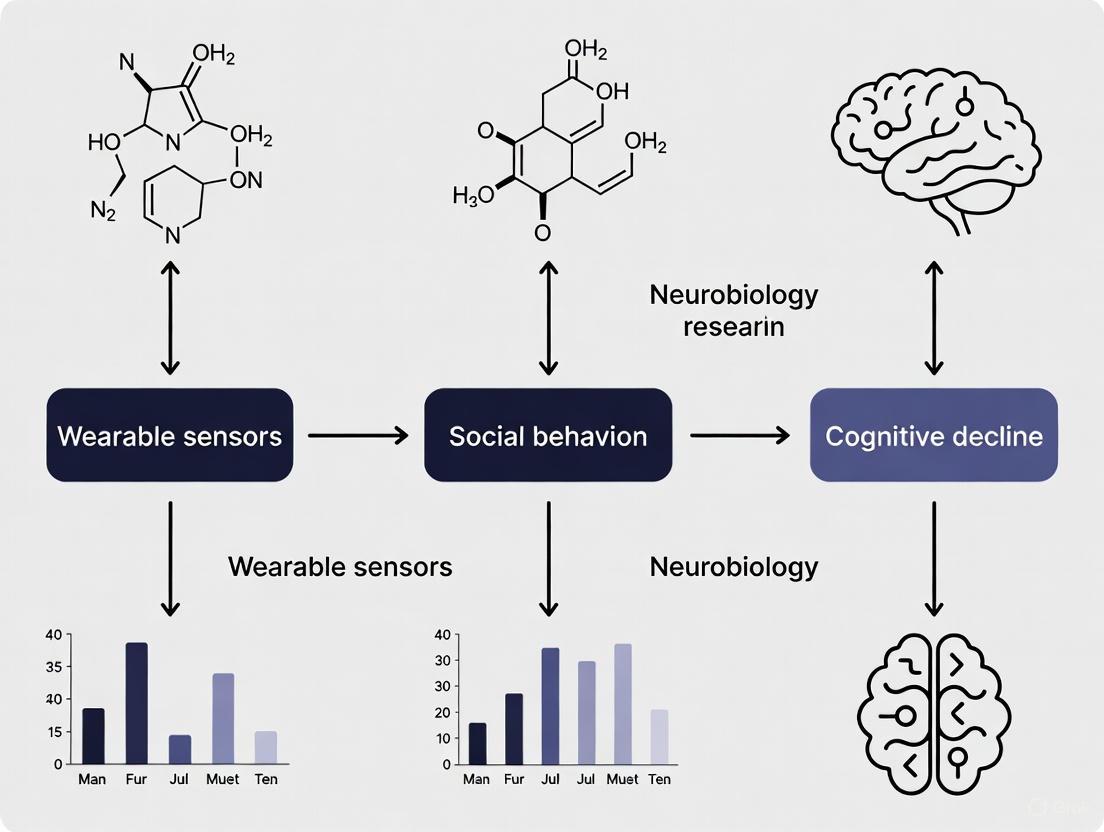
This article synthesizes current research and methodological approaches for using wearable sensors to quantify social behavior and motor patterns as digital biomarkers for cognitive decline.
Wearable Sensors for Social Behavior Analysis and Cognitive Decline: From Biomarker Discovery to Clinical Validation
Abstract
This article synthesizes current research and methodological approaches for using wearable sensors to quantify social behavior and motor patterns as digital biomarkers for cognitive decline. Targeting researchers, scientists, and drug development professionals, it explores the foundational science linking behavior to neurodegeneration, details data collection and analysis methodologies, addresses key technical and adoption challenges, and reviews validation frameworks. By integrating evidence from studies on Parkinson's disease and aging, this review aims to provide a comprehensive roadmap for developing clinically valid tools that can enable early detection, objective monitoring, and more efficient evaluation of therapeutic interventions in cognitive health.
The Neurobehavioral Bridge: Linking Social and Motor Patterns to Cognitive Health
Application Notes
Quantitative Evidence from Recent Studies
Wearable sensors are emerging as powerful tools for quantifying subtle motor and cognitive changes that often precede overt clinical symptoms of cognitive decline. The following tables summarize key quantitative findings from recent research.
Table 1: Wearable Sensor Gait Parameters Predictive of Cognitive Impairment in Parkinson's Disease [1]
| Gait Parameter | Association with Cognitive Impairment | Notes |
|---|---|---|
| Step Length | Shorter step length associated with impairment | One of the most influential predictors in the model |
| Walk Speed | Slower speed associated with impairment | - |
| Stride Time | Increased stride time variability associated with impairment | - |
| Peak Arm Angular Velocity | Reduced velocity associated with impairment | Measured during swing phase |
| Peak Angular Velocity (Steering) | Reduced velocity during turning associated with impairment | - |
Table 2: Cognitive and Physical Outcomes from Interactive Cognitive-Motor Training (ICMT) in Older Adults [2]
| Outcome Measure | ICMT Group (Change) | Control Group (Change) | Significance |
|---|---|---|---|
| Global Cognitive Function | +1.94 points (8.60% increase) | Not specified | p < 0.05 |
| 6-Minute Walk Distance | +18.0 meters (4.65% farther) | Not specified | p < 0.05 |
| Balance (Postural Sway) | Significant improvement | Not specified | p < 0.05 |
| Grip Strength | Significant improvement | Not specified | p < 0.05 |
Table 3: Scalable Biomarkers for Early Detection of Cognitive Decline [3]
| Biomarker | Biological Fluid | Association with Cognitive Decline | Predictive Accuracy (AROC) |
|---|---|---|---|
| Aβ42/40 Ratio | Blood Plasma | Reduced ratio in Alzheimer's Disease continuum | Up to 0.90 (when combined with age & APOE-ε4) |
| p-tau181 | Blood Plasma | Increased levels predict future decline in CU individuals | 0.94 - 0.98 |
| p-tau231 | Blood Plasma | Increases early in the disease process, before Aβ PET positivity | - |
| p-tau217 | Blood Plasma | Associated with the spread of neocortical tangles in AD | - |
Experimental Protocols
Protocol 1: Gait Analysis for Predicting Cognitive Impairment in Parkinson's Disease
This protocol is adapted from a cross-sectional study investigating the link between gait parameters and cognitive impairment in PD patients [1].
Equipment and Setup
- Wearable Sensor System: MATRIX wearable motion and gait analysis system (or equivalent IMU-based system) with NMPA/FDA/CE certifications [1].
- Sensor Configuration: Ten Inertial Measurement Unit (IMU) sensors.
- Sensor Placement:
- Feet: Dorsum of each foot (metatarsal region).
- Thighs: Bilaterally, ~2 cm above the knees.
- Lower Legs: Bilaterally, ~2 cm above the ankle joints.
- Hands: Dorsal side of each wrist.
- Torso: One sensor on the sternum (chest) and one at the fifth lumbar vertebra (lumbar).
- Data Acquisition: Sampling frequency of 100 Hz. Synchronize all sensors via a centralized clock with Bluetooth streaming to ensure inter-sensor synchronization accuracy within ± 2 ms [1].
Participant Preparation and Data Collection
- Participant Onboarding: Recruit PD patients based on MDS criteria during their medication "on" phase. Obtain informed consent.
- Sensor Attachment: Securely fasten all ten sensors using adjustable straps as described in the setup.
- Walking Task: Instruct the participant to complete a straight-line walking trial on a flat, unobstructed surface. The trial should consist of an out-and-back course for a total distance of 16 meters (8 meters in one direction) at their self-selected comfortable speed.
- Data Recording: Initiate and monitor data collection via the central system. Raw motion signals (accelerometer and gyroscope data) are transmitted in real-time via Bluetooth.
Data Processing and Analysis
- Data Extraction: Process raw sensor data to extract spatiotemporal gait parameters, including but not limited to: Step Length, Walk Speed, Stride Time, Peak Arm Angular Velocity, and Peak Angular Velocity during steering [1].
- Cognitive Assessment: Administer standard cognitive assessments (e.g., MoCA, MMSE) to classify patients as cognitively impaired or unimpaired based on defined cut-offs [1].
- Statistical Modeling:
- Perform baseline comparisons and logistic regression analyses to identify independent risk factors.
- Train machine learning models (e.g., Logistic Regression, Random Forest) using the gait parameters and clinical variables to predict cognitive impairment status.
- Evaluate model performance using AUC-ROC curves, decision curve analysis, and calibration plots.
- Apply SHAP analysis to interpret the model and identify the most influential predictors.
Protocol 2: Interactive Cognitive-Motor Training (ICMT) for Older Adults
This protocol details a single-blind, randomized controlled trial designed to improve cognitive and physical function in community-dwelling older adults using a wearable sensor-based system [2].
Equipment and Setup
- Core Device: A custom wearable sensor-based ICMT device developed using Arduino and RFID technology [2].
- Components: The system includes a wearable sensor unit and RFID tags/reader for interactive tasks.
- Cognitive Tasks: The system is programmed with five core cognitive tasks:
- Number Sequence
- Number-Word Sequence
- Card Matching
- Number Memorization
- Route-Finding
Participant Preparation and Intervention
- Screening: Recruit community-dwelling adults aged ≥65 with an MMSE score ≥18 and no diagnosis of dementia or mobility-impairing conditions. Obtain informed consent [2].
- Randomization: Randomly assign participants to the ICMT group or an active control group (e.g., seated tablet-based cognitive training).
- Intervention Sessions (ICMT Group):
- Frequency/Duration: Conduct sessions twice a week for 6 weeks, 50 minutes per session.
- Aerobic Warm-up: Begin with 5 minutes of stepping exercises (forward, backward, left, right) to music at 126 bpm.
- Device Setup: Participants attach the wearable device to their dominant upper extremity.
- Task Execution: Participants perform the five cognitive tasks while engaging in free physical movements. These include transitions from sitting to standing, walking, pivot turns, and reaching with their arms. The cognitive task display is placed at least 3 meters away from the chair to encourage movement.
Outcome Measures and Data Analysis
- Pre- and Post-Testing: Assess the following domains before and after the 6-week intervention:
- Cognitive Function: Using standardized cognitive batteries.
- Physical Function: Balance (e.g., postural sway), muscle strength (e.g., grip strength), and endurance (6-minute walk test).
- Prefrontal Cortex Activity: Hemodynamic response using functional near-infrared spectroscopy (fNIRS).
- Instrumental Activities of Daily Living (IADLs).
- Data Analysis: Use repeated-measures ANOVA or similar statistical methods to compare within-group and between-group changes in outcome measures.
Visualization of Workflows
Gait Analysis Protocol for Cognitive Impairment Prediction
Interactive Cognitive-Motor Training Study Design
The Scientist's Toolkit: Research Reagent Solutions
Table 4: Essential Materials for Wearable Sensor-Based Cognitive Decline Research
| Item / Solution | Specification / Example | Primary Function in Research |
|---|---|---|
| Multi-Sensor IMU System | MATRIX System (Gyenno Science); 10 sensors, 100Hz sampling [1] | Captures high-fidelity kinematic data (acceleration, angular velocity) for quantitative gait and movement analysis. |
| Validated Cognitive Assessments | MoCA (Montreal Cognitive Assessment), MMSE (Mini-Mental State Examination) [1] [2] | Provides standardized, clinical benchmarks for classifying cognitive status and validating digital biomarkers. |
| Custom ICMT Platform | Arduino-based wearable with RFID tasks [2] | Enables integrated cognitive-motor training and assessment, facilitating dual-task paradigm studies. |
| Data Processing Pipeline | Custom software for signal processing & feature extraction (e.g., in Python/MATLAB) [1] | Converts raw sensor data into analyzable spatiotemporal gait parameters and movement features. |
| Machine Learning Libraries | Scikit-learn, SHAP (SHapley Additive exPlanations) [1] | Used to build and interpret predictive models that identify individuals at risk of cognitive decline. |
| Blood-Based Biomarker Assays | SIMOA, IP-MS for Aβ42/40, p-tau181/217/231 [3] | Provides pathophysiological correlates of Alzheimer's disease for validating digital biomarkers. |
The early detection of neurodegenerative diseases is a critical public health imperative, given the projected exponential increase in global dementia prevalence [4]. The current diagnostic paradigm often relies on invasive techniques or clinical assessments administered only after significant cognitive decline has occurred. However, the progression of neurodegenerative diseases like Alzheimer's disease (AD) and Parkinson's disease (PD) is characterized by extended preclinical and prodromal phases where subtle behavioral and motor changes manifest long before traditional diagnosis [5]. This application note synthesizes current research on two promising early behavioral indicators—social withdrawal and gait changes—and details how wearable sensor technology can capture these digital biomarkers for early detection and monitoring within real-world environments.
Quantitative Evidence: Linking Gait, Social Behavior, and Neurodegeneration
Table 1: Key Gait Digital Mobility Outcomes (DMOs) in Neurodegenerative Disease Detection
| Digital Mobility Outcome (DMO) | Association with Neurodegeneration | Detection Capability | Relevant Condition(s) |
|---|---|---|---|
| Walking Speed | Most common DMO; significantly different in real-world vs. supervised settings [6]. Differentiates patients from controls [6]. | PD, general neurodegeneration | |
| Step Length | Reduced in real-world environments compared to clinical settings [6]. | PD | |
| Stride Time | Commonly measured gait characteristic; shows variability in neurodegenerative populations [6]. | PD | |
| Real-world vs. Supervised Gait | Consistent pattern of lower values (e.g., slower speeds, reduced step length) in real-world conditions [6]. | PD, general neurodegeneration | |
| Gait, Balance, & Fall Risk | Wearables show good diagnostic accuracy for assessing these composite outcomes [7]. | PD, Stroke, AD, MS |
Table 2: Wearable Device Acceptability and Feasibility for Continuous Monitoring
| Wearable Form Factor | Key Acceptability Findings | Primary User Concerns | Target User Population |
|---|---|---|---|
| Wrist-worn (Smartwatch) | Preferred due to familiarity and minimal impact on appearance; higher long-term usage [4]. | Accuracy for medical purposes; data disclosure [4]. | Broad, including SCD, MCI [4]. |
| Head-worn (EEG Headband) | Less preferred due to comfort and impact on appearance [4]. | Wearability, aesthetics [4]. | Specialized sleep monitoring [4]. |
| Smartphone Apps (Passive) | Acceptable for continuous, background data collection on fine motor movements [4]. | Lack of transparency on data collected [4]. | Broad population [4]. |
| Smartphone Apps (Active) | Cognitive testing games can cause frustration and increased awareness of impairment in MCI [4]. | Digital anxiety, cognitive burden [4]. | Populations with minimal cognitive impairment [4]. |
Experimental Protocols for Digital Biomarker Capture
Protocol: Multi-Day Real-World Gait Assessment
Objective: To capture ecologically valid digital mobility outcomes (DMOs) from individuals in their everyday environment to identify early signs of motor impairment.
Materials:
- Single inertial measurement unit (IMU) sensor(s)
- Adhesive pads or hypoallergenic bandages for sensor attachment
- Data docking station or charging equipment
- Secure cloud storage and processing platform
Procedure:
- Sensor Configuration: Initialize and calibrate the wearable sensors according to manufacturer specifications.
- Sensor Placement: Attach a single sensor at the lower-back (L5 vertebra) using a medical-grade adhesive pad. This is the most common placement for gait analysis [6]. Alternative placements include both feet and the lower back for more detailed analysis.
- Assessment Duration: Instruct the participant to wear the device during all waking hours for a continuous 7-day period to capture weekday and weekend activity variations [6].
- Data Collection: Sensors passively collect tri-axial accelerometer, gyroscope, and magnetometer data at a sampling frequency ≥ 100 Hz.
- Data Processing:
- Bout Detection: Identify "Walking Bouts" (WBs) from the continuous data stream. A WB is typically defined as a sequence containing at least two consecutive strides from both feet, bookended by non-walking periods [6].
- DMO Extraction: From each valid WB, extract key DMOs such as walking speed, step length, and stride time.
- Data Aggregation: Generate summary statistics (e.g., mean, variance, distribution) for each DMO across all WBs over the assessment period.
Protocol: Remote Assessment of Cognition and Social Engagement
Objective: To classify mild cognitive impairment (MCI) and detect patterns of social withdrawal through unsupervised remote interaction.
Materials:
- Consumer smartphone and/or smartwatch (e.g., iPhone, Apple Watch)
- Custom research application with gamified cognitive assessments and passive data collection capabilities [8]
Procedure:
- Enrollment & Consent: Obtain electronic informed consent. Onboard participants remotely, providing clear instructions and support for device setup [4] [8].
- Passive Data Collection:
- Smartphone: Deploy a passive app that runs in the background to collect metrics on fine motor movements, reaction times, keystroke dynamics (characters redacted), and device usage patterns (e.g., screen-on time, app usage frequency) as a proxy for social and cognitive engagement [4] [8].
- Smartwatch: Continuously collect data on activity levels, heart rate, and sleep [4] [8].
- Active Cognitive Assessment: The research application should prompt participants to complete brief, gamified cognitive tasks randomly scheduled throughout the day. These should assess domains such as episodic memory, executive function, and language [4] [8]. Each session should last 5-10 minutes.
- Self-Reported Scales: Integrate short digital surveys on mood, sleep, and subjective cognitive function.
- Data Integration and Analysis: Transmit encrypted data to a secure analysis platform. Apply machine learning models to the multimodal data stream (passive digital phenotyping, active cognitive tasks, self-report) to classify MCI and identify longitudinal trends indicating social withdrawal or cognitive decline [8].
The Scientist's Toolkit: Research Reagent Solutions
Table 3: Essential Materials and Analytical Tools for Digital Biomarker Research
| Category | Item | Function/Application |
|---|---|---|
| Hardware | Inertial Measurement Unit (IMU) Sensor | Core component of wearables for capturing kinematic gait data (acceleration, angular velocity) [7] [6]. |
| Consumer Smartwatch & Smartphone | Ubiquitous platforms for deploying active tests and passive sensing in real-world settings [8]. | |
| Software & Data | protViz R Package |
A specialized tool for visualizing and analyzing mass spectrometry data in proteomics, useful for correlating digital findings with fluid biomarkers [9]. |
| Digital Biomarker Classification Models | Machine learning algorithms to classify cognitive status (e.g., MCI) from multimodal digital data streams [8]. | |
| Biomarker Assays | Plasma/CSF Proteomic Panels | Multiplexed assays (e.g., SomaScan, Olink) to measure proteins like Aβ42, p-tau, NFL, and α-synuclein for biological validation of digital findings [10] [5]. |
Visualizing the Integrated Assessment Workflow
Diagram 1: Integrated digital assessment workflow for detecting early signs of neurodegeneration, combining passive and active data collection in real-world settings.
Diagram 2: Logical relationship showing how sensor data is transformed into an integrated risk profile for early neurodegeneration through the analysis of key behavioral red flags.
Wearable sensors have emerged as powerful tools for continuous, objective data collection in real-world settings, offering significant potential for research on social behavior and cognitive decline. These devices, encompassing technologies from Inertial Measurement Units (IMUs) to Photoplethysmography (PPG), enable researchers to move beyond traditional laboratory assessments and subjective reporting to capture fine-grained behavioral and physiological data in ecological environments [11] [12]. For researchers and drug development professionals, this technological evolution provides unprecedented opportunities to quantify novel digital biomarkers, monitor intervention efficacy, and understand the complex relationships between behavior, physiology, and cognitive health across the lifespan.
The integration of wearable sensor data is particularly valuable for studying aging populations, where early detection of cognitive decline and social isolation can enable timely interventions. Recent research demonstrates that sensor-derived metrics can predict cognitive performance [13] and quantify social behavior patterns [14] [15] with clinical relevance. This application note provides a comprehensive framework for utilizing wearable sensor technologies in research investigating the relationships between social behavior and cognitive decline, including standardized protocols for data collection, processing, and analysis.
Wearable Sensor Technologies and Their Applications
Core Sensor Types and Measurable Parameters
Wearable sensors encompass multiple technological approaches for monitoring physiological, kinematic, biochemical, and behavioral parameters. Table 1 summarizes the primary sensor types, their applications, and key considerations for research on social behavior and cognitive decline.
Table 1: Wearable Sensor Technologies for Social Behavior and Cognitive Decline Research
| Sensor Type | Measured Parameters | Research Applications | Limitations & Considerations |
|---|---|---|---|
| Inertial Measurement Units (IMUs) | Acceleration, angular velocity, orientation [11] | Physical activity quantification, gait analysis, movement patterns [16] | Soft-tissue artifacts, integration drift, placement sensitivity [11] |
| Photoplethysmography (PPG) | Heart rate, heart rate variability, blood volume changes [17] | Stress response, autonomic nervous system activity, cardiovascular function [11] [18] | Motion artifacts, skin tone/perfusion effects, signal quality variability [11] [17] |
| Electrophysiological Sensors | Electrocardiogram (ECG), electromyogram (EMG), electrodermal activity (EDA) [11] [12] | Cardiac function, muscle activity, sympathetic nervous system arousal [11] | Contact quality dependency, environmental interference |
| Biochemical Sensors | Lactate, cortisol, glucose, electrolytes in sweat or interstitial fluid [11] | Metabolic stress, energy homeostasis, physiological stress response [11] | Calibration stability, sweat-blood correlation variability, limited analyte selection [11] |
| Acoustic Sensors | Conversation time, ambient sound analysis [14] | Social interaction quantification, communication patterns [14] | Privacy considerations, content/text distinction needed |
Sensor Selection Framework for Research Objectives
The selection of appropriate wearable sensors should align with specific research questions in social behavior and cognitive decline. Table 2 provides a decision matrix linking common research objectives to recommended sensor configurations and validation approaches.
Table 2: Sensor Selection Guide for Research Objectives
| Research Objective | Primary Sensor(s) | Complementary Sensor(s) | Validation Approach |
|---|---|---|---|
| Social interaction quantification | Acoustic sensors (conversation time) [14] | IMUs (proximity/movement), PPG (stress response) | Self-report questionnaires, behavioral coding [14] |
| Cognitive function assessment | IMUs (activity patterns, gait) [13] | PPG (heart rate variability), sleep parameters | Standardized cognitive tests (DSST, CERAD-WL, AFT) [13] |
| Early neurodegenerative disease detection | IMUs (tremor, bradykinesia) [16] | PPG (autonomic function), dynamic monitoring | Clinical diagnosis (MDS-PD criteria), specialist assessment [16] |
| Intervention response monitoring | PPG (stress physiology), IMUs (activity) [11] | Biochemical sensors (cortisol, lactate), self-report measures | Pre-post intervention assessment, control group comparison |
Experimental Protocols and Methodologies
Protocol for Measuring Social Interaction and Cognitive Function in Older Adults
Background: This protocol outlines procedures for investigating relationships between social behavior (measured via wearable sensors) and cognitive function in older adult populations, based on validated methodologies [14] [15].
Materials:
- Wrist-worn wearable sensors with microphone (e.g., Silmee W20 type device) [14]
- Validated cognitive assessment tools (e.g., MMSE, DSST, CERAD-WL, AFT) [13]
- Social behavior questionnaires (community engagement, outing frequency, social contact) [14]
- Data processing infrastructure for sensor data analysis
Procedure:
- Participant Screening and Recruitment:
- Recruit adults aged ≥60 years without dementia diagnosis [14]
- Obtain informed consent following institutional ethics approval
- Collect baseline demographics (age, sex, education, medical history)
Sensor Deployment and Data Collection:
- Instruct participants to wear wristband sensor continuously except when bathing
- Minimum monitoring period: 7-14 consecutive days quarterly to account for seasonal variations [14]
- Define valid sensing day as ≥4 days per period with at least two periods per year
- Process acoustic data to calculate conversation time (defined as minutes with ≥4 speech frames/minute) [14]
- Validate sensor-measured conversation time against video observation (target correlation: r ≥ 0.85) [14]
Cognitive and Social Assessment:
- Administer cognitive tests (MMSE for global function, DSST for processing speed/working memory, CERAD-WL for memory, AFT for verbal fluency) [13]
- Collect self-reported social behavior data:
- Frequency of community activities (continuous scale)
- Outing frequency (4-point scale: none to ≥5 days/week)
- Lesson/class participation (5-point scale: none to ≥5 days/week)
- Contact with friends/relatives (5-point scale: none to ≥5 days/week) [14]
Data Analysis:
- Calculate mean daily conversation time across monitoring period
- Perform correlation analysis between conversation time and social behavior metrics
- Conduct multivariate regression adjusting for age, sex, education
- For longitudinal designs, employ cross-lagged panel models to examine temporal relationships [15]
Quality Control:
- Implement regular sensor synchronization and data offloading
- Monitor participant compliance through wear time validation
- Train assessors on standardized cognitive test administration
- Apply data quality filters for acoustic signals (remove non-speech sounds)
Protocol for Cognitive Status Prediction Using Wearable Sensor Data
Background: This protocol describes methodology for developing machine learning models to differentiate cognitive status using wearable-derived features, based on validated approaches [13].
Materials:
- Hip-worn accelerometers (e.g., ActiGraph GT3X+)
- Light sensors with calibrated lux measurement
- Cognitive test materials (DSST, CERAD-WL, AFT)
- Machine learning infrastructure (Python/R with relevant libraries)
Procedure:
- Data Collection:
- Collect ≥7 days of accelerometer data with waking-hour wear requirement
- Administer cognitive tests within temporal proximity to sensor monitoring
- Define poor cognition as scores in bottom quartile on each cognitive test [13]
Feature Extraction:
- Activity parameters: sedentary time, light/moderate/vigorous activity, activity variability
- Sleep parameters: sleep efficiency, sleep duration, sleep efficiency variability
- Circadian rhythm metrics: relative amplitude, intradaily variability
- Light exposure: mean lux, timing of light exposure
Model Development:
- Employ machine learning algorithms (CatBoost, XGBoost, Random Forest)
- Include core demographic features (age, education) in all models
- Perform repeated cross-validation (e.g., 100 repeats of 5-fold CV)
- Evaluate performance using AUC, AUPRC, sensitivity, specificity
Model Interpretation:
- Apply SHapley Additive exPlanations (SHAP) for feature importance
- Identify strongest predictors across cognitive domains
- Validate model robustness across demographic subgroups
Expected Outcomes:
- Highest predictive performance for processing speed/working memory (DSST; AUC ≥0.82)
- Moderate performance for memory (CERAD-WL; AUC ≥0.72)
- Lower performance for verbal fluency (AFT; AUC ≥0.68) [13]
Signaling Pathways and Workflow Diagrams
Diagram 1: Comprehensive Workflow for Wearable Sensor Research in Social Behavior and Cognitive Decline
The Researcher's Toolkit
Essential Research Reagents and Solutions
Table 3: Essential Research Materials and Tools for Wearable Sensor Studies
| Category | Specific Items | Purpose/Function | Example Products/Protocols |
|---|---|---|---|
| Wearable Sensor Platforms | Research-grade accelerometers, IMU sensors, PPG devices | High-frequency raw data capture, research SDK access | ActiGraph, Axivity, Empatica E4, Fitbit Charge 5 [19] [13] |
| Sensor Calibration Tools | Shake tables, optical heart rate simulators, standardized motion tasks | Device validation, measurement accuracy assessment | NIST-traceable calibration equipment, six-minute walk test protocol |
| Data Processing Software | Signal processing toolboxes, machine learning libraries, statistical packages | Feature extraction, model development, data analysis | MATLAB Toolboxes, Python (scikit-learn, TensorFlow), R packages |
| Cognitive Assessment Tools | Standardized cognitive tests, administration guides | Ground truth cognitive status assessment | DSST, CERAD-WL, AFT, MMSE [14] [13] |
| Data Quality Tools | Signal quality indices, compliance algorithms, wear time validation | Data quality assurance, outlier detection | Choi algorithm for wear time, PPG SQI algorithms [11] [17] |
Data Analysis and Interpretation Framework
Quantitative Data Standards and Performance Metrics
For research utilizing PPG sensors, standardized performance evaluation is essential. Table 4 outlines recommended metrics for assessing PPG-based algorithm performance based on recent consensus recommendations [17].
Table 4: Standardized Performance Metrics for PPG-Based Algorithms
| Metric Category | Specific Metrics | Calculation Method | Acceptance Thresholds |
|---|---|---|---|
| Absolute Error Metrics | Mean Absolute Error (MAE), Root Mean Square Error (RMSE) | Average absolute differences between measured and reference values | Device- and parameter-specific; should be compared to clinical standards |
| Relative Error Metrics | Mean Absolute Percentage Error (MAPE), Coefficient of variation | Error normalized to the measured value range | ≤10-15% for most physiological parameters |
| Correlation Metrics | Pearson's r, Spearman's ρ, R² | Strength and direction of linear relationship between measures | r ≥ 0.8 for strong agreement |
| Bland-Altman Analysis | Bias, Limits of Agreement (LOA) | Mean difference and spread between measurement methods | Bias should be minimal with narrow LOA |
| Clinical Accuracy | Grade A/B/C/D per IEEE/BSI standards | Percentage of measurements within error thresholds | ≥85% within ±10 mmHg for BP [17] |
Methodological Considerations for Robust Research
Dataset Requirements:
- Ensure sufficient sample size (N≥100 for model development)
- Include diverse demographic representation (age, sex, skin tone for PPG) [17]
- Balance dataset across cognitive status categories (normal, mild impairment, dementia)
- Include appropriate clinical reference standards for validation
Signal Quality Management:
- Implement signal quality indices (SQI) for automated data quality assessment
- Apply motion artifact correction algorithms (adaptive filtering, template matching)
- Establish minimum wear time requirements (e.g., ≥4 valid days including weekend) [14]
- Document and report data loss and reasons for exclusion
Analytical Considerations:
- Address multiple comparison issues in association analyses (Benjamini-Hochberg FDR control)
- Account for repeated measures in longitudinal designs
- Validate models in held-out test sets not used for training
- Report performance metrics with confidence intervals
Wearable sensors, from IMUs to PPG, represent a transformative approach for data collection in social behavior and cognitive decline research. The protocols and frameworks presented herein provide researchers with standardized methodologies for generating robust, reproducible evidence. As the field advances, key challenges remain in ensuring data quality, addressing privacy concerns, and validating digital biomarkers against clinical endpoints. Nevertheless, the integration of multimodal sensor data with advanced analytics offers unprecedented opportunities to understand the complex interplay between social behavior, physiological function, and cognitive health, ultimately supporting earlier detection and more personalized interventions for cognitive decline.
The early detection of cognitive decline is a critical challenge in neurogeriatric research and therapeutic development. Wearable sensors offer a transformative approach by enabling continuous, objective, and high-resolution monitoring of digital biomarkers in free-living environments. This document frames the assessment of key physiological targets—gait parameters, activity levels, and social interaction metrics—within a broader research thesis on wearable sensors for social behavior and cognitive decline. It provides detailed application notes and standardized protocols to facilitate robust, reproducible research for scientists and drug development professionals. By quantifying subtle changes in motor function, daily activity patterns, and social engagement, these biomarkers can provide critical insights into underlying neurological integrity and the efficacy of novel therapeutic interventions.
Quantitative Data on Key Physiological Targets
The following tables synthesize key quantitative parameters derived from wearable sensor data, which serve as potential biomarkers for cognitive health and functional decline.
Table 1: Gait Parameters as Biomarkers for Neurological and Orthopedic Conditions (from a multi-pathology dataset) [20]
| Gait Domain | Specific Parameter | Measurement Method | Relevance to Cognitive & Motor Function |
|---|---|---|---|
| Temporal | Gait cycle time, Stance phase, Swing phase | IMU on dorsal foot; event detection algorithms | Reflects motor control efficiency; prolonged cycle time indicates gait deterioration [20]. |
| Spatial | Stride length, Step width, Cadence | Fused accelerometer & gyroscope data from foot IMUs | Assesses locomotor stability and balance; reduced stride length correlates with fear of falling [20] [21]. |
| Rhythmicity | Step time variability, Stride length variability | Statistical analysis (e.g., Coefficient of Variation) over multiple gait cycles | High variability is a strong indicator of impaired motor automaticity and elevated fall risk [20] [22]. |
| Turning | Turning duration, Number of steps to turn, Peak turning velocity | IMU on lower back and head during 180° turn | Turning kinetics are highly sensitive to Parkinson's disease and other neurodegenerative disorders [20]. |
Table 2: Activity Level Metrics for Community-Dwelling Older Adults (Evidence from Meta-Analyses) [23]
| Metric Category | Specific Metric | Device Typical Use | Association with Health Outcomes |
|---|---|---|---|
| Volume | Daily step count, Physical activity time (minutes/day) | Wrist-worn activity trackers (e.g., Fitbit, Garmin) | Significantly increased by WAT-based interventions vs. usual care (SMD=0.58, 95% CI 0.33-0.83) [23]. |
| Intensity | Time in moderate-to-vigorous physical activity (MVPA), Sedentary time | Triaxial accelerometers (e.g., ActiGraph) | MVPA is associated with better physical function; sedentary behavior correlates with functional decline [23] [21]. |
| Pattern | Bout length of sedentary behavior, Activity fragmentation | Algorithm-derived from accelerometer data | Patterns of activity (e.g., prolonged sedentary bouts) may be more informative than total volume alone for predicting cognitive decline. |
Table 3: Sensor-Derived Metrics for Intrinsic Capacity and Social Behavior [21] [24] [25]
| Intrinsic Capacity Dimension | Sensor-Measurable Proxy | Typical Sensor Modality | Research Application |
|---|---|---|---|
| Locomotion | Gait speed, Rhythm, Stability during brisk walking | IMU, Plantar pressure sensor | Primary indicator of functional reserve; closely linked to cognitive load [21]. |
| Vitality | Heart rate, Heart rate variability (HRV) during exercise | PPG, ECG chest strap | HRV, especially during physical activity, indicates autonomic nervous system health [21] [26]. |
| Cognition | Dual-task cost on gait parameters | IMU + cognitive task | Gait stability under dual-task conditions is a marker of cognitive-motor interference [21]. |
| Psychological | Electrodermal Activity (EDA), Skin temperature | EDA sensor (e.g., Empatica E4) | Indicates emotional arousal and stress, which can affect social motivation [21] [24]. |
| Sensory | N/A | N/A | (Typically assessed directly; less commonly proxied by motor sensors) |
| Social Interaction | Mobility radius, Location entropy, Phone usage data | GPS from smartphone, Bluetooth proximity, Call logs | Proxies for social engagement; reduced mobility and interaction are linked to social withdrawal and depression [25]. |
Experimental Protocols
Protocol for Instrumented Gait Analysis
This protocol is adapted from a standardized clinical gait assessment with inertial sensors [20].
- Objective: To quantitatively assess spatiotemporal gait parameters and turning kinematics in a controlled setting to identify markers of motor impairment and cognitive decline.
- Equipment:
- Four synchronized Inertial Measurement Units (IMUs), e.g., XSens or Technoconcept models [20].
- Adhesive straps or hypoallergenic tape for sensor attachment.
- A measuring tape and markers for a 10-meter walkway.
- A data acquisition laptop/tablet with relevant software.
- Sensor Placement:
- Head (HE): Centered on the parietal bone.
- Lower Back (LB): Over the L4/L5 vertebrae.
- Left Foot (LF) and Right Foot (RF): On the dorsal surface of the foot.
- Procedure:
- Participant Preparation: Explain the protocol and obtain informed consent. Attach sensors securely to the specified body locations.
- Calibration: Record a 10-second static standing trial with the participant looking straight ahead. This serves as a baseline for sensor orientation.
- Gait Trial:
- Instruct the participant to: "Stand still until I give the signal. Then, walk at your comfortable, normal pace for 10 meters, make a 180° turn within the designated area, walk back 10 meters, and stand still again until I tell you to stop."
- Initiate data recording.
- Signal the participant to begin.
- After the trial, stop the recording.
- Repetition: Perform a minimum of 3 trials to ensure data reliability and account for natural variability.
- Data Processing and Output:
- Event Detection: Use validated algorithms to detect initial contact (heel strike) and final contact (toe off) for each foot from the foot-mounted IMU signals [20] [22].
- Parameter Calculation: From these events, calculate for each gait cycle: stride length, stride time, cadence, stance phase duration, swing phase duration, and their respective variabilities (Coefficient of Variation).
- Turn Analysis: From the lower back and head IMUs, identify the turn phase and extract metrics like turning velocity, number of steps, and turn duration.
The workflow for this protocol is summarized in the diagram below:
Protocol for Continuous Activity and Social Metric Monitoring
This protocol outlines a framework for longer-term, free-living data collection.
- Objective: To monitor real-world physical activity levels, sleep patterns, and proxy measures of social interaction over an extended period (e.g., 7-14 days).
- Equipment:
- A wrist-worn wearable device (e.g., research-grade ActiGraph, or consumer-grade Fitbit/Garmin with research permissions) with accelerometry and PPG.
- A smartphone with a dedicated research app for GPS and communication log data collection.
- Procedure:
- Device Setup: Configure devices to collect data at a specified sampling frequency (e.g., 30-100 Hz for accelerometry). Ensure informed consent for continuous monitoring and data privacy is obtained.
- Device Distribution: Instruct participants to wear the wrist device continuously (24/7) for the study duration, removing only for charging as needed. Ensure the smartphone app is running in the background.
- Compliance Check: Monitor data streams for compliance (e.g., periods of non-wear). Use automated alerts or daily diaries to prompt participants if needed.
- Data Processing and Output:
- Activity Levels: Process accelerometer data using validated algorithms (e.g, Freedson et al.) to estimate daily step count, time spent in sedentary, light, and moderate-to-vigorous physical activity [23].
- Sleep: Use device-native or open-source algorithms (e.g., Cole-Kripke) to estimate total sleep time, sleep efficiency, and wake-after-sleep-onset from accelerometry and PPG [27].
- Social Proxies:
- Mobility: From GPS data, calculate the diameter of the daily mobility radius or location entropy (a measure of routine) [25].
- Interaction: From smartphone logs (with privacy safeguards), aggregate metrics like the number of outgoing calls/messages or Bluetooth proximity events to other devices.
The data processing pipeline for free-living monitoring is illustrated below:
The Scientist's Toolkit: Research Reagent Solutions
Table 4: Essential Materials and Tools for Wearable Sensor Research
| Category / Item | Specific Examples | Function & Application Note |
|---|---|---|
| Wearable Sensors | XSens IMUs, Technoconcept I4 Motion [20]; Shimmer3 GSR+ [24]; Empatica E4 [24] [25] | Function: Capture raw inertial data (acceleration, angular velocity), electrodermal activity, heart rate, etc. Note: Select based on sampling rate, accuracy, and synchronization capabilities required for your protocol. |
| Research Software & Toolkits | Gaitmap [20]; OpenSense [11]; Machine Learning Libraries (Python, R) | Function: Standardized algorithms for gait event detection, sensor-to-segment calibration, and feature extraction. Note: Gaitmap provides a verified directory of algorithms for processing IMU gait data. |
| Data Processing Algorithms | Finite Impulse Response Neural Network (FIRNN), Long Short-Term Memory (LSTM) networks [22] | Function: Model temporal dependencies in sensor data for high-accuracy Human Activity Recognition (HAR). Note: LSTM achieved highest accuracy (98.76%) in HAR tasks, while FIRNN offers lower computational cost [22]. |
| Explainable AI (XAI) Methods | Layer-wise Relevance Propagation (LRP), SHAP [22] | Function: Interpret model predictions to identify which sensor inputs (e.g., gyroscope Y-axis) drive activity classification. Note: Critical for building trust and understanding digital biomarkers in clinical and research settings [22]. |
| Analytical Assays | N/A (Biospecimen analysis is typically a separate parallel assessment in multimodal studies) | Note: While wearable sensors capture functional/behavioral data, correlative assays (e.g., plasma biomarkers like NfL) can be collected to validate against pathophysiological processes. |
Cognitive impairment is a prevalent and debilitating non-motor symptom in Parkinson's disease (PD), significantly affecting patients' quality of life and disease progression. Understanding the connection between motor and cognitive dysfunction provides a critical pathway for early intervention strategies. Recent research demonstrates that gait parameters, quantified through wearable sensors, serve as sensitive biomarkers for predicting cognitive decline in PD patients. This application note synthesizes current evidence and methodologies, positioning gait analysis within a broader research context that integrates wearable sensor technology, machine learning analytics, and social behavior monitoring to combat cognitive decline.
Experimental Design and Key Findings
A recent cross-sectional study provides compelling evidence for gait parameters as independent predictors of cognitive impairment in PD. The research involved 177 early-to-mid-stage PD patients, with approximately 28.8% diagnosed with cognitive impairment based on education-adjusted Mini-Mental Status Examination (MMSE) scores [1]. The study collected 38 clinical variables, including demographic data, medical history, cognitive scale scores, and gait parameters captured using a wearable sensor system.
Independent Predictors of Cognitive Impairment
Multivariate logistic regression analysis identified seven independent risk factors for cognitive impairment in PD, with several representing quantifiable gait parameters [28] [1].
Table 1: Independent Predictors of Cognitive Impairment in Parkinson's Disease
| Predictor Variable | Category | Clinical/Role Significance |
|---|---|---|
| Duration of PD | Clinical | Indicates disease progression burden |
| UPDRS-III Score | Clinical | Measures motor symptom severity |
| Step Length | Gait Parameter | Reflects stride integrity and coordination |
| Walk Speed | Gait Parameter | Indicates overall motor function and confidence |
| Stride Time | Gait Parameter | Reveals gait rhythm and timing control |
| Peak Arm Angular Velocity | Gait Parameter | Measures upper body movement fluidity |
| Peak Angular Velocity During Steering | Gait Parameter | Assesses dynamic balance and adaptation |
Predictive Model Performance
The study employed six different machine learning models to predict cognitive impairment. The logistic regression model demonstrated superior performance, achieving an area under the curve (AUC) of 0.957 on the test set, outperforming other algorithms [1]. SHapley Additive exPlanations (SHAP) analysis further identified Step Length, UPDRS-III score, Duration of PD, and Peak angular velocity during steering as the most influential predictors within the model [28] [1].
Experimental Protocols
Participant Recruitment and Assessment
Inclusion Criteria:
- Diagnosis of PD confirmed by two movement disorder specialists per International Parkinson and Movement Disorder Society (MDS) criteria [1].
- Age ≥ 18 years.
- Ability to walk independently without assistance.
- Availability of complete and accurate clinical data.
- Capacity to provide autonomous informed consent.
Exclusion Criteria:
- History of neurological or psychiatric disorders interfering with PD diagnosis or treatment.
- History of deep brain stimulation (DBS) or other invasive brain surgeries.
- Recent (< 4 weeks) initiation or dose adjustment of antiparkinsonian drugs, or use of medications affecting cognition or gait (e.g., anticholinergics, cholinesterase inhibitors, memantine, sedatives) [1].
- Presence of severe systemic diseases (cardiac, hepatic, renal), symptomatic orthostatic hypotension, or other conditions impairing gait.
- History of substance abuse or alcoholism.
Wearable Sensor-Based Gait Analysis Protocol
Equipment: MATRIX wearable motion and gait analysis system (Gyenno Science Co., Ltd.), certified by NMPA, FDA, and CE [1]. The system uses ten inertial measurement unit (IMU) sensors.
Sensor Placement: Sensors were attached to the following locations, sampling at 100 Hz [1]:
- Feet: Dorsum of each foot (metatarsal region)
- Thighs: Bilaterally, approximately 2 cm above the knees
- Lower Legs: Bilaterally, approximately 2 cm above the ankle joints
- Hands: Dorsal side of each wrist
- Torso: One sensor on the sternum (chest) and one at the fifth lumbar vertebra (lumbar)
Data Collection Procedure:
- Patients performed tests during their medication "on" phase.
- Participants completed a straight-line walking trial consisting of an out-and-back course (16 m total distance, 8 m in one direction) at a self-selected comfortable speed.
- Raw motion signals from the 10 sensors were captured in real-time and transmitted via Bluetooth to a central system for analysis [1].
Data Quality Assurance and Analysis
Implementing rigorous data quality assurance is fundamental prior to statistical analysis [29]. Key steps include:
- Checking for Duplications: Identifying and removing identical copies of data, ensuring only unique participant data remains.
- Managing Missing Data: Establishing percentage thresholds for questionnaire completion and using statistical tests (e.g., Little's Missing Completely at Random test) to analyze the pattern of missingness.
- Checking for Anomalies: Running descriptive statistics to identify data points that deviate from expected patterns or fall outside scoring ranges.
Following data cleaning, analysis proceeds in waves:
- Descriptive Analysis: Summarizing the dataset using frequencies, means, medians, and modes.
- Assessing Normality: Testing if data stems from a normal distribution using measures of kurtosis, skewness, Kolmogorov–Smirnov, or Shapiro–Wilk tests to inform the choice of statistical tests [29].
- Inferential Analysis: Employing statistical tests to compare groups, analyze relationships, and build predictive models.
Visualization of Research Workflow
The following diagram illustrates the integrated research workflow, from data acquisition to clinical application, incorporating both the cited study on gait analysis and the broader context of social robot-driven interventions for cognitive decline.
The Scientist's Toolkit: Essential Research Reagents and Materials
Table 2: Key Research Reagents and Materials for Wearable Sensor-Based Gait and Cognitive Research
| Item Name | Specification / Model Example | Primary Function in Research |
|---|---|---|
| Wearable Gait Sensor System | MATRIX System (Gyenno Science) with 10 IMU sensors [1] | Captures high-frequency (100 Hz) kinematic data (acceleration, angular velocity) for quantitative gait analysis. |
| Inertial Measurement Unit (IMU) | Triaxial accelerometer (±16 g) & gyroscope (±2000 dps) [1] | Provides raw motion data for calculating specific gait parameters like step length and peak angular velocity. |
| Cognitive Assessment Tools | MMSE, Montreal Cognitive Assessment (MoCA) [1] | Standardized instruments for classifying cognitive impairment and validating predictive models. |
| Motor Symptom Scale | Unified Parkinson's Disease Rating Scale Part III (UPDRS-III) [1] | Quantifies motor symptom severity, a key clinical covariate in predictive models. |
| Social Robot Platform | Pepper Robot (engAGE Project) [30] [31] | Provides cognitive therapy and engagement; part of broader digital health ecosystems for intervention. |
| Activity Tracker | Fitbit (engAGE Project) [30] [31] | Monitors physical activity and sleep patterns, contributing to holistic lifestyle management in longitudinal studies. |
| Data Analysis Software | Machine Learning Libraries (e.g., for Logistic Regression, SHAP) | Used to develop, validate, and interpret predictive models of cognitive decline. |
Application Note: The SOR Framework in Wearable Sensor Research
The Stimulus-Organism-Response (SOR) model provides a robust theoretical framework for understanding how wearable sensors influence user behavior and generate valuable data, particularly in research on social behavior and cognitive decline. Originating from psychological and consumer behavior studies, the SOR model explains how external stimuli (S) affect an individual's internal state (O), leading to observable behaviors or responses (R) [32]. This framework is exceptionally well-suited for structuring research on how data from wearables can predict and monitor cognitive health.
- Stimulus (S): In the context of wearable sensors, the stimulus comprises the continuous, multi-modal data collection from devices. This includes tracked metrics such as gait, posture, head motion, heart rate variability, respiration, location, orientation, and movement [33]. The sheer volume and temporal nature of this data constitute a persistent environmental stimulus.
- Organism (O): The organism represents the internal cognitive and physiological state of the user. For cognitive decline research, this encompasses constructs like mild cognitive impairment (MCI), memory function, processing speed, and working memory [34] [13]. The organism is the "black box" where raw sensor data is translated into meaningful digital phenotypes related to cognitive health.
- Response (R): The response includes the observable behavioral and psychological outcomes. This can be a direct health behavior, such as changes in physical activity or sleep patterns monitored by the wearable [30]. In a research context, the response can also be a clinically measurable cognitive outcome, such as performance on the Digit Symbol Substitution Test (DSST) or the Montreal Cognitive Assessment (MoCA) [13] [30].
The diagram below illustrates the application of the SOR model to wearable sensor research for cognitive decline.
Quantitative Data on Wearable Performance in Cognitive Assessment
Recent large-scale studies demonstrate the strong predictive value of wearable data for cognitive assessment. The tables below summarize key performance metrics from recent research.
Table 1: Performance of Machine Learning Models in Predicting Poor Cognition from Wearable Data (n=2,479 older adults) [13]
| Cognitive Test | Cognitive Domains Assessed | Best-Performing Model | Median AUC | Key Predictive Wearable Features |
|---|---|---|---|---|
| Digit Symbol Substitution Test (DSST) | Processing Speed, Working Memory, Attention | CatBoost | 0.84 | Lower activity variability, Less time in moderate-vigorous activity, Greater sleep efficiency variability |
| CERAD Word-Learning (CERAD-WL) | Immediate/Delayed Memory | CatBoost | 0.73 | Higher sedentary activity levels, Lower total activity variability |
| Animal Fluency Test (AFT) | Categorical Verbal Fluency | CatBoost | 0.71 | Activity levels, Sleep parameters |
Table 2: Performance of Foundation Models on Behavioral Data from Wearables [35] [36]
| Model / Approach | Data Volume | Number of Tasks | Key Strengths | Notable Results |
|---|---|---|---|---|
| Behavioral Foundation Model (Apple) | 2.5B hours from 162K individuals | 57 health-related tasks | Excels in behavior-driven tasks (e.g., sleep prediction); improves when combined with raw sensor data | Strong performance across individual-level classification and time-varying health state prediction |
| LSM-2 with AIM (Google) | 40 million hours from 60K participants | Health condition classification, activity recognition, data imputation | Robust to missing data; achieves high performance even with sensor gaps | Outperformed LSM-1 on hypertension/anxiety classification, activity recognition, and BMI regression |
Experimental Protocols for SOR-Based Cognitive Decline Research
Protocol 1: Kitchen Activity Assessment for MCI Detection
Objective: To quantify mild cognitive impairment (MCI) in older adults using multi-modal wearable sensor data during instrumental activities of daily living (IADL) in a kitchen environment [34].
Background: Deficits in visuospatial navigation affect functional independence in individuals with MCI, with kitchen activities serving as a sensitive indicator of cognitive decline.
Materials & Methods:
- Participants: 19 older adults (11 with MCI, 8 with normal cognition) diagnosed via standardized clinical assessment.
- Wearable Sensors: Wrist-worn activity sensors and eye-tracking glasses.
- Protocol:
- Task: Participants prepare a standardized yogurt bowl in a controlled kitchen environment.
- Data Collection: Simultaneously collect upper limb movement data from wrist sensors and visual attention data from eye-tracking.
- Feature Extraction: Analyze motor function features (movement smoothness, efficiency) and oculomotor features (fixation duration, saccadic patterns).
- Modeling: Apply multimodal machine learning analysis to classify MCI status.
Outcomes: The model achieved 74% F1 score in discriminating older adults with MCI from normal cognition. Feature importance analysis confirmed association of weaker upper limb motor function and delayed eye movements with cognitive decline [34].
Protocol 2: Social Robot-Driven Intervention (engAGE)
Objective: To counteract cognitive decline in older adults with MCI through a technology-based multidomain intervention combining social robot-driven cognitive therapy with wearable-enabled lifestyle monitoring [30].
Background: Cognitive interventions, physical activity, and reminiscence therapy can improve outcomes in MCI, but require consistent implementation that technology can facilitate.
Materials & Methods:
- Study Design: 6-month randomized controlled trial (RCT) with 49 older adults with MCI (40 experimental, 9 control).
- Technology Platform:
- Social Robot: Pepper robot for weekly cognitive therapy sessions at healthcare facilities.
- Wearable: Fitbit activity tracker for daily sleep and physical activity monitoring.
- Mobile App: Cognitive games for daily home use.
- Measures:
- Primary: Cognitive capacity (Montreal Cognitive Assessment, Memory Assessment Clinic Questionnaire).
- Secondary: Social engagement (UCLA Loneliness Scale), quality of life (Warwick-Edinburgh Mental Well-Being Scale), acceptability (System Usability Scale).
Procedure:
- Weekly Sessions: Participants engage in social robot-driven cognitive therapy supervised by a psychologist/therapist.
- Daily Monitoring: Participants wear activity tracker and use mobile app for cognitive games at home.
- Data Integration: Combine robot interaction data, wearable sensor data, and app usage data.
- Assessment: Evaluate pre-post changes in cognitive and psychosocial measures.
Applications: This protocol exemplifies the SOR model by using technology-generated stimuli (robot interactions, wearable data) to influence internal cognitive state (organism), resulting in improved cognitive outcomes (response) [30].
The workflow below details the implementation of an SOR-informed digital phenotyping study.
The Scientist's Toolkit: Research Reagent Solutions
Table 3: Essential Research Tools for Wearable Sensor Studies in Cognitive Decline
| Tool / Technology | Type | Function in Research | Example Use Cases |
|---|---|---|---|
| Foundation Models for Behavioral Data [35] [36] | Algorithm | Pre-trained models that learn general representations from massive-scale wearable data; fine-tunable for specific cognitive tasks. | Transfer learning for cognitive classification tasks; generating behavioral embeddings for predictive models. |
| LSM-2 with Adaptive and Inherited Masking (AIM) [37] | Algorithm | Self-supervised learning approach that handles incomplete wearable data without imputation, improving real-world robustness. | Maintaining data integrity in longitudinal studies where sensor data has inevitable gaps; sensor imputation. |
| Social Robot Platform (Pepper) [30] | Hardware/Software | Provides standardized, engaging cognitive therapy sessions; integrates with wearable data for personalized interventions. | delivering cognitive stimulation therapy in RCT settings; engaging older adults with MCI in regular cognitive exercises. |
| Multi-modal Sensor Suite [34] [33] | Hardware | Collects complementary data streams (wrist movement, eye-tracking, physiology) to capture diverse aspects of behavior and cognition. | Quantifying kitchen task performance in MCI; monitoring gait, posture, and head motion for motor-cognitive coupling. |
| Digital Phenotyping Frameworks [38] | Methodology | Standardized protocols for moment-by-moment quantification of human behavior using personal digital devices. | Developing reliable digital biomarkers for cognitive decline; ensuring reproducibility across studies and populations. |
Technical and Methodological Considerations
Handling Data Incompleteness
A fundamental challenge in wearable sensor research is the inevitable missingness of data due to device removal, charging, motion artifacts, or signal noise [38] [37]. Traditional approaches of imputation or aggressive filtering introduce bias or discard valuable data. The Adaptive and Inherited Masking (AIM) approach in LSM-2 represents a significant advancement by treating missingness as a natural artifact rather than an error [37]. During self-supervised learning, AIM combines artificially masked tokens (for reconstruction objectives) with naturally missing tokens, using both token dropout and attention masking to handle variable fragmentation. This results in foundation models that are more robust to the realities of incomplete wearable data.
Standardization and Interoperability
The lack of standardization in digital phenotyping methodologies limits reproducibility and generalizability across studies [38]. Proposed solutions include:
- Universal Frameworks: Developing standardized protocols for data collection, processing, and feature extraction.
- Open-Source APIs: Promoting seamless data integration across devices and platforms (e.g., Apple HealthKit, Google Fit).
- Cross-Platform Interoperability: Ensuring wearable data from different manufacturers can be combined and analyzed consistently.
- Industry-Academia Collaboration: Aligning technology development with research needs through partnerships.
These strategies enhance data reliability, promote scalability, and maximize the potential of wearable sensors in cognitive health research and clinical applications [38].
From Raw Data to Digital Biomarkers: Methodologies for Sensor Data Acquisition and Analysis
The accurate capture of physiological and behavioral data through wearable sensors is foundational to modern research into social behavior and cognitive decline. The selection of sensor modality and its precise placement on the body directly influences the quality, reliability, and validity of the data collected, ultimately determining the success of longitudinal studies and interventional trials. In the context of cognitive decline research, multimodal sensing approaches that combine inertial, cardiac, and neural activity data are increasingly critical for developing digital biomarkers that can detect subtle, early changes in cognitive function [39] [8]. Furthermore, the strategic positioning of these sensors is not merely a technical consideration but a fundamental aspect of participant compliance in long-term studies; uncomfortable or obtrusive placement can significantly impact adherence and data integrity, particularly in older adult populations with mild cognitive impairment (MCI) [30] [31]. This document provides detailed application notes and experimental protocols to guide researchers in optimizing sensor deployment for studies investigating the complex interplay between physiology, behavior, and cognitive health.
Sensor Modalities: Technical Specifications and Research Applications
Inertial Measurement Units (IMUs)
IMUs, typically comprising accelerometers, gyroscopes, and sometimes magnetometers, are the cornerstone for quantifying physical activity and motor behavior in unsupervised, free-living environments. Their data is crucial for human activity recognition (HAR), which can reveal patterns of activity and rest, gait quality, and overall mobility—all of which are potential indicators of cognitive and functional decline [39] [40].
Table 1: Key Specifications and Applications of Inertial Measurement Units (IMUs)
| Parameter | Typical Specifications | Primary Research Applications | Considerations for Cognitive Studies |
|---|---|---|---|
| Accelerometer | Range: ±2g to ±16g; Sampling: 10-100 Hz [40] | Activity classification (walking, sitting), gait analysis, fall risk assessment [39] | Correlate activity intensity and patterns with cognitive test performance [8]. |
| Gyroscope | Range: ±250 to ±2000 dps [40] | Quantifying rotational movements, posture transitions, and complex motions [40] | Detect slowing or hesitancy in movement as a potential proxy for psychomotor slowing. |
| Placement Efficacy | Wrist, lower back, ankle, thigh [40] | Recognition of activities of daily living (ADLs) | The back is optimal for full-body movement assessment with a single sensor [40]. |
| Performance Data | Accuracy up to 91.77% for 54 activity classes using a single sensor on the back [40] | Unsupervised HAR in real-world settings | High accuracy is vital for reliable behavioral phenotyping in decentralized trials [8]. |
Electrocardiography (ECG)
ECG sensors measure the heart's electrical activity, providing insights into autonomic nervous system function through metrics like heart rate variability (HRV). In cognitive research, cardiac dynamics are studied as they correlate with cognitive load, stress, and may offer early signs of neurocognitive disorders [41] [24].
Table 2: Key Specifications and Applications of Electrocardiography (ECG)
| Parameter | Typical Specifications | Primary Research Applications | Considerations for Cognitive Studies |
|---|---|---|---|
| Standard Placement | Chest (e.g., 12-lead, 5-lead systems) [41] | Clinical-grade heart rate and HRV monitoring for stress and workload [24] | Can be obtrusive for continuous, long-term monitoring. |
| Non-Standard Placement | Thoracic area, single arm (wrist, upper arm) [41] | Enables compact, wearable form factors suitable for continuous monitoring | Signal strength decreases with distance from the heart; waveform morphology changes [41]. |
| Signal Quality | R-wave detection sensitivity can be as low as 27.3% for non-standard placements [41] | Feasibility of regional ECG monitoring for joint acquisition with other signals (e.g., ICG) | Requires robust signal quality assessment (SQA) algorithms for post-processing [41]. |
| Biometric Utility | Shows higher discriminative power for subject identification (NMI=0.641) than for activity recognition [39] | Can be used for user verification in longitudinal studies while collecting physiological data. |
Electroencephalography (EEG)
EEG measures electrical activity in the brain, providing direct insight into neural correlates of cognitive processes. It is a critical tool for assessing cognitive workload, mental state, and neurophysiological changes associated with cognitive decline [24].
Table 3: Key Specifications and Applications of Electroencephalography (EEG)
| Parameter | Typical Specifications | Primary Research Applications | Considerations for Cognitive Studies |
|---|---|---|---|
| Common Devices | EPOC X EEG headset [24] | Monitoring cognitive workload, engagement, and emotional state during tasks [24] | Consumer-grade headsets improve accessibility but may have lower resolution than clinical systems. |
| Placement | Scalp, according to the 10-20 international system | Assessing neural oscillations (alpha, beta, theta bands) related to various cognitive functions. | Setup can be challenging for self-administration by older adults or those with cognitive impairment. |
| Research Context | Used in human-robot collaboration studies to measure human factors [24] | Evaluating a user's cognitive state during interactions with assistive technologies or cognitive tests. | Provides a direct neural metric to complement behavioral data from IMUs and self-reports. |
Strategic Sensor Positioning on the Body
Optimal sensor placement is a trade-off between data accuracy, participant comfort, and the specific behaviors or physiological signals of interest. The following diagram summarizes the decision workflow for selecting and positioning sensors in a cognitive research context.
Key findings from recent research on sensor placement include:
- Back Placement for IMUs: A single IMU on the back can accurately classify a wide range of activities with low variability in movement, making it an excellent compromise for capturing whole-body motion without requiring multiple sensors [40].
- Non-Standard ECG Locations: For wearable devices, the thoracic area and single arm (including wrist and upper arm) are feasible for ECG acquisition, enabling compact form factors. However, this comes with a recognized trade-off, including lower R-wave detection sensitivity (27.3%) compared to T-wave (49%) and S-wave (44.9%) [41].
- Comfort and Compliance: For populations such as older adults with MCI, comfort and simplicity are paramount for adherence. Devices like the Empatica E4 wristband are widely used because they balance the capture of key physiological parameters with a socially acceptable and comfortable form factor [24].
Application in Social Behavior and Cognitive Decline Research
The integration of multimodal sensor data is pivotal for creating a holistic picture of an individual's health and cognitive status. This is exemplified by several recent research initiatives:
- The engAGE Project: This project uses a social robot (Pepper) for cognitive therapy, integrated with a wearable fitness tracker (Fitbit) to monitor sleep and physical activity at home. The combination of in-facility robot-led sessions and continuous at-home monitoring aims to counteract cognitive decline in older adults with MCI [30] [31].
- The Intuition Brain Health Study: This large-scale remote study uses iPhones and Apple Watches to capture multimodal data for classifying MCI. It leverages both passive sensing (e.g., activity, sleep) and interactive cognitive assessments on the devices to track cognitive health trajectories in a diverse, aging population [8].
- Unsupervised Activity and Identity Recognition: Research shows that while accelerometer data is superior for activity recognition (NMI=0.728, accuracy=0.817), ECG data has higher discriminative power for subject identification (NMI=0.641). This dual utility is valuable for ensuring data integrity and understanding individual behavioral patterns in longitudinal cognitive studies [39].
Detailed Experimental Protocols
Protocol for Validating Non-Standard ECG Placements
Objective: To evaluate the feasibility of acquiring clinically usable ECG signals from non-standard locations (thorax, upper arm, wrist) for long-term monitoring of participants in cognitive decline studies.
Materials:
- Commercial wet gel Ag/AgCl electrodes or integrated dry-electrode systems.
- A data acquisition system capable of simultaneous recording from multiple channels.
- A signal processing software (e.g., MATLAB, Python with SciPy/NumPy).
Methodology:
- Participant Preparation: Clean the skin with alcohol wipes at all electrode sites to reduce impedance.
- Electrode Placement: Apply electrodes to:
- Standard Lead I: Right and left wrists (for reference).
- Experimental Locations: Thoracic area (targeting proximity to the heart) and the upper arm and wrist of a single limb.
- Data Acquisition: Record ECG signals simultaneously from all locations for a minimum of 10 minutes at rest and, if possible, during light activity (e.g., walking).
- Signal Processing:
- Apply a bandpass filter (e.g., 0.5-40 Hz) to remove baseline wander and high-frequency noise.
- Implement an R-peak detection algorithm (e.g., Pan-Tompkins).
- Signal Quality Assessment (SQA):
- Calculate the sensitivity of R, S, and T wave detection for each non-standard lead compared to the standard lead.
- Apply a custom algorithm to distinguish R waves in cases of large T-wave amplitudes [41].
- Data Analysis: Compare the median sensitivity of waveform detection across locations. A location is deemed feasible if key waveform features are recognizable and allow for reliable RR-interval calculation.
Protocol for Human Activity Recognition (HAR) with a Single IMU
Objective: To accurately classify Activities of Daily Living (ADLs) using a single IMU sensor placed on the lower back for studies on mobility and functional decline.
Materials:
- A single IMU sensor with tri-axial accelerometer and gyroscope.
- A data logger or Bluetooth transmitter for data streaming.
- A computing system with a hybrid 2D CNN-BiLSTM model for analysis [40].
Methodology:
- Sensor Configuration: Secure the IMU sensor to the participant's lower back using an adhesive patch or an elastic belt.
- Activity Protocol: Instruct participants to perform a series of scripted activities:
- Basic motions: Sitting, standing, lying down.
- Ambulation: Walking on a flat surface, climbing stairs, descending stairs.
- Complex tasks: Cleaning the floor (bending, stretching), lifting objects.
- Data Collection: Record IMU data at a minimum of 50 Hz. Label the data for each activity segment.
- Data Pre-processing:
- Normalize the sensor data per participant.
- Segment the data into fixed-length windows (e.g., 2-5 seconds) with 50% overlap.
- Model Training:
- Train a hybrid 2D CNN-BiLSTM model. The CNN extracts spatial features from the sensor data within each window, while the BiLSTM layer captures temporal dependencies between consecutive windows.
- Use the collected labeled data to train the model for multi-class activity classification.
- Validation: Evaluate model performance using leave-one-subject-out cross-validation and report the overall accuracy and per-class F1 scores. The cited study achieved 91.77% accuracy for 54 activity classes using this methodology [40].
The Scientist's Toolkit: Essential Research Reagents and Materials
Table 4: Key Materials and Reagents for Wearable Sensor Research
| Item Name | Function/Application | Example Use Case | Specific Examples |
|---|---|---|---|
| Empatica E4 Wristband | A research-grade wearable capturing EDA, PPG-based HR/HRV, skin temperature, and motion. | Measuring psychophysiological responses (stress, cognitive workload) in real-world settings [24]. | Used in human-robot collaboration studies to capture physiological parameters for human factors analysis [24]. |
| Shimmer3 GSR+ Unit | A versatile sensing platform for electrodermal activity (GSR), ECG, and EMG. | Investigating sympathetic nervous system arousal as an indicator of emotional or cognitive state. | A common choice for laboratory and field research requiring multi-modal physiological data capture [24]. |
| EPOC X EEG Headset | A consumer-grade electroencephalography (EEG) device with 14 channels. | Assessing cognitive workload, attention, and engagement during cognitive tasks or therapy sessions. | Provides direct neural metrics to complement behavioral and physiological data in cognitive studies [24]. |
| Ag/AgCl Electrodes | Standard disposable electrodes with wet gel electrolyte for superior signal quality. | Acquiring high-fidelity ECG and EEG signals in controlled or clinical settings. | Essential for validation studies comparing standard and non-standard ECG placements [41]. |
| Hybrid 2D CNN-BiLSTM Model | A deep learning architecture for time-series classification. | Human Activity Recognition (HAR) from IMU data streams. | Achieved 91.77% accuracy in classifying 54 activity classes from a single back-placed IMU [40]. |
The proliferation of consumer-grade wearable devices presents an unprecedented opportunity to monitor human behavior and cognitive health in real-world settings. The Activity Recognition Chain (ARC) provides the essential computational framework for transforming raw sensor data into meaningful insights about an individual's activities and cognitive status. Within research on social behavior and cognitive decline, ARC serves as a critical methodological backbone, enabling the development of digital biomarkers for conditions like Mild Cognitive Impairment (MCI) through continuous, unobtrusive monitoring [8]. Technological advances now allow researchers to capture rich, multimodal data streams from wearable sensors, creating new paradigms for early detection and monitoring of neurodegenerative conditions [30] [8]. This protocol outlines standardized methodologies for the preprocessing, segmentation, and feature extraction stages of ARC, with specific application to cognitive health research for scientific and drug development professionals.
The Activity Recognition Chain Framework
The ARC represents a structured pipeline for converting raw sensor data into identifiable activity classes. This framework is particularly vital for healthcare applications, where it enables the recognition of Activities of Daily Living (ADL)—crucial indicators for supporting independence and quality of life in elderly populations [42]. In cognitive decline research, deviations in normal activity patterns captured through this chain can serve as early warning signs of MCI progression [8]. The ARC follows a sequential protocol comprising data acquisition, preprocessing, segmentation, feature extraction, and model classification, with the output facilitating remote monitoring, accident prevention, and rehabilitation support [42].
Table 1: Core Components of the Activity Recognition Chain
| Chain Component | Primary Function | Output | Significance in Cognitive Health Research |
|---|---|---|---|
| Data Acquisition | Collection of raw sensor signals | Time-series data from accelerometers, gyroscopes, magnetometers | Provides foundational behavioral data for cognitive assessment |
| Preprocessing | Noise reduction and data cleaning | Cleaned, normalized sensor data | Ensures data quality for reliable digital biomarker development |
| Segmentation | Division of data streams into analyzable units | Fixed or variable-length data windows | Enables pattern analysis for activity-specific cognitive demands |
| Feature Extraction | Calculation of informative descriptors | Time-domain, frequency-domain, and statistical features | Facilitates identification of discriminative patterns related to cognitive status |
| Model Classification | Activity recognition and pattern identification | Activity labels or cognitive health classifications | Supports MCI detection and cognitive trajectory mapping [8] |
Preprocessing Protocols
Data Cleaning and Imputation
Raw sensor data from wearables invariably contains imperfections that must be addressed before analysis. The preprocessing phase begins with identification and handling of missing values, commonly represented as NaN in datasets. Research employing the PAMAP2 dataset has successfully applied linear interpolation to estimate missing values based on surrounding data points, effectively maintaining temporal continuity in sensor recordings [43]. Subsequent steps involve removing redundant features that provide little discriminatory power, including timestamps and invalid sensor readings (e.g., 6g acceleration and orientation values in the PAMAP2 dataset) [43]. Additionally, non-activity data segments, such as breaks between activities (coded as 0 in PAMAP2), should be excluded from analysis.
Sensor Calibration and Noise Filtering
Inertial Measurement Units (IMUs) in wearable devices require careful calibration to ensure signal accuracy. Data collection should account for sensor placement variations across participants, particularly in studies examining cognitive-motor interactions where subtle changes in movement quality may be informative. Digital filtering techniques (e.g., low-pass filters) are essential for removing high-frequency noise from accelerometers and gyroscopes without compromising the integrity of movement signals. For cognitive decline studies, it is particularly important to preserve the subtle kinematic features that may correlate with early neurodegenerative processes.
Segmentation Methodologies
Windowing Techniques
Segmentation divides continuous sensor data streams into analyzable units, a critical step for capturing meaningful behavioral patterns. The sliding window approach is most commonly employed, with parameters carefully selected based on the activities of interest and sensor characteristics. Research on the PAMAP2 dataset has demonstrated effective segmentation using a window size of 200 samples (2 seconds at 100Hz) with 50% overlap (100 samples) [43]. This configuration balances temporal resolution with sufficient data length for robust feature extraction.
Activity-Specific Considerations
Different cognitive states and activities may require customized segmentation strategies. Complex activities with cognitive components (e.g., cooking while following instructions) may benefit from longer window sizes to capture meaningful behavioral sequences, whereas basic motions (e.g., sit-to-stand transitions) can be identified with shorter segments. In studies focusing on cognitive decline, researchers should consider how segmentation parameters might affect the detection of activity fragmentation or rhythm disruption—known markers of neurodegenerative conditions.
Feature Extraction Protocols
Time-Domain Features
Time-domain features provide statistical summaries of signal properties within each segmented window and offer low computational complexity ideal for continuous monitoring applications. These should be calculated for each axis (x, y, z) of the relevant sensors (accelerometer, gyroscope, magnetometer) as well as for the signal magnitude vector, computed as (\sqrt{x^2 + y^2 + z^2}).
Table 2: Essential Feature Categories for Cognitive Health Research
| Domain | Feature Examples | Computational Method | Relevance to Cognitive Monitoring |
|---|---|---|---|
| Time-Domain | Mean, Standard Deviation, Variance, Median, Minimum, Maximum, Range, Correlation between axes | Statistical calculations on raw sensor values | Captures activity intensity, movement variability, and motor control quality |
| Frequency-Domain | Spectral entropy, Dominant frequency, Power spectral density, Wavelet coefficients | Fourier transform, Wavelet transform | Reveals rhythmic patterns, movement smoothness, and cyclic activity integrity |
| Sensor-Specific | Gyroscope orientation changes, Accelerometer posture transitions, Heart rate variability during activity | Cross-sensor correlation, Multi-modal fusion | Identifies sensor-specific patterns that may correlate with cognitive load or decline |
Frequency-Domain Features
Frequency-domain features capture inherent patterns and trends by decomposing signals into constituent frequencies, providing complementary information to time-domain metrics. These features are particularly valuable for identifying rhythmic activities and periodic patterns that may be affected in early cognitive decline. The Fourier transform is commonly applied to convert time-domain signals to frequency representations, from which features like spectral entropy and dominant frequencies can be extracted [43]. For cognitive studies, these features may help detect alterations in gait rhythm or repetitive activity patterns that correlate with MCI progression.
Sensor Selection Considerations
Research comparing sensor modalities has demonstrated that gyroscopic data often shows the most variation across different activities, particularly during rapid movements with cognitive components [43]. While some experiments utilize only accelerometer readings, multimodal approaches incorporating gyroscopes and magnetometers typically provide superior activity discrimination. For cognitive decline research, heart rate monitors can additionally capture physiological responses to cognitive load during activities, providing valuable contextual information.
Experimental Protocols for Validation
Cross-Validation Methodologies
Robust validation is essential for ensuring that ARC models generalize to new individuals, a critical consideration for cognitive screening applications. Studies have highlighted that k-fold cross-validation can significantly overestimate model performance due to data leakage, where segments from the same participant appear in both training and testing sets [43]. One study demonstrated this effect clearly: a random forest model achieved 89% accuracy with k-fold validation but only 76% accuracy with more rigorous subject-wise validation [43]. For cognitive research, where models must generalize across diverse populations, Leave-One-Subject-Out (LOSO) cross-validation is recommended, as it ensures an entirely new subject is used for evaluation in each fold [43].
Performance Metrics and Reporting
Comprehensive evaluation of ARC systems should include multiple performance metrics to fully characterize model behavior. Beyond overall accuracy, researchers should report F1-scores (particularly for imbalanced activity distributions), precision, and recall for each activity class. In cognitive decline applications, it is especially important to document performance specifically on activities with known cognitive demands (e.g., multi-step tasks) that may be most sensitive to early MCI. Recent research on the CogAge dataset has demonstrated the importance of separately analyzing performance on state activities (94.10%–96.48% Average F1-Score) versus behavioral activities (69.23%–79.91% AF1-Score) for different healthcare contexts [42].
Visualization and Workflows
Figure 1: Activity Recognition Chain Workflow. The sequential processing pipeline transforms raw sensor data into recognizable activities through structured computational stages.
Research Reagents and Materials
Table 3: Essential Research Toolkit for Wearable Sensor Studies
| Component | Specifications | Research Application |
|---|---|---|
| Inertial Measurement Units (IMUs) | 3-axis accelerometer (±2g to ±16g), 3-axis gyroscope (±250 to ±2000 dps), 3-axis magnetometer (±4900 μT) | Captures kinematic data for activity classification and movement quality assessment |
| Sampling Protocol | 50-100Hz for research-grade applications; 9Hz for heart rate monitoring | Balances temporal resolution with battery life for continuous monitoring |
| Sensor Placement | Wrist (dominant arm), chest, ankle | Provides complementary perspectives on full-body movements |
| Data Processing Tools | Python (Pandas, NumPy, Scikit-learn), MATLAB | Enables implementation of preprocessing, segmentation, and feature extraction algorithms |
| Validation Framework | Leave-One-Subject-Out (LOSO) cross-validation | Ensures robust generalization across participants in cognitive studies |
Application to Cognitive Decline Research
The methodological framework described herein directly supports the development of digital biomarkers for cognitive health assessment. Recent large-scale studies have demonstrated the feasibility of using consumer-grade devices for MCI classification, with the Intuition Brain Health study enrolling over 23,000 participants to validate remote assessment protocols [8]. Multimodal approaches that combine ARC-derived activity patterns with cognitive performance metrics show particular promise for identifying at-risk individuals earlier than traditional assessment methods.
The engAGE project exemplifies the integration of ARC methodologies into holistic cognitive support systems, combining social robot-driven cognitive therapy with wearable-based activity monitoring to counteract cognitive decline in older adults with MCI [30]. Such integrated approaches highlight how activity recognition protocols can be deployed in real-world healthcare scenarios to support both clinical research and therapeutic interventions.
Feature engineering, particularly the creation of hand-crafted time and frequency domain features, forms a critical foundation for analyzing wearable sensor data in cognitive health research. While deep learning approaches offer automated feature extraction, hand-crafted features provide interpretability, robustness in out-of-distribution scenarios, and effectiveness with limited labeled data—frequent challenges in clinical and real-world settings [44]. Within the specific domain of wearable sensors for social behavior and cognitive decline research, these features enable researchers to quantify subtle behavioral biomarkers that may indicate early signs of conditions like Mild Cognitive Impairment (MCI) [34]. This document outlines the theoretical basis, practical applications, and detailed protocols for implementing time and frequency domain feature engineering in cognitive health research.
Theoretical Foundations of Time-Frequency Features
The Basis in Signal Composition
Sensor data from wearables can be conceptually interpreted using Bayesian structural time series models, which decompose signals into three core components: trends, seasonality, and noise [45]. The trend component represents slow, long-term changes in the signal, often correlating with overall activity levels or sustained motor patterns. Seasonality (or periodicity) captures repeating cycles, such as those found in gait or other rhythmic movements. The noise component encompasses random fluctuations and measurement errors. Hand-crafted feature engineering aims to create mathematical representations that systematically extract the informative trend and seasonal components while minimizing the influence of noise [45].
Comparative Performance in Cognitive Research
The strategic value of hand-crafted features is evident in their robust performance across different experimental conditions, particularly when compared to deep learning approaches.
Table 1: Comparison of Hand-Crafted vs. Deep Learning Features in HAR for Cognitive Health
| Feature Type | In-Distribution Accuracy | Out-of-Distribution Performance | Data Efficiency | Interpretability |
|---|---|---|---|---|
| Hand-Crafted Features | Competitive (e.g., ~85% LOSO CV [44]) | Superior generalization across domains, subjects, and sensor positions [44] | Effective with limited labeled data [45] | High - Direct physiological interpretation possible |
| Deep Learning Features | Higher (e.g., >99% k-fold CV [44]) | Significant performance drops in OOD settings [44] | Requires large labeled datasets | Low - "Black box" representations |
As shown in Table 1, while deep learning models can achieve exceptional performance when training and test data share similar distributions, their accuracy substantially decreases in Out-of-Distribution (OOD) settings, such as when models are applied to data from new subjects, different sensor placements, or unseen environments [44]. In contrast, models utilizing handcrafted features demonstrate superior generalization capabilities under these challenging conditions. This robustness is particularly valuable in cognitive decline research, where data collection often involves heterogeneous populations and varied real-world settings.
Quantitative Feature Analysis in Cognitive Applications
Sensor Modality Contributions
Research quantifying mild cognitive impairments using multi-modal wearable sensors has demonstrated that specific feature categories and sensor modalities show distinct predictive value for cognitive assessment.
Table 2: Feature and Sensor Modality Performance in Cognitive Impairment Detection
| Study Focus | Sensor Type / Location | Key Feature Categories | Reported Performance |
|---|---|---|---|
| Kitchen Activity Classification in MCI [34] | Wrist IMU, Eye-Tracker | Upper limb motor function, Eye movement dynamics | 74% F1 score for MCI vs. Normal Cognition classification |
| Gait Identity Recognition [46] | Shank, Waist, Wrist IMU | Time-domain: Signal statistics, entropy; Frequency-domain: Spectral energy | Shank IMU dominated recognition accuracy; Time-domain features showed greatest contribution |
| Cognitive Assessment Score Prediction [47] | EmbracePlus (BVP, EDA, Temp, Motion) | Wavelet-based statistical features | Spearman's ρ: 0.73-0.82 against NIH Toolbox scores |
The findings in Table 2 highlight several important patterns. First, upper limb motor features and eye movement dynamics extracted from wrist and eye-tracking sensors can successfully distinguish individuals with MCI from cognitively normal older adults during complex daily activities like food preparation [34]. Second, in gait analysis—a well-established biomarker of cognitive function—the shank (lower leg) sensor position provides the most discriminative information for identifying individual patterns, with time-domain features contributing most significantly to recognition accuracy [46]. Finally, physiological features derived from cardiac, electrodermal, and temperature signals show strong correlations with standardized cognitive assessment scores, demonstrating the potential for continuous, non-invasive cognitive monitoring [47].
Domain-Specific Feature Contributions
Different cognitive domains appear to associate with distinct sensor modalities and feature types, enabling more targeted assessment approaches.
Table 3: Sensor-Feature Combinations for Specific Cognitive Domains [47]
| Cognitive Domain | Most Predictive Sensor Signals | Key Feature Types | Performance (Spearman's ρ) |
|---|---|---|---|
| Working Memory | Heart-related signals + Movement + Temperature | Wavelet-based statistical features | 0.73-0.82 |
| Processing Speed | Movement + Skin Conductance | Segmentation-based features | 0.73-0.82 |
| Attention | Heart signals + Skin Conductance | Time-frequency hybrid features | 0.73-0.82 |
As detailed in Table 3, research indicates that specific cognitive functions map to distinct physiological and behavioral signatures. Working memory performance associates with a combination of cardiac activity, movement, and temperature signals, suggesting autonomic nervous system involvement. Processing speed primarily relates to motor coordination and electrodermal activity, while attention involves both cardiac and electrodermal measures [47]. This domain-specific mapping enables researchers to design targeted feature extraction protocols for assessing particular cognitive functions rather than relying on generic feature sets.
Experimental Protocols and Methodologies
Protocol 1: Multi-Modal Kitchen Activity Assessment for MCI
Objective: To classify Mild Cognitive Impairment through upper limb motor and eye movement features during instrumental activities of daily living [34].
Sensor Configuration:
- Wrist-worn IMU: 3-axis accelerometer and gyroscope, sampling rate ≥ 64Hz
- Head-mounted eye-tracker: Binocular eye movement recording at 60Hz minimum
Experimental Setup:
- Participants perform standardized food preparation task (yogurt bowl)
- Fixed ingredient locations and preparation sequence
- First-person video recording for ground truth annotation
Feature Extraction Workflow:
- Segmentation: Identify distinct activity phases (reaching, pouring, stirring)
- Upper Limb Motor Features:
- Jerk magnitude and smoothness during reaching motions
- Tremor frequency power (4-8Hz) during stabilization phases
- Movement trajectory variability across trial repetitions
- Eye Movement Features:
- Saccadic latency to target objects
- Fixation duration on task-relevant areas
- Visual search pattern entropy
Analysis: Train gradient boosting classifiers using 10-fold cross-validation, with feature importance analysis through permutation methods.
Protocol 2: Cognitive Assessment Score Prediction from Physiological Signals
Objective: To predict standardized cognitive test scores (NIH Toolbox) using physiological features from a wrist-worn device [47].
Sensor Configuration:
- Empatica EmbracePlus or similar clinical-grade wearable
- Recorded signals: Blood Volume Pulse (BVP), Skin Conductance (EDA), Skin Temperature, 3-axis accelerometry
Experimental Protocol:
- 23 older adults with mild cognitive impairment or mild dementia
- Simultaneous physiological recording during cognitive testing
- NIH Toolbox tests: Working Memory, Processing Speed, Attention
Feature Engineering Pipeline:
- Preprocessing: Signal quality assessment, motion artifact detection
- Wavelet-Based Feature Extraction:
- Multi-resolution analysis using Morlet or Daubechies wavelets
- Statistical features (mean, variance, skewness) per frequency band
- Segmentation-Based Features:
- Physiological response windows aligned with cognitive task events
- Peak detection and recovery slopes for EDA and BVP
Validation: Supervised learning with cross-validation, hold-out testing, and bootstrapping to ensure generalizability.
Protocol 3: Gait Biometrics for Cognitive Motor Integration
Objective: To quantify individual gait patterns using multi-sensor time-frequency features [46].
Sensor Configuration:
- IMU placements: Shank (dominant side), Waist (L5 vertebra), Wrist (non-dominant)
- Minimum specifications: ±8g accelerometer, ±1000°/s gyroscope
Data Acquisition:
- 5-minute walking protocol at self-selected pace
- Controlled and free-walking conditions
- Minimum of 20 participants for reliable model training
Time-Domain Feature Extraction:
- Signal statistics: mean, variance, skewness, kurtosis
- Autocorrelation function features at key lags
- Signal magnitude area and vector magnitude
- Entropy measures (sample, approximate entropy)
Frequency-Domain Feature Extraction:
- Fast Fourier Transform (FFT) spectral power in 0.5-10Hz bands
- Dominant frequency and harmonic ratios
- Spectral entropy and flux
- Wavelet energy ratios at different decomposition levels
Analysis: Attention-gated fusion network to weight sensor contributions, with ablation studies to determine optimal feature combinations.
Implementation Framework
Research Reagent Solutions Toolkit
Table 4: Essential Tools for Time-Frequency Feature Engineering in Cognitive Research
| Tool Category | Specific Tools / Libraries | Primary Function | Application Example |
|---|---|---|---|
| Signal Processing | Python: SciPy, NumPy, PyWavelets MATLAB Wavelet Toolbox | Signal filtering, decomposition, transformation | Wavelet-based statistical feature extraction [47] |
| Feature Extraction | TSFEL, tsfresh, Python Temporal | Automated feature calculation, selection | Comprehensive time-frequency feature extraction [44] |
| Machine Learning | Scikit-learn, XGBoost, LightGBM | Model training, validation, interpretation | Gradient boosting for MCI classification [34] |
| Deep Learning | TensorFlow, PyTorch | Representation learning, model comparison | TFC network implementation [45] |
| Data Visualization | Tableau, Matplotlib, Seaborn | Feature distribution analysis, pattern discovery | Comparative performance charts [48] |
Workflow Visualization
Diagram 1: Comprehensive Workflow for Time-Frequency Feature Engineering in Cognitive Research
Sensor Contribution Analysis
Diagram 2: Sensor Position and Feature Domain Contributions to Gait Analysis
Hand-crafted time and frequency domain features provide an essential methodological foundation for wearable sensor research in cognitive decline. Their interpretability, robustness in out-of-distribution scenarios, and effectiveness with limited data make them particularly valuable for the practical challenges of cognitive health assessment. The protocols and frameworks presented here offer researchers comprehensive guidance for implementing these approaches across various cognitive domains, from basic gait analysis to complex instrumental activities of daily living. As the field advances, the integration of these hand-crafted features with emerging self-supervised learning approaches [45] presents a promising path forward for developing sensitive, specific, and clinically actionable digital biomarkers of cognitive health.
The integration of machine learning (ML) with data from wearable sensors presents a transformative opportunity for the early detection and monitoring of cognitive decline. This protocol details the practical application of three core analytical pillars—Logistic Regression, Random Forests, and SHAP (SHapley Additive exPlanations) analysis—for developing interpretable models that can identify subtle biomarkers of cognitive impairment from multimodal sensor data. Within the broader context of wearable sensors and social behavior research, these models can quantify the relationship between physiological metrics, activity patterns, and social engagement on cognitive health. This document provides a standardized framework for researchers and drug development professionals, featuring structured performance comparisons, step-by-step experimental protocols, and visualization of critical workflows to ensure robust, reproducible, and clinically interpretable results.
Performance Comparison of ML Models in Cognitive Decline Research
The selection of an appropriate machine learning model is critical and depends on the specific predictive task, data modality, and need for interpretability. The following tables summarize the performance and characteristics of commonly used models, including Logistic Regression and Random Forests, as evidenced by recent research.
Table 1: Comparative Model Performance on Cognitive Assessment Tasks
| Cognitive Task (Domain Measured) | Best Performing Model(s) | Reported Performance (Metric) | Data Modality | Citation |
|---|---|---|---|---|
| Processing Speed, Working Memory, Attention | CatBoost, XGBoost, Random Forest | Median AUC ≥ 0.82 | Wearable (Activity, Sleep) | [13] |
| 7-Day Mortality Prediction in Terminal Cancer | eXtreme Gradient Boost (XGBoost) | AUC: 96%, F1-score: 78.5% | Wearable (HR, Steps) & Clinical | [49] |
| MCI vs. AD vs. Healthy Control Diagnosis | Support Vector Machine (SVM), Random Forest | Balanced Accuracy: 87.5%, F1-score: 90.8% | Brain MRI & Genetic Data | [50] |
| Mild Cognitive Impairment (MCI) Classification | Multimodal Analysis Model | F1-score: 74% | Wearable (Wrist & Eye-Tracking) | [34] |
| Agitation Detection in Dementia | Personalized Machine Learning Models | Median AUC: 0.87 | Wearable (ACC, EDA, BVP, Temp) | [51] |
Table 2: Model Characteristics and Suitability
| Model | Key Strengths | Key Weaknesses | Ideal Use Case |
|---|---|---|---|
| Logistic Regression | Highly interpretable, efficient to train, less prone to overfitting with regularization. | Limited capacity to model complex, non-linear relationships without manual feature engineering. | Establishing baseline performance and identifying linear relationships between a few key biomarkers and cognitive status. |
| Random Forest | Handles non-linear relationships, robust to outliers and missing data, provides feature importance. | Less interpretable than linear models, can overfit with noisy data. | High-accuracy classification tasks with multimodal data; identifying complex interactions between sensor features. |
| XGBoost | Often state-of-the-art performance, efficient handling of mixed data types, built-in regularization. | "Black-box" nature, requires careful hyperparameter tuning. | Winning prediction competitions and clinical tasks where maximum accuracy is the primary goal. |
| Support Vector Machine (SVM) | Effective in high-dimensional spaces, memory efficient. | Performance is sensitive to kernel and hyperparameter choice, less interpretable. | Classifying high-dimensional neuroimaging or genetic data. |
Experimental Protocols
Protocol 1: Detecting Mild Cognitive Impairment Using Kitchen Activity
This protocol is adapted from a pilot study that used wrist and eye-tracking sensors to quantify MCI during an instrumental activity of daily living (IADL) [34].
Aim
To classify older adults with MCI from those with normal cognition using multi-modal wearable sensor data collected during a yogurt preparation task.
Research Reagents and Solutions
Table 3: Essential Materials for Sensor-Based MCI Detection
| Item | Specification / Example | Function in the Protocol |
|---|---|---|
| Wrist-Worn Sensor | Accelerometer, Gyroscope | Quantifies upper limb motor function, movement efficiency, and tremor during task performance. |
| Eye-Tracking Glasses | Commercial wearable eye-tracker | Captures visuospatial navigation patterns, fixation duration, and saccadic delays. |
| Kitchen Environment | Standardized with pre-defined ingredients and tools | Provides a controlled, ecologically valid setting for assessing IADL performance. |
| Data Synchronization Software | Custom or commercial platform (e.g., LabStreamingLayer) | Precisely aligns temporal data streams from multiple sensors for multimodal analysis. |
Procedure
- Participant Recruitment: Recruit two age-matched groups: older adults with clinically diagnosed MCI (e.g., n=11) and older adults with normal cognition (e.g., n=8) [34].
- Sensor Setup: Fit each participant with a wrist sensor on the dominant hand and a calibrated eye-tracking device.
- Task Execution: Instruct the participant to prepare a yogurt bowl according to a standardized script. The session should be video-recorded for ground truth validation.
- Data Collection: Simultaneously collect data from all sensors for the duration of the task.
- Wrist Sensor: Capture high-frequency (e.g., 50-100 Hz) accelerometer and gyroscope data.
- Eye-Tracker: Record gaze coordinates, fixations, and saccades relative to the kitchen environment.
- Data Preprocessing:
- Synchronization: Align all data streams (sensors, video) to a common clock.
- Signal Processing: For wrist data, filter noise and extract features such as:
- Movement Smoothness: Jerk, spectral arc length.
- Activity Intensity: Signal magnitude area (SMA).
- Movement Economy: Duration of pauses, path efficiency.
- Eye-Tracking Processing: Extract features such as:
- Visual Search Efficiency: Scanpath length, number of fixations.
- Attention Metrics: Fixation duration on relevant vs. irrelevant objects.
- Saccadic Dynamics: Saccade peak velocity, latency.
- Model Training and Evaluation:
- Construct a feature matrix from the extracted sensor metrics.
- Train a classifier (e.g., Random Forest or Logistic Regression with regularization) using a leave-one-subject-out or k-fold cross-validation scheme to distinguish MCI from controls.
- Evaluate performance using F1-score, accuracy, sensitivity, and specificity.
Workflow Visualization
Protocol 2: Predicting Cognitive Test Performance from Wearable Activity Data
This protocol leverages large-scale survey data and machine learning to link wearable-derived activity and sleep parameters with cognitive performance [13].
Aim
To predict poor performance on standardized cognitive tests using features derived from consumer-grade wearable devices.
Procedure
- Data Source and Cohorts: Utilize a large public dataset such as the National Health and Nutrition Examination Survey (NHANES), which includes accelerometer data and cognitive test results from thousands of older adults.
- Cognitive Outcome Definition: Define the binary prediction label. For example, "poor cognition" can be defined as a score in the bottom quartile on tests like the Digit Symbol Substitution Test (DSST) for processing speed and working memory.
- Feature Engineering from Raw Accelerometry:
- Activity Parameters: Calculate total activity counts, time spent in sedentary, light, and moderate-to-vigorous physical activity, and the standard deviation of total activity (variability).
- Sleep Parameters: Derive total sleep duration, sleep efficiency, and variability in sleep efficiency.
- Circadian Rhythm: Compute interdaily stability and intradaily variability.
- Demographics: Include age and years of education as baseline features.
- Model Training and Comparison:
- Train multiple models, including Logistic Regression (as a baseline), Random Forest, and XGBoost.
- Use repeated cross-validation (e.g., 5x4 fold) for robust performance estimation.
- Compare models based on the Area Under the Receiver Operating Characteristic Curve (AUC).
- Interpretability Analysis:
- Apply SHAP analysis to the best-performing model (e.g., CatBoost or Random Forest).
- Generate summary plots and dependence plots to identify which activity and sleep features are most predictive of poor cognitive performance and to understand their directional effect.
Workflow Visualization
SHAP for Interpretability: A Practical Guide
SHAP is a unified framework based on game theory that explains the output of any machine learning model by quantifying the marginal contribution of each feature to the final prediction [50] [13] [52]. This is crucial for building trust in clinical applications.
Application Protocol
- Model Agnosticism: SHAP can be applied to both linear models (Logistic Regression) and complex ensemble models (Random Forest, XGBoost). For tree-based models, use the highly efficient
TreeSHAPalgorithm. - Calculation: After training a model, compute SHAP values for every prediction in the test set or a representative sample. This results in a matrix of SHAP values with the same dimensions as the feature matrix.
- Interpretation and Visualization:
- Global Interpretability (Feature Importance): Create a bar plot of the mean absolute SHAP values for each feature across the entire dataset. This shows which features, on average, have the largest impact on the model's output. For example, in predicting cognitive test scores, average heart rate and steps taken were identified as top features [49], while activity variability and sleep efficiency were critical in other studies [13].
- Global Interpretability (Interaction Effects): Use summary plots (beeswarm plots) to show the distribution of each feature's impact (SHAP value) and how the feature's value (color) influences the prediction. This reveals the directionality: for instance, lower activity levels and higher stress are consistently associated with higher risk predictions for poor outcomes [13] [52].
- Local Interpretability (Individual Predictions): Use force plots or waterfall plots to explain a single prediction. This allows a clinician to see why a specific individual was classified as "high risk for MCI"—for example, due to a combination of prolonged saccadic latency, low movement smoothness, and high activity variability.
SHAP Analysis Workflow
The Scientist's Toolkit
Table 4: Key Research Reagent Solutions for Wearable Sensor ML Research
| Category | Item | Example Use Case & Function |
|---|---|---|
| Wearable Sensors | Wrist-worn Accelerometer (e.g., Garmin VivoSmart, Empatica E4) | Captures gross motor activity, step count, and sleep-wake patterns for correlation with cognitive function [49] [51]. |
| Wearable Sensors | Multimodal Sensor (e.g., Empatica E4 with EDA, BVP, Temp) | Measures physiological arousal (stress) through electrodermal activity, useful for detecting agitation in dementia [51]. |
| Wearable Sensors | Wearable Eye-Tracker | Quantifies visual search patterns and attention deficits during functional tasks in MCI [34]. |
| Data Processing | Signal Processing Toolbox (e.g., Python: Scipy, Pandas) | Filters raw sensor data, extracts time-domain (e.g., mean, std) and frequency-domain features. |
| ML Frameworks | Scikit-learn, XGBoost | Provides implementations for Logistic Regression, Random Forest, and other ML models for model development [50] [13]. |
| Interpretability | SHAP (SHapley Additive exPlanations) Python Library | Explains model predictions post-hoc, identifying feature importance and direction of effect for clinical translation [50] [13] [52]. |
Age-related cognitive decline poses a significant challenge to healthy aging, often manifesting as reduced processing speed, memory loss, and executive function impairment that compromises daily functioning and quality of life [53]. Concurrently, physical performance domains including balance, strength, and mobility also deteriorate, collectively increasing fall risk and dependency. Within the broader context of wearable sensors and social behavior research for cognitive decline, Interactive Cognitive-Motor Training (ICMT) has emerged as a promising non-pharmacological intervention that simultaneously targets cognitive and physical domains through integrated training paradigms [54].
ICMT requires individuals to perform gross motor movements while simultaneously processing complex information, creating a dual-task training environment that engages multiple cognitive domains including executive function, attention, and visuospatial processing [55]. The integration of wearable sensor technology has advanced ICMT applications by enabling precise movement tracking, real-time feedback, and portable training solutions that overcome spatial and economic constraints of traditional equipment-based interventions [53]. This case study examines the implementation of wearable sensor-based ICMT for community-dwelling older adults, with specific focus on clinical outcomes, implementation protocols, and practical applications for researchers and clinicians.
Quantitative Outcomes of ICMT Interventions
Table 1: Cognitive and Physical Outcomes from ICMT Clinical Studies
| Study Reference | Population | Intervention Duration | Cognitive Outcomes | Physical Outcomes | Other Outcomes |
|---|---|---|---|---|---|
| Wearable Sensor-based ICMT (2025) [53] | 36 community-dwelling older adults (≥65 years) | 6 weeks, 2x/week, 50 min/session | Significant improvement in cognitive function (1.94±2.98 score, 8.60% increase, p<0.05) | Enhanced balance and strength (p<0.05); 6-minute walk distance increased by 18.00±31.0m (4.65% farther) than control group (p<0.05) | Decreasing trend in prefrontal cortex hemodynamic responses; Improved IADLs |
| Interactive Step Training (2015) [55] | 90 community-dwelling older adults (mean age 81.5±7) | 16 weeks, 3x/week, 20 min/session | Significant improvements in processing speed, attention/executive function, and visuo-spatial ability | Reduced concerns about falling | Significant interactions for executive function and divided attention; Depression scores stable in intervention group but increased in control |
| Nintendo Switch ICMT (2023) [56] | 38 older adults | 12 weeks, 3x/week, 60 min/session | Not specifically measured | Significant improvements in static balance (swing path and velocity in medial-lateral direction with eyes open, p<0.05); Improved dynamic balance in lateral angle limit of stability (p<0.05) | Enhanced sustainable exercise participation |
| Eye-Hand Coordination ICMT (2019) [57] | 62 older adults | 8 weeks, 3x/week, 30 min/session | Significant improvement in attention (p=0.04); No significant differences in other cognitive domains | Small to moderate effect sizes for visual-motor integration | Effects maintained at 3- and 6-month follow-ups |
Table 2: Comparative Efficacy of Different ICMT Modalities
| ICMT Modality | Cognitive Domains Targeted | Physical Domains Targeted | Key Advantages | Adherence & Feasibility |
|---|---|---|---|---|
| Wearable Sensor-based Systems [53] | Concentration, Reaction time, Memory, Executive function | Balance, Strength, Endurance, Transitions from sitting to standing | Portability, minimal space requirements, customizable difficulty | High adherence (few dropouts), suitable for various settings |
| Interactive Step Training [55] | Divided attention, Response inhibition, Task switching, Decision making | Multi-directional stepping, Balance, Weight shifting | Can be performed unsupervised at home, integrates fall-relevant cognitive tasks | High adherence (90% retention), appropriate for home-based implementation |
| Commercial Exergames (Nintendo Switch) [56] | Not specified but implied executive function and attention | Static and dynamic balance, Weight shifting | High enjoyment factor, commercially available, real-time feedback | Good adherence despite 12-week duration, moderate attrition due to external factors |
| Computer-Based Interactive Systems [57] | Attention, Visual-motor integration, Visual perception, Motor coordination | Upper extremity function, Eye-hand coordination | Lower cost, standardized instructions, can provide performance metrics | Good short-term adherence, retention through follow-up periods |
Theoretical Framework and Mechanisms
The effectiveness of ICMT stems from its engagement of shared neural networks that process both cognitive and motor information. Research indicates that cognitive-motor training produces reversible changes in the brain, resulting in improved cognitive function [53]. Neurophysiological studies have demonstrated that ICMT is associated with decreased activation in the prefrontal cortex (PFC), suggesting increased neural efficiency as individuals become more proficient at processing multiple tasks simultaneously [53]. This cortical response to processing multiple tasks reflects improved neural efficiency and optimized resource allocation even after learning is complete [53].
The dual-task intervention theory provides the foundational framework for ICMT, proposing that simultaneously combining cognitive tasks with balance exercises enhances coordination and response abilities more effectively than isolated training approaches [56]. This simultaneous application of exercise and cognition represents a more promising and time-efficient approach compared to sequential training modalities [53]. The integration of wearable sensors enhances this process by providing interactive feedback to support motor learning while enabling portability and adaptability to individual needs [53].
Figure 1: Theoretical Framework of Wearable Sensor-Based ICMT
Detailed Experimental Protocols
Wearable Sensor-Based ICMT Protocol
Table 3: Wearable Sensor ICMT Implementation Protocol
| Component | Specifications | Rationale |
|---|---|---|
| Target Population | Community-dwelling older adults ≥65 years, MMSE-K ≥18, no diagnosed dementia, no musculoskeletal limitations preventing physical activity [53] | Ensures safety while targeting population with mild age-related decline |
| Equipment Setup | Wearable sensor system developed using Arduino and RFID reader with RFID tags; detachable cognitive tasks positioned 3m from participant [53] | Enables portability and flexibility for various settings without specialized facilities |
| Session Structure | 5 min aerobic exercise (stepping in patterns at 126 bpm) + 45 min ICMT + 5 min cool down; twice weekly for 6 weeks [53] | Provides adequate dose while maintaining feasibility and adherence |
| Cognitive Tasks | Five progressive tasks: (1) number sequence, (2) number-word sequence, (3) card matching, (4) number memorization, (5) route-finding [53] | Targets multiple cognitive domains: concentration, reaction time, memory, executive function |
| Motor Components | Transitions from sitting to standing, walking, pivot turns, reaching with arms while wearing sensor device [53] | Incorporates functional movements relevant to daily activities |
| Progression | Difficulty levels adjusted from easy to medium to hard based on learning gains and improved cognitive function [53] | Maintains challenge level and promotes continued adaptation |
| Safety Monitoring | Researcher monitoring of discomfort, satisfaction, and health status before and after each session [53] | Ensures participant safety and identifies adverse effects |
Interactive Cognitive-Motor Step Training Protocol
This protocol adapts the home-based stepping intervention for researchers requiring unsupervised training modalities:
Participant Selection: Community-dwelling adults aged ≥70 years, independently living, able to walk with or without aid, capable of stepping unassisted on step pad (25-30cm step size), without severe lower extremity pain or major cognitive impairment (Mini-Cog ≥3) [55]
Equipment Configuration: Interactive training system using stepping pad connected to standard home television screens; system installed in participants' homes with comprehensive 90-minute instruction session [55]
Training Games & Cognitive Targets:
- Stepper: Choice reaction task training processing speed and visual attention
- StepMania: Multi-directional variable-speed stepping with go/no-go response inhibition
- Trail-Stepping: Visual attention and set-shifting equivalent to Trailmaking test
- Tetris: Visuospatial skills, planning and decision-making [55]
Dosage & Compliance: Minimum three 20-minute sessions weekly for 16 weeks unsupervised; compliance support through telephone calls at weeks 1, 4, 8, and 12 with option for additional home visits if requested [55]
Progression Mechanism: Automatic difficulty progression based on performance with variations in step directions, stimulus presentation time, object speed, number of distractors, and complexity of shapes [55]
Figure 2: ICMT Implementation Workflow
Assessment Protocols
Comprehensive evaluation of ICMT efficacy requires multidimensional assessment across cognitive, physical, and functional domains:
Cognitive Assessment: Mini-Mental State Examination (MMSE) for global cognition; domain-specific tests for processing speed, attention/executive function (Stroop test, Trail Making Test), visuospatial ability, and working memory [55] [57]
Physical Function Assessment: Balance measures (sway path and velocity under eyes open/closed conditions); strength (upper and lower extremity); endurance (6-minute walk test); dynamic balance (limit of stability) [53] [56]
Neurophysiological Monitoring: Prefrontal cortex hemodynamic responses using functional near-infrared spectroscopy (fNIRS) to measure neural efficiency changes [53]
Functional Outcomes: Instrumental Activities of Daily Living (IADL) scale; fall efficacy scales; quality of life measures [53] [55]
Adherence Metrics: Session completion rates; attrition rates; subjective enjoyment and usability scales [58]
The Scientist's Toolkit: Research Reagent Solutions
Table 4: Essential Research Materials and Equipment for ICMT Studies
| Item Category | Specific Examples | Research Function | Key Considerations |
|---|---|---|---|
| Wearable Sensor Systems | Arduino-based sensors with RFID readers and tags [53] | Tracking movement and providing interactive feedback for cognitive-motor tasks | Customizability and portability for various environments |
| Commercial Exergame Platforms | Nintendo Switch with Joy-Con controllers [56] | Providing accessible, engaging ICMT with real-time feedback | Commercial availability reduces development time; may require validation for clinical populations |
| Interactive Step Training Systems | Custom step pads with pressure sensors connected to television displays [55] | Training stepping accuracy, speed, and direction with cognitive challenges | Can be deployed in home settings for unsupervised training |
| Cognitive Assessment Tools | MMSE, Trail Making Test, Stroop test, processing speed tests [55] [57] | Quantifying baseline cognitive function and intervention-related changes | Essential for establishing efficacy and documenting domain-specific improvements |
| Balance and Mobility Measures | Force plates, accelerometers, 6-minute walk test, timed Up-and-Go [53] [56] | Objective measurement of physical function improvements | Critical for documenting fall risk reduction and mobility enhancements |
| Neuroimaging Equipment | Functional near-infrared spectroscopy (fNIRS) systems [53] | Monitoring prefrontal cortex hemodynamic responses during cognitive-motor tasks | Provides insights into neural mechanisms underlying behavioral improvements |
| Adherence Monitoring Tools | Session logs, heart rate monitors (Fitmao system), compliance tracking software [56] [58] | Documenting intervention fidelity and participant engagement | Important for determining real-world feasibility and dose-response relationships |
The evidence from multiple randomized controlled trials supports the efficacy of Interactive Cognitive-Motor Training as a multifaceted intervention for enhancing cognitive and physical function in older adults. Wearable sensor-based ICMT represents a particularly promising approach due to its portability, adaptability, and potential for home-based implementation, thereby increasing accessibility for older populations [53]. The integration of wearable sensor technology aligns with broader research initiatives exploring technological solutions for aging-related challenges.
Future research directions should include larger-scale trials with longer follow-up periods to establish durability of effects, comparative effectiveness studies against single-domain interventions, and personalized ICMT protocols adapted to individual cognitive and physical profiles. Additionally, further investigation is needed to establish the direct impact of ICMT on fall incidence rates rather than solely on fall risk factors [54]. The integration of more sophisticated wearable sensors and social connectivity features may enhance both efficacy and adherence through personalized feedback and social support mechanisms.
For researchers and drug development professionals, ICMT represents a valuable non-pharmacological approach that could be used as a standalone intervention or combined with pharmacological treatments to potentially enhance therapeutic outcomes. The protocols and implementation strategies outlined in this case study provide a foundation for developing standardized, evidence-based ICMT interventions that can be consistently applied across research and clinical settings.
Application Notes
The following tables consolidate key quantitative findings and device specifications from recent research utilizing Sociometric Wearable Devices (SWDs).
Table 1: SWD Performance in Behavioral and Clinical Research Settings
| Study Context | Key Measured Parameters | Performance/Association Findings | Citation |
|---|---|---|---|
| Teacher-Student Interaction (Group activity task) | Face-to-face interaction time | Changes in interaction time were in the same direction in 5 out of 6 teachers post-intervention; provided objective measure of classroom dynamics. [59] | |
| Cognitive Test Performance Prediction (Older Adults) | Activity levels, sleep parameters, light exposure | CatBoost model predicted poor processing speed/working memory (DSST test) with median AUC: 0.84; higher activity variability associated with lower odds of poor cognition (OR: 0.69). [13] | |
| Mild Cognitive Impairment (MCI) Classification (Kitchen activity) | Upper limb motor function, eye movement delays | Multimodal model (wrist & eye-tracking) classified MCI vs. normal cognition with a 74% F1-score. [34] | |
| Healthcare Workplace Interactions | Face-to-face interaction time, physical proximity | Correlated with social constructs like teamwork; requires validation for acute medical settings. [60] |
Table 2: Technical Specifications and Measurable Metrics of SWDs
| Device Component/Sensor | Primary Function | Measurable Sociometric/Behavioral Metric |
|---|---|---|
| Infrared Sensor | Line-of-sight detection | Face-to-face interaction events and duration. [59] [60] |
| Bluetooth | Proximity sensing | Physical distance between individuals; group cohesion. [59] |
| Accelerometer | Motion measurement | Physical activity levels, gesture recognition, activity patterns. [59] [13] |
| Microphone (Audio Analysis) | Speech capture | Conversation time, speaker turn-taking, vocal stress. [59] |
| Inertial Measurement Unit (IMU) | Movement and orientation | Detailed kinematic data for activity recognition. [34] |
| Eye-Tracker | Gaze direction and movement | Visual attention patterns, deficits in visuospatial navigation. [34] |
Integration within a Broader Research Thesis
SWDs provide a critical, objective methodology for a research thesis investigating the links between social behavior and cognitive decline. These devices move beyond subjective questionnaires to quantify real-world, naturalistic social behavior (e.g., interaction time, activity levels) with high temporal resolution. [59] [60] This objective data can be correlated with:
- Standardized Cognitive Tests: Strong predictive relationships have been established between SWD-derived activity/sleep metrics and performance on cognitive tests, particularly those assessing processing speed and working memory (e.g., DSST). [13]
- Functional Markers: SWDs can detect subtle behavioral deficits during complex activities of daily living (ADLs), such as kitchen tasks, which are instrumental in identifying Mild Cognitive Impairment (MCI). [34]
- Intervention Efficacy: In intervention studies (e.g., teacher training, social skills groups), SWDs offer an objective tool to measure changes in behavioral outcomes, providing robust evidence for or against the intervention's effectiveness. [59]
Experimental Protocols
Protocol: Measuring Changes in Social Interaction Following an Intervention
This protocol is adapted from a study measuring teacher-student interactions before and after a teacher training program. [59]
1. Objective To objectively quantify changes in face-to-face interaction time between teachers and students during a structured group activity following a targeted intervention.
2. Materials and Reagents
- Sociometric wearable sensor badges (e.g., containing infrared, Bluetooth, accelerometer).
- Battery charging station.
- Video recording equipment (for validation purposes).
- Data processing software or platform.
3. Procedure
- Step 1: Pre-Intervention Baseline Measurement
- Obtain ethical approval and informed consent from all participants (e.g., teachers, students, parents).
- Equip the teacher and all consenting students with sociometric badges at the start of a school day.
- Conduct a structured group activity task (e.g., a collaborative problem-solving exercise) lasting a predefined period (e.g., 20-30 minutes) while the badges are active.
- Collect the badges and download the interaction data.
Step 2: Intervention Phase
- Administer the intervention (e.g., Teacher Training focused on interaction skills) to the target group.
Step 3: Post-Intervention Measurement
After the intervention period (e.g., 2-3 months), repeat the baseline measurement procedure (Step 1) under identical conditions (same class, same activity type, same duration).
Step 4: Data Processing and Analysis
- Use the device's software to process raw sensor data into structured interaction matrices. Key metrics include:
- Total face-to-face interaction time for the teacher with the class.
- Average interaction time per student.
- Number of distinct student interactions.
- For validation, code a subset of video recordings using a time-sampling method to verify the accuracy of the sensor data. [59]
- Compare pre- and post-intervention data using appropriate statistical tests (e.g., paired t-test) to identify significant changes.
Protocol: Predicting Cognitive Performance Using Wearable Device Data
This protocol is based on a large-scale study using NHANES data to predict cognitive test performance. [13]
1. Objective To develop a machine learning model that differentiates between older adults with normal and poor cognition based on data collatable from consumer-grade wearable devices.
2. Materials and Reagents
- Wrist-worn accelerometer devices.
- Demographic and lifestyle factor surveys (to be input via user interface).
- Standardized cognitive tests (e.g., Digit Symbol Substitution Test - DSST, CERAD Word-Learning subtest - CERAD-WL, Animal Fluency Test - AFT).
- Data processing and machine learning environment (e.g., Python with libraries like XGBoost, CatBoost).
3. Procedure
- Step 1: Data Collection
- Recruit a large cohort of older adults (e.g., >2000 participants).
- Collect baseline demographics (age, education) via survey.
- Have participants wear a research-grade accelerometer on the wrist for 7 consecutive days to capture activity and sleep patterns.
- Administer a battery of cognitive tests to all participants.
Step 2: Feature Engineering
- Process accelerometer data to derive features including:
- Activity parameters: time in sedentary/light/moderate-vigorous activity, total activity variability (standard deviation), maximum activity level.
- Sleep parameters: sleep efficiency, sleep efficiency variability.
- Circadian rhythm metrics: relative amplitude, intra-daily variability.
- Light exposure: average and maximum ambient light exposure.
- Process accelerometer data to derive features including:
Step 3: Model Training and Validation
- Define the outcome variable (e.g., poor cognition = scoring in the bottom quartile on the DSST).
- Train multiple machine learning algorithms (e.g., CatBoost, XGBoost, Random Forest) using the derived features and demographic data.
- Evaluate model performance using repeated cross-validation and report the median Area Under the Curve (AUC) and Area Under the Precision-Recall Curve (AUPRC).
Step 4: Interpretation
- Use SHapley Additive exPlanations (SHAP) to identify which wearable-derived features (e.g., low activity variability, less moderate-vigorous activity) were most influential in predicting poor cognitive outcomes. [13]
Visualization Diagrams
SWD Research Workflow
Cognitive Decline Analysis Pipeline
The Scientist's Toolkit: Research Reagent Solutions
Table 3: Essential Materials and Tools for SWD Research
| Item Name | Type/Function | Brief Description and Research Purpose |
|---|---|---|
| Sociometric Badge | Hardware | A wearable device integrating infrared sensors, Bluetooth, an accelerometer, and a microphone to objectively quantify face-to-face interactions, proximity, and motion. [59] [60] |
| Wrist-Worn Accelerometer | Hardware | A sensor worn on the wrist to continuously capture raw tri-axial acceleration data, used to derive activity levels, sleep patterns, and circadian rhythms. [13] |
| Eye-Tracking Glasses | Hardware | Wearable glasses that monitor gaze direction and pupil movement, used to assess visuospatial navigation and cognitive load during complex tasks like kitchen activities. [34] |
| Digit Symbol Substitution Test (DSST) | Cognitive Assessment | A standardized paper-and-pencil or digital test measuring processing speed, sustained attention, and working memory; used as a ground truth for validating wearable-based predictions. [13] |
| CatBoost / XGBoost | Software Algorithm | Gradient-boosting decision tree libraries ideal for handling tabular data with mixed feature types; demonstrated high performance (AUC ≥0.82) in predicting cognitive scores from wearable data. [13] |
| Data Processing Pipeline | Software / Custom Code | A computational workflow for raw data ingestion, signal processing, feature extraction (e.g., activity variability, sleep efficiency), and aggregation into analyzable formats. [59] [13] |
Navigating the Real-World Hurdles: Technical and Adoption Challenges
In research involving wearable sensors, social behavior, and cognitive decline, the integrity of model validation is paramount. The core challenge lies in ensuring that predictive models generalize to new, unseen individuals rather than just performing well on the subjects they were trained on. A common but flawed practice in human activity recognition (HAR) and related fields is the use of standard k-fold cross-validation, which can lead to overly optimistic performance estimates due to data leakage. This occurs when data from the same subject appears in both the training and test sets, allowing the model to learn subject-specific noise rather than generalizable patterns of activity or behavior. This article provides a detailed comparison of two validation methodologies—Leave-One-Subject-Out (LOSO) and k-fold cross-validation—within the context of wearable sensor-based research, and offers explicit protocols for their implementation to combat data leakage.
Understanding the Methods and the Data Leakage Problem
k-Fold Cross-Validation and Its Pitfalls
Standard k-fold cross-validation randomly partitions the entire dataset into k equal-sized subsets (folds). The model is trained k times, each time using k-1 folds for training and the remaining one fold for testing. The performance is then averaged over the k iterations [61] [62]. While this method is computationally efficient and provides a good estimate of performance for many datasets, it is inappropriate for data with multiple samples per subject, such as those from wearable sensors. The random splitting often results in data from the same subject appearing in both the training and test sets. Since data from a single subject is often highly correlated (e.g., similar gait, posture), the model can "cheat" by learning these subject-specific signatures, leading to inflated accuracy that does not reflect true generalization to new subjects [43]. One study demonstrated this starkly, where a random forest model achieved an accuracy of 89% with k-fold CV but only 76% with LOSO CV, a clear indicator of data leakage [43].
Leave-One-Subject-Out (LOSO) Cross-Validation
Leave-One-Subject-Out (LOSO) cross-validation is a specific type of leave-one-out validation where each "observation" is all the data from one subject. For a dataset with N subjects, the model is trained N times. In each fold, the data from N-1 subjects form the training set, and the data from the one remaining, left-out subject is used as the test set. This process ensures that the model is always tested on a subject it has never seen during training, providing a realistic and subject-independent assessment of model performance [43]. LOSO is particularly suited for fields like wearable sensor research and cognitive health, where the primary goal is to build models that work robustly for new individuals.
Table 1: Conceptual Comparison of k-Fold and LOSO Cross-Validation
| Feature | k-Fold Cross-Validation | LOSO Cross-Validation |
|---|---|---|
| Core Principle | Randomly split data into k folds. | Split data by subject. |
| Training Set | k-1 folds (data from nearly all subjects). | Data from N-1 subjects. |
| Test Set | 1 fold (data from a mix of subjects, some of which were in training). | All data from one held-out subject. |
| Subject Independence | Not guaranteed; high risk of data leakage. | Always maintained. |
| Computational Cost | Lower (trains k models, e.g., 5 or 10). | Higher (trains N models, one per subject). |
| Variance of Estimate | Lower | Higher |
| Reported Accuracy | Often over-optimistic (e.g., 89% in a HAR study [43]). | Realistic/generalizable (e.g., 76% in the same study [43]). |
| Ideal Use Case | Datasets with independent samples; non-correlated data. | Datasets with grouped data (e.g., by subject); HAR; clinical trials. |
Diagram 1: Workflow comparison highlighting the fundamental difference in how the test set is created, leading to the risk of data leakage in k-fold and its mitigation in LOSO.
Application Notes for Research on Cognitive Decline and Social Behavior
Research that uses wearable sensors to link social behavior and physical activity to cognitive outcomes faces specific validation challenges. The data is inherently hierarchical and personal: thousands of data points are nested within individuals, who have unique behavioral baselines. Using k-fold validation on such data risks building models that detect "Subject A's walking pattern" rather than the general motor signature of "walking" that might be predictive of cognitive decline. For instance, studies aiming to predict future literacy from preliterate brain morphology or to classify dementia based on engagement behaviors from wearable sensors or serious games must ensure their models are not latching onto idiosyncratic subject features [63] [64]. LOSO CV is the definitive method to prove that a model's predictive power for cognitive status (e.g., Normal, MCI, AD) generalizes across the population, a non-negotiable requirement for clinical application or drug development.
Experimental Protocols
Protocol 1: Implementing LOSO Cross-Validation
This protocol is designed for a typical study using wearable sensor data (e.g., from accelerometers and gyroscopes) to classify activities or behaviors, which may serve as biomarkers for cognitive health.
1. Data Preprocessing and Feature Engineering
- Handle Missing Data: Identify missing values (often marked as NaN) and apply linear interpolation to estimate values based on surrounding data points [43].
- Remove Redundant Data: Drop features not used for modeling (e.g., timestamps, invalid sensor readings). Remove activity codes that represent breaks or transitions. Consider removing data from subjects who did not complete the full protocol [43].
- Segmentation: Use a sliding window (e.g., 200 data points, equivalent to 2 seconds for a 100 Hz sensor) with an overlap (e.g., 50%) to segment the continuous time-series data into samples [43].
- Feature Extraction: For each axis (x, y, z) of each sensor, calculate hand-crafted features. The importance of this step is highlighted by experiments showing a 30% higher accuracy for feature-based models compared to raw data models [43].
- Time-domain features: Mean, standard deviation, median, min, max, correlation between axes.
- Frequency-domain features: Fourier or Wavelet transforms to capture inherent rhythmic patterns [43].
2. The LOSO Validation Loop
- Identify Subjects: Let
Sbe the list of all unique subject IDs in your dataset. - Iterate: For each subject
iinS:- Test Set: All data segments from subject
i. - Training Set: All data segments from all subjects except
i. - Train Model: Train the chosen classifier (e.g., Random Forest, SVM) on the training set. Standardize features by fitting the scaler only on the training set and then transforming both training and test sets.
- Validate: Predict on the test set (subject
i) and store the performance metrics (e.g., accuracy, F1-score) for that subject.
- Test Set: All data segments from subject
- Final Performance: Calculate the average and standard deviation of the performance metrics across all left-out subjects. This is your unbiased estimate of generalization performance.
Protocol 2: A Comparative Validation Study
This protocol outlines a direct comparison between k-fold and LOSO to empirically demonstrate data leakage, as referenced in the introduction.
1. Data Setup
- Use a publicly available dataset such as the PAMAP2 Physical Activity Monitoring Dataset from the UCI Machine Learning Repository [43]. It contains data from multiple subjects performing various activities with wearable sensors.
- Follow the preprocessing and feature engineering steps outlined in Protocol 1.
2. Model Training and Evaluation
- Train the same model (e.g., Random Forest) using two different validation strategies.
- K-Fold Condition: Perform 10-fold cross-validation on the entire, subject-shuffled dataset. Use
sklearn.model_selection.KFoldwithout stratifying by subject. - LOSO Condition: Perform LOSO cross-validation as described in Protocol 1. Use
sklearn.model_selection.LeaveOneGroupOutwith the subject ID as the group.
3. Results Analysis
- Record the overall accuracy for both the k-fold and LOSO conditions.
- Expected Outcome: The k-fold accuracy will be significantly higher than the LOSO accuracy. The difference quantifies the extent of data leakage and model overfitting to subject-specific noise.
- Report the per-class performance metrics (precision, recall) for the LOSO condition, as this provides a more reliable picture of the model's utility for distinguishing specific activities or behaviors.
Table 2: Expected Results from a Comparative Study Following Protocol 2 (Based on [43])
| Model | Validation Method | Reported Accuracy | Interpretation |
|---|---|---|---|
| Random Forest | 10-Fold CV | ~89% | Over-optimistic due to data leakage; not a true test of generalization. |
| Random Forest | LOSO CV | ~76% | Realistic estimate of performance on new, unseen subjects. |
| Raw Sensor Data (e.g., CNN) | LOSO CV | ~46% | Significantly lower performance, underscoring the critical value of feature engineering. |
Diagram 2: A flowchart of the comparative validation study (Protocol 2) to empirically demonstrate the presence and impact of data leakage.
The Scientist's Toolkit: Research Reagent Solutions
Table 3: Essential Tools and Datasets for Wearable Sensor Behavioral Research
| Item / Resource | Function / Description | Example Use Case |
|---|---|---|
| PAMAP2 Dataset | A benchmark dataset containing IMU and heart rate data from subjects performing 12 different physical activities [43]. | Validating HAR models and comparing validation strategies, as in Protocol 2. |
| Scikit-learn (sklearn) | A core Python ML library with built-in functions for LeaveOneGroupOut, GroupKFold, and standard KFold, ensuring correct implementation of validation schemes [62]. |
Implementing the LOSO and k-fold validation loops described in the protocols. |
| Hand-crafted Features | Statistically engineered inputs (e.g., mean, std, FFT coefficients) derived from raw sensor data that are critical for model performance [43] [65]. | Creating meaningful inputs for classical ML models to recognize behavioral patterns. A study showed these can boost accuracy by 30% over raw data [43]. |
| NIH Toolbox | A standardized, iPad-based assessment battery measuring cognitive, emotional, motor, and sensory function [66]. | Providing robust, standardized outcome measures (e.g., cognitive status) for models predicting cognitive decline. |
| CogAge Dataset | A dataset containing both atomic and composite activities recorded from multiple wearable devices (smartphone, watch, glasses) [65]. | Developing hierarchical activity recognition models for complex daily behaviors. |
The choice between k-fold and LOSO cross-validation is not merely a technicality; it is a fundamental decision that dictates the real-world validity of research findings. For the field of wearable sensors, social behavior, and cognitive decline, where the ultimate goal is to develop models that work for new individuals, LOSO is the gold-standard validation method. It rigorously prevents data leakage by ensuring complete subject independence between training and test sets, thereby providing a realistic performance estimate that is critical for clinical translation and drug development. Researchers are strongly encouraged to adopt LOSO as a best practice to ensure their models are truly generalizable and their findings are robust.
A core challenge in cognitive health research is the "Specificity Problem"—distinguishing the earliest signs of pathological cognitive decline from the effects of normal aging or other neurological conditions. Traditional neuropsychological assessments, though valuable, often lack the sensitivity to detect subtle, preclinical changes and provide only snapshot views of an individual's cognitive status [67]. Wearable sensors present a paradigm shift, enabling continuous, objective measurement of cognitive and motor function in free-living environments [33]. These Application Notes detail the protocols and analytical frameworks for using multimodal wearable data to enhance the specificity of cognitive decline detection, a critical need for targeted drug development and early therapeutic intervention.
Quantitative Data Synthesis: Wearable-Derived Biomarkers for Cognitive Status Differentiation
The following tables synthesize key quantitative findings from recent research, highlighting biomarkers that can differentiate cognitive stages.
Table 1: Differentiation of Subjective Cognitive Decline (SCD) from Normal Cognition Using Neuropsychological Discrepancy Scores Source: Adapted from [67]
| Cognitive Domain | Specific Discrepancy Score | Group Performance (SCD+ vs SCD−) | Classification Accuracy | Area Under Curve (AUC) |
|---|---|---|---|---|
| Language | Boston Naming Test (BNT) vs ECCO_Senior Sentence Comprehension | Significant difference | 71.6% overall accuracy | AUC_BNT = 0.690 |
| Language | ECCO_Senior Sentence Comprehension vs BNT | Significant difference | Primary role in classification | AUC_ECCO = 0.722 |
Table 2: Differentiation of Mild Cognitive Impairment (MCI) from Normal Cognition Using Multimodal Wearable Sensors During Kitchen Activities Source: Adapted from [68]
| Sensor Modality | Measured Parameters | Key Differentiating Features in MCI | Model Performance (F1 Score) |
|---|---|---|---|
| Wrist Sensor (Accelerometer) | Tri-axial acceleration, skin temperature | Weaker upper limb motor function during meal preparation | 74% (Multimodal Model) |
| Eye-Tracking Glasses | Gaze position (17 features), pupil position (16 features) | Delayed eye movements; altered visuospatial navigation | 74% (Multimodal Model) |
Experimental Protocols for Real-World Cognitive Assessment
This section provides a detailed methodology for collecting and analyzing wearable sensor data to address the specificity problem in naturalistic settings.
Protocol: Multimodal Kitchen Activity Assessment
Objective: To quantify subtle deficits in instrumental activities of daily living (IADL) that differentiate individuals with MCI from those with normal cognition [68].
3.1.1. Pre-Experiment Setup
- Participant Recruitment: Recruit age-matched older adults (e.g., 11 MCI, 8 normal cognition) from clinical settings like cognitive neurology clinics. Normal cognition controls can be care partners [68].
- Sensor Preparation:
- Use two GENEActiv wrist sensors (or equivalent), initialized to collect tri-axial accelerometer data and skin temperature at 100 Hz.
- Use Pupil Labs Core eye-tracking glasses (or equivalent), calibrated using manufacturer software to collect gaze and pupil data at 30 Hz.
- Environment Setup: Utilize a controlled, instrumented kitchen space. Ensure all necessary ingredients (e.g., granola, raisins, blueberries, diced pineapples) and non-sharp utensils are available in designated locations (cabinet, refrigerator) [68].
3.1.2. Data Collection Procedure
- Greeting and Consent: Obtain informed consent approved by the relevant Institutional Review Boards (IRB).
- Sensor Fitting: Fit sensors on both of the participant's wrists and calibrate the eye-tracking glasses.
- Task Instruction: Provide the participant with a 26-step written recipe for preparing a yogurt parfait bowl. Steps include "Take a bowl from the cabinet," "Scoop 4 spoons of yogurt into the bowl," etc. [68].
- Task Execution: Instruct the participant to begin. Research staff must not intervene unless for safety. Staff should annotate the start and end times of each major activity class (e.g., "High Pick," "Scoop," "Low Pick") [68].
- Monitoring: Staff should monitor the session for sensor disconnections or other technical issues.
- Conclusion: Upon task completion, thank the participant, debrief them, and remove the sensors.
3.1.3. Data Processing and Analysis
- Feature Extraction: From wrist sensor data, extract features related to upper limb motor function (e.g., movement smoothness, intensity, tremor). From eye-tracking data, extract features related to visual search efficiency, fixation stability, and saccadic latency [68].
- Model Training: Train a machine learning classifier (e.g., a multimodal analysis model that fuses features from both sensor types) to distinguish between MCI and normal cognition groups.
- Validation: Validate the model using appropriate cross-validation techniques and report performance metrics such as F1 score, as shown in Table 2.
Protocol: Continuous Monitoring of Cognitive and Motor Decline
Objective: To longitudinally track biosignals indicative of cognitive and motor function decline in elderly populations during daily life [33].
3.2.1. System Setup
- Wearable Technology: Develop or deploy soft, wearable gel patches designed for comfort and long-term wear. The system should simultaneously monitor eight domains [33]:
- Gait
- Posture
- Head motion
- Heart rate variability
- Respiration
- Location
- Orientation
- Movement
- Algorithm Development: Develop machine learning or deep learning algorithms to convert raw, multi-domain sensor data into trendlines and estimates of cognitive and mobility decline over time [33].
3.2.2. Deployment and Data Collection
- Participant Onboarding: Provide participants with the wearable patches and instruct them on use for free-living monitoring outside clinical facilities.
- Longitudinal Data Acquisition: Collect continuous data streams from the sensors over an extended period (e.g., months to years).
3.2.3. Data Analysis and Output
- Trend Analysis: The algorithms analyze the longitudinal data to establish individual baselines and detect deviations or declines in typical performance across the monitored domains.
- Reporting: The system provides analysis and estimations to researchers (or clinicians) to support early detection and intervention.
Visualization of Experimental Workflows
The following diagrams, generated with Graphviz, illustrate the logical flow of the key experimental protocols described in these notes.
Multimodal Kitchen Assessment Workflow
Free-Living Monitoring & Analysis Pipeline
The Scientist's Toolkit: Research Reagent Solutions
Table 3: Essential Materials and Tools for Wearable Sensor-Based Cognitive Research
| Item Name | Specification / Example | Primary Function in Research |
|---|---|---|
| Research-Grade Wrist Sensor | GENEActiv (ActivInsights Ltd) | Captures tri-axial accelerometry and skin temperature data for quantifying gross motor activity and autonomic function [68]. |
| Head-Mounted Eye Tracker | Pupil Labs Core (Pupil Labs GmbH) | Captures high-fidelity gaze position and pupil data to assess visual attention, search patterns, and cognitive load [68]. |
| Multimodal Wearable Patch | Experimental gel patches with integrated sensors [33] | Simultaneously monitors gait, posture, heart rate variability, respiration, and other biosignals in free-living environments for holistic decline detection [33]. |
| Standardized Neuropsychological Battery | Boston Naming Test (BNT), ECCO_Senior, Verbal Fluency tasks [67] | Provides gold-standard cognitive scores for validation and for creating sensitive discrepancy scores (e.g., language domain) [67]. |
| Naturalistic Instrumented Kitchen | Controlled kitchen space with annotated recipe [68] | Serves as an ecologically valid environment to assess complex Instrumental Activities of Daily Living (IADLs) like meal preparation [68]. |
| Data Processing & ML Platform | Custom algorithms for sensor fusion and trend analysis [33] | Converts raw, multi-modal sensor data into analyzable features and predictive models of cognitive status and decline slope [33]. |
Wearable sensors represent a transformative technology for social behavior and cognitive decline research, enabling continuous, real-world data collection on physiological and behavioral markers. For researchers and drug development professionals, these devices offer unprecedented potential to capture rich, longitudinal datasets outside traditional lab settings, thereby providing more ecologically valid measures of cognitive function and decline [8] [69]. However, the adoption of wearable sensors in rigorous scientific research faces significant barriers related to battery life limitations, sensor invasiveness, and usability challenges that can compromise data quality, participant compliance, and study validity [70] [71] [72]. This application note examines these critical barriers within the context of cognitive decline research and provides evidence-based protocols to mitigate their impact, ensuring more reliable data collection for clinical trials and observational studies.
Quantitative Analysis of Key Barriers
The following table summarizes the quantitative impact of primary barriers to wearable sensor adoption in research settings, synthesizing data from recent studies and market analyses:
Table 1: Quantitative Analysis of Key Adoption Barriers for Wearable Sensors in Research
| Barrier Category | Specific Metric | Impact on Research | Reference Data |
|---|---|---|---|
| Battery Life | Smartphone battery drain with continuous sensing (1Hz) | Limits data collection duration; requires daily charging disruption | 5.5-6 hours until battery depletion [72] |
| Battery consumption with location tracking (GPS) | Significant drain restricts mobility/activity monitoring | 13-38% of battery life [72] | |
| Typical wearable sensor battery life | Inconvenience leads to compliance issues; data gaps | Varies; many devices require daily charging [70] | |
| User Compliance & Adoption | Fitness tracker abandonment rate | High attrition compromises longitudinal study integrity | ~30% within 6 months; >50% within 1 year [73] |
| Impact of gamification on continued usage intention | Positive influence on long-term adherence in studies | Significant positive effect (p<0.05) [71] | |
| Data & Technical Challenges | Market fragmentation | Integration challenges for multi-device studies | Multiple proprietary ecosystems [74] |
| Market growth projection | Increasing relevance for large-scale studies | Projected to reach $10.83B by 2032 (CAGR 14.96%) [74] |
Experimental Protocols for Mitigating Key Barriers
Protocol for Optimizing Battery Life in Longitudinal Studies
Objective: To maximize battery efficiency and data continuity in long-term cognitive decline studies using wearable sensors.
Materials:
- Wearable sensors with configurable sampling rates (e.g., ActiGraph GT9X, Fitbit Charge 5, Apple Watch)
- Smartphones with research applications
- Power banks and charging stations
Procedure:
- Adaptive Sampling Configuration: Implement dynamic sensor sampling rates based on activity detection [72]. Configure accelerometers to operate at lower frequencies (e.g., 10-25 Hz) during sedentary periods and increase sampling (e.g., 50-100 Hz) during high-movement activities.
- Sensor Duty Cycling: Program devices to alternate between high-power and low-power sensors [72]. For example, activate GPS intermittently (e.g., every 15 minutes) rather than continuously, using accelerometer data to trigger location sampling during movement transitions.
- Data Transmission Optimization: Schedule data synchronization during natural charging periods (e.g., overnight) and use Bluetooth Low Energy (BLE) protocols to reduce power consumption during transmission [72].
- Participant Guidance: Provide participants with structured charging protocols, including recommended charging schedules that minimize data gaps (e.g., during showering or sedentary work periods).
Validation: Monitor battery performance weekly and compare data completeness against fixed-sampling approaches. In the engAGE study, this approach supported 6-month continuous monitoring with <5% data loss due to power failure [30].
Protocol for Minimizing Perceived Invasiveness and Enhancing Compliance
Objective: To reduce participant burden and increase long-term adherence in cognitive decline research studies.
Materials:
- Discrete form-factor devices (e.g., Samsung Galaxy Ring, smart textiles)
- Mobile applications with gamification elements
- User experience feedback questionnaires
Procedure:
- Device Selection Hierarchy: Prioritize devices based on minimal invasiveness:
- Gamification Implementation: Integrate three core gamification elements into monitoring protocols [71]:
- Performance Points: Award points for consistent device wear and task completion
- Progress Feedback: Provide visual dashboards of cognitive performance trends
- Social Comparison: Enable anonymous peer comparison (with ethical approval)
- Structured Habituation: Implement a 14-day graduated wear schedule starting with 4 hours daily and increasing to target wear time, with daily adherence feedback.
- User-Centered Design Validation: Conduct weekly usability assessments using the System Usability Scale (SUS) during the first month of deployment to identify and address wearability concerns [30].
Validation: Compare adherence rates between gamified and standard protocols. The cited UTAUT study demonstrated significantly higher continued usage intention (p<0.05) with gamification elements [71].
Protocol for Standardizing Multi-Device Data Collection
Objective: To ensure data consistency and interoperability in studies utilizing multiple wearable sensor platforms.
Materials:
- Multiple sensor platforms (e.g., Apple Watch, Fitbit, Garmin)
- Cross-platform data integration framework (e.g., Apple HealthKit, Google Fit)
- Data normalization and processing pipeline
Procedure:
- Pre-Study Sensor Validation: Conduct a 7-day parallel monitoring period with all device types on a subset of participants (n=5-10) to establish device-specific variance and create normalization parameters.
- Unified Data Collection Framework: Implement native application development (rather than cross-platform) for optimal sensor integration [72]. Utilize platform-specific APIs (e.g., Apple ResearchKit, Android Research Stack) for maximal data accuracy.
- Cross-Platform Interoperability: Develop standardized data extraction protocols using open-source APIs where available, while documenting all preprocessing steps applied by proprietary algorithms [72].
- Quality Control Checks: Implement automated daily data quality checks for abnormal values, missing data patterns, and device-specific artifacts, with trigger alerts for technical staff.
Validation: Apply intraclass correlation coefficients (ICC) between devices during validation phase, with ICC >0.8 considered acceptable for cross-device comparisons.
Visualization of Research Framework and Barriers
Wearable Sensor Research Implementation Workflow
Diagram 1: Research implementation workflow incorporating barrier mitigation protocols at the design phase.
Barrier-Mitigation Relationship Mapping
Diagram 2: Relationship between key barriers, mitigation strategies, and research outcomes.
The Scientist's Toolkit: Essential Research Reagents and Materials
Table 2: Essential Materials for Wearable Sensor Research in Cognitive Decline Studies
| Category | Specific Items | Research Function | Key Considerations |
|---|---|---|---|
| Wearable Sensors | Apple Watch Series 8+/Samsung Galaxy Watch 8 | Continuous biophysical monitoring (HR, activity, sleep) | FDA-authorized sleep apnea detection; on-device AI processing [75] [8] |
| Samsung Galaxy Ring | Discrete continuous monitoring; complements wrist-worn devices | 7-day battery life; reduces wearability burden [75] | |
| Fitbit Charge 5/ActiGraph GT9X | Activity and sleep tracking; research-grade validation | 7-day battery life; research-grade algorithms [30] [72] | |
| Research Software | Apple ResearchKit/Android Research Stack | Native app development for sensor data collection | Optimal sensor integration; platform-specific capabilities [72] |
| CANTAB/Cognitive Assessment Tools | Validated cognitive function testing | Remote administration; correlation with traditional measures [8] | |
| Data Management | Apple HealthKit/Google Fit APIs | Cross-platform data integration and standardization | Pre-processed data awareness; metadata consistency [72] |
| Polar H10 chest strap | Validation of cardiac metrics from consumer devices | High-accuracy HRV reference (400h battery life) [72] |
The integration of wearable sensors into cognitive decline research represents a paradigm shift in how researchers can capture real-world, continuous data on brain health and social behavior. By systematically addressing the critical barriers of battery life, invasiveness, and ease of use through the protocols and frameworks outlined in this document, researchers can significantly enhance participant compliance, data quality, and study validity. The standardized approaches to power management, user-centered design, and cross-platform interoperability provide a foundation for more robust and scalable research methodologies. As the wearable sensor market continues to evolve at a rapid pace (projected CAGR of 14.96% through 2032) [74], these protocols offer researchers a flexible yet standardized approach to leverage these technologies effectively in the pursuit of advanced cognitive decline biomarkers and intervention strategies.
The rising global prevalence of age-related cognitive decline represents a critical public health challenge. Early detection of conditions like mild cognitive impairment (MCI), a potential precursor to dementia, is essential for timely intervention. Traditional neuropsychological assessments, while valuable, are often limited by their episodic nature, cost, and accessibility barriers. Wearable sensor technology offers a promising alternative, enabling continuous, real-world monitoring of cognitive health. However, for these technologies to realize their full potential, they must be affordable, scalable, and accessible to demographically and socioeconomically diverse populations. This application note provides a structured analysis of the cost landscape and detailed experimental protocols for implementing wearable sensor solutions in cognitive decline research, with a focus on social behavior.
Market Analysis and Cost Considerations
A comprehensive understanding of the market size and growth trajectories is fundamental for planning scalable research initiatives. The following table summarizes key market data from recent analyses.
Table 1: Wearable Sensors Market Overview and Forecasts
| Market Segment | 2024 Market Size | 2030/2034 Forecasted Size | CAGR | Key Drivers |
|---|---|---|---|---|
| Overall Wearable Sensors [76] | $1.9 billion | $13.2 billion (by 2034) | 21.4% (2025-2034) | Integration with smartphones/IoT, rising chronic disease prevalence, health awareness. |
| Wearable Medical Devices [77] | $42.68 billion | $53.73 billion (by 2025) | 25.9% (2025-2034) | Shift from fitness tracking to clinical-grade health monitoring. |
| Smartwatches [77] | $33.58 billion | $105.20 billion (by 2032) | N/A | Multi-functionality (e.g., ECG, SpO₂, stress tracking). |
| Fitness Trackers [77] | $60.9 billion | $162.8 billion (by 2030) | 18.0% (2025-2030) | Usability and focus on physical activity, sleep, and heart rate. |
| Smart Rings [77] | (U.S. Market: $190M in 2025) | Global Shipments: 3.1M units (by 2028) | 17% (CAGR until 2028) | Miniaturization and discreet health tracking. |
The data indicates robust growth across all wearable segments. For researchers, the dominance of wrist-worn devices (smartwatches and fitness trackers) is particularly relevant. Their large consumer market drives down costs through economies of scale, making them inherently more affordable and accessible for large-scale studies compared to specialized, clinical-grade equipment [12] [78]. The emergence of smart rings offers an alternative form-factor for studies where wrist-worn devices are impractical.
Regional Cost and Accessibility Dynamics
Accessibility and cost-effectiveness of wearable solutions vary significantly across regions, influenced by market penetration and local infrastructure.
Table 2: Regional Analysis of Wearable Technology Adoption
| Region | Market Share / Characteristics | Implications for Research & Accessibility |
|---|---|---|
| North America [77] | Leader, 39% of the global wearable medical device market. | High device availability and tech literacy facilitate recruitment but may present challenges for inclusive sampling of low-income groups. |
| Europe [77] | Holds 31% of the market, with strong regulatory frameworks. | EU-wide projects (e.g., Pharaon [79]) demonstrate feasibility of using commercial devices (e.g., Fitbit) in public health interventions for aging populations. |
| Asia-Pacific [76] [77] | Fastest-growing market (CAGR 28.4%); technological advancements and government investments. | High growth potential for large-scale studies; China is a major manufacturing hub, influencing device affordability. |
| Latin America [77] | Smaller segment (7%) but showing significant growth. | Presents an opportunity for targeted research but may face challenges in device affordability and digital infrastructure. |
Experimental Protocols for Diverse Populations
Below are detailed protocols from recent landmark studies that exemplify the use of affordable wearable sensors in cognitive health research.
Protocol 1: Large-Scale Remote Digital Biomarker Discovery
This protocol is based on the "Intuition" study, which successfully enrolled over 23,000 participants across the U.S., demonstrating high scalability and a focus on demographic diversity [8].
- Objective: To classify mild cognitive impairment (MCI) and characterize cognitive trajectories using consumer-grade devices.
- Study Design: Remote, observational, longitudinal (24 months).
- Target Population: 23,004 adults aged 21-86, including controls and individuals with subjective cognitive complaints or MCI. The cohort was diverse: 64.4% female, 31.5% from racial/ethnic minorities, and 34.1% with less than a bachelor's degree [8].
- Research Reagent Solutions:
Table 3: Key Materials for Remote Digital Biomarker Studies
| Item | Function in Research | Rationale for Cost/Accessibility |
|---|---|---|
| Apple iPhone & Watch [8] | Primary data collection tools for passive (activity, sleep) and interactive cognitive assessments. | High consumer penetration allows for "bring your own device" (BYOD) models, drastically reducing research costs and leveraging familiar technology. |
| Custom Research Application [8] | Captures routine device use, self-reports, and administers cognitive tests (e.g., CANTAB battery). | Centralizes data collection; can be designed for ease-of-use to minimize participant burden and tech support needs. |
| Cloud Data Platform | Securely stores and manages high-volume multimodal data (passive sensing, active tasks). | Scalable and cost-effective compared to maintaining on-premise servers; essential for handling big data from large cohorts. |
- Methodology:
- Recruitment & Consent: Implemented via digital channels (targeted emails, app store, social media) and word-of-mouth, which was particularly effective for recruiting minority participants [8]. Electronic consent (e-consent) was used.
- Data Acquisition:
- Passive Sensing: Continuous data collection from the iPhone and Apple Watch, including speech, mobility, sleep, and activity patterns.
- Interactive Cognitive Assessments: Unsupervised cognitive tests performed remotely by participants using their devices.
- Data Analysis: Machine learning models are built to classify MCI status using the multimodal digital data, moving beyond traditional, potentially biased neuropsychological assessments [8].
Protocol 2: Integrated Social Robot and Wearable System
This protocol, from the engAGE project, combines a social robot for facility-based cognitive therapy with wearables for home monitoring, targeting older adults with MCI in Italy, Switzerland, and Norway [31].
- Objective: To counteract cognitive decline through a multidomain intervention combining cognitive therapy and lifestyle management.
- Study Design: 6-month randomized controlled trial (RCT).
- Target Population: Older adults with Mild Cognitive Impairment (MCI).
- Research Reagent Solutions:
Table 4: Key Materials for Integrated Care Studies
| Item | Function in Research | Rationale for Cost/Accessibility |
|---|---|---|
| Social Robot (Pepper) [31] | Provides weekly, group-based cognitive therapy (games, storytelling) in a daycare facility. | High initial cost but operates under supervision, sharing resources among participants. Engages users effectively, potentially improving adherence. |
| Fitbit Activity Tracker [31] | Monitors daily physical activity and sleep patterns at the participant's home. | Low-cost, commercially available device for continuous health monitoring outside the clinic. Reliable for step count [79]. |
| Tablet with Mobile App [31] | Offers cognitive games at home and facilitates communication. | Provides a complementary, lower-cost channel for cognitive training, increasing the intervention's dosage and accessibility. |
- Methodology:
- Setting: Hybrid (healthcare/daycare facilities and home environments).
- Intervention:
- In-Facility: Weekly group sessions with the Pepper robot, led by a psychologist/therapist.
- At-Home: Daily use of the Fitbit tracker and a tablet app for cognitive games and monitoring.
- Outcome Measures: Cognitive capacity (MoCA, MAC-Q), quality of life (WEMWBS), social engagement (UCLA Loneliness Scale), and technology acceptance (SUS, UTAUT) [31].
Protocol 3: Real-World Physical Activity Intervention
This 12-month pilot study within the Pharaon project exemplifies a simple, low-cost intervention using commercially available wearables to promote health in older adults [79].
- Objective: To assess the impact of a wearable-based physical activity monitoring scenario on fall risk, quality of life, and cognitive status.
- Study Design: 12-month pilot intervention with a control group.
- Target Population: Community-dwelling older adults (≥60 years) in Italy.
- Research Reagent Solutions:
- Fitbit Versa 2 Smartwatch: The core intervention device, provided to participants to track daily steps and receive activity prompts [79].
- Questionnaires: Tinetti Balance Assessment (TBA), EQ-5D-3L (QoL), and Mini-Mental State Examination (MMSE) for outcome measurement.
- Methodology:
- Recruitment: Participants were recruited from local centers and randomized into intervention or control groups.
- Intervention: The intervention group used the Fitbit, which reminded them to reach a goal of 250 steps per hour for 9 hours each day. No external enforcement was used, simulating a real-world setting.
- Data Analysis: Participants were grouped into "low steps" (<4500/day) and "high steps" (≥4500/day) based on literature-derived thresholds. The study showed significant improvements in balance and QoL, particularly in the low-activity group, highlighting the benefit of even light physical activity [79].
Visualization of Research Workflows
The following diagram illustrates a consolidated research workflow for deploying affordable wearable sensor solutions, integrating elements from the protocols described above.
Affordable Wearables Research Workflow
The Scientist's Toolkit
This table catalogs essential tools and platforms for developing cost-effective wearable sensor research.
Table 5: Research Reagent Solutions for Affordable Wearable Studies
| Category | Item | Specific Function |
|---|---|---|
| Consumer Sensing Hardware | Smartwatch / Fitness Tracker (e.g., Fitbit, Apple Watch) [31] [79] | Tracks physical activity (steps), heart rate, and sleep patterns as behavioral proxies for cognitive health. |
| Smartphone [8] | Primary device for interactive tests and passive data collection (typing, speech, usage patterns). Enables BYOD models. | |
| Smart Ring (e.g., Oura Ring) [77] [25] | Provides discreet, continuous monitoring of sleep, activity, and physiological signals (PPG, temperature). | |
| Software & Data Platforms | Custom Research App [8] | Captures active task data, self-reports, and facilitates passive data streaming from sensors. |
| Cloud Data Platform (e.g., AWS, Google Cloud) | Securely stores and processes high-volume, longitudinal multimodal data from a dispersed cohort. | |
| Data Analytics & ML Platform (e.g., Python, R) | For developing models to fuse sensor data and identify digital biomarkers of cognitive decline. | |
| Validation & Assessment | Standardized Cognitive Tests (e.g., MoCA, MMSE) [31] [79] | Gold-standard tools for ground-truth validation of digital biomarker models. |
| Usability & Acceptance Questionnaires (e.g., SUS, UTAUT) [31] | Measures participant technology adoption and adherence, critical for assessing scalability. |
Developing affordable and scalable wearable solutions for cognitive decline research is not only a technical challenge but also a methodological and strategic one. The protocols and data presented here demonstrate that a strategic focus on commercially available devices, remote decentralized trial designs, and inclusive recruitment strategies can effectively lower barriers to participation. By leveraging the growing and diverse consumer wearable market, researchers can build large, representative datasets to discover robust digital biomarkers of cognitive health. This approach promises to transform the early detection and monitoring of cognitive decline, making it more accessible, equitable, and integrated into the daily lives of diverse populations worldwide. Future work must continue to address data security, algorithmic bias, and digital literacy to ensure these technologies benefit all segments of society.
Application Notes: Theoretical Foundations and Empirical Evidence
The integration of gamification strategies and the cultivation of positive affect present a transformative opportunity for enhancing user engagement with wearable sensors in long-term studies on social behavior and cognitive decline. Research indicates that nearly half of wearable users discontinue use within six months, highlighting a critical retention challenge that threatens data continuity in longitudinal research [80]. Effective gamification moves beyond basic badges and streaks to address fundamental psychological needs for autonomy, competence, and relatedness, which foster the intrinsic motivation necessary for sustained engagement [80].
Evidence from dementia research populations reveals that positive affect significantly mediates the relationship between wearable device features and health promotion behaviors [81]. Users experiencing enthusiasm, energy, and alertness during device interaction demonstrate improved adherence to monitoring protocols. This is particularly relevant for cognitive decline research where sustained data collection is essential for detecting subtle behavioral and physiological patterns indicative of progressive conditions.
The following table summarizes key quantitative evidence linking engagement strategies to outcomes in health monitoring contexts:
Table 1: Evidence for Gamification and Positive Affect in Health Monitoring
| Study Focus | Population/Setting | Key Metric | Result | Source |
|---|---|---|---|---|
| AI-Personalized Nudging | 1.1M+ users in Singapore | Daily steps; Exercise minutes | 6.17% increase in steps; 7.61% increase in exercise minutes | [80] |
| Wearable Engagement | 8,616 patients in health system | 1-year retention | 68.13% engaged at 1-year follow-up | [82] |
| Age & Engagement | Same health system cohort | Disengagement hazard | Younger age (18-34) associated with increased disengagement | [82] |
| Activity Level & Engagement | Same health system cohort | Disengagement by step count | Lower step counts (<5,000) linked to higher disengagement | [82] |
| Positive Affect Mechanism | 506 wearable users | Psychological pathway | Positive affect significantly influences health promotion behaviors | [81] |
Population-Specific Considerations for Cognitive Decline Research
Research with persons living with dementia requires specialized protocols addressing unique challenges, including remembering to wear devices, fluctuating acceptance, and reliance on potentially overwhelmed caregivers [83]. A systematic review identified 29 factors influencing wearable adherence in dementia research, categorized into four critical domains:
- Device Selection: Comfort, familiarity, and non-stigmatizing appearance
- Protocol Considerations: Flexibility, caregiver support, and ethical consent processes
- Recruitment Enhancement: Clear communication of benefits and alignment with participant values
- Adherence Promotion: Regular support, feedback mechanisms, and simple charging solutions [83]
Game-based cognitive assessments (GBCAs) show particular promise for older populations, with studies indicating preferences for intellectually stimulating games (puzzle, educational, and strategy formats) over those requiring quick reflexes or featuring violent content [84]. However, usability challenges persist even with purpose-built games, highlighting the need for age-appropriate design and adaptable difficulty levels [84].
Experimental Protocols
Protocol: Evaluating Gamification Elements in Wearable Adherence
Objective: To quantitatively assess the effect of specific gamification mechanics on long-term adherence to wearable sensor protocols in populations at risk for cognitive decline.
Background: Sustainable engagement requires intrinsic motivation, which emerges from psychological needs for autonomy, competence, and relatedness rather than extrinsic rewards alone [80]. This protocol evaluates an AI-powered approach that adapts to individual behavioral patterns.
Table 2: Research Reagent Solutions for Wearable Adherence Studies
| Item/Category | Specific Examples | Function/Application | Key Characteristics |
|---|---|---|---|
| Wearable Sensors | Fitbit, Apple Watch, Oura, specialized research devices (e.g., NeckSense, HabitSense) [85] | Continuous data collection (activity, physiology, context) | Multi-modal sensing; Bluetooth connectivity; Research-grade capabilities |
| AI-Personalization Platform | CZ NudgeRank, Oura AI Advisor, WHOOP AI Coach, Thrive AI Health [80] | Generates personalized behavioral interventions | Adaptive goal-setting; Predictive coaching; Context-aware nudging |
| Game-Based Cognitive Assessments (GBCAs) | Customizable tablet-based games targeting executive function, memory, and processing speed [84] | Engages participants in cognitive testing through enjoyable tasks | Age-appropriate design; Adjustable difficulty; Culturally adaptable content |
| Data Integration & Analysis Framework | Sheep Flock Optimization Algorithm-Attention-Based Bidirectional Long Short-Term Memory (SFOA-Bi-LSTM) [86] | Advanced analysis of complex temporal patterns in sensor data | High accuracy (98.90% in medication adherence detection); Robust to noisy data |
| Participant Feedback System | Ecological Momentary Assessment (EMA) via smartphone app; Integrated rating prompts | Captures self-reported mood, context, and user experience | Low-burden; Real-time data collection; Contextualizes sensor data |
Participants:
- Adults (aged 50+), including those with mild cognitive impairment and age-matched controls
- Sample size: Minimum 120 participants (60 per condition) for adequate power
- Exclusion criteria: Severe cognitive impairment preventing consent, conditions contraindicating wearable use
Materials:
- Commercial wearables (e.g., Fitbit, Apple Watch) or research-grade sensors
- Custom mobile application with modular gamification components
- AI-powered personalization engine for adaptive goal setting
- Data integration platform for synchronized sensor and engagement metrics
Procedure:
- Baseline Assessment (Week 1):
- Collect demographic, cognitive (MoCA), and psychological (self-efficacy, positive affect) measures
- Train participants on device use and app features
- Establish individual baseline activity patterns
Randomization & Intervention (Weeks 2-25):
- Participants randomly assigned to:
- Group A (AI-Personalized): Receives adaptive goals, predictive coaching, and contextually intelligent nudges
- Group B (Standard Gamification): Receives standard badges, streaks, and social comparisons
- Both groups use identical hardware with different software experiences
- Participants randomly assigned to:
Data Collection:
- Primary adherence metric: Proportion of days with ≥10 hours of wearable wear time
- Secondary metrics: App engagement, self-reported positive affect (PANAS), system usability (SUS)
- Cognitive measures: Game-based assessment performance at baseline, 3 months, and 6 months
Analysis:
- Survival analysis to compare time-to-disengagement between groups
- Multilevel modeling to examine daily associations between positive affect and adherence
- Mediation analysis to test whether positive affect explains gamification effects
Protocol: Investigating Positive Affect Mechanisms in Wearable-Mediated Health Behaviors
Objective: To examine the psychological pathways through which positive affect influences health promotion behaviors in wearable sensor users, specifically testing the Stimulus-Organism-Response (SOR) model.
Background: Positive affect reflects the extent to which an individual exhibits enthusiasm, energy, and alertness, and has been empirically linked to health behavior adoption [81]. The SOR model provides a framework for understanding how wearable features (stimulus) influence internal states (organism) to drive behavioral outcomes (response).
Participants:
- Community-dwelling adults (aged 40-70) using wearables for health monitoring
- Target N = 200 with 80% power to detect medium effects in mediation models
- Stratified by cognitive status (normal vs. mild impairment)
Materials:
- Multi-sensor wearable platform (wristband + optional necklace sensor)
- Smartphone app for ecological momentary assessment (EMA)
- Validated measures of positive affect (PANAS), self-efficacy, and health behaviors
- AI-driven data integration platform for real-time analysis
Procedure:
- System Familiarization (Week 1):
- Equipment setup and functionality verification
- Practice with EMA protocols (3 random prompts daily)
- Initial orientation to system feedback features
Intensive Monitoring Phase (Weeks 2-9):
- Continuous wearable data collection (activity, sleep, physiology)
- EMA measures of positive affect, stress, and context
- System-generated feedback on health behaviors
- Weekly cognitive assessments using game-based tasks
Stimulated Recall Interviews (Week 10):
- Select participants (n=30) for in-depth qualitative interviews
- Review personalized data visualizations and system interaction history
- Explore experiences of positive affect in relation to device use
Data Integration & Analysis:
- Primary analysis: Structural equation modeling to test SOR pathways
- Secondary analysis: Time-series analysis of affect-behavior contingencies
- Mixed methods: Integration of quantitative and qualitative data
Implementation Framework for Research Settings
Phase-Based Integration Roadmap
Successful implementation of gamification and positive affect strategies requires systematic adoption across research workflows:
Table 3: Implementation Roadmap for Research Settings
| Phase | Timeline | Key Activities | Outcome Metrics |
|---|---|---|---|
| Phase 1: Enhanced Analytics | Months 1-3 | Implement behavior pattern recognition; Develop personalized insight algorithms; A/B test different coaching approaches | Pattern detection accuracy; User feedback on initial prototypes |
| Phase 2: AI Integration | Months 4-9 | Deploy conversational AI interfaces; Build predictive modeling capabilities; Create adaptive intervention systems | System responsiveness; Prediction accuracy; User satisfaction scores |
| Phase 3: Outcomes Partnership | Months 10-15 | Establish enterprise pilot programs; Develop B2B pricing models based on health outcomes; Scale proven interventions | Partnership agreements; Pilot study recruitment; Preliminary outcome data |
| Phase 4: Platform Evolution | Months 16-24 | Transition to subscription revenue models; Build healthcare provider ecosystem partnerships; Establish ROI measurement frameworks | Subscription conversion rates; Partner retention; Demonstrated cost savings |
Special Considerations for Cognitive Decline Populations
Research involving persons with dementia or mild cognitive impairment requires specific adaptations:
- Informed Consent: Implement progressive consent processes that accommodate fluctuating cognitive capacity [83]
- Caregiver Engagement: Develop parallel support systems for caregivers who facilitate device use [83]
- Simplified Interfaces: Prioritize intuitive design with clear visual feedback and minimal complexity [84]
- Flexible Protocols: Allow for varying adherence levels without penalizing participants, maintaining engagement through positive reinforcement
Emerging sensor technologies like the HabitSense activity-oriented camera, which uses thermal sensing to trigger recording only when food enters the field of view, demonstrate how privacy-preserving design can enhance acceptability in vulnerable populations [85]. Similarly, specialized wearables like NeckSense can precisely capture eating behaviors without intrusive video recording, balancing data quality with ethical considerations [85].
Regulatory Hurdles and Demonstrating Clinical Efficacy for Medical-Grade Devices
For researchers developing wearable sensors to detect social behavior and cognitive decline, navigating the regulatory landscape and robustly demonstrating clinical efficacy are critical, interconnected challenges. Medical-grade devices must provide valid, reliable, and clinically meaningful data to be adopted in both healthcare and pharmaceutical development. This document outlines the primary regulatory pathways, details protocols for establishing clinical efficacy, and provides a toolkit for researchers in this rapidly advancing field, with a specific focus on applications in cognitive decline research.
The Regulatory Landscape for Medical-Grade Wearables
Navigating regulatory requirements is a fundamental step in translating research prototypes into approved medical devices. Regulatory bodies like the U.S. Food and Drug Administration (FDA) and the European Medicines Agency (EMA) provide frameworks for approval, with an increasing focus on devices powered by artificial intelligence (AI) and machine learning (ML) [87].
Table 1: Key Regulatory Considerations for Wearable Sensors
| Regulatory Aspect | Key Requirements & Challenges |
|---|---|
| Premarket Approval | Requires demonstration of safety and effectiveness through analytical and clinical validation. For AI/ML devices, the FDA has issued specific guidance for a streamlined review process [87]. |
| Postmarket Surveillance | Continuous monitoring is required after a device is approved to identify any unforeseen harms or hazards. As of mid-2025, adverse-event data for AI devices was still emerging [88] [87]. |
| Quality Management | Manufacturers are expected to invest in risk management throughout the entire device lifecycle, from design to post-market monitoring [88]. |
| Software as a Medical Device (SaMD) | Software intended for diagnostic or therapeutic purposes is regulated as a medical device, requiring validation of its intended use [87]. |
| AI-Specific Concerns | Regulators are addressing issues of algorithmic bias, performance drift in continuously learning systems, and model explainability ("black box" problem) [89] [87]. |
A significant challenge is the balance between innovation and regulation. Strict regulations can hinder market entry for novel devices, while leniency can compromise patient safety [88]. Furthermore, global harmonization of regulations remains a work in progress, which can create confusion and delays for manufacturers planning international distribution [88].
Establishing Clinical Efficacy: Protocols and Data Management
For a wearable device aimed at detecting cognitive decline, efficacy must be proven against established clinical standards. This involves defining digital biomarkers, collecting high-quality data, and rigorously validating the device's outputs.
Defining and Measuring Digital Biomarkers for Cognitive Decline
Wearable sensors can capture a range of behavioral and physiological metrics that serve as proxies for cognitive function. These digital biomarkers must be precisely defined and measurable.
Table 2: Candidate Digital Biomarkers for Cognitive Decline Research
| Biomarker Category | Specific Metrics | Research Device Example |
|---|---|---|
| Social & Physical Activity | GPS-derived location variance, number of social encounters (via Bluetooth proximity), daily step count, activity level classification [90] [91]. | Smartwatch with accelerometer, gyroscope, and Bluetooth. |
| Gait & Motor Function | Walking speed, stride length, balance (postural sway), arm swing symmetry, dual-task performance (e.g., walking while talking) [91] [92]. | In-shoe pressure sensors; wrist-worn IMU (Inertial Measurement Unit). |
| Speech Patterns | Vocabulary richness, speech rate, frequency of pauses/fillers, semantic coherence, pronunciation clarity [91]. | Smartphone app for passive audio recording and analysis. |
| Sleep Patterns | Total sleep time, sleep efficiency, REM sleep duration, sleep latency, nighttime awakenings [90] [92]. | EEG headband; smartwatch with photoplethysmography (PPG). |
Experimental Protocol for Validation Studies
A robust validation study for a wearable sensor targeting cognitive decline should follow a structured protocol.
Protocol Title: Validation of a Multi-Sensor Wearable Platform for Early Detection of Cognitive Decline in At-Risk Populations.
1. Study Objectives:
- Primary: To determine the correlation and predictive value of digital biomarkers (from Table 2) with clinical scores of cognitive function (e.g., MMSE, MoCA) over a 12-month period.
- Secondary: To assess the device's usability and acceptability in an elderly population with subjective cognitive decline (SCD) or mild cognitive impairment (MCI).
2. Participant Recruitment:
- Cohorts: Recruit three cohorts: (1) Individuals with SCD (n=XX), (2) Individuals with MCI (n=XX), and (3) Cognitively healthy controls (n=XX).
- Criteria: Inclusion criteria: Age 60+, ability to provide informed consent. Exclusion criteria: Major psychiatric disorders, other neurological conditions that severely impact mobility [90].
3. Device Deployment & Data Collection:
- Kit: Provide each participant with a kit containing a smartwatch, an EEG headband for sleep monitoring, and a smartphone with a dedicated passive monitoring app [90].
- Schedule: Participants will use the devices for 14 days, every three months, over a total period of 12 months [90].
- Clinical Correlation: During each 3-month visit, administer standard cognitive assessments (MoCA, GPCOG) and collect blood-based biomarkers (e.g., beta-amyloid, tau) where feasible [90] [91].
4. Data Management and Analysis:
- Data Management: Check all ingested data for errors and missing values. Define and code variables for analysis. Employ descriptive statistics (mean, median, standard deviation) to summarize participant characteristics and digital biomarkers [93].
- Statistical Analysis: Use inferential statistics to test hypotheses. Employ regression models to identify digital biomarkers that significantly predict clinical cognitive scores. Report P-values alongside effect sizes to interpret the magnitude of the relationship [93]. Machine learning models (e.g., convolutional neural networks) can be trained to classify participant cohorts based on the sensor data [92].
Workflow Visualization
The following diagram illustrates the logical flow and key decision points in the regulatory and clinical validation pathway for a medical-grade wearable.
The Scientist's Toolkit: Research Reagent Solutions
Successful research and development in this field relies on a combination of hardware, software, and methodological components.
Table 3: Essential Research Reagents and Materials
| Item / Solution | Function / Rationale |
|---|---|
| Wrist-worn Activity Tracker | Provides continuous, objective data on physical activity, sleep patterns, and heart rate variability, which are key behavioral biomarkers [90] [92]. |
| EEG Headband | Monitors brain wave patterns during sleep. Sleep architecture changes are strongly linked to neurodegenerative diseases like Alzheimer's [90]. |
| Smartphone with Passive Monitoring App | Serves as a platform for active cognitive tests and passive data collection (e.g., speech analysis, typing dynamics, social interaction patterns) [90] [91]. |
| Federated Learning Framework | A privacy-preserving AI technique that trains models across decentralized devices. Allows collaboration without sharing raw patient data, addressing a major privacy concern [89] [92]. |
| Validated Cognitive Assessments (MoCA, GPCOG) | The clinical gold standard against which the efficacy of digital biomarkers must be validated [90] [91]. |
| Data Processing Pipeline (e.g., Python/Pandas) | For managing, cleaning, and analyzing the large, complex datasets generated by continuous monitoring, including handling missing data and feature extraction [93]. |
Experimental Workflow Visualization
The technical process of data acquisition, processing, and model training is outlined in the following workflow.
Benchmarks and Efficacy: Validating Digital Biomarkers and Comparative Study Outcomes
In the field of wearable sensor research for cognitive decline, establishing the reliability and validity of digital measurements is paramount before these tools can be deployed in clinical trials or routine care. Agreement analysis provides the statistical framework for determining whether a new wearable sensor-based measurement method can adequately replace or supplement existing clinical assessments. Unlike correlation, which merely measures the strength of a relationship between two variables, agreement analysis quantifies how closely two measurement methods produce identical results, making it essential for validating new digital biomarkers against established clinical ground truths [94].
Within the context of social behavior and cognitive decline research, these statistical frameworks take on added significance. Wearable sensors can capture subtle changes in gait, mobility, and behavior that may precede overt cognitive symptoms. For instance, research has demonstrated that gait parameters derived from wearable sensors serve as effective biomarkers for cognitive impairment in Parkinson's disease patients [1]. Proper validation of these digital measures ensures that observed changes genuinely reflect cognitive status rather than measurement error, thereby enabling more robust detection of at-risk cognitive health trajectories in demographically diverse aging populations [95].
Statistical Foundations and Methodologies
Intraclass Correlation Coefficient (ICC)
The Intraclass Correlation Coefficient (ICC) is a reliability index used in test-retest, intrarater, and interrater reliability analyses that reflects both the degree of correlation and agreement between measurements [96]. Mathematically, ICC represents a ratio of true variance over true variance plus error variance, with values closer to 1 indicating stronger reliability. Unlike Pearson correlation, which is only a measure of correlation, ICC provides a more desirable measure of reliability because it incorporates both correlation and agreement between measurements [96].
Selecting the Appropriate ICC Form Researchers must select from multiple forms of ICC based on their experimental design, with selection guided by four key questions [96]:
- Model Selection: Determined by whether the same raters measure all subjects and whether raters represent a random sample from a larger population.
- Type Selection: Depends on whether the reliability of a single rater/measurement or the mean of multiple raters/measurements is of interest.
- Definition Selection: Based on whether consistency or absolute agreement between measurements is important.
Table 1: Guidelines for Selecting the Appropriate ICC Form
| ICC Form | Model Type | Appropriate Use Case |
|---|---|---|
| One-way random effects | Different raters for each subject | Multicenter studies where distance prevents same raters |
| Two-way random effects | Raters randomly selected from population | Generalizing results to any raters with similar characteristics |
| Two-way mixed effects | Specific raters of interest | Results apply only to the specific raters in the experiment |
Interpretation Guidelines ICC values are interpreted using established benchmarks where values less than 0.5 indicate poor reliability, between 0.5 and 0.75 indicate moderate reliability, between 0.75 and 0.90 indicate good reliability, and greater than 0.90 indicate excellent reliability [96]. These benchmarks should be considered alongside the 95% confidence interval of the ICC estimate when evaluating measurement reliability.
Bland-Altman Analysis
The Bland-Altman plot provides a comprehensive method for assessing agreement between two quantitative measurement methods by visualizing the differences between paired measurements against their means [94]. This approach quantifies agreement through calculation of the mean difference (bias) and limits of agreement, defined as the mean difference ± 1.96 standard deviations of the differences, within which 95% of the differences between the two methods are expected to fall.
Key Components of Bland-Altman Analysis
- Bias Estimation: The mean difference between two measurement methods indicates systematic overestimation or underestimation by one method compared to the other.
- Limits of Agreement: The range within which most differences between measurement methods lie, calculated as mean difference ± 1.96 × standard deviation of differences.
- Clinical Acceptability: The determination of whether the observed limits of agreement are sufficiently narrow for clinical or research purposes, which must be defined a priori based on clinical requirements or biological considerations [94].
Bland-Altman analysis is particularly valuable in wearable sensor validation because it can reveal proportional bias or changing variability across the measurement range that might be missed by correlation-based approaches alone. The method only defines the intervals of agreements but does not specify whether those limits are acceptable—this determination must be made based on clinical necessity, biological considerations, or other a priori goals [94].
Experimental Protocols for Wearable Sensor Validation
Protocol for ICC Reliability Testing in Wearable Sensor Studies
Objective: To evaluate the test-retest reliability of gait parameters derived from wearable sensors in a cognitive decline research cohort.
Materials and Equipment:
- Inertial Measurement Unit (IMU) sensors with triaxial accelerometer (±16 g range) and triaxial gyroscope (±2000 dps range) [1]
- Sensor attachment straps and positioning templates
- Standardized walking course (16m total distance, 8m in one direction) [1]
- Data acquisition system with Bluetooth connectivity
- Secure data storage and processing infrastructure
Participant Preparation:
- Recruit participants representing the target population (e.g., older adults with subjective cognitive complaints, mild cognitive impairment, and healthy controls)
- Exclude individuals with conditions that might confound gait assessment (e.g., severe musculoskeletal disorders, other neurological conditions affecting gait)
- Obtain informed consent following institutional ethics committee approval
- Ensure participants wear standardized footwear and clothing
Sensor Placement Protocol:
- Attach ten IMU sensors to specific anatomical locations:
- Foot sensors on the dorsum of each foot (metatarsal region)
- Thigh sensors bilaterally approximately 2 cm above the knees
- Lower leg sensors bilaterally about 2 cm above the ankle joints
- Hand sensors on the dorsal side of each wrist
- Chest sensor on the sternum
- Lumbar sensor at the fifth lumbar vertebra [1]
- Verify secure attachment without restricting movement
- Confirm Bluetooth connectivity and data streaming before testing
Testing Procedure:
- Conduct two testing sessions separated by 1-2 weeks to assess test-retest reliability
- For each session, instruct participants to complete a straight-line walking trial at their self-selected comfortable speed under natural walking conditions
- For patients with Parkinson's disease, conduct testing during the "on" medication phase [1]
- Collect raw motion signals at 100 Hz sampling frequency in real-time via the wearable sensors
- Ensure consistent environmental conditions (lighting, temperature, noise levels) across testing sessions
- Document any deviations from protocol or technical issues
Data Processing and Analysis:
- Extract gait parameters including step length, walk speed, stride time, peak arm angular velocity, and peak angular velocity during steering [1]
- Calculate ICC using two-way random effects model for absolute agreement if raters represent a random sample from a larger population
- Report ICC form used, point estimate, and 95% confidence interval
- Interpret results using established benchmarks for reliability
Protocol for Bland-Altman Method Comparison in Digital Biomarker Validation
Objective: To assess agreement between wearable sensor-derived gait parameters and clinical gold-standard measures in detecting cognitive impairment.
Materials and Equipment:
- Wearable sensor system (e.g., MATRIX wearable motion and gait analysis system) with appropriate regulatory approvals [1]
- Reference standard equipment for clinical gait assessment (e.g., motion capture systems, electronic walkways)
- Cognitive assessment tools (e.g., MoCA, MMSE) for establishing clinical ground truth [1]
- Data analysis software with statistical capabilities for Bland-Altman analysis
Study Design:
- Employ a cross-sectional design with participants spanning the spectrum of cognitive function
- Include approximately 28.8% of participants with cognitive impairment to ensure adequate representation [1]
- Collect 38 clinically relevant variables including demographic data, medical history, cognitive scale scores, and gait data
Testing Procedure:
- Simultaneously collect gait data using the wearable sensor system and reference standard method
- Administer cognitive assessments following standardized protocols by trained personnel
- Ensure blinding of cognitive assessors to wearable sensor results
- Counterbalance testing order to minimize fatigue effects
Data Analysis:
- For each gait parameter, calculate differences between wearable sensor values and reference standard values
- Compute the mean of paired measurements for the x-axis and their differences for the y-axis
- Generate Bland-Altman plots with:
- Mean difference (bias) as a solid horizontal line
- Limits of agreement (mean difference ± 1.96 × SD of differences) as dashed horizontal lines
- Assess for proportional bias by examining the relationship between differences and means
- Determine clinical acceptability of agreement limits based on predetermined criteria
Application in Wearable Sensor Research for Cognitive Decline
Current Research Applications
Recent studies have successfully implemented these validation frameworks in wearable sensor research for cognitive decline. One investigation developed a diagnostic model using gait parameters derived from wearable sensors to predict cognitive impairment in Parkinson's disease patients [1]. The researchers identified seven independent risk factors for cognitive impairment, including duration of PD, UPDRS-III score, step length, walk speed, stride time, peak arm angular velocity, and peak angular velocity during steering. The logistic regression model demonstrated superior predictive performance with a test set AUC of 0.957, outperforming other machine learning algorithms [1].
Large-scale remote assessment studies, such as the Intuition Brain Health study, have enrolled over 23,000 participants to capture multimodal passive and interactive digital signals from aging individuals on a continuum of susceptibility to cognitive decline [95]. These studies leverage the ubiquity of consumer-grade mobile devices to robustly capture everyday cognition, addressing sources of bias in current cognitive health research including limited representativeness and accuracy of cognitive measurement tools.
Gait Parameters as Digital Biomarkers for Cognitive Impairment Table 2: Wearable Sensor-Derived Gait Parameters Associated with Cognitive Impairment in Parkinson's Disease
| Gait Parameter | Relationship with Cognitive Impairment | Measurement Method |
|---|---|---|
| Step Length | Significant reduction in cognitively impaired patients | IMU sensors on dorsum of each foot |
| Walk Speed | Decreased velocity associated with cognitive decline | Calculated from straight-line walking test |
| Stride Time | Increased variability linked to cognitive dysfunction | Temporal analysis of gait cycle |
| Peak Arm Angular Velocity | Reduced angular velocity in impaired patients | Gyroscope sensors on wrists |
| Peak Angular Velocity During Steering | Impaired steering control in cognitive impairment | Gyroscope data during turning tasks |
Emerging Technologies and Future Directions
Innovative wearable technologies continue to emerge for detecting cognitive decline. Tufts University is developing a gel-like patch that would detect both cognitive decline and fall risk in real time, designed to be unobtrusive and appealing to older adults [97]. The patch tracks eight variables, including gait, posture, head motion, heart rate variability, and respiration, which researchers have linked to increased risk of falling and cognitive decline. These patches are designed to detect micromovements that aren't captured by current wearables, potentially offering more sensitive digital biomarkers for early cognitive decline [97].
The integration of machine learning with wearable sensor data has opened new avenues for developing predictive models for cognitive impairment. SHAP (Shapley Additive Explanations) analysis has revealed that step length, UPDRS-III score, duration of PD, and peak angular velocity during steering are among the most influential predictors in logistic regression models for cognitive impairment classification [1].
Research Reagents and Essential Materials
Table 3: Essential Research Materials for Wearable Sensor Validation Studies
| Item | Specifications | Primary Function |
|---|---|---|
| IMU Sensors | Triaxial accelerometer (±16 g range), triaxial gyroscope (±2000 dps range), 100 Hz sampling frequency [1] | Captures motion and gait parameters |
| Sensor Attachment System | Adjustable straps, hypoallergenic materials, precise positioning templates | Secure sensor placement without restricting movement |
| Data Acquisition Platform | Bluetooth connectivity, real-time streaming, synchronization algorithms | Collects and synchronizes data from multiple sensors |
| Gait Analysis Software | Algorithm libraries for parameter extraction (step length, velocity, angular velocity) | Processes raw sensor data into quantitative gait metrics |
| Cognitive Assessment Tools | MoCA, MMSE with education-adjusted cutoff scores [1] | Establishes clinical ground truth for cognitive status |
| Statistical Analysis Software | ICC calculation capabilities, Bland-Altman analysis functions | Performs reliability and agreement statistics |
Visualizing Validation Workflows
Wearable Sensor Validation Framework
Validation Workflow
ICC Selection Algorithm
ICC Selection Guide
Bland-Altman Analysis Process
Bland-Altman Process
The integration of wearable sensors into research on social behavior and cognitive decline represents a paradigm shift in how we collect and interpret digital biomarkers. These devices, including smartwatches and activity trackers, generate continuous, high-frequency data on physiological and behavioral parameters in real-world settings. To translate this raw data into clinically and scientifically valid insights, researchers must rigorously apply specific performance metrics that evaluate both the accuracy of the sensors themselves and the predictive models built upon their data. This document provides detailed application notes and protocols for using Area Under the Curve (AUC), Sensitivity, Specificity, and Absolute Percentage Error within the context of a broader thesis on wearable sensors for monitoring social behavior and cognitive decline.
The selection of appropriate metrics is not merely a statistical exercise; it directly influences the validity and clinical applicability of research findings. For instance, in a cognitive decline study using wrist-worn accelerometers to classify mild cognitive impairment (MCI), the choice between optimizing for sensitivity or specificity determines whether the model is better at correctly identifying all at-risk individuals or at avoiding false alarms in healthy subjects [8]. Similarly, understanding the Absolute Percentage Error of a wearable's heart rate measurement is fundamental before using that signal to derive more complex biomarkers like heart rate variability, which may be correlated with stress or cognitive load [98]. This framework is designed to equip researchers, scientists, and drug development professionals with the methodologies to critically evaluate and implement these essential metrics.
Metric Definitions and Quantitative Summaries
Core Definitions and Formulas
- Sensitivity (True Positive Rate, Recall): The proportion of actual positive cases that are correctly identified by the test or model. It answers the question: "Of all individuals with cognitive decline, how many did the test correctly identify?" [99]. Formally, Sensitivity = TP / (TP + FN), where TP is True Positive and FN is False Negative.
- Specificity (True Negative Rate): The proportion of actual negative cases that are correctly identified. It answers: "Of all healthy individuals, how many did the test correctly rule out?" [99]. Formally, Specificity = TN / (TN + FP), where TN is True Negative and FP is False Positive.
- Area Under the Receiver Operating Characteristic Curve (AUC or ROC-AUC): A performance measurement for classification problems at various threshold settings. The ROC curve plots the True Positive Rate (Sensitivity) against the False Positive Rate (1-Specificity), and the AUC represents the degree of separability between classes [99] [100]. An AUC of 1.0 indicates a perfect model, while 0.5 indicates a worthless model.
- Absolute Percentage Error (APE): A measure of prediction accuracy for continuous data, often used to validate the raw readings of a wearable sensor against a gold-standard device [98]. It is calculated as APE = |(Measured Value - True Value) / True Value| * 100%. The Mean Absolute Percentage Error (MAPE) is its average across all observations.
Metric Interpretation and Performance Standards
Table 1: Interpretation Guidelines for Key Classification Metrics
| Metric | Perfect Score | Excellent Performance | Poor Performance | Primary Use Case |
|---|---|---|---|---|
| Sensitivity | 1.0 (100%) | > 0.9 | < 0.7 | Ruling out disease; minimizing false negatives [99]. |
| Specificity | 1.0 (100%) | > 0.9 | < 0.7 | Confirming disease; minimizing false positives [99]. |
| AUC | 1.0 | 0.9 - 1.0 (Excellent)0.8 - 0.9 (Very Good)0.7 - 0.8 (Good) [99] | 0.5 | Overall model performance across all thresholds; model comparison [99] [100]. |
| F1 Score | 1.0 | > 0.8 | < 0.6 | Balancing precision and recall on imbalanced datasets [100] [101]. |
Table 2: Representative Performance Data from Wearable Sensor Studies
| Study Context | Wearable Device & Signal | Predicted Outcome | Reported Performance |
|---|---|---|---|
| In-hospital Deterioration [102] | Chest-worn monitor (Continuous vital signs) | Clinical Alert (within 24 hrs) | AUC: 0.89Precision-Recall AUC: 0.58 |
| Mild Cognitive Impairment [8] | Smartwatch & Smartphone (Multimodal data) | Classification of MCI | Foundational models presented; relies on AUC and sensitivity/specificity for validation. |
| ICU Acuity Assessment [103] | Wrist-worn accelerometer (Mobility data) | Stable vs. Unstable Patient | AUC: 0.73 (with EHR data)Baseline (SOFA score) AUC: 0.53 |
| General Diagnostic Test [99] | N/A | N/A | Likelihood Ratio+ >10 for ruling in;Likelihood Ratio- <0.1 for ruling out. |
Experimental Protocols for Metric Validation
Protocol 1: Validating Wearable Sensor Output Using Absolute Percentage Error
Objective: To determine the measurement accuracy of a physiological signal (e.g., Heart Rate) from a wearable sensor against a gold-standard reference device [98].
Materials:
- Test wearable sensor(s) (e.g., smartwatch).
- Gold-standard reference device (e.g., clinical-grade ECG monitor).
- Participant cohort (See Table 3 for population considerations).
- Data synchronization software or hardware.
Procedure:
- Participant Recruitment: Recruit a cohort that reflects the intended use case, considering factors like age, skin tone, BMI, and health status, as these can affect sensor performance [98]. A minimum sample size of 10-15 participants is often used, but larger samples are preferable.
- Device Fitting: Simultaneously fit the wearable sensor and the gold-standard reference device on the participant according to manufacturers' instructions. Ensure proper placement and skin contact.
- Data Collection Protocol: Conduct a structured protocol designed to induce a range of physiological states for the signal of interest. For heart rate validation, this may include:
- 5 minutes of rest (seated or supine).
- 5 minutes of controlled breathing.
- 10 minutes of moderate-intensity exercise (e.g., walking on a treadmill).
- 5 minutes of cool-down/recovery.
- Data Synchronization: Precisely synchronize the timestamps of data streams from the test wearable and the gold-standard device at the beginning and end of the protocol.
- Data Analysis:
- For each participant, segment the data into comparable epochs (e.g., 1-minute intervals).
- For each epoch, calculate the average value from the wearable (
Value_wearable) and the gold standard (Value_gold). - Calculate the Absolute Percentage Error (APE) for each epoch:
APE = | (Value_wearable - Value_gold) / Value_gold | * 100%. - Report the Mean Absolute Percentage Error (MAPE) across all epochs and participants, along with standard deviation. A Bland-Altman plot is also recommended for visualizing agreement between the two devices [98].
Protocol 2: Building and Evaluating a Cognitive Decline Classification Model
Objective: To develop a predictive model for cognitive status (e.g., Healthy vs. Mild Cognitive Impairment) using features derived from wearable sensors and evaluate its performance using AUC, Sensitivity, and Specificity [8].
Materials:
- Multimodal dataset from wearables (e.g., actigraphy, heart rate, sleep metrics).
- Gold-standard clinical diagnoses for all participants (e.g., via neuropsychological assessment).
- Computing environment with machine learning libraries (e.g., Python, scikit-learn).
Procedure:
- Data Preprocessing and Feature Engineering:
- Process raw accelerometry and physiological signals to remove artifacts and handle missing data.
- Extract relevant features from the cleaned data. Examples include:
- Sleep metrics: Total sleep time, sleep efficiency, wake-after-sleep-onset (WASO) [104].
- Activity metrics: Mean daily activity count, circadian rhythm strength, sedentary time.
- Social behavior proxies: Communication patterns (from smartphone use), mobility variance.
- Model Training: Split the dataset into training (e.g., 70%) and hold-out test (e.g., 30%) sets, ensuring stratification by the diagnostic label. Train a chosen classifier (e.g., Random Forest, Deep Neural Network [103]) on the training set using the extracted features to predict the diagnostic label.
- Model Evaluation and Threshold Selection:
- Use the trained model to generate prediction probabilities for the hold-out test set.
- Generate the ROC curve by calculating the sensitivity and (1-specificity) pairs at various probability thresholds [99] [100].
- Calculate the Area Under the ROC Curve (AUC).
- Based on the ROC curve and the clinical or research goal, select an optimal classification threshold.
- To prioritize identifying at-risk individuals (e.g., for a screening tool), choose a threshold that yields high sensitivity (e.g., >0.9), even at the cost of lower specificity.
- To prioritize confirming a diagnosis, choose a threshold that yields high specificity.
- Performance Reporting: Report the final model's AUC, and the sensitivity and specificity at the chosen operating threshold on the test set.
Visualization of Workflows
Wearable Data Validation and Model Evaluation Workflow
The following diagram illustrates the logical sequence from raw data collection to the final evaluation of a model designed for cognitive decline research.
The Scientist's Toolkit: Research Reagent Solutions
Table 3: Essential Materials and Tools for Wearable Sensor Research
| Item Category | Specific Examples | Function & Rationale |
|---|---|---|
| Wearable Sensors | Wrist-worn accelerometers (ActiGraph, Shimmer3) [103], Smartwatches (Apple Watch) [8], Chest-strap ECG monitors [102] | Capture raw physiological (HR, HRV) and behavioral (acceleration, sleep) data in ecological settings. The choice depends on the target signal and required accuracy. |
| Gold-Standard Reference | Clinical-grade Polysomnography (PSG), 12-lead ECG holter monitors, Vicon motion capture systems | Provide validated, high-fidelity measurements against which consumer-grade wearables are benchmarked for APE calculation [98]. |
| Software & Libraries | Python (scikit-learn, TensorFlow/PyTorch), R | Provide open-source environments for data preprocessing, feature extraction, model training, and calculation of performance metrics (AUC, Sensitivity, etc.) [103] [100]. |
| Validation Cohorts | Cohort with clinical diagnoses (e.g., MCI, Alzheimer's disease) [8], Cohort of healthy controls, Population with diverse age, skin tone, and BMI [98] | Essential for training and testing classification models. Diverse cohorts help ensure models are generalizable and not biased toward specific demographic groups. |
| Performance Metric Tools | scikit-learn's roc_auc_score, precision_score, recall_score [100] [101], Custom scripts for MAPE and Bland-Altman analysis |
Standardized code libraries ensure the correct and reproducible calculation of complex metrics like AUC and F1-score. |
Wearable sensors are fundamentally transforming the landscape of healthcare monitoring, offering a conduit for continuous, real-world data collection on physiological and behavioral parameters. In the specific context of research on social behavior and cognitive decline, these devices present a paradigm shift from episodic, clinic-based assessments to continuous, objective measurement in a participant's natural environment. This Application Note provides a structured comparison of the performance metrics of prevalent wearable sensors against gold-standard clinical assessments and delineates detailed protocols for their validation and application in longitudinal studies. The focus is on leveraging these technologies for robust data collection in studies concerning cognitive health, social engagement, and behavioral analysis.
The tables below provide a consolidated overview of the performance of various wearable-derived metrics compared to their clinical gold standards, which is critical for informing sensor selection in research protocols.
Table 1: Accuracy of Common Consumer-Grade Wearable-Derived Metrics
| Biometric Parameter | Common Wearable Sensor | Gold-Standard Reference | Reported Accuracy / Error | Key Contextual Factors |
|---|---|---|---|---|
| Heart Rate (HR) | PPG (Reflectance) [105] | Electrocardiography (ECG) [105] | Mean Absolute Error (AE): ~2 bpm at rest; MAPE: <10% [105] | Accuracy declines during intense physical activity and with arm movement [105] |
| Heart Rate Variability (HRV) | PPG (yields Pulse Rate Variability, PRV) [105] | ECG-derived HRV [105] | Shown to be similar at rest [105] | Differences arise from pulse arrival time; requires validation for the specific population [105] |
| Resting Heart Rate | PPG, Accelerometry [105] | ECG [105] | 56.5% of measurements within ±3% error [105] | Slight tendency for wearables to underestimate HR [105] |
| Physical Activity (Step Count) | Tri-axial Accelerometry [106] | Direct Observation / Video Recording [106] | Data collection ongoing; specific accuracy for LC population pending [106] | Accuracy decreases substantially at slower walking speeds, relevant in impaired populations [106] |
| Sleep/Wake Patterns | Accelerometry, PPG, HRV [107] | Polysomnography [106] | Systematic review indicates benefits but uncertain effectiveness for specific outcomes [107] | Used in dementia care; often part of a larger technological ecosystem [107] |
| Electrodermal Activity (EDA) | Embedded Electrodes [108] [105] | Laboratory-grade EDA system [108] | Correlates with sympathetic nervous system arousal [108] [105] | Used to infer stress, anxiety, and emotional states [105] |
Table 2: Research-Grade vs. Consumer-Grade Device Application
| Device Grade | Example Devices | Typical Use-Case in Research | Key Considerations |
|---|---|---|---|
| Research-Grade | activPAL3 micro, ActiGraph LEAP [106] | Validation studies; high-stakes clinical outcome measurement [106] | High accuracy for specific metrics (e.g., activPAL for posture); requires rigorous standardization [106] |
| Consumer-Grade | Fitbit Charge 6, Apple Watch, Oura Ring [106] [105] | Large-scale population health, longitudinal monitoring, feasibility studies [105] | High user acceptability and familiarity; proprietary algorithms; suitable for trend analysis [90] [105] |
Experimental Protocols
Protocol: Validation of Wearable Sensors in a Laboratory Setting
This protocol is adapted from a validation study for patients with lung cancer and can be tailored for populations with cognitive impairment [106].
Objective: To assess the validity and reliability of consumer-grade (e.g., Fitbit Charge 6) and research-grade (e.g., ActiGraph LEAP, activPAL3 micro) wearable activity monitors (WAMs) against the gold-standard of direct observation (DO) and video recording in a controlled laboratory environment [106].
Participants:
- Target enrollment of 15 participants is sufficient for validation studies, generating robust datasets through multiple observations [106].
- Inclusion criteria: Adults (e.g., 18-89 years) with a diagnosis or condition relevant to the study (e.g., Mild Cognitive Impairment (MCI), Subjective Cognitive Decline (SCD)) who can engage in physical activity and provide informed consent [106] [90].
- Exclusion criteria: Conditions that severely limit mobility or the ability to comply with the protocol, or administration of adjunct therapy that causes significant fatigue shortly before or during data collection [106].
Materials & Equipment:
- Wearable devices to be validated (e.g., Fitbit Charge 6, ActiGraph LEAP, activPAL3 micro) [106].
- Video recording system for direct observation and validation.
- Standardized scripts and timers for structured activities.
- Survey instruments to control for confounding factors (e.g., stress, quality of life, symptom burden) [106].
Procedure:
- Device Initialization: All devices are initialized according to manufacturers' specifications and synchronized to a common time standard before the laboratory visit.
- Device Placement: Devices are simultaneously placed on the participant. Wrist-worn devices should be placed on the non-dominant wrist unless specified otherwise. The activPAL is typically attached to the midline of the thigh.
- Structured Activities: Participants perform a series of activities while being video-recorded. Each activity should be performed for a predefined duration.
- Variable-Pace Walking: Participants walk at a slow, comfortable, and fast pace along a defined path.
- Sitting and Standing: Participants remain seated quietly and then perform a series of sit-to-stand transitions.
- Posture Changes: Participants alternate between lying, sitting, and standing.
- Gait Speed Assessment: Walking over a measured distance to calculate speed.
- Data Collection: Video recordings are annotated to mark the start and end of each activity, creating the ground truth.
- Data Processing and Analysis:
- Criterion Measures: Time-stamped activity labels from video observation.
- Outcome Measures: Step count, activity intensity (light, moderate, vigorous), time spent in postures, and heart rate from the WAMs.
- Statistical Analysis: Calculate sensitivity, specificity, positive predictive value, and agreement. Bland-Altman plots and intraclass correlation coefficients (ICC) can be used to assess the level of agreement between devices and the gold standard [106].
Protocol: Free-Living Validation and Monitoring
Objective: To evaluate the validity and reliability of wearable devices in an individual's natural environment and to collect continuous data on physical activity, sleep, and circadian rhythms.
Participants: As above.
Materials & Equipment:
- Wearable devices.
- Charging cables and instructions.
- Sleep and activity logs (if applicable).
Procedure:
- Device Onboarding: A research team member provides each participant with the wearables and supports the initial setup. This includes helping them download relevant apps, create accounts, and pair devices with their smartphones. Clear instructions on use, charging, and troubleshooting are provided [90].
- Data Collection Period: Participants are instructed to wear the devices continuously for 7 days (or longer, e.g., 14 days) except during water-based activities. They are encouraged to go about their typical daily routines.
- Concurrent Surveys: Participants may complete survey instruments before and after the data collection period to assess confounding factors like health-related quality of life, stress, and sleep quality [106].
- Data Processing and Analysis:
- Criterion Measures: For consumer-grade devices, research-grade devices (e.g., activPAL) can serve as the criterion [106].
- Agreement Assessment: Analyze free-living agreement between devices using Bland-Altman plots with 95% limits of agreement and intraclass correlation analysis [106].
- Data Feasibility: Calculate adherence rates (percentage of participants using WAMs as instructed for a defined percentage of the observation period). Previous studies report rates >70% over 28 days and >50% over 12 weeks in cancer populations [106].
The Scientist's Toolkit: Research Reagent Solutions
Table 3: Essential Materials for Wearable Sensor Research
| Item | Function/Application | Example Use in Protocol |
|---|---|---|
| Research-Grade Accelerometer | High-fidelity measurement of movement and acceleration in three planes; provides validated algorithms for activity classification and energy expenditure [106] [105]. | Serves as a criterion measure for validating step count and activity intensity from consumer-grade devices in free-living validation [106]. |
| Direct Observation / Video Recording System | Provides the gold-standard, frame-by-frame ground truth for validating specific activities, postures, and step counts in a laboratory setting [106]. | Used in the laboratory protocol to timestamp the start and end of each structured activity (sitting, standing, walking) [106]. |
| Electrocardiography (ECG) | Gold-standard non-invasive measure of heart rate and heart rhythm; used to validate optical heart rate sensors [105]. | Worn concurrently with wrist-worn PPG devices during laboratory structured activities to assess heart rate accuracy [105]. |
| Validated Survey Instruments | Control for potential confounding factors that may influence movement patterns and device accuracy; assess user experience and acceptability [106] [90]. | Administered before and after data collection to measure stress, health-related quality of life, and user-reported acceptability of the devices [106]. |
| Social Robot Platform | Provides a standardized, engaging medium for delivering cognitive therapy and assessments in a clinical or daycare setting, often integrated with wearable data [30]. | Used in interventions for older adults with MCI to provide weekly cognitive therapy sessions, while wearables monitor activity and sleep at home [30]. |
Workflow and Signaling Diagrams
The following diagram illustrates the logical workflow for validating and deploying wearable sensors in a research study focused on cognitive decline.
Diagram 1: Wearable Sensor Research Workflow.
This second diagram outlines the pathway from raw sensor data to a derived digital biomarker relevant for cognitive and behavioral research.
Diagram 2: From Sensor Data to Digital Biomarkers.
The proliferation of consumer-grade wearable sensors has created unprecedented opportunities for remote health monitoring in both clinical and real-world settings. Within research domains such as social behavior and cognitive decline, accurate physiological monitoring is paramount for drawing valid scientific conclusions. Heart rate (HR) serves as a fundamental vital sign and digital biomarker, making the validation of wearable HR sensors a critical step before their deployment in large-scale studies [109]. This application note presents a formal validation case study of a novel wearable sensor prototype using the Polar H10 as a reference standard. The Polar H10 is widely regarded as a gold standard in wireless heart rate monitoring for its precision and is frequently used by researchers to validate other devices [110] [111]. The protocols and results detailed herein provide a framework for researchers, scientists, and drug development professionals to execute robust sensor validation within the context of a broader research thesis on wearable sensors for social behavior and cognitive decline.
This case study assessed the prototype sensor's performance across various conditions relevant to longitudinal health monitoring, including rest, physical activity, and cognitive tasks. The following tables summarize the key quantitative findings from the validation study, comparing the prototype's performance not only against the Polar H10 but also contextualizing it with published data for other commercial devices.
Table 1: Summary of Prototype Heart Rate Accuracy Against Polar H10 Reference
| Validation Metric | Resting Condition | Physical Activity | Cognitive Task |
|---|---|---|---|
| Bias (Mean Difference) | +1.2 BPM | -2.5 BPM | +0.8 BPM |
| Lower LoA (95%) | -4.8 BPM | -18.5 BPM | -5.2 BPM |
| Upper LoA (95%) | +7.2 BPM | +13.5 BPM | +6.8 BPM |
| Mean Absolute Error (MAE) | 2.1 BPM | 8.9 BPM | 2.9 BPM |
| Mean Absolute Percentage Error (MAPE) | 1.4% | 5.8% | 1.9% |
| Intraclass Correlation Coefficient (ICC) | 0.98 | 0.91 | 0.97 |
BPM: Beats per minute; LoA: Limits of Agreement.
Table 2: Comparative Performance of Commercial Wearable Devices
| Device (Type) | Reference Standard | Typical MAE (Rest) | Typical MAE (Activity) | Key Findings | Source |
|---|---|---|---|---|---|
| Apple Watch 7 | 12-lead ECG | <2% (MAPE) | <2% (MAPE) | Excellent agreement (ICC >0.99) in CAD patients during CPX. | [112] |
| Galaxy Watch 4 | 12-lead ECG | <2% (MAPE) | <2% (MAPE) | Excellent agreement (ICC >0.99), though accuracy slightly decreased at HR>160 BPM. | [112] |
| Corsano CardioWatch | Holter ECG | N/A | ~5% (Error) | Good agreement in pediatric patients; accuracy declined with higher movement. | [113] |
| EmotiBit (PPG) | ECG | 1-2 BPM (Bias) | N/A | Good HR agreement during cognitive workload; HRV measures were insufficient. | [114] |
| Various Consumer Wearables | ECG | ~9.5 BPM (MAE) | ~30% higher error vs. rest | Error varies significantly by device and activity type; no significant impact from skin tone found. | [109] |
MAE: Mean Absolute Error; MAPE: Mean Absolute Percentage Error; CPX: Cardiopulmonary Exercise Test; CAD: Coronary Artery Disease.
Experimental Protocols for Validation
A robust validation protocol must assess device performance under conditions that mirror its intended use. For research on cognitive decline and social behavior, this includes states of rest, cognitive stress, and mild physical activity.
Protocol 1: Laboratory-Based Controlled Conditions
This protocol is designed to establish baseline accuracy in a controlled environment.
A. Objectives:
- To determine the accuracy and agreement of the prototype sensor against the Polar H10 during resting conditions.
- To assess the sensor's ability to track dynamic heart rate changes during controlled physical exertion and cognitive workload.
B. Materials and Equipment:
- Reference Device: Polar H10 chest strap with a fresh CR2025 battery [110].
- Test Device: The wearable sensor prototype.
- Data Acquisition: Smartphone or computer with necessary software (e.g., Polar Beat/Flow for H10, custom software for prototype) to record data simultaneously from both devices [110].
- Cognitive Task Setup: A computer-based platform for administering the n-back task or similar cognitive workload tests [114].
- Exercise Equipment: Treadmill or stationary cycle ergometer.
C. Procedure:
- Device Setup: Moisten the Polar H10 electrode areas with water or electrode gel and secure it snugly around the participant's chest, below the pectoral muscles. Ensure the prototype sensor is fitted according to its intended use (e.g., on the wrist, ensuring proper skin contact).
- Simultaneous Recording: Initiate data recording on both devices simultaneously. Ensure timestamps are synchronized, for example, using Lab Streaming Layer (LSL) [114].
- Resting Phase (10 minutes): Participant remains seated in a relaxed, quiet environment. Data is collected for the entire duration.
- Cognitive Task Phase (15 minutes): Participant performs a cognitive task, such as an n-back paradigm, to induce cognitive workload and moderate HR changes. Data is collected throughout [114].
- Exercise Phase (20-30 minutes): Using a modified Bruce protocol or similar graded exercise test [112] [115]:
- Begin with a warm-up at a low intensity.
- Gradually increase the intensity every 3 minutes.
- Continue until the participant reaches 85% of their age-predicted maximum heart rate or reports a rating of perceived exertion (RPE) of 15-17 (on the 6-20 Borg scale).
- Recovery Phase (5 minutes): Participant performs slow walking or sits quietly while data collection continues.
Protocol 2: Free-Living Validation
This protocol assesses the sensor's performance during unsupervised, daily activities, which is crucial for ecological validity in long-term studies.
A. Objectives:
- To evaluate the practical accuracy of the prototype sensor over an extended period outside the laboratory.
- To identify real-world challenges such as motion artifacts and signal dropout.
B. Procedure:
- Participants are outfitted with the Polar H10 and the prototype sensor.
- They are instructed to wear both devices for a continuous 24-hour period during their normal routine, excluding only water-based activities [113].
- Participants are provided with an activity diary to log specific activities (e.g., typing, walking, climbing stairs, sleeping), symptom occurrences, and device removal times [113].
- Data from both devices is extracted at the end of the monitoring period for synchronized analysis.
The Scientist's Toolkit: Research Reagent Solutions
Table 3: Essential Materials and Equipment for Wearable Sensor Validation
| Item | Function/Description | Example Products/Notes |
|---|---|---|
| Reference HR Sensor | Provides gold-standard or high-accuracy heart rate data for comparison. | Polar H10 or H9 chest strap. The H10 offers dual Bluetooth connectivity and is validated for HRV research [110] [115] [111]. |
| ECG Monitor | Medical-grade reference standard for validation studies requiring clinical-grade accuracy. | 12-lead ECG during CPX [112]; 3-lead Holter monitor for ambulatory validation [113]. |
| Data Synchronization Software | Critical for aligning data streams from multiple devices with high temporal precision. | Lab Streaming Layer (LSL) [114]; custom timestamp-based scripts. |
| Cognitive Task Software | Induces controlled cognitive workload and stress to test physiological responsivity. | n-back tasks, Stroop tests, or other standardized cognitive batteries (e.g., CANTAB) [8]. |
| Exercise Equipment | Provides a controlled and reproducible means to elevate heart rate through physical exertion. | Treadmill, cycle ergometer. A modified Bruce or ramp protocol is standard [112] [115]. |
| Data Analysis Toolkit | Software for statistical comparison and visualization of agreement between devices. | Bland-Altman plots, Intraclass Correlation Coefficient (ICC), Mean Absolute Error (MAE) calculated in R, Python, or SPSS. |
Workflow and Signaling Pathways
The following diagram illustrates the end-to-end workflow for validating a wearable heart rate sensor, from preparation through to data analysis and decision-making.
The presented case study demonstrates a comprehensive methodology for validating a wearable HR sensor prototype against the Polar H10. The results indicate that the prototype shows strong agreement with the reference standard during resting conditions and cognitive tasks, with performance during physical activity being acceptable but highlighting an area for potential improvement, a common challenge for optical HR sensors [109].
For researchers in social behavior and cognitive decline, these findings are significant. The reliable assessment of physiological states during rest and cognitive tasks suggests that the sensor is suitable for use in studies investigating the interplay between psychological stress, cognitive load, and autonomic function. The slight decrease in accuracy during high-intensity movement is less critical for studies focused on sedentary or mildly active behaviors, which are common in these research populations.
Integrating a validated sensor like this into a broader research platform—such as one that includes social robots for cognitive therapy and activity trackers for lifestyle monitoring, as seen in the engAGE project—ensures that the physiological data underpinning behavioral and cognitive analysis is robust and reliable [30] [31]. This level of methodological rigor is essential for developing valid digital biomarkers and advancing our understanding of cognitive health trajectories.
The progressive decline in cognitive function, a hallmark of neurodegenerative diseases and even healthy aging, has traditionally been assessed through standardized cognitive screening tools such as the Montreal Cognitive Assessment (MoCA) and the Mini-Mental State Examination (MMSE). However, recent research has revealed that motor performance, particularly gait, and social behavior can serve as sensitive proxies for cognitive integrity. The integration of wearable sensor technology has enabled the precise quantification of gait parameters, facilitating the exploration of their relationship with cognitive scores. This application note synthesizes current research findings and provides detailed protocols for researchers and drug development professionals aiming to utilize gait analysis and social metrics as biomarkers for cognitive decline. Framed within a broader thesis on wearable sensors and social behavior, this document outlines how quantitative motor and social data can map to established cognitive assessments, offering a multi-dimensional approach to tracking cognitive health.
Quantitative Relationships Between Gait Parameters and Cognitive Scores
Empirical evidence consistently demonstrates significant correlations between specific spatiotemporal gait parameters and scores on the MoCA and MMSE. These relationships are observed across various populations, including healthy older adults, those with mild cognitive impairment (MCI), and patients with neurodegenerative diseases like Parkinson's disease (PD) and dementia with Lewy bodies (DLB). The following table summarizes key documented correlations.
Table 1: Documented Correlations Between Gait Parameters and Cognitive Scores
| Gait Parameter | Cognitive Assessment | Population | Correlation Finding | Reference |
|---|---|---|---|---|
| Walking Speed | MoCA | MCI & Early-Stage Dementia | Significant positive correlation (r=0.408, p<0.05); remains after age adjustment (r=0.331, p<0.05) [116]. | |
| Walking Speed | MMSE | MCI & Early-Stage Dementia | Positive correlation (r=0.264, p=0.11) not significant after age adjustment [116]. | |
| Walking Speed | MoCA | Dementia with Lewy Bodies (DLB) | Significant positive correlation (p=0.001) [117]. | |
| Walking Speed | MMSE | Dementia with Lewy Bodies (DLB) | Positive correlation (p=0.005) [117]. | |
| Stride Length | MoCA | MCI & Early-Stage Dementia | Significant positive correlation (r=0.334, p<0.05) [116]. | |
| Stride Length | MoCA | Parkinson's Disease | Identified as an independent risk factor and influential predictor for cognitive impairment [118] [28]. | |
| Stride Length | MMSE | Dementia with Lewy Bodies (DLB) | Patients with MoCA<20 had significantly shortened stride length (p=0.001) [117]. | |
| Gait Symmetry | MMSE | Dementia with Lewy Bodies (DLB) | Weak positive correlation (p=0.027) [117]. | |
| Stride Time | MoCA/MMSE | Parkinson's Disease | Identified as an independent risk factor for cognitive impairment [118] [28]. | |
| Peak Arm Angular Velocity | MoCA/MMSE | Parkinson's Disease | Identified as an independent risk factor for cognitive impairment [118] [28]. |
These quantitative relationships underscore that gait is not a purely motor function but is intimately linked to cognitive processes. Parameters such as speed and stride length, which are fundamental to the "pace" domain of gait, are strongly associated with global cognitive function. The underlying mechanism is believed to involve shared neural networks; gait control requires integrated function across cortical, subcortical, and cerebellar regions, many of which also support cognitive domains like executive function and attention [116] [117].
Comparative Utility of MoCA vs. MMSE in Gait-Cognition Research
When designing studies, the choice of cognitive assessment tool is critical. Research indicates that the MoCA is often more sensitive than the MMSE for detecting subtle cognitive impairments and their relationship with gait.
Table 2: Comparison of MoCA and MMSE as Correlates of Gait
| Feature | Montreal Cognitive Assessment (MoCA) | Mini-Mental State Examination (MMSE) |
|---|---|---|
| Cognitive Domains | Assesses 8 domains: visuospatial/executive, naming, memory, attention, language, abstract reasoning, delayed recall, and orientation [119]. | Assesses 6 domains: orientation, registration, attention and calculation, recall, language, and visuospatial abilities [120]. |
| Sensitivity to MCI | Superior sensitivity; better detects mild cognitive impairment [119] [120]. | Lower sensitivity; can miss MCI due to ceiling effect [119] [120]. |
| Correlation with Gait | Consistently shows stronger and more significant correlations with gait parameters like speed and stride length [116]. | Shows weaker and sometimes non-significant correlations with gait parameters after adjusting for confounders like age [116]. |
| Key Advantage in Gait Studies | More comprehensive assessment of executive functions, which are critically involved in gait control [119] [116]. | Brief and widely used, but lacks complexity in assessing executive and attention domains [121]. |
The MoCA's superiority in this context is largely attributed to its more comprehensive evaluation of executive functions. Since gait, especially under complex or dual-task conditions, relies heavily on executive control, the MoCA is naturally better suited to capture the cognitive components that underlie gait performance [116]. One study concluded that the "MoCA reflects the gait status in patients with cognitive decline more accurately than does the MMSE" [116].
Experimental Protocols for Integrated Gait and Cognitive Assessment
To ensure the collection of high-quality, reproducible data, the following detailed protocols are recommended for studies investigating the gait-cognition relationship.
Protocol 1: Wearable Sensor-Based Gait Analysis
This protocol is adapted from studies on Parkinson's disease and can be applied to other populations investigating cognitive decline [118] [28].
Objective: To quantitatively assess spatiotemporal gait parameters using wearable Inertial Measurement Units (IMUs) and correlate them with cognitive scores.
Equipment:
- Inertial Measurement Units (IMUs): A set of 10 IMUs (e.g., MATRIX system by Gyenno Science) containing triaxial accelerometers and gyroscopes [118].
- Central Synchronization System: A device (e.g., tablet or laptop) running proprietary software to receive and synchronize data via Bluetooth.
- Cognitive Assessments: Standardized MoCA and MMSE forms.
Procedure:
- Sensor Placement: Attach IMUs securely using adjustable straps to the following body segments:
- Dorsum of each foot (metatarsal region).
- Bilaterally on thighs, approximately 2 cm above the knees.
- Bilaterally on lower legs, approximately 2 cm above the ankle joints.
- Dorsal side of each wrist.
- Chest sensor on the sternum.
- Lumbar sensor at the fifth lumbar vertebra (L5) [118].
- Walking Task: Instruct the participant to walk a straight-line out-and-back course (e.g., 8 meters each way for a total of 16 m) at their self-selected comfortable speed. For PD patients, testing should be conducted during the "on" medication phase [118].
- Data Collection:
- Initiate data recording on the central system.
- Ensure all sensors are synchronized via a shared clock (synchronization accuracy should be within ± 2 ms).
- Record raw motion signals at a sampling frequency of 100 Hz.
- Data Processing:
- Use validated proprietary algorithms to automatically extract gait parameters from raw IMU signals.
- Key parameters to extract include: Step Length, Walk Speed, Stride Time, Stride Length, Cadence, Peak Arm Angular Velocity, and Peak Angular Velocity during steering [118].
- Cognitive Assessment: Administer the MoCA and MMSE in a quiet room, following standard procedures. For the MoCA, add one point to the total score for participants with fewer than 12 years of education [120].
Analysis:
- Perform correlation analysis (e.g., Pearson or Spearman) between extracted gait parameters and MoCA/MMSE total scores.
- Use multivariate logistic regression or machine learning models to identify which gait parameters are independent predictors of cognitive impairment status [118].
Protocol 2: Instrumented Walkway Analysis in Dementia Populations
This protocol is tailored for studies involving individuals with diagnosed dementia, such as Dementia with Lewy Bodies (DLB) [117].
Objective: To evaluate gait characteristics and their association with cognitive decline and fall risk using a pressure-sensing walkway.
Equipment:
- Pressure-Sensing Walkway: GAITRite system or equivalent.
- Cognitive Assessments: MoCA and MMSE forms.
- Fall Risk Assessment: Tinetti Balance and Gait Assessment scale, Fall History Questionnaire.
Procedure:
- Setup: Lay the GAITRite walkway on a flat, obstacle-free surface. The total walk distance should be at least 8 meters to allow for acceleration and deceleration.
- Walking Task: Instruct the participant to wear comfortable shoes and walk at their habitual pace along the walkway. Have them complete three round trips. Provide rest between trials as needed [117].
- Data Collection: The system automatically records parameters including Gait Speed (m/s), Stride Length (cm), Gait Symmetry (Symmetry Index), and Swing Time (s) for each pass. Calculate the average of three trials for analysis.
- Cognitive & Fall Risk Assessment:
- Administer the MoCA and MMSE.
- Conduct the Tinetti Assessment and complete the Fall History Questionnaire via participant/caregiver interview.
Analysis:
- Use Spearman correlation to examine relationships between gait parameters and cognitive scores.
- Employ multiple logistic regression models to determine the influence of gait parameters on fall risk, adjusting for confounders like age and disease severity [117].
Conceptual Workflow for Gait-Cognition Research
The following diagram illustrates the integrated experimental and analytical workflow for studying the relationship between gait, social metrics, and cognitive scores.
The Scientist's Toolkit: Essential Research Reagents and Materials
Successful implementation of the described protocols requires a suite of reliable tools and technologies. The following table details key components of the research toolkit.
Table 3: Essential Research Reagents and Solutions for Gait-Cognition Studies
| Tool Category | Specific Example | Function & Rationale |
|---|---|---|
| Wearable Sensor Systems | MATRIX System (Gyenno Science) [118] | A multi-sensor IMU platform with FDA/CE/NMPA certification for clinical research. Provides high-fidelity motion data for extracting spatiotemporal and angular gait parameters. |
| Instrumented Walkways | GAITRite Pressure-Sensing Walkway [117] | A gold-standard mat for lab-based gait analysis. Precisely measures spatiotemporal parameters like speed, stride length, and symmetry via footfall pressure. |
| Cognitive Assessments | Montreal Cognitive Assessment (MoCA) [119] [116] | A 30-point cognitive screening tool sensitive to MCI. Its inclusion of executive function tasks makes it ideal for correlating with gait. |
| Cognitive Assessments | Mini-Mental State Examination (MMSE) [116] [120] | A widely used 30-point cognitive screen. Useful for comparative purposes and studying later-stage cognitive decline. |
| Activity Trackers | Fitbit Smartwatch [79] | A commercial wearable for longitudinal monitoring of step count and physical activity in free-living conditions, providing ecological social and mobility metrics. |
| Data Analysis Software | Custom Algorithms (e.g., in MATLAB, Python) [118] [121] | Proprietary or open-source scripts for processing raw accelerometer/gyroscope data to compute gait parameters (e.g., step length, stride time). |
| Social Robotics Platform | Pepper Robot [30] | A social robot used to deliver standardized cognitive therapy and engagement tasks, allowing for the quantification of social interaction metrics. |
The convergence of gait analysis, social metrics, and cognitive assessment represents a paradigm shift in how we quantify and understand cognitive decline. Robust evidence establishes that quantifiable gait parameters, particularly those related to pace and rhythm, are significantly correlated with MoCA and MMSE scores. The MoCA, with its superior sensitivity to executive function, often serves as a more meaningful cognitive correlate. The provided experimental protocols and toolkit offer a roadmap for researchers to systematically investigate these relationships. By leveraging wearable sensors and instrumented walkways, the field can move towards developing objective, non-invasive biomarkers for cognitive impairment. This multi-modal approach holds significant promise for enhancing early detection, monitoring disease progression, and evaluating the efficacy of novel therapeutics in clinical trials for neurodegenerative diseases.
The escalating prevalence of age-related cognitive decline has accelerated the development of innovative non-pharmacological interventions. Within this landscape, sensor-based interventions have emerged as a promising alternative to traditional cognitive training (CT) approaches. Traditional CT, often administered via paper-and-pencil tasks or computerized exercises performed in a seated position, primarily targets specific cognitive domains such as memory and executive function [122]. In contrast, sensor-based interventions leverage technologies like wearable sensors, optical motion capture, and interactive systems to create integrated cognitive-motor experiences, often within a dual-task paradigm [2]. This application note, framed within broader research on wearable sensors and social behavior, synthesizes current evidence on their comparative effectiveness for researchers and drug development professionals, providing actionable data and reproducible protocols.
Summarized Quantitative Evidence
The following tables consolidate key quantitative findings from recent meta-analyses and clinical trials, facilitating direct comparison of intervention outcomes.
Table 1: Comparative Effectiveness on Gait and Balance (Meta-Analysis Findings) [123] [124]
| Outcome Measure | Intervention Type | Mean Difference vs. Control (95% CI) | P-value | Clinical Significance |
|---|---|---|---|---|
| Timed Up & Go (s) | Optical Sensors (OPTS) | -0.68 s | < 0.000 | Statistically significant |
| Perception Sensors (PCPS) | -0.23 s | 0.106 | Not statistically significant | |
| Wearable Sensors (WS) | -1.26 s | 0.101 | Not statistically significant | |
| Normal Gait Speed (cm/s) | Optical Sensors (OPTS) | +4.24 cm/s | < 0.000 | Statistically significant |
| Perception Sensors (PCPS) | +4.38 cm/s | 0.034 | Statistically significant | |
| Wearable Sensors (WS) | +6.68 cm/s | 0.109 | Not statistically significant | |
| Berg Balance Scale | Optical Sensors (OPTS) | +2.33 points | 0.001 | Clinically Important |
| Perception Sensors (PCPS) | +1.87 points | < 0.000 | Clinically Important | |
| 6-Minute Walk Test (m) | Optical Sensors (OPTS) | +25.17 m | < 0.000 | Clinically Important |
| Perception Sensors (PCPS) | +21.90 m | < 0.000 | Clinically Important |
Abbreviations: CI, Confidence Interval; s, seconds; cm/s, centimeters per second; m, meters.
Table 2: Cognitive and Physical Outcomes from a Randomized Controlled Trial [2]
| Outcome Domain | Specific Measure | Sensor-Based ICMT Group (Change) | Traditional CT Group (Change) | Between-Group Difference |
|---|---|---|---|---|
| Cognitive Function | Global Cognitive Score | +1.94 points (+8.60%) | Not Specified | Significant (p < 0.05) |
| Physical Function | 6-Minute Walk Test | +18.0 m (+4.65%) | Not Specified | Significant (p < 0.05) |
| Balance & Strength | Significant Improvement (p < 0.05) | Not Specified | Significant (p < 0.05) | |
| Neurophysiology | Prefrontal Cortex Hemodynamics | Decreasing Trend | Not Specified | Significant (p < 0.05) |
Abbreviations: ICMT, Interactive Cognitive-Motor Training; CT, Cognitive Training.
Experimental Protocols
This protocol details a 6-week intervention demonstrating superior gains in cognitive and physical function compared to traditional seated CT.
- Objective: To evaluate the effects of wearable sensor-based ICMT on cognitive function, prefrontal cortex activity, muscle performance, and balance in community-dwelling older adults.
- Materials:
- Custom wearable sensor device (developed with Arduino, RFID reader, and tags).
- Monitor for task display.
- Chair, cones, and other minimal equipment for movement tasks.
- Participant Selection:
- Inclusion Criteria: Community-dwelling adults ≥65 years, score ≥18 on the Korean Mini-Mental State Examination (MMSE-K), no diagnosis of dementia.
- Exclusion Criteria: Hospitalized/institutionalized, diagnosed Alzheimer's disease or vascular dementia, musculoskeletal conditions limiting activity, dizziness/vertigo, head wounds/bleeding.
- Procedure:
- Pre-Test Assessment: Measure baseline PFC hemodynamic response, cognitive function, balance, muscle strength, and instrumental activities of daily living (IADLs).
- Intervention (ICMT Group):
- Frequency & Duration: 50-minute sessions, twice weekly for 6 weeks.
- Session Structure:
- Aerobic Warm-up (5 mins): Stepping in patterns (forward, backward, left, right) to music (126 bpm).
- ICMT Tasks (45 mins): Participants don a wearable sensor on the dominant upper extremity and perform 5 cognitive tasks integrated with physical movement:
- Number Sequence & Number-Word Sequence: Recalling and sequencing information while moving.
- Card Matching & Number Memorization: Memory tasks performed while walking to different locations.
- Route-Finding: Navigating a path based on instructions.
- Motor Component: Sessions involve transitions from sitting to standing, walking, pivot turns, and reaching arms.
- Control Group (Traditional CT):
- Performs the same five cognitive tasks on a seated tablet computer for an equivalent duration and frequency, without integrated physical movement.
- Post-Test Assessment: Repeat baseline measures after the 6-week intervention.
- Key Outcome: The ICMT group showed significant improvements in global cognition, walking endurance, balance, and strength, with a concomitant decrease in PFC hemodynamic response, suggesting improved neural efficiency.
This protocol describes a feasibility study for quantifying mild cognitive impairment (MCI) during an instrumental activity of daily living (IADL), using a multi-modal sensing approach.
- Objective: To investigate the use of wrist and eye-tracking wearable sensors to classify older adults with MCI based on their performance in a kitchen environment.
- Materials:
- Wrist-worn wearable sensor (e.g., accelerometer, gyroscope).
- Mobile eye-tracking glasses.
- Standardized kitchen setting.
- Ingredients for preparing a yogurt bowl.
- Participant Selection:
- Cohort: 19 older adults (11 with MCI, 8 with normal cognition) as determined by clinical diagnosis.
- Procedure:
- Sensor Calibration: Fit participants with both wrist and eye-tracking sensors and calibrate according to manufacturer specifications.
- Task Administration: Instruct participants to prepare a yogurt bowl in the kitchen environment according to a standardized script. Allow them to proceed at their own pace.
- Data Collection: Simultaneously record data streams from both sensors during the entire task performance. Key metrics include:
- Wrist Sensor: Upper limb motor function (movement smoothness, speed, variability).
- Eye-Tracker: Oculomotor metrics (saccadic latency, fixation duration, visual search patterns).
- Data Analysis & Modeling:
- Extract features from the multi-modal sensor data.
- Train a machine learning classifier (e.g., Random Forest, Support Vector Machine) to distinguish between MCI and cognitively normal individuals.
- Key Outcome: The multi-modal analysis model achieved an F1 score of 74% for MCI classification. Feature importance analysis identified weaker upper limb motor function and delayed eye movements as key biomarkers associated with cognitive decline.
Visualized Workflows and Pathways
Sensor-Based MCI Classification Workflow
Cognitive-Motor Training Logic
The Scientist's Toolkit: Research Reagent Solutions
Table 3: Essential Materials and Technologies for Sensor-Based Cognitive Decline Research
| Category / Item | Specific Examples | Primary Function in Research |
|---|---|---|
| Wearable Motion Sensors | Wrist-worn accelerometers/gyroscopes (e.g., IMUs) [34] [33] | Quantifies gross motor activity, gait patterns, upper limb function, and movement quality in free-living environments. |
| Physiological Sensors | Soft gel patches with integrated biosensors [33] | Monitors heart rate variability, respiration, and other physiological biomarkers associated with cognitive state. |
| Eye-Tracking Systems | Mobile eye-tracking glasses [34] | Captures oculomotor metrics (saccades, fixations) as sensitive biomarkers of visuospatial and attention deficits in MCI. |
| Optical Sensors (OPTS) | Microsoft Kinect, Infrared Sensors, Cameras [123] [124] | Provides whole-body motion capture and biofeedback for detailed gait and balance analysis, often in clinical or lab settings. |
| Perception Sensors (PCPS) | Wii Balance Board, Force Platforms [123] [124] | Measures ground reaction forces and center of pressure to assess postural stability and balance control. |
| Interactive Platforms | Custom ICMT systems, Exergaming (VR) setups [2] [125] | Delivers integrated cognitive-motor training with real-time performance feedback to enhance engagement and intervention efficacy. |
| Data Analysis & ML | Python/R, CatBoost/XGBoost/Random Forest models [13] | Processes high-volume sensor data to extract features and build predictive models for classifying cognitive status. |
Conclusion
The integration of wearable sensor technology with advanced analytics presents a paradigm shift in monitoring and understanding cognitive decline. Evidence confirms that digital biomarkers derived from gait, such as step length and stride time, and social behavior are significantly correlated with cognitive scores and can powerfully predict impairment, as demonstrated in Parkinson's disease models. Methodologically, the field is moving toward more rigorous validation techniques like LOSO cross-validation and sophisticated machine learning models with strong interpretability. However, overcoming challenges related to specificity, user adherence, and clinical translation remains critical. Future directions for biomedical research should prioritize the development of multi-biomarker platforms that fuse motor, social, and physiological data, the design of large-scale longitudinal studies to validate prognostic value, and the integration of these digital endpoints into clinical trials for neurodegenerative diseases to accelerate drug development and personalize therapeutic strategies.
References
- 1. Frontiers | Modeling and validation of wearable -based gait... sensor [https://www.frontiersin.org/journals/aging-neuroscience/articles/10.3389/fnagi.2025.1590224/full]
- 2. Enhancing cognitive and physical performance in older adults through... [https://pmc.ncbi.nlm.nih.gov/articles/PMC12120118/]
- 3. Developments in scalable strategies for detecting early ... [https://www.nature.com/articles/s41398-022-02237-w]
- 4. Acceptability of wearable technology for the early detection ... [https://pmc.ncbi.nlm.nih.gov/articles/PMC12394386/]
- 5. The Global Neurodegeneration Proteomics Consortium [https://www.nature.com/articles/s41591-025-03834-0]
- 6. A systematic review of real-world gait-related digital ... [https://www.nature.com/articles/s41746-025-01938-y]
- 7. Gait assessment using wearable technologies in ... [https://pubmed.ncbi.nlm.nih.gov/41024673/]
- 8. Smartwatch- and smartphone-based remote assessment of ... [https://www.nature.com/articles/s41591-024-03475-9]
- 9. CRAN: Package protViz - R Project [https://cran.r-project.org/package=protViz]
- 10. Biomarkers of Neurodegenerative Diseases - PubMed Central [https://pmc.ncbi.nlm.nih.gov/articles/PMC9313182/]
- 11. Wearable Sensors for Precise Exercise Monitoring and ... [https://pmc.ncbi.nlm.nih.gov/articles/PMC12650453/]
- 12. Wearable Sensors Market 2025-2035: Technologies, ... [https://www.idtechex.com/en/research-report/wearable-sensors-market-2025/1051]
- 13. Predicting poor performance on cognitive tests among ... [https://www.nature.com/articles/s41514-024-00177-x]
- 14. Relationship between objectively measured conversation ... [https://pmc.ncbi.nlm.nih.gov/articles/PMC11491351/]
- 15. Longitudinal relationships between smart wearables ... [https://www.sciencedirect.com/science/article/abs/pii/S0197457224003306]
- 16. Evaluating the Utility of Wearable Sensors for the Early ... [https://www.jmir.org/2025/1/e69422]
- 17. Recommendations for evaluating photoplethysmography ... [https://pmc.ncbi.nlm.nih.gov/articles/PMC11245506/]
- 18. Photoplethysmograhic sensors, potential and limitations [https://www.sciencedirect.com/science/article/pii/S0263224123007145]
- 19. Wearable sensor data visualization for patient monitoring and ... [https://pmc.ncbi.nlm.nih.gov/articles/PMC12320870/]
- 20. A Dataset of Clinical Gait Signals with Wearable Sensors ... [https://www.nature.com/articles/s41597-025-05959-w]
- 21. Sensor for sports applications: monitoring and assessment of ... [https://pmc.ncbi.nlm.nih.gov/articles/PMC12462642/]
- 22. Wearable Sensor-Based Human Activity Recognition [https://www.mdpi.com/1424-8220/25/14/4420]
- 23. Wearable Activity Tracker–Based Interventions for Physical ... [https://www.jmir.org/2025/1/e59507]
- 24. A survey of wearable devices to capture human factors for ... [https://www.sciencedirect.com/science/article/pii/S1574119225000379]
- 25. Advances in Wearable Sensors for Learning Analytics [https://www.mdpi.com/1424-8220/25/9/2714]
- 26. Wearable physiological monitoring of physical exercise ... [https://www.sciencedirect.com/science/article/pii/S3050544525000015]
- 27. Physiological Sensors Equipped in Wearable Devices for ... [https://www.jmir.org/2025/1/e69506]
- 28. Modeling and validation of wearable sensor-based gait ... [https://pubmed.ncbi.nlm.nih.gov/40787670/]
- 29. Quantitative Data Quality Assurance, Analysis and Presentation [https://pmc.ncbi.nlm.nih.gov/articles/PMC12056448/]
- 30. Managing Cognitive Decline Through a Social Robot ... [https://www.researchprotocols.org/2025/1/e67601]
- 31. Managing Cognitive Decline Through a Social Robot ... [https://pmc.ncbi.nlm.nih.gov/articles/PMC12441641/]
- 32. - Stimulus - Organism (SOR) Response Model [https://www.phdassistance.com/blog/stimulus-organism-response-sor-model/]
- 33. Wearable technology to help detect cognitive decline [https://engineering.tufts.edu/news-events/news/wearable-technology-help-detect-cognitive-decline]
- 34. Quantifying Mild Cognitive Impairments in Older Adults ... [https://pubmed.ncbi.nlm.nih.gov/40661293/]
- 35. Beyond Sensor Data: Foundation Models of Behavioral ... [https://machinelearning.apple.com/research/beyond-sensor]
- 36. Beyond Sensor Data: Foundation Models of Behavioral ... [https://openreview.net/forum?id=DtVVltU1ak]
- 37. LSM-2: Learning from incomplete wearable sensor data [https://research.google/blog/lsm-2-learning-from-incomplete-wearable-sensor-data/]
- 38. Challenges and standardisation strategies for sensor-based ... [https://pmc.ncbi.nlm.nih.gov/articles/PMC12365157/]
- 39. Comparative Evaluation of ECG and Motion Signals in the ... [https://pmc.ncbi.nlm.nih.gov/articles/PMC12526925/]
- 40. Sensor placement determination for a wearable device in ... [https://www.sciencedirect.com/science/article/abs/pii/S0952197624013757]
- 41. Non-Standard Electrode Placement Strategies for ECG ... [https://pmc.ncbi.nlm.nih.gov/articles/PMC9740955/]
- 42. Machine learning models for wearable-based human ... [https://www.sciencedirect.com/science/article/pii/S0925231225015838]
- 43. Human Activity Recognition: A Comparative Study of ... [https://www.mdpi.com/1999-4893/17/12/556]
- 44. Comparing Handcrafted Features and Deep Neural ... [https://pmc.ncbi.nlm.nih.gov/articles/PMC9572241/]
- 45. TFC: Time–frequency contrasting network for wearable ... [https://www.sciencedirect.com/science/article/abs/pii/S0950705125004204]
- 46. Analysis of Sensor Location and Time–Frequency Feature ... [https://www.mdpi.com/2079-9292/14/19/3905]
- 47. Predicting Cognitive Assessment Scores in Older Adults ... [https://arxiv.org/abs/2511.04983]
- 48. 7 Types of Comparison Charts for Effective Data Visualization [https://ninjatables.com/types-of-comparison-charts/?srsltid=AfmBOooxtpeMGE7b4z5ve7CjWIi05XFsS7rQHQ2qgMc6MKfRY_qdbCLM]
- 49. Evaluating the Potential of Machine Learning and Wearable ... [https://pmc.ncbi.nlm.nih.gov/articles/PMC10474512/]
- 50. A comprehensive interpretable machine learning ... [https://www.nature.com/articles/s41598-025-92577-6]
- 51. Wearable multimodal sensors for the detection of ... [https://pmc.ncbi.nlm.nih.gov/articles/PMC9043905/]
- 52. SHAP-based interpretable machine learning for injury risk ... [https://www.nature.com/articles/s41598-025-24144-y]
- 53. Enhancing cognitive and physical performance in older ... [https://www.nature.com/articles/s41598-025-03725-x]
- 54. The effect of interactive cognitive-motor training in reducing ... [https://bmcgeriatr.biomedcentral.com/articles/10.1186/1471-2318-14-107]
- 55. Interactive Cognitive-Motor Step Training ... - PubMed Central [https://pmc.ncbi.nlm.nih.gov/articles/PMC4682965/]
- 56. Interactive Cognitive Motor Training: A Promising Approach ... [https://www.mdpi.com/2071-1050/15/18/13407]
- 57. Effect of interactive cognitive-motor training on eye-hand ... [https://bmcgeriatr.biomedcentral.com/articles/10.1186/s12877-019-1029-y]
- 58. Technology-Assisted Motor-Cognitive Training Among Older ... [https://games.jmir.org/2025/1/e67250]
- 59. Frontiers | Measuring changes in face-to-face interaction between... [https://www.frontiersin.org/journals/education/articles/10.3389/feduc.2025.1545758/full]
- 60. for studying Sociometric behavior in... wearable devices human [https://pubmed.ncbi.nlm.nih.gov/34164992/]
- 61. Smart CV Tools: A Guide for Econ Data [https://www.numberanalytics.com/blog/smart-cv-guide-econ-data]
- 62. Cross-Validation in Machine Learning: How to Do It Right [https://neptune.ai/blog/cross-validation-in-machine-learning-how-to-do-it-right]
- 63. Structural gray matter features and behavioral preliterate skills ... [https://pmc.ncbi.nlm.nih.gov/articles/PMC9558903/]
- 64. Machine Learning Analysis of Engagement Behaviors in Older ... [https://games.jmir.org/2025/1/e54797/]
- 65. A Comparative Study of Feature Selection Approaches for ... [https://pmc.ncbi.nlm.nih.gov/articles/PMC8036571/]
- 66. Predicting and Evaluating Cognitive Status in Aging ... [https://pmc.ncbi.nlm.nih.gov/articles/PMC12056332/]
- 67. Differentiation between Normal Cognition and Subjective Cognitive Decline in Older Adults Using Discrepancy Scores Derived from Neuropsychological Tests - PMC [https://pmc.ncbi.nlm.nih.gov/articles/PMC11202516/]
- 68. Quantifying Mild Cognitive Impairments in Older Adults ... [https://pmc.ncbi.nlm.nih.gov/articles/PMC12258764/]
- 69. Transforming Healthcare: Intelligent Wearable Sensors ... [https://pmc.ncbi.nlm.nih.gov/articles/PMC12107229/]
- 70. 3 Challenges Facing the Wearable Sensors Market [https://www.edge-ai-vision.com/2025/02/3-challenges-facing-the-wearable-sensors-market/]
- 71. Research on the influencing factors of users' continuance ... [https://pmc.ncbi.nlm.nih.gov/articles/PMC12313638/]
- 72. Challenges and standardisation strategies for sensor- ... [https://www.nature.com/articles/s43856-025-01013-3]
- 73. Beyond Wearables: The Rise of Invisible Tech That Monitors ... [https://journalismweb.ca/beyond-wearables-the-rise-of-invisible-tech-that-monitors-your-health/]
- 74. Wearable Sensors Market Forecast 2032 [https://www.snsinsider.com/blogs/common-problems-with-wearable-sensors]
- 75. Samsung's Wearable Sensor Array: A 2025 Field Report [https://www.humanoidsdaily.com/feed/samsung-s-wearable-sensor-array-a-2025-field-report]
- 76. Wearable Sensors Market to Reach $13.2 billion, Globally ... [https://finance.yahoo.com/news/wearable-sensors-market-reach-13-153100403.html]
- 77. Wearable Medical Devices 2025: Stats & Trends [https://citrusbug.com/blog/wearable-medical-devices-stats-and-trends/]
- 78. Five Key Trends for Wearables in 2025 [https://www.techinsights.com/blog/five-key-trends-wearables-2025]
- 79. Twelve-month pilot study on wearables to enhance health ... [https://link.springer.com/article/10.1007/s12553-025-01016-z]
- 80. Wearables Must Evolve: AI-Powered Behavioral Outcomes [https://cuezen.com/beyond-the-badge-why-wearables-must-evolve-from-hardware-sales-to-ai-powered-behavioral-outcomes/]
- 81. The impact of smart wearable product influence elements ... [https://www.nature.com/articles/s41599-025-05903-8]
- 82. Predicting Engagement Patterns With Connected ... [https://www.jmir.org/2025/1/e78507]
- 83. Qualitative Systematic Review and Meta-Synthesis - JMIR Aging [https://aging.jmir.org/2025/1/e63768]
- 84. Evaluating the User Experience and Usability of Game-Based ... [https://aging.jmir.org/2025/1/e65252]
- 85. Wearable Sensors Could Reshape Obesity Treatment [https://news.feinberg.northwestern.edu/2025/09/19/wearable-sensors-could-reshape-obesity-treatment/]
- 86. Smart wearable sensor-based model for monitoring ... [https://pubmed.ncbi.nlm.nih.gov/40520140/]
- 87. AI Medical Devices: 2025 Status, Regulation & Challenges [https://intuitionlabs.ai/articles/ai-medical-devices-regulation-2025]
- 88. Medical Device Regulatory Challenges in 2025 and Beyond [https://www.mastercontrol.com/gxp-lifeline/medical-device-regulatory-challenge/]
- 89. Wearable AI to enhance patient safety and clinical decision ... [https://www.nature.com/articles/s41746-025-01554-w]
- 90. Acceptability of wearable technology for the early detection of ... [https://bmcdigitalhealth.biomedcentral.com/articles/10.1186/s44247-025-00191-3]
- 91. Smart Devices Detect Early Cognitive Decline [https://globalrph.com/2025/06/smart-devices-detect-early-cognitive-decline/]
- 92. AI-Powered Wearable Sensors for Health Monitoring and ... [https://www.sciencedirect.com/science/article/abs/pii/S2468451125000534]
- 93. An Overview of the Fundamentals of Data Management ... [https://www.sciencedirect.com/science/article/pii/S0749208123000293]
- 94. Understanding Bland Altman analysis - PMC [https://pmc.ncbi.nlm.nih.gov/articles/PMC4470095/]
- 95. Smartwatch- and smartphone-based remote... | Nature Medicine [https://www.nature.com/articles/s41591-024-03475-9?error=cookies_not_supported&code=da5f4bc3-d9f1-42e2-9cb5-69d4e4e33951]
- 96. A Guideline of Selecting and Reporting Intraclass ... [https://pmc.ncbi.nlm.nih.gov/articles/PMC4913118/]
- 97. Tufts is developing a tiny wearable to detect cognitive decline [https://www.bostonglobe.com/2024/11/26/metro/wearable-sensor-digital-cognitive-decline/]
- 98. Methods for the metrological characterization of wearable ... [https://pmc.ncbi.nlm.nih.gov/articles/PMC9900615/]
- 99. Measures of Diagnostic Accuracy: Basic Definitions - PMC [https://pmc.ncbi.nlm.nih.gov/articles/PMC4975285/]
- 100. F1 Score vs ROC AUC vs Accuracy vs PR AUC [https://neptune.ai/blog/f1-score-accuracy-roc-auc-pr-auc]
- 101. Understanding F1 Score, Accuracy, ROC-AUC & PR- ... [https://www.deepchecks.com/f1-score-accuracy-roc-auc-and-pr-auc-metrics-for-models/]
- 102. Development and validation of a clinical wearable deep ... [https://www.nature.com/articles/s41467-025-65219-8]
- 103. Wearable sensors in patient acuity assessment in critical care [https://pmc.ncbi.nlm.nih.gov/articles/PMC11112699/]
- 104. Wearable sensors for monitoring caregivers of people with ... [https://pmc.ncbi.nlm.nih.gov/articles/PMC12014814/]
- 105. A guide to consumer-grade wearables in cardiovascular ... [https://www.nature.com/articles/s44325-025-00082-6]
- 106. Comparing the Accuracy of Different Wearable Activity ... [https://pmc.ncbi.nlm.nih.gov/articles/PMC12226780/]
- 107. Wearable Technology, Smart Home Systems, and Mobile ... [https://www.jmir.org/2025/1/e65385]
- 108. A Comprehensive Survey on Wearable Computing for ... [https://www.mdpi.com/2079-9292/14/17/3443]
- 109. Investigating sources of inaccuracy in wearable optical ... [https://www.nature.com/articles/s41746-020-0226-6]
- 110. Polar H10 Heart Rate Monitor: Very Long Term In-Depth ... [https://www.dcrainmaker.com/2021/12/polar-monitor-review.html]
- 111. Polar H10 | Polar USA [https://www.polar.com/us-en/sensors/h10-heart-rate-sensor?srsltid=AfmBOorWBfzwiHGnJfxQD0F55chfmwHEYk6UXY3P6xzxSuiYMabeeFkV]
- 112. Validation of Wearable Digital Devices for Heart Rate ... - PMC [https://pmc.ncbi.nlm.nih.gov/articles/PMC10475817/]
- 113. The Validation and Accuracy of Wearable Heart Rate Trackers ... [https://formative.jmir.org/2025/1/e70835]
- 114. Validation of the EmotiBit wearable sensor for heart-based ... [https://www.frontiersin.org/journals/neuroergonomics/articles/10.3389/fnrgo.2025.1585469/full]
- 115. Validity of the Polar H10 Sensor for Heart Rate Variability ... [https://pmc.ncbi.nlm.nih.gov/articles/PMC9459793/]
- 116. The Correlation between Cognition Screening Scores and ... [https://pmc.ncbi.nlm.nih.gov/articles/PMC6444137/]
- 117. Gait characteristics and factors associated with fall risk in ... [https://www.frontiersin.org/journals/neurology/articles/10.3389/fneur.2025.1670016/full]
- 118. Modeling and validation of wearable sensor-based gait ... [https://pmc.ncbi.nlm.nih.gov/articles/PMC12331692/]
- 119. Montreal Cognitive Assessment vs the Mini-Mental State ... [https://pmc.ncbi.nlm.nih.gov/articles/PMC11837847/]
- 120. A comparison of the Mini-Mental State Examination (MMSE ... [https://bmcpsychiatry.biomedcentral.com/articles/10.1186/s12888-021-03495-6]
- 121. Relationship between gait parameters and cognitive indexes ... [https://journals.plos.org/plosone/article?id=10.1371/journal.pone.0291963]
- 122. Development of an Evidence-Based Cognitive Training ... [https://www.mdpi.com/2227-9032/13/3/215]
- 123. Effectiveness of sensor-based interventions in improving gait ... [https://pmc.ncbi.nlm.nih.gov/articles/PMC11131332/]
- 124. Effectiveness of sensor-based interventions in improving gait ... [https://jneuroengrehab.biomedcentral.com/articles/10.1186/s12984-024-01375-0]
- 125. Efficacy of Sensor-Based Training Using Exergaming or ... [https://www.mdpi.com/1424-8220/24/19/6269]