Validating Neuronal Functional Maturity: A Comprehensive Guide to Electrophysiological Testing and Biomarkers
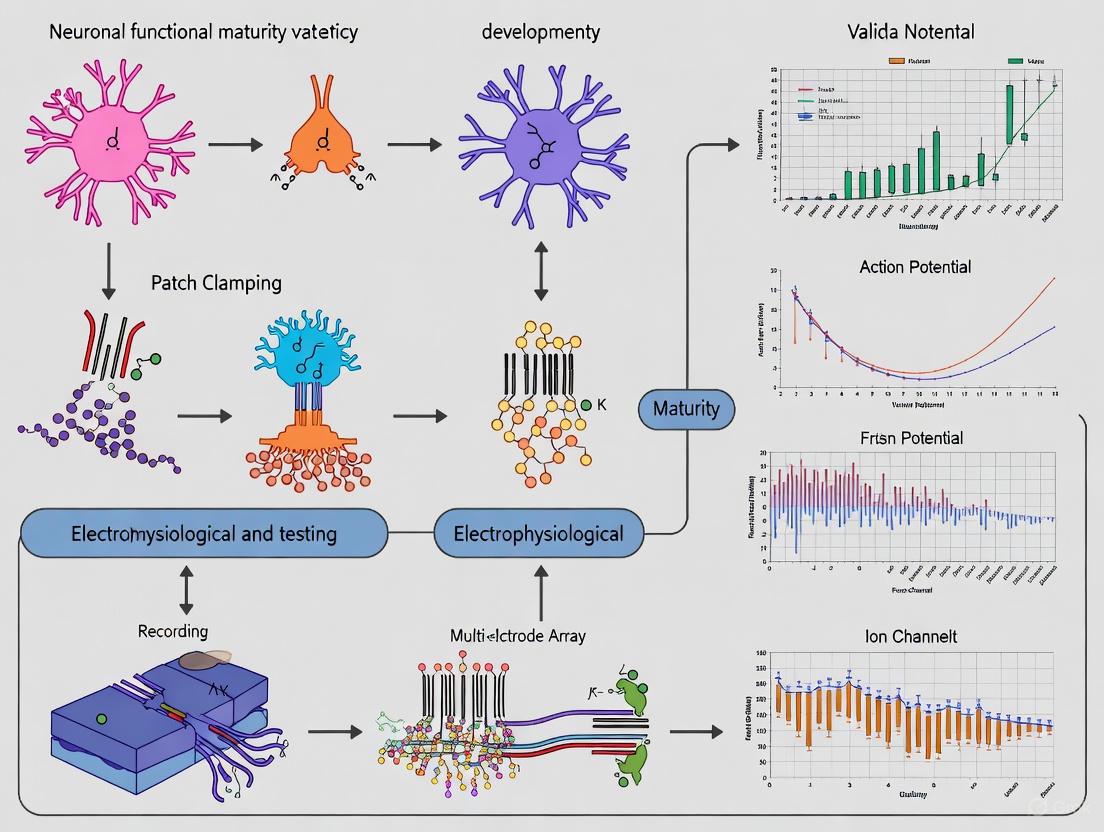
This article provides a comprehensive framework for researchers, scientists, and drug development professionals to validate the functional maturity of neuronal models, a critical step for reliable disease modeling and neurotoxicity...
Validating Neuronal Functional Maturity: A Comprehensive Guide to Electrophysiological Testing and Biomarkers
Abstract
This article provides a comprehensive framework for researchers, scientists, and drug development professionals to validate the functional maturity of neuronal models, a critical step for reliable disease modeling and neurotoxicity screening. We explore the foundational electrophysiological biomarkers of mature neural networks, from action potentials to synchronized bursting. The review details current methodological applications using Micro-Electrode Arrays (MEAs) and patch-clamp techniques on advanced models like human induced pluripotent stem cell (hiPSC)-derived neurons and brain organoids. Furthermore, we address common troubleshooting and optimization challenges, including protracted maturation times and 3D measurement limitations. Finally, we present strategies for the pharmacological and computational validation of functional maturity, comparing the sensitivity of different in vitro models to enable more predictive and translationally relevant neuroscience research.
The Electrophysiological Blueprint of a Mature Neuron: Key Biomarkers and Significance
The validation of neuronal functional maturity represents a paradigm shift in modern neuroscience. For decades, the assessment of neuronal development and maturity relied heavily on structural markers—morphological characteristics, immunohistochemical staining for specific proteins, and transcriptomic profiles. While these indicators provide valuable snapshots of cellular state, they offer limited insight into the dynamic, functional capabilities that define a neuron's integrative role within neural networks. The emergence of sophisticated human-derived neuronal models, including cerebral organoids and induced pluripotent stem cell (pluripotent stem cell)-derived neurons, has accelerated the need for rigorous functional assessment. These complex three-dimensional systems recapitulate aspects of human neurodevelopment that are inaccessible in traditional animal models, but their utility hinges on the ability to accurately gauge their functional maturation [1] [2].
Electrophysiological testing has thereby ascended as an indispensable tool, providing a direct, quantitative readout of neuronal functionality that transcends structural appearance. This guide provides a comparative analysis of the electrophysiological benchmarks and technologies used to define and validate functional maturity across different neuronal model systems. We focus on providing researchers and drug development professionals with standardized experimental protocols, quantitative data comparisons, and essential reagent solutions to bridge the gap between neuronal structure and function.
Electrophysiological Hallmarks of Neuronal Maturity
Functional maturity is not a binary state but a multi-stage continuum characterized by the acquisition of specific electrophysiological properties. These properties evolve from basic intrinsic excitability to sophisticated network-level communication. The table below summarizes the key electrophysiological signals used to track this progression.
Table 1: Key Electrophysiological Modalities for Assessing Neuronal Maturity
| Signal Type | Physiological Basis | Analysis Methods | Interpretation & Correlation with Maturity |
|---|---|---|---|
| Action Potentials (APs, Spikes) | All-or-nothing electrical impulses for neuronal communication, generated by voltage-gated ion channels [2]. | Band-pass filtering, spike detection via amplitude thresholding, waveform analysis (e.g., FWHM) [2]. | Increasing spike amplitude and decreased waveform duration indicate enhanced ion channel expression and function. A shift from single, abortive APs to sustained, repetitive firing is a hallmark of maturity [3] [4]. |
| Spike Bursts | High-frequency clusters of spikes separated by quiescent periods [2]. | Burst detection algorithms based on inter-spike intervals (ISI) and spike density; Mean Firing Rate (MFR) calculation [2]. | The emergence of bursting activity signifies the formation of functional synaptic connections and initial network formation. Increased burst regularity and duration reflect network refinement [1]. |
| Local Field Potentials (LFPs) & Network Oscillations | Summed synaptic activity of a local neuronal population; complex, rhythmic, synchronized network activity [2]. | Low-pass filtering of raw signals; power spectrum analysis; wavelet analysis; Hilbert transform [2]. | The presence of oscillatory activity (e.g., gamma bursts) is a hallmark of mature, interconnected neural networks capable of coordinated information processing, resembling in vivo patterns [1] [2]. |
| Synaptic Activity | Postsynaptic currents mediated by glutamate (excitatory, EPSCs) and GABA (inhibitory, IPSCs) receptors. | Patch-clamp recording of miniature (mEPSCs/mIPSCs) and spontaneous (sEPSCs/sIPSCs) postsynaptic currents. | Maturation involves an increase in the frequency and amplitude of synaptic events, and a developmental shift in GABAergic transmission from depolarizing to hyperpolarizing [4]. |
| Functional Connectivity | Temporal relationships between spatially remote neurophysiological events [2]. | Cross-correlation, spike time tiling coefficient (STTC), correlated spectral entropy (CorSE) [2]. | Increased functional connectivity and the emergence of hub neurons indicate advanced network integration and maturity, allowing for complex computational tasks. |
The progression of these signals provides a multi-dimensional maturity signature. For instance, in cerebral organoids, weak spiking activity emerges around day 30-40, with synchronized burst firing and oscillatory activity becoming prominent only after 3-6 months in culture [1] [5]. Similarly, in 2D iPSC-derived neuronal cultures, a study documented a gradual decrease in membrane resistance alongside improved excitability, with mature, regular firing patterns emerging by the fifth week and synchronized network activity appearing from the sixth week onward [4].
Comparative Analysis of Model System Maturation
Different model systems exhibit distinct timelines and characteristics of functional maturation. The following table benchmarks key models based on electrophysiological and molecular data.
Table 2: Functional Maturation Benchmarks Across Neuronal Model Systems
| Model System | Timeline to First APs | Timeline to Network Bursting | Key Maturity Markers & Notes | Supporting Evidence |
|---|---|---|---|---|
| Cerebral Organoids (COs) | ~34 days [1] | ~120 days [1] | Synchronized burst firings (SBFs) emerge; increased mean spike rate and amplitude; activation of neurotrophin/TRK signaling by 5 months [1]. | MEA recordings, scRNA-seq [1] |
| iPSC-Derived Cortical Neurons (2D) | Varies by protocol; repetitive APs develop over months [3] | Sparse-to-synchronous firing switch by ~60 days [3] | Gradual hyperpolarization of membrane potential, decreased input resistance, increased AP amplitude/kinetics, emergence of mEPSCs [3]. | Patch-clamp, Ca²⁺ imaging, RNA-seq [3] |
| iPSC-Derived Neurons (BDNF/GDNF Protocol) | Repetitive APs within 1-3 weeks [4] | Synchronized network activity from 6th week [4] | Firing profiles consistent with mature regular-spiking neurons by week 5; fast glutamatergic and depolarizing GABAergic synapses abundant [4]. | Patch-clamp, Dynamic Clamp, Ca²⁺ imaging [4] |
| Human Fetal Midbrain-Pons | Detectable by gestational week (GW) 10 [6] | Rapid maturation of networks from GW10-17 [6] | Non-linear developmental trajectory; regional asynchrony between midbrain (synaptic maturation) and pons (morphology) after GW13.5 [6]. | Ex vivo electrophysiology, Smart-seq [6] |
A critical insight from recent studies is the concept of a cell-intrinsic epigenetic clock that governs the pace of human neuronal maturation. This clock, which is established in progenitor cells, creates an "epigenetic barrier" that actively maintains a poised state for maturation genes, leading to the characteristically protracted timeline of human neuronal development. This mechanism is retained in iPSC-derived neurons even upon transplantation into a rapidly maturing mouse brain, explaining why these models require months to achieve functional maturity [3].
Essential Methodologies for Electrophysiological Validation
Multi-Electrode Array (MEA) Recording for Network-Level Assessment
MEA technology has become a cornerstone for non-invasive, long-term functional monitoring of neural networks, especially in 3D systems like organoids.
Detailed Protocol: MEA Recording of Cerebral Organoids
- Organoid Generation & Culture: Generate whole-brain COs from human iPSCs using established protocols (e.g., Lancaster method). Maintain organoids in culture with agitation for several months to permit maturation. The use of BrainPhys medium, designed to support neuronal synaptic function, is recommended over standard basal media [1] [5].
- MEA Preparation & Plating: Utilize a planar 64-channel or higher-density MEA. To enhance signal-to-noise ratio, electrodes can be electroplated with porous Platinum (Pt) black, which reduces impedance and increases the contact area [5]. Transfer individual, mature organoids onto the MEA plate, ensuring direct contact with the electrode grid.
- Signal Acquisition: Record extracellular field potentials at a high sampling rate (e.g., ≥10 kHz). Record spontaneous activity for periods of 10-20 minutes under stable physiological conditions (e.g., 37°C, 5% CO₂ if applicable) [1].
- Data Analysis:
- Spike Detection: Apply a band-pass filter (e.g., 300-3500 Hz) to raw data. Detect spikes using an amplitude threshold (typically 5x the standard deviation of the baseline noise) [2].
- Burst & Network Analysis: Use burst detection algorithms (based on inter-spike intervals) to identify periods of high-frequency activity. Calculate network burst parameters: duration, spike count per burst, and inter-burst interval [1].
- Oscillation Analysis: Low-pass filter the raw signal (e.g., <300 Hz) to extract LFPs. Perform power spectral analysis or wavelet transforms to identify dominant oscillatory rhythms [2].
Patch-Clamp Electrophysiology for Single-Cell Resolution
Patch-clamp remains the gold standard for detailed biophysical and synaptic characterization of individual neurons.
Detailed Protocol: Whole-Cell Patch-Clamp of Mature Neurons
- Cell Preparation: Plate synchronized iPSC-derived neurons or prepare acute slices from mature organoids.
- Electrophysiological Recording: Use pipettes with a resistance of 3-6 MΩ when filled with intracellular solution. Target neurons under differential interference contrast (DIC) optics.
- Intrinsic Properties: In current-clamp mode, inject a series of hyperpolarizing and depolarizing current steps to measure: resting membrane potential, input resistance, action potential threshold, and the ability to fire repetitive spikes [3] [4].
- Synaptic Properties: In voltage-clamp mode, hold the cell at potentials for detecting excitatory (+10 mV from chloride reversal) or inhibitory (-70 mV) postsynaptic currents. Record miniature events in the presence of tetrodotoxin (TTX) to isolate postsynaptic receptor function [4].
- Pharmacological Validation: Apply receptor-specific antagonists (e.g., CNQX for AMPA receptors, AP5 for NMDA receptors, Bicuculline for GABAA receptors) to confirm the identity of synaptic currents and probe the excitatory/inhibitory balance [4].
The Scientist's Toolkit: Essential Reagents & Technologies
Table 3: Key Research Reagent Solutions for Functional Maturation Studies
| Item/Category | Function & Utility in Maturation Studies | Example Application |
|---|---|---|
| BrainPhys Medium | A defined, serum-free medium optimized for neuronal survival, synapse function, and spontaneous electrical activity. Supports more physiologically relevant network maturation compared to standard neuronal media [1]. | Long-term culture of cerebral organoids and 2D neuronal networks to enhance functional maturation and synaptic signaling [1]. |
| Maturation Cocktails (BDNF, GDNF) | Trophic factors that promote neuronal survival, differentiation, and synaptic plasticity. BDNF is critical for excitatory synapse development, while GDNF supports dopaminergic and other neuronal subtypes. | Terminal differentiation of iPSC-derived neural precursor cells into functional, synaptically connected neurons; used in multiple established protocols [4]. |
| Notch Signaling Inhibitors (e.g., DAPT) | A γ-secretase inhibitor that blocks Notch signaling, forcing the exit of neural progenitor cells from the cell cycle and enabling synchronized neuronal differentiation. | Generation of highly synchronous populations of cortical neurons from iPSC-derived neural precursors, reducing heterogeneity for maturation studies [3]. |
| High-Density Microelectrode Arrays (HD-MEAs) | CMOS-based devices with thousands of electrodes enabling extracellular recording at sub-cellular to network-wide spatial resolution. Ideal for mapping functional connectivity and activity propagation in 2D and 3D cultures [7]. | Large-scale, long-term monitoring of network development and drug responses in cerebral organoids and dense neuronal monolayers [1] [7]. |
| Epigenetic Modulators (e.g., EZH2, DOT1L inhibitors) | Small molecule inhibitors that transiently disrupt the "epigenetic barrier" in progenitor cells, potentially accelerating the intrinsic timeline of neuronal maturation. | Experimental preconditioning of neural progenitors to generate neurons that acquire mature electrophysiological and synaptic properties on a shortened timeline [3]. |
Signaling Pathways and Experimental Workflows
The molecular control of neuronal maturation involves key signaling pathways that can be modulated experimentally. The diagram below illustrates the workflow for generating and functionally validating mature neuronal models, highlighting critical signaling interventions.
Diagram Title: Workflow for Generating and Validating Mature Neuronal Models
The neurotrophin signaling pathway is a critical driver of functional maturation, particularly in later stages. Its activation correlates with the emergence of complex network activity in cerebral organoids [1]. The diagram below outlines this key pathway.
Diagram Title: Neurotrophin/TRK Signaling in Functional Maturation
Defining functional maturity through electrophysiological testing is no longer an adjunct to structural analysis but a central pillar of validation for human neuronal models. The benchmarks, technologies, and methodologies detailed in this guide provide a framework for researchers to quantitatively assess the functional state of neurons and networks. As the field advances, the integration of high-density electrophysiology with multi-omics approaches and targeted epigenetic modulation will further refine our standards for maturity, ultimately yielding more predictive and physiologically relevant models for understanding brain development and disease.
The action potential (AP) is the fundamental, all-or-nothing electrical impulse that enables neuronal communication [2]. In modern neuroscience research and drug development, the detailed characterization of APs has become a critical method for validating the functional maturity of neuronal models, from stem cell-derived neurons to complex three-dimensional organoids [8] [2]. Electrophysiological testing provides indispensable insights into neuronal health, network formation, and disease phenotypes that structural markers alone cannot reveal [2]. This guide compares key technologies and experimental approaches for AP measurement, providing researchers with objective performance data and detailed methodologies for assessing neuronal excitability and functional maturation.
Action Potential Measurement Technologies: A Comparative Analysis
Multiple electrophysiological platforms enable AP recording, each with distinct advantages and limitations for specific research applications. The choice of technology significantly impacts data quality, throughput, and biological relevance.
Table 1: Comparison of Action Potential Measurement Technologies
| Technology | Temporal Resolution | Spatial Resolution | Throughput | Invasiveness | Key Applications |
|---|---|---|---|---|---|
| Patch Clamp | Very High (direct intracellular measurement) | Single-cell | Low | High (ruptures cell membrane) | Gold-standard for detailed AP waveform analysis [9] [2] |
| Planar Microelectrode Arrays (MEAs) | High (extracellular) | Population-level | High | Low | Network-level activity screening [2] |
| 3-D MEAs | High (extracellular) | Multi-cellular clusters | Medium | Medium | 3-D organoid and tissue assessment [2] |
| Implantable/Flexible MEAs | High (extracellular) | Distributed networks | Medium | High (penetrating) | Chronic recording in developing organoids [2] |
Table 2: Quantitative Action Potential Parameters for Maturity Assessment
| AP Parameter | Immature Neurons | Mature Neurons | Measurement Technique | Biological Significance |
|---|---|---|---|---|
| Firing Rate | Low, random spikes | Higher, organized patterns | MEA, Patch Clamp | Network connectivity development [2] |
| Spike Amplitude | Lower amplitude | Increased amplitude over maturation | MEA, Patch Clamp | Ion channel density and function [2] |
| Waveform Duration (FWHM) | Broader spikes | Narrowed spikes | MEA analysis | Improved kinetics of voltage-gated channels [2] |
| Spike Bursts | Isolated spikes | Organized bursting patterns | MEA analysis | Emergence of synaptic communication [2] |
Experimental Protocols for Action Potential Characterization
Patch Clamp Protocol for Single-Cell AP Recording
The patch clamp technique remains the gold standard for detailed AP characterization at the single-cell level, providing direct intracellular measurement of membrane potential dynamics [9]. The following protocol is adapted from methodologies used for neonatal rat ventricular cardiomyocytes [9] and neuronal systems:
Cell Preparation: Plate neurons on appropriate substrate (e.g., Matrigel-coated coverslips). For iPSC-derived neurons, validate differentiation through immunofluorescence staining for neuronal markers (e.g., TUJ1, MAP2) prior to recording [8].
Electrode Fabrication: Pull borosilicate glass capillaries to resistance of 3-6 MΩ using a pipette puller. Fill with intracellular solution containing (in mM): 130 K-gluconate, 10 KCl, 10 HEPES, 4 Mg-ATP, 0.3 Na-GTP (pH 7.2-7.3 with KOH) [9].
Whole-Cell Configuration: Approach cell membrane with positive pressure. Form gigaseal (≥1 GΩ) by applying gentle suction. Establish whole-cell access by additional suction or brief voltage zap [9].
Current-Clamp Recording: Maintain cells at defined holding membrane potential (typically -70 mV to -80 mV) [9]. Induce APs using depolarizing current injections (1-2 ms pulses at 1 Hz frequency). Record membrane potential at sampling rate ≥50 kHz [9].
Data Analysis: Analyze AP parameters including resting membrane potential, threshold, amplitude, max upstroke velocity (dV/dt), and duration at different repolarization percentages (APD20, APD50, APD90) [9].
Microelectrode Array (MEA) Protocol for Network-Level AP Assessment
MEA recording enables non-invasive, long-term monitoring of AP activity across neuronal networks, ideal for maturation studies and drug screening [10] [2]:
Plate Preparation: Coat MEA plates with poly-D-lysine/laminin or other appropriate extracellular matrix proteins. Allow to dry sterilely overnight [10].
Cell Plating: Seed iPSC-derived neurons or brain organoids at optimized density (e.g., 60,000-100,000 cells per well for 96-well MEA plates). Maintain in culture for desired maturation period [10].
Recording Setup: Place MEA plate in recording station maintained at 37°C and 5% CO₂. Allow system to equilibrate for 15-30 minutes prior to recording [10].
Data Acquisition: Record spontaneous activity for 10-15 minutes. For paced experiments, use optical stimulation (channelrhodopsin) [10] or electrical field stimulation at defined frequencies.
Signal Processing: Band-pass filter raw data (300-3,500 Hz) to isolate APs [2]. Detect spikes using amplitude thresholding (typically 5× standard deviation of baseline noise) [2]. Analyze firing rates, inter-spike intervals, burst patterns, and synchronization indices.
Diagram 1: MEA Experimental Workflow
The Scientist's Toolkit: Essential Research Reagents and Solutions
Table 3: Key Research Reagent Solutions for AP Studies
| Reagent/Solution | Function | Example Application |
|---|---|---|
| Induced Pluripotent Stem Cells (iPSCs) | Source for patient-specific neuronal differentiation | Disease modeling, personalized drug screening [8] [11] [10] |
| Differentiation Media Components | Direct stem cell fate toward neuronal lineages | Generation of iPSC-derived motor neurons and cortical neurons [8] |
| Extracellular Matrix Proteins | Provide structural support and biochemical cues | Matrigel for iPSC-derived cardiomyocyte plating [10] |
| Patch Clamp Solutions | Maintain ionic gradients and cell health | Intracellular pipette solutions for current-clamp recordings [9] |
| Optogenetic Tools | Enable precise temporal control of neuronal firing | Channelrhodopsin for optical pacing in iPSC-CMs [10] |
| Immunostaining Markers | Validate neuronal differentiation and maturity | Antibodies against TUJ1, MAP2, and synapsin for neuronal validation [8] |
Signaling Pathways Underlying Action Potential Generation
The initiation and propagation of APs involve precisely coordinated activity of voltage-gated ion channels that drive the cyclical depolarization and repolarization of the neuronal membrane.
Diagram 2: Action Potential Signaling Pathway
Data Interpretation and Functional Maturity Assessment
Interpreting AP data requires understanding how specific parameters reflect underlying biological maturation. As neurons mature, several key electrophysiological developments occur. The transition from sporadic, low-amplitude spikes to sustained, high-fidelity APs with organized bursting patterns indicates functional ion channel expression and synaptic integration [2]. Cerebral organoids show increased spike amplitude and the emergence of network oscillations between 30-64 days in culture, marking critical milestones in functional maturation [2]. Analysis of AP waveforms provides direct insight into ion channel function, while bursting patterns and network synchronization reveal the development of functional connectivity. These electrophysiological signatures serve as essential validation metrics for neuronal models in basic research and drug development applications [2].
Action potential characterization provides the most direct method for evaluating functional maturity in neuronal model systems. As the field advances toward increasingly complex human-derived models, including brain organoids and assembloids [11] [2], standardized electrophysiological assessment becomes increasingly critical for validating these platforms. The technologies and methodologies compared in this guide enable researchers to quantitatively assess neuronal excitability, network formation, and disease-related functional alterations. By applying these standardized approaches, the neuroscience community can establish rigorous benchmarks for neuronal model quality, ultimately accelerating drug discovery and improving the translational potential of neurological disease research.
Spike bursts and network-level synchronization represent critical electrophysiological signatures of maturing neural networks. These phenomena serve as fundamental biomarkers for assessing functional connectivity in various neural models, from in vitro cultures to advanced brain organoids. This guide compares experimental methodologies and analytical frameworks used to quantify these hallmarks, providing researchers with objective data on their efficacy in validating neuronal functional maturity. We synthesize evidence from computational, in vitro, and bioengineering approaches, offering a structured comparison of tools and techniques that enable robust evaluation of emerging network dynamics in both healthy and diseased states.
The transition from sporadic, isolated neuronal firing to organized, synchronized network activity marks a critical milestone in neural functional maturation. This progression is characterized by two primary electrophysiological phenomena: spike bursts—high-frequency clusters of action potentials separated by periods of quiescence—and network synchronization—the coordinated timing of neural activity across distributed neuronal populations [12]. Together, these hallmarks indicate the development of functional synaptic connections and the emergence of complex network dynamics essential for information processing [13] [12].
Within the broader thesis of validating neuronal functional maturity, electrophysiological testing provides indispensable, functional readouts that complement structural and molecular analyses. The presence of organized spike bursts and network oscillations demonstrates not merely the viability of neurons but their capacity to form operational circuits—a prerequisite for modeling cognitive processes and neurological disorders [12]. This guide objectively compares the experimental platforms and analytical methods used to detect and quantify these phenomena, providing researchers with standardized frameworks for assessing functional connectivity across different neural model systems.
Experimental Platforms for Electrophysiological Characterization
The accurate detection of spike bursts and network synchronization requires technologies capable of capturing neural activity at appropriate temporal and spatial resolutions. The following platforms represent the primary tools used in the field, each with distinct advantages and limitations for specific applications.
Table 1: Comparison of Electrophysiological Platforms for Functional Maturity Assessment
| Platform Type | Key Applications | Spatial Resolution | Temporal Resolution | Key Advantages | Primary Limitations |
|---|---|---|---|---|---|
| Planar Microelectrode Arrays (MEAs) | Network-level burst and oscillation analysis in 2D cultures | Limited to 2D electrode grid | Excellent (sub-millisecond) | Non-invasive; long-term recordings; high-throughput compatibility | Limited access to 3D network structure; lower density in 3D organoid models |
| 3D & Implantable MEAs | Functional mapping in brain organoids and 3D cultures | High (volumetric access) | Excellent (sub-millisecond) | Volumetric access to neural activity; chronic interfacing with developing tissues | Higher invasiveness; potential tissue disruption; more complex implementation |
| Patch-Clamp Electrophysiology | Single-neuron properties and synaptic connectivity | Single-cell precision | Excellent (sub-millisecond) | Gold standard for detailed neuronal characterization; intracellular access | Low-throughput; technically challenging; limited network-scale assessment |
| Calcium Imaging | Large-scale population activity in 2D and 3D systems | High (cellular level possible) | Moderate (limited by indicator kinetics) | High spatial mapping; cellular resolution in 3D tissues | Indirect measure of electrical activity; slower temporal dynamics |
Traditional planar microelectrode arrays (MEAs) have been widely adapted for organoid studies, offering non-invasive, long-term monitoring of network activity [12]. However, their primary limitation lies in limited access to the three-dimensional structure of organoids, potentially missing critical components of network dynamics. Next-generation 3D MEAs and implantable flexible electrodes address this limitation by providing volumetric access to neural activity throughout the developing tissue, enabling more comprehensive functional mapping [12]. For researchers requiring single-cell resolution, patch-clamp techniques remain the gold standard for characterizing intrinsic neuronal properties and synaptic connectivity, though with lower throughput than MEA approaches [12].
Quantitative Metrics and Analytical Methodologies
Rigorous assessment of functional maturity requires quantifying specific parameters of spike bursts and network synchronization. Standardized analytical pipelines have been developed to extract these metrics from raw electrophysiological data.
Spike Burst Characterization
Spike bursts represent fundamental building blocks of network communication, emerging as synaptic connections strengthen and stabilize during maturation [12]. The MaxInterval burst detection algorithm provides a standardized framework for identifying and characterizing these events based on five key parameters: maximum inter-spike interval (ISI) at burst start, maximum ISI within burst, minimum burst duration, minimum inter-burst interval (IBI), and minimum spike count per burst [14]. This method proceeds through three phases: initial burst detection, burst merging based on IBI criteria, and quality control to exclude insignificant events [14].
Table 2: Key Metrics for Spike Burst Analysis in Functional Maturation
| Metric | Description | Interpretation in Maturation Context | Typical Values in Mature Networks |
|---|---|---|---|
| Burst Duration | Time from first to last spike in a burst | Increases with network integration | 0.01 - 1.0 seconds [14] |
| Inter-Burst Interval (IBI) | Time between consecutive burst events | Decreases with higher network coordination | 0.2 - 10 seconds [14] |
| Spikes per Burst | Number of action potentials within a burst | Increases with synaptic strength | 3 - 100+ spikes [14] |
| Intra-Burst Frequency | Firing rate within bursts (spikes/second) | Increases with neuronal excitability | 10 - 100 Hz [12] |
| Burst Percentage | Proportion of spikes occurring in bursts | Higher values indicate more organized activity | 20% - 80% of total spikes |
Network Synchronization Analysis
Network synchronization reflects the large-scale coordination of neural activity, emerging through balanced excitatory-inhibitory interactions and synaptic connectivity [15] [13]. Computational modeling reveals that different synchronization mechanisms dominate under varying conditions: with low synaptic strength, networks show sensitivity to external oscillatory drive (resonance), while strongly-connected networks generate synchronization through direct excitation-inhibition interactions (PING mechanisms) [15]. The spectral entropy of population activity provides a key metric for quantifying the stability and strength of network oscillations, with lower entropy indicating more stable, synchronized dynamics [13].
Synchronization Mechanisms in Developing Networks
Experimental Protocols for Functional Validation
MaxInterval Burst Detection Protocol
The following protocol provides a standardized method for detecting and characterizing spike bursts from single-electrode or single-unit recordings, based on the established MaxInterval algorithm [14]:
Data Preparation: Extract spike timestamps from raw electrophysiological data. For MEA recordings, focus initially on single electrodes demonstrating clear single-unit activity.
Parameter Selection: Set the five critical detection parameters based on experimental context:
- Maximum ISI at burst start: 0.17s (typical default)
- Maximum ISI within burst: 0.3s (typical default)
- Minimum burst duration: 0.01s
- Minimum inter-burst interval (IBI): 0.2s
- Minimum spikes in burst: 3
Burst Detection Phase: Identify burst initiations when two consecutive spikes show ISI less than maximum ISI at burst start. Define burst termination when two consecutive spikes exceed maximum ISI within burst.
Burst Merging Phase: Merge adjacent bursts separated by IBI less than minimum IBI threshold.
Quality Control Phase: Remove bursts shorter than minimum duration or containing fewer than minimum spikes.
Validation: Visually inspect detected bursts against raster plots to verify algorithm performance. Adjust parameters iteratively if necessary to match visual assessment.
Network Synchronization Analysis Protocol
This protocol enables quantification of network-level synchronization from multi-electrode recordings or population activity data:
Data Acquisition: Record spontaneous activity from neural networks for sufficient duration (typically 10-30 minutes) to capture multiple oscillatory cycles.
Population Rate Calculation: Bin spike data across the network (10-50ms bins) to create a population firing rate trace.
Spectral Analysis: Apply Fourier transform to population rate signal to identify dominant oscillation frequencies.
Spectral Entropy Calculation: Compute spectral entropy (Hs) as a measure of oscillation stability using the formula:
- Hs = -Σ(P(f) × log₂P(f)), where P(f) represents normalized power spectral density
- Lower Hs values indicate more stable, synchronized dynamics [13]
Cross-Correlation Analysis: Calculate pairwise cross-correlations between spike trains of different units to quantify synchronization strength.
Shuffle Correction: Apply shuffle correction to distinguish true synchronization from stimulus-induced correlations by subtracting correlations from trial-shuffled data [16].
The Scientist's Toolkit: Essential Research Reagents and Solutions
The following tools and reagents represent essential components for electrophysiological investigation of spike bursts and network synchronization:
Table 3: Essential Research Reagents and Solutions for Functional Connectivity Studies
| Tool/Reagent | Function | Example Applications |
|---|---|---|
| MLIB Toolbox | Spike data analysis in MATLAB | Peri-stimulus time histograms, ISI distribution analysis, autocorrelation [17] |
| FieldTrip Toolbox | Open-source spike and LFP analysis | Waveform characterization, spike density calculation, cross-correlation analysis [16] |
| BrainNet Viewer | Network visualization | Connectome visualization as ball-and-stick models, functional connectivity mapping [18] |
| MaxInterval Algorithm | Burst detection from spike trains | Standardized identification of burst events in single-electrode recordings [14] |
| iPSC-Derived Motor Neurons | Human-specific neural models | Disease modeling, drug screening, maturation studies [19] |
| TTX (Tetrodotoxin) | Sodium channel blocker | Verification of action potential dependence in recorded signals [12] |
| Brain Organoid Cultures | 3D neural network models | Studying development of functional connectivity in human-like tissue [12] |
Comparative Analysis of Methodological Approaches
Different methodological approaches offer complementary insights into functional network maturity, with selection dependent on specific research questions and model systems.
Analytical Framework for Functional Maturity Assessment
Spike burst analysis provides crucial information about microcircuit maturity and synaptic strength at the local level, with the advantage of requiring only single-electrode recordings but limited in capturing network-wide dynamics [14]. Network synchronization approaches reveal macrocircuit integration and excitatory-inhibitory balance across larger scales, offering insights into global network function though requiring multi-electrode setups [15] [13]. Computational modeling generates mechanistic understanding of how specific parameters affect synchronization, enabling hypothesis testing and experimental design optimization despite requiring specialized expertise [15].
Spike bursts and network synchronization provide complementary, quantifiable hallmarks of emerging functional connectivity in developing neural networks. Through standardized experimental protocols and analytical frameworks, researchers can objectively assess functional maturity across diverse neural preparations, from 2D cultures to complex 3D organoid models. The continued refinement of these electrophysiological assessment tools, particularly through the development of 3D recording interfaces and more sophisticated analytical algorithms, will enhance our ability to validate neuronal models for both basic research and therapeutic development. As the field advances, integrating these functional metrics with molecular and structural analyses will provide a comprehensive picture of neural network maturation, ultimately strengthening the validity of in vitro models for studying human brain function and dysfunction.
Local Field Potentials (LFPs) represent the low-frequency component (<500 Hz) of extracellular electrical recordings, primarily generated by synaptic currents and intrinsic membrane potentials from populations of neurons within a local neighborhood of a recording electrode [20] [21]. In contrast to action potentials ("spikes") which reflect the output of individual neurons, LFPs provide a mesoscale measure of integrated inputs and local processing within neural networks [20]. The rhythmic, oscillatory components of LFPs—organized into canonical frequency bands including delta (1-4 Hz), theta (4-8 Hz), alpha (8-13 Hz), beta (13-30 Hz), and gamma (30-150 Hz)—are increasingly recognized not merely as epiphenomena but as functional signatures of network coordination mechanisms [22]. This review synthesizes current evidence establishing LFPs and neural oscillations as robust proxies for complex network activity, with particular relevance for researchers validating neuronal functional maturity through electrophysiological testing.
The functional significance of oscillatory activity extends beyond descriptive correlation to potential mechanistic roles in neuronal computation. As [22] articulates, "Oscillations are hypothesized to facilitate the self-organized orchestration of neuronal computation, influencing how information is processed across ensembles." This perspective positions LFP oscillations as both measurable signals and potential contributors to network dynamics, offering a valuable window into the functional maturity and integrity of neuronal systems in both basic research and drug development contexts.
Comparative Analysis of Neural Activity Measures
Technical and Functional Characteristics
Understanding the relative strengths and limitations of different neural recording modalities is essential for appropriate experimental design and interpretation in neuropharmacology and development studies.
Table 1: Comparison of Neural Activity Measurement Modalities
| Feature | Local Field Potentials (LFPs) | Multi-Unit Activity (MUA) | Single-Unit Activity |
|---|---|---|---|
| Biological Source | Synaptic currents, dendritic integration, intrinsic potentials [20] | Action potentials from local neuronal population [20] | Action potentials from individual neurons |
| Frequency Range | <500 Hz [20] | >1000 Hz [20] | >1000 Hz |
| Spatial Resolution | ~100-500 μm (frequency-dependent) [21] | ~50-150 μm [21] | Single neuron |
| Temporal Resolution | Milliseconds [21] | Milliseconds | Sub-millisecond |
| Stability for Chronic Recording | High (months) - less sensitive to micromotion [21] | Moderate - affected by electrode drift [21] | Low - requires stable isolation |
| Information Type | Population input integration, network state [20] [23] | Local spiking output, population firing rate | Individual neuron output, precise timing |
| Relationship to BOLD fMRI | Strongly correlated [20] | Weakly correlated [20] | Variable |
Information Content and Decoding Performance
Different neural signals offer complementary insights into network function, with practical implications for experimental and clinical applications.
Table 2: Information Content and Decoding Performance Across Modalities
| Application | LFP Performance | MUA/Spiking Performance | Key Insights |
|---|---|---|---|
| Motor Kinematics Decoding | Comparable to spikes for offline decoding [21] | Superior in closed-loop BMI [21] | Low-frequency LFP (<5 Hz) outperforms high-gamma power for kinematic decoding [21] |
| Sensory Response Sustainedness | Sustained responses to visual stimuli [20] | Equally sustained as LFP for optimal stimuli [20] | Challenges previous findings that MUA is less sustained than LFP [20] |
| Stability in Chronic Recordings | High (days to months) [21] | Degrades over time [21] | LFP-based interfaces potentially more suitable for long-term clinical applications [21] |
| Network Parameter Estimation | Accurate estimation of synaptic weights possible [24] | Traditional validation method | LFP power spectra contain sufficient information to recover network model parameters [24] |
| Band-Specific Information | Low-frequency (<5 Hz) and high-gamma (>60 Hz) most informative [21] | Generally broad spectrum | Alpha/beta bands often suppressed during movement, providing limited decoding utility [21] |
Methodological Framework: From Recording to Interpretation
Core Experimental Protocols
LFP Acquisition in Macaque Visual Cortex [20]: Acute experiments in macaque primary visual cortex (V1) employed a seven-electrode Thomas recording system with platinum/tungsten electrodes (300μm spacing, 0.7-4 MΩ impedance). Signals were amplified, digitized, and filtered (0.3-10 kHz) using Tucker-Davis Technologies System 3. Visual stimuli consisted of drifting sinusoidal gratings (2 cycles/°, 4 Hz temporal frequency) presented within a 3° circular patch covering all recording sites. Stimuli drifted in different directions (0°-360° in 20° steps) in pseudorandom order, with each condition presented for 2-4 seconds and repeated 25-50 times. LFP was extracted as the low-frequency component (<500 Hz) of the raw recording, while MUA was obtained from the high-frequency portion (>1000 Hz).
Thalamic LFP Analysis in Human Patients [25]: Deep brain LFPs were recorded from thalamic nuclei in patients with neuropathic pain and dystonic tremor using implanted deep brain stimulation electrodes. Signals were analyzed during rest using three complementary approaches: (1) Power spectral analysis to quantify rhythmic behavior, (2) Power ratio analysis to assess balancing behavior between frequency bands, and (3) Cross-frequency power coupling analysis to measure interaction behaviors. This multidimensional approach allowed characterization of disease-specific oscillatory signatures, with pain patients showing dominant alpha rhythms (8-12 Hz) and dystonic tremor patients exhibiting enhanced high-beta power (20-30 Hz).
Network Parameter Estimation from LFP [24]: A computational framework demonstrated that LFP signals contain sufficient information to accurately estimate underlying network parameters. The approach utilized a Brunel network model with excitatory and inhibitory populations of leaky integrate-and-fire neurons. LFP signals were generated using a hybrid scheme where network-computed spikes were replayed onto biophysically detailed multicompartment neuron models. Convolutional neural networks were then trained on LFP power spectra to estimate synaptic connection weights, demonstrating accurate parameter recovery and validating LFP's utility for network model constraint.
Signaling Pathways and Analytical Workflows
The Scientist's Toolkit: Essential Research Reagents and Solutions
Table 3: Key Reagents and Materials for LFP Research
| Category | Specific Examples | Research Function |
|---|---|---|
| Recording Systems | Thomas multi-electrode system, Tucker-Davis Technologies System 3, BioSemi ActiveTwo [20] [26] | Multi-channel signal acquisition with precise temporal resolution |
| Electrode Types | Platinum/tungsten microelectrodes, silicon probes, deep brain stimulation electrodes [20] [25] | Extracellular potential recording from specific brain regions |
| Signal Processing Tools | Fitting Oscillations and One Over F (FOOOF) algorithm, LSTM networks, Convolutional Neural Nets [24] [26] [27] | Separation of periodic and aperiodic signal components, cycle detection, parameter estimation |
| Computational Models | Brunel network model, Kuramoto oscillator model, dynamic causal modeling [24] [28] [23] | Linking LFP features to underlying network mechanisms and connectivity |
| Analytical Frameworks | Power spectral analysis, power ratio analysis, cross-frequency coupling analysis [25] | Quantifying rhythmic, balancing, and coupling behaviors of local networks |
Interpreting LFP Oscillations in Network Function Assessment
Frequency-Specific Functional Correlates
Different frequency bands in LFP oscillations provide distinct insights into network functioning, each with characteristic associations and potential interpretations for functional maturity assessment.
Gamma oscillations (30-150 Hz): Reflect local processing and feature integration, with power increases typically associated with enhanced cognitive processing or sensory drive. In visual cortex, gamma power demonstrates contrast-response functions resembling those of single neurons [20]. Gamma oscillations are sensitive to stimulus contrast and attention, suggesting their utility in assessing sensory network integrity [23].
Beta oscillations (13-30 Hz): Often associated with top-down processing and maintenance of current sensorimotor or cognitive states. In cortical hierarchies, beta oscillations frequently propagate in feedback directions [23]. Pathological beta synchronization in basal ganglia-thalamocortical circuits represents a hallmark of Parkinson's disease, making this frequency band particularly relevant for neuropharmacology studies targeting movement disorders [23].
Alpha oscillations (8-13 Hz): Prominent in posterior regions during resting states, exhibiting strong age-related changes including power decreases and peak frequency slowing [26] [29]. Alpha oscillations have been linked to functional inhibition and timing of neural processing, potentially reflecting the integrity of thalamocortical circuits.
Theta oscillations (4-8 Hz): Important for memory processes and long-range communication, with posterior theta dominance associated with encoding states in working memory tasks [28]. Theta-gamma cross-frequency coupling provides a mechanism for integrating information across temporal scales.
LFP-Based Assessment of Network Integrity
The application of LFP analysis for evaluating neuronal functional maturity and network integrity extends across multiple research domains:
Developmental and Aging Studies: Healthy aging produces distinctive spectral changes, generally characterized by decreased low-frequency power (particularly posterior alpha) and increased high-frequency power (especially frontal beta) [29] [26]. These changes reflect alterations in excitatory-inhibitory balance and network connectivity, providing quantitative metrics for assessing whether engineered neuronal systems recapitulate mature functional properties.
Disease Biomarker Identification: Distinctive oscillatory signatures have been identified across neurological and psychiatric conditions. For example, enhanced beta oscillations in basal ganglia circuits characterize Parkinson's disease, while altered gamma oscillations are observed in schizophrenia [23] [25]. These disease-specific signatures provide targets for therapeutic development and validation.
Network Parameter Estimation: Computational approaches demonstrate that LFP power spectra contain sufficient information to accurately estimate underlying synaptic weights and connectivity parameters in network models [24]. This capability positions LFP as a valuable tool for validating in vitro neuronal systems against established functional benchmarks.
Local Field Potentials and their oscillatory components provide a powerful window into complex network activity, offering distinct advantages for assessing neuronal functional maturity in both basic research and therapeutic development contexts. Their mesoscale nature, stability in chronic recordings, and rich information content make them particularly valuable for validating engineered neuronal systems and screening candidate therapeutics. The continuing development of sophisticated analytical approaches—including cross-frequency coupling analysis, computational modeling, and machine learning—is further enhancing our ability to extract meaningful network-level insights from LFP signals, solidifying their role as essential proxies for complex network activity in electrophysiological research.
The Critical Excitatory/Inhibitory (E/I) Balance in Functional Neural Networks
The excitatory/inhibitory (E/I) balance is a fundamental property of neural circuits, serving as a crucial index of neurophysiological homeostasis associated with healthy brain functioning. This balance between glutamatergic excitation and GABAergic inhibition regulates network dynamics, information processing, and cognitive function. Maintaining an appropriate E/I balance is essential for normal brain operations, while its disruption constitutes a pathophysiological basis for various neuropsychiatric and neurological disorders including schizophrenia, autism spectrum disorder, major depressive disorder, Alzheimer's disease, and epilepsy [30] [31]. The critical importance of E/I balance extends from basic neuronal signaling to complex network phenomena, influencing everything from cellular communication to large-scale brain organization.
Recent technological advances have enabled researchers to quantify and manipulate E/I balance across multiple experimental platforms, from in vitro neuronal cultures and cerebral organoids to non-invasive human neuroimaging. This guide provides a comparative analysis of current methodologies for assessing E/I balance, detailing their experimental protocols, applications, and performance characteristics to inform research on neuronal functional maturity and drug development.
Comparative Analysis of E/I Balance Assessment Technologies
Table 1: Comparison of Major Technologies for Assessing E/I Balance
| Technology | Key Measured Parameters | Temporal Resolution | Spatial Resolution | Key Applications | Notable Advantages |
|---|---|---|---|---|---|
| Microelectrode Arrays (MEAs) | Spike rates, network bursts, synchronized bursting frequency [1] [5] | Milliseconds (real-time) | Single-cell to network level | Drug screening, disease modeling, functional maturation studies [1] [5] | Non-invasive long-term monitoring; high-throughput capability [5] |
| EEG Data Assimilation (DA) | E/I synaptic gain parameters (A, B), E/I ratio [30] | Sub-second scale | Regional cortical areas | Tracking sleep-dependent E/I changes, neuropsychiatric disorder research [30] | Non-invasive; tracks dynamic changes over time; validated against TMS-EEG [30] [32] |
| TMS-EEG | N100 (SICI), P60 (ICF), gamma ERSP [30] | Milliseconds | Regional cortical areas | Assessing GABAA and NMDA receptor-mediated functions [30] | Direct physiological assessment of inhibitory and excitatory neurotransmission [30] |
| Aperiodic Exponent Analysis | Slope of 1/f power spectrum [31] | Seconds to minutes | Whole-brain source-localized | Epilepsy research, seizure prediction, cognitive studies [31] | Completely non-invasive; full-cortex assessment; sensitive to E/I dynamics [31] |
Table 2: Performance Metrics Across E/I Assessment Platforms
| Platform | Maturation Detection Capability | Drug Response Testing | Network-level Analysis | Clinical Translation Potential |
|---|---|---|---|---|
| Cerebral Organoids + MEA | Detects progression from single spikes (Day 34) to synchronized bursts (Day 120+) [1] | Robust response to KCl (30 mM) demonstrating enhanced network excitability [5] | Excellent for studying synchronized burst firing and functional connectivity [1] | Moderate (disease modeling, drug screening) [1] [5] |
| EEG Data Assimilation | Tracks sleep-dependent E/I changes over time [30] | Potential for pharmaceutical assessment | Good for large-scale network dynamics | High (non-invasive, directly applicable to patients) [30] |
| Aperiodic Exponent (hdEEG) | Identifies preictal inhibitory shifts (minutes before seizure) [31] | Can track medication effects [31] | Excellent for whole-brain functional connectivity and network topology | High (seizure prediction, treatment monitoring) [31] |
Experimental Protocols for E/I Balance Assessment
Microelectrode Array (MEA) Analysis of Cerebral Organoids
Objective: To evaluate functional maturation and E/I balance in human iPSC-derived cerebral organoids through long-term electrophysiological monitoring [1] [5].
Workflow Overview: The following diagram illustrates the key stages in the MEA analysis workflow for assessing neural network maturity in cerebral organoids:
Detailed Methodology:
- Cerebral Organoid Generation: Generate whole-brain cerebral organoids from human induced pluripotent stem cells (hiPSCs) using undirected differentiation protocols with BrainPhys medium to enhance neuronal synaptic function [1].
- MEA Platform Preparation: Fabricate planar microelectrode arrays (32-64 channels) with Pt black electroplating to significantly reduce electrode impedance and improve neural signal capture. Electrodes typically feature 50μm diameter with 200μm inter-electrode spacing [5].
- Recording Protocol: Transfer organoids to MEA probes and record spontaneous electrical activity. Maintain recordings under controlled conditions (37°C, 5% CO₂) for consistent physiological function.
- Data Acquisition Parameters: Sample at ≥1kHz to capture action potentials and local field potentials. Record from multiple sites simultaneously to assess network synchronization.
- Pharmacological Challenge: Apply 30mM potassium chloride (KCl) to test network responsiveness. Mature networks typically show marked increase in spike rate, indicating enhanced neuronal depolarization and network excitability [5].
- Functional Analysis:
- Quantify mean spike rates and spike amplitudes across development (Days 34-161)
- Detect synchronized burst firings (SBFs) as hallmarks of synaptic signal propagation
- Calculate network burst metrics: duration, spike number per burst, and inter-burst intervals [1]
Key Maturation Markers: Weak spiking activity emerges by day 34, followed by elevated mean spike rates by day 64. Synchronized burst firing typically appears by day 120, indicating mature network interconnectedness. By day 161, networks show highly interconnected properties with burst durations of ~985ms and ~1700 spikes per network burst [1].
EEG Data Assimilation for E/I Balance Estimation
Objective: To non-invasively estimate time-varying E/I balance from scalp EEG data using computational modeling [30].
Workflow Overview: The diagram below outlines the computational process for estimating E/I balance from EEG data using data assimilation techniques:
Detailed Methodology:
- EEG Data Collection: Acquire 5-minute resting-state EEG recordings from participants using standard scalp electrode placement. Focus on signals from dorsolateral prefrontal cortex regions for E/I assessment [30].
- Signal Preprocessing: Apply bandpass filtering (0.1-45Hz), artifact removal, and bad channel interpolation using standardized pipelines in EEGLAB or similar platforms.
- Neural Mass Model Setup: Implement a neural mass model containing parameters for E/I synaptic gains. The model simulates population-level neural dynamics that generate EEG signals.
- Data Assimilation Algorithm: Apply the variational Bayesian noise-adaptive constrained Ensemble Transform Kalman Filter (vbcETKF) to assimilate observed EEG data into the neural mass model. This method reduces computational cost while maintaining estimation accuracy [30].
- Parameter Estimation: Estimate E and I synaptic gain parameters (A and B) at sample-by-sample temporal resolution through direct assimilation of EEG time-series.
- E/I Ratio Calculation: Compute the E/I balance ratio from the estimated gain parameters. This ratio reflects the relative strength of excitatory to inhibitory influences in cortical circuits.
- Validation: Correlate DA-based E/I estimates with TMS-EEG indices including short-interval intracortical inhibition (SICI, reflecting GABAA function) and intracortical facilitation (ICF, reflecting NMDA function) [30].
Performance Characteristics: The enhanced DA method successfully tracks sleep-dependent E/I changes and shows significant correlations with TMS-EEG measures (Spearman's r = 0.399 for TEP-based estimation; r = 0.339 for ERSP-based estimation), confirming its neurophysiological validity [30].
The Scientist's Toolkit: Essential Research Reagents and Solutions
Table 3: Key Research Reagents and Solutions for E/I Balance Studies
| Reagent/Solution | Function | Application Examples | Considerations |
|---|---|---|---|
| BrainPhys Medium | Supports neuronal synaptic function and electrophysiological maturation [1] | Cerebral organoid culture; enhances functional maturation of neuronal networks [1] | Superior to standard media for promoting synaptic activity |
| Potassium Chloride (KCl), 30mM | Induces neuronal depolarization; tests network excitability [5] | Pharmacological validation of neural network maturity in MEA studies [5] | Concentration-dependent response indicates functional maturity |
| Pt Black Electroplating Solution | Reduces electrode impedance; enhances signal capture [5] | MEA fabrication for cerebral organoid recordings [5] | Critical for stable long-term recordings from 3D structures |
| hiPSC Lines | Source for generating human cerebral organoids [1] [5] | Disease modeling, drug screening, development studies [1] | Line-to-line variability may affect results |
| Neurotransmitter Receptor Modulators | Specific manipulation of E/I balance (GABAA, NMDA receptors) [30] | TMS-EEG protocols (SICI, ICF); pharmacological challenges [30] | Receptor-specificity allows targeted investigations |
Advanced Applications and Research Implications
E/I Balance in Neurological Disorders and Structure-Function Relationships
The assessment of E/I balance provides critical insights into the mechanisms underlying various neurological conditions. Research using aperiodic exponent analysis of high-density EEG has revealed that seizure onset in epilepsy is preceded by a dynamic shift toward inhibition at the whole-brain level, with the aperiodic exponent increasing progressively in the minutes preceding seizures [31]. This preictal inhibitory shift represents a potential protective mechanism and offers promising avenues for seizure prediction algorithms.
The relationship between E/I balance and large-scale brain organization is further illuminated by structure-function coupling (SFC) research. Studies combining neuroimaging and computational approaches demonstrate that intracortical myelination and E/I balance synergistically shape how closely functional connectivity patterns reflect underlying structural connections across the cortical hierarchy [33]. Notably, a lower E/I ratio is associated with more rigid structure-function coupling, particularly in granular cortical regions, highlighting the role of inhibition in stabilizing neural circuits [33].
In Parkinson's disease patients, research shows widespread increases in structure-function coupling compared to healthy controls, particularly in agranular and frontal cortical types. These changes are correlated with alterations in E/I balance, demonstrating the translational relevance of E/I assessments in neurodegenerative disease characterization [34].
Computational Modeling and Brain-Inspired Algorithms
The principles of E/I balance are increasingly informing artificial intelligence development. Recent work in reservoir computing demonstrates that incorporating biologically plausible E/I balance with distinct excitatory and inhibitory populations significantly enhances performance in memory capacity and time-series prediction tasks [35]. Notably, optimal performance consistently occurs in balanced or slightly inhibited regimes rather than excitation-dominated networks, mirroring findings from biological systems [35].
The introduction of adaptive E/I balance mechanisms, where inhibitory weights self-tune to achieve target firing rates, provides performance gains of up to 130% compared to static networks. This approach reduces the need for extensive parameter tuning while improving network functionality, offering insights both for machine learning and understanding biological neural computation [35].
The critical importance of E/I balance in functional neural networks is now firmly established across multiple research domains, from basic cellular studies to human cognitive neuroscience. The technologies reviewed here—including MEA analysis of cerebral organoids, EEG data assimilation, TMS-EEG, and aperiodic exponent analysis—provide complementary approaches for quantifying this fundamental property of neural systems.
As research continues to elucidate how E/I balance shapes neural network development, function, and dysfunction, these assessment platforms offer powerful tools for validating neuronal functional maturity, screening potential therapeutics, and advancing our understanding of brain health and disease. The integration of these approaches across experimental models and computational frameworks promises to accelerate progress in both basic neuroscience and clinical applications.
Tools and Techniques: Electrophysiological Assessment from 2D Cultures to 3D Organoids
Micro-Electrode Arrays (MEAs) have emerged as a pivotal technology for evaluating network-level electrophysiological activity in neuronal cultures, providing a physiologically based testing platform for the 21st century [36]. This technology enables simultaneous extracellular recordings from multiple sites within a neural network in real time, offering enhanced spatial resolution and a robust measure of holistic network activity that arises from the interaction of all cellular mechanisms responsible for spatio-temporal pattern generation [36]. For researchers focused on validating neuronal functional maturity, MEA systems provide critical advantages over traditional electrophysiological methods by preserving cellular interconnectivity while enabling label-free, non-invasive operation that avoids perturbation of natural cell function [37].
The fundamental principle underlying MEA technology involves using microfabricated arrays of electrodes to capture electrical activity from populations of neurons or cardiomyocytes with high spatial and temporal resolution [38]. Unlike patch-clamp electrophysiology, which offers single-cell resolution but limited throughput, or calcium imaging, which may miss rapid bursting activity due to frame rate limitations, MEAs directly record voltage changes at sampling rates sufficient to accurately capture action potential shape and timing across numerous electrodes simultaneously [37]. This capability makes MEAs particularly valuable for assessing the functional maturation of human neuronal models, which follows a protracted timeline lasting months to years, mirroring the slow development of the human brain in vivo [3].
MEA Technology and System Configurations
MEA System Design and Technical Specifications
MEA systems vary in design and configuration based on their specific applications, ranging from in vitro screening platforms to in vivo neural recording interfaces. The core technology typically consists of multiple embedded electrodes arranged in grid or array patterns, fabricated using microelectromechanical systems (MEMS) technology to ensure precise electrode placement and consistent performance [39]. Modern high-density MEA systems may incorporate 64-channel arrays or more, with recording sites strategically distributed across specific depths to enable comprehensive sampling of neural activity [39].
Advanced MEA designs feature platinum nanoparticle-modified surfaces on detection sites to achieve impedance values of approximately 61.1 kΩ, enhancing the signal-to-noise ratio for more precise recordings [39]. Electrode site dimensions typically range from 10-30μm in diameter, with center-to-center spacing of 50-200μm to optimize spatial resolution while minimizing crosstalk between channels [39] [37]. The evolution toward flexible high-density MEAs (FHD-MEAs) has addressed limitations of conventional rigid arrays by providing improved mechanical compliance and long-term biocompatibility, enabling more stable neural recording and precise stimulation [40].
Comparative Performance of MEA Systems
Table 1: Comparison of MEA System Configurations and Their Applications
| System Type | Channel Count | Electrode Density | Primary Applications | Key Advantages |
|---|---|---|---|---|
| Multi-well MEA Plates | 768-channel (12-well, 64 electrodes/well) | 30μm diameter, 200μm spacing | High-throughput neurotoxicity screening, drug discovery | Simultaneous screening of multiple compounds, standardized protocols [37] |
| High-Density In Vivo MEAs | 64-channel single-shaft | 10μm diameter, 50μm vertical spacing | Deep brain stimulation targeting, Parkinson's disease research | Micrometer-level precision for functional localization [39] |
| Flexible HD-MEAs | Variable high-density configurations | Custom layouts, enhanced contact | Brain-computer interfaces, chronic implants | Mechanical compliance, reduced tissue damage, long-term stability [40] |
| Cerebral Organoid MEA Platforms | 64-channel array | Planar configuration for 3D samples | Human brain development modeling, neurological disease modeling | Non-destructive functional assay of 3D structures [1] |
Experimental Design and Methodologies for MEA Screening
Standardized MEA Experimental Workflow
A typical MEA experimental workflow for assessing network-level activity involves several standardized steps to ensure reproducibility and reliability of results. The process begins with cell culture preparation, where surfaces are coated with adhesion-promoting substrates such as poly-L-lysine (50μg/mL) or laminin (1mg/mL) to enhance cell attachment [37]. Primary neurons or stem cell-derived neural cultures are then plated at optimized densities, typically ranging from 40,000 to 250,000 cells per well depending on the specific MEA platform and research objectives [37] [41].
Following cell attachment, cultures undergo a maturation period of several weeks to allow for network development, during which regular media changes maintain nutritional support. For human neuronal models, this maturation period is particularly protracted, with functional maturation requiring months rather than weeks to develop mature electrophysiological properties, reflecting the slow timeline of human neuronal development [3]. Once networks establish stable spontaneous activity, baseline recordings are conducted before experimental interventions, typically lasting 30+ minutes to establish reliable control data [37].
Experimental treatments are then applied, which may include pharmacological compounds, conditioned media, or co-culture conditions, followed by post-treatment recordings to assess functional changes. Throughout the process, recordings are conducted under controlled physiological conditions (e.g., 37°C) with simultaneous sampling across all electrodes at frequencies of 12.5 kHz or higher to adequately capture action potential waveforms [37]. Data analysis employs both real-time spike detection algorithms and offline analysis of recorded waveforms to extract quantitative parameters describing network activity.
MEA Data Analysis and the Neural Activity Score (NAS)
The complexity of MEA data, which encompasses multiple parameters describing various aspects of network activity, presents analytical challenges. To address this, researchers have developed sophisticated analytical approaches, including a method called Neural Activity Score (NAS), which implements dimensionality reduction techniques to create a singular index score reflective of overall neural network health and development [41].
The derivation of NAS begins with principal component analysis (PCA) of multiple MEA parameters, with the first principal component typically strongly correlated with time and representing neural culture development [41]. Factor loading values from this analysis identify which parameters contribute most significantly to network maturation, with burst percentage, network burst percentage, number of spikes per burst, number of bursting electrodes, number of spikes per network burst, and synchrony index emerging as the strongest contributors [41]. Notably, mean firing rate—the most commonly reported MEA parameter—ranks only as the 11th-strongest contributor, highlighting the value of multidimensional assessment [41].
The NAS formula is calculated as follows: NAS = Σ(loadingi * parameteri) for all parameters, where loading_i represents the factor loading value for each parameter derived from PCA [41]. This approach effectively consolidates multiple functional parameters into a single quantifiable index that accurately recapitulates network ontogeny and treatment effects, providing a more comprehensive assessment of neuronal functional maturity than individual parameters alone.
Diagram 1: Standardized Experimental Workflow for MEA Screening
Quantitative Assessment of Network Activity and Maturation
Key Parameters for Evaluating Neuronal Functional Maturity
MEA recordings generate multiple quantitative parameters that collectively describe the functional state and maturity of neuronal networks. These parameters can be categorized into spike metrics, burst metrics, and network/synchrony metrics, each providing distinct insights into different aspects of network functionality [41]. Spike metrics include basic measures such as mean firing rate (MFR) and the number of active electrodes, which reflect overall network activity levels [37]. Burst metrics capture the patterned activity of neurons, including burst percentage, burst duration, spikes per burst, and inter-burst intervals, which indicate the development of local synaptic connectivity [41]. Network-level metrics assess coordinated activity across the entire network, including synchrony index, network burst percentage, and spikes per network burst, which reflect the maturation of global network integration [41].
The developmental trajectory of neuronal networks typically follows a predictable pattern, beginning with sparse and sporadic spikes appearing first, followed by sporadic bursts, and eventually progressing to synchronized network bursts as connectivity and synaptic strength increase [41]. This progression is clearly observable in raster plots and is quantifiable through the temporal evolution of the aforementioned parameters. For human neuronal models, this developmental process is particularly protracted, with cerebral organoids showing weak spiking activity emerging after 34 days in culture, followed by gradual increases in mean spike rate and amplitude over subsequent months, and the appearance of synchronized burst firings only after 120 days [1].
Comparative Performance Data from MEA Studies
Table 2: Quantitative MEA Parameters in Various Experimental Models
| Experimental Model | Mean Firing Rate (Hz) | Burst Percentage | Synchrony Index | Key Developmental Findings |
|---|---|---|---|---|
| Rat Cortical Cultures (DIV 12-22) | Steady state by DIV 12 | Increasing pattern from DIV 5 | Development of synchronous bursts | Established model for neurotoxicity screening [37] |
| Human Cerebral Organoids (Day 161) | Significant increases from day 64 | Synchronized burst firings by day 120 | Network bursts with 25.3±4.2s intervals | Protracted development mirrors human brain maturation [1] |
| hPSC-Derived Cortical Neurons (Day 100) | Gradual increase over months | Progressive functional synapse development | Sparse-to-synchronous firing switch by day 60 | Slow maturation limited by epigenetic barriers [3] |
| Mouse ES-Derived Neural Cultures (19-day maturation) | Detection from day 5, increasing over 3 weeks | Sporadic bursts to synchronous network bursts | Significant increases in synchrony metrics | Used for Neural Activity Score validation [41] |
Advanced Applications in Drug Development and Toxicity Screening
Neurotoxicity Screening Applications
MEA technology has been widely adopted for neurotoxicity screening, offering a more physiologically relevant assessment of compound effects on neural function compared to traditional cytotoxicity assays. The technology's ability to detect subtle changes in network function enables identification of neuroactive compounds that may not exhibit overt toxicity but nevertheless disrupt normal neural network activity [37]. In comprehensive screening assessments, MEA systems have demonstrated capability to evaluate training sets of chemicals, correctly identifying 23 "positive" compounds previously established as neuroactive while confirming the neutral profile of negative control compounds [37].
A key advantage of MEA-based neurotoxicity screening is the ability to detect compound effects on specific aspects of network function. For instance, some compounds may primarily affect synchronized bursting activity while having minimal impact on overall firing rates, a pattern that would be missed by approaches focusing solely on mean firing rate [41]. The development of consolidated metrics like the Neural Activity Score (NAS) has further enhanced screening applications by providing a single quantitative index that reflects overall network health, simplifying the interpretation of complex multiparameter data and improving the detection of subtle toxicological effects [41].
MEA in Disease Modeling and Drug Discovery
Beyond toxicity screening, MEA technology provides valuable platforms for disease modeling and therapeutic development. In Parkinson's disease research, high-density MEAs have enabled precise functional localization of deep brain structures such as the globus pallidus internus (GPi), facilitating optimized targeting for deep brain stimulation therapies [39]. These applications leverage the ability of MEAs to detect characteristic β-band oscillations (13-35 Hz) that are prominently elevated in Parkinsonian brain circuits and correlate with disease symptoms [39].
In neurodevelopmental disorder research, MEA assessment of cerebral organoids has provided insights into functional abnormalities associated with genetic mutations or environmental insults [1]. The technology's ability to track functional development over extended periods is particularly valuable for studying disorders with protracted developmental timelines, allowing researchers to identify critical windows of vulnerability and assess potential therapeutic interventions [1] [3]. Furthermore, the combination of MEA with emerging human cell-based models enables more physiologically relevant drug screening, potentially improving the translational predictiveness of preclinical testing [36] [1].
The Scientist's Toolkit: Essential Research Reagents and Materials
Key Reagents for MEA Research
Table 3: Essential Research Reagents and Materials for MEA Experiments
| Reagent/Material | Function/Application | Example Specifications | References |
|---|---|---|---|
| Poly-L-Lysine | Surface coating to enhance cell adhesion | 50μg/mL concentration, 1hr incubation | [37] |
| Laminin | Extracellular matrix protein for improved neuronal attachment | 1mg/mL solution applied as 50μL drop | [37] |
| BrainPhys Medium | Optimized for neuronal electrophysiology, enhances maturation | More physiological ion composition than standard media | [1] [41] |
| Neurobasal-A Medium | Traditional basal medium for neuronal culture | Typically supplemented with B27, glutamine, antibiotics | [37] |
| 6-Hydroxydopamine (6-OHDA) | Neurotoxin for creating Parkinson's disease models | 2μg/μL solution injected in specific brain coordinates | [39] |
| Propidium Iodide | Viability stain for cytotoxicity assessment | 5μM in Locke's buffer, identifies compromised membranes | [37] |
| DAPT (Notch Inhibitor) | Synchronizes neurogenesis in differentiation protocols | Promotes uniform neuronal maturation from progenitors | [3] |
Signaling Pathways in Neuronal Maturation and MEA Applications
Understanding the molecular mechanisms controlling neuronal maturation is essential for interpreting MEA data in the context of functional validation. Recent research has identified an epigenetic developmental programme that sets the timing of human neuronal maturation, revealing that the pace of maturation is limited by the retention of specific epigenetic factors in progenitor cells [3]. Key epigenetic regulators include EZH2, EHMT1, EHMT2, and DOT1L, which establish a barrier that holds transcriptional maturation programmes in a poised state that is gradually released to ensure the prolonged timeline of human cortical neuron maturation [3].
In cerebral organoids, functional maturation measured by MEA correlates with activation of the neurotrophin (NTR)/TRK receptor signaling pathway, which becomes active around 5 months in culture and coincides with the emergence of more complex electrophysiological properties [1]. This pathway, along with coordinated expression of genes related to neuronal excitability (voltage-gated ion channels) and connectivity (pre- and postsynaptic compartments), drives the progression from isolated spiking to synchronized network bursting observed in MEA recordings [1] [3].
The relationship between molecular maturation pathways and functional electrophysiological development highlights the value of MEA technology for validating neuronal functional maturity across different model systems. By correlating electrophysiological parameters with molecular markers of maturation, researchers can establish comprehensive benchmarks for assessing the functional state of neuronal cultures in both basic research and drug development applications.
Diagram 2: Signaling Pathways in Neuronal Maturation Measured by MEA
Patch-clamp electrophysiology remains the gold standard technique for direct, high-fidelity investigation of neuronal function at the single-cell and synaptic levels. This method provides unparalleled resolution for assessing key indicators of neuronal maturity, including the development of intrinsic membrane properties, action potential dynamics, and synaptic communication capabilities. In the context of validating neuronal functional maturity—a critical requirement for both basic neuroscience and drug development—patch-clamp recording offers unmatched precision for quantifying the electrophysiological hallmarks of maturation. While emerging technologies such as high-density microelectrode arrays (HD-MEAs) provide valuable large-scale screening capabilities, they cannot yet replicate the subthreshold resolution and direct ionic current measurement provided by patch-clamp methodologies [7].
The technique's unique value proposition lies in its ability to directly probe the fundamental electrical properties that define a neuron's functional state. As demonstrated in studies of primate prefrontal cortex development, patch-clamp electrophysiology has revealed that different electrophysiological properties, such as resting membrane potential and inward sodium current, mature along distinct timelines and are governed by specific genetic networks [42] [43]. Furthermore, its application in human stem cell-derived neurons has been instrumental in establishing standardized maturation timelines by providing precise measurements of evolving membrane resistance, action potential generation, and synaptic activity over a 10-week in vitro period [4].
Key Electrophysiological Parameters for Assessing Neuronal Maturity
Quantitative Metrics of Functional Maturation
The transition from immature to functionally mature neurons is characterized by predictable changes in intrinsic electrical properties and the emergence of specific activity patterns. Patch-clamp electrophysiology enables researchers to quantify these developmental trajectories with millivolt and picoamp precision, providing unambiguous validation of maturity status.
Table 1: Key Electrophysiological Parameters for Assessing Neuronal Maturity
| Parameter Category | Specific Measurement | Typical Maturation Trend | Functional Significance |
|---|---|---|---|
| Intrinsic Membrane Properties | Resting Membrane Potential | Gradual hyperpolarization | Development of ion channel expression and pump activity |
| Membrane Input Resistance | Progressive decrease | Increased membrane area and channel density | |
| Membrane Capacitance | Gradual increase | Expansion of neuronal surface area | |
| Action Potential Properties | Action Potential Threshold | Becomes more negative | Enhanced neuronal excitability |
| Action Potential Amplitude | Increases | Maturation of voltage-gated sodium channels | |
| After-hyperpolarization | Deepens | Development of potassium channel function | |
| Synaptic Properties | Frequency of sEPSCs/sIPSCs | Increases | Growth of synaptic connections |
| Amplitude of synaptic currents | Increases | Strengthening of individual synapses | |
| AMPA:NMDA Ratio | Increases | Synaptic maturation and plasticity capability |
Data compiled from studies on human iPSC-derived neurons [4], primate prefrontal cortex development [43], and environmental regulation of maturation [44].
Advanced Functional Correlates
Beyond basic electrical properties, patch-clamp enables investigation of more sophisticated functional correlates of maturity. In human iPSC-derived neurons, maturation involves not only changes in single-cell properties but also the emergence of synchronized network activity typically observed around 5-6 weeks in vitro, characterized by fast glutamatergic and depolarizing GABAergic synaptic connections [4]. The technique also allows direct correlation of functional properties with underlying molecular mechanisms, as demonstrated by studies showing how the mechanosensitive ion channel Piezo1 regulates maturation timing via transthyretin activity in response to environmental stiffness [44].
Core Methodologies and Protocols
Standard Whole-Cell Patch-Clamp Technique
The fundamental protocol for whole-cell patch-clamp recording in brain slices involves a series of carefully optimized steps to maintain neuronal viability and ensure experimental reliability [45]:
Acute Brain Slice Preparation:
- Transcardial perfusion with ice-cold cutting solution containing protective agents (glycerol, ascorbic acid)
- Rapid brain dissection and slicing in protective solution with low calcium (0.5 mM) and high magnesium (7 mM) to reduce excitotoxicity
- Slice incubation in oxygenated artificial cerebrospinal fluid (aCSF) at physiological temperature
Recording Solutions:
- Extracellular aCSF: 125 mM NaCl, 2.5 mM KCl, 25 mM NaHCO₃, 1.25 mM NaH₂PO₄, 2.5 mM CaCl₂, 1.3 mM MgCl₂, 10 mM D-glucose; continuously oxygenated with 95% O₂/5% CO₂
- KCl-based intracellular solution (for action potentials and sIPSCs): 135 mM KCl, 0.5 mM EGTA, 10 mM HEPES, 2 mM Mg-ATP, 0.2 mM Na-GTP, 4 mM Na₂-phosphocreatine
- CsCl-based intracellular solution (for mIPSCs and EPSCs): 130 mM CsCl, 5 mM KCl, 0.5 mM EGTA, 10 mM HEPES, 2 mM Mg-ATP, 0.2 mM Na-GTP, 4 mM Na₂-phosphocreatine [45]
Cell Type Identification:
- Pyramidal neurons: Triangular-shaped soma with prominent apical dendrite
- Medium spiny neurons: Smaller, rounder somas with dense dendritic spines
- Astrocytes: Passive membrane properties, no action potentials, SR101 labeling
- Oligodendrocyte precursor cells: Voltage-gated conductances without action potentials, identified via NG2-DsRed reporters [45]
Figure 1: Standard patch-clamp workflow for assessing neuronal maturity, highlighting critical steps from tissue preparation to data analysis.
Advanced Integrated Approaches
Patch2MAP: Correlating Physiology with Protein Localization This innovative method combines whole-cell patch-clamp with epitope-preserving magnified analysis of the proteome (eMAP) for concomitant functional and super-resolution structural/proteomic investigation [46]. The protocol involves:
- Obtaining whole-cell patch-clamp recordings with biocytin filling
- Chemical fixation preserving biocytin-streptavidin complex
- Gel-based tissue expansion and super-resolution imaging
- Multiplexed protein staining and nanoscale localization
This approach has enabled direct correlation of functional AMPA-to-NMDA receptor ratios with respective protein expression levels at individual synapses in human cortical neurons, validating that protein content predicts synaptic transmission strength [46].
Patch-Seq: Multimodal Cellular Profiling This approach combines patch-clamp electrophysiology with single-cell RNA sequencing, enabling researchers to match individual neurons' gene expression profiles with their developing electrophysiological properties [42] [43]. The methodology has been successfully applied to:
- Map genetic and regulatory networks guiding early neuronal maturation in primate prefrontal cortex
- Identify specific genes (e.g., RAPGEF4) underlying the maturation of resting membrane potential and inward sodium current
- Demonstrate how autism risk gene CHD8 impairs electrophysiological maturation through downregulation of key genes [43]
Comparison with Alternative Electrophysiological Methods
Technical Capabilities and Limitations
While patch-clamp electrophysiology provides the highest fidelity measurements, other methods offer complementary advantages for specific applications. The table below compares key electrophysiological approaches used in neuronal characterization.
Table 2: Comparison of Electrophysiological Methods for Neuronal Characterization
| Method | Spatial Resolution | Temporal Resolution | Throughput | Key Strengths | Principal Limitations |
|---|---|---|---|---|---|
| Patch-Clamp Electrophysiology | Single-channel to whole-cell | Sub-millisecond | Low (manual)Medium (automated) | Gold standard resolutionDirect current measurementIntracellular access | Technically challengingLow throughputRequires direct cell access |
| High-Density Microelectrode Arrays (HD-MEAs) | Single-cell to network | Millisecond | High | Long-term network recordingsNon-invasiveLarge-scale mapping | Indirect measurementLimited subthreshold resolutionExtracellular only |
| Calcium Imaging | Single-cell to network | Seconds | High | Large population recordingCell-type specific targetingSpatial information | Indirect proxy for electrical activitySlow temporal dynamicsDye loading/genetic modification |
Data synthesized from multiple sources comparing electrophysiological techniques [7] [4].
Throughput and Efficiency Innovations
Recent technological advances have substantially addressed patch-clamp's traditional limitation of low throughput. Automated systems like the "PatcherBot" can perform unattended, multi-hour experiments with whole-cell success rates of approximately 51% [47]. The innovative "patch-walking" approach coordinates multiple pipettes to efficiently probe synaptic connections by reusing individual pipettes while maintaining others, increasing probed connections by 80-92% compared to traditional methods for experiments with 10-100 cells [47].
Figure 2: Signaling pathways and functional relationships through which environmental factors regulate neuronal maturation, as elucidated through patch-clamp studies.
Essential Research Reagents and Solutions
Critical Experimental Components
Successful patch-clamp electrophysiology requires carefully optimized reagents and solutions tailored to specific experimental goals. The table below details essential components for neuronal maturation studies.
Table 3: Essential Research Reagents for Neuronal Maturation Studies
| Reagent Category | Specific Formulation | Key Components | Functional Purpose |
|---|---|---|---|
| Protective Cutting Solution | Glycerol-based solution | 220 mM glycerol, 2.5 mM KCl, 0.5 mM CaCl₂, 7 mM MgCl₂, 20 mM D-glucose, 0.4 mM ascorbic acid | Minimize tissue damage during slicingReduce excitotoxicityImprove neuronal viability |
| Artificial Cerebrospinal Fluid (aCSF) | Physiological recording solution | 125 mM NaCl, 2.5 mM KCl, 2.5 mM CaCl₂, 1.3 mM MgCl₂, 25 mM NaHCO₃, 10 mM D-glucose | Maintain physiological conditions during recordingSupport synaptic transmission |
| KCl-based Internal Solution | Action potential recording | 135 mM KCl, 0.5 mM EGTA, 10 mM HEPES, 2 mM Mg-ATP, 0.2 mM Na-GTP | Record action potentials and spontaneous IPSCsMinimize liquid junction potentials |
| CsCl-based Internal Solution | Synaptic current recording | 130 mM CsCl, 5 mM KCl, 0.5 mM EGTA, 10 mM HEPES, 2 mM Mg-ATP, 0.2 mM Na-GTP | Block K⁺ currents for improved synaptic event resolutionRecord mEPSCs/mIPSCs |
| Pharmacological Modulators | Receptor-specific agents | DNQX/AP5 (glutamate receptor blockers)TTX (Na⁺ channel blocker)Picrotoxin (GABAₐ receptor blocker) | Isolate specific current componentsDetermine receptor contributions |
Solution compositions based on optimized protocols from [45] with applications across multiple studies [44] [48] [4].
Applications in Disease Modeling and Drug Development
Elucidating Pathological Mechanisms
Patch-clamp electrophysiology has proven indispensable for uncovering cellular mechanisms underlying neurodevelopmental disorders. In KCNQ2 developmental and epileptic encephalopathy (KCNQ2-DEE), patch-clamp analysis of patient iPSC-derived neurons revealed a biphasic pattern featuring initial delayed neuronal maturation with impaired action potential generation, followed by later hyperexcitability—challenging the prevailing view that symptoms are solely driven by hyperexcitability [49]. Similarly, studies of CHD8, a high-confidence autism risk gene, demonstrated that knockdown impairs electrophysiological maturation, and restoring expression of downstream effector RAPGEF4 can rescue proper maturation trajectories [43].
In cancer neuroscience, Patch2MAP has been applied to investigate neuron-to-glioma synapses in surgically resected human glioblastoma tissue, revealing how tumors synaptically integrate into neuronal networks to promote growth [46]. This application highlights patch-clamp's evolving role in understanding brain cancer pathophysiology.
Environmental Regulation of Maturation
Patch-clamp studies have revealed how extracellular cues influence maturation timelines. Research using substrate stiffness manipulation demonstrated that mechanical environments regulate neuronal maturation via Piezo1-mediated transthyretin activity [44]. Specifically:
- Neurons on stiff substrates (∼10 kPa) showed delayed voltage-gated sodium channel expression and action potential generation
- Synapse density was significantly lower on stiff versus soft (∼0.1 kPa) substrates for both excitatory and inhibitory connections
- Piezo1 knockdown attenuated stiffness-dependent maturation delays
These findings establish environmental mechanics as a fundamental regulator of neuronal maturation with implications for neurodevelopmental disorders and in vitro modeling.
Patch-clamp electrophysiology maintains its position as the gold standard for validating neuronal functional maturity due to its unparalleled resolution and direct measurement capabilities. While alternative methods offer advantages in throughput and network-scale analysis, none can supplant patch-clamp's precision for quantifying the fundamental electrical properties that define neuronal maturation. The ongoing integration of patch-clamp with genomic, proteomic, and super-resolution imaging techniques continues to expand its applications, enabling unprecedented correlation of electrophysiological function with underlying molecular mechanisms. For drug development professionals and basic researchers alike, patch-clamp remains an essential tool for establishing robust functional validation of neuronal models in health and disease.
The validation of neuronal functional maturity is a critical challenge in neuroscience research and drug development. Pharmacological interrogation, the use of receptor-specific agonists and antagonists to probe neuronal responses, serves as a powerful method for assessing the functional maturity of neuronal cultures derived from human pluripotent stem cells (hPSCs). This guide compares the performance of different pharmacological agents and receptor targets in maturity assays, providing researchers with experimental data and methodologies for effectively evaluating neuronal maturity. The ability to accurately determine maturity is essential for modeling neurological diseases, screening therapeutic compounds, and developing cell-based therapies, as immature neurons may not adequately recapitulate adult brain physiology or drug responses [3] [50].
Foundations of Pharmacological Interrogation
Receptor-specific agonists and antagonists provide a direct means to test the functional integrity of neuronal signaling systems. Receptor antagonists are defined as compounds that bind to neural receptor sites without activating them, thereby competing with endogenous neurotransmitters and blocking or dampening biological responses [51]. Common examples include curare, which inhibits acetylcholine binding at nicotinic receptors, and bicuculline, an antagonist of gamma-aminobutyric acid (GABA) receptors [51]. The mechanisms of antagonism vary, including competitive antagonism where molecules bind reversibly to the same site as the agonist, non-competitive antagonism where binding occurs at a distinct allosteric site, and uncompetitive antagonism which requires receptor activation before binding [51].
The principle behind using these pharmacological tools for maturity assessment lies in the fact that functionally mature neurons express a complete repertoire of receptors, ion channels, and signaling molecules that respond predictably to specific pharmacological challenges. As neurons mature, they undergo characteristic changes in morphology, electrophysiological properties, and synaptic connectivity, all of which can be evaluated through targeted pharmacological approaches [3] [50].
Key Receptor Targets for Maturity Assessment
Table 1: Receptor Targets for Assessing Neuronal Maturity
| Receptor Type | Specific Subtypes | Key Pharmacological Agents | Maturity Indicators | Applications in Research |
|---|---|---|---|---|
| NMDA Receptors | GluN1/GluN2A-D, GluN3A-B | NMDA (agonist), MK-801, memantine, ketamine (antagonists) | Presence of slow EPSC component, calcium influx, LTP induction | Study of synaptic plasticity, excitotoxicity, neuroprotection [52] |
| GABA_A Receptors | Various subunit combinations (α, β, γ, etc.) | Muscimol (agonist), bicuculline, gabazine (antagonists) | Shift from depolarizing to hyperpolarizing responses, inhibitory postsynaptic currents | Epilepsy research, anesthetic mechanisms, anxiety disorders [51] |
| AMPA Receptors | GluA1-4 subunits | AMPA (agonist), CNQX, perampanel (antagonists) | Fast EPSC kinetics, receptor trafficking, synaptic strengthening | Cognitive enhancement, epilepsy treatment, synaptic physiology [51] |
| Trk Receptors | TrkA, TrkB, TrkC | NGF, BDNF (agonists), D3 (partial agonist) | Neurite outgrowth, survival signaling, synaptic differentiation | Neurodegenerative disease modeling, neurotrophin signaling [53] |
| Serotonin Receptors | 5-HT1A, 5-HT2A, 5-HT3, 5-HT6 | 8-OH-DPAT (5-HT1A agonist), WAY-100635 (5-HT1A antagonist) | Modulation of network activity, cognitive processing | Anxiety, depression, cognitive disorders [51] |
Experimental Protocols for Pharmacological Interrogation
Protocol 1: Automated Patch-Clamp Electrophysiology for Receptor Characterization
The patcherBotPharma system represents an advanced automated approach for high-throughput pharmacological interrogation of ligand-gated ionotropic receptors [54].
Methodology:
- Cell Preparation: Culture cells expressing receptors of interest (e.g., HEK-293 cells transiently transfected with NMDA receptor subunits GluN1 and GluN2A, or stable GABA_A receptor-expressing cell lines) on poly-D-lysine-coated glass coverslips [54].
- System Setup: Utilize an automated patch-clamp system built on an inverted microscope with three-axis micromanipulators, high-sensitivity camera for computer vision, and precision pressure control [54].
- Solution Handling: Employ a three-barreled square cross-section solution manifold attached to a piezoelectric translator for rapid solution exchange (millisecond timeframe) connected to eight-valve solution changers for agonist/antagonist application [54].
- Recording Parameters: Establish whole-cell configuration with appropriate intracellular and extracellular solutions. Maintain consistent temperature and pH conditions throughout experiments.
- Pharmacological Application: Apply increasing concentrations of agonists to generate concentration-response curves, followed by antagonists to assess blockade efficacy and mechanism.
- Data Analysis: Quantify peak current amplitudes, desensitization kinetics, and recovery profiles using specialized software (e.g., custom LabVIEW code) [54].
Key Advantages: This automated approach substantially improves throughput, with the patcherBotPharma system achieving a data point every 2.1 minutes of operator interaction time, representing up to a 10-fold reduction in research effort compared to manual patch-clamp techniques [54].
Protocol 2: Multielectrode Array (MEA) Recording for Network-Level Maturity Assessment
MEA recordings provide a non-invasive method to monitor network-level neuronal activity and responses to pharmacological manipulation.
Methodology:
- Culture Preparation: Plate synchronized human iPSC-derived cortical neurons on MEA chips at optimized density (e.g., 100,000-200,000 cells per chip) [55] [50].
- Baseline Recording: Record spontaneous activity for 10-15 minutes to establish baseline firing patterns, bursting behavior, and network synchronization.
- Pharmacological Challenge: Apply receptor-specific agonists or antagonists at predetermined concentrations while maintaining continuous recording.
- Validation Approach: For receptor target validation, pretreat cultures with confirmed antagonists before testing compounds of interest to determine receptor-specific effects [55].
- Data Acquisition: Monitor multiple parameters including mean firing rate, burst frequency, burst duration, network bursting, and interspike intervals.
- Post-Recording Analysis: Combine MEA data with molecular read-outs (Western blotting, RNA sequencing) for comprehensive pathway analysis [55].
Applications: This approach is particularly valuable for tracking the progression of synaptic activity and network communication during neuronal maturation, which typically shows a sparse-to-synchronous firing switch as networks develop [50].
Quantitative Data Comparison of Pharmacological Responses
Table 2: Maturation-Dependent Changes in Pharmacological Responses
| Maturation Week | Membrane Resistance (MΩ) | Action Potential Amplitude (mV) | GABA Response | AMPA/NMDA Ratio | Network Synchronization |
|---|---|---|---|---|---|
| 2-3 weeks | 800-1200 | 40-60 | Depolarizing | Low (0.5-1.5) | Sparse, random firing |
| 4-5 weeks | 400-800 | 60-80 | Transition phase | Moderate (1.5-2.5) | Emerging bursts |
| 6-8 weeks | 200-400 | 80-100 | Hyperpolarizing | Higher (2.5-3.5) | Regular network bursts |
| 9+ weeks | 100-300 | >100 | Fully inhibitory | Adult-like (>3.5) | Highly synchronized |
Data compiled from multiple studies on human iPSC-derived neuronal maturation [3] [50] [56].
Signaling Pathways in Neuronal Maturation
The following diagram illustrates key signaling pathways involved in neuronal maturation that can be modulated through pharmacological interrogation:
Experimental Workflow for Pharmacological Interrogation
The diagram below outlines a comprehensive experimental workflow for conducting pharmacological interrogation studies:
The Scientist's Toolkit: Essential Research Reagents
Table 3: Key Research Reagent Solutions for Pharmacological Interrogation
| Reagent/Category | Specific Examples | Function in Experiments | Considerations for Use |
|---|---|---|---|
| NMDA Receptor Agents | NMDA, D-AP5, MK-801, memantine | Probe excitatory synaptic function, calcium signaling, LTP induction | Monitor excitotoxicity; magnesium concentration critical for voltage-dependent block [52] |
| GABA_A Receptor Agents | Muscimol, bicuculline, gabazine, picrotoxin | Assess inhibitory neurotransmission, GABA shift during maturation | Consider developmental shift from depolarizing to hyperpolarizing responses [50] |
| AMPA Receptor Agents | AMPA, CNQX, NBQX, perampanel | Evaluate fast excitatory transmission, synaptic strength | Desensitization kinetics important for interpretation of responses |
| Trk Receptor Agents | NGF, BDNF, D3 (TrkA partial agonist) | Investigate neurotrophic signaling, neuronal survival, differentiation | Hyperactivation may cause paradoxical effects in healthy vs. impaired systems [53] |
| Serotonin Receptor Agents | 8-OH-DPAT, WAY-100635 | Study modulation of cognitive function, network activity | WAY-100635 is a selective silent 5-HT1A antagonist with high affinity (K_d = 0.2–0.4 nM) [51] |
| Tool Compounds | Tetrodotoxin (TTX), 4-aminopyridine | Block voltage-gated sodium or potassium channels to isolate specific currents | Useful for isolating receptor-specific effects from network activity |
| Cell Culture Systems | iPSC-derived neurons, primary neuronal cultures, heterologous expression systems | Provide biological context for pharmacological testing | Human iPSC-derived neurons show protracted maturation timeline [3] |
Interpretation of Pharmacological Interrogation Data
Interpreting data from pharmacological interrogation experiments requires understanding several key principles:
Response Kinetics: Mature neurons typically exhibit faster response kinetics and more robust recovery profiles compared to immature neurons. For example, NMDA receptor-mediated currents in mature neurons show characteristic slow decay time constants (tens to hundreds of milliseconds) that are distinct from AMPA receptor-mediated currents [52].
Dose-Response Relationships: The potency (EC50/IC50) and efficacy (Emax/Imax) of pharmacological agents often shift during maturation as receptor subtypes and signaling complexes change. For instance, the developing GABAergic system shows changes in receptor subunit composition that alter benzodiazepine sensitivity [50].
Network Integration: In mature neuronal networks, pharmacological manipulation of individual receptors produces coordinated network-level effects, while immature networks show disorganized responses. The emergence of synchronized network bursting is a hallmark of functional maturity [3] [50].
Homeostatic Plasticity: Mature neurons exhibit robust homeostatic mechanisms that maintain stable activity levels, while immature neurons may show exaggerated or poorly regulated responses to pharmacological challenges.
Pharmacological interrogation using receptor-specific agonists and antagonists provides a powerful, functionally relevant approach for assessing neuronal maturity. The methods and data presented in this guide highlight how systematic pharmacological profiling can discriminate between developmental stages of neuronal cultures, with direct implications for disease modeling and drug discovery. As the field advances, integrating these pharmacological approaches with emerging technologies like automated electrophysiology systems and human iPSC-derived models will continue to enhance our ability to accurately evaluate and validate neuronal functional maturity for research and therapeutic applications.
The development of human induced pluripotent stem cell (hiPSC)-derived neuronal models, including two-dimensional (2D) cultures and three-dimensional (3D) cortical organoids, has revolutionized the study of human neurodevelopment and brain disorders in vitro. A critical challenge, however, lies in comprehensively validating the functional maturity of these models, as their physiological relevance depends on recapitulating the electrophysiological properties and network characteristics of the human brain [57] [58]. While transcriptomic and morphological analyses provide essential data, ultimate validation requires rigorous electrophysiological testing to confirm that these models develop into functionally active systems with appropriate synaptic connectivity, network synchronization, and neuronal excitability [59]. This guide provides a comparative analysis of functional assessment methodologies across different hiPSC-derived neuronal models, summarizing key experimental data and detailing the protocols essential for researchers to evaluate and benchmark the functional maturity of their own systems.
Comparative Functional Profiling of hiPSC-Derived Neuronal Models
Different hiPSC-derived model systems exhibit distinct functional maturation timelines and electrophysiological characteristics. The table below synthesizes quantitative functional data from published studies across 2D cortical neurons, 3D cortical organoids, and more complex assembloid systems.
Table 1: Electrophysiological Properties of hiPSC-Derived Neuronal Models
| Model Type | Key Functional Characteristics | Maturation Timeline | Representative Functional Metrics | Applications & Advantages |
|---|---|---|---|---|
| 2D Cortical Neurons [4] | Regular firing patterns; Depolarizing GABAergic responses early; Synchronized network activity | - Mature firing patterns by Week 5- Synchronized network activity by Week 6 | - Membrane resistance: Decreases with maturation- Firing rate: Increases with maturation- Synaptic events: Present from Week 6 | - High-throughput screening- Simplified, reproducible system- Easy access for patch-clamp |
| 3D Cortical Organoids [57] | Spontaneous EPSCs; Evoked action potentials; Emerging network bursting | - Spontaneous EPSCs: Day 90-130- Network bursting: 6-10 months | - sEPSC frequency: ~0.25 Hz- Mean firing rate: ~18 Hz at 40 weeks- Burst frequency: ~0.25 Hz at 10 months | - Complex 3D cytoarchitecture- Human-specific developmental features- Intrinsic network formation |
| Cortico-Striatal Assembloids [57] | Functional long-range projections; Optogenetically-evoked postsynaptic currents | - Formation after 70-150 days in culture | - oEPSC amplitude: ~ -40 pA- Responsive hStrS neurons: 31.4%- Increased firing in fused hStrS: Max ~22 Hz | - Modeling circuit connectivity- Studying long-range projections- Cross-regional neural communication |
| Transplanted Cortical Organoids [60] | Enhanced maturation; Sensory responses; Host circuit integration; Reward behavior modulation | - Extensive growth over 3 months post-transplant- Functional integration within 2-3 months | - Dendritic length: 6x increase vs. in vitro- Spine density: Significantly increased- Spontaneous EPSC rate: Significantly increased | - Superior maturation- Functional integration into behavior- Vascularization |
Essential Methodologies for Functional Characterization
A comprehensive functional analysis of hiPSC-derived neuronal models requires a multifaceted experimental approach. The following section details core methodologies for assessing functional maturity at both cellular and network levels.
Patch-Clamp Electrophysiology
Protocol Description: Patch-clamp electrophysiology remains the gold standard for characterizing the intrinsic electrical properties of individual neurons and their synaptic connectivity. This technique involves forming a high-resistance seal between a glass micropipette and the neuronal membrane, allowing for precise measurement of ionic currents and voltage changes [57] [4].
Detailed Workflow:
- Preparation: Generate acute slices (300-400 µm thick) from 3D organoids using a vibratome, or use mature 2D neuronal cultures. Maintain recordings in artificial cerebrospinal fluid (aCSF) at ~30°C [57].
- Electrode & Solution: Use a K-gluconate-based internal solution (290 mOsm). Pipette resistance typically ranges from 4-7 MΩ.
- Recording Configuration:
- Voltage-Clamp: To isolate synaptic events, hold neurons at -70 mV (near the reversal potential for GABAA receptor-mediated currents) to record spontaneous excitatory postsynaptic currents (sEPSCs). To record inhibitory postsynaptic currents (sIPSCs), use a low Cl- internal solution and hold at -40 mV [57].
- Current-Clamp: To assess intrinsic excitability, inject depolarizing current steps (e.g., 0-35 pA in 5 pA increments) and record action potential firing patterns, resting membrane potential (RMP), and input resistance [57].
Key Readouts: Action potential amplitude and threshold, input resistance, membrane capacitance, firing frequency, sEPSC/sIPSC frequency and amplitude [57] [4].
Calcium Imaging
Protocol Description: This optical technique uses genetically encoded (e.g., GCaMP6s) or chemical calcium indicators to monitor fluctuations in intracellular calcium concentration ([Ca²⁺]i), which serve as a proxy for neuronal activation and network-level activity [61] [4].
Detailed Workflow:
- Loading: Transfer cultures to aCSF containing a cell-permeable dye like Cal-520 AM (5 µM) or transduce with a GCaMP6s-expressing virus. Incubate for 30-60 minutes at 37°C.
- Acquisition: Image using an epifluorescence or confocal microscope equipped with a high-speed camera. Capture images at a frame rate of at least 10 Hz for several minutes to detect spontaneous activity.
- Analysis: Use software (e.g., ImageJ, MATLAB) to identify regions of interest (ROIs) corresponding to neuronal somas. Measure fluorescence (F) over time (F(t)) for each ROI. Calculate the relative change in fluorescence (ΔF/F) where ΔF = F(t) - F₀ (baseline fluorescence). Detect transients that exceed a threshold (e.g., 5 standard deviations above the baseline noise) [61].
Key Readouts: Frequency and amplitude of calcium transients, synchronicity of events across the network, correlation index between neuronal pairs [61] [4].
Multi-Electrode Array (MEA)
Protocol Description: MEAs consist of a grid of extracellular microelectrodes embedded in a culture substrate that allows for long-term, non-invasive recording of network-level electrophysiological activity from multiple sites simultaneously [57] [58].
Detailed Workflow:
- Plating: Plate entire 3D organoids or 2D cultures directly onto 12-well MEA plates, each containing 64 low-impedance (e.g., ~0.04 MΩ) platinum microelectrodes.
- Recording: Maintain cultures in a CO₂ incubator between recordings. Conduct recordings for 10-20 minutes per session to capture baseline activity. The system records extracellular field potentials.
- Signal Processing: High-pass filter (>200 Hz) signals to isolate spiking activity. Detect spikes using a threshold (e.g., -5.5 times the standard deviation of the background noise).
- Analysis: Calculate mean firing rate (MFR, in Hz) and burst frequency. A burst is typically defined as a period where the firing rate exceeds a critical value (e.g., 100 Hz) for a minimum duration (e.g., 50 ms) [57].
Key Readouts: Mean firing rate, burst frequency and duration, number of active electrodes, network burst propagation patterns [57] [58].
The following diagram illustrates the logical relationship between these core methodologies and the aspects of neuronal function they probe.
Research Reagent Solutions for Functional Maturation and Analysis
Optimizing the functional maturity of hiPSC-derived neurons requires carefully selected reagents and culture conditions. The following toolkit lists essential solutions used in the field to promote neuronal health, synaptogenesis, and functional network formation.
Table 2: Essential Research Reagent Toolkit for Functional Neuronal Maturation
| Reagent / Solution | Function & Purpose | Example Application |
|---|---|---|
| BrainPhys Neuronal Medium [4] | Optimized serum-free medium with specific neurotransmitter and nutrient composition to support neuronal signaling and synaptogenesis. | Base medium for terminal differentiation and long-term maturation of cortical neurons. |
| Neurobasal-A Medium [57] | A common basal medium formulation used in various cortical organoid and neuronal culture protocols. | Base medium for cortical spheroid and assembloid cultures. |
| BDNF & GDNF [4] | Trophic factors (Brain-Derived and Glial cell line-Derived Neurotrophic Factors) that support neuronal survival, differentiation, and maturation. | Added at 10 ng/mL each to differentiation media to enhance functional maturation. |
| Activity-Permissive Medium (APM) [62] | A modified version of BrainPhys medium designed to support both long-term culture viability and advanced neuronal maturation in organoids. | Used for sustaining cortical organoids in culture for extended periods (up to several years). |
| K-gluconate Internal Solution [57] | A standard, high-quality internal pipette solution for patch-clamp experiments, allowing for stable recordings of neuronal membrane properties. | Used in whole-cell patch-clamp configuration for current- and voltage-clamp recordings. |
| GCaMP6s Sensor [61] | A genetically encoded calcium indicator (GECI) that exhibits high sensitivity to calcium transients, enabling visualization of neuronal activity. | Transduced into neurons to monitor spontaneous and evoked activity via live-cell imaging. |
| NGN2 Induction System [63] | Forced expression of the transcription factor Neurogenin-2 (NGN2) to rapidly and efficiently generate homogeneous populations of glutamatergic cortical neurons. | Used for direct induction of cortical neurons from hiPSCs, bypassing a prolonged progenitor stage. |
Insights from Disease Modeling Studies
Functional analyses of hiPSC-derived models from patients with neurodevelopmental disorders frequently reveal specific electrophysiological phenotypes, validating the utility of these models for mechanistic studies.
- 22q11.2 Deletion Syndrome & Schizophrenia: Cortical organoids from patients with 22q11.2 deletion syndrome show delayed neuronal maturation and blunted glutamate-induced Ca²⁺ responses, indicating a functional impairment in excitatory signaling [64].
- Idiopathic Autism Spectrum Disorder (ASD): Neurons derived from individuals with idiopathic ASD consistently show reduced frequency of calcium transients and impaired synaptic neurotransmission, supporting a "hypoactive" network phenotype in a subset of the disorder [61].
- Attention-Deficit/Hyperactivity Disorder (ADHD): hiPSC-derived cortical neurons from adults with ADHD exhibit a deficit in glutamatergic development, including reduced synaptic signaling strength and frequency, pointing toward altered excitatory/inhibitory balance [65].
The selection of an appropriate hiPSC-derived neuronal model—be it 2D cultures, 3D organoids, assembloids, or transplanted organoids—involves a critical trade-off between throughput, physiological complexity, and maturation level. Reliable validation of these models hinges on a multi-modal electrophysiological approach that probes function across scales, from single neurons to synchronized networks. As the field progresses, the standardization of functional maturity benchmarks and the adoption of novel bioengineering strategies will be crucial for enhancing the translational relevance of these powerful human-specific models in fundamental neuroresearch and drug discovery.
A fundamental objective in modern neuroscience research, particularly in the study of neurodevelopment, disease modeling, and drug discovery, is the validation of neuronal functional maturity. This process extends beyond confirming the mere presence of neuronal markers to demonstrating the existence of sophisticated, synaptically connected networks that communicate via defined neurotransmitter systems. Electrophysiological testing provides the most direct method for this functional validation, allowing researchers to probe the excitatory and inhibitory synaptic transmission that underpins all brain function.
The core dialogue in the central nervous system occurs between the primary excitatory neurotransmitter, glutamate, and the primary inhibitory neurotransmitter, gamma-aminobutyric acid (GABA). The precise balance between this glutamatergic and GABAergic signaling, known as the excitation-inhibition (E/I) balance, is a critical indicator of a healthy and mature neural network [66]. Disruptions to this balance are hallmark features of numerous neurological and neurodevelopmental disorders, including epilepsy, autism spectrum disorder, and schizophrenia [66].
This case study focuses on the use of three essential pharmacological tools—APV (D-(-)-2-Amino-5-phosphonopentanoic acid), CNQX (6-Cyano-7-nitroquinoxaline-2,3-dione), and Bicuculline—to dissect these synaptic transmissions. By selectively blocking specific receptor subtypes, these reagents allow researchers to isolate and quantify the contributions of NMDA-type glutamate receptors, AMPA/kainate-type glutamate receptors, and GABA_A receptors, respectively. The data derived from their application serves as a rigorous benchmark for assessing the functional maturity and health of neuronal preparations, from primary cultures to advanced brain organoid models [2].
The Scientist's Toolkit: Key Research Reagent Solutions
The following table details the core pharmacological reagents essential for experiments aimed at validating glutamatergic and GABAergic function.
Table 1: Essential Pharmacological Reagents for Dissecting Synaptic Transmission
| Reagent Name | Primary Target | Mechanism of Action | Key Functional Role in Validation |
|---|---|---|---|
| APV (AP5) | NMDA Receptor (NMDAR) | Competitive antagonist at the glutamate binding site [67] | Isolates NMDAR-mediated synaptic currents; critical for assessing Hebbian plasticity and calcium-dependent signaling [66]. |
| CNQX | AMPA & Kainate Receptors | Competitive antagonist at the glutamate binding site [67] [66] | Blocks fast excitatory synaptic transmission; used to isolate NMDAR currents or abolish glutamatergic drive [67]. |
| Bicuculline | GABA_A Receptor | Competitive antagonist at the GABA binding site [66] | Blocks fast inhibitory synaptic transmission; reveals underlying excitability and tests E/I balance [66]. |
Experimental Protocols for Functional Dissection
To reliably assess neuronal maturity and network function, standardized experimental protocols are required. The following methodologies are widely used in conjunction with the toolkit reagents.
Whole-Cell Patch-Clamp Electrophysiology
This technique is the gold standard for measuring ionic currents and membrane potentials in individual neurons, providing unparalleled detail on synaptic events.
- Preparation: Experiments can be performed on dissociated neuronal cultures (e.g., from rodent embryonic hypothalamus or cortex) [67] or on acute brain slices (e.g., 400 μm coronal slices from postnatal day 0-5 rats) [67]. Brain organoids are also increasingly used as a 3-D model system [2].
- Recording Setup: Patch pipettes (4-7 MΩ) are used to achieve a high-resistance seal ("giga-seal") on the neuronal membrane. For postsynaptic current measurements, neurons are typically voltage-clamped at a holding potential of -70 mV. The internal pipette solution is crucial; to study the depolarizing effects of GABA in developing neurons, a gramicidin-perforated patch technique is used to preserve the endogenous intracellular chloride concentration [67].
- Solution Application: A continuous perfusion system is used to apply agonists and antagonists. Reagents like APV, CNQX, and bicuculline can be bath-applied for global effects or applied locally via a picospritzer for focal stimulation [67].
- Data Acquisition: Synaptic events can be evoked with a bipolar stimulating electrode or recorded spontaneously. Signals are amplified and digitized for analysis of parameters like amplitude, frequency, and kinetics of excitatory and inhibitory postsynaptic currents (EPSCs and IPSCs).
Pharmacological Isolation of Synaptic Currents
A common application of the toolkit reagents is to pharmacologically dissect a complex postsynaptic current into its constituent parts.
- Record Baseline Activity: Begin by recording total synaptic activity in artificial cerebrospinal fluid (ACSF).
- Isolate AMPA/KA Receptor Currents: Apply APV (e.g., 50 μM) [67] to block NMDARs. The remaining fast EPSCs are mediated by AMPA/kainate receptors.
- Isolate NMDA Receptor Currents: Apply CNQX (e.g., 25 μM) [67] to block AMPA/kainate receptors. To record pure NMDAR-mediated EPSCs, the neuron must be depolarized (e.g., to +40 mV) to relieve the magnesium block of the NMDAR channel. APV application at this stage will abolish these currents.
- Block Inhibition to Assess E/I Balance: To study network excitability and the contribution of inhibition, apply bicuculline (e.g., 30 μM) [67] to block GABA_A receptors. This reveals the level of disinhibition and can unmask epileptiform activity in immature or diseased networks.
Calcium Imaging with Fura-2
Cytosolic calcium levels are a key indicator of neuronal activity and health, influencing processes from transmitter release to gene expression [67].
- Dye Loading: Cells are loaded with the ratiometric calcium indicator Fura-2 AM.
- Imaging: An inverted microscope with a high-speed filter wheel alternates between 340 nm and 380 nm excitation wavelengths, measuring emission intensity. The 340/380 ratio is calculated and correlates directly with intracellular calcium concentration [67].
- Stimulation & Pharmacological Interruption: Neurons are stimulated with GABA or glutamate receptor agonists (e.g., muscimol, NMDA) in a rapid perfusion chamber. The resulting calcium transients are recorded. The role of specific receptors in these transients can be probed by pre-applying antagonists like APV, CNQX, or bicuculline [67].
Signaling Pathways and Experimental Workflow
The following diagrams, generated using DOT language, illustrate the core molecular mechanisms and a generalized experimental workflow for using these reagents.
Receptor Pharmacology and Calcium Signaling
Electrophysiology Workflow with Pharmacological Dissection
The application of APV, CNQX, and bicuculline generates quantitative electrophysiological data that is the cornerstone of functional validation. The tables below summarize typical experimental findings.
Table 2: Quantified Effects of Toolkit Reagents on Synaptic Currents
| Reagent | Concentration Range | Measured Parameter | Typical Effect | Experimental Context |
|---|---|---|---|---|
| APV | 50 - 100 μM [67] | NMDA-EPSC Amplitude | > 80% Reduction [67] | Isolates AMPAR component of EPSC. |
| CNQX | 10 - 25 μM [67] | AMPA-EPSC Amplitude | > 90% Reduction [67] | Abolishes fast excitation; isolates NMDAR currents. |
| Bicuculline | 10 - 30 μM [67] | IPSC Amplitude | Complete Blockade [66] | Eliminates fast inhibition; tests network E/I balance. |
| Bicuculline | 20 μM | Spontaneous Bursting | Increased Burst Duration & Frequency | In developing cortical/hypothalamic networks [67]. |
Table 3: Summary of Validated Functional Outcomes Using the Pharmacological Toolkit
| Validated Function | Key Experimental Readout | Toolkit Reagents Used | Interpretation of Functional Maturity |
|---|---|---|---|
| Glutamate Receptor Expression | Presence of CNQX-sensitive AMPA/KA-EPSCs and APV-sensitive NMDA-EPSCs. | CNQX, APV | Confirms expression of core ionotropic glutamate receptors. |
| GABA_A Receptor Expression | Presence of bicuculline-sensitive IPSCs. | Bicuculline | Confirms functional inhibitory synapse formation. |
| E/I Balance | Ratio of EPSC to IPSC amplitude/charge; change in network activity upon bicuculline application. | Bicuculline, CNQX, APV | A stable network maintains E/I balance; imbalance suggests immaturity or disease. |
| Synaptic Plasticity | Long-Term Potentiation (LTP) induction (e.g., sustained increase in EPSC amplitude after high-frequency stimulation). | APV | APV-blockade of LTP confirms NMDAR-dependent plasticity, a hallmark of mature synapses [66]. |
| Network Maturation | Emergence of synchronized oscillatory bursts and complex spike patterns [2]. | All Three | Mature networks exhibit complex, modulated activity, not just random firing. |
The strategic application of APV, CNQX, and bicuculline provides an indispensable, reductionist approach for deconstructing the complex symphony of neural network activity into the contributions of its principal players. The quantitative data generated—from the blockade of specific synaptic currents to the unmasking of network excitability—serves as a rigorous, functional assay for neuronal maturity. This is particularly critical for validating new and complex model systems like brain organoids, where demonstrating the presence of coordinated excitatory and inhibitory transmission is a key milestone beyond simple structural or genetic analysis [2].
Furthermore, the toolkit enables the direct assessment of the excitation-inhibition (E/I) balance, a dynamic and critical state that is frequently disrupted in neurodevelopmental disorders [66]. By quantifying the relative strengths of glutamatergic and GABAergic inputs, researchers can move beyond a binary confirmation of receptor presence to a nuanced understanding of network health and stability.
In conclusion, the pharmacological dissection achieved with APV, CNQX, and bicuculline remains a cornerstone of electrophysiological validation. It provides unambiguous, functional evidence of synaptic maturity and network integrity, forming a critical bridge between neuronal morphology, molecular biology, and the emergent computational functions of the brain. This methodology is therefore essential for researchers and drug development professionals aiming to model healthy brain function and its pathological disruptions accurately.
Overcoming Hurdles: Strategies to Accelerate and Enhance Functional Maturation
Addressing Protracted Maturation Times in hiPSC-Derived Neuronal Cultures
The use of human induced pluripotent stem cell (hiPSC)-derived neurons has revolutionized the modeling of neurological diseases and drug screening. However, a significant challenge persists: these neurons require an extended in vitro maturation period to achieve adult-like electrophysiological function, often spanning months rather than the weeks typical of rodent models [3]. This protracted timeline, governed by a cell-intrinsic epigenetic clock [3], hampers research efficiency and clinical translation. This guide objectively compares current strategies designed to accelerate functional maturity, providing researchers with experimental data and methodologies to inform protocol selection.
Comparative Analysis of Maturation Acceleration Strategies
The table below summarizes the performance of four key approaches for reducing neuronal maturation time, based on quantitative electrophysiological outcomes.
Table 1: Comparison of Strategies for Accelerating hiPSC-Derived Neuronal Maturation
| Strategy | Key Intervention | Reported Maturation Time | Key Functional Outcomes | Experimental Model |
|---|---|---|---|---|
| Epigenetic Priming [3] | Transient inhibition of EZH2, EHMT1/2, or DOT1L in progenitor stage | Precocious maturation, timeline reduced by weeks to months | Accelerated acquisition of repetitive action potentials, hyperpolarized membrane potential, synchronous network activity [3] | hiPSC-derived synchronized cortical neurons |
| Advanced Culture Substrates [68] | SCAD device (aligned electrospun polystyrene fibers) | Promoted faster maturation vs. standard MEA plates | Enhanced functional maturation; appropriate response to convulsants; enabled measurement of network parameters [68] | hiPSC-derived cortical neurons (XCL-1) |
| Cell Purification [69] | PSA-NCAM+ purification of human Neural Precursor Cells (hNPCs) | Reduced maturation time in 3D culture | Significantly accelerated electrophysiological activity; high sensitivity to neuroactive compounds [69] | 3D neurons from PSA-NCAM+ purified hNPCs |
| Co-culture & Long-Term Culture [70] | Co-culture with astrocytes and prolonged culture (>20 weeks) | 20-30 weeks for full pharmacological maturity | Development of epileptiform synchronized burst firing (SBF); physiological drug responses [70] | hiPSC-derived cortical neurons co-cultured with astrocytes |
Detailed Experimental Protocols and Methodologies
Protocol for Epigenetic Priming of Progenitor Cells
This protocol is based on the finding that an epigenetic barrier in progenitor cells sets the pace of neuronal maturation [3].
- Key Reagents: Small molecule inhibitors for EZH2 (e.g., GSK126), EHMT1/2 (e.g., UNC0638), and/or DOT1L (e.g., EPZ004777).
- Workflow:
- Cortical Neural Induction: Differentiate hiPSCs toward cortical neural progenitor cells (NPCs) using dual SMAD inhibition and WNT signaling inhibition for approximately 20 days to obtain a homogeneous NPC population [3].
- Epigenetic Priming: Treat NPCs with a combination of the chosen epigenetic inhibitors for a transient, defined period (e.g., 3-5 days). The critical factor is applying the intervention before the induction of neurogenesis.
- Synchronized Neurogenesis: Induce synchronous differentiation into post-mitotic neurons by replating NPCs at an optimized density and adding a Notch signaling inhibitor (e.g., DAPT, 10 µM) for 3-5 days [3].
- Long-Term Culture & Maturation: Maintain neurons in a defined maturation medium (e.g., BrainPhys-based medium supplemented with BDNF, GDNF, and ascorbic acid [4]) and assess functional maturity from day 25 onward.
Diagram 1: Workflow for epigenetic priming protocol.
Protocol for Functional Maturation Assessment using Multi-Electrode Array (MEA)
MEA is a critical tool for non-invasively tracking the functional maturation of neuronal networks over time [71] [70].
- Key Reagents: MEA system (e.g., 64-channel Axion Maestro), coating substrate (e.g., Matrigel, dPGA [72], or SCAD device [68]), and culture medium (e.g., BrainPhys [1] [4]).
- Workflow:
- Plate Preparation: Coat MEA plates with the selected substrate (e.g., dPGA at 25 µg/mL followed by Matrigel [72], or seed cells on the SCAD device placed on the MEA [68]).
- Cell Seeding: Plate dissociated hiPSC-derived neurons or NPCs at a density of ~50,000 cells per well of a 24-well MEA plate [72].
- Long-Term Culture: Maintain cultures in a specialized medium such as BrainPhys, which supports synaptic function, with half-medium changes performed twice weekly [68] [4].
- Recording Parameters: Record spontaneous activity weekly. Typical settings include a sampling rate of 12.5 kHz, a band-pass filter of 200–5000 Hz, and a recording duration of 5-10 minutes at 32°C [72] [70].
- Data Analysis: Quantify key parameters:
- Mean Firing Rate (MFR): The average number of spikes per second per electrode, indicating network activity levels [69] [70].
- Synchronized Burst Firing (SBF): Brief periods of high-frequency, coordinated firing across multiple electrodes, a hallmark of mature networks [1] [70]. Analyze burst duration, spikes per burst, and inter-burst interval.
- Network Bursting: The presence of array-wide synchronized events indicates robust synaptic connectivity and functional maturity [1].
Table 2: Key Electrophysiological Metrics of Maturation in MEA Recordings
| Electrophysiological Metric | Definition | Significance in Maturation |
|---|---|---|
| Mean Firing Rate (MFR) | Average number of detected spikes per second per electrode. | Increases with neuronal excitability and synapse formation [70]. |
| Synchronized Bursts | Short, high-frequency firing events coordinated across multiple electrodes. | Indicates development of functional synaptic connections and network integration [1] [70]. |
| Network Burst Duration | The average length of a network-wide bursting event. | Increases with maturity; longer durations suggest stronger synaptic connectivity [70]. |
| Spike Amplitude | The voltage amplitude of recorded extracellular action potentials. | Increases with neuronal size and ion channel density [70]. |
The Scientist's Toolkit: Essential Research Reagents and Materials
Table 3: Key Reagent Solutions for Functional Maturation Studies
| Item | Function/Application | Example Use Case |
|---|---|---|
| Small Molecule Epigenetic Inhibitors (e.g., EZH2i, DOT1Li) | Temporarily remove epigenetic barriers to maturation in neural progenitors [3]. | Precocious induction of mature electrophysiological properties in cortical neurons [3]. |
| dPGA (dendritic polyglycerol amine) | A cytocompatible coating substrate that improves cell adhesion and reduces aggregation in long-term cultures [72]. | Enables stable long-term MEA recordings from hiPSC-derived motor neurons by preventing detachment [72]. |
| SCAD Device | A nanofiber-based culture platform that promotes neuronal maturation and is transferable between MEA systems [68]. | Provides a scaffold for accelerated functional maturation and convenient network measurement [68]. |
| BrainPhys Medium | A defined culture medium optimized for neuronal synaptic function and activity [1] [4]. | Supports the development of complex electrophysiological activity in cerebral organoids and 2D cultures [1] [4]. |
| PSA-NCAM Antibodies | Used for fluorescence-activated cell sorting (FACS) to purify a population of neuronal precursors with high differentiation potential [69]. | Generation of pure 3D neuronal cultures with accelerated maturation and enhanced electrophysiological activity for neurotoxicity screening [69]. |
The protracted maturation of hiPSC-derived neurons is no longer an insurmountable obstacle. The strategies detailed herein—epigenetic priming, advanced culture substrates, and cell purification—offer tangible, data-backed paths to significantly reduce the time required to achieve functionally mature neuronal networks. The choice of strategy depends on research goals: epigenetic manipulation offers a fundamental mechanism to accelerate intrinsic timelines, while engineered substrates and purification methods provide more direct practical solutions for enhancing specific culture models. By adopting these protocols and utilizing the outlined tools for rigorous electrophysiological validation, researchers can enhance the throughput and relevance of their hiPSC-based disease modeling and drug discovery efforts.
Hmm, the user is asking for a very specific type of scientific comparison guide with strict formatting requirements. They want a published-style article comparing bioengineering solutions for neuronal maturity, focusing on scaffolds and co-culture systems, with an emphasis on electrophysiological validation.
Well, the user might be a researcher or scientific writer preparing a comprehensive resource for the neuroscience or tissue engineering community. They need authoritative, data-rich content that directly compares different technological approaches. The requirement for current information through live search suggests they want the latest developments in this rapidly advancing field.
I need to structure this as a proper scientific comparison guide with tables, methodologies, and visualizations. The search results I saw provide excellent material for this. [73] offers detailed information about a sophisticated 3D vascularized tri-culture model using silk fibroin scaffolds, which demonstrates clear electrophysiological maturation through neurovascular interactions. [1] and [59] provide crucial information about MEA analysis of brain organoids, showing how electrophysiological properties mature over time. [74] gives me data on printable biomaterials and their biocompatibility, while [75] covers 3D co-culture systems for interneuron development.
The authority of these sources is quite strong - [73] [1] [74] and other similar webpages come from established scientific publishers and databases. [76] has lower authority as it's from LinkedIn, so I will use it minimally. [77] and [78] are less relevant to the core focus on bioengineering solutions.
I can organize this around two main approaches: scaffold-based systems and advanced co-culture models. The tables will compare performance metrics directly, which meets the user's requirement for structured data presentation. For experimental protocols, I can draw detailed methodologies from the methods sections of these papers.
The DOT language diagrams will help visualize the key signaling pathways and experimental workflows. The color palette requirements are specific but manageable with the provided hex codes. The research reagents table will serve as a practical resource for scientists looking to implement these techniques.
This comprehensive approach should provide researchers with both the theoretical understanding and practical tools needed to evaluate and implement these bioengineering solutions for neuronal maturation studies.
The pursuit of physiologically relevant human neuronal models for drug discovery and disease modeling is a central goal in modern neuroscience. A significant bottleneck in this endeavor is the protracted functional maturation of human induced pluripotent stem cell (hiPSC)-derived neurons, which can require 6 weeks or more to develop rudimentary electrophysiological characteristics in vitro, never fully reaching the maturity of their in vivo counterparts [79] [80]. This challenge is particularly acute for three-dimensional organoids and complex co-cultures, where traditional planar microelectrode arrays (MEAs) provide limited access to network activity occurring within the three-dimensional tissue volume. The convergence of advanced culture technologies like the SCAD (Stem Cell & Device) device with innovative three-dimensional MEA (3D MEA) platforms represents a transformative approach to bridging this gap. These technologies collectively enable researchers to not only accelerate and enhance neuronal maturation but also to perform comprehensive functional characterization within volumetric tissues, thereby providing a more complete platform for validating neuronal functional maturity through electrophysiological testing [79] [81] [82].
Technology Comparison: SCAD Devices and 3D MEA Platforms
The SCAD 3D Cell Culture Platform
The SCAD device addresses fundamental challenges in long-term neuronal culture through a unique engineered scaffold. The platform consists of a frame of aligned electrospun polystyrene (ESPS) fibers that creates a three-dimensional microenvironment for cell growth [79] [83]. This scaffold is fabricated using an electrospinning apparatus with a solution of 25% polystyrene in N,N-Dimethylformamide, applied at 9-10 kV DC with a rotational speed of 2,000 rpm to create oriented fibers [79]. Before cell seeding, the device undergoes plasma treatment followed by UV irradiation, then sequential coating with poly-L-ornithine and laminin 511 to enhance cellular adhesion [79].
The notable advantage of this system lies in its ability to promote multilayered cell sheets where neurons align along the fibers, creating a tissue-like structure with a thickness of 50 to 100 μm [83]. This architecture strongly suppresses cell aggregation and enables stable long-term culture exceeding 100 days, while simultaneously accelerating functional maturation of hiPSC-derived neurons – a critical advancement for high-fidelity disease modeling and drug screening [79] [83].
Three-Dimensional Microelectrode Array Systems
Conventional MEAs face inherent limitations in interrogating three-dimensional tissues due to their planar configuration. Next-generation 3D MEAs address this limitation through various fabrication approaches:
Makerspace-Fabricated 3D MEAs utilize a novel "Hypo-Rig" system to transition planar metal microelectrodes into 3D structures, applying approximately 40N of force to achieve a 70° angular transition [81]. These systems are fabricated using Digital Light Processing (DLP) and Micro-Stereolithographic (μSLA) 3D printing for substrate definition, combined with selective laser micromachining for electrode fabrication [81]. The resulting 3D MEAs demonstrate impedance of approximately 45.4 kΩ and phase measurements of -34.6° at the biologically relevant frequency of 1 kHz [81].
Dual-Mode High-Density MEAs (DM-MEAs) represent another architectural approach, featuring 19,584 electrodes at a density of 3,050 electrodes/mm² within an area of 1.8 × 3.5 mm² [82]. This CMOS-based platform combines full-frame recording capability (all electrodes simultaneously) with a high-signal-to-noise switch-matrix mode (246 channels), enabling both large-scale network monitoring and high-fidelity detection of small-amplitude signals such as axonal activity [82].
Table 1: Comparative Analysis of 3D MEA Platforms
| Parameter | Makerspace 3D MEA [81] | Dual-Mode HD-MEA [82] | Traditional MEA |
|---|---|---|---|
| Electrode Count | Configurable (3×3 to 8×8 demonstrated) | 19,584 electrodes | Typically 60-256 electrodes |
| Electrode Density | Not specified | 3,050 electrodes/mm² | Significantly lower |
| Recording Modes | Single mode | Dual-mode (full-frame + high-SNR) | Typically single mode |
| 3D Capability | Yes (transitioned electrodes) | Planar but high-density | Planar |
| Noise Level | Not specified | 3.0 μVrms (SM mode), 10.4 μVrms (APS mode) | Typically higher |
| Key Advantage | Customizable 3D electrode geometry | Massive parallel recording + high SNR | Established protocols |
Table 2: Functional Outcomes with SCAD Device vs. Conventional Culture
| Maturation Parameter | SCAD Device Culture [79] [83] | Conventional 2D Culture [79] |
|---|---|---|
| Culture Duration | >100 days | Limited by cell aggregation |
| Neuronal Architecture | Multi-layered, aligned along fibers | Monolayer, often aggregated |
| Functional Maturation | Accelerated | Protracted (6+ weeks) |
| Network Stability | High, minimal detachment | Variable, prone to detachment |
| Drug Response | Appropriate to convulsant agents | May be inconsistent |
| IVIVE Potential | Enables parameter analysis for extrapolation | Limited |
Experimental Protocols for Functional Validation
SCAD Device Preparation and Neuronal Culture
The following protocol has been established for functional maturation studies using the SCAD device [79]:
- Device Preparation: Subject SCAD devices to 4 minutes of plasma treatment followed by 1 minute of UV irradiation.
- Surface Coating: Coat overnight at 37°C with 0.02% poly-L-ornithine. After washing with PBS, coat with 2.5 μg/mL laminin 511 for 2 hours at 37°C.
- Cell Seeding: Seed cryopreserved hiPSC-derived cortical neurons at a density of 6.0 × 10^5 cells/cm^2 (5.4 × 10^4 cells in 20 μL Neuron Medium) directly onto the treated device.
- Culture Maintenance: After 2 hours, transfer devices to 24-well plates with 1 mL Neuron Medium. After 1 week, replace medium with BrainPhys Neuronal Medium containing SM1 neuronal supplement and 20% astrocyte-conditioned medium.
- Medium Refreshment: Replace half the medium volume twice per week for long-term culture.
For those seeking to accelerate maturation beyond scaffold-based approaches, the GENtoniK cocktail – comprising GSK2879552 (LSD1 inhibitor), EPZ-5676 (DOT1L inhibitor), NMDA, and Bay K 8644 (LTCC agonist) – has demonstrated efficacy across multiple maturation parameters including synaptic density, electrophysiology, and transcriptomics [80].
3D MEA Fabrication and Measurement
The makerspace microfabrication protocol for 3D MEAs enables rapid prototyping and customization [81]:
- Substrate Fabrication: Design substrate with microgrooves (150μm wide traces) and vias (400μm diameter) using Solidworks 3D CAD software.
- 3D Printing: Print substrate using μSLA 3D printing with clear resin at 405 nm wavelength.
- Metal Deposition: Create electrode traces using silver-ink casting or similar approaches.
- Electrode Definition: Use selective multimodal laser micromachining to define microelectrode geometry.
- 2D to 3D Transition: Employ the Hypo-Rig apparatus to apply controlled force (~40N) to transition planar electrodes to 3D configurations.
- Insulation: Apply polystyrene insulation to define active electrode areas.
For functional measurements, the dual-mode MEA employs specific recording strategies [82]:
- Full-frame APS mode: For simultaneous recording from all electrodes to capture network-wide activity.
- Switch-matrix mode: For high-SNR recording from selected electrode subsets to detect small-amplitude signals.
- Spike-triggered averaging: Using high-SNR signals to trigger averaging of full-frame recordings to reconstruct complete electrical images.
Diagram 1: Technological Convergence for Maturity Validation. The SCAD device and 3D MEA platforms provide complementary capabilities that collectively enable comprehensive validation of neuronal functional maturity.
Experimental Data and Functional Outcomes
Electrophysiological Maturation Metrics
The combination of SCAD devices with MEA analysis provides quantitative metrics for neuronal functional maturation:
Functional Maturation Acceleration: hiPSC-derived neurons cultured on SCAD devices demonstrate significantly accelerated functional maturation compared to conventional 2D cultures, with appropriate response profiles to convulsant agents [79]. This acceleration is critical for practical drug screening applications where prolonged culture periods are prohibitive.
Network-Level Functional Analysis: Studies utilizing hiPSC-derived neuronal networks on MEAs have shown high sensitivity to pharmacological manipulation of ionotropic receptors. For example, APV (NMDA receptor antagonist) and CNQX (AMPA receptor antagonist) completely abolish network bursting activity and cause major changes in functional connectivity, while GABAA receptor antagonists (bicuculline, picrotoxin, pentylenetetrazole) increase firing and network bursting activity in cultures containing inhibitory components [84].
Axonal Conduction Velocity: The SCAD device platform has enabled measurement of axonal conduction velocity in peripheral neurons, providing a key parameter for in vitro to in vivo extrapolation (IVIVE) [79]. This measurement is essential for validating the functional relevance of in vitro models to in vivo nervous system function.
Table 3: Pharmacological Response Profiles in hiPSC-Derived Neuronal Networks
| Pharmacological Agent | Target | Effect on Network Activity | Functional Implications |
|---|---|---|---|
| APV [84] | NMDA receptor antagonist | Abolishes network bursting; disrupts functional connectivity | Confirms glutamatergic transmission integrity |
| CNQX [84] | AMPA receptor antagonist | Eliminates network bursting; major connectivity changes | Validates AMPA receptor contribution to network dynamics |
| Bicuculline [84] | GABAA receptor antagonist | Increases firing and network bursting in E/I cultures | Demonstrates functional inhibitory transmission |
| Picrotoxin [84] | GABAA receptor antagonist | Enhances network activity in balanced cultures | Confirms GABAergic signaling functionality |
| Convulsants [79] | Various | Appropriate response profiles | Validates predictive drug response capability |
Advanced Functional Imaging Capabilities
The dual-mode HD-MEA platform enables comprehensive functional characterization through multiple assay modalities [82]:
- Whole-Sample Activity Imaging: Produces dynamic videos of spontaneous neuronal activity while providing information about cell location and movement during culture development.
- Axonal Arbor Analysis: Provides detailed morphology of axons and conduction velocity along each branch, enabling functional tracking of individual neurons.
- Network Connectivity Assessment: Identifies putative synaptic connections and measures signal propagation delays between neurons across the network.
This platform dramatically increases throughput for axonal arbor analysis from tens to hundreds of cells per sample, meeting the requirements for large-scale screening applications [82].
Diagram 2: Integrated Workflow for Functional Maturation. The combined experimental approach accelerates neuronal maturation while enabling comprehensive functional characterization through electrophysiological analysis.
Essential Research Reagents and Materials
Table 4: Key Research Reagent Solutions for SCAD and 3D MEA Applications
| Reagent/Material | Function/Application | Specifications | Experimental Context |
|---|---|---|---|
| Electrospun Polystyrene Fibers [79] | Scaffold for 3D neuronal culture | 25% polystyrene in DMF; aligned fiber orientation | Creates biomimetic environment for multilayered neuronal sheets |
| Poly-L-ornithine/Laminin Coating [79] | Surface functionalization | 0.02% poly-L-ornithine; 2.5 μg/mL laminin 511 | Enhances cell adhesion and prevents aggregation on SCAD devices |
| BrainPhys Neuronal Medium [79] | Culture maintenance | With SM1 neuronal supplement | Supports long-term functional maturation |
| Astrocyte-Conditioned Medium [79] | Maturation enhancement | 20% supplement to BrainPhys medium | Promotes neuronal maturation and network formation |
| GENtoniK Cocktail [80] | Accelerated maturation | GSK2879552, EPZ-5676, NMDA, Bay K 8644 | Small-molecule combination driving multiple maturation parameters |
| Stainless Steel Microelectrodes [81] | 3D MEA fabrication | Laser-micromachined; ~70μm size | Provides cytocompatible electrode material for makerspace MEAs |
| μSLA/DLP 3D Printing Resin [81] | MEA substrate fabrication | Clear resin for Formlabs Form 2 printer | Creates custom MEA substrates with microgrooves and vias |
The convergence of SCAD device technology with advanced 3D MEA platforms represents a significant advancement in our ability to validate neuronal functional maturity through comprehensive electrophysiological testing. The SCAD device addresses the critical challenge of protracted maturation in hiPSC-derived neurons while providing long-term culture stability, whereas 3D MEA systems enable detailed functional interrogation of the resulting volumetric tissues. Together, these technologies provide researchers with an integrated toolkit for generating physiologically relevant human neuronal models that demonstrate appropriate pharmacological responses, complex network dynamics, and mature functional characteristics. This technological synergy bridges a crucial gap between in vitro models and in vivo neuronal function, offering enhanced predictive validity for drug discovery and disease modeling applications in neuroscience. As these platforms continue to evolve, they promise to accelerate the development of effective therapies for neurological disorders while reducing reliance on animal models through more human-relevant in vitro systems.
The pursuit of physiologically relevant in vitro models is a cornerstone of modern neuroscience research and drug development. The functional maturity of neuronal cultures is not solely determined by neurons themselves but is critically dependent on their interplay with astrocytes and the neurotrophic support they receive, particularly through brain-derived neurotrophic factor (BDNF). This guide compares key culture components and methodologies, providing structured experimental data and protocols to validate neuronal functional maturity through electrophysiological testing. We objectively evaluate the impact of different culture conditions, highlighting how astrocyte-derived signaling and defined media compositions work in concert to drive the expression of mature neuronal phenotypes, which is essential for high-throughput screening and disease modeling.
The Critical Role of BDNF Signaling in Astrocyte-Neuron Communication
Brain-derived neurotrophic factor (BDNF) is a key regulator of neuronal development, synaptic plasticity, and survival. While neurons are a primary source, astrocytes significantly contribute to the BDNF landscape in the brain through both synthesis and recycling mechanisms, making them a vital component in co-culture systems.
Astrocytic BDNF Synthesis and Signaling
Astrocytes can up-regulate BDNF expression in response to specific stimuli. For instance, the proinflammatory cytokine Tumor Necrosis Factor-alpha (TNF-α) induces BDNF in primary rat astrocytes. This up-regulation occurs through the activation of the NF-κB and C/EBPβ transcription factors, and is dependent on the ERK MAP kinase pathway, which couples to C/EBPβ activation [85]. This identifies a novel pathway by which a cytokine can exert neurotrophic effects via astrocytes.
Once released, BDNF signals through its receptor, TrkB. Astrocytes predominantly express the truncated TrkB.T1 isoform, which peaks during the critical period of astrocyte morphological maturation [86]. This receptor is crucial for astrocyte development; its deletion results in morphologically immature astrocytes with reduced cell volume and dysregulated expression of perisynaptic genes essential for mature astrocyte function [86]. The following diagram illustrates the key BDNF signaling pathways in astrocytes:
Astrocytic Recycling of Neuronal BDNF
Beyond synthesizing BDNF, astrocytes play a crucial role in recycling BDNF derived from neurons. Recent research has elucidated that this recycling occurs through an extracellular vesicle (EV)-dependent secretory pathway [87]. The process can be summarized as follows:
- Uptake: Astrocytes endocytose extracellular BDNF (e.g., released from neurons).
- Sorting: The endocytosed BDNF is sorted into CD63-positive vesicles, which are EVs.
- Release: Stimulation of astrocytes with agents like ATP evokes the release of these BDNF-containing EVs.
- Regulation: The SNARE protein Vesicle-associated membrane protein 3 (Vamp3) is necessary for this EV-mediated BDNF secretion. Vamp3 knockdown decreases both EV release and the secretion of endocytosed BDNF [87].
This recycling mechanism underscores a dynamic, activity-dependent loop where astrocytes can capture, package, and re-release neuronal BDNF to sustain synaptic function and plasticity.
Comparative Analysis of BDNF's Impact on Neuronal Maturity
The presence and source of BDNF have profound and measurable effects on neuronal health, morphology, and synaptic function. The table below summarizes key experimental findings from different models.
Table 1: Comparative Effects of BDNF on Neuronal Morphology and Function
| Culture Model / Manipulation | Key Findings Related to Neuronal Maturity | Experimental Evidence |
|---|---|---|
| BDNF −/− Astrocytes co-cultured with WT neurons [88] | Significant impairment in dendritic outgrowth and spine density in wild-type neurons. | Demonstrates that astrocyte-derived BDNF is crucial for normal neuronal dendritic architecture. |
| 5xFAD mice crossed with pGFAP-BDNF mice (Astrocyte-specific BDNF overexpression) [88] | Rescue of memory deficits; recovery of dendritic spine density and morphology; increased clusters of PSD-95 and synaptophysin; improved LTP. | Shows that conditional BDNF delivery from astrocytes can reverse structural and functional synaptic deficits in a disease model. |
| pGFAP-BDNF mice in TLE model [89] | Worsened epileptic phenotype; increased neuronal death in CA1/CA3; enhanced hippocampal CA3-CA1 excitability and longer-lasting seizures. | Highlights the dual nature of BDNF, where astrocytic overexpression can be detrimental in hyperexcitable conditions. |
Establishing Physiologically Relevant Culture Systems
The baseline culture environment, including the media and the intrinsic maturation clock of the cells, sets the stage for all experimental outcomes.
The Importance of Serum-Free Media
The use of serum-free, defined media is a critical factor in promoting a mature, physiologically relevant astrocyte morphology. Traditional serum-containing media can suppress complex morphological development. One study demonstrated that culturing astrocytes in serum-free media resulted in a 3.43-fold increase in morphological complexity, as measured by the Shape Index, compared to serum-containing conditions [86]. This complex morphology is essential for astrocytes to properly interact with and support synapses in vitro.
The Intrinsic Timing of Human Neuronal Maturation
A significant challenge in working with human stem cell-derived neurons is their protracted maturation timeline. Unlike rodent neurons, human cortical neurons follow a slow, cell-intrinsic program that can take months to develop adult functions, a timeline retained even after transplantation into a mouse brain [3]. Research shows this pace is set by an epigenetic barrier in progenitor cells, involving factors like EZH2, EHMT1, and DOT1L, which poise maturation genes for gradual release [3]. This has critical implications for experimental design, as neurons analyzed too early will not exhibit mature electrophysiological properties.
Table 2: Timeline of Key Maturation Events in Synchronized Human iPSC-Derived Cortical Neurons [3]
| Day of Differentiation | Morphological Properties | Electrophysiological Properties | Synaptic & Network Activity |
|---|---|---|---|
| Day 25 | Early neurite outgrowth | Abortive or low-amplitude single action potentials; high input resistance; depolarized membrane potential. | Limited synaptic activity. |
| Day 50 | Increased neurite length and complexity | Repetitive action potentials with improved kinetics; more hyperpolarized membrane potential. | Presence of miniature excitatory postsynaptic currents (mEPSCs). |
| Day 60+ | Elaborate arborizations | Mature intrinsic properties (hyperpolarized Vm, low Rin, fast AP kinetics). | Sparse-to-synchronous switch in network activity (Ca²⁺ imaging). |
Experimental Protocols for Validation
To ensure the physiological relevance of your culture system, consistent validation using standardized protocols is essential. Below are key methodologies for characterizing astrocytes and neurons.
This protocol generates a homogeneous population for tracking intrinsic maturation.
- Neural Induction: Pattern human iPSCs towards a cortical fate using dual SMAD inhibition and WNT signaling inhibition for ~10 days to generate FOXG1+/PAX6+ neural progenitor cells (NPCs).
- Expansion & Purity: Maintain and expand a homogeneous population of cortical NPCs until approximately Day 20.
- Synchronized Neurogenesis: Replate NPCs at an optimized density and treat with DAPT, a γ-secretase inhibitor, to block Notch signaling. This forces nearly all NPCs to exit the cell cycle simultaneously.
- Maturation: By Day 25, a highly synchronous population of post-mitotic, TBR1+ lower-layer cortical neurons is obtained. These neurons can be maintained for over 100 days for longitudinal analysis.
Whole-cell patch-clamp recording is the gold standard for assessing functional maturity.
- Solutions:
- Key Recordings:
- Passive Properties: Resting membrane potential (RMP) and input resistance (Rin) using hyperpolarizing current steps.
- Action Potentials (AP): Elicit single APs with brief depolarizing current pulses. Analyze threshold, amplitude, and kinetics.
- Repetitive Firing: Apply 500-ms depolarizing current pulses to assess the ability to fire multiple APs.
- Synaptic Activity: Record miniature excitatory postsynaptic currents (mEPSCs) in voltage-clamp mode to confirm functional synaptogenesis.
- Cell Culture: Use primary astrocytes isolated from postnatal mouse pups and cultured in serum-free, defined media.
- Stimulation: Treat cultures with recombinant BDNF (e.g., 50 ng/mL for 24-48 hours).
- Immunocytochemistry: Stain fixed astrocytes using antibodies against Glast (for membrane delineation) and Ezrin (for fine processes).
- Quantitative Analysis: Capture high-resolution confocal images. Calculate the Shape Index (SI) using the formula: SI = (cell perimeter)² / (4π × cell area). A perfect circle has an SI of 0, with increasing values indicating greater complexity.
The Scientist's Toolkit: Essential Research Reagents
The table below lists key reagents and their functions for studies focusing on astrocytes, BDNF, and neuronal maturation.
Table 3: Essential Reagents for Astrocyte-Neuron Co-culture and BDNF Signaling Research
| Reagent / Tool | Function / Target | Key Application in Research |
|---|---|---|
| Recombinant BDNF | Activates TrkB receptors | Used to supplement cultures to enhance neuronal survival, dendritogenesis, and synaptogenesis [85] [86]. |
| TrkB.FL / TrkB.T1 Modulators | BDNF receptor isoforms | To dissect the specific roles of the full-length (neuronal) vs. truncated (astrocytic) TrkB receptors [86] [89]. |
| DAPT (γ-Secretase Inhibitor) | Notch signaling pathway | Induces synchronized neurogenesis from neural progenitor cell populations [3]. |
| CD63 & Vamp3 reagents | Extracellular Vesicle (EV) pathway | Antibodies against CD63 for EV labeling; siRNA against Vamp3 to inhibit EV-mediated BDNF recycling in astrocytes [87]. |
| Serum-Free B27/NDF Media | Chemically defined supplement | Promotes mature, complex astrocyte morphology and supports long-term neuronal health without serum-induced variability [86] [3]. |
| EZH2/EHMT1 inhibitors | Epigenetic regulators | Transient inhibition in progenitors to precociously accelerate the slow maturation timeline of human neurons [3]. |
Optimizing culture conditions for neuronal research requires a holistic approach that integrates the supportive functions of astrocytes, the trophic support of BDNF, and the application of physiologically relevant media. The data and protocols presented here provide a framework for objectively comparing and validating culture systems. As the field advances, leveraging these insights to create more complex and faithful in vitro models will be paramount for accelerating the discovery of effective therapeutics for neurological disorders.
A critical challenge in neuroscience research and drug development is the inherent variability in functional readouts from neuronal models. This guide objectively compares three advanced experimental platforms for assessing neuronal functional maturity through electrophysiological testing, providing standardized methodologies and quantitative data to help researchers select the most appropriate system for their validation needs.
Comparative Analysis of Experimental Platforms
The following table summarizes the key electrophysiological maturation timelines and functional outcomes across the three primary platforms.
| Experimental Platform | Key Maturation Markers & Timeline | Functional Electrophysiological Readouts | Key Advantages for Standardization |
|---|---|---|---|
| Whole-Brain Cerebral Organoids (COs) [1] | • Day 34: Weak spiking activity [1]• Day 64-99: Increase in mean spike rate and amplitude [1]• Day 120+: Synchronized burst firings (SBFs), a hallmark of functional networks [1] | • Mean Spike Rate: Increases over time [1]• Synchronized Bursting: Network burst duration: 985 ± 152 ms; Spike number: 1700 ± 300 per burst [1] | Recapitulates complex cellular diversity and human-specific developmental trajectory [1]. |
| Synchronized hPSC-Derived Cortical Neurons [3] | • Day 25: Abortive, single action potentials [3]• Day 50-100: Gradual acquisition of hyperpolarized membrane potential, repetitive action potentials, and mEPSCs [3]• Day 60: Sparse-to-synchronous network activity switch [3] | • mEPSC Frequency/Amplitude: Indicators of functional synaptogenesis [3]• Calcium Imaging: Increased amplitude/frequency of spontaneous Ca2+ spikes [3] | High temporal and cellular homogeneity; ideal for tracking intrinsic maturation timelines [3]. |
| PSA-NCAM-Purified 3D Neurons [69] | • Accelerated Maturation: Reduced maturation time compared to non-purified cultures [69]• Enhanced Activity: Significantly accelerated and enhanced electrophysiological activity [69] | • Mean Firing Rate (MFR): Key parameter for neurotoxicity screening [69]• Burst Parameters: High sensitivity for discriminating excitatory/inhibitory chemicals [69] | Defined cellular composition improves reproducibility and sensitivity for neurotoxicity screening [69]. |
Detailed Experimental Protocols
To ensure reproducibility, below are the detailed methodologies for generating and testing each neuronal model.
Generation and MEA Analysis of Whole-Brain Cerebral Organoids
This protocol is adapted from studies using an undirected differentiation approach to generate whole-brain COs, followed by non-destructive multi-electrode array (MEA) analysis [1].
- CO Generation: Human induced pluripotent stem cells (hiPSCs) are used to generate neuroepithelial bodies using a modified Lancaster protocol, which are then switched to agitation culture conditions in BrainPhys medium to enhance neuronal synaptic function over long-term culture (up to 5+ months) [1].
- Immunohistochemistry (IHC) Validation: At defined time points, COs are fixed and stained for key cellular markers. Early-stage COs (e.g., day 25) show proliferative SOX2+ neural progenitor cells (NPCs) organized into neuroepithelium, positive for markers like Ki67 and pHH3 [1]. Later stages show expansion of astrocyte markers [1].
- MEA Electrophysiology: A 64-channel MEA platform is used for non-destructive recording. Individual COs are transferred onto the MEA probe to record spontaneous extracellular field potentials. This method detects activity from superficial layer neurons and is performed at serial time points to track the development of spikes and network bursts [1].
Synchronized Differentiation of hPSC-Derived Cortical Neurons
This protocol creates a homogeneous population of cortical neurons to precisely trace maturation [3].
- Neural Patterning: hPSCs are directed toward a cortical fate using dual SMAD inhibition and WNT signaling inhibition. This efficiently generates NPCs expressing cortical markers (FOXG1, PAX6) by approximately day 10 [3].
- Synchronized Neurogenesis: By day 20, a homogeneous population of cortical NPCs is obtained. Synchronous neurogenesis is triggered by cell replating at an optimized density and treatment with DAPT, a gamma-secretase inhibitor that blocks Notch signaling. This results in nearly all Ki67+ NPCs exiting the cell cycle and becoming MAP2+ post-mitotic neurons by day 25 [3].
- Functional Validation: Neurons are monitored over 100+ days using:
- Whole-cell patch-clamp electrophysiology to track action potential properties and the emergence of mEPSCs [3].
- Calcium imaging using GCaMP6m to visualize the transition from sparse to synchronous network activity [3].
- RNA-seq and ATAC-seq to correlate functional maturation with transcriptional and chromatin accessibility changes [3].
Production and Neurotoxicity Screening with PSA-NCAM-Purified 3D Neurons
This protocol focuses on obtaining a highly pure and functionally active neuron population for sensitive neurotoxicity screening [69].
- Cell Purification: Human neural precursor cells (hNPCs) are purified based on high expression of the polysialylated neural cell adhesion molecule (PSA-NCAM). This step is critical for obtaining a uniform population primed for efficient neuronal differentiation [69].
- 3D Neuron Differentiation: The purified hNPCs (hNPCPSA-NCAM+) are differentiated into 3D neuronal cultures. The purification process itself contributes to reduced maturation time and enhanced electrophysiological activity in the resulting 3D neurons [69].
- MEA Neurotoxicity Screening: The 3D neurons are plated on MEA chips. Once a robust and accelerated electrophysiological profile is established, the cultures are exposed to environmental chemicals. Neurotoxicity is assessed by monitoring changes in key parameters like the Mean Firing Rate (MFR) and burst patterns. A subdivided population analysis of active MFR is used to enhance the sensitivity and predictive power of the screening [69].
The Scientist's Toolkit: Research Reagent Solutions
The table below lists essential reagents and tools used in the featured protocols, with their specific functions.
| Reagent / Tool | Function in Experimental Protocol |
|---|---|
| BrainPhys Medium [1] | A specialized culture medium designed to enhance neuronal synaptic function and promote the electrophysiological maturation of neuronal cultures, used in long-term CO culture [1]. |
| DAPT (Notch Inhibitor) [3] | A gamma-secretase inhibitor used to trigger synchronized, large-scale neurogenesis in cortical NPC cultures by inhibiting the Notch signaling pathway, which is critical for NPC maintenance [3]. |
| PSA-NCAM Antibody [69] | An antibody used for the purification of human neuronal precursor cells (hNPCs) via cell sorting. This yields a highly pure population of neuronal-committed precursors (hNPCPSA-NCAM+) for consistent neuron generation [69]. |
| Multi-Electrode Array (MEA) [1] [69] | A 64-channel platform for non-invasive, multi-site recording of extracellular field potentials. It allows for the label-free, functional assay of spontaneous electrical activity (spikes and network bursts) in 2D or 3D neuronal cultures over time [1] [69]. |
| GCaMP6m [3] | A genetically encoded calcium indicator. When expressed in neurons, it allows for the visualization and quantification of spontaneous neuronal activity and network synchronization dynamics in real-time through calcium imaging [3]. |
Visualizing Experimental Workflows
Cerebral Organoid MEA Analysis Workflow
Synchronized Cortical Neuron Differentiation
Neurotoxicity Screening with Purified 3D Neurons
From Data to Confidence: Benchmarking and Validating Functional Readouts
Pharmacological validation is a critical process in drug development that establishes a causal link between a compound's interaction with its biological target and the resulting therapeutic effect. It provides conclusive evidence that the observed pharmacological response is indeed mediated by the intended mechanism of action. In the context of neuroscience research, this often involves demonstrating that a drug produces a specific, expected profile of functional changes in mature neuronal circuits. The complexity of the human-drug interaction means that drug response cannot be predicted by genetic polymorphism alone; rather, response must be viewed as a complete biologic system [91]. For neurotherapeutics, validation relies heavily on electrophysiological readouts that serve as direct proxies for neuronal function and network maturity, moving beyond simple biomarker assessment to functional validation in complex systems.
Core Principles of Pharmacological Validation
Quantitative Pharmacology Foundations
The foundation of robust pharmacological validation rests on quantitative pharmacology principles, specifically pharmacokinetic-pharmacodynamic (PKPD) integration [92]. This approach focuses on concentration-response and response-time relationships with special emphasis on the proposed impact of the drug on disease pathology. A primary requirement for PKPD integration is establishing the inter-relationships between in vitro and in vivo PK and PD properties and extrapolation to the known or possible future clinical use of a compound [92]. Ignoring factors such as bioavailability, nonlinear concentration-dose relationships, active metabolites, and concentration-dependent plasma protein binding may confound the interpretation of pharmacological responses and lead to misleading conclusions [92].
Accounting for Pharmacological Plasticity
The plasticity of responses to drugs is an ever-present confounding factor influencing all aspects of pharmacology, from discovery to clinical use [93]. This plasticity manifests at multiple levels:
- Molecular Structure: Variations in drug and receptor structures significantly impact drug responses and require rigorous methodology in preclinical compound screening [93].
- Gene Expression: Individual alterations in therapy-relevant target genes, including polymorphisms and epigenetic modifications, create substantial variability in drug responses [93].
- Drug Metabolism: Individual variations in expression of metabolic enzymes, polymorphic enzyme forms, and sex differences in metabolism contribute to response plasticity [93].
- Cell Plasticity: Phenotype changes in target cells, particularly in immune cells and neurons, can dramatically alter drug responsiveness [93].
Experimental Approaches for Validation in Neuronal Systems
Electrophysiological Profiling of Neuronal Maturation
Validating drug responses in neuronal systems requires establishing functional maturity through electrophysiological parameters. Recent multimodal studies combining Patch-seq and single-nucleus multiomic analyses have identified specific electrophysiological properties with distinct maturational kinetics in primate prefrontal cortex neurons [43]. These parameters serve as critical validation endpoints for neurotherapeutic candidates. Research on midbrain and pons development during human gestation has further refined these functional markers, demonstrating rapid maturation of neural networks characterized by swift increases in neuronal excitability, gradual maturation of synaptic transmission, and enhanced synaptic plasticity from gestational weeks 10-17 [6].
Table 1: Key Electrophysiological Parameters for Validating Neuronal Functional Maturity
| Parameter Category | Specific Measurements | Significance in Validation | Technical Approach |
|---|---|---|---|
| Neuronal Excitability | Resting membrane potential, Action potential firing frequency, Inward sodium current | Indicates ion channel development and capacity for signal generation | Whole-cell patch clamp, Current clamp |
| Synaptic Transmission | AMPAR/NMDAR-mediated EPSC ratio, sEPSCs/sIPSCs frequency and amplitude | Measures excitatory-inhibitory balance and receptor maturation | Voltage clamp, Spontaneous postsynaptic current recording |
| Synaptic Plasticity | Long-term potentiation (LTP), Paired-pulse ratio, Short-term plasticity | Assesses functional connectivity and learning capacity | Theta-burst stimulation, Paired-pulse protocols |
Advanced Machine Learning Approaches
Cutting-edge machine learning methods now enable more robust pharmacological validation by integrating drug molecular representations with genetic profiles for enhanced drug response prediction (DRP) [94]. These approaches are particularly valuable for addressing the complexity of neuronal systems:
- Molecular Representation Integration: Combining PubChem fingerprints, Morgan fingerprints, or SMILES representations with genetic profiles significantly enhances DRP accuracy in deep learning models [94].
- Context-Dependent Performance: The optimal choice of drug representation varies depending on the predictive model and specific DRP task, with PubChem fingerprints demonstrating particular efficacy when integrated with genetic profiles in HiDRA models [94].
- Validation Frameworks: Comparative effectiveness is evaluated through systematic data masking strategies (Mask-Pairs, Mask-Cells, Mask-Drugs) to assess prediction accuracy under different validation scenarios [94].
Detailed Experimental Protocols
Protocol 1: Electrophysiological Validation of Neuronal Maturation
This protocol outlines the key steps for assessing drug effects on neuronal functional maturity using electrophysiological parameters, adapted from studies of primate prefrontal cortex and human fetal brain development [43] [6].
Primary Materials and Reagents:
- Acute brain slices (300-400 μm thickness) prepared in ice-cold cutting solution
- Artificial cerebrospinal fluid (aCSF) saturated with 95% O2/5% CO2
- Intracellular pipette solution with appropriate ionic composition
- Pharmacological agents: AMPA/NMDA receptor antagonists, GABAA receptor antagonists, ion channel modulators
- Patch-clamp recording setup with appropriate amplification and data acquisition systems
Step-by-Step Methodology:
- Tissue Preparation: Prepare acute brain slices using a vibratome in oxygenated, ice-cold cutting solution containing (in mM): 92 NMDG, 2.5 KCl, 1.25 NaH2PO4, 30 NaHCO3, 20 HEPES, 25 glucose, 2 thiourea, 5 Na-ascorbate, 3 Na-pyruvate, 0.5 CaCl2, and 10 MgSO4 (pH 7.3-7.4, 300-310 mOsm).
- Recovery Phase: Incubate slices in the same solution at 32-34°C for 10-12 minutes, then transfer to standard aCSF containing (in mM): 124 NaCl, 2.5 KCl, 1.25 NaH2PO4, 24 NaHCO3, 12.5 glucose, 2 CaCl2, and 2 MgSO4 (saturated with 95% O2/5% CO2) at room temperature for at least 1 hour before recording.
- Whole-Cell Patch Clamp Recording: Visualize neurons using infrared differential interference contrast microscopy. Establish whole-cell configuration with 3-5 MΩ borosilicate glass electrodes.
- Intrinsic Property Measurement: In current-clamp mode, measure resting membrane potential, input resistance, and action potential properties in response to current injections.
- Synaptic Current Recording: In voltage-clamp mode, record spontaneous excitatory and inhibitory postsynaptic currents (sEPSCs/sIPSCs) at appropriate holding potentials.
- Receptor-Specific Responses: Isolate AMPAR-mediated responses at -70 mV and NMDAR-mediated responses at +40 mV in the presence of appropriate receptor antagonists.
- Synaptic Plasticity Assessment: Deliver theta-burst stimulation (5 bursts of 4 pulses at 100 Hz, separated by 200 ms) to induce long-term potentiation while recording evoked EPSPs.
Data Analysis Pipeline:
- Analyze action potential properties using threshold detection algorithms
- Quantify synaptic event frequency, amplitude, and kinetics with automated detection software
- Calculate AMPAR/NMDAR ratio from peak currents at different holding potentials
- Measure LTP as the percentage change in EPSP slope 30-60 minutes post-tetanus
Protocol 2: Multi-Omic Integration for Target Validation
This protocol combines electrophysiological profiling with single-cell multi-omic approaches to validate drug targets and their functional effects on neuronal maturation [43].
Primary Materials and Reagents:
- Single-cell RNA sequencing kit (10x Genomics)
- Patch-seq compatible intracellular solution
- Cell sorting equipment or manual collection setup
- Library preparation reagents
- Bioanalyzer or tape station for quality control
Step-by-Step Methodology:
- Electrophysiological Characterization: Perform whole-cell patch-clamp recordings as described in Protocol 1, focusing on maturation-specific parameters.
- Cellular Content Collection: Gently aspirate cytoplasmic contents into the patch pipette after electrophysiological recording, applying slight negative pressure.
- RNA Preservation: Expel contents into RNAse-free tubes containing appropriate RNA stabilization buffer.
- cDNA Synthesis and Amplification: Process samples using single-cell RNA sequencing protocols with unique molecular identifiers.
- Library Preparation and Sequencing: Prepare libraries following manufacturer instructions and sequence on appropriate platforms.
- Data Integration: Correlate electrophysiological parameters with transcriptional profiles to identify genes governing functional maturation.
Validation and Perturbation Experiments:
- Candidate Gene Identification: Select top genes correlated with key electrophysiological maturation parameters.
- Functional Manipulation: Perform knockdown experiments using RNA interference or CRISPR-based approaches in relevant model systems.
- Rescue Experiments: Re-express target genes in knockdown systems to confirm specificity and mechanism.
- Drug Testing: Apply candidate compounds to manipulated systems to assess restoration of normal functional maturation.
Visualization of Experimental Workflows
Electrophysiological Validation Workflow
Multi-Modal Validation Integration
Comparative Performance of Validation Approaches
Table 2: Comparison of Pharmacological Validation Methods for Neuronal Maturation
| Validation Method | Key Measured Parameters | Strengths | Limitations | Predictive Value for Clinical Translation |
|---|---|---|---|---|
| Traditional Electrophysiology | Resting membrane potential, AP firing, synaptic currents | Direct functional measurement, high temporal resolution | Low throughput, technically demanding, limited molecular insight | Moderate (depends on parameter selection and disease relevance) |
| Multi-Omic Integration (Patch-seq) | Gene expression + electrophysiology correlation | Identifies molecular mechanisms, high content data | Complex analysis, expensive, integration challenges | High (provides mechanistic insight alongside functional data) |
| Machine Learning DRP Models | Drug representation + genomic profile prediction | High throughput, predictive power, handles complexity | Black box limitations, requires large training datasets | Emerging (high potential but requires clinical validation) |
| PKPD Modeling | Concentration-response relationships, temporal dynamics | Quantitative, clinically translatable, accounts for metabolism | Requires extensive pharmacokinetic data, may miss tissue-specific effects | High (established regulatory acceptance) |
| Functional Network Analysis | Network synchronization, oscillatory activity, connectivity | Systems-level assessment, clinically relevant readouts | Complex interpretation, equipment intensive, variable standardization | High for neurological disorders (direct circuit-level assessment) |
Table 3: Performance Metrics of Drug Representation Methods in Prediction Models
| Drug Representation | Prediction Model | RMSE | PCC | Optimal Application Context |
|---|---|---|---|---|
| PubChem Fingerprints | HiDRA | 0.974 | 0.935 | Mask-Pairs and Mask-Drug settings |
| SMILES | PaccMann | 1.137 | 0.901 | Mask-Cells setting |
| Morgan Fingerprints (1024-bit) | ADRML | 3.539 | 0.392 | Mask-Drug setting with similarity matrix |
| Null-Drug Representation | PathDSP | 1.152 | 0.878 | Baseline comparison |
| Morgan Fingerprints (512-bit) | SRMF | 1.507 | 0.785 | Mask-Drug setting |
The Scientist's Toolkit: Essential Research Reagents
Table 4: Key Research Reagent Solutions for Electrophysiological Validation
| Reagent/Category | Specific Examples | Function in Validation | Application Notes |
|---|---|---|---|
| Electrophysiology Solutions | NMDG-based cutting solution, Standard aCSF, Intracellular pipette solutions | Tissue preservation and ionic environment control | NMDG solution enhances slice viability; specific ionic compositions target different currents |
| Receptor Antagonists | CNQX (AMPAR antagonist), APV (NMDAR antagonist), Bicuculline (GABAAR antagonist) | Receptor-specific pathway isolation | Enables dissection of specific synaptic components and pharmacological mechanisms |
| Ion Channel Modulators | Tetrodotoxin (Na+ channel blocker), TEA (K+ channel blocker), Ni2+ (Ca2+ channel blocker) | Intrinsic excitability assessment | Identifies specific ion channel contributions to neuronal maturation phenotypes |
| Gene Expression Tools | siRNA, CRISPR-Cas9 components, Viral vectors (AAV, Lentivirus) | Target gene manipulation | Enables causal validation of gene-function relationships; critical for rescue experiments |
| Single-Cell Analysis Kits | 10x Genomics Single Cell RNA-seq, SMART-seq kits, Multiome ATAC + Gene Expression | Molecular profiling integration | Links electrophysiological phenotypes to transcriptional and epigenetic states |
| Cell Type Markers | NeuN, MAP2, GAD67, VGLUT1, GFAP antibodies | Cellular identity confirmation | Ensures validation in relevant neuronal subtypes and exclusion of contaminating cells |
Emerging Frontiers and Future Directions
The field of pharmacological validation for neuronal maturation is rapidly evolving with several emerging frontiers. Multi-modal machine learning approaches that integrate electrophysiological data with transcriptomic, proteomic, and metabolic profiles show particular promise for enhancing prediction accuracy of drug responses in complex neuronal systems [94]. The systematic identification of genes driving electrophysiological maturation, such as RAPGEF4 and autism risk gene CHD8, provides novel targets for therapeutic intervention and demonstrates how functional genomics can illuminate previously opaque mechanisms of neuronal maturation [43].
Furthermore, the discovery that functional deficits manifest extremely early in neurodevelopmental disorders - with Down syndrome fetuses showing decreased action potential firing frequency, unbalanced AMPAR/NMDAR-mediated currents, and impaired synaptic plasticity as early as gestational week 17 - highlights the critical importance of early intervention windows and provides valuable electrophysiological biomarkers for preclinical validation [6]. These advances, coupled with growing recognition of the limitations of current model systems and the need for region-specific network features in disease modeling, are driving innovation in pharmacological validation approaches that will ultimately enhance the translational success of neurotherapeutics [6].
For researchers and drug development professionals working with in vitro neuronal models, a critical question persists: how closely do these systems recapitulate the functional complexity of the living brain? The pursuit of physiological relevance is not merely an academic exercise; it is fundamental to the validity of disease modeling, drug screening, and developmental studies. This guide objectively compares the performance of various neuronal models and analytical techniques against the gold standard of in vivo data, providing a framework for the validation of neuronal functional maturity through electrophysiological testing. As the field advances, integrating sophisticated computational modeling and high-throughput transcriptomics with traditional electrophysiology is setting a new standard for benchmarking physiological relevance.
Experimental Protocols for Benchmarking Physiological Relevance
To ensure consistent and reproducible benchmarking, standardized experimental protocols are essential. The following methodologies represent current best practices for comparing in vitro models to in vivo conditions.
Protocol for In Vivo Electrophysiology and Behavioral Correlation
This protocol, adapted from octopus motor circuit studies, details how to correlate neural signals with specific behavioral outputs [95].
- Animal Preparation: Anesthetize the subject using approved institutional protocols. For the cited octopus study, anesthesia was induced with 1.25%-3% ethanol in aerated seawater until non-reactive to noxious stimuli [95].
- Electrode Implantation: Surgically expose the target neural structure. Implant a high-density carbon fiber electrode array (e.g., 16-electrode configuration) into the nerve tissue. Carbon fibers are preferred for their minimal neuronal damage and high-amplitude spike recording capabilities [95].
- Stimulation and Recording: Deliver controlled mechanical or electrical stimuli at specific locations (e.g., base vs. distal arm). Simultaneously record both electrophysiological signals (single-unit and multi-unit activity) and high-resolution video of the resultant movements [95].
- Data Analysis:
- Spike Sorting: Use automated spike-sorting algorithms to isolate single units, documenting processing steps and stationarity metrics [96].
- Kinematic Analysis: Apply deep learning models and unsupervised dimensionality reduction to video data to extract quantifiable features of arm movement [95].
- Predictive Modeling: Build machine learning models (e.g., using temporal electrophysiological features) to predict the occurrence and type of movement (e.g., grasping vs. lateral movement) from neural data [95].
Protocol for Validating Brain Organoid Functional Maturity
This protocol leverages large-scale transcriptomic meta-analyses to assess the fidelity of brain organoids against developing human brain tissue [97].
- Data Collection and Curation: Aggregate publicly available single-cell RNA sequencing (scRNA-seq) data from multiple studies. A relevant meta-analysis incorporated ~3 million cells from primary developing brains and ~1.6 million cells from various brain organoid protocols [97].
- MetaMarker Identification: Identify robust, cell type-specific gene sets ("MetaMarkers") from the primary in vivo reference data. These gene sets should be stable across temporal and regional variations in the brain. Cell types typically include glutamatergic neurons, GABAergic neurons, and various progenitor cells [97].
- Co-expression Network Analysis: Calculate gene co-expression networks for each cell type within both the primary tissue and the organoid datasets. Genes involved in related biological processes are often co-expressed, making this a powerful measure of functional similarity [97].
- Preservation Analysis: Quantitatively assess how well the co-expression networks identified in the primary tissue are preserved within the organoid models. High preservation indicates that the organoid cells are maintaining authentic molecular interactions and identities [97].
- Stress Analysis: Evaluate the expression of cell stress-related genes (e.g., endoplasmic reticulum stress, glycolysis) and determine their correlation, if any, with the disruption of cell-type identity co-expression networks [97].
Protocol for Universal Workflow in Neuronal Model Validation
This computational protocol is used for creating and validating detailed electrical models of neurons against empirical data [98].
- Input Data Preparation: Gather two key types of experimental data: 1) 3D morphological reconstructions of neurons (in SWC or Neurolucida format), and 2) electrophysiological recordings (in formats such as NWB or Igor) [98].
- Model Construction: Integrate the morphology with a set of ionic mechanisms (e.g., specific channel types and distributions) to create a initial computational model [98].
- Feature Extraction Optimization: Use tools like BluePyEfel to extract specific electrophysiological features (e.g., spike width, adaptation index) from the experimental data. An evolutionary algorithm is then employed to optimize the model's parameters (e.g., channel densities) to match these features [98].
- Model Validation and Generalization: Test the optimized model's robustness by simulating its response to a different set of stimuli not used during optimization. Finally, assess the model's generalizability by testing it on a population of similar but distinct morphological reconstructions [98].
Quantitative Benchmarking of Model Systems
The following tables summarize key performance metrics for different model systems and validation technologies, providing a direct comparison of their capabilities in recapitulating in vivo physiology.
Table 1: Benchmarking Functional Performance of Neuronal Model Systems
| Model System | Key Benchmarking Metric | Reported Performance vs. In Vivo | Limitations & Variability |
|---|---|---|---|
| Octopus ANC ex vivo [95] | Prediction of arm movement type from neural spikes | 88.6% accuracy (movement occurrence); 75.5% accuracy (grasp vs. lateral) [95] | Provides a simplified circuit; limited to motor programs. |
| Brain Organoids [97] | Preservation of primary brain co-expression networks | High variability across protocols; aggregated data shows comparability to fetal brain [97] | Elevated cellular stress in some protocols; poor recapitulation of adult brain networks [97]. |
| Detailed Computational Models [98] | Generalizability across a population of morphologies | 5-fold improvement in generalizability vs. canonical models [98] | Quality dependent on input data fidelity; computationally intensive. |
Table 2: Comparison of Electrophysiology and Alternative Functional Assessment Tools
| Assessment Method | Application Context | Sensitivity / Key Finding | Key Advantage |
|---|---|---|---|
| IR Thermography [99] | Diagnosing radiculopathy in spinal schwannoma | 93.7% sensitivity in radiculopathy group (n=16) [99] | Non-invasive; high sensitivity for peripheral nerve dysfunction. |
| Needle Electromyography [99] | Diagnosing radiculopathy in spinal schwannoma | 56.2% sensitivity in radiculopathy group (n=16) [99] | Direct measure of electrical muscle activity. |
| Neuron Maturity Index (NMI) [100] | Quantifying maturation state from transcriptome | Model estimates significantly correlated with maturation trajectories [100] | Quantitative, transcriptome-based score for maturity. |
Visualizing Benchmarking Workflows
The following diagrams illustrate the logical flow of key experimental and computational processes described in this guide.
In Vivo Electrophysiology Benchmarking
Organoid Transcriptomic Fidelity Assessment
Universal Workflow for Neuronal Model Validation
The Scientist's Toolkit: Essential Research Reagents and Materials
Successful benchmarking requires a carefully selected set of tools and reagents. The following table details key solutions used in the featured experiments.
Table 3: Key Research Reagent Solutions for Electrophysiological Benchmarking
| Item / Solution | Function in Experimental Context | Specific Example / Rationale |
|---|---|---|
| High-Density Carbon Fiber Electrodes [95] | In vivo single-unit and multi-unit electrophysiology recording. | Small diameter and strength minimize tissue damage while providing high-amplitude spikes; used in octopus ANC recordings [95]. |
| MetaMarker Gene Sets [97] | Defining cell-type identity for transcriptomic fidelity assessment. | Robust gene sets derived from primary tissue that are stable across temporal/regional variations; used to benchmark organoids [97]. |
| Universal Model Workflow Software [98] | Automated creation and validation of detailed neuronal models. | Open-source tools (e.g., BluePyEfel, BluePyOpt) for feature extraction and model optimization; compatible with Neuron and Arbor simulators [98]. |
| IR Thermography Systems [99] | Non-invasive objectification of neurological symptoms (e.g., radiculopathy). | Systems like DITI (Dorex Inc.) used to detect >0.3°C thermal asymmetry on a dermatome, complementing electrophysiology tests [99]. |
| SMAD Inhibitors [101] | Patterning of pluripotent stem cells into regionalized brain organoids. | Key signaling molecules used in patterned protocols to direct differentiation toward anterior neuroectoderm and specific brain regions [101]. |
| Neuron Maturity Index (NMI) Model [100] | Quantitative scoring of neuronal maturation state from transcriptomic data. | A LASSO-regularized logistic regression model based on discriminating functional modules to score maturity from RNA-seq data [100]. |
The rigorous benchmarking of neuronal models against in vivo data is a multi-faceted endeavor, requiring a combination of electrophysiology, transcriptomics, and computational modeling. No single metric is sufficient. As the data shows, high-performance machine learning can decode behavior from neural signals, but transcriptomic analyses reveal that even advanced organoids show variability in recapitulating primary tissue co-expression networks. The field is moving toward integrated validation strategies, where functional maturity is assessed not by a single readout, but by converging evidence from electrical activity, gene expression patterns, and computational model robustness. This multi-pronged approach is essential for building the reliable, physiologically relevant models needed to advance our understanding of the brain and develop effective therapeutics.
The accurate validation of neuronal functional maturity is a cornerstone of research in neurodevelopment, neurodegeneration, and drug discovery. For decades, the field has relied primarily on two-dimensional (2D) cell cultures and animal models. However, the inherent limitations of these systems—including their inability to fully recapitulate human-specific brain complexity, cellular diversity, and tissue-level architecture—have driven the development of more advanced three-dimensional (3D) models [102] [103]. This evolution has progressed from simple 2D cultures to complex 3D organoids and, most recently, to assembloids, which integrate multiple organoids or cell types to model neural circuits and inter-regional communication [104] [105].
The central thesis of this guide is that each model system offers a distinct balance of physiological relevance, experimental throughput, and technical complexity. Selecting the appropriate model requires a clear understanding of their respective strengths and limitations, particularly when the research goal is the rigorous electrophysiological validation of neuronal maturity. This article provides a structured comparison of 2D, 3D organoid, and assembloid systems, equipping researchers with the data and methodologies needed to make informed decisions for their specific experimental aims.
Defining the Model Systems
- 2D Neural Cultures: These are traditional monolayers of neurons, typically derived from pluripotent stem cells (PSCs) or isolated primary tissue. They are characterized by their simplicity, high reproducibility, and suitability for high-throughput screening [102]. However, they lack the 3D cytoarchitecture, complex cell-cell interactions, and tissue-like microenvironment of the native brain.
- 3D Brain Organoids: Self-organizing 3D structures derived from PSCs that mimic key aspects of human brain development, including regional architecture, cellular diversity, and the presence of various neural cell types such as neurons and astrocytes [102] [58]. They can be unpatterned or region-specific (e.g., cortical, midbrain). A significant challenge is their tendency to develop hypoxic cores and exhibit batch-to-batch variability [102].
- Assembloids: These represent the next level of complexity, generated by integrating multiple region-specific organoids or co-culturing organoids with other cell types (e.g., microglia) to model functional neural circuits and inter-tissue interactions [106] [104] [105]. For instance, a four-part assembloid has been developed to model the ascending somatosensory pathway by integrating sensory, spinal, thalamic, and cortical organoids [106].
Direct Quantitative and Qualitative Comparison
The table below summarizes the core characteristics of each model system, highlighting their suitability for different research applications.
Table 1: Direct Comparison of 2D, 3D Organoid, and Assembloid Model Systems
| Aspect | 2D Models | 3D Organoid Models | Assembloid Models |
|---|---|---|---|
| Physiological Relevance & 3D Architecture | Low; lacks tissue organization [102] | High; recapitulates tissue organization and cellular diversity [102] [58] | Very High; models inter-regional communication and complex circuit formation [106] [104] |
| Key Strength | High-throughput screening, target validation [102] | Disease pathogenesis studies, host-graft interaction modelling [102] | Modeling multi-regional neural pathways and neuro-immune interactions [106] [105] |
| Throughput & Cost | High throughput; Low cost [102] | Low throughput; High cost [102] | Lowest throughput; Highest cost |
| Reproducibility | High (standardized protocols) [102] | Variable (batch-to-batch heterogeneity) [102] | Complex; requires integration of multiple components [104] |
| Disease Phenotype Recapitulation | Often requires artificial induction of pathology [102] | Spontaneous α-synuclein/Lewy pathology in PD models [102] | Coordinated circuit-level responses; modeling of pathological hypersynchrony [106] |
| Limitations | Artificial environment, limited cell-cell interaction | Hypoxic cores, limited long-range connections, immature networks [102] [58] | High technical complexity, integration efficiency, scalability |
Electrophysiological Validation of Functional Maturity
A critical step in working with any neural model is confirming that the neurons within it have achieved a functionally mature state, characterized by defined electrophysiological properties and network activity.
Key Electrophysiological and Functional Assays
- Patch Clamp Electrophysiology: This technique provides high-resolution data on the intrinsic membrane properties of individual neurons, including the presence and kinetics of action potentials, as well as synaptic transmission [58]. It is the gold standard for validating neuronal maturity at the single-cell level but offers limited spatial resolution for network-wide assessment.
- Calcium Imaging: This method uses fluorescent indicators to visualize calcium transients, which serve as a proxy for neural activity. It is excellent for mapping the spatial patterns of activity across cell populations [106] [58]. Its limitation lies in the relatively slow kinetics of calcium signaling, which provides lower temporal resolution compared to direct electrophysiology.
- Multielectrode Arrays (MEAs): MEAs record extracellular signals from multiple sites simultaneously, allowing for the long-term monitoring of synchronized network activity, including spontaneous action potentials and oscillatory bursts [58]. They have become a standard tool for assessing the functional maturation of neural networks in 3D systems.
- Circuit Tracing and Stimulation: In assembloids, functional connectivity can be validated using modified rabies virus tracing to map monosynaptic connections [106]. Furthermore, coordinated circuit-level responses can be elicited through targeted chemical stimulation or glutamate uncaging, demonstrating functional integration between different regions [106].
Benchmarking Maturation in 3D Systems
A significant bottleneck in organoid research is their protracted maturation timeline. Extended cultures (often ≥6 months) are typically required to observe late-stage maturity markers such as synaptic refinement, gliogenesis, and complex network oscillations [58]. Prolonged culture, however, can exacerbate central hypoxia and necrosis. Consequently, researchers are employing bioengineering strategies—such as vascularization, microfluidic integration, and active stimulation—to accelerate and improve the maturation process [58].
Table 2: Key Metrics for Assessing Neuronal Functional Maturity
| Assessment Category | Specific Metric | Detection Method |
|---|---|---|
| Neuronal Maturation & Diversity | Expression of mature neuronal markers (NEUN, MAP2) | Immunofluorescence, scRNA-seq [58] |
| Presence of excitatory (VGLUT1+) and inhibitory (GAD65/67+) neurons | Immunofluorescence, scRNA-seq [58] | |
| Synaptic Formation | Co-localization of pre-synaptic (SYB2) and post-synaptic (PSD-95) proteins | Immunofluorescence, Electron Microscopy [58] |
| Functional Network Activity | Synchronized bursting and oscillatory dynamics | Multielectrode Array (MEA) [58] |
| Coordinated calcium transients across cell populations | Calcium Imaging [106] [58] | |
| Circuit Integration (Assembloids) | Monosynaptic tracing between connected regions | Rabies virus mapping [106] |
| Coordinated response across regions upon stimulation | Calcium Imaging or MEA post-stimulation [106] |
Experimental Protocols for Functional Validation
This section outlines detailed methodologies for key experiments used to validate functional maturity across the different model systems.
Protocol 1: Assessing Network Synchrony via Multielectrode Array (MEA)
Objective: To record and analyze spontaneous and evoked network activity in 3D organoids and assembloids. Workflow Description: This protocol involves recording extracellular signals from 3D models plated on MEAs to quantify network-level maturation. The key steps include placing the organoid/assembloid on the MEA, recording spontaneous activity under physiological conditions, and then analyzing the data for metrics like burst frequency and synchrony. Optionally, the network can be challenged with electrical or chemical stimuli to probe its functional robustness.
Protocol 2: Validating Circuit Connectivity in Assembloids
Objective: To confirm the presence of monosynaptic connections between fused regions in an assembloid. Workflow Description: This protocol uses genetically modified rabies virus for retrograde tracing of neural connections. The process begins with the generation of starter neurons in one region of the assembloid that express a helper protein (TVA receptor). These cells are then infected with a glycoprotein-deleted rabies virus, which can only spread retrogradely one synapse to connected neurons. The resulting fluorescent labeling allows for mapping direct inputs to the starter population.
The Scientist's Toolkit: Essential Research Reagents and Materials
Successful generation and validation of these advanced models depend on a suite of specialized reagents and tools.
Table 3: Essential Reagents and Tools for Neural Model Generation and Validation
| Item Name | Function/Application | Specific Example |
|---|---|---|
| Pluripotent Stem Cells (iPSCs/ESCs) | The foundational cell source for generating human-specific models. | Patient-derived iPSCs for disease modeling [105]. |
| Patterning Morphogens | Direct stem cell differentiation toward specific neural fates. | SHH (ventralization), WNT activators (posteriorization), FGFs [102]. |
| Neurotrophic Factors | Enhance neuronal survival, maturation, and synaptic function. | Brain-Derived Neurotrophic Factor (BDNF), Glial cell line-Derived Neurotrophic Factor (GDNF) [102]. |
| Genetically Encoded Calcium Indicators (GECIs) | Visualize neuronal activity in live cells via fluorescence. | GCaMP series; used for calcium imaging in sensory organoids [106]. |
| Multielectrode Array (MEA) Systems | Record extracellular network activity from 2D or 3D cultures over time. | Commercial MEA systems for measuring spontaneous bursting and synchrony [58]. |
| Monosynaptic Tracing System | Map neural circuit connectivity with cellular resolution. | Glycoprotein-deleted Rabies virus + helper AAV [106]. |
| Microglia Induction Kits | Generate microglia for incorporation into neural models to study neuroinflammation. | Kits for differentiating iPSCs into induced microglia-like cells (iMGs) [105]. |
The progression from 2D cultures to 3D organoids and assembloids represents a concerted effort to more accurately mirror the complexity of the human brain. 2D systems remain powerful for high-throughput initial screens. 3D organoids offer unparalleled insight into regional development and the pathophysiology of disorders like Parkinson's disease [102]. Assembloids now open the door to investigating circuit-level dysfunctions, as demonstrated by models showing disrupted synchrony in pain insensitivity disorders [106].
The future of these technologies lies in overcoming their current limitations. Key areas of development include the integration of functional vascular networks to overcome diffusion constraints, the incorporation of immune cells like microglia to more fully model neuroinflammation in diseases like Alzheimer's [105], and the use of bioengineering and artificial intelligence to improve reproducibility and accelerate maturation [104] [58]. By carefully selecting the model that best aligns with their specific research question—and rigorously validating the functional maturity of the neurons within it—researchers can leverage these powerful tools to deepen our understanding of the brain and accelerate the development of novel therapeutics.
The validation of neuronal functional maturity is a cornerstone in advancing our understanding of neurodevelopment, disease modeling, and the efficacy of novel therapeutic compounds. Traditional assessments, while informative, often provide a fragmented view. Multi-omics approaches integrate diverse biological data layers—from the static genomic blueprint to dynamic molecular readouts—to create a comprehensive picture of the cellular state [107]. When this integrated molecular profile is correlated with electrophysiological phenotyping, which serves as a direct functional readout of neuronal activity, it creates a powerful framework for robust validation [108]. This guide compares the strategies and outputs of different multi-omics integration methodologies, providing a roadmap for researchers and drug development professionals to objectively assess neuronal maturity.
Core Multi-Omics Technologies and Their Role in Neuronal Validation
Multi-omics studies leverage a suite of high-throughput technologies, each contributing a unique perspective on the molecular landscape of neurons. The integration of these layers helps trace the causal chain from genetic predisposition to functional outcome.
Table 1: Key Omics Layers and Their Application to Neuronal Maturity
| Omics Layer | Description | Insight for Neuronal Maturity | Common Technologies |
|---|---|---|---|
| Genomics [107] | Analysis of an organism's complete DNA sequence, including genetic variants. | Identifies inherited variants that may predispose to neuronal dysfunction or influence maturation pathways. | Whole-genome sequencing, Genotyping arrays |
| Epigenomics [107] | Study of reversible modifications to DNA that regulate gene expression without altering the DNA sequence. | Reveals maturation-associated changes, such as DNA methylation patterns that silence progenitor genes or activate synaptic genes. | DNA methylation arrays (e.g., Illumina MethylationEPIC) |
| Transcriptomics [107] | Genome-wide profiling of RNA levels, both coding and non-coding. | Provides a snapshot of active pathways; mature neurons show distinct expression of synaptic, ion channel, and neurotransmitter-related genes. | RNA-Seq, Single-cell RNA-Seq |
| Proteomics [107] | Large-scale study of proteins, including their abundances, modifications, and interactions. | Quantifies the executive molecules; validates the presence of key functional proteins like ion channels, receptors, and synaptic scaffolding proteins. | Mass spectrometry (MS), Affinity-based arrays (e.g., Olink, Somalogic) |
| Metabolomics [107] | Comprehensive analysis of small-molecule metabolites. | Reflects the functional state of biochemical activity; mature neurons have distinct metabolic profiles supporting synaptic transmission. | NMR, MS-based platforms |
Comparative Analysis of Multi-Omics Integration Strategies
Different computational strategies are employed to integrate these omics layers, each with distinct strengths, data requirements, and applicability to electrophysiology correlation.
Table 2: Comparison of Multi-Omics Data Integration Strategies
| Integration Strategy | Description | Best For | Key Tools & Algorithms | Considerations for Electrophysiology |
|---|---|---|---|---|
| Vertical (Matched) Integration [109] | Integrates different omics data (e.g., transcriptome + epigenome) profiled from the same single cell or sample. | High-resolution analysis of cell identity and state; directly linking a neuron's epigenome to its transcriptome and proteome. | Seurat v4, MOFA+, totalVI, scMVAE | Ideal for linking single-cell electrophysiology data (where feasible) with a cell's complete molecular profile. |
| Horizontal Integration [109] | Merges the same type of omic data (e.g., transcriptomics) across multiple datasets or studies. | Increasing statistical power by combining cohorts; validating molecular signatures of maturity across different models. | Meta-analysis methods, Batch correction tools (e.g., ComBat) | Allows for correlating a unified molecular signature with aggregate electrophysiological metrics from multiple studies. |
| Diagonal (Unmatched) Integration [109] | Integrates different omics data profiled from different cells of the same sample or related samples. | Building generalized models when matched multi-omics data is unavailable. | GLUE, UnionCom, Pamona, LIGER | Useful for predicting the electrophysiological phenotype of a neuronal population based on its bulk transcriptome and a separate set's epigenome. |
| Network-Based Integration [110] | Constructs molecular interaction networks by connecting omics features (e.g., genes, proteins) based on statistical associations (correlations, GWAS). | Revealing system-level properties and key regulatory hubs that drive the mature neuronal state. | Gaussian Graphical Models (GGM), Mutual Best Hit (MBH) analysis | Identifies master regulator genes whose network position makes them critical for the electrophysiological phenotype. |
Experimental Protocols for Multi-Omics Validation
A robust multi-omics validation pipeline moves from computational integration to experimental confirmation, often employing a cross-model validation strategy.
Protocol 1: An Integrated Computational-Experimental Workflow
This protocol, adapted from a framework for Alzheimer's disease, is designed to identify and validate key molecular drivers of neuronal maturity [108].
Multi-Omic Data Acquisition and Preprocessing:
- Input: Differentiated neuronal cultures (e.g., iPSC-derived neurons).
- Method: Simultaneously extract DNA, RNA, and protein from one set of cultures. Perform whole-genome sequencing, RNA-seq, and proteomic analysis (e.g., via LC-MS/MS). From a parallel set of cultures, perform multi-electrode array (MEA) or patch-clamp recordings to obtain electrophysiological metrics (e.g., mean firing rate, network bursting, synaptic currents).
- Output: Genomic variants, gene expression matrices, protein abundance data, and quantitative electrophysiology readouts.
Computational Integration and Biomarker Identification:
- Method: Apply an ensemble of machine learning algorithms (e.g., Random Forest, Support Vector Machines) to the multi-omics data to identify features most predictive of the electrophysiological maturity score [108] [111]. Use network analysis (e.g., GGM) to connect features across omics layers [110].
- Output: A shortlist of high-confidence biomarker candidates (e.g., genes, proteins, miRNAs) implicated in functional maturity.
Functional Experimental Validation:
- In Vitro Model: Use CRISPRa/i or siRNA to overexpress/knock down candidate genes in immature neuronal precursors. Alternatively, treat cultures with compounds targeting identified pathways.
- Validation Readout: Re-run the electrophysiological assessment (MEA/patch-clamp) on the perturbed models. A successful validation is demonstrated by a significant shift in electrophysiological metrics (e.g., increased spontaneous activity, more mature synaptic properties) in the predicted direction.
Diagram 1: Multi-omics validation workflow for neuronal maturity.
Protocol 2: Cross-Model Validation for Robustness
This protocol emphasizes validating findings across different biological models to ensure generalizability and translational relevance [108].
Discovery in Human Cellular Models:
- Perform the full multi-omics and electrophysiology pipeline (as in Protocol 1) using human iPSC-derived neurons.
- Identify a core set of maturity-associated molecular features.
In Vivo Validation in Animal Models:
- Method: Analyze brain tissue from mice at different postnatal developmental stages (representing immature and mature states). Conduct transcriptomic (e.g., RNA-seq from cortical regions) and proteomic analysis.
- Validation: Confirm that the core molecular signature identified in human cells is also differentially expressed during in vivo maturation in the animal model. Correlate with local field potential (LFP) or single-unit recordings across development.
Mechanistic Confirmation in Vitro:
- Method: Use a simplified system, such as a mouse hippocampal neuronal cell line (HT22) or primary rodent neurons. Induce a stressor (e.g., H₂O₂-induced oxidative stress) known to impair maturation [108].
- Validation: Demonstrate that the core maturity signature is dysregulated under stress conditions and that this correlates with impaired electrophysiological function, thereby cementing the functional link.
The Scientist's Toolkit: Essential Research Reagents and Platforms
Success in multi-omics integration relies on a suite of reliable reagents, platforms, and computational tools.
Table 3: Research Reagent Solutions for Multi-Omics Validation
| Category | Item / Platform | Function in Validation Pipeline |
|---|---|---|
| Cell Models | iPSC-derived Neurons (e.g., from commercial vendors) | Provides a reproducible, human-relevant system for simultaneous molecular and functional analysis. |
| Omics Profiling | Illumina Sequencing Platforms, Olink/Somalogic Proteomics, SomaScan Platform | Generate high-throughput genomic, transcriptomic, and proteomic data. SomaScan was used for plasma proteomics in a myelin study [112]. |
| Electrophysiology | Multi-Electrode Array (MEA) Systems, Patch-Clamp Rigs | Gold-standard for functional validation, quantifying neuronal activity and synaptic maturity. |
| Data Integration | MOFA+ [109], Seurat [109], Random Forest, SVM [111] | Computational tools for integrating multiple omics datasets and identifying predictive features. |
| Functional Validation | CRISPR-Cas9 Kits, siRNA Libraries, Pharmacological Inhibitors/Agonists | Tools for perturbing candidate genes or pathways to test their causal role in functional maturity. |
Signaling Pathways and Molecular Networks in Neuronal Maturity
The integration of multi-omics data often points to the involvement of specific biological pathways in establishing and maintaining neuronal function. Key pathways frequently associated with neuronal maturation and synaptic activity include:
- Ion Channel and Synaptic Vesicle Cycling: Transcriptomic and proteomic analyses will show upregulated expression of voltage-gated sodium/potassium channels, pre-synaptic proteins (e.g., SNAP25, Synapsin), and post-synaptic density proteins (e.g., PSD-95, GluR subunits) [108] [107].
- Energy Metabolism and Oxidative Phosphorylation (OXPHOS): Metabolomic and proteomic data reveal a shift towards mitochondrial oxidative metabolism to meet the high energy demands of firing neurons. Multi-omics studies highlight the importance of the tricarboxylic acid (TCA) cycle and mitochondrial health [108].
- Neuronal Gene Regulatory Networks: Epigenomic and transcriptomic data can reconstruct networks of transcription factors (e.g., NEUROD1, MEF2) and non-coding RNAs (e.g., miR-129-5p) that orchestrate the expression of the mature neuronal phenotype [108].
Diagram 2: Molecular network driving neuronal maturity.
In the study of neurodevelopmental disorders such as Down syndrome (DS), identifying early functional deficits is paramount for understanding disease progression and developing targeted interventions. DS, caused by trisomy of chromosome 21, represents the most common genetic cause of intellectual disability worldwide, affecting approximately 1 in 800 births [113] [114]. The validation of neuronal functional maturity through electrophysiological testing provides critical insights into the mechanistic underpinnings of cognitive impairment, offering objective biomarkers for both clinical assessment and preclinical research.
Electroencephalography (EEG) has emerged as a particularly valuable tool in this endeavor, allowing researchers to non-invasively measure the brain's electrical activity with excellent temporal resolution [113]. Unlike behavioral assessments or structural imaging alone, electrophysiological measures can detect subtle functional alterations in neuronal networks before more overt cognitive or anatomical manifestations become apparent. This capability is especially crucial in DS, where individuals face an ultra-high risk of developing Alzheimer's disease dementia, with a lifetime prevalence reaching 90% [114]. Understanding the early electrophysiological signatures associated with DS not only provides insights into the neurobiological consequences of trisomy 21 but also establishes a framework for evaluating therapeutic interventions across the lifespan.
Neural Circuit Dysfunction in Down Syndrome: From Synapses to Networks
The pathological cascade in DS begins with fundamental disruptions in neurodevelopment that subsequently impact neural circuit function. Neurostructural abnormalities include consistently reduced brain volume, attributed to fewer neuronal cells resulting from impaired neurogenesis during prenatal development [115]. This impaired neurogenesis stems from a smaller pool of neural progenitor cells, ultimately producing fewer neurons. Additionally, the balance of glial cells is disrupted, with evidence suggesting individuals with DS produce more glial cells than typically developing individuals, potentially due to premature switching from neurogenesis to gliogenesis [115].
At the synaptic level, DS is characterized by significant synaptic pathology. Neurons with trisomy 21 demonstrate fewer synapses and impaired synaptic function, which are considered key drivers of intellectual disability in DS [115]. The structural changes include reduced dendritic arborizations and decreased spine density, particularly affecting the hippocampus, cerebellum, and cerebral neocortex [116]. Functionally, chemical and electrical signaling at synapses is disrupted, hindering neuronal communication and leading to wider disruptions in brain circuitry.
These structural and synaptic abnormalities manifest as network-level dysregulation in brain activity. The balance between excitatory and inhibitory neurotransmission is altered, with evidence pointing to GABAergic over-inhibition contributing to cognitive deficits [117]. The combination of these factors—reduced neurogenesis, synaptic dysfunction, and network imbalance—creates a foundation for the functional deficits observable through electrophysiological measures.
Quantitative EEG Analysis: Revealing Characteristic Spectral Patterns in Down Syndrome
Resting-state EEG provides a non-invasive method to quantify the brain's oscillatory activity, offering insights into the functional consequences of the neural circuit disruptions in DS. Multiple studies have consistently identified an overall 'slower' EEG spectrum in individuals with DS compared to typically developing (TD) controls, characterized by increased power in lower frequencies and decreased power in higher frequencies [113] [114].
Spectral Power Abnormalities Across Frequency Bands
Table 1: EEG Spectral Power Differences in Down Syndrome vs. Typically Developing Controls
| Frequency Band | Power in DS vs. Controls | Functional Correlates | Topographical Patterns |
|---|---|---|---|
| Delta (0.5-4 Hz) | Increased [114] | Sleep, pathological states [114] | Most apparent in frontal and centro-anterior regions [114] |
| Theta (4-8 Hz) | Increased [114] | Drowsiness, cognitive effort [114] | Most prominent in centro-posterior regions [114] |
| Alpha (8-13 Hz) | Decreased [113] [114] | Relaxed wakefulness, memory performance [114] | Most pronounced in posterior regions [114] |
| Beta (13-30 Hz) | Inconsistent findings (increased [114] vs. decreased [113]) | Active thinking, focus [114] | Differences in parieto-temporal regions [114] |
Alpha activity particularly demonstrates robust group differences, with people with DS showing not only lower power but also lower peak amplitude and greater peak frequency variance [114]. This EEG 'slowing' pattern has been associated with cognitive impairment in both DS and typically developing populations, suggesting it may represent a universal electrophysiological signature of cognitive dysfunction regardless of origin (neurodevelopmental or neurodegenerative) [114].
Methodological Considerations for EEG in Down Syndrome Research
The inconsistent findings in some frequency bands, particularly beta power, highlight the importance of methodological standardization in EEG research with DS populations. Several factors must be considered:
- Power measurement type: Both absolute and relative power should be examined, as findings may differ between these measures [113] [114].
- Topographical specificity: Regional analyses are crucial, as spectral power differences may be most apparent in specific scalp regions [114].
- Cognitive decline confounds: Participants with cognitive decline or dementia should be carefully screened and either excluded or analyzed separately, as cognitive decline independently affects EEG patterns [114].
- Eyes condition: EEG recordings should include both eyes-open and eyes-closed conditions, as some rhythms become more evident after alpha rhythm reduction from eye opening [113].
Experimental Protocols for Electrophysiological Assessment in Disease Models
Resting-State EEG Acquisition and Pre-processing
Table 2: Standardized Protocol for Resting-State EEG in Down Syndrome Research
| Protocol Component | Specifications | Rationale & Considerations |
|---|---|---|
| Participant Selection | Genetic confirmation of trisomy 21; exclusion of dementia/cognitive decline via CAMDEX-DS; age-matched TD controls [114] | Reduces confounding factors; ensures group differences reflect core pathophysiology rather than comorbidities |
| EEG Acquisition | 128-channel EEG Geodesic Hydrocel nets; electrode impedances < 50 kΩ; vertex reference; bandpass filter 0.1-100 Hz [114] | Standardized equipment allows cross-study comparisons; appropriate impedance ensures signal quality |
| Recording Parameters | Sampling rate: 250-500 Hz; amplifier gain: 10,000; multiple eyes-closed recording blocks to combat drowsiness [114] | Sufficient sampling rate captures relevant frequencies; multiple short blocks improve compliance in DS participants |
| Pre-processing | Low-pass filter at 30 Hz; manual removal of movement and blink artefacts; bad channel replacement via spherical spline interpolation; average re-referencing [114] | Consistent pre-processing enables valid group comparisons; manual artefact removal crucial due to movement in DS |
Primary Neuronal Culture and Functional Maturation Assessment
For in vitro modeling of DS, primary neuronal cultures from mouse models provide a controlled system for investigating cell-autonomous defects:
Figure 1: Experimental workflow for primary neuronal culture from DS mouse models
The methodology involves isolating cortical neurons from postnatal day 0 (P0) Ts65Dn or Ts2Cje mouse pups and their euploid littermates [116]. Following genotype confirmation via PCR, cortices are dissected, treated with trypsin, and carefully disaggregated. Cells are plated in Mem Horse medium on poly-L-lysine pre-coated coverslips at a density of 32,500 cells/cm², with medium changed to supplemented Neurobasal after 4 hours [116]. Fresh medium is added every 4 days thereafter.
For morphological analysis, neurons are transfected with pEGFP-C1 plasmid using Lipofectamine LTX to highlight neuronal structure [116]. Key developmental stages are assessed at specific time points: axonogenesis (days in vitro, DIV~3), dendritogenesis (DIV~7), and synaptic maturation (DIV~14) [116]. At analysis time points, neurons are fixed with paraformaldehyde and processed for immunofluorescence using anti-GFP antibodies and phalloidin for F-actin visualization [116]. Images are acquired via fluorescent or confocal microscopy and analyzed using FiJi software with NeuronJ plugin for neurite tracing and manual spine counting on 10 μm dendritic segments [116].
This approach has revealed that while initial neuronal differentiation (axonogenesis and dendritogenesis) appears normal in trisomic neurons, they exhibit significant reductions in spine density and maturity, suggesting cell-autonomous defects in synaptic development [116].
Table 3: Essential Research Reagents and Experimental Resources
| Reagent/Resource | Application | Specifications & Considerations |
|---|---|---|
| Ts65Dn & Ts2Cje Mouse Models | In vivo & in vitro modeling of DS pathophysiology | Ts65Dn: Contains ~2/3 HSA21 orthologs; male infertility issues. Ts2Cje: More tractable breeding; stable translocation to chr12 [116] |
| Neurobasal Medium + B27 Supplement | Primary neuronal culture maintenance | Provides optimized environment for neuronal survival and maturation; serum-free formulation reduces glial proliferation [116] |
| Poly-L-Lysine Coating | Substrate for neuronal adhesion | Promotes neuronal attachment and neurite outgrowth; critical for establishing polarized neurons in culture [116] |
| pEGFP-C1 Plasmid | Neuronal morphology visualization | Enables detailed analysis of dendritic arborization and spine density when transfected via Lipofectamine LTX [116] |
| Anti-GFP Antibodies | Immunofluorescence detection | Allows amplification of GFP signal for enhanced morphological analysis; used with Alexa Fluor-conjugated secondaries [116] |
| Geodesic Hydrocel EEG Nets | Human resting-state EEG acquisition | 128-channel configuration provides comprehensive scalp coverage; high-impedance tolerance (<50 kΩ) suitable for DS populations [114] |
| CAMDEX-DS Assessment | Cognitive decline screening | Validated informant-based tool for detecting dementia-related decline in DS; essential for participant characterization [114] |
Data Interpretation and Translational Applications
The electrophysiological profile observed in DS—characterized by EEG slowing with increased delta/theta and decreased alpha/beta power—aligns with the underlying neuropathology. This pattern reflects a combination of factors including GABAergic over-inhibition [117], compromised synaptic plasticity [117] [115], and disrupted neural synchrony [114]. The consistency of these findings across study populations suggests they represent core features of the DS phenotype rather than epiphenomena.
From a translational perspective, these electrophysiological measures offer valuable biomarkers for several applications:
Therapeutic Development: EEG parameters can serve as functional outcome measures in clinical trials, potentially detecting treatment effects before cognitive changes become apparent.
Disease Progression Tracking: Longitudinal EEG assessment may help monitor the progression of neural dysfunction and identify individuals at heightened risk for cognitive decline.
Target Validation: In preclinical models, electrophysiological measures can help validate potential therapeutic targets by demonstrating functional rescue alongside molecular and structural improvements.
The combination of in vitro models (revealing cell-autonomous defects) and human EEG (capturing integrated network activity) provides a comprehensive framework for understanding DS pathophysiology across biological scales. This multi-level approach will be essential for developing effective interventions that address the complex functional deficits in Down syndrome.
Visualizing the Pathophysiological Cascade in Down Syndrome
Figure 2: Pathophysiological cascade linking trisomy 21 to functional deficits
Conclusion
The rigorous validation of neuronal functional maturity through electrophysiological testing is no longer an optional step but a fundamental requirement for advancing in vitro neuroscience and drug discovery. By integrating foundational biomarkers, sophisticated methodological applications, optimized culture protocols, and robust validation strategies, researchers can now generate more reliable and translationally relevant human neuronal models. The future of this field lies in the continued development of next-generation, multimodal platforms that offer chronic, high-fidelity interrogation of 3D neural networks. Furthermore, the integration of electrophysiological data with genomic and computational modeling, as exemplified by universal neuronal workflow pipelines, promises a more holistic understanding of neural function and dysfunction. These advances will ultimately accelerate the development of targeted therapeutics for a wide range of neurodevelopmental and neurological disorders, moving us closer to personalized medicine for the brain.
References
- 1. Electrophysiological Maturation of Cerebral Organoids ... [https://pmc.ncbi.nlm.nih.gov/articles/PMC7562943/]
- 2. Beyond Structure: Next-Generation Electrophysiological ... [https://pmc.ncbi.nlm.nih.gov/articles/PMC12394082/]
- 3. An epigenetic barrier sets the timing of human neuronal ... [https://www.nature.com/articles/s41586-023-06984-8]
- 4. Multifactorial approach is needed to unravel the maturation ... [https://www.nature.com/articles/s41598-024-81140-4]
- 5. Non-Invasive and Long-Term Electrophysiological ... [https://www.mdpi.com/2079-6374/15/3/173]
- 6. Functional development of midbrain and pons during ... [https://www.sciencedirect.com/science/article/pii/S2090123225008410?dgcid=rss_sd_all]
- 7. Advances in large-scale electrophysiology with high-density ... [https://pubs.rsc.org/en/content/articlehtml/2025/lc/d5lc00058k]
- 8. Electrophysiological characterization of sourced human ... [https://pubmed.ncbi.nlm.nih.gov/40131207/]
- 9. Heterogeneity of ventricular action potentials in neonatal ... [https://www.frontiersin.org/journals/physiology/articles/10.3389/fphys.2025.1537345/full]
- 10. A high-performance extracellular field potential analyzer for ... [https://www.nature.com/articles/s41598-025-88946-w]
- 11. MIT researchers invent new human brain model to enable ... [https://news.mit.edu/2025/researchers-invent-human-brain-model-to-enable-disease-research-drug-discovery-1105]
- 12. Beyond Structure: Next-Generation Electrophysiological ... [https://www.ijstemcell.com/journal/view.html?uid=670&&vmd=Full]
- 13. Dynamical state of the network determines the efficacy ... [https://www.nature.com/articles/srep26029]
- 14. MaxInterval Burst Detection Algorithm (Python/Matlab) [https://kartikpradeepan.com/projects/MaxInterval/]
- 15. Heterogeneous mechanisms for synchronization of networks ... [https://pmc.ncbi.nlm.nih.gov/articles/PMC10013004/]
- 16. Preprocessing and analysis of spike-train data [https://www.fieldtriptoolbox.org/tutorial/intracranial/spike/]
- 17. MLIB - toolbox for analyzing spike data - File Exchange [https://www.mathworks.com/matlabcentral/fileexchange/37339-mlib-toolbox-for-analyzing-spike-data]
- 18. A Network Visualization Tool for Human Brain Connectomics [https://journals.plos.org/plosone/article?id=10.1371/journal.pone.0068910]
- 19. Electrophysiological characterization of sourced human ... [https://pubmed.ncbi.nlm.nih.gov/PMC11938304]
- 20. Comparisons of the Dynamics of Local Field Potential and ... [https://pmc.ncbi.nlm.nih.gov/articles/PMC3518461/]
- 21. Decoding Local Field Potentials for Neural Interfaces - PMC [https://pmc.ncbi.nlm.nih.gov/articles/PMC6051483/]
- 22. a framework for understanding neural oscillations in field ... [https://www.sciencedirect.com/science/article/pii/S1364661324003243]
- 23. LFP and oscillations—what do they tell us? - PMC [https://pmc.ncbi.nlm.nih.gov/articles/PMC4376394/]
- 24. Estimation of neural network model parameters from local field ... [https://journals.plos.org/ploscompbiol/article?id=10.1371/journal.pcbi.1007725]
- 25. Measuring complex behaviors of local oscillatory networks ... [https://www.sciencedirect.com/science/article/abs/pii/S0165027016000765]
- 26. Age-related changes in neural oscillations vary as a ... [https://www.frontiersin.org/journals/aging-neuroscience/articles/10.3389/fnagi.2025.1488811/full]
- 27. Isolating single cycles of neural oscillations in population spiking [https://pmc.ncbi.nlm.nih.gov/articles/PMC12136316/]
- 28. Low frequency oscillations – neural correlates of stability ... [https://www.nature.com/articles/s41467-025-60821-2]
- 29. Predicting brain age across the adult lifespan with ... [https://pmc.ncbi.nlm.nih.gov/articles/PMC12272185/]
- 30. Validation of an electroencephalography data assimilation- ... [https://www.nature.com/articles/s44172-025-00525-z]
- 31. Dynamic excitation/inhibition balance preceding seizure ... [https://www.medrxiv.org/content/10.1101/2025.06.16.25329680v1.full-text]
- 32. Validation of an electroencephalography data assimilation- ... [https://pubmed.ncbi.nlm.nih.gov/41266594/]
- 33. Myelination and excitation-inhibition balance ... [https://www.nature.com/articles/s41467-023-41686-9]
- 34. Excitation-inhibition balance abnormally shapes structure ... [https://pmc.ncbi.nlm.nih.gov/articles/PMC12166066/]
- 35. Boosting reservoir computing with brain-inspired adaptive ... [https://www.nature.com/articles/s41467-025-64978-8]
- 36. Microelectrode arrays : a physiologically based neurotoxicity testing... [https://pubmed.ncbi.nlm.nih.gov/20399226/]
- 37. Neurotoxicity Screening with High - Throughput Microelectrode Arrays [https://www.axionbiosystems.com/resources/application-note/neurotoxicity-screening-high-throughput-microelectrode-arrays]
- 38. MEA Systems 2025 Trends and Forecasts 2033 [https://www.archivemarketresearch.com/reports/mea-systems-778198]
- 39. High-Throughput Microelectrode Arrays for Precise Functional ... [https://pmc.ncbi.nlm.nih.gov/articles/PMC11112599/]
- 40. Advances in flexible high-density microelectrode arrays for ... [https://www.sciencedirect.com/science/article/pii/S0956566325009790]
- 41. Development of an objective index, neural score... activity [https://www.nature.com/articles/s41598-021-88675-w?error=cookies_not_supported&code=e47b4ef7-895b-4b1c-bca2-ceb49b22f996]
- 42. Genetic blueprint behind early brain development ... [https://www.waisman.wisc.edu/2025/05/22/genetic-blueprint-behind-early-brain-development-uncovered-by-team-of-waisman-investigators/]
- 43. Multimodal analyses reveal genes driving electrophysiological ... [https://pubmed.ncbi.nlm.nih.gov/40398411/]
- 44. Environmental stiffness regulates neuronal maturation via ... [https://www.nature.com/articles/s41467-025-64810-3]
- 45. Whole-cell patch clamp and extracellular electrophysiology ... [https://pmc.ncbi.nlm.nih.gov/articles/PMC12337184/]
- 46. Patch2MAP combines patch-clamp electrophysiology with ... [https://www.nature.com/articles/s41598-025-18207-3]
- 47. Patch-walking, a coordinated multi-pipette patch clamp for ... [https://elifesciences.org/articles/97399]
- 48. Cellular and synaptic properties of molecularly defined ... [https://www.sciencedirect.com/science/article/pii/S2589004225012635]
- 49. KV7.2 channel dysfunction delays neuronal maturation and ... [https://www.sciencedirect.com/science/article/pii/S0969996125003377]
- 50. Multifactorial approach is needed to unravel the maturation ... [https://pubmed.ncbi.nlm.nih.gov/39837910]
- 51. Receptor Antagonist - an overview [https://www.sciencedirect.com/topics/neuroscience/receptor-antagonist]
- 52. NMDA receptors in the central nervous system - PMC [https://pmc.ncbi.nlm.nih.gov/articles/PMC7325486/]
- 53. Pharmacological interrogation of TrkA-mediated mechanisms ... [https://journals.plos.org/plosone/article?id=10.1371/journal.pone.0218036]
- 54. Automated Intracellular Pharmacological Electrophysiology for ... [https://pmc.ncbi.nlm.nih.gov/articles/PMC8274318/]
- 55. Receptor Target Validation [https://www.neuroproof.com/services/target-validation]
- 56. A comprehensive review of electrophysiological ... [https://www.frontiersin.org/journals/cellular-neuroscience/articles/10.3389/fncel.2024.1435619/full]
- 57. Electrophysiological Properties of Human Cortical Organoids [https://pmc.ncbi.nlm.nih.gov/articles/PMC8888527/]
- 58. Navigating Brain Organoid Maturation: From Benchmarking ... [https://pmc.ncbi.nlm.nih.gov/articles/PMC12383812/]
- 59. Electrophysiological Analysis of Brain Organoids [https://www.frontiersin.org/journals/neuroscience/articles/10.3389/fnins.2020.622137/full]
- 60. Maturation and circuit integration of transplanted human ... [https://www.nature.com/articles/s41586-022-05277-w]
- 61. Analysis of neuronal activity impairment in iPSC-derived ... [https://pmc.ncbi.nlm.nih.gov/articles/PMC12546973/]
- 62. Neurons Born and Raised in Organoids Act Their Age [https://www.alzforum.org/news/research-news/neurons-born-and-raised-organoids-act-their-age/]
- 63. Proteomics-based receptor-ligand matching enhances ... [https://pubmed.ncbi.nlm.nih.gov/40845849/]
- 64. Aberrant pace of cortical neuron development in brain ... [https://www.nature.com/articles/s41467-025-62187-x]
- 65. hiPSC-derived cortical neurons from ADHD individuals ... [https://www.nature.com/articles/s41380-025-03213-8]
- 66. The Yin and Yang of GABAergic and Glutamatergic Synaptic ... [https://pmc.ncbi.nlm.nih.gov/articles/PMC9160301/]
- 67. Glutamate Inhibits GABA Excitatory Activity in Developing ... [https://pmc.ncbi.nlm.nih.gov/articles/PMC6793361/]
- 68. A functional neuron device provides convenient... maturation [https://biomaterialsres.biomedcentral.com/articles/10.1186/s40824-022-00324-z]
- 69. Enhanced electrophysiological activity and neurotoxicity ... [https://www.sciencedirect.com/science/article/pii/S014765132400592X]
- 70. Physiological maturation and drug responses of human ... [https://www.nature.com/articles/srep26181]
- 71. A functional hiPSC -cortical neuron differentiation and maturation ... [https://pmc.ncbi.nlm.nih.gov/articles/PMC8758945/]
- 72. Optimization of Long-Term Human iPSC-Derived Spinal ... [https://pmc.ncbi.nlm.nih.gov/articles/PMC8784909/]
- 73. Bioengineering an improved three-dimensional vascularized ... [https://pmc.ncbi.nlm.nih.gov/articles/PMC12628055/]
- 74. Printable biomaterials for 3D brain regenerative scaffolds [https://www.sciencedirect.com/science/article/pii/S2352320425001762]
- 75. Three-dimensional co-culturing reveals human stem cell- ... [https://www.sciencedirect.com/science/article/pii/S2213671125002383]
- 76. Top Neuroscience Antibodies And Assays Companies & How to... [https://www.linkedin.com/pulse/top-neuroscience-antibodies-assays-companies-how-yaite]
- 77. ISIN - International society of intraoperative neurophsysiology [https://neurophysiology.org/]
- 78. Looking for consistency in an uncertain world: test-retest reliability of... [https://jneurodevdisorders.biomedcentral.com/articles/10.1186/s11689-021-09383-0]
- 79. A functional neuron maturation device provides convenient ... [https://pmc.ncbi.nlm.nih.gov/articles/PMC9768978/]
- 80. Combined small-molecule treatment accelerates ... [https://www.nature.com/articles/s41587-023-02031-z]
- 81. Rapid Makerspace Microfabrication and Characterization of ... [https://pmc.ncbi.nlm.nih.gov/articles/PMC8691745/]
- 82. Versatile live-cell activity analysis platform for ... [https://www.nature.com/articles/s41467-020-18620-4]
- 83. TECHNOLOGY | Stem Cell & Device Laboratory, Inc. [https://scad-kyoto.com/en/technology/]
- 84. In vitro electrophysiological drug testing on neuronal networks ... [https://stemcellres.biomedcentral.com/articles/10.1186/s13287-024-04018-2]
- 85. Up-regulation of BDNF in Astrocytes by TNF-α - PubMed Central [https://pmc.ncbi.nlm.nih.gov/articles/PMC2131740/]
- 86. Astrocyte morphogenesis is dependent on BDNF signaling via ... [https://pmc.ncbi.nlm.nih.gov/articles/PMC6726422/]
- 87. Recycling of endocytic BDNF through extracellular vesicles ... [https://www.nature.com/articles/s41598-025-86200-x]
- 88. Conditional BDNF Delivery from Astrocytes Rescues Memory ... [https://pmc.ncbi.nlm.nih.gov/articles/PMC6435824/]
- 89. Astrocytic BDNF and TrkB regulate severity and neuronal ... [https://www.nature.com/articles/s41419-020-2615-9]
- 90. Electrophysiological characterization of sourced human iPSC ... [https://pmc.ncbi.nlm.nih.gov/articles/PMC11938304/]
- 91. Prediction of Drug Response and Safety in Clinical Practice [https://pmc.ncbi.nlm.nih.gov/articles/PMC3550218/]
- 92. Quantitative Pharmacology or Pharmacokinetic ... [https://www.sciencedirect.com/science/article/abs/pii/S0022356524455419]
- 93. Factors Determining Plasticity of Responses to Drugs [https://www.mdpi.com/1422-0067/23/4/2068]
- 94. a comprehensive investigation via machine learning methods [https://www.nature.com/articles/s41598-024-84711-7]
- 95. In vivo electrophysiology recordings and computational ... [https://bioelecmed.biomedcentral.com/articles/10.1186/s42234-025-00166-9]
- 96. Recommendations for the Design and Analysis of In Vivo ... [https://pmc.ncbi.nlm.nih.gov/articles/PMC6595969/]
- 97. PLOS Biology - Research journals [https://journals.plos.org/plosbiology/article?id=10.1371/journal.pbio.3002965]
- 98. A universal workflow for creation, validation, and ... [https://www.sciencedirect.com/science/article/pii/S2666389923002398]
- 99. of the Clinical Effectiveness Between Infrared... Comparison [https://pmc.ncbi.nlm.nih.gov/articles/PMC9634310/]
- 100. Identification and characterization of functional modules ... [https://pmc.ncbi.nlm.nih.gov/articles/PMC5905132/]
- 101. Upgrading the Physiological Relevance of Human Brain ... [https://pmc.ncbi.nlm.nih.gov/articles/PMC10042151/]
- 102. Three-dimensional midbrain organoids: a next-generation tool ... [https://pmc.ncbi.nlm.nih.gov/articles/PMC12465556/]
- 103. Human organoids: model systems for human biology and ... [https://www.nature.com/articles/s41580-020-0259-3]
- 104. Evolving from organoid to assembloid with enhanced ... [https://www.sciopen.com/article/10.26599/CO.2025.9410010]
- 105. A neuroimmune cerebral assembloid model to study the ... [https://pmc.ncbi.nlm.nih.gov/articles/PMC12509420/]
- 106. Human assembloid model of the ascending neural sensory ... [https://www.nature.com/articles/s41586-025-08808-3]
- 107. Multi-omics approaches to disease | Genome Biology | Full Text [https://genomebiology.biomedcentral.com/articles/10.1186/s13059-017-1215-1]
- 108. Integrated Multi‐Omics Analysis and Cross‐Model Validation ... [https://pmc.ncbi.nlm.nih.gov/articles/PMC12559030/]
- 109. A Guide to Multi-omics Integration Strategies [https://frontlinegenomics.com/a-guide-to-multi-omics-integration-strategies/]
- 110. A roadmap to the molecular human linking multiomics with ... [https://www.nature.com/articles/s41467-024-51134-x]
- 111. Machine learning and multi-omics integration - PubMed Central [https://pmc.ncbi.nlm.nih.gov/articles/PMC11966820/]
- 112. Mutli-Omics Validation of Myelin Water Fraction as a ... [https://www.medrxiv.org/content/10.1101/2025.08.27.25334582v1]
- 113. EEG in Down Syndrome—A Review and Insights into ... [https://pmc.ncbi.nlm.nih.gov/articles/PMC10886507/]
- 114. Comparison of resting-state EEG between adults with Down ... [https://jneurodevdisorders.biomedcentral.com/articles/10.1186/s11689-021-09392-z]
- 115. What research has revealed about Down syndrome's ... [https://www.waisman.wisc.edu/2025/02/13/what-research-has-revealed-about-down-syndromes-influence-on-brain-development/]
- 116. Neuronal Cell-Intrinsic Defects in Mouse Models of Down ... [https://www.frontiersin.org/journals/neuroscience/articles/10.3389/fnins.2019.01081/full]
- 117. Neurodevelopmental Abnormalities in Down Syndrome [https://pmc.ncbi.nlm.nih.gov/articles/PMC11750628/]