Stereotaxic Surgeries and In Vivo Techniques: A Comprehensive Protocol Guide for Neuroscience Research and Drug Development
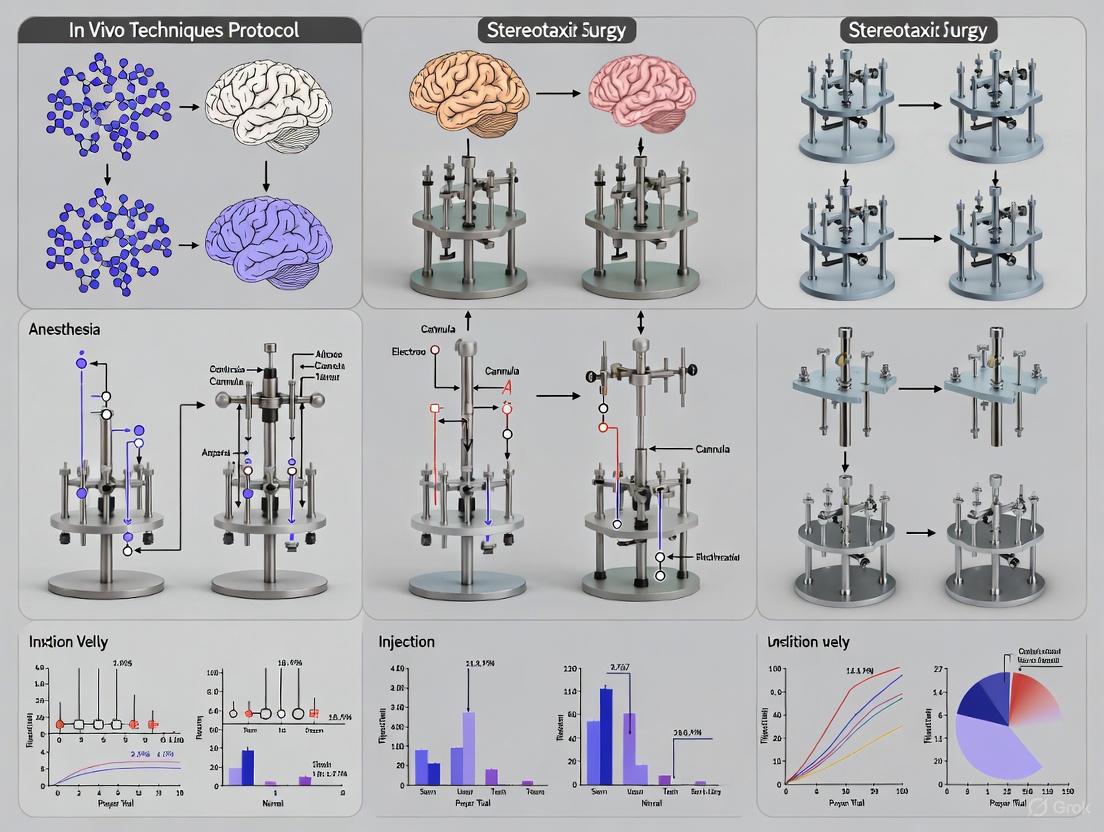
This article provides a comprehensive guide to stereotaxic surgery and in vivo techniques for researchers, scientists, and drug development professionals.
Stereotaxic Surgeries and In Vivo Techniques: A Comprehensive Protocol Guide for Neuroscience Research and Drug Development
Abstract
This article provides a comprehensive guide to stereotaxic surgery and in vivo techniques for researchers, scientists, and drug development professionals. It covers the foundational principles of stereotaxic navigation, detailed methodological protocols for procedures like electrode implantation and viral vector injection, advanced troubleshooting and optimization strategies for improved accuracy and reproducibility, and finally, methods for experimental validation and comparative analysis of techniques. The content is designed to serve as an authoritative resource for planning, executing, and validating precise neuroscientific interventions in preclinical models, thereby enhancing research efficacy and translational potential.
Principles and Evolution of Stereotaxic Surgery: From Historical Frameworks to Modern Neuroscience
Stereotaxy, derived from the Greek words "stereós" (three-dimensional) and "taxis" (position), represents a cornerstone technique in neuroscience and functional neurosurgery that enables precise localization and intervention within the brain using spatial coordinates [1]. The revolutionary concept of accessing deep-seated brain regions without direct surgical exposure has transformed both experimental neuroscience and clinical practice, creating an indispensable bridge between basic research and therapeutic applications. This document traces the remarkable evolution of stereotactic systems from their initial conception in the early 20th century to their current sophisticated implementations, providing researchers and drug development professionals with essential historical context and practical methodological frameworks. The journey from the first mechanical frames to contemporary image-guided systems exemplifies how technological innovation has expanded our capability to interrogate neural circuits and develop targeted neurological therapies with unprecedented precision.
The fundamental principle underlying all stereotactic systems is the creation of a three-dimensional coordinate system that establishes a consistent spatial relationship between external reference points and internal brain structures [1]. This conceptual framework allows researchers and surgeons to accurately navigate to specific targets within the brain despite its complex and variable anatomy. The development of stereotaxy parallels advances in our understanding of brain localization, which began with seminal discoveries by pioneers like Paul Broca, who in 1861 identified the brain area responsible for speech articulation through meticulous clinicopathological correlation [1]. This foundation of cerebral localization, coupled with subsequent breakthroughs in neuroimaging and computational methods, has enabled the precise targeting necessary for both basic neuroscience research and advanced therapeutic interventions.
Historical Evolution of Stereotactic Systems
The Horsley-Clarke Prototype: Birth of a Paradigm
The genesis of stereotactic technology dates to 1906 when British surgeon, anatomist, and physiologist Robert Henry Clarke collaborated with pioneering neurosurgeon Victor Horsley to create the first stereotactic instrument [2]. Designated "Clarke's stereoscopic instrument employed for excitation and electrolysis," this apparatus was constructed in 1905 by instrument maker James Swift in London and was initially used to create minute electrolytic lesions in the central nervous systems of experimental animals [2]. Clarke patented the stereotactic apparatus in 1914 at a cost of 300 pounds, establishing the intellectual property protection for this groundbreaking technology [2].
The original Horsley-Clarke apparatus employed a Cartesian coordinate system based on cranial landmarks (external auditory canals, inferior orbital rims, midline) to establish reproducible relationships with specific brain structures in experimental animals [1]. This three-dimensional reference system enabled researchers to reliably target specific brain regions across subjects, a methodological advancement that fundamentally transformed experimental neuroscience. The mechanical precision of this system allowed for the first time systematic investigation of functional neuroanatomy through localized stimulation and lesioning studies. Two additional instruments were subsequently manufactured by Goodwin and Velacott in London and brought to the United States for animal research, disseminating the technology beyond its British origins [2].
Interestingly, the original Clarke instrument had a circuitous journey after its initial use. It was last employed by Dr. Barrington, a genitourinary surgeon in London, in the early 1950s before subsequently disappearing [2]. Parts were rediscovered by Dr. Hitchcock in 1960, and the complete apparatus was eventually detected by Dr. Merrington in 1970 [2]. This historical artifact now resides at the museum of University College Hospital in London, representing a tangible link to the origins of stereotactic technology [2].
Translation to Human Applications
The adaptation of stereotactic principles for human neurosurgery required significant innovation beyond the original Horsley-Clarke animal apparatus. The first human application of a Horsley-Clarke frame occurred in 1947 when Robert Hayne and Frederic Gibbs utilized the device for depth electroencephalography [3]. This pioneering work paralleled the independent efforts of Ernest Spiegel and Henry Wycis, who are widely credited with establishing human stereotactic surgery as a distinct neurosurgical discipline [1] [3].
Spiegel and Wycis recognized that human stereotactic surgery required a fundamentally different approach than the animal model, specifically needing brain-based landmarks rather than cranial references [1]. Their seminal insight was to utilize intracerebral reference points that could be visualized radiographically, initially employing the pineal gland calcification visible on plain X-ray films [1]. However, they soon abandoned this approach due to significant spatial variability (up to 12 mm in the anteroposterior axis and 16 mm in the interaural axis), which was incompatible with the precision required for stereotactic procedures [1]. Instead, they pioneered the use of lumbar pneumography to visualize the posterior commissure (PC), foramen of Monro (FM), and anterior commissure (AC), defining an imaginary baseline known as the CP-PO line (connecting the center of the PC with the pontomedullary sulcus) for their first human atlas [1].
Table 1: Key Milestones in Early Stereotactic System Development
| Year | Developer(s) | Contribution | Significance |
|---|---|---|---|
| 1906 | Clarke & Horsley | First stereotactic instrument for animal research | Established Cartesian coordinate system for brain targeting [2] |
| 1914 | Clarke | Patent filed for stereotactic apparatus | Formal intellectual property protection for the technology [2] |
| 1947 | Hayne & Gibbs | First human application of Horsley-Clarke frame | Depth electroencephalography in humans [3] |
| 1952 | Spiegel & Wycis | Human-adapted stereotactic apparatus | Transition from cranial to brain landmarks [1] |
| 1950s | Talairach | Proportional grid system & intercommissural line | AC-PC line as standard reference; addressing individual neuroanatomical variation [1] |
| 1959 | Schaltenbrand & Bailey | Detailed human brain atlas | Microscope-based sectional anatomy with coordinate system [1] |
The Atlas Revolution: Cartography for the Brain
The evolution of stereotactic surgery is inextricably linked to the development of detailed brain atlases that provide neuroanatomical roadmaps for targeting. Jean Talairach, a visionary French psychiatrist and neurosurgeon, made monumental contributions to this field through his introduction of the anterior commissure-posterior commissure (AC-PC) line as the standard stereotactic reference system [1]. Talairach's innovative use of combined positive-contrast and air ventriculography enabled reliable visualization of the AC and PC, which maintained consistent spatial relationships with deep brain nuclei targeted in functional procedures [1].
Talairach's most revolutionary insight was the development of a proportional coordinate system that avoided absolute measurements (e.g., millimeters) in favor of subdivided geometric forms outlined by the intercommissural line and the roof of the thalamus [1]. This approach accounted for individual neuroanatomical variation by adapting coordinates along the anteroposterior dimension based on the AC-PC distance, while medio-lateral and cranio-caudal adjustments depended on the overall cerebral cortex size [1]. This proportional system allowed neurosurgeons to reconstruct properly scaled atlas templates directly from patient ventriculograms, creating patient-specific coordinates for stereotactic procedures [1].
The 1959 publication of the Schaltenbrand and Bailey atlas represented another milestone, providing researchers and clinicians with detailed microscope sections of human brain anatomy [1]. While this atlas derived its coordinate system from Talairach's space, it differed fundamentally by employing more rigid measurements based on histological sections without proportional system verification [1]. This atlas presented frontal sections at 4× magnification with scaled transparent overlays, spanning the region from 16.5 mm anterior to 16.5 mm posterior to the midcommissural plane [1]. The tension between patient-specific proportional systems and standardized atlas-based approaches continues to influence contemporary stereotactic methodology, with each approach offering distinct advantages for specific applications.
Modern Stereotactic Systems: Technical Specifications and Applications
Contemporary Stereotactic Apparatus Design
Modern stereotactic systems have evolved considerably from their mechanical predecessors but retain the fundamental principle of creating a stable three-dimensional coordinate system for intracranial navigation. Current systems can be categorized into several distinct architectural approaches, each with specific advantages for particular applications [4].
Table 2: Classification of Modern Stereotactic System Architectures
| System Type | Operating Principle | Applications | Advantages | Limitations |
|---|---|---|---|---|
| Simple Orthogonal | Probe directed perpendicular to square base unit fixed to skull [4] | Basic targeting applications | Mechanical simplicity | Limited trajectory options |
| Burr Hole Mounted | Provides angular freedom with fixed entry point [4] | Deep brain stimulation, biopsy | Minimal invasiveness | Restricted target range |
| Arc-Quadrant | Probes directed perpendicular to tangent of arc rotating vertically and quadrant rotating horizontally [4] | Radiosurgery, precision targeting | Spherical coordinate flexibility | Complex calibration |
| Arc-Phantom | Transferable aiming bow with simulated target [4] | Multi-trajectory procedures, training | Preoperative trajectory verification | Increased setup time |
| Frameless Navigation | Image-guided referencing without rigid frame [5] | Tumor resection, cortical mapping | Enhanced patient comfort | Requires sophisticated tracking |
The emergence of frameless stereotaxy represents a paradigm shift in intracranial navigation technology [5]. This approach leverages sophisticated tracking systems that continuously monitor surgical instrument positions in relation to preoperatively acquired imaging studies, effectively creating a virtual coordinate system without physical frame fixation [5]. The development of frameless systems mirrors advances in nautical navigation, where satellite-based GPS replaced traditional celestial navigation methods [5]. Just as early sailors progressed from visual landmarks to coordinate-based celestial navigation and eventually to satellite triangulation, neurosurgeons have evolved from anatomical landmarks to frame-based coordinates and now to image-guided navigation systems [5].
Stereotactic Radiosurgery: Non-Invasive Intervention
Stereotactic radiosurgery represents a revolutionary application of stereotactic principles that utilizes externally generated ionizing radiation to inactivate or eradicate defined intracranial and spinal targets without surgical incision [4]. This approach requires exceptionally steep dose gradients to maximize target effect while minimizing injury to adjacent normal tissue, with overall treatment accuracy matching planning margins of 1-2 mm or better [4]. The procedure demands multidisciplinary collaboration between radiation oncologists, medical physicists, and radiation therapists to ensure optimal patient outcomes [4].
Commercial stereotactic radiosurgery platforms include the Gamma Knife, CyberKnife, and Novalis Radiosurgery systems, each implementing distinct technical approaches to achieve precise radiation delivery [4]. These systems have established stereotactic radiosurgery as a well-described management option for numerous neurological conditions including metastases, meningiomas, schwannomas, pituitary adenomas, arteriovenous malformations, and trigeminal neuralgia [4]. The fundamental distinction between stereotactic radiosurgery and conventional fractionated radiotherapy lies in their underlying biological mechanisms: radiosurgery aims to destroy target tissue through precise high-dose ablation while fractionated radiotherapy exploits differential radiation sensitivity between target and normal tissues [4].
Experimental Protocols in Preclinical Research
Small Animal Stereotactic Surgery: Fundamental Methodology
Stereotactic surgery in rodent models represents an essential methodology for neuroscience research and therapeutic development, enabling precise intracerebral interventions for studies investigating neurological and psychiatric disorders [6]. The following protocol outlines standardized procedures for electrode implantation and drug delivery in murine models, with specific targeting of hippocampal structures for electrophysiological investigation [7].
Preoperative Preparation and Animal Positioning
- Anesthesia Administration: Administer urethane (1.6 g/kg, intraperitoneal) for stable surgical anesthesia. Supplemental doses (one-tenth initial dose) may be administered as needed based on reflex testing [7].
- Reflex Assessment: Evaluate depth of anesthesia using tail and toe pinch withdrawal reflexes before proceeding with surgical preparation [7].
- Head Positioning: Secure the animal in the stereotaxic frame by inserting ear bars into the auditory canal. Correct positioning is confirmed by observation of the corneal blinking reflex [7].
- Stabilization: Place the incisor bar between upper and lower jaws to maintain stable head position. Retract the tongue laterally using forceps to ensure patent airway [7].
- Surgical Site Preparation: Shave the scalp using an electric razor and prepare the skin with alternating scrubs of isopropyl alcohol and povidone-iodine. Apply ophthalmic ointment and protective eye covering to prevent corneal drying [7].
- Surgical Exposure: Make a midline scalp incision using fine scissors and gently retract skin margins. Remove periosteal connective tissue using a dental scraper to clearly expose cranial sutures [7].
Coordinate Calculation and Target Localization
- Landmark Identification: Use a guide cannula (27-28 gauge) to identify and record coordinates of bregma (intersection of sagittal and coronal sutures) and lambda (intersection of sagittal and lambdoidal sutures) [7].
- Coordinate Validation: Calculate the anterior-posterior (AP) difference between bregma and lambda (AP~Br~ - AP~La~). For a standard adult Wistar rat (290 g), this value should be 9.1 ± 0.3 mm. Significant deviation from this range necessitates application of a correction coefficient to adjust target coordinates [7].
- Target Calculation: For hippocampal targeting, standard coordinates from the Paxinos atlas include Schaffer collaterals (AP: -4.2 mm, ML: +3.8 mm, DV: 2.7-3.8 mm from dura) and CA1 region (AP: -3.4 mm, ML: +1.5 mm, DV: 4.4-5.1 mm from dura) [7]. Apply correction coefficient when necessary using proportional calculation based on actual bregma-lambda distance.
Table 3: Standardized Stereotactic Coordinates for Rodent Hippocampus
| Brain Region | Anterior-Posterior (mm from bregma) | Mediolateral (mm from midline) | Dorsoventral (mm from dura) | Function |
|---|---|---|---|---|
| Schaffer Collaterals | -4.2 | +3.8 | 2.7 - 3.8 | Input pathway to CA1 [7] |
| CA1 Hippocampus | -3.4 | +1.5 | 4.4 - 5.1 | Synaptic plasticity recording [7] |
| Dentate Gyrus | -3.8 | +2.3 | 3.0 - 3.8 | Granule cell layer |
| CA3 Hippocampus | -3.8 | +3.0 | 3.2 - 4.0 | Mossy fiber input |
Surgical Implementation and Electrode Placement
- Craniotomy Procedure: Position guide cannula at calculated coordinates and mark drilling location. Create four pilot holes at corners of marked location using dental micromotor hand drill. Complete craniotomy by removing central bone mass, limiting exposure to 2-3 mm area [7].
- Sinus Preservation: Avoid damage to superior sagittal sinus by maintaining at least 0.5 mm distance from midline longitudinal suture during craniotomy [7].
- Dura Penetration: Gently pierce dura mater using sterile hypodermic needle (small gauge) or specialized hook to facilitate electrode insertion while minimizing cortical damage [7].
- Electrode Implantation: Slowly advance stimulation electrode into brain tissue at controlled rate (1 mm per 10 seconds) until reaching calculated depth target [7].
- Electrode Configuration: For hippocampal recordings, secure bipolar stimulation electrode on right stereotaxic arm positioned at Schaffer collaterals, with recording electrode on left arm angled at 52.5 degrees targeting CA1 region [7].
- Hydration Maintenance: Continuously irrigate exposed dura with saline or artificial cerebrospinal fluid to prevent tissue desiccation during procedure [7].
Figure 1: Workflow for Rodent Stereotactic Surgery. Critical anatomical landmarks (red) and validation steps (green) ensure targeting accuracy.
Targeting Accuracy Assessment: Advanced Imaging Approaches
Traditional assessment of stereotactic targeting accuracy in rodent models has relied exclusively on post-mortem histological verification, an approach with significant limitations including two-dimensional analysis, tissue distortion, and end-point-only evaluation [6]. Contemporary methodologies now incorporate multi-modal imaging for comprehensive three-dimensional assessment of targeting accuracy [6].
Multi-Modal Imaging Protocol
- Pre-operative Baseline: Acquire pre-operative CT (computed tomography) and MRI (magnetic resonance imaging) scans within one week prior to surgical intervention to establish anatomical baseline and facilitate trajectory planning [6].
- Post-operative Verification: For electrode implantation studies, acquire post-operative CT with electrode in situ to document physical device location. Follow with post-operative MRI after electrode removal to visualize electrode trajectory trace and assess potential tissue damage [6].
- Image Co-registration: Fuse multi-modal post-operative images (CT and MRI) through advanced registration algorithms to verify agreement between physical electrode position and reconstructed trajectory [6].
- Spatial Normalization: Co-register individual animal images to standardized stereotaxic template to quantify targeting accuracy in normalized coordinate space [6].
- Three-dimensional Reconstruction: Reconstruct complete electrode trajectory from imaging data to evaluate potential deviations from planned approach angle and depth [6].
- Complication Assessment: Systematically evaluate images for procedure-related adverse effects including intracerebral hemorrhage, vascular damage, or unintended tissue injury along trajectory path [6].
This imaging-based assessment paradigm represents a significant advancement over traditional histological methods by providing comprehensive three-dimensional quantification of targeting accuracy while simultaneously evaluating surgical complications [6]. Implementation of this approach enables early identification of off-target interventions in longitudinal studies, preserving resources by excluding inaccurate placements before initiating extended behavioral or physiological assessments [6].
The Scientist's Toolkit: Essential Research Reagents and Materials
Successful implementation of stereotactic procedures requires meticulous selection of specialized equipment and reagents. The following compilation represents essential components for establishing a robust stereotactic research platform.
Table 4: Essential Research Reagents and Materials for Stereotactic Procedures
| Category | Specific Items | Specifications | Application |
|---|---|---|---|
| Stereotactic Apparatus | Species-specific head holder, micromanipulators, ear bars, incisor bar [7] | Three-dimensional movement (X, Y, Z axes) with vernier scales (0.1 mm precision) | Precise positioning and coordinate implementation |
| Reference Materials | Stereotaxic atlas (species-specific), coordinate calculation software [1] [7] | Digital or print format with standardized coordinate system | Surgical planning and target identification |
| Anesthetic Agents | Urethane, ketamine/xylazine, isoflurane delivery system [7] | Pharmaceutical grade, dose-appropriate formulations | Surgical anesthesia and physiological stability |
| Surgical Instruments | Micro-drill system (dental drill), fine scissors, forceps, retractors, periosteal elevator [7] | Sterilizable micro-instruments | Surgical exposure and cranial access |
| Electrodes | Teflon-coated stainless steel, tungsten, or platinum electrodes [7] | Diameter: 0.125 mm; appropriate coating for recording/stimulation | Neural recording and stimulation |
| Injection Systems | Hamilton syringes, infusion pumps, glass micropipettes [7] | Precision calibration (0.1 µL increments) | Micro-volume drug delivery |
| Imaging Integration | Post-operative CT/MRI capability, image registration software [6] | High-resolution (μm scale) for small animals | Targeting verification and accuracy assessment |
The evolution of stereotactic systems from the mechanical precision of the Horsley-Clarke apparatus to contemporary image-guided platforms represents a remarkable convergence of anatomical knowledge, engineering innovation, and computational advancement. The fundamental principles established a century ago - Cartesian coordinate systems, reproducible referencing to anatomical landmarks, and precise mechanical manipulation - continue to underpin modern stereotactic methodologies despite dramatic transformations in implementation technology.
For contemporary researchers and drug development professionals, understanding this historical continuum provides valuable context for selecting appropriate stereotactic approaches for specific applications. The ongoing tension between standardized atlas-based coordinates and patient-specific proportional systems mirrors the broader challenge in biomedical research between population-based norms and individual variation. Similarly, the emergence of frameless navigation systems represents not an abandonment of core stereotactic principles but rather their translation into virtual coordinate spaces enabled by advanced imaging and tracking technologies.
As stereotactic techniques continue to evolve through integration with robotics, enhanced imaging modalities, and computational modeling, the foundational legacy of Horsley, Clarke, Talairach, and other pioneers remains embedded in contemporary practice. This rich historical foundation, combined with ongoing technological innovation, ensures that stereotaxy will continue to enable unprecedented precision in both experimental neuroscience and clinical therapeutic interventions for the foreseeable future.
In the realm of stereotaxic surgeries and in vivo techniques research, the three-dimensional (3D) Cartesian coordinate system serves as an indispensable framework for precise navigation within biological structures. This system provides a standardized method for defining any point in space using three numerical coordinates—anteroposterior (AP), mediolateral (ML), and dorsoventral (DV)—which represent distances from a defined reference origin along three perpendicular axes [8]. The fundamental principle of stereotaxis involves using this coordinate system to locate specific brain regions with exceptional accuracy, enabling researchers to perform intricate procedures including intracranial injections, electrode implantations, and device placements with minimal tissue damage [9] [10].
The historical development of stereotaxic techniques is deeply intertwined with the evolution of coordinate systems. The pioneering work of Horsley and Clarke in 1908 established the first stereotaxic apparatus for animal research, using external skull landmarks to define their coordinate framework [8] [10]. This foundation was later adapted for human applications by Spiegel and Wycis in 1947, who recognized the limitations of cranial landmarks and transitioned to using intracerebral references visible through radiography, particularly the anterior commissure (AC) and posterior commissure (PC) [8] [10]. This critical advancement paved the way for modern stereotaxic coordinate systems that rely on consistent anatomical relationships rather than variable external landmarks.
Theoretical Framework: Principles of the 3D Cartesian System in Stereotaxis
Core Components and Terminology
The 3D Cartesian coordinate system used in stereotaxic research comprises several essential components, each with specific anatomical correlations:
Origin Point (Zero Point): The reference point from which all measurements originate. In rodent stereotaxic surgery, this is typically bregma (the intersection of the sagittal and coronal sutures) or lambda (the intersection of the sagittal and lambdoid sutures) [9]. For human procedures, the intercommissural line (connecting the anterior and posterior commissures) often serves as the primary reference [8] [10].
Anatomical Planes: The three perpendicular planes that define spatial relationships:
- Sagittal Plane: Divides the brain into left and right portions, corresponding to ML coordinates
- Coronal Plane: Divides the brain into anterior and posterior portions, corresponding to AP coordinates
- Horizontal Plane: Divides the brain into dorsal and ventral portions, corresponding to DV coordinates
Coordinate Conventions: Standardized directional conventions:
- Anteroposterior (AP): Positive values indicate positions anterior to bregma
- Mediolateral (ML): Positive values indicate positions right of the midline
- Dorsoventral (DV): Positive values indicate positions ventral to the brain surface (or dura mater)
The Talairach Coordinate System
A pivotal advancement in human stereotaxic standardization was the proportional system developed by Jean Talairach, which introduced a method to account for individual neuroanatomical variations [10]. Rather than relying solely on absolute measurements, Talairach's system uses the AC-PC line as a reference to create a proportional grid system that normalizes brain dimensions. This system defines:
- The midsagittal plane (determined by the AC, PC, and interhemispheric fissure)
- The horizontal commissural plane (perpendicular to the midsagittal plane passing through AC-PC)
- The vertical coronal plane (perpendicular to both previous planes passing through the AC)
This proportional approach allows for more accurate targeting across individuals with varying brain sizes and represents a fundamental framework for modern human stereotaxic procedures and neuroimaging [8] [10].
Practical Implementation: From Theory to Laboratory Application
Establishing a Level Skull Position
A critical prerequisite for accurate stereotaxic surgery is proper head positioning to ensure coordinate reliability:
Anesthesia and Secure Fixation: The anesthetized animal is positioned in the stereotaxic frame with secure placement of the incisor bar and ear bars to prevent movement [9] [11].
AP Leveling: Using a dissecting microscope, the drill bit is positioned at bregma and the Z-coordinate recorded. The bit is then moved to lambda and the Z-coordinate recorded again. The difference between these measurements should be <0.05 mm for a properly leveled skull [9].
Lateral Leveling: The drill bit is returned to bregma, then moved 2 mm laterally to the left and the Z-coordinate recorded. This process is repeated on the right side. The measurements should be symmetrical, confirming proper lateral alignment [9].
Table 1: Essential Equipment for Stereotaxic Coordinate Procedures
| Equipment Category | Specific Items | Research Function |
|---|---|---|
| Stereotaxic Apparatus | Stereotaxic frame with attachments, drill, probe holder, injection needle holder | Precise positioning and stabilization of the subject's head during procedures |
| Injection Systems | Micro4 injector system, Hamilton Syringe Pump, glass pipettes with picospritzer | Controlled delivery of viruses, drugs, or tracers to targeted brain regions |
| Surgical Instruments | Sterile forceps, small scissors, heostat, surgical clips, scalpel | Surgical exposure of the skull and manipulation of tissues |
| Anesthesia & Analgesia | Isoflurane system, ketamine/xylazine, buprenorphine, ketoprofen | Maintenance of anesthesia and postoperative pain management |
| Skull Preparation | Dental drill with bits, metabond brushes, dental acrylic | Creating access points in the skull and securing implants |
| Imaging & Verification | C-arm X-ray device, MRI compatible markers | Validation of target accuracy and postoperative assessment |
Surgical Workflow for Stereotaxic Procedures
The following workflow outlines a standardized protocol for stereotaxic surgery in research models:
Diagram 1: Stereotaxic Surgical Workflow. Key coordinate-related steps highlighted in green.
Target Coordinate Calculation and Adjustment
The process for determining precise coordinates for specific brain regions involves:
Atlas Consultation: Reference a stereotaxic atlas (e.g., Paxinos for rodents) for approximate coordinates of the target structure relative to bregma [10].
Pilot Studies: Conduct non-survival pilot surgeries to refine coordinates before experimental procedures, significantly improving targeting accuracy [11].
Coordinate Adjustment: Apply appropriate corrections based on individual anatomical variations. The Talairach proportional grid system is particularly valuable for human applications, normalizing for brain size differences [10].
Table 2: Example Stereotaxic Coordinates for Rodent Brain Regions
| Brain Region | Abbreviation | AP (mm from Bregma) | ML (mm from Midline) | DV (mm from Dura) | Application Notes |
|---|---|---|---|---|---|
| Prelimbic Cortex | PreL | +2.0 | ±0.5 | -2.1 | Use angled approaches (10°) for medial structures to avoid sinus [12] |
| Infralimbic Cortex | IL | +1.8 | ±1.0 | -2.95 | Angled approach (10° away from midline) recommended [12] |
| Ventral Hippocampus | vH | -3.0 | ±2.9 | -3.5 | Bilateral injections commonly performed [12] |
| Basolateral Amygdala | BLA | -1.6 | ±3.0 | -4.3 | Deep structure requiring precise depth control [12] |
| Subthalamic Nucleus | STN | -1.8 | ±1.5 | -4.8 | Common target for Parkinson's disease studies [9] |
Advanced Applications and Techniques
Integration with Modern Imaging Technologies
Contemporary stereotaxic procedures increasingly incorporate advanced imaging modalities to enhance precision:
3D Reconstruction from 2D Images: Advanced algorithms can reconstruct 3D coordinate systems from multiple 2D X-ray images, allowing for compatibility between commercial C-arm X-ray devices and stereotaxic navigation systems [13]. The TMPR (Transformation Method from two 2D X-ray Pixel images to a 3D Real-world coordinate) enables the creation of 3D vascular maps from limited-angle X-ray images, facilitating precise control of medical robots in constrained environments [13].
Multi-Modal Image Fusion: Combining different imaging techniques (MRI, CT, CBCT) through voxel-based superposition creates comprehensive 3D models for surgical planning and postoperative verification [14]. This approach allows researchers to quantify translational displacements of bone segments with high reliability (mean error <0.1mm) [14].
Post-mortem Brain Mapping: Custom-built stereotaxic apparatuses enable cutting post-mortem human brains in standardized stereotaxic planes, particularly the Talairach space, facilitating direct correlation between histological findings and in vivo neuroimaging [8].
Specialized Injection and Implantation Techniques
Different experimental objectives require specific procedural adaptations:
Intracranial Injection Protocol:
- Injection System Setup: Load the Hamilton syringe or Micro4 injector with the substance (virus, drug, or tracer) ensuring no air bubbles [9].
- Needle Priming: Lower the needle into a bead of injection fluid on parafilm and use the withdraw function to load the precise volume [9].
- Injection Execution: Lower the needle to the target coordinate and inject at controlled rates (typically 100 nL/min for drugs) [12].
- Diffusion Time: After injection completion, leave the needle in place for 5-10 minutes to allow for adequate diffusion and prevent backflow [12].
- Needle Withdrawal: Slowly retract the needle (over 1-2 minutes) to minimize tissue damage and reflux along the injection tract [12].
Implant Placement Protocol:
- Burr Hole Creation: For larger implants (≥400μm fibers), create a "cloverleaf" pattern by drilling overlapping holes around the target coordinate [9].
- Dura Management: Carefully puncture or retract the dura mater to allow implant passage while minimizing cortical damage [9].
- Anchoring: Place skull screws in the right frontal area (for DBS or electrode arrays) or over the cerebellum (for ground wires) to secure implants [9].
- Fixation: Use Metabond or dental acrylic to firmly anchor the implant to the skull, creating a stable chronic preparation [9].
Troubleshooting and Quality Control
Even with meticulous technique, several factors can compromise stereotaxic accuracy:
Skull Flatness Misalignment: AP or lateral differences >0.05 mm require repositioning the animal in the stereotaxic frame [9].
Bregma/Lambda miscalculation: Always verify bregma coordinates after skull exposure, as the reference point may shift after skin removal [9].
Dura Resistance: Failure to properly puncture the dura can cause deflection of injection needles or implants, resulting in dorsal-ventral targeting errors [9].
Brain Shift and Edema: Minimize cerebrospinal fluid loss and use slow injection rates to reduce tissue displacement [12].
Post-mortem Verification: Always conduct histological verification of target accuracy through perfusion, sectioning, and staining to validate coordinate precision and refine future procedures [11] [8].
The 3D Cartesian coordinate system represents the fundamental framework that enables precise spatial navigation in stereotaxic research. From its historical foundations in the Horsley-Clarke apparatus to modern implementations incorporating advanced neuroimaging and proportional normalization systems, this conceptual framework continues to evolve alongside technological advancements. Mastery of both the theoretical principles and practical implementations of 3D coordinate systems remains essential for researchers conducting stereotaxic procedures, ultimately enhancing experimental reproducibility, reducing animal usage through improved accuracy, and advancing our understanding of brain function through precise intervention and measurement.
The Crucial Role of Brain Atlases and Anatomical Landmarks (Bregma, Lambda)
Stereotaxic surgery is a foundational technique in neuroscience research, enabling precise access to specific brain regions for interventions such as drug delivery, lesioning, and electrode implantation. The technique operates on a 3D Cartesian coordinate system, where anatomical landmarks on the skull serve as critical reference points for navigation [15]. The Bregma, defined as the junction of the coronal and sagittal sutures, and the Lambda, the intersection of the sagittal and lambdoid sutures, are the two most pivotal landmarks used to define the stereotaxic coordinate system [16] [15]. Accurate identification of these points is paramount, as even minor errors in this initial step can propagate, leading to significant target miss and compromised experimental results [15]. This application note details the integral role of modern brain atlases and the rigorous protocols for using cranial landmarks, providing a framework for reproducible and precise stereotaxic surgery within the context of advanced in vivo techniques.
Evolution and Comparison of Brain Atlases
Brain atlases have evolved substantially from traditional 2D plate-based diagrams to sophisticated digital 3D reference frameworks. This transition is critical for supporting contemporary large-scale, high-resolution data generation efforts.
From 2D Plates to 3D Digital Frameworks
Traditional reference atlases, such as the Mouse Brain in Stereotaxic Coordinates (MBSC) by Paxinos and Franklin, were constructed from manually annotated Nissl-stained coronal sections spaced hundreds of micrometers apart [17] [18]. While invaluable, these 2D atlases are limited in their ability to represent continuous 3D brain structures and can present inconsistencies when brain slices are cut at angles different from the reference [17]. The advent of whole-brain imaging techniques necessitated the development of 3D digital atlases, which offer significant advantages for data visualization, integration, and informatics-based workflows [19].
High-Resolution and Multimodal 3D Atlases
Several state-of-the-art 3D atlases now provide unprecedented resolution and integration capabilities:
- The Allen Mouse Brain Common Coordinate Framework (CCFv3): An openly accessible 3D reference atlas constructed as a population average from 1,675 young adult C57BL/6J mice. It provides a cellular-level resolution of 10 μm isotropic voxels and parcellates the entire brain into 43 isocortical areas, 329 subcortical gray matter structures, 81 fiber tracts, and 8 ventricular structures [19].
- The Stereotaxic Topographic Atlas of the Mouse Brain (STAM): A recently developed atlas that leverages a 3D Nissl-stained image dataset with isotropic 1-μm resolution, enabling single-cell resolution localization. It delineates 916 brain structures and allows for the generation of atlas levels at arbitrary angles [17].
- The Duke Mouse Brain Atlas (DMBA): A multiscalar atlas that uniquely combines 3D magnetic resonance histology (MRH) at 15 μm resolution with light sheet microscopy (LSM) of the same brains, all mapped into a stereotaxic space defined by cranial landmarks (Bregma and Lambda) via micro-CT. This corrects geometric distortions common in other atlases [18].
Table 1: Comparison of Modern Mouse Brain 3D Reference Atlases
| Atlas Name | Spatial Resolution | Primary Data Source | Number of Structures | Key Feature |
|---|---|---|---|---|
| CCFv3 [19] | 10 μm isotropic | STPT Autofluorescence (1,675 mice) | 461 structures per hemisphere | Population-average template; openly accessible web portal |
| STAM [17] | 1 μm isotropic | MOST-Nissl Staining | 916 structures total | Single-cell resolution; topography of small nuclei & fibers |
| Duke (DMBA) [18] | 15 μm isotropic (MRH) | MRH & Light Sheet Microscopy (5 mice) | Integrated CCFv3 labels | Stereotaxic space with cranial landmarks; multi-contrast |
Experimental Protocols for Stereotaxic Surgery
Reliable stereotaxic surgery requires meticulous attention to pre-, peri-, and post-operative procedures. The following protocol integrates best practices for ensuring accuracy and animal welfare.
Pre-Surgical Planning and Animal Preparation
- Target Coordinate Determination: Using a reference atlas (e.g., CCFv3 or MBSC), identify the Anteroposterior (AP), Mediolateral (ML), and Dorsoventral (DV) coordinates of your target structure relative to Bregma.
- Anesthesia and Analgesia: Induce anesthesia with an appropriate agent like isoflurane (e.g., 5% for induction, 1-3% for maintenance). Administer pre-operative analgesics (e.g., buprenorphine or meloxicam) subcutaneously for pain management [20].
- Aseptic Setup and Animal Positioning: Perform all procedures in a dedicated surgical area. Sterilize all surgical instruments. Secure the anesthetized animal in the stereotaxic frame using blunt-tipped ear bars. Apply ophthalmic ointment to prevent corneal desiccation [20].
- Active Warming: Place the animal on a thermostatically controlled heating pad throughout the procedure. Maintaining normothermia (∼37°C) is critical, as isoflurane anesthesia induces hypothermia, which can significantly increase mortality and confound results [16] [20].
Landmark Identification and Coordinate Alignment (Critical Step)
- Exposing the Skull: Shave the scalp, clean the skin with alternating iodine scrub and alcohol, and make a midline incision to expose the skull. Gently clear the surface of the skull from connective tissue.
- Locating Bregma and Lambda: Under magnification, identify the Bregma and Lambda landmarks.
- Setting the Coordinate Origin: Lower the tip of the stereotaxic injector/drill bit onto the center of the Bregma point. Set this position as the zero point (AP=0, ML=0, DV=0) for your coordinate system [15].
- Aligning the Head Plane (Flat Skull): Move the tip to the Lambda point. The DV coordinate reading at Lambda should match that at Bregma. If it does not, carefully adjust the angle of the head in the stereotaxic frame until both Bregma and Lambda are in the same horizontal plane [18]. This ensures a level skull position, which is fundamental for the accuracy of all subsequent coordinates derived from the atlas.
Surgical Intervention and Post-Operative Care
- Drilling and Injection/Implantation: Calculate the final target coordinates from Bregma. Move the tool to the AP and ML coordinates and mark the location. Drill a small craniotomy at the marked site. Finally, lower the instrument (e.g., a Hamilton syringe for cell implantation [21] or an electrode for neural stimulation [16]) to the target DV coordinate to perform the procedure.
- Closure and Recovery: After the intervention, suture the skin and administer post-operative analgesics. Place the animal in a warm, clean recovery cage and monitor until it is fully ambulatory. Continue post-operative care and pain management for at least 48-72 hours [20].
Workflow Visualization
The following diagram illustrates the integrated workflow for planning and performing a stereotaxic surgery, highlighting the central role of atlases and anatomical landmarks.
The Scientist's Toolkit: Research Reagent and Material Solutions
Successful stereotaxic surgery relies on a suite of specialized materials and reagents. The following table details essential items for a standard procedure.
Table 2: Essential Materials and Reagents for Stereotaxic Surgery
| Item / Reagent | Function / Application | Key Considerations |
|---|---|---|
| Stereotaxic Frame | Provides rigid, precise 3D positioning of surgical tools. | Must include blunt ear bars and a heating pad adapter [16] [20]. |
| Digital Brain Atlas (CCFv3/STAM) | 3D reference for target coordinate identification and validation. | Prefer 3D, high-resolution atlases over 2D plate-based ones for accuracy [19] [17]. |
| Micro-Drill & Burrs | Creating a craniotomy in the skull for brain access. | Use fine-tipped burrs (< 0.5 mm) to minimize skull damage and brain trauma. |
| Hamilton Syringe | Precise intracerebral delivery of cells, viruses, or drugs. | Essential for creating disease models (e.g., glioblastoma) [21]. |
| Active Warming System | Maintains rodent body temperature at ~37°C during surgery. | Critical for survival; prevents isoflurane-induced hypothermia [16]. |
| Isoflurane Anesthesia System | Induction and maintenance of surgical-plane anesthesia. | Allows for fine control of anesthesia depth and promotes faster recovery. |
| Analgesics (e.g., Buprenorphine) | Pre- and post-operative pain management. | A key ethical and refinement requirement; improves animal welfare and data quality [20]. |
| Antiseptic Solution (Iodine/Chlorhexidine) | Aseptic preparation of the surgical site on the scalp. | Reduces risk of post-surgical infection [20]. |
The fidelity of stereotaxic surgery is fundamentally dependent on the synergistic use of high-precision brain atlases and the correct application of anatomical landmarks. The emergence of cellular-resolution 3D atlases like STAM and integrated multimodal platforms like the Duke Mouse Brain Atlas provides researchers with unprecedented tools for precise spatial targeting. When combined with rigorous surgical protocols—emphasizing aseptic technique, active warming, meticulous landmark identification, and comprehensive pain management—these resources significantly enhance experimental reproducibility, animal welfare, and the reduction of animal numbers, fully aligning with the 3Rs principle. Adherence to these detailed application notes and protocols will empower researchers in neuroscience and drug development to achieve the highest standards of accuracy in their in vivo experiments.
The evolution of stereotactic surgery represents a paradigm shift in neurosurgical and preclinical research, transitioning from macroscopic interventions to procedures that target specific cell populations within deep brain structures. This precision is fundamentally enabled by advances in medical imaging, particularly Magnetic Resonance Imaging (MRI) and Computed Tomography (CT). These technologies provide the three-dimensional coordinate system that guides surgical navigation, allowing researchers and surgeons to approach intracranial targets with sub-millimeter accuracy. The integration of imaging has not only improved the safety and efficacy of clinical procedures for conditions like Parkinson's disease and brain tumors but has also revolutionized the reproducibility and design of in vivo experiments in animal models. This application note details the critical technological drivers behind imaging-guided precision, providing structured data comparisons and detailed protocols tailored for the research and drug development community working within the context of stereotactic surgeries and in vivo techniques.
Core Imaging Technologies and Their Impact
The precision of modern stereotactic procedures is inextricably linked to the capabilities of imaging modalities. MRI and CT serve distinct, complementary roles in surgical planning and execution.
Magnetic Resonance Imaging (MRI)
MRI provides unparalleled soft-tissue contrast, enabling direct visualization of anatomical structures and pathological targets. In stereotactic neurosurgery, MRI is used to create a 3D map of the brain, which is integrated with a coordinate system to guide the surgeon to the exact location for the procedure [22]. For functional neurosurgery, specialized sequences such as T2-weighted images and modified proton-density images are crucial for visualizing critical deep brain structures like the subthalamic nucleus and the globus pallidus [23].
A key challenge with MRI is geometric distortion caused by magnetic field inhomogeneities. However, modern scanners incorporate software correction algorithms that can achieve geometric fidelity in the sub-voxel range, making MRI a reliable tool for precise targeting. To minimize distortion, the surgical target should be positioned at the center of the magnetic bore, where field inhomogeneity is lowest [23].
Computed Tomography (CT)
CT imaging excels in providing geometrically accurate representations of cranial anatomy without the distortion risks associated with MRI. It offers superior visualization of bony structures, making it invaluable for calculating trajectories that avoid vasculature and sensitive anatomical regions [23]. In frameless stereotactic systems, the fusion of pre-operative MRI with intra-operative CT provides a powerful combination: the high soft-tissue contrast of MRI with the geometric precision of CT [24]. This fusion process, known as image registration, aligns the coordinate systems of different medical images, creating a comprehensive roadmap for navigation [24].
Table 1: Comparative Analysis of Key Imaging Modalities in Stereotactic Surgery
| Feature | Magnetic Resonance Imaging (MRI) | Computed Tomography (CT) |
|---|---|---|
| Primary Strength | Excellent soft-tissue contrast [22] | Superior geometric accuracy, no image distortion [23] |
| Key Applications | Direct target visualization (e.g., subthalamic nucleus), tumor/lesion delineation [22] [23] | Anatomical localization, trajectory planning, fusion with MRI for frameless systems [24] [23] |
| Inherent Limitations | Potential for geometric distortion [23] | Poor soft-tissue resolution compared to MRI [23] |
| Mitigation Strategies | Distortion correction software, centering target in magnetic bore [23] | Image fusion with MRI (registration) [24] |
| Common in Preclinical Research | Yes (for target planning) | Less common |
Quantitative Impact on Surgical Precision
Imaging technology directly dictates the achievable precision in stereotactic procedures. A comparative study on deep brain stimulation (DBS) revealed a significant difference in targeting error between frame-based and frameless (mini-frame) techniques, a difference attributable to the integration of imaging with the stereotactic platform. The frame-based technique, which tightly couples imaging fiducials to the surgical arc, demonstrated a targeting error of 1.2 ± 0.6 mm, whereas the mini-frame technique resulted in an error of 2.5 ± 1.4 mm [23]. This data underscores that the choice of imaging-integrated surgical system is a critical determinant of procedural accuracy.
Table 2: Impact of Surgical Technique on Stereotactic Precision
| Stereotactic Technique | Description | Typical Targeting Error | Key Technological Drivers |
|---|---|---|---|
| Frame-Based | A rigid frame is fixed to the patient's head; fiducials create a coordinate system on imaging [25]. | 1.2 ± 0.6 mm [23] | Arc-centered engineering principle; MRI/CT fiducial localization [23]. |
| Frameless/Mini-Frame | A smaller base is fixed to the skull; navigation relies on image registration and optical tracking [23]. | 2.5 ± 1.4 mm [23] | Pre-operative MRI/CT fused with intra-operative CT; surface registration [24] [23]. |
| Robotic-Assisted | A robotic arm positions surgical tools along a pre-planned trajectory [24]. | Potentially sub-millimeter (preclinical data) | AI-driven planning; real-time imaging feedback; robot control algorithms [24] [26]. |
Detailed Experimental Protocols
Protocol 1: Clinical Stereotactic Procedure for Deep Brain Stimulation (DBS)
This protocol outlines the key steps for a frame-based stereotactic procedure, such as DBS electrode implantation, highlighting the integral role of imaging at each stage [22] [25] [23].
Workflow Overview
Materials and Reagents
Table 3: Research Reagent Solutions and Essential Materials for Stereotactic Surgery
| Item | Function/Application | Example/Note |
|---|---|---|
| Stereotactic Frame | Provides a rigid 3D coordinate system fixed to the skull [25]. | Leksell, CRW frames; used with torque wrench for application [23]. |
| Contrast Agent | Enhances vascular visualization on MRI/CT to avoid vessel damage [23]. | Gadolinium-based contrast agents (GBCAs) e.g., Gadobutrol (Gadovist) [27]. |
| Microelectrode | Records neuronal activity to physiologically verify the anatomical target [25] [23]. | Used for microelectrode recording (MER) in functional procedures [25]. |
| MRI-Compatible Head Frame | Allows MRI scanning with the frame in place for accurate registration. | Must use insulated posts in high-field MR to prevent pin site overheating [23]. |
Procedure
- Frame Application: The stereotactic head frame is applied under local anesthesia. The frame must be firmly secured to the skull to prevent movement between imaging and surgery, but over-tightening must be avoided to prevent skull penetration [25] [23].
- Image Acquisition:
- An indicator box (fiducial system) is attached to the head frame, and the patient undergoes MRI or CT scanning [25].
- The surgeon must supervise image acquisition. Sequences should be optimized for the target (e.g., T2-weighted for subthalamic nucleus). The use of contrast media is recommended to highlight vasculature [23].
- The axes of the frame should be aligned with the scanner planes to ensure accurate geometric reproduction [23].
- Surgical Planning:
- The 3D images are transferred to a planning station. The fiducial markers on the images are registered to define the stereotactic space [22].
- The target (e.g., subthalamic nucleus) is directly visualized or indirectly defined using an atlas. The surgical trajectory is planned to avoid vessels and critical structures [23].
- Target Verification and Intervention:
- In the operating room, a targeting arc is attached to the head frame. A burr hole is made, and a probe is directed to the target [25].
- For functional procedures, microelectrode recording (MER) is often used to verify the target based on characteristic neuronal firing patterns [25] [23].
- Once confirmed, the therapeutic intervention (e.g., lesion creation or DBS electrode implantation) is performed [25].
Protocol 2: Preclinical Stereotaxic Intracranial Injection in Rodents
This protocol is adapted for in vivo research, such as intracranial injection of viruses or drugs in mice or rats, crucial for disease modeling and drug development [28] [29].
Workflow Overview
Materials and Reagents
- Animals: Adult Wistar rats or C57BL/6 mice.
- Anesthetic: Ketamine (90 mg/kg) and Xylazine (5 mg/kg) for intraperitoneal (i.p.) injection [29].
- Stereotaxic Apparatus: A digital stereotaxic device (e.g., from Stoelting) with ear bars and a nose clamp [29].
- Injection System: Hamilton microsyringe (e.g., 1-μL volume) for precise delivery [29].
- Stereotaxic Atlas: e.g., Paxinos and Watson rat brain atlas, for determining coordinates relative to Bregma [29].
- Test Substance: e.g., dissolved in an appropriate vehicle. For water-insoluble compounds like betulin, a lipid-based vehicle (e.g., olive oil) can be used [30].
Procedure
- Anesthesia and Positioning: Anesthetize the rodent via i.p. injection and firmly fix the head in the stereotaxic device. Ensure the skull is level [29].
- Incision and Landmark Identification: Make a midline scalp incision, retract the skin, and clean the skull. Locate the Bregma point (the junction of the coronal and sagittal sutures) [29].
- Coordinate Calculation: Using the stereotaxic atlas, calculate the Anterior-Posterior (AP) and Medial-Lateral (ML) coordinates relative to Bregma. The Dorsal-Ventral (DV) coordinate is measured from the skull surface. Example coordinates for rat hippocampal CA1 injection: AP: -3.8 mm, ML: ±3.2 mm, DV: -2.7 mm from Bregma [29].
- Drilling and Injection:
- Drill a small burr hole at the calculated (AP, ML) coordinates.
- Lower the Hamilton syringe to the target DV coordinate.
- Infuse the solution slowly (e.g., over 60 seconds per microliter) to allow for tissue diffusion and minimize backflow [29].
- Closure: After the injection, leave the needle in place for 1-2 minutes before slowly retracting it. Suture the incision and place the animal in a warm, clean cage for recovery.
The fusion of imaging with robotics and artificial intelligence (AI) represents the next frontier in surgical precision. The stereotactic surgery devices market, projected to grow from USD 28.54 billion in 2025 to USD 42.66 billion by 2035, is being driven by these technological integrations [26]. AI-powered segmentation tools, such as the U-Net architecture and foundation models like MedSAM, are enabling automatic, robust identification of anatomical structures and targets from MRI and CT scans [24]. Furthermore, surgical robots are emerging as high-precision stereotactic instruments, capable of executing pre-planned trajectories with sub-millimeter accuracy, guided by real-time imaging [24] [23]. The future will see tighter integration of real-time imaging, AI-based planning, and robotic execution, creating a closed-loop system that further enhances the precision, safety, and efficacy of stereotactic procedures in both clinical and research settings. For researchers, this translates to more reliable disease models and higher fidelity in evaluating novel therapeutic interventions.
Stereotaxic surgery represents a cornerstone technique in modern neuroscience and preclinical drug development, enabling precise access to specific brain regions in live animal models [31]. The core principle involves using a standardized three-dimensional coordinate system to navigate and manipulate deep brain structures with sub-millimeter accuracy [32]. This platform technology has evolved far beyond its initial neuroscientific applications, expanding into sophisticated targeted therapeutic delivery and neuromodulation across multiple disease models. The integration of advanced imaging and computational tools has transformed traditional stereotaxic procedures into highly refined methodologies capable of addressing complex research questions in neurology, oncology, and metabolic disorders [32] [33].
The fundamental requirement for successful stereotaxic intervention lies in establishing a reliable coordinate framework. As detailed in the AtlasGuide software methodology, this process typically involves identifying cranial landmarks (bregma and lambda) to create a reference plane, then applying spatial normalization to align experimental subjects with standardized brain atlases [32]. This coordinate system enables researchers to target diverse brain structures—from the subthalamic nucleus for deep brain stimulation studies to specific cortical layers for targeted drug delivery—with consistent precision across experimental cohorts [9] [12]. The development of 3D atlas systems has further enhanced this precision by allowing for oblique trajectory planning and virtual simulation of intervention paths before physical execution [32].
Application Note 1: Deep Brain Stimulation (DBS) in Parkinsonian Mouse Models
Protocol: Surgical Implantation of DBS Electrodes
This protocol adapts clinical deep brain stimulation principles for preclinical research using mouse models of Parkinson's disease, enabling investigation of neural circuit mechanisms and therapeutic optimization [9].
Materials:
- Anesthetics: Ketamine/Xylazine (40/10 mg/kg) or Isoflurane (1.5-2% for maintenance)
- Analgesics: Buprenorphine (0.05-0.1 mg/kg) and Ketoprofen (5 mg/kg)
- Stereotaxic frame with electrode holders
- Heating pad for physiological maintenance
- Drill with 0.5-1.0 mm burrs
- DBS electrode (customized for murine applications)
- Skull screw for ground connection
- Dental acrylic (Metabond or equivalent) for securement
Methodology:
Anesthesia and Stabilization: Induce anesthesia using Ketamine/Xylazine injection or isoflurane inhalation (4% for induction, 1.5-2.0% for maintenance). Secure the mouse in the stereotaxic frame using ear bars and bite block, ensuring stable head fixation without compromising airway patency. Apply ophthalmic ointment to prevent corneal desiccation [9] [12].
Surgical Exposure: Remove hair from the surgical site using depilatory cream, then prepare the scalp with alternating betadine and 70% ethanol scrubs (3 cycles each). Execute a midline incision extending from the frontal to occipital bone, then retract the skin using surgical clips or sutures to expose the skull surface [9].
Coordinate Mapping: Precisely identify the bregma and lambda sutures under surgical microscopy. Adjust the head position until the height difference between these landmarks is <0.05 mm, ensuring a horizontal skull orientation. Record the dorsoventral (DV) coordinate at bregma as the zero reference point [9] [32].
Craniotomy and Electrode Implantation:
- Target the subthalamic nucleus (STN) using stereotaxic coordinates relative to bregma: AP -2.0 mm, ML +1.8 mm, DV -4.6 mm [9].
- Perform a "cloverleaf" craniotomy by drilling a primary hole at the target coordinates, then creating four overlapping holes 0.2 mm in each cardinal direction to accommodate the electrode assembly.
- Carefully puncture the dura mater using a bent 32G needle to facilitate electrode passage.
- Slowly lower the DBS electrode to the target depth at a rate of 0.1 mm/10 seconds to minimize tissue displacement.
- Install a skull screw in the right frontal bone to serve as a ground connection [9].
Securement and Closure: Secure the electrode assembly to the skull using multiple layers of dental acrylic, ensuring robust adhesion without thermal damage to underlying tissues. Close the surgical incision with interrupted sutures or tissue adhesive [9].
Postoperative Care: Administer analgesic therapy (buprenorphine every 8-12 hours for 48 hours) and monitor recovery in a thermoregulated environment until ambulatory. Allow 7-10 days for surgical recovery before initiating stimulation protocols [9].
Table 1: Stereotaxic Coordinates for Common DBS Targets in Mice
| Brain Structure | Anteroposterior (AP) | Mediolateral (ML) | Dorsoventral (DV) | Clinical Relevance |
|---|---|---|---|---|
| Subthalamic Nucleus | -2.0 mm | +1.8 mm | -4.6 mm | Parkinson's Disease |
| Globus Pallidus | -0.5 mm | +2.0 mm | -3.8 mm | Dystonia, Parkinson's |
| Ventral Intermediate | -1.8 mm | +1.2 mm | -3.2 mm | Essential Tremor |
| Nucleus Accumbens | +1.5 mm | +1.0 mm | -4.2 mm | OCD, Depression |
Data Analysis and Therapeutic Validation
Quantitative assessment of DBS efficacy in Parkinsonian models involves multimodal behavioral and electrophysiological measures. The therapeutic disruption of movement-related subthalamic nucleus activity serves as a key indicator of successful intervention [9].
Table 2: Quantitative Assessment of DBS Efficacy in Parkinsonian Mice
| Parameter | Pre-DBS Mean | Post-DBS Mean | Change (%) | Measurement Technique |
|---|---|---|---|---|
| Locomotor Activity | 12.5 ± 3.2 beam breaks/min | 28.7 ± 4.1 beam breaks/min | +129.6% | Open Field Test |
| Tremor Amplitude | 2.34 ± 0.41 mV | 0.87 ± 0.19 mV | -62.8% | Electromyography |
| Bradykinesia Score | 7.2 ± 1.1 (au) | 3.1 ± 0.7 (au) | -56.9% | Forelimb Akinesia Test |
| Neural Entropy | 0.18 ± 0.03 | 0.29 ± 0.04 | +61.1% | Local Field Potential |
Diagram 1: DBS Experimental Workflow
Application Note 2: Targeted CNS Drug Delivery Systems
Protocol: Intracranial Injection of Nanocarrier-Based Therapeutics
This protocol describes precise intracerebral administration of advanced drug delivery systems for pre-clinical evaluation of CNS-targeted therapeutics, incorporating nanosuspensions and lipid-based carriers to overcome biological barriers [34] [12].
Materials:
- Test articles: Drug nanosuspensions (10-20% w/v), lipid nanoparticles, or viral vectors
- Injection apparatus: Hamilton syringe (5-10 μL) or Micro4 injector system with 33-gauge needle
- Surgical supplies: Sterile swabs, betadine, 70% ethanol, sutures
- Anesthetic system: Isoflurane delivery apparatus with precision vaporizer
- Stereotaxic stabilization platform
Methodology:
Pharmaceutical Preparation: For nanosuspension formulations, implement wet media milling with Zirconia beads to achieve target particle size (D90 < 200 nm). Stabilize with appropriate surfactants (e.g., 0.1-0.5% polysorbate 80) [34]. For viral vectors (AAV, lentivirus), thaw aliquots on ice and dilute to desired titer (typically 10¹²-10¹³ GC/mL) in sterile saline [9].
Surgical Preparation: Anesthetize the subject using isoflurane (4% induction, 1.5% maintenance) and secure in the stereotaxic apparatus. Perform scalp preparation and craniotomy as described in Section 2.1, steps 2-3 [9] [12].
Injection System Priming: Load the test article into the injection syringe, ensuring elimination of air bubbles. Pre-wet the needle by aspirating 200 nL of formulation to coat the internal surface, then expel a small droplet to verify patency [9].
Targeted Infusion:
- Navigate the injection needle to the target coordinates (e.g., striatum: AP +0.5 mm, ML +2.0 mm, DV -3.0 mm).
- Lower the needle to the target depth at 0.1 mm/sec to minimize tissue damage.
- Initiate infusion at 100 nL/min for a total volume of 200-500 nL, depending on target structure and formulation properties.
- Upon completion, pause for 5-10 minutes to allow for tissue diffusion and prevent backflow along the needle track [12].
System Removal and Recovery: Withdraw the needle slowly (0.05 mm/sec) to minimize reflux. Close the surgical site and monitor recovery as described in Section 2.1, step 6 [9].
Advanced Formulation Strategies for CNS Delivery
The blood-brain barrier represents a significant challenge for systemic CNS drug delivery, necessitating advanced formulation approaches. Nanosuspensions provide enhanced bioavailability for hydrophobic compounds (BCS Class II) through increased saturation solubility and adhesion to gastrointestinal mucosa when administered systemically [34]. For direct CNS delivery, lipid nanoparticles and viral vectors enable sustained release and genetic manipulation, respectively.
Table 3: Performance Metrics of Advanced CNS Delivery Systems
| Delivery Platform | Encapsulation Efficiency | Brain Bioavailability | Release Duration | Therapeutic Cargo |
|---|---|---|---|---|
| Polymeric Nanoparticles | 82.5 ± 5.3% | 3.2 ± 0.8% ID/g | 5-7 days | Small Molecules, Peptides |
| Lipid Nanoparticles (LNPs) | 95.1 ± 2.7% | 5.7 ± 1.2% ID/g | 2-4 days | Nucleic Acids, siRNA |
| Adeno-Associated Virus | N/A | 12.3 ± 3.1% ID/g | 3-6 weeks | Genetic Material |
| Nanosuspensions | N/A | 2.8 ± 0.6% ID/g | 1-3 days | Small Molecules |
Diagram 2: Drug Formulation Development
Integrated Experimental Design: Combining DBS and Targeted Delivery
The convergence of neuromodulation and targeted drug delivery enables innovative therapeutic strategies for complex neurological disorders. Integrated experimental designs might combine DBS with localized delivery of neurotrophic factors or circuit-specific neuromodulators to achieve synergistic effects [9] [12].
Table 4: Quantitative Framework for Combined Therapy Assessment
| Experimental Group | Therapeutic Outcome | Molecular Biomarkers | Circuit Function | Behavioral Recovery |
|---|---|---|---|---|
| DBS Alone | 47.2% improvement | BDNF: +35.2% | Theta Power: +28.7% | 52.8% of baseline |
| Targeted Delivery Alone | 38.7% improvement | c-Fos: +41.8% | Gamma Sync: +19.3% | 44.1% of baseline |
| Combined Therapy | 82.5% improvement | BDNF: +73.4%, c-Fos: +69.5% | Theta-Gamma Coupling: +52.6% | 89.3% of baseline |
| Control | 5.3% change | BDNF: +2.1%, c-Fos: -1.7% | Oscillatory Power: -3.2% | 7.4% of baseline |
The Scientist's Toolkit: Essential Research Reagents and Materials
Table 5: Essential Research Reagents for Stereotaxic Surgery and In Vivo Applications
| Reagent/Material | Function/Application | Example Specifications |
|---|---|---|
| Ketamine/Xylazine | Surgical anesthesia | 40/10 mg/kg IP injection [9] |
| Isoflurane | Inhalation anesthesia | 4% induction, 1.5-2% maintenance [12] |
| Buprenorphine | Post-operative analgesia | 0.05-0.1 mg/kg SQ q8-12h [9] |
| Betadine Solution | Surgical site antisepsis | 7.5% povidone-iodine [9] |
| Metabond/Dental Acrylic | Cranial implant securement | Dental cement with catalyst [9] |
| AAV Vectors | CNS gene delivery | Serotype 1-9, 10¹²-10¹³ GC/mL [9] |
| Drug Nanosuspensions | Poorly soluble drug delivery | D90 < 200 nm, 10-20% drug load [34] |
| Hamilton Syringes | Precise intracerebral injection | 5-10 μL volume, 33-gauge needle [12] |
| STE Buffer | Genomic DNA isolation | 0.1 M NaCl, 0.01 M Tris-HCl, 1 mM EDTA [33] |
Stereotaxic platforms continue to evolve with advancements in imaging guidance, delivery technologies, and analytical methods. The integration of 3D atlas systems with real-time surgical navigation has significantly improved targeting precision, while novel biomaterials and formulation strategies have expanded the therapeutic window for CNS interventions [32] [34]. These methodologies provide essential bridges between basic neuroscience discovery and clinical therapeutic development, enabling rigorous preclinical validation of novel neuromodulation approaches and targeted delivery systems.
Step-by-Step Stereotaxic Protocols: Electrode Implantation, Viral Injection, and Cannula Placement
Stereotaxic surgery is a foundational methodology in modern neuroscience research, enabling precise access to specific brain regions in live animals for interventions such as drug microinfusion, device implantation, and neuronal recording [11]. The reliability of the resulting scientific data is profoundly influenced by the quality of the pre-surgical preparation. Meticulous attention to anesthesia, animal positioning, and sterile technique is not merely a procedural formality but a critical determinant of both animal welfare and experimental success. These practices directly impact postoperative recovery, minimize infectious complications, and enhance the precision of targeting brain structures, thereby reducing the number of animals required by preventing experimental attrition [11] [35]. This protocol details the essential pre-surgical steps, framed within the broader context of in vivo techniques and the ethical imperative of the 3Rs (Replacement, Reduction, and Refinement) [11] [35].
Pre-Surgical Planning and Animal Preparation
Animal Health Assessment and Preprocedural Planning
A comprehensive preprocedural plan is the cornerstone of a successful stereotaxic experiment. Before initiating any surgery, a confirmatory study must be designed with rigorous statistical power, adequate sample size, and proper randomization to ensure the generation of valid and reproducible data [36].
Crucially, each animal must undergo a thorough clinical examination to ensure it is in good health on the day before and the day of surgery [37]. This examination involves checking the animal's appearance and analyzing its general behavior. Animals should be immediately excluded from the procedure if they show any of the following signs: reduced appetite or weight loss; deficits in normal exploratory behavior; hyperresponsiveness to handling; vocalization; self-mutilation; prostration; the presence of bite marks or scratches; or patchy, dull, and/or ruffled fur [37]. Any such observations must be documented in the animal's follow-up register and reported to the veterinarian [37].
Table 1: Key Considerations for Pre-Surgical Planning
| Planning Aspect | Key Considerations |
|---|---|
| Study Design | Develop a confirmatory study with statistical validation, proper randomization, and appropriate sample size to ensure reproducibility and meaningful results [36]. |
| Animal Model Selection | Choose based on a thorough literature review to identify the model with the greatest anatomical and physiological similarities to the human condition for the research question [35]. |
| Health Assessment | Conduct immediately before surgery. Exclude animals showing signs of illness, stress, or abnormal behavior to avoid confounding experimental results [37]. |
| Pre-surgical Fasting | Unlike in human surgery, rats should not be subject to food restriction before a stereotaxic procedure [11]. |
| Weight Measurement | Weigh the animal carefully for accurate adjustment of anesthesia dosage and use as a baseline for post-surgical monitoring [11]. |
Anesthesia and Analgesia Protocols
Effective anesthesia and pre-emptive analgesia are critical for animal welfare and for maintaining a stable physiological state throughout the surgical procedure. Protocols have evolved to improve safety and pain management.
Table 2: Evolution of Anesthesia Protocols for Rat Stereotaxic Surgery
| Time Period | Anesthesia Protocol | Key Components and Notes |
|---|---|---|
| 1992-1999 | Intraperitoneal (i.p.) injection | Diazepam (5 mg/kg) followed by Ketamine (100 mg/kg) [11]. |
| 1999-2006 | Intraperitoneal (i.p.) injection | Sodium Pentobarbital (50 mg/kg) supplemented with Atropine Sulfate (0.4 mg/kg) to suppress salivation and bronchial secretions [11]. |
| 2006-Present | Refined protocols | Continued refinement of anesthesia agents, with a focus on improved safety and analgesic components [11]. |
The implementation of presurgical analgesia is a key refinement. To mitigate postoperative pain, a subcutaneous injection of a local anesthetic should be administered on each side of the planned incision line before making the skin cut [37].
Surgical Asepsis and Space Organization
Maintaining asepsis is a fundamental requirement to prevent postoperative infections that can compromise animal well-being and experimental outcomes. A coherent organization of the surgical space is crucial for limiting the risk of breaking the chain of asepsis [37]. The principle of a forward-moving operational workflow (the "go-forward principle") should be implemented to separate clean and dirty activities [11] [37].
The following diagram illustrates the recommended workflow for organizing the surgical environment to maintain asepsis.
Animal Positioning in the Stereotaxic Frame
Correct positioning of the animal's head in the stereotaxic apparatus is paramount for achieving reproducible and accurate targeting of brain structures.
- Transfer: After preparation in the "dirty" zone, the anesthetized animal is moved to the "clean" surgical zone and placed on a thermostatically controlled heating blanket to maintain normal body temperature throughout the procedure [11].
- Head Fixation: The head is securely fixed into the stereotaxic frame by positioning it between the ear bars and the incisor/nose bar.
- Ear Bar Placement: Blunt-tipped ear bars should be used. Accurate positioning is confirmed by 1) observing a blink of the eyelids as the bars gently enter the external auditory canal, and 2) systematically using the scale on the bars to monitor their progression and final position [11].
- Eye Care: Apply a sterile ophthalmic ointment to both eyes to protect the corneas from desiccation during surgery [11].
- Head Orientation: Ensure the skull is leveled precisely. The stability and symmetry of the head should be checked before proceeding. The head should not tilt or move when lightly touched.
The Scientist's Toolkit: Essential Materials and Reagents
Table 3: Key Research Reagent Solutions for Pre-Surgical Preparation
| Item | Function / Application |
|---|---|
| Ketamine / Xylazine | Anesthetic combination used for inducing and maintaining surgical anesthesia in rodents [29]. |
| Local Anesthetic (e.g., Lidocaine) | Injected subcutaneously at the incision site for pre-emptive analgesia to reduce postoperative pain [37]. |
| Iodine-based Solution (e.g., Vetedine Solution) | Used for surgical scrubbing and disinfection of the skin prior to incision [11]. |
| Chlorhexidine-based Soap (e.g., Hibitane) | Alternative antiseptic for surgical scrubbing and disinfection [11]. |
| Ophthalmic Ointment | Protects the cornea from desiccation during anesthesia [11]. |
| Sterile Surgical Instruments | Scalpels, forceps, retractors, scissors, and needle holders for performing the procedure [37]. |
| Sterile Drums & Autoclave | For heat-sterilization (170°C for 30 min) and storage of surgical drapes, gowns, and instruments [11] [37]. |
| Disinfectant Wipes | For cleaning non-sterilizable components of the stereotaxic frame (e.g., ear bars, incisor bar) between animals [11]. |
Step-by-Step Experimental Protocol
Pre-Anesthesia and Animal Preparation
- Health Check: Perform a final clinical examination of the animal to confirm good health status.
- Weigh: Accurately measure the animal's body weight.
- Anesthetize: Administer the pre-defined anesthetic regimen via intraperitoneal injection at the calculated dosage. Ensure the animal is fully anesthetized by confirming the absence of pedal and other reflex responses.
- Prepare: In the "dirty" zone, shave the fur from the top of the head. Clean the paws and tail with an iodine or chlorhexidine scrub solution [11].
Surgical Site Preparation and Animal Positioning
- Position Animal: Transfer the animal to the "clean" zone and place it on a heating pad. Gently secure the head in the stereotaxic frame using ear bars and an incisor bar, verifying correct and stable positioning [11].
- Apply Eye Ointment: Administer ophthalmic ointment to both eyes.
- Disinfect Skull: Scrub the top of the head with an iodine foaming solution or chlorhexidine-based soap, then rinse with sterile water. Apply iodine solution or chlorhexidine solution and allow it to dry [11].
- Administer Local Analgesic: Inject local anesthetic subcutaneously on both sides of the intended incision line [37].
- Create Sterile Field: The surgeon performs a surgical hand wash, dons a sterile gown, mask, and gloves. A sterile drape is then placed to create the operating field, with sterile instruments arranged for use.
Sterilization Methods for Surgical Equipment
Two primary methods are employed for sterilizing surgical equipment, each suitable for different materials. The following chart outlines the decision process for selecting and applying these methods.
The pre-surgical phase of stereotaxic surgery, encompassing meticulous planning, reliable anesthesia, precise positioning, and uncompromising sterile technique, is not a prelude but the foundation of the entire experiment. Adherence to the detailed protocols outlined in this document—from the organization of the surgical space and the administration of analgesics to the rigorous sterilization of equipment—directly enhances animal welfare, minimizes experimental variables, and ensures the integrity and reproducibility of the scientific data collected. By integrating these refined practices into their work, researchers uphold the highest ethical standards of the 3Rs while simultaneously advancing the rigor and reliability of neuroscience research.
Stereotaxic surgery is a foundational technique in modern neuroscience research, enabling precise intracranial injections and implant placements in specific brain regions of animal models [9]. The success of these procedures, which are crucial for fields like optogenetics, electrophysiology, and drug development, fundamentally depends on the accuracy of targeting [7]. Standard stereotaxic atlases provide three-dimensional coordinates based on skull reference points like bregma and lambda. However, a significant challenge arises from individual anatomical variability due to factors such as age, body weight, gender, and species strain [38]. This variability means that atlas-derived coordinates alone are often insufficient for precise targeting, potentially compromising experimental outcomes and reproducibility.
The application of a correction coefficient (CC) is a critical methodological advance that addresses this challenge. It adjusts standard atlas coordinates to account for the unique cranial dimensions of each subject, thereby improving targeting accuracy. This protocol details the methodology for calculating and applying this coefficient, a technique particularly valuable in laboratories without access to advanced intraoperative imaging [7] [38]. Furthermore, within the evolving regulatory landscape—where the FDA is actively promoting New Approach Methodologies (NAMs) to reduce animal testing—employing such refined surgical techniques aligns with the principles of the 3Rs (Replace, Reduce, Refine) by enhancing data quality and potentially reducing the number of animals needed due to failed experiments [39] [40].
Core Methodology: Calculating the Correction Coefficient
The following section provides a detailed, step-by-step protocol for determining the individual correction coefficient for a rodent subject, based on the method described by [7].
Experimental Protocol
- Animal Preparation: Anesthetize the animal according to your institutional approved protocol (e.g., intraperitoneal injection of urethane or inhaled isoflurane) and secure it in the stereotaxic frame. Ensure the head is stable and level. Shave the scalp, make a midline incision, and clear the skull surface of connective tissue to clearly expose the bregma (the intersection of the sagittal and coronal sutures) and lambda (the intersection of the sagittal and lambdoidal sutures) [9] [7].
- Skull Flatness Verification: Before calculating the CC, you must ensure the skull is flat in both the anterior-posterior (AP) and mediolateral (ML) planes.
- Lower a sterile drill bit or guide cannula onto bregma and record the dorsoventral (DV) coordinate.
- Move the tool to lambda and record the DV coordinate.
- The difference between these two Z-coordinates should be < 0.05 mm. If it is greater, adjust the animal's position in the ear bars or the bite bar height and repeat until the skull is flat [9].
- Measurement and Calculation:
- Using the stereotaxic manipulator, position a guide cannula (gauge 27 or 28) precisely at bregma. Record the AP coordinate (APBr).
- Move the cannula to lambda. Record the AP coordinate (APLa).
- Calculate the observed distance: Observed Distance = APBr - APLa.
- Consult your stereotaxic atlas for the standard distance between bregma and lambda for the specific species, strain, and weight. For example, the standard distance for a 290g male Wistar rat is 9.1 mm ± 0.3 [7].
- Calculate the Correction Coefficient (CC) using the formula: CC = Observed Distance / Standard Atlas Distance
Workflow Diagram
The following diagram illustrates the logical workflow for determining and applying the correction coefficient to target a specific brain structure.
Application of the Correction Coefficient
Once the CC is calculated, it is applied to the atlas-derived coordinates for your target brain region (e.g., the hippocampal CA1 or Schaffer collaterals). The adjustment is typically applied to the AP and ML coordinates, while the DV coordinate is usually measured from the dura and may not require scaling.
Calculation for a Target Structure:
- Adjusted AP Coordinate = (Atlas AP Coordinate) * CC
- Adjusted ML Coordinate = (Atlas ML Coordinate) * CC
Example Calculation from Experimental Data [7]:
The table below demonstrates the calculation for targeting the Schaffer collaterals in a specific subject where the measured distance between bregma and lambda was 8.3 mm, against a standard atlas distance of 9.1 mm.
Table 1: Example Correction Coefficient Calculation for a Wistar Rat
| Parameter | Value | Description |
|---|---|---|
| APBr | 47.5 mm | Anterior-Posterior coordinate at Bregma |
| APLa | 39.2 mm | Anterior-Posterior coordinate at Lambda |
| Observed Distance | 8.3 mm | APBr - APLa |
| Standard Distance | 9.1 mm | From Paxinos Atlas for a 290g Wistar Rat |
| Correction Coefficient (CC) | 0.912 | 8.3 / 9.1 |
| Atlas AP for Schaffer Collaterals | -4.2 mm | From Paxinos Atlas |
| Corrected AP for Schaffer Collaterals | -3.8 mm | -4.2 * 0.912 |
Validation and Advanced Considerations
Multi-Axis Adjustment for Non-Human Primates
The principle of applying correction factors can be extended to more complex models, such as non-human primates (NHPs), where brain growth is non-uniform across different axes [38]. Research has shown that skull reference lines have a linear relationship with body weight, but growth is more prominent in the X (mediolateral) and Y (anterior-posterior) axes than in the Z (dorsoventral) axis. This necessitates axis-specific craniometric indices for highly accurate targeting.
- Method: A study on cynomolgus monkeys established linear relationships between various skull reference lines (e.g., Glabella-Opisthocranion for Y-axis, Inter-aural line for X-axis) and body weight. By comparing empirically measured lengths to atlas-based lengths, researchers created unique indices for each axis [38].
- Validation: Histological verification of dye infusion into the internal capsule using this three-axis modification method confirmed an accuracy of within 1 mm, a significant improvement over non-adjusted coordinates [38].
Table 2: Key Skull Reference Lines for Multi-Axis Coordinate Adjustment [38]
| Axis | Representative Skull Reference Lines | Relationship to Brain Growth |
|---|---|---|
| X-Axis (ML) | Inter-auricular canal line (IAL), Interporion line (IPL) | Reflects endocranial volume variability in width |
| Y-Axis (AP) | Glabella-Opisthocranion (GL-OPC), Glabella-Tuberculum Sellae (GL-TS) | Reflects non-uniform anterior-posterior expansion |
| Z-Axis (DV) | Tuberculum Sellae-Vertical Vertex Line (TS-VVL) | Shows less prominent growth compared to X and Y axes |
The Scientist's Toolkit: Essential Materials and Reagents
The following table lists critical reagents and equipment required for performing stereotaxic surgery with precise coordinate calculation.
Table 3: Research Reagent Solutions for Stereotaxic Surgery
| Item | Function / Application | Protocol Example |
|---|---|---|
| Stereotaxic Frame | Provides a stable, three-dimensional coordinate system for precise tool placement. | Used in all protocols for head fixation and coordinate navigation [9] [7] [12]. |
| Anesthetics (e.g., Ketamine/Xylazine, Isoflurane, Urethane) | Induces and maintains a surgical plane of anesthesia, ensuring animal welfare and immobility. | Isoflurane (1.5-2.0% for maintenance) [9] [12]; Urethane (1.6 g/kg for rats) [7]. |
| Analgesics (e.g., Buprenorphine) | Manages post-operative pain, adhering to animal care ethics and improving recovery outcomes. | Administered pre- or post-operatively for analgesia [9]. |
| Micro-injector System (e.g., Hamilton Syringe, Micro4, Picospritzer) | Enables controlled, slow-rate delivery of small volumes of viruses or drugs into the brain. | Virus injection using a Picospritzer over 10 min [12]; 6-OHDA injection using a Micro4 injector [9]. |
| Drill & Drill Bits | Creates a craniotomy in the skull at the calculated coordinates to access the brain. | Used to drill a hole or a "cloverleaf" pattern for larger implants [9] [7]. |
| Sterile Surgical Tools (Forceps, Scissors, Scalpel) | For performing the scalp incision and retracting tissue to expose the skull. | Essential for all survival surgical procedures [9] [7]. |
| Dental Acrylic / Metabond | Used to securely affix implants (e.g., electrodes, cannulae) to the skull for long-term studies. | Applied to secure optical fibers or electrode arrays to the skull [9]. |
The drive for greater precision and reproducibility in biomedical research is mirrored in the evolving regulatory landscape. The U.S. Food and Drug Administration (FDA) has announced a groundbreaking plan to phase out animal testing requirements for monoclonal antibodies and other drugs, favoring more human-relevant New Approach Methodologies (NAMs) like advanced computer simulations and human-based lab models [39] [40]. This initiative, supported by the New Alternative Methods Program and the FDA Modernization Act 2.0, underscores a paradigm shift toward more predictive and ethical science [40] [41].
In this context, the refinement of established in vivo techniques like stereotaxic surgery is more critical than ever. By implementing the correction coefficient protocol, researchers directly support the "Refine" principle of the 3Rs. This method enhances the quality of data obtained from each animal subject, reduces experimental variability, and increases the likelihood that preclinical findings will be translatable—a key goal in modern drug development [41]. Therefore, mastering precise coordinate calculation is not merely a technical skill but an essential component of responsible and forward-looking neuroscientific research.
Step-by-Step Guide to Hippocampal Electrode Implantation for In Vivo Electrophysiology
Stereotaxic neurosurgery is a foundational technique in neuroscience research, enabling precise access to specific brain regions for interventions such as electrode implantation [16] [20]. When performed for in vivo electrophysiology in the hippocampus, this procedure allows for the direct recording of neural activity, such as local field potentials (LFP) and single-unit activity, from a structure critical for learning, memory, and spatial navigation. This protocol details the refined surgical methods for chronic hippocampal electrode implantation in rodents, contextualized within the broader framework of stereotaxic surgery best practices. Adherence to this detailed guide promotes the principles of the 3Rs (Replacement, Reduction, and Refinement) by enhancing surgical reproducibility, minimizing experimental errors, and improving animal welfare [20]. The following sections provide a comprehensive account of the materials, preparatory steps, surgical procedure, and post-operative care required for successful long-term electrophysiological recordings.
Materials and Reagents
Research Reagent Solutions
Table 1: Essential Materials and Reagents for Hippocampal Electrode Implantation.
| Item | Function/Application |
|---|---|
| Isoflurane Vaporizer | Induction and maintenance of surgical anesthesia [42] [43]. |
| Active Warming Pad/Blanket | Maintains normothermia and prevents anesthesia-induced hypothermia [16] [42]. |
| Stereotaxic Apparatus | Provides a stable, precise 3D coordinate system for targeting brain structures [16] [15]. |
| Bipolar Electrodes | Twisted stainless-steel, Teflon-coated wires for differential recording in the hippocampus [42]. |
| Ultraflexible Nanoelectronic Thread (NET) Electrodes | Thin (e.g., 1-μm) polymer electrodes that minimize tissue damage and foreign-body response for chronic recordings [44]. |
| Dental Acrylic/Cement | Secures the implanted electrode assembly (headset) to the skull [42] [43]. |
| Sterile Surgical Tools | Includes scalpel, forceps, scissors, and retractors for aseptic dissection [20]. |
| Hand-held Drill with fine bits (e.g., 0.6-0.8 mm) | Creates precise burr holes in the skull for electrode insertion [42] [43]. |
| Betadine or Chlorhexidine Solution | Skin antiseptic for pre-surgical disinfection [20] [43]. |
| Ophthalmic Ointment | Prevents corneal drying during anesthesia [20] [42]. |
| Local Anesthetic (e.g., Bupivacaine) | Provides localized pain relief at the incision site [42]. |
| Systemic Analgesics (e.g., Ketoprofen, Buprenorphine) | Manages post-operative pain [42] [43]. |
| Sterile Saline | Used for hydration and as a vehicle for injectable drugs [43]. |
Methodology
Pre-Surgical Planning and Preparation
- Animal Considerations: House animals according to institutional guidelines. Do not subject them to food restriction before surgery. Weigh the animal accurately to calculate appropriate drug dosages and use this weight as a baseline for post-surgical monitoring [20].
- Anesthesia Protocol: Induce anesthesia in an induction box using 3-5% isoflurane in oxygen. Maintain anesthesia during surgery at 1.5-2.5% isoflurane delivered via a nose cone attached to the stereotaxic frame [42] [43]. The depth of anesthesia must be monitored throughout the procedure by the absence of a withdrawal reflex to a hindlimb toe pinch [42].
- Animal Preparation:
- Place the anesthetized animal on a thermostatically controlled heating pad set to 37°C to prevent hypothermia, a critical factor for survival and recovery [16] [20].
- Apply ophthalmic ointment to both eyes to prevent corneal desiccation [20] [42].
- Administer subcutaneous fluids (e.g., 0.5 mL Normosol) for hydration [42].
- Subcutaneously inject a systemic analgesic (e.g., Ketoprofen) and a local analgesic (e.g., Bupivacaine) at the planned incision site for pre-emptive pain management [42].
- Remove the hair from the scalp using electric clippers or depilatory cream. Disinfect the exposed skin with three alternating cycles of iodine and ethanol (or chlorhexidine), finishing with the antiseptic solution [20] [42].
- Stereotaxic Positioning: Secure the animal's head in the stereotaxic frame using blunt-tipped ear bars. Ensure the head is level and stable. Confirm the head is leveled in the stereotaxic frame by verifying the horizontal alignment between the Bregma and Lambda points [20] [42] [15].
- Aseptic Technique: The surgeon should perform a surgical hand scrub and wear sterile gloves, a gown, and a mask. Organize the surgical space into "dirty" (animal preparation) and "clean" (stereotaxic frame) zones. Use sterilized instruments (autoclaved or chemically sterilized) throughout the procedure [20].
Surgical Procedure for Electrode Implantation
- Incision and Skull Exposure: Make a midline incision (~1.5-2 cm) along the scalp using a scalpel. Gently retract the skin and underlying tissue to fully expose the skull. Use cotton swabs to clean the skull surface of any fascia or connective tissue until the Bregma and Lambda sutures are clearly visible [42].
- Skull Etching and Drying: Clean the skull with a cotton swab moistened with hydrogen peroxide to dehydrate and define the cranial sutures. Dry the skull thoroughly. Apply a self-etching dental adhesive to the skull surface, wait 60 seconds, and cure it with a dental UV light for 40 seconds to create a strong bonding surface for the dental cement [42].
- Coordinate Determination and Drilling:
- Zero the stereotaxic manipulator at the Bregma point. The Bregma serves as the primary reference point (origin) for the Cartesian coordinate system [15].
- Move the manipulator to the target coordinates for the hippocampus. Common coordinates from Bregma for a mouse hippocampus are: -2.0 mm Anteroposterior (AP), ±1.5 mm Mediolateral (ML), -1.5 mm Dorsoventral (DV). For rats, a common target is: -3.0 mm to -4.0 mm AP, ±2.0 to ±3.0 mm ML, -2.5 to -4.0 mm DV [42] [43]. Note: Exact coordinates are strain-, age-, and sex-dependent and should be verified with a relevant brain atlas.
- Drill burr holes at the calculated coordinates using a 0.6-0.8 mm drill bit. Carefully drill through the skull without penetrating the dura mater to minimize cortical damage [42].
- Electrode Assembly and Implantation:
- For chronic recordings, assemble the electrode into a headset (e.g., a multi-pin pedestal). For flexible electrodes like NETs, temporarily attach them to a rigid insertion shuttle (e.g., a sharpened tungsten wire) using a bio-dissolvable adhesive like polyethylene glycol (PEG) to facilitate implantation [44].
- Mount the electrode assembly securely into the holder on the stereotaxic arm.
- Align the electrode tip precisely above the burr hole and zero the Z-axis. Slowly lower the electrode to the target DV coordinate at a controlled speed (e.g., 0.1 mm/s) to minimize tissue dimpling and damage.
- Headset Fixation: Mix dental acrylic cement according to the manufacturer's instructions. Apply the cement around the base of the electrode assembly and the exposed skull surface, ensuring it encapsulates the electrodes and integrates with the etched skull. The cement should form a robust "head cap" that securely anchors the implant. Ensure the skin edges are adjacent to the cement to prevent underlying tissue exposure [42].
- Wound Closure and Recovery:
- Once the cement has fully hardened, detach the electrode holder from the stereotaxic arm.
- Suture the skin incision around the head cap if necessary, though often the dental cement itself serves as the closure.
- Administer a second dose of analgesic and subcutaneous fluids [42].
- Remove the animal from the stereotaxic frame and place it in a clean cage positioned on a heating pad (37°C) until it fully regains consciousness.
- Provide soft food and hydrogel for the first 72 hours post-surgery and monitor the animal daily for weight loss, dehydration, and signs of pain or distress [42].
Key Workflow and Configuration
The following diagram summarizes the critical steps for a successful hippocampal electrode implantation surgery.
Figure 1: Surgical workflow for hippocampal electrode implantation. The process flows from pre-surgical planning through the surgical procedure to post-operative care.
Anticipated Results and Technical Validation
Quantitative Surgical Parameters
Table 2: Key parameters for successful surgery and recording from search results.
| Parameter | Target Value / Outcome | Citation |
|---|---|---|
| Improved Survival with Warming | 75% survival with active warming vs. 0% without in a severe TBI model. | [16] |
| Reduced Surgery Time | 21.7% decrease in total operation time using a modified stereotaxic header. | [16] |
| Hippocampal LFP Recording | Successful chronic recording of local field potentials and single-unit activity. | [45] [44] |
| Long-term Recording Stability | Ultraflexible electrodes support recording for several months. | [44] |
| Post-operative Weight Monitoring | Animals should not lose >10-15% of pre-surgical body weight. | [42] |
When performed correctly, this protocol yields a stable and chronic electrode implantation that allows for high-quality electrophysiological recordings from the hippocampus for weeks to months [44]. Successful implantation is indicated by:
- A secure, infection-free head cap.
- Rapid post-operative recovery of the animal, with minimal weight loss (typically <10% of pre-surgical weight) and normal grooming and exploratory behavior within 24-48 hours [42].
- The ability to record characteristic hippocampal neural signals, such as theta oscillations during exploration and sharp-wave ripples during rest [45] [44].
Electrode Configurations and Targeting
The diagram below illustrates the final configuration of a typical electrode assembly implanted for hippocampal recording.
Figure 2: Schematic of a chronic electrode implant. The assembly consists of depth electrodes targeting the hippocampus and a reference electrode, all secured to the skull by a dental cement head cap connected to an electrical pedestal.
Discussion
Technical and Ethical Refinements
The protocol described herein incorporates key technical refinements that enhance both scientific outcomes and animal welfare. The use of an active warming system is critical to counteract isoflurane-induced hypothermia, a factor directly linked to significantly improved intraoperative survival rates [16]. Furthermore, stringent aseptic techniques, including the segregation of "dirty" and "clean" zones and the use of sterile instruments, minimize the risk of post-surgical infections, thereby reducing animal morbidity and experimental confounds [20]. The implementation of comprehensive analgesia (both local and systemic) represents an essential ethical refinement, ensuring humane endpoints and aligning with the principles of the 3Rs [20] [42].
Troubleshooting and Optimization
- Inaccurate Targeting: The most critical step for accurate targeting is the precise identification of the Bregma point and ensuring the skull is perfectly level [15]. Discrepancies in Bregma measurement are a major source of stereotaxic error. Conducting pilot surgeries on cadavers or non-survival animals to refine coordinates for your specific setup is highly recommended [20].
- Poor Signal Quality: If recordings are noisy or signals are lost after initial success, check the integrity of the head cap and all electrical connections. For chronic recordings, the use of ultraflexible electrodes can significantly improve long-term signal stability by mitigating chronic foreign-body response and mechanical mismatch with the brain tissue [44].
- Animal Morbidity: Adherence to aseptic technique, proper post-operative analgesia, and supportive care (soft food, hydration) are paramount for reducing morbidity. Daily monitoring of weight and general condition for at least one week post-surgery is essential [20] [42].
This protocol, when executed with precision and care, provides a reliable method for investigating hippocampal network dynamics in vivo, forming a robust foundation for research in systems neuroscience and neuropharmacology.
Protocol for Stereotaxic Viral Vector Injection for Gene Expression or Calcium Imaging
Stereotaxic viral vector injection is a foundational technique in modern neuroscience, enabling precise genetic manipulation and functional imaging of specific neural circuits in vivo. This protocol is situated within a broader thesis on advancing stereotaxic surgeries, detailing a reliable method for intracerebral delivery of adeno-associated viral (AAV) vectors. Such precision is paramount for studying brain physiology and the pathophysiology of neurological disorders, allowing for spatiotemporal regulation of gene expression [46] [47]. The procedures outlined herein form the basis for subsequent in vivo techniques, such as chronic optical fiber implantation for monitoring neurotransmitter dynamics [48] and calcium imaging with GRIN lenses [49]. This document provides a comprehensive, step-by-step guide for researchers and drug development professionals, incorporating quantitative data and key reagents to ensure experimental reproducibility and rigor.
Materials and Reagent Solutions
Research Reagent Solutions
The following table catalogues essential reagents and their specific applications as drawn from established protocols.
Table 1: Key Research Reagents for Stereotaxic Viral Vector Injection
| Item | Function/Application | Example Specifications & Notes |
|---|---|---|
| Viral Vectors | Delivery of genetic material for gene expression, sensor expression, or functional manipulation. | AAV serotypes (e.g., AAV9, AAV5, AAV2/8); Common promoters: hSyn, CAG; Examples: AAV9-hSyn-ACh3.0 (for ACh sensing), AAV5-CAG-dlight1.3b (for DA sensing), AAV for FLEX-TeLC (for cell-specific suppression) [48]. |
| Anesthetic | Induction and maintenance of surgical anesthesia. | Isoflurane (3-4% for induction, 1-2% for maintenance in pure oxygen) [48] [50]. |
| Analgesic | Pre- and post-operative pain management. | Buprenorphine extended-release (pre-operative, 3.25 mg kg⁻¹) [48]; Meloxicam or Carprofen (post-operative) [48] [50]. |
| Pulled Glass Pipette | Precise, low-volume injection into brain tissue. | Tip diameter: 30-50 μm [48]. |
| Surgical Sealants | Protection of the brain and stabilization of the surgical site. | Kwik-Sil to seal craniotomies; Metabond for securing implants and head plates to the skull [48]. |
Equipment
- Stereotaxic frame (e.g., Kopf Instruments) [48] [50]
- Electric heating pad with temperature control (e.g., Physitemp) [48] [16]
- Microinjection pump or system for controlled pressure injection
- Surgical drill for craniotomy
- 3D-printed guides or headers (optional, for improving speed and accuracy) [16]
Method
Experimental Workflow
The following diagram illustrates the complete experimental workflow from surgical preparation to data collection.
Anesthetic Induction and Surgical Preparation
- Anesthesia: Induce anesthesia in the mouse using isoflurane (3-4%) delivered in an induction chamber. Then, transfer the animal to the stereotaxic frame, maintaining a constant flow of isoflurane (1-2% in 0.8-1 L min⁻¹ pure oxygen) throughout the procedure [48] [50].
- Analgesia: Administer a pre-operative analgesic such as buprenorphine extended-release (3.25 mg kg⁻¹, subcutaneous) to manage pain [48].
- Vital Support: Place the animal on an electric heating pad and maintain its body temperature at 37-40°C throughout surgery. Actively maintaining normothermia is critical for animal survival and recovery [48] [16].
- Head Fixation: Secure the animal's head in the stereotaxic frame using ear bars and a nose cone for continuous anesthetic delivery.
Stereotaxic Viral Vector Injection
- Head Positioning and Measurement: Make a midline incision on the scalp and clean the skull. Identify the bregma and lambda sutures. Adjust the head position to ensure the skull is flat by verifying that the dorsal-ventral (DV) coordinate at bregma and lambda are equal [16].
- Craniotomy: Calculate the target anterior-posterior (AP) and medial-lateral (ML) coordinates relative to bregma. Drill a small craniotomy (∼0.5-1 mm diameter) above the injection site(s) [48].
- Viral Injection:
- Load the prepared viral vector solution into a pulled glass pipette (tip diameter 30-50 μm) [48].
- Lower the pipette to the target dorsal-ventral (DV) coordinate relative to the brain surface.
- Pressure-inject the virus at a controlled rate. The table below summarizes injection parameters from various studies.
- After injection is complete, leave the pipette in place for an additional 5-10 minutes to allow for pressure equilibration and prevent viral reflux upon withdrawal [50].
- Slowly withdraw the pipette.
Table 2: Quantitative Data for Stereotaxic Viral Injections
| Experimental Goal | Viral Vector Example | Injection Coordinates (AP, ML, DV in mm from Bregma) | Injection Volume & Rate | Number of Sites |
|---|---|---|---|---|
| Suppress ACh Release | AAV2/8-hSyn-FLEX-TeLC [48] | AP: 0.8, ML: ±1.25, DV: -2.5, -3.0AP: 1.0, ML: ±1.4, DV: -2.75, -3.0 | 300 nL/site at 100 nL/min | 4-12 sites/hemisphere |
| Monitor Dopamine | AAV5-CAG-dlight1.3b [48] | Throughout the striatum | 200-800 nL/site | 10-40 total locations |
| Calcium Imaging (mPFC) | AAV for GCaMP [49] | Protocol for medial Prefrontal Cortex (mPFC) | N/A | N/A |
| Gene Knockout | Viral Vectors for MC3R-flox [50] | AP: -1.35, -1.8; ML: ±0.40; DV: -5.65, -5.75, -5.80 | 75/100/75 nL per DV site at 50 nL/min | 2 AP coordinates, 3 DV sites each |
Post-operative Care and Recovery
- Closure: Seal the craniotomy with a silicone-based sealant (e.g., Kwik-Sil). If an implant was placed, secure it and the skull with dental cement (e.g., Metabond) [48].
- Post-operative Monitoring: Place the animal in an individual cage on a heating pad until fully ambulatory.
- Post-operative Medications: Administer post-operative analgesics (e.g., meloxicam, 5 mg kg⁻¹, subcutaneous) and fluids (e.g., 1 mL saline subcutaneous) daily for 2-4 days to support recovery [48] [50].
- Recovery Period: Allow the animal to recover for at least 2 weeks to ensure sufficient viral expression and full surgical recovery before commencing experimental data collection [48] [50] [49].
Signaling Pathways and Genetic Strategies
The genetic strategies enabled by stereotaxic injection often involve manipulating specific signaling pathways. The diagram below outlines a common approach for cell-specific suppression of neurotransmitter release using Cre-dependent expression of tetanus toxin light chain (TeLC).
Description of the Logical Pathway: This strategy is used for cell-specific manipulation of neural circuits [48]. A viral vector carrying a flipped, inverted (FLEXed) gene for tetanus toxin light chain (TeLC) is injected into the brain of a transgenic mouse expressing Cre recombinase in a specific cell population (e.g., ChAT-Cre mice for cholinergic neurons). In Cre-positive neurons, the TeLC gene is inverted into the correct orientation and expressed. TeLC is a zinc-dependent protease that cleaves the synaptic protein VAMP2 (synaptobrevin). The cleavage of VAMP2 disrupts the formation of the SNARE complex, which is essential for synaptic vesicle fusion with the presynaptic membrane. Consequently, this disruption blocks the release of neurotransmitters from the targeted neurons, allowing researchers to investigate the functional role of specific neural pathways.
Discussion
This protocol provides a standardized framework for stereotaxic viral vector injection, a critical technique for in vivo neuroscience research. The success of this procedure hinges on several key factors: precise calculation of stereotaxic coordinates, meticulous control of injection parameters (volume and rate) to minimize tissue damage and achieve sufficient transduction, and rigorous post-operative care to ensure animal well-being and data validity [48] [50]. The integration of modified techniques, such as the use of 3D-printed guides and active warming systems, can significantly enhance surgical efficiency and animal survival rates, thereby improving the reliability and reproducibility of experimental outcomes [16].
The 2-week post-surgical recovery and viral expression period is critical for the success of subsequent procedures, whether for optical imaging, electrophysiology, or behavioral studies. This protocol serves as a foundational step within a larger ecosystem of in vivo techniques, enabling precise spatial and temporal control over gene expression in the mammalian brain for the advanced study of circuit function and behavior.
GRIN Lens Implantation for Deep-Brain In Vivo Calcium Imaging in Freely Behaving Animals
In vivo calcium imaging using miniature microscopes (Miniscopes) has revolutionized neuroscience by enabling researchers to record neural activity from hundreds of neurons in freely behaving animals. The success of these experiments critically depends on effective surgical implantation of Gradient Index (GRIN) lenses to relay optical signals from deep brain structures to the miniscope. This application note provides a comprehensive, step-by-step protocol for GRIN lens implantation across multiple brain regions, incorporating the latest refinements in stereotaxic surgical techniques. We detail procedures for targeting medial prefrontal cortex subregions (PrL, IL, DP), hippocampal areas (dCA1, CA2, vCA1), and the ventral striatum (nucleus accumbens), as well as emerging multi-region imaging approaches. Special emphasis is placed on appropriate GRIN lens selection, aseptic techniques, anesthesia management, and post-operative care to ensure animal welfare and data quality. These protocols are presented within the broader context of stereotaxic surgery best practices, highlighting technical considerations that enhance surgical precision, reduce animal morbidity, and improve experimental reproducibility in accordance with 3R principles.
Over the past decade, miniature microscopy has become one of the most valuable tools for neuroscience research, allowing tracking of the same neural populations over weeks to months during free behavior [51]. The UCLA Miniscope Project and other open-source initiatives have provided accessible platforms for in vivo calcium imaging, leading to transformative discoveries about neural coding across diverse behaviors [51]. A critical requirement for successful implementation of these technologies is mastering the surgical implantation of GRIN lenses, which serve as optical relays for visualizing deep brain structures that cannot be accessed directly through cranial windows [51].
GRIN lens implantation represents a specialized form of stereotaxic neurosurgery that requires particular precision and attention to detail. Recent advancements in stereotaxic techniques have highlighted the importance of modifications that enhance survival rates and reduce surgical time in rodent models [16]. Furthermore, implementation of refined aseptic procedures and comprehensive post-operative care protocols has significantly improved animal welfare and experimental outcomes [20]. This protocol integrates these advancements specifically for GRIN lens implantation, providing researchers with a robust framework for obtaining high-quality neural recordings while maintaining high ethical standards in animal research.
Materials and Methods
Pre-Surgical Preparation
Animals and Housing
- Animal Selection: Use adult mice (>6 weeks old) of appropriate background, age, and sex for the experimental aims. Transgenic lines with GCaMP expression allow longer-term recordings (months), while viral approaches using AAV-GCaMP provide cell-type specificity but may have more limited expression windows [51] [49].
- Housing Conditions: House mice on a 12h:12h light/dark cycle with food and water ad libitum. Single-house animals for three to four weeks before in vivo calcium imaging and behavioral experiments to prevent damage to implanted hardware [51].
- Pre-surgical Health Assessment: Conduct a clinical examination to ensure good health status before surgery. Record baseline weight for anesthesia dosage and post-surgical monitoring [20].
Anesthesia and Analgesia
- Anesthesia Protocol: Induce anesthesia with 3-5% isoflurane-oxygen mixture, then maintain with 1-2% isoflurane-oxygen throughout surgery [51]. Monitor depth of anesthesia regularly by checking pedal reflexes.
- Pre-operative Medications: Administer dexamethasone (0.2 mg/kg) to prevent brain swelling and lidocaine (2%) as local analgesic 30 minutes before surgery [51]. Some protocols also use bupivacaine (0.25%) subcutaneously at the incision site [52].
- Active Warming System: Implement an active warming pad with temperature feedback control throughout surgery to maintain body temperature at approximately 40°C. This critically prevents hypothermia caused by isoflurane anesthesia and significantly improves survival rates [16].
Aseptic Technique and Surgical Setup
- Surgical Area Preparation: Designate separate "dirty" (animal preparation) and "clean" (surgery) zones. Organize instruments following a "go-forward" principle to prevent contamination between sterile and non-sterile items [20].
- Instrument Sterilization: Sterilize all surgical instruments (scalpels, forceps, drills, cannulas) via autoclaving (170°C for 30 minutes) or chemical sterilization using hexamidine solution [20].
- Surgeon Preparation: Perform thorough surgical handwashing before donning sterile gown, mask, and gloves with assistance to maintain sterility [20].
GRIN Lens Selection Guide
Selecting the appropriate GRIN lens is critical for successful imaging and depends on the target brain region, desired field of view, and degree of tissue displacement considered acceptable for the experimental goals.
Table 1: Commercial GRIN Lens Specifications
| Lens Length (mm) | Lens Diameter (mm) | Part Number |
|---|---|---|
| 4.3 | 1.8 | Edmund #64-531 |
| 4 | 1 | Inscopix 1050-004595 |
| 7.3 | 0.6 | Inscopix 1050-004597 |
| 6.1 | 0.5 | Inscopix 1050-004599 |
| 8.4 | 0.5 | Inscopix 1050-004600 |
Table 2: Recommended GRIN Lenses for Specific Brain Regions
| Brain Region | Selected Lens (Diameter/Length mm) |
|---|---|
| dCA1 | 1.8/4.3 (Edmund) or 1/4 (Inscopix) |
| CA2 | 1/4 (Inscopix) |
| vCA1 | 0.5/6.1 (Inscopix) |
| PL | 1/4 (Inscopix) |
| IL | 0.5/6.1 (Inscopix) |
| DP | 0.5/6.1 (Inscopix) |
| NAc | 0.6/7.3 (Inscopix) |
| VTA | 0.6/7.3 (Inscopix) |
| VMH | 0.5/8.4 (Inscopix) |
| Bilateral PFC | 1/4 + 1/4 (Inscopix) |
| PFC + NAc | 0.5/6.1 + 0.5/8.4 (Inscopix) |
Selection Considerations:
- Length: The GRIN lens should be long enough to reach the target area while leaving >2mm outside the skull for handling during implantation, but not so long (>4mm external) that it creates excessive gap filling with dental cement [51].
- Diameter: Larger diameters (1.0-1.8mm) provide larger fields of view but create more tissue displacement. Smaller diameters (0.5-0.6mm) are less invasive but offer smaller imaging areas. For multi-region imaging, select lenses that will position their tops at similar heights after implantation [51].
Surgical Procedure for GRIN Lens Implantation
Animal Positioning and Stereoxtaxic Registration
- Secure the anesthetized animal in the stereotaxic frame using blunt-tip ear bars. Observe a blink of the eyelids to confirm proper positioning in the external auditory canal [20].
- Apply ophthalmic ointment to prevent corneal desiccation during surgery [51].
- Shave the surgical site and disinfect the skin with alternating scrubs of iodine or chlorhexidine-based solution and sterile water [20].
- Make a midline incision to expose the skull and clear periosteum and connective tissue.
- Level the skull by adjusting the stereotaxic frame to ensure equal coordinates at Bregma and Lambda points. Modified stereotaxic systems with 3D-printed headers can significantly reduce the time required for this alignment step [16].
Viral Injection and Craniotomy
- Viral Delivery: For calcium indicator expression, inject AAV vectors encoding GCaMP (typically 100-500 nL) into the target region using a microinjection pump. Allow 2-4 weeks for sufficient GCaMP expression before proceeding with lens implantation [49].
- Craniotomy: Mark the implantation coordinates based on stereotaxic atlas references. Perform a craniotomy using a dental drill slightly larger than the GRIN lens diameter to prevent compression during insertion. Take care not to damage the underlying dura [51].
- Durotomy: Carefully incise the dura matter to facilitate GRIN lens insertion while minimizing cortical damage and bleeding [49].
GRIN Lens Implantation
- Lens Handling: Use a custom vacuum holder constructed from two plastic pipette tips to securely hold the GRIN lens during implantation. This holder stabilizes the lens vertically and allows release without mechanical force [51].
- Lens Lowering: Slowly lower the GRIN lens to the target depth at a controlled rate (e.g., 1-2 μm/sec for final approach). For hippocampal implants, target depths are typically 1.5-2.0 mm ventral to the brain surface [52].
- Multi-region Implantation: For simultaneous imaging of multiple regions, implant thinner lenses (0.5-0.6 mm diameter) with adjustments to dorsal/ventral coordinates so lens tops are at approximately the same height [51].
Securing the Implant
- Initial Adhesion: Apply tissue glue (e.g., Vetbond) to the skull surface around the lens to create initial stability [52].
- Dental Cement Foundation: Mix and apply dental acrylic around the lens exterior, building a stable foundation that integrates with skull anchor screws (3-4 screws recommended).
- Baseplate Attachment: After the foundation sets, attach the miniscope baseplate using additional dental acrylic, ensuring proper alignment for future miniscope attachment. Allow complete curing before proceeding [51].
Post-operative Care and Monitoring
- Immediate Post-operative Care: Maintain the animal on a heating pad until fully recovered from anesthesia. Administer subcutaneous saline (1 ml) to prevent dehydration [51].
- Analgesia Protocol: Administer Carprofen (5 mg/kg) subcutaneously every 12-24 hours for 48 hours, with additional doses as needed based on pain assessment. Continue Dexamethasone (0.2 mg/kg) to control brain swelling [51].
- Antibiotic Prophylaxis: Provide Amoxicillin (0.25 ml/mL) in drinking water for 7 days to prevent infection [51].
- Health Monitoring: Monitor animals daily for signs of infection, discomfort, or neurological deficit. Animals showing untreatable health issues, surgical site infections, or GRIN lens damage should be euthanized according to approved protocols [51].
The Scientist's Toolkit
Table 3: Essential Materials for GRIN Lens Implantation Surgery
| Item Category | Specific Products/Models | Function |
|---|---|---|
| Stereotaxic System | Digital stereotaxic frame (e.g., Neurostar DigiW) | Precise positioning for cranial procedures |
| Anesthesia Equipment | Isoflurane vaporizer system with induction chamber | Controlled delivery of inhalant anesthesia |
| GRIN Lenses | Inscopix 1050-004595 (1mm/4mm), 1050-004597 (0.6mm/7.3mm) | Optical relay for deep brain imaging |
| Calcium Indicators | AAV-GCaMP6s, AAV-GCaMP6f; Thy1-GCaMP transgenic mice | Genetic encoded calcium indicators for neural activity |
| Surgical Tools | Stereotaxic vacuum lens holder, fine forceps, microscissors | Handling and implantation of GRIN lenses |
| Dental Cement | C&B-Metabase, Jet Denture Repair Acrylic | Secure attachment of implants to skull |
| Analgesics | Carprofen, Bupivacaine, Lidocaine | Pain management during and after surgery |
| Antibiotics | Amoxicillin, Dexamethasone | Infection control and anti-inflammatory |
Workflow and Data Analysis
Experimental Timeline
The following diagram illustrates the complete workflow from surgical preparation to data analysis in a GRIN lens imaging experiment:
Data Processing Pipeline
Calcium imaging data acquired through GRIN lenses requires specialized processing to extract neural activity traces correlated with behavior:
- Motion Correction: Correct for movement artifacts using algorithms like regional Lucas Kanade implemented in tools such as CAVE (Calcium ActiVity Explorer) [52].
- ΔF/F Calculation: Compute relative fluorescence changes (ΔF/F) to normalize signals and highlight calcium transients.
- Cell Identification: Automatically identify regions of interest (ROIs) corresponding to individual neurons, with manual audit and refinement capabilities [52].
- Behavioral Analysis: Track animal position and orientation, define behavioral epochs, and correlate with calcium activity [52].
Open-source tools like CAVE provide integrated workflows specifically designed for single-photon miniscope data, combining calcium imaging analysis with behavioral tracking in a user-friendly interface [52].
Discussion
GRIN lens implantation for in vivo calcium imaging represents a powerful methodology in the neuroscience toolkit, enabling unprecedented access to neural population dynamics during natural behaviors. The protocols outlined here synthesize recent technical advancements in stereotaxic surgery with specialized approaches for miniscope technology, providing a comprehensive resource for researchers implementing these techniques.
Critical considerations for successful implementation include appropriate GRIN lens selection balanced against invasiveness, meticulous attention to aseptic technique, and comprehensive post-operative care. Recent innovations such as active warming systems [16] and modified stereotaxic devices [16] have substantially improved survival rates and surgical efficiency, while refined aseptic protocols [20] have reduced morbidity. For imaging experiments, the development of specialized analysis software like CAVE has addressed the unique challenges of single-photon miniscope data, particularly in correlating neural activity with simultaneous behavioral tracking [52].
Future directions in the field include continued refinement of multi-region imaging approaches, development of even less invasive micro-optics, and integration with other recording modalities such as electrophysiology [51]. Additionally, ongoing efforts to standardize and optimize surgical protocols will further enhance reproducibility across laboratories while maintaining the highest standards of animal welfare.
When properly implemented, GRIN lens implantation for miniscope imaging provides a robust platform for investigating neural circuit function in behaving animals, offering unique insights into the population coding principles underlying natural behaviors.
Stereotaxic surgery is a foundational technique in modern neuroscience research, enabling precise access to specific brain regions in animal models for interventions such as drug delivery, electrode implantation, and genetic modulation. The accuracy and success of these procedures are profoundly influenced by the selection of appropriate tools, including stereotaxic frames, injection systems, and electrodes. Within the context of a broader thesis on stereotaxic surgeries and in vivo techniques, this application note provides a detailed guide to selecting these critical tools. It further outlines standardized protocols to ensure high reproducibility and data quality, supporting the work of researchers, scientists, and drug development professionals in advancing neurological disorder research.
Stereotaxic Frames: A Comparative Analysis
The stereotaxic frame is the cornerstone of the surgical setup, providing the stable platform necessary for accurate targeting. Frames are categorized by their level of precision and automation, which should be matched to the specific requirements of the experimental application [53].
Table 1: Comparison of Stereotaxic Frame Types
| Frame Type | Precision (Resolution) | Ideal For | Key Applications | Market/User Profile |
|---|---|---|---|---|
| Motorized Digital | 10 µm [53] | Hands-free targeting; High-throughput studies | General stereotaxic, deep brain targeting, high repeatability-demanding studies | Academia, Core facilities, pharmaceutical/CRO |
| Ultra-Precise Digital | 1 µm [53] | High-specificity target regions; Simultaneous bilateral applications | General stereotaxic, high repeatability-demanding studies | Academia, Core facilities, government contract-research |
| Standard Manual (U-Frame) | 10 µm [53] | Simple infusions; Large target regions not requiring digital readout | General stereotaxic, medium-to-low specificity target regions | Academia, Core facilities |
The integration of advanced features is a key trend in the stereotaxic device market. Modern systems are increasingly incorporating robotics, artificial intelligence for enhanced targeting, and seamless integration with MRI or CT imaging for real-time guidance [54] [55]. A notable innovation is the use of modified, 3D-printed headers that allow for multiple instruments (e.g., a needle for coordinate measurement and a pneumatic duct for electrode insertion) to be mounted without changing the setup, significantly reducing operation time by over 20% [56].
Microinjection Systems for Precise Fluid Delivery
Accurate delivery of viruses, drugs, or tracers is critical for many neuroscientific experiments. The choice of injector and syringe depends on the required volume, viscosity of the solution, and need to minimize dead volume.
Table 2: Comparison of Microinjection Systems and Syringes
| System / Component | Volume Range | Key Features | Ideal for Applications Involving |
|---|---|---|---|
| Positive Displacement Pump (e.g., NANOLITER2020) | Nanoliters to microliters | Positive displacement; ideal for use with glass micropipettes [53] | Viscous fluids (e.g., certain viral vectors), precise nanoinjections |
| Ultra-Precise Syringe Pump (e.g., UMP3T-1) | Nanoliters to microliters | High precision; often used with gas-tight syringes [53] | Standard virus injections, drug delivery, tracer infusions |
| Gas-Tight Syringe (e.g., NanoFil) | < 1 µL | Zero dead volume; minimizes sample loss [53] | Low-volume, high-cost agents (e.g., AAVs, drugs) |
| Glass Micropipette | ~200 nL [12] | Fine tip diameter (10-20 µm); used with pressure injectors (e.g., Picospritzer) [12] | Very small target regions, minimal tissue disruption |
A critical protocol for successful injection involves preventing backflow and controlling the infusion rate. For drug injections, slowly lowering the needle slightly beyond the target coordinate and then retracting it to the intended site can create a "pocket" that prevents backflow [12]. A slow injection rate of 100 nL/min for a maximum volume of ~200 nL, followed by leaving the needle in place for an additional 5-10 minutes to allow for diffusion, is a standard practice to ensure precise delivery and minimize spread to neighboring areas [9] [12].
Electrodes for Neural Recording and Stimulation
Selecting the right electrode is paramount for electrophysiological recordings and neurostimulation experiments. Key considerations include electrode size, material, and geometry, which directly impact signal quality, tissue damage, and long-term stability.
Carbon Fiber Microelectrodes (CFMEs) for Neurochemical Sensing
Carbon Fiber Microelectrodes (CFMEs) are widely used with Fast Scan Cyclic Voltammetry (FSCV) for detecting neurotransmitters like dopamine with high temporal and spatial resolution [57] [58]. Recent advancements have focused on improving their mechanical durability and biocompatibility for chronic applications.
Table 3: Comparison of Carbon Fiber Microelectrode (CFME) Designs
| CFME Type | Diameter | In Vitro Sensitivity | In Vivo Dopamine Signal | Key Characteristics & Longevity |
|---|---|---|---|---|
| Standard CFME | 7 µm [57] | 12.2 ± 4.9 pA/µm² [57] | 24.6 ± 8.1 nA [57] | Minimal tissue damage; comparable to neuron size; limited mechanical durability [57] [58] |
| Bare CFME | 30 µm [57] | 33.3 ± 5.9 pA/µm² [57] | 12.9 ± 8.1 nA [57] | Higher sensitivity & strength; causes significant tissue damage [57] |
| Cone-Shaped CFME | 30 µm (etched tip) [57] | Data not available | 47.5 ± 19.8 nA [57] | Reduced tissue damage; enhanced biocompatibility (lower glial activation); 4.7x longer lifespan than 7µm CFMEs [57] |
The table demonstrates that while increasing the diameter of CFMEs improves mechanical robustness and in vitro sensitivity, it can exacerbate tissue damage and impair in vivo performance. The cone-shaped geometry effectively mitigates this issue by facilitating easier insertion, leading to a 3.7-fold improvement in dopamine signals and significantly reduced glial activation, as evidenced by lower Iba1 and GFAP markers [57].
Emerging Electrode Technologies
The field is rapidly evolving with new electrode technologies designed for specific applications.
- Biodegradable Stimulating Electrodes: These devices provide electrical stimulation for interventions such as neural stem cell activation and then safely dissolve in the body, eliminating the need for a second removal surgery and reducing long-term foreign body response [59].
- Advanced Material Composites: Incorporating nanomaterials like carbon nanotubes (CNTs) and graphene into electrodes is a prominent research focus. These materials enhance electrical conductivity, increase surface area, and improve sensitivity, enabling the detection of lower neurotransmitter concentrations and reducing surface fouling [58].
Research Reagent Solutions
A successful stereotaxic surgery relies on a suite of supporting reagents and materials.
Table 4: Essential Research Reagents and Materials
| Item | Function / Application | Example Protocols |
|---|---|---|
| Anesthetics | To induce and maintain unconsciousness during surgery. | Isoflurane (1.5-2.0% for maintenance) [9] [12] or Ketamine/Xylazine (40/10 mg/kg) [9]. |
| Analgesics | To manage post-operative pain. | Buprenorphine, Ketoprofen [9]. |
| Viral Vectors (e.g., AAV) | For genetic modulation (optogenetics, chemogenetics) or neuronal tracing. | ~200 nL injected slowly over 10 min [12]. |
| Tracers (e.g., fluorescent) | For mapping neuronal pathways (anterograde or retrograde tracing). | Critical for identifying pathway distribution and tropism [53]. |
| Cranial Adhesive (e.g., Metabond) | To securely attach implants (e.g., optical fibers, cannula) to the skull. | Used with dental acrylic for a stable, long-term headcap [9]. |
Standardized Experimental Protocol for Mouse Stereotaxic Surgery
The following workflow details a standardized protocol for stereotaxic surgery in mice, incorporating best practices for anesthesia, coordination, and post-operative care.
Protocol Details for Key Steps
- Level Skull (Critical Step): Using a dissecting microscope, lower a drill bit to touch the Bregma point and note the dorsal-ventral (DV) coordinate. Move the drill bit to the Lambda point and note the DV coordinate. Adjust the animal's head position until the difference between these two coordinates is less than 0.05 mm, ensuring a flat skull surface in the anteroposterior (AP) plane. Repeat this leveling process 2 mm lateral to Bregma on both sides to ensure the skull is flat in the mediolateral (ML) plane [9].
- Perform Primary Procedure (Injection): Before injecting, intentionally puncture the dura mater at the drill hole site using a bent 32G needle. Load the injection syringe (e.g., onto a Micro4 injector) and carefully draw up the solution without introducing air bubbles. Lower the needle to the target DV coordinate. Inject at a slow, controlled rate (e.g., 100 nL/min). Upon completion, leave the needle in place for an additional 5-10 minutes to allow for diffusion before slowly withdrawing it [9] [12].
- Post-operative Care: Maintain the animal's body temperature using a heating pad until it fully recovers from anesthesia. Administer analgesics (e.g., Buprenorphine) for post-operative pain management and monitor the animal daily until it resumes normal behavior [9] [56].
The selection of stereotaxic tools is a critical determinant of experimental success. Researchers must strategically match the capabilities of the frame, injector, and electrode to their specific application, whether it involves high-throughput genetic screening, chronic neurochemical monitoring, or neural circuit mapping. By adhering to the detailed protocols and comparative data presented in this guide, scientists can enhance the precision, reproducibility, and overall quality of their in vivo stereotaxic research, thereby accelerating discoveries in neuroscience and drug development.
Troubleshooting Common Pitfalls and Optimizing for Accuracy, Survival, and Data Quality
Stereotaxic surgery is a cornerstone technique in neuroscience research, enabling precise intracranial interventions for drug delivery, viral vector injection, and neural circuit manipulation. The fundamental principle of stereotaxis relies on using standardized coordinate systems from atlases to target specific brain regions. However, anatomical variability in skull size and shape presents a significant challenge, potentially compromising targeting accuracy and experimental reproducibility. This application note details validated strategies to identify, quantify, and correct for skull size variation, ensuring anatomical precision in stereotaxic procedures within the context of modern in vivo research and drug development.
Quantifying Cranial Variation: Insights from Computational and 3D Analysis
Understanding the specific dimensions of cranial variation is the first step in developing effective correction strategies. Research using advanced 3D modeling and computational frameworks has provided quantitative insights into the patterns of skull size and shape.
Table 1: Primary Modes of Cranial Form Variation in Human Populations (Based on 3D Analysis of 342 Specimens) [60]
| Principal Component | Description of Variation | Key Geographical Correlates |
|---|---|---|
| PC1 | Variation in overall cranial size | Distinguishes small South Asian crania |
| PC2 | Contrast in neurocranium length/breadth proportion | Elongated crania of Africans vs. globular crania of Northeast Asians |
| PC3 | Facial profile correlates | Elongation among Africans, compaction in Europeans |
| PC4 | Calvarial outline, including frontal and occipital inclines | Forward-projected cheeks in Northeast Asians |
Meanwhile, validated Finite-Element (FE) models of infant skull growth have demonstrated that computational approaches can accurately predict skull size changes. These models showed all size measurements were within 5-8.3% of both in vitro 3D-printed physical models and in vivo clinical CT scan data [61]. This confirms that systematic size variation is a quantifiable and predictable factor that can be modeled and corrected.
Strategic Framework for Correcting Skull Size Variation
A multi-tiered strategy is essential for mitigating the impact of skull size variation. The following workflow integrates foundational and advanced correction protocols.
Foundational Protocol: Bregma-Lambda Scaling
This classic method is the most common for adjusting coordinates based on individual animal skull dimensions.
- Principle: The distance between the Bregma and Lambda sutures on the skull is used as a scaling factor to adjust the stereotaxic coordinates derived from a standard atlas [29].
- Procedure:
- Anesthetize and securely position the animal (e.g., mouse, rat) in the stereotaxic instrument [62].
- Make a midline incision to expose the skull surface and clean the Bregma and Lambda points.
- Using the stereotaxic manipulator, precisely measure the actual Bregma-Lambda distance.
- Calculation: Compute the scaling factor (S) as:
S = Actual Bregma-Lambda Distance / Atlas Bregma-Lambda Distance. - Adjust the target Anterior-Posterior (AP) and Medial-Lateral (ML) coordinates by multiplying them by the scaling factor (S). The Dorso-Ventral (DV) coordinate is typically less affected and may not require scaling.
- Considerations: This method effectively corrects for overall size scaling but may not account for asymmetries or specific shape variations.
Advanced Protocol: Pre-operative 3D Model Registration
For the highest level of precision, particularly in critical studies, creating a subject-specific 3D model is the gold standard.
- Principle: Pre-operative 3D imaging data (e.g., micro-CT) of the subject's skull is used to create a digital model. This model is then co-registered with a standard digital atlas to generate customized coordinates [61] [60].
- Procedure:
- Image Acquisition: Perform a high-resolution micro-CT scan of the subject's skull prior to surgery.
- Segmentation and Model Generation: Import scan data into image-processing software (e.g., Avizo). Segment the skull vault bones, sutures, and skull base to generate a 3D homologous surface model [61] [60].
- Atlas Registration: Use a non-rigid iterative closest point (ICP) algorithm to deform and fit a standard atlas skull model onto the subject's 3D model. This process preserves the topology while accounting for individual shape differences [60].
- Coordinate Transformation: Apply the calculated transformation matrix to the atlas-defined target coordinates to derive the subject-specific target.
- Considerations: This protocol offers superior accuracy by correcting for both size and shape variations but requires access to imaging equipment and computational resources.
The Scientist's Toolkit: Essential Reagents and Materials
Successful implementation of these strategies relies on specific tools and reagents.
Table 2: Research Reagent Solutions for Precision Stereotaxis
| Item | Function/Description | Example Use Case |
|---|---|---|
| Stereotaxic Instrument | Apparatus to immobilize the animal's head and allow precise 3D movement. | Foundational for all stereotaxic procedures [62]. |
| Microsyringe Pump Injector | Provides ultra-precise, controlled-rate microinjection of substances (e.g., viruses, drugs). | Intracranial injection of AAV-GCaMP for calcium imaging [62]. |
| GCaMP AAV | Genetically encoded calcium indicator expressed in neurons via adeno-associated virus (AAV). | Enables in vivo calcium imaging to monitor neuronal activity [62]. |
| GRIN Lens | Gradient-Refractive-Index lens implanted into the brain; relays light for deep-brain imaging. | Used with a miniscope to image neurons in freely behaving animals [62]. |
| C&B Metabond | Dental cement used to create a stable, durable headcap for securing cranial implants. | Anchoring skull screws and GRIN lenses to the skull [62]. |
| Finite-Element (FE) Model | Computational model that divides geometry into elements to simulate biomechanical behavior. | Validating skull growth and surgical planning in silico [61]. |
Integrating these protocols for correcting skull size variation significantly enhances the reliability and reproducibility of stereotaxic surgery. The choice of protocol depends on the precision requirements of the experiment and available resources. The Bregma-Lambda scaling provides a robust foundational method, while 3D model registration offers unparalleled accuracy for the most demanding applications. As the field moves towards greater integration of in silico validation—exemplified by finite-element models and digital twins—the ability to pre-emptively plan for anatomical variation will become a standard pillar of preclinical research, ensuring more predictive and successful in vivo outcomes.
Stereotaxic surgery represents a pinnacle of precision in neuroscience research, enabling investigators to target specific brain structures with sub-millimeter accuracy for intracerebral drug delivery, viral vector injection, and device implantation. The fundamental thesis governing advanced in vivo techniques posits that experimental validity is contingent upon surgical precision, which in turn depends on meticulous management of three critical challenges: intraoperative bleeding, controlled dural penetration, and avoidance of venous sinus injury. These technical hurdles assume paramount importance in protocols involving delicate neurovascular structures and chronic implant viability, where methodological rigor directly correlates with both animal welfare and data fidelity.
The integration of these surgical principles aligns with the core objectives of the 3R framework (Replacement, Reduction, and Refinement), which has driven significant technical evolution in stereotaxic procedures over recent decades [11]. As the demand for more complex neuroscientific interventions grows, systematic documentation and standardization of techniques to manage bleeding risks and anatomical vulnerabilities become increasingly critical for the drug development community seeking to translate preclinical findings into therapeutic applications.
Anatomical Considerations and Risk Assessment
Superior Sagittal Sinus: Anatomical Relationships and Variability
The superior sagittal sinus (SSS) presents a significant anatomical hazard during midline stereotaxic approaches. Understanding its positional relationship to external cranial landmarks is crucial for preventing catastrophic hemorrhage during cranial access.
Table 1: Superior Sagittal Sinus Dimensions and Midline Displacement
| Landmark Point | Mean Width (mm ± SD) | Width Range (mm) | Mean Midline Displacement (mm ± SD) | Displacement Range (mm) |
|---|---|---|---|---|
| Nasion-Bregma Midpoint | 5.62 ± 2.5 | 2.0 - 10.9 | 0.87 ± 1.4 (Right) | 0 - 4.7 |
| Bregma | 6.5 ± 2.8 | 1.4 - 13.4 | 0.93 ± 1.7 (Right) | 0 - 6.3 |
| Bregma-Lambda Midpoint | 7.4 ± 3.2 | 3.8 - 16.3 | 0.85 ± 1.6 (Right) | 0 - 6.4 |
| Lambda | 8.5 ± 2.1 | 4.8 - 13.0 | 0.57 ± 1.1 (Right) | 0 - 3.9 |
Data derived from MRI analysis of 76 adult patients shows significant individual variability in SSS position and dimensions [63]. The SSS demonstrates a consistent right-sided displacement from the sagittal midline across all measured landmarks, with the greatest displacement observed at bregma (up to 6.3 mm). The sinus also widens progressively from anterior (nasion-bregma midpoint) to posterior (lambda) positions. These findings underscore the inadequacy of relying solely on external midline markings for surgical planning and highlight the need for incorporating safety margins during burr hole placement and craniotomy procedures along the sagittal midline.
Preoperative Planning and Imaging
Precision in stereotaxic surgery begins with comprehensive preoperative planning. Modern approaches utilize multi-modal imaging to create patient-specific anatomical roadmaps that guide surgical intervention while minimizing risks to vascular structures.
Stereotactic MRI Protocol: High-resolution T1-weighted and T2-weighted sequences provide excellent soft tissue contrast for visualizing target structures and surrounding vasculature [23]. For optimal precision, the surgical target should be centered within the magnet bore where geometric distortion is minimal, with thin-slice contiguous imaging extending from the intended entry point to the target depth.
Venous Sinus Visualization: CT venography (CTV) offers superior visualization of the dural venous sinuses and their patency, providing critical information for approaches near the midline or posterior fossa [64]. This imaging modality accurately depicts the relationship between the SSS, confluence of sinuses, and transverse sinuses, enabling safer surgical corridor planning.
Surgical Trajectory Planning: Modern planning software allows visualization of the proposed surgical trajectory in relation to the SSS and other vascular structures. This virtual planning enables surgeons to select approaches that minimize bleeding risk while maintaining accuracy to the target coordinate [23].
Preoperative Preparations and Protocols
Anticoagulation Management
Researchers must carefully manage anticoagulant medications in surgical subjects to mitigate bleeding risks while respecting the experimental protocol and animal welfare considerations.
Table 2: Direct Oral Anticoagulants (DOACs) - Relevant Considerations for Surgical Research
| Anticoagulant | Primary Elimination | Preoperative Discontinuation | Reversal Agents | Research Considerations |
|---|---|---|---|---|
| Dabigatran | Renal (80%) | ≥24-48 hours (CrCl ≥50 mL/min) | Idarucizumab | Avoid with CrCl ≤30 mL/min |
| Apixaban | Renal/Hepatic | ≥24-48 hours | Andexanet alfa | Avoid with CrCl ≤25 mL/min |
| Rivaroxaban | Renal/Hepatic | ≥24-48 hours | Andexanet alfa | Avoid with CrCl ≤15 mL/min |
Direct oral anticoagulants (DOACs) present specific management challenges in perioperative research settings [65]. The elimination half-lives of these medications necessitate appropriate discontinuation timelines before elective procedures, while specific reversal agents (idarucizumab for dabigatran, andexanet alfa for apixaban and rivaroxaban) may be required in emergency scenarios. For subjects with compromised renal function, alternative anticoagulation strategies should be considered, as DOACs are not recommended with severe renal impairment.
Aseptic Protocol and Surgical Setup
Maintaining strict asepsis throughout the surgical procedure is fundamental to preventing postoperative infections that can compromise both animal welfare and research outcomes.
Surgical Environment Organization: Implement a "go-forward" principle with distinct "dirty" (animal preparation) and "clean" (surgical procedure) zones to prevent cross-contamination [11]. All surgical instruments (cannulas, drills, retractors) must undergo sterilization via autoclaving (170°C for 30 minutes) or chemical disinfection (hexamidine solution bath with sterile saline rinse) before use.
Surgeon Preparation: Perform thorough surgical handwashing followed aseptic gowning with sterile gloves, gown, and mask. An assistant should handle non-sterile equipment and help maintain the sterile field throughout the procedure [11].
Animal Preparation: Administer preoperative analgesics and anesthetics according to approved protocols. Following adequate anesthesia induction, position the animal in the stereotaxic frame and apply ophthalmic ointment to prevent corneal desiccation. Prepare the surgical site by clipping hair, scrubbing with iodine or chlorhexidine-based solutions, and allowing adequate drying time before incision [11].
Intraoperative Technical Protocols
Stereotaxic Precision and Trajectory Planning
The foundation of successful stereotaxic surgery lies in maximizing precision at every procedural step, from frame application to target engagement.
Stereotaxic Surgical Workflow
Frame-based stereotactic systems provide the highest level of surgical precision, particularly for deep targets, due to their arc-centered engineering principles that maximize accuracy at the target regardless of surgical trajectory [23]. Meticulous attention to technical details throughout the procedural workflow minimizes cumulative error and reduces complication risks.
Frame Application: Secure the stereotaxic frame firmly to the subject's skull using a torque wrench to prevent pin penetration through the inner table while ensuring stable fixation. Position the frame to avoid interference with the planned surgical trajectory and use insulated posts if performing MRI with the frame in place [23].
Image Acquisition and Target Planning: Acquire thin-slice contiguous images through the target region with the frame axes aligned to the scanner planes. Utilize contrast-enhanced sequences to highlight vasculature and avoid vascular injury during trajectory planning. For high-precision applications, employ sequences optimized for specific targets (T2-weighted for subthalamic nucleus, modified proton-density for globus pallidus) [23].
Error Minimization: Routinely verify equipment integrity and calibration. For MRI-guided procedures, acknowledge and correct for potential geometric distortions, particularly near the base ring where field inhomogeneities are greatest. Consider phantom-based verification of fiducial localization accuracy for critical applications [23].
Dural Penetration Techniques
The dura mater presents a significant barrier to intracranial access that requires specialized techniques for safe penetration while minimizing underlying cortical injury.
Controlled Durotomy: Under high magnification, use a micro-scalpel or 25-gauge needle to create a small, cruciate incision in the dura. This technique provides controlled access while preserving the underlying arachnoid membrane when possible. Avoid tearing the dura with excessive force, which can lead to uncontrolled extension of the dural opening [11].
Needle/Cannula Insertion: Advance implantation cannulas or injection needles slowly and steadily through the dural opening, taking care to avoid deviation from the planned trajectory. For procedures requiring repeated dural access, consider implanting a guide cannula secured to the skull with dental cement to serve as a permanent conduit [11].
"Skull Bridge" Technique for Midline Approaches: When working near the superior sagittal sinus, leave a narrow strip of bone ("skull bridge") over the sinus area during craniotomy. This technique allows the dura to be suspended to the bony bridge, providing hemostatic compression while protecting the underlying sinus from direct injury [64].
Hemostatic Protocols and Bleeding Management
Despite meticulous technique, intraoperative bleeding can occur and requires systematic management strategies to maintain surgical visibility and prevent complications.
Table 3: Hemostatic Agents and Their Research Applications
| Agent/Category | Mechanism of Action | Specific Applications | Research Considerations |
|---|---|---|---|
| Gelfoam Compression | Physical tamponade + platelet activation | Small venous sinus tears, cortical surface bleeding | Can be combined with hitch stitches to adjacent bone |
| Bipolar Electrocautery | Thermal coagulation | Discrete vessel sealing, superficial hemorrhage | Risk of tissue adhesion; use low power settings |
| Sinus Repair Suturing | Direct structural apposition | Larger sinus lacerations with clean edges | Requires vascular instrumentation and expertise |
| Oxidized Cellulose Polymers | Scaffold for clot formation | Generalized oozing, capillary bleeding | Absorbable; minimal tissue reaction |
| Microfibrillar Collagen | Platelet activation and aggregation | Persistent capillary bleeding | Avoid in confined spaces due to swelling |
Effective management of surgical bleeding employs a hierarchical approach based on hemorrhage severity and source. For general parenchymal bleeding, bipolar electrocautery at low settings provides precise hemostasis with minimal collateral thermal damage [11]. Gelfoam compression offers effective control for diffuse cortical surface bleeding and minor venous oozing [66]. When encountering significant sinus hemorrhage, head elevation (reverse Trendelenburg position) reduces venous pressure while applying controlled pressure with cottonoid patties over Gelfoam [66]. For larger sinus lacerations, direct suture repair (sinoraphy) with non-absorbable monofilament suture may be necessary, potentially reinforced with a muscle patch or autologous fascia [66] [64].
The Scientist's Toolkit: Essential Research Reagents and Materials
Table 4: Stereotaxic Surgery Research Toolkit
| Category/Item | Specific Examples | Research Function |
|---|---|---|
| Stereotaxic Systems | Frame-based systems, Robotic platforms | Precise 3D navigation and instrument stabilization |
| Anesthetic Agents | Ketamine, Diazepam, Pentobarbital | Surgical anesthesia and analgesia |
| Analgesic Protocols | Local anesthetics, NSAIDs | Preemptive and postoperative pain management |
| Antiseptic Solutions | Iodine-based, Chlorhexidine | Surgical site preparation and infection prevention |
| Hemostatic Agents | Gelfoam, Oxidized cellulose | Control of intraoperative bleeding |
| Cranial Fixation | Dental acrylic, Anchor screws | Secure device implantation and stability |
| Intracranial Delivery | Guide cannulas, Microinjection systems | Precise drug/virus administration |
| Physiological Monitoring | Heating blanket, Temperature probe | Homeostasis maintenance during surgery |
The research toolkit for stereotaxic surgery encompasses both specialized equipment and consumable reagents that collectively enable precise neurological interventions. Beyond the core stereotaxic apparatus, anesthetic and analgesic regimens must be carefully selected to provide adequate surgical conditions while minimizing confounding physiological effects on experimental outcomes [11]. Aseptic materials including antiseptic solutions, sterile drapes, and surgical instruments maintain procedural sterility, while hemostatic agents address the inevitable bleeding challenges inherent to intracranial procedures [66]. For chronic implantation studies, cranial fixation materials such as dental acrylic and anchor screws provide stable long-term device attachment [11].
Postoperative Care and Complication Management
The period following stereotaxic surgery represents a critical window for monitoring recovery, identifying complications, and ensuring the welfare of research subjects.
Neurological Assessment: Implement standardized scoring systems to evaluate species-specific neurological function postoperatively. Monitor for signs of increased intracranial pressure (lethargy, seizure, Circling behavior) that might indicate hematoma formation [11].
Analgesia Protocol: Administer multimodal analgesia including non-steroidal anti-inflammatory drugs and/or opioids for a minimum of 48-72 hours postoperatively, with extended coverage for procedures involving significant tissue dissection [11].
Hydration and Nutritional Support: Provide subcutaneous fluids if oral intake is inadequate during the immediate recovery period. Supplement standard diet with moistened food or nutritional gels to support recovery until normal feeding resumes [11].
Complication Surveillance: Monitor surgical sites for signs of infection or dehiscence. For subjects with cranial implants, verify device integrity and position. Document any unexpected neurological deficits that might indicate surgical complications such as hemorrhage or cortical injury [11] [23].
Mastering the management of bleeding, dural penetration, and sagittal sinus avoidance represents an essential competency in stereotaxic research surgery. These technical challenges, when addressed through systematic protocols and meticulous technique, significantly enhance both the humanitarian and scientific dimensions of in vivo neuroscience research. The integration of detailed anatomical knowledge, precise surgical execution, and comprehensive perioperative care creates a foundation upon which valid and reproducible experimental outcomes are built. As stereotaxic applications continue to evolve in complexity and precision, the principles outlined in these application notes will remain fundamental to advancing our understanding of brain function and developing novel therapeutic interventions.
Reflux, also known as backflow, is a significant challenge in stereotaxic surgery, occurring when infused material flows backward along the needle track instead of dispersing into the target tissue. This phenomenon compromises delivery accuracy, reduces therapeutic efficacy, and risks unintended effects in non-target brain regions. Successful convection-enhanced delivery (CED) relies on understanding and optimizing key injection parameters to minimize reflux and ensure precise targeting. This protocol details evidence-based strategies to optimize injection volume, flow rate, and needle retraction practices, providing a framework for improving the reliability and reproducibility of intracerebral injections in preclinical research.
The following tables consolidate key experimental findings from the literature to inform parameter selection for stereotaxic injections.
Table 1: Effects of Flow Rate and Needle Gauge on Injection Pressure and Cell Viability
| Parameter | Conditions | Key Findings | Source |
|---|---|---|---|
| Flow Rate | 1, 5, 10 µL/min using 26G needle | Higher flow rates (e.g., 10 µL/min) with viscous vehicles (e.g., Hypothermosol) reduced cell viability by ~10% and increased apoptosis to 28% [67]. | [67] |
| Needle Gauge | 20G, 26G, 32G needles | Smaller bore sizes (e.g., 32G) increase cell shear stress. A 26G needle may offer a balance between cell viability and practical throughput [67]. | [67] |
| Injection Pressure | 26G needle, 5 µL/min | Ejection pressure can exceed 3.33 kPa, which is higher than normal intracranial pressure (7-15 mmHg or 0.93-1.99 kPa) [67]. | [67] |
Table 2: Influence of Insertion Speed on Tissue Injury and Backflow
| Parameter | Conditions | Key Findings | Source |
|---|---|---|---|
| Insertion Speed | 0.2 mm/s vs. 2 mm/s vs. 10 mm/s | Faster insertion (10 mm/s) caused more immediate tissue bleeding and disruption. Slower insertion (0.2 mm/s) resulted in 2.46-fold greater tracer backflow and generated higher compressive pre-stress at the needle-tissue interface [68]. | [68] |
| Insertion Speed (Phantom) | 0.2 mm/s vs. 1.8 mm/s in hydrogel | The lower insertion speed (0.2 mm/s) showed significant accumulation of material at the needle tip, creating a gap that promoted backflow. Faster insertion (1.8 mm/s) reduced this local damage and minimized backflow [69]. | [69] |
Experimental Protocols
Protocol 1: Measuring Ejection Pressure and Shear Stress
This methodology is adapted from ex vivo biomechanical characterization studies for intracerebral cell delivery [67].
1. Syringe-Needle Preparation:
- Use gas-tight syringes (e.g., Hamilton 10, 50, or 250 µL). Clean syringes with an appropriate solvent (e.g., Hamilton cleaning solution) and sterilize with pressurized air and UV irradiation.
- Use blunt metal needles (e.g., 20G, 26G, 32G). Clean needle interiors by drawing sterile water and PBS, then sterilize in a hot bead dry sterilizer.
2. System Setup:
- Mount the prepared syringe-needle vertically (90°) on a stereotactic frame.
- Position a subminiature compression load cell (e.g., Omega LCKD-1KG) on top of the syringe plunger.
- Connect the load cell to a high-performance strain gage indicator (e.g., Omega DP41-S) to record applied force (in mN) at intervals (e.g., every 10 seconds).
3. Ejection and Data Collection:
- Fill the syringe with the suspension vehicle (e.g., PBS, Hypothermosol, Pluronic) with or without cells.
- Use a microsyringe pump controller (e.g., World Precision Instruments Micro4) to control injection speed (e.g., 1, 5, 10 µL/min).
- Eject a standardized total volume (e.g., 10 µL) for all tests.
- Record the force measurements throughout the ejection process.
4. Data Analysis:
- Calculate pressure (Pa) using the formula: Pressure = Force / Area, where Area is the cross-sectional area of the syringe barrel.
- Calculate the Reynolds number (Re) to determine flow characteristics (laminar vs. turbulent) using the formula: Re = (ρQ) / (15πDη), where:
- ρ = density of the vehicle (g/µL)
- Q = volumetric flow rate (µL/s)
- D = diameter of the needle or syringe (cm)
- η = dynamic viscosity of the vehicle (kg/(m·s))
Protocol 2: Assessing Reflux and Tissue Injury In Vivo
This protocol evaluates how needle insertion speed and infusion parameters affect backflow and tissue damage in rodent brain [68].
1. Animal Preparation and Surgery:
- Anesthetize the animal (e.g., Sprague-Dawley rat) using an approved regimen (e.g., xylazine and isoflurane).
- Secure the animal in a stereotaxic frame with a nose mask for maintaining anesthesia.
- Shave the head, disinfect the skin, and make a mid-sagittal incision to expose the skull. Identify bregma and lambda.
2. Needle Insertion:
- Select a target coordinate (e.g., caudate putamen).
- Drill a burr hole at the calculated location.
- Using a stereotaxic arm, insert the needle (e.g., 22G-32G) to the target depth at a controlled speed (e.g., 0.2, 2, or 10 mm/s).
3. Infusion and Backflow Measurement:
- Connect the needle to an infusion pump via minimally compliant tubing.
- Infuse a visible tracer (e.g., Evans Blue Albumin, EBA) at a defined flow rate (e.g., 0.5, 1, 2 µL/min).
- After infusion, retract the needle slowly.
4. Tissue Analysis:
- Backflow Quantification: Euthanize the animal and extract the brain. Section the brain and measure the distance the tracer traveled back along the needle track from the tip.
- Tissue Injury Assessment: Fix brain sections and use histological staining (e.g., H&E). Reconstruct the needle track and measure the cross-sectional area of the hole or regions of hemorrhage to quantify tissue damage.
Visualization of Workflows and Relationships
Reflux Prevention Strategy Workflow
Parameter Effects on Reflux Risk
The Scientist's Toolkit: Essential Research Reagents and Materials
Table 3: Key Research Reagent Solutions and Materials for Stereotaxic Injection
| Item | Function/Application | Examples & Notes |
|---|---|---|
| Gas-Tight Syringes | Precise fluid delivery with minimal dead volume. | Hamilton syringes (e.g., 10, 50, 250 µL); NanoFil syringes are noted for zero dead volume [67] [70]. |
| Blunt Tip Needles | Minimizes tissue damage during insertion and provides a symmetrical bolus ejection [67]. | Stainless steel, point 2 style; Gauge selection (e.g., 26G) balances cell viability and reflux risk [67]. |
| Suspension Vehicles | Liquid phase for delivering cells or therapeutics. | PBS (low viscosity), Hypothermosol (higher viscosity, cryopreservation), Pluronic F68 (prevents shear damage) [67]. |
| Microsyringe Pump | Provides precise control over infusion flow rate. | World Precision Instruments Micro4; UMP3 or NANOLITER pumps are commonly used [67] [70]. |
| Stereotaxic Frame | Provides precise, stable positioning of the needle in 3D space. | Motorized or digital frames (e.g., from Kopf Instruments or WPI) offer high accuracy (1-10µm resolution) [68] [70]. |
| Load Cell & Indicator | Measures force applied to the syringe plunger for pressure calculation [67]. | e.g., Omega LCKD-1KG load cell with DP41-S indicator. |
| Tracers | Visualizing infusion distribution and reflux. | Evans Blue Albumin (EBA); fluorescently tagged molecules [68]. |
| Dental Cement/Adhesive | Secures implanted cannulas or devices to the skull. | Cyanoacrylate tissue adhesive combined with UV light-curing resin improves fixation and healing [71]. |
Optimizing injection parameters is critical for preventing reflux and ensuring successful targeted delivery in stereotaxic surgery. Based on the consolidated data and protocols, the following best practices are recommended:
- Needle Insertion: Utilize a faster insertion speed (≥2 mm/s) to minimize tissue damage and create a favorable compressive pre-stress at the needle-tissue interface, which helps seal the track against backflow [68] [69].
- Flow Rate: Employ moderate, continuous flow rates (e.g., 1-5 µL/min) to balance efficient delivery with minimized shear stress and reflux risk [67].
- Needle Gauge: Select an appropriate needle gauge (e.g., 26G) that minimizes shear stress while allowing practical cellular throughput [67].
- Post-Infusion Wait Time: Implement a post-infusion wait time (2-5 minutes) with the needle in place before retraction. This allows for pressure dissipation within the tissue, reducing the pressure gradient that drives reflux along the needle track upon retraction.
- Needle Retraction: Retract the needle slowly and steadily to minimize tissue disruption that could create a low-resistance path for backflow.
By systematically applying these optimized parameters, researchers can significantly improve the accuracy and efficacy of intracerebral injections, advancing the reliability of preclinical models and therapeutic testing.
Stereotaxic surgery is a cornerstone technique in modern neuroscience and drug development research, enabling investigators to target specific brain regions in live animals with exceptional precision. The core principle involves using a three-dimensional coordinate system, often referenced to cranial landmarks like bregma and lambda, to accurately guide instruments to deep brain structures for procedures such as virus injection, electrode implantation, and lesion creation [72]. The reliability and reproducibility of in vivo data are fundamentally linked to the precision and capabilities of the stereotaxic instrument employed. Consequently, selecting the appropriate system—whether standard, ultra-precise, or motorized—is a critical decision that directly influences experimental outcomes, animal survival, and procedural efficiency [16].
This application note provides a structured comparison of the three primary categories of stereotaxic systems. We will summarize their key specifications, detail specialized protocols that leverage their unique advantages, and provide a clear framework to help researchers align their equipment choices with specific experimental goals. The objective is to equip scientists with the knowledge needed to optimize their stereotaxic surgery protocols within the broader context of rigorous and reproducible in vivo research.
Comparative Analysis of Stereotaxic System Types
The choice between stereotaxic systems involves balancing factors such as precision, ease of use, throughput, and cost. The following table provides a quantitative comparison of standard, ultra-precise, and motorized systems to inform this decision.
Table 1: Quantitative Comparison of Stereotaxic System Types
| Feature | Standard Systems | Ultra-Precise Systems | Motorized Systems |
|---|---|---|---|
| Typical Accuracy/Resolution | 100 microns (0.1 mm) [73] | 1-10 microns (0.001-0.01 mm) [73] | 10 microns (0.01 mm) [73] |
| Key Technological Differentiator | Manual control with Vernier scales [74] | Enhanced mechanical lead screws; often includes digital readouts [73] | Electric motors for remote, automated control [73] |
| Best Suited Applications | Common injections, cannula placements, training | Targeting small brain nuclei (e.g., subiculum), delicate procedures, studies requiring high reproducibility [73] [75] | High-throughput studies, prolonged infusions, multi-site injections |
| Relative Cost | Low | Medium to High [73] | High |
| Ease of Use / Learning Curve | Moderate (requires skill to read Vernier scales) [72] | Moderate to High | High (requires understanding of motorized controls) |
| Integrated Warming Base | Available (sold separately) [74] | Available (sold separately) [73] | Available (sold separately) |
Key Considerations from Comparative Data
- Accuracy vs. Application: The leap from 100-micron resolution in standard systems to 1-micron resolution in ultra-precise systems is critical for targeting small but functionally distinct brain regions in mice, such as the subiculum or specific thalamic nuclei [75]. Motorized systems offer a balance with 10-micron resolution, beneficial for automated protocols.
- Integrated Features: A significant development in stereotaxic systems is the availability of an integrated warming base as a standard or optional feature. This is not merely a convenience; it is a critical component for animal welfare and data integrity. Research demonstrates that active warming pads significantly improve survival rates during prolonged stereotaxic surgeries by preventing anesthesia-induced hypothermia [16].
- Workflow Efficiency: Digital readouts on advanced systems reduce the risk of human error associated with interpreting Vernier scales, especially in low-light surgical conditions [73]. Motorized systems further enhance efficiency by allowing precise, programmable control, which can reduce total operation time—a factor shown to improve surgical outcomes [16].
Application Notes and Detailed Protocols
Protocol for Ultra-Precise Viral Vector Injection in the Subiculum
This protocol is designed for the delivery of viral vectors (e.g., AAV) to a deep and small brain structure like the mouse subiculum, a procedure that demands the highest level of precision [75].
Research Reagent Solutions:
- Viral Vector: Adeno-associated virus (AAV) with a titer of ~1x10¹¹ - 1x10¹² VG/mL [75].
- Anesthetic: Isoflurane (1.5% vol/vol in oxygen) [75].
- Injection System: NanoFil syringe with a 34-gauge needle [75].
- Microinjection Pump: A system such as the UMP3 with Micro4 controller [75].
- Analgesics and Antibiotics: As required by your institutional animal care committee.
Methodology:
- Anesthesia and Preparation: Induce and maintain anesthesia using isoflurane. Place the mouse in the stereotaxic instrument with ultra-precise manipulators. Ensure the animal's body temperature is maintained at 37°C using an integrated warming base or a separate homeothermic system [75].
- Skull Exposure and Leveling: Perform a midline scalp incision and clean the skull. Identify bregma and lambda. Level the skull by ensuring the dorsal-ventral (DV) coordinate at bregma and lambda differ by less than 0.05 mm.
- Coordinate Calculation: The target coordinates for the subiculum from bregma are: -3.0 mm Anterior-Posterior (AP), ±1.6 mm Medial-Lateral (ML), -1.6 mm Dorsal-Ventral (DV) [75]. Set the zero point at bregma for all three axes on your digital ultra-precise manipulator.
- Craniotomy: Drill a small craniotomy (~1 mm diameter) at the target AP and ML coordinates.
- Viral Injection: Load the viral solution into the NanoFil syringe. Move the needle to the target AP and ML coordinates, then lower it to the target DV coordinate at a controlled rate. Inject 100 nL of the virus at a slow rate of 20 nL/min to minimize backflow and tissue damage.
- Needle Retraction: After the injection is complete, leave the needle in place for 5 minutes to allow for pressure dissipation. Slowly retract the needle over another minute.
- Recovery: Close the surgical wound and allow the animal to recover on a warming pad. Post-operative analgesia and monitoring should be provided. Allow at least 4 weeks for adequate viral expression before proceeding with experiments [75].
Protocol for a Modified Stereotaxic System in Traumatic Brain Injury (TBI) with Electrode Implantation
This protocol, adapted from a recent study, combines a severe TBI model with simultaneous electrode implantation, showcasing how modified techniques and equipment can enhance survival and efficiency [16].
Methodology:
- System Modification: Mount a custom 3D-printed header onto an electromagnetic Controlled Cortical Impact (CCI) device. This header holds a pneumatic duct for electrode insertion, eliminating the need to change the stereotaxic header between the CCI impact and electrode implantation steps [16].
- Anesthesia and Warming: Anesthetize the rat with isoflurane. Maintain body temperature at 40°C throughout the entire procedure using an active warming pad system with a PID controller and a thermal sensor. This step is critical for survival [16].
- Efficient Bregma-Lambda Measurement: Use the needle tip of the modified CCI header to perform the Bregma-Lambda measurement and coordinate zeroing. The integrated design avoids a time-consuming tool change.
- Craniotomy and CCI: Perform a craniotomy at the target site. Induce a severe TBI using the CCI device with predefined parameters (e.g., impact depth, velocity, dwell time).
- Simultaneous Electrode Implantation: Immediately following the CCI, use the pneumatic duct on the same 3D-printed header to convey and implant the rehabilitation electrode into the injury area via vacuum suction, without moving the animal or changing the instrument's base position.
- Post-operative Care: Close the surgical site and monitor the animal closely during recovery. The combined use of the modified header and active warming has been shown to decrease total operation time by 21.7% and significantly improve rodent survival from 0% to 75% in preliminary studies [16].
The workflow below illustrates the procedural efficiency gained by using a modified stereotaxic system for combined Traumatic Brain Injury (TBI) and electrode implantation.
The Scientist's Toolkit: Essential Research Reagents and Materials
Successful stereotaxic surgery relies on a suite of specialized instruments and reagents. The following table details the core components of a stereotaxic toolkit.
Table 2: Essential Materials for Stereotaxic Surgery Protocols
| Item Name | Function/Application | Specific Example / Note |
|---|---|---|
| Ultra-Precise Digital Stereotaxic | High-accuracy targeting of small brain nuclei. | 1-micron resolution manipulator arm with digital LED coordinate display [73]. |
| Microsyringe & Needle | Precise delivery of viral vectors or tracers. | NanoFil syringe with 34-gauge needle for 100 nL injections [75]. |
| Microinjection Pump | Controls infusion rate and volume for consistent delivery. | UMP3 microinjection system with Micro4 controller [75]. |
| Integrated Warming Base | Maintains rodent body temperature to prevent hypothermia and increase survival. | Base plate with embedded heating pad; requires separate temperature control box and probe [73] [16]. |
| Active Warming System Controller | Precisely regulates the temperature of the warming base. | Temperature Control Box with a thermal probe for homeothermic regulation [73] [74]. |
| 3D-Printed Surgical Header | Custom tool to combine multiple surgical steps (e.g., CCI and electrode insertion). | Polylactic acid (PLA) header mounted on a CCI device to eliminate instrument changes [16]. |
| Stereotaxic Atlas | Reference for three-dimensional coordinates of brain structures. | Used in conjunction with bregma and lambda landmarks for targeting [72]. |
Navigating the selection of stereotaxic equipment requires a clear understanding of experimental priorities. The following decision diagram outlines a logical path for choosing the most appropriate system based on key project requirements.
In conclusion, the evolution of stereotaxic systems offers researchers powerful tools to enhance the precision, efficiency, and reproducibility of their in vivo work. Standard systems provide a cost-effective entry point for common procedures. Ultra-precise systems are indispensable for targeting minuscule brain regions and for studies where the highest level of reproducibility is required for publication. Motorized systems bring automation and potential for increased throughput. Beyond the manipulator itself, integrating an active warming system is a critical best practice for animal welfare and data quality. By carefully matching the system's capabilities to the experimental demands, as guided by the protocols and frameworks provided, researchers can significantly advance the quality and impact of their stereotaxic surgery outcomes.
Post-Operative Care and Health Monitoring for Survival Surgeries
Within the context of stereotaxic surgeries and advanced in vivo techniques, meticulous post-operative care is a critical determinant of experimental success and animal welfare. Survival surgeries, including those for device implantation, drug delivery, and disease modeling, induce significant physiological stress. The post-operative period presents substantial risks, including infection, hypothermia, pain, and dehydration, which can confound research outcomes and compromise animal well-being [76] [16]. This document provides detailed Application Notes and Protocols for post-operative care and health monitoring, framed within a rigorous research environment for drug development professionals and scientists. The protocols are designed to enhance data reproducibility, improve animal survival rates, and uphold the highest standards of ethical research, drawing upon the latest advancements in the field [77] [16].
Quantitative Data on Monitoring and Outcomes
Effective post-operative management is guided by empirical evidence. The following tables summarize key quantitative findings from recent studies on vital sign monitoring and the impact of specific care interventions on surgical outcomes.
Table 1: Quantitative Findings on Continuous vs. Intermittent Vital Sign Monitoring
This table compares outcomes from a randomized clinical trial investigating continuous wireless monitoring versus standard intermittent monitoring in a surgical ward [77].
| Monitoring Parameter | Standard of Care (Intermittent) | Intervention (Continuous with Alerts) | Statistical Significance (P-value) | Clinical/Research Implication |
|---|---|---|---|---|
| Cumulative Severe Vital Sign Deviations (min/day) | 76 [28-192] (Median [IQR]) | 60 [25-136] (Median [IQR]) | P = 0.19 | Continuous monitoring did not significantly reduce the cumulative duration of all severe deviations in this setup. |
| Duration of SpO₂ <88% (min/day) | Not explicitly stated | Mean reduction of 47 minutes | P = 0.02 | Continuous monitoring significantly reduced severe desaturation events. |
| Patients with any Adverse Event (within 30 days) | 31.5% | 42.5% | P = 0.02 | The intervention group had a higher rate of adverse events; context required for interpretation. |
| Patients with Serious Adverse Events | 29.5% | 34.5% | P = 0.39 | No significant difference in serious adverse event rates was detected. |
Table 2: Impact of Modified Stereotaxic Techniques on Rodent Surgical Outcomes
This table summarizes data from a preclinical study that modified stereotaxic procedures with an active warming system and a 3D-printed surgical header to improve efficiency and survival [16].
| Intervention Parameter | Control / Baseline Condition | Intervention Outcome | Impact on Research |
|---|---|---|---|
| Active Warming System | 0% survival (without warming, n=4) | 75% survival (with warming, n=4) | Prevents anesthesia-induced hypothermia, drastically improves animal survival for valid long-term data. |
| Modified CCI Device with 3D-Printed Header | Baseline total operation time | 21.7% reduction in total operation time | Reduces anesthesia exposure and potential complications from prolonged surgery. |
| Focus of Time Reduction | Bregma-Lambda measurement and header changes | Significant decrease in time for Bregma-Lambda measurement | Enhances surgical workflow and precision by minimizing repetitive calibration steps. |
Experimental Protocols for Post-Operative Care
Protocol: Continuous Vital Sign Monitoring in a Research Setting
Adapted from a randomized clinical trial on surgical wards [77].
1. Objective: To implement continuous wireless vital sign monitoring for the early detection of complications in animal subjects during the immediate post-operative period.
2. Materials:
- Wireless vital sign monitors (e.g., for heart rate, respiratory rate, SpO₂, blood pressure).
- Base station or smartphone system for receiving real-time alerts.
- Standard housing cages or specialized post-operative monitoring enclosures.
3. Methodology:
- Randomization & Blinding: Randomly assign subjects to either continuous monitoring or standard intermittent monitoring groups. Outcome assessors should be blinded to the group assignment.
- Intervention Group: Fit subjects with wireless monitors immediately following surgery. Set alert thresholds for key parameters (e.g., SpO₂ <88%, extreme tachycardia/bradycardia). Ensure alerts are sent directly to researcher or veterinary staff smartphones.
- Control Group: Monitor subjects according to standard institutional protocols, typically involving manual checks at set intervals (e.g., every 4-6 hours).
- Data Collection: Record the duration and frequency of vital sign deviations. Systematically document all adverse events for a pre-defined period (e.g., 30 days post-surgery).
4. Analysis: Compare the cumulative duration of severe vital sign deviations and the incidence of adverse events between the intervention and control groups using appropriate statistical tests (e.g., Mann-Whitney U test for non-normal data, Chi-square test for proportions).
Protocol: Prevention and Management of Peri-Operative Hypothermia
Adapted from a modified stereotaxic neurosurgery technique for rodents [16].
1. Objective: To maintain normothermia in rodent subjects during and after survival surgery to reduce mortality and improve data quality.
2. Materials:
- Active warming pad system with feedback control (e.g., custom PCB heat pad, thermistor, MCU).
- Rectal or subcutaneous temperature probe.
- Isoflurane anesthesia system.
3. Methodology:
- Pre-Op Setup: Pre-warm the surgical surface and post-operative recovery cage. Configure the active warming system to maintain a target body temperature (e.g., 37°C for mice, 37-38°C for rats). Note: The cited study maintained rats at 40°C [16].
- Intra-Op Management: Place the anesthetized subject on the active warming pad immediately after induction. Continuously monitor core body temperature throughout the procedure. The warming system should use a PID controller to maintain temperature and prevent overheating.
- Post-Op Management: Transfer the subject to a pre-warmed recovery cage equipped with a warming element. Continue monitoring temperature until the subject is fully ambulatory and able to maintain its own body temperature.
4. Analysis: Compare intra-operative body temperature stability and post-operative survival rates between subjects managed with and without the active warming system.
Visualization of Workflows
The following diagrams illustrate the logical workflow for implementing these post-operative care protocols.
Post-Op Monitoring Setup
Hypothermia Prevention
The Scientist's Toolkit: Research Reagent Solutions
Table 3: Essential Materials for Post-Operative Care Following Survival Surgery
This table details key reagents, equipment, and materials necessary for implementing the protocols described in this document.
| Item | Function/Application | Example/Notes |
|---|---|---|
| Active Warming System | Prevents anesthesia-induced hypothermia during and after surgery. Critical for survival. | Custom system with heat pad, thermistor, and PID controller [16]; or commercial circulating water pads. |
| Wireless Vital Sign Monitors | Enables continuous monitoring of physiological parameters for early complication detection. | Systems capable of monitoring SpO₂, heart rate, respiratory rate, and temperature with alert functions [77]. |
| Analgesics | Management of post-operative pain. Essential for animal welfare and scientific validity. | Buprenorphine, Carprofen, or other regimens approved by institutional veterinary staff. |
| Antiseptics & Antibiotics | Prevents surgical site infections. Used for pre-surgical skin preparation and post-operative prophylaxis. | Povidone-iodine, chlorhexidine. Post-op antibiotics as prescribed. |
| Sterile Saline and Fluids | Prevents dehydration and supports recovery. Used for fluid therapy (subcutaneous or intraperitoneal). | 0.9% sterile saline for injection. |
| 3D-Printed Surgical Aids | Enhances surgical precision and reduces operation time, minimizing anesthesia exposure. | Custom headers for stereotaxic devices that combine multiple functions (e.g., measurement and injection) [16]. |
| Isoflurane Anesthesia System | Standard and well-controlled method for inducing and maintaining anesthesia during survival surgery. | Vaporizer, induction chamber, and nose cones for maintenance [12] [16]. |
Validating Technique Efficacy and Comparing Models for Translational Research
Post-Mortem Histological Verification of Target Location
Post-mortem histological verification represents a critical final step in the validation chain for stereotaxic procedures, bridging the gap between in vivo targeting and ultimate anatomical confirmation. Within the broader context of stereotaxic surgery and in vivo techniques research, this process provides the definitive proof of localization required to confirm that experimental interventions—whether drug injections, device placements, or lesion procedures—have accurately reached their intended neural targets [8] [78]. The fundamental principle underlying this verification is the precise correlation between anatomical structures identified histologically and coordinates derived from stereotaxic atlases and procedures [8].
The importance of rigorous histological verification extends across multiple domains of neuroscience research and clinical applications. In experimental settings, it confirms the accuracy of stereotaxic coordinates used in animal models, thereby ensuring the validity of functional outcomes [20]. In human post-mortem studies, it enables the correlation of neuroimaging findings with underlying cellular pathology, serving as a ground truth for developing non-invasive biomarkers [78]. Furthermore, for procedures such as deep brain stimulation or stereotactic biopsies, histological verification provides essential feedback on targeting accuracy that can refine future surgical procedures [8] [78].
The integration of classical histological techniques with modern imaging technologies and standardized coordinate systems has significantly enhanced the reliability and inter-study comparability of target verification. The stereotaxic space defined by anatomical landmarks such as the anterior commissure (AC) and posterior commissure (PC) provides a consistent framework for localizing neural structures across specimens despite individual neuroanatomical variations [8] [79]. This review details the methodologies, materials, and analytical approaches that constitute robust protocols for post-mortem histological verification of target location, with particular emphasis on techniques that facilitate correlation with in vivo stereotaxic procedures.
Background and Significance
Historical Context and Evolution of Stereotaxic Verification
The foundation of stereotaxic surgery was established with the pioneering work of Horsley and Clarke, who developed the first stereotaxic apparatus in 1908 to create precise brain lesions in laboratory animals [8]. Their initial approach relied on external skull fiduciary marks to estimate target locations, which proved inadequate due to poor correlation between cranial landmarks and underlying brain structures. This limitation impeded the translation of stereotaxic techniques to human neurosurgery until the development of internal reference systems based on intracerebral landmarks [8].
A transformative advancement came with Spiegel et al.'s introduction of ventricular system landmarks identified through pneumoencephalograms and pineal gland calcifications visible in roentgenography [8]. This innovation enabled the creation of the first human stereotaxic atlases, which provided neurosurgeons with detailed maps of deep brain structures relative to consistent internal references. Among these, the Talairach and Tournoux atlas emerged as particularly influential by establishing a standardized coordinate system based on the intercommissural line connecting the AC and PC [8]. This approach provided more specific and reproducible alignment guidelines than earlier atlases, making it the predominant system for human brain mapping in both research and clinical applications.
The evolution of histological verification techniques has paralleled these developments in stereotaxic targeting. Early verification methods relied on gross anatomical examination or basic histological staining to confirm lesion placement or injection sites. Contemporary approaches now integrate sophisticated tissue processing, advanced imaging, and computational analysis to achieve unprecedented precision in localizing and quantifying stereotaxic interventions [78] [79].
The Critical Role of Verification in Modern Neuroscience
In current neuroscience research and drug development, histological verification of target location serves multiple essential functions beyond simple confirmation of anatomical placement. It provides quality control for stereotaxic procedures, identifies sources of experimental variability, and validates novel targeting approaches [20]. Furthermore, it forms the foundation for correlating structural interventions with functional outcomes, thereby strengthening causal inferences in behavioral neuroscience and neuropharmacology.
The integration of histological verification with neuroimaging has become particularly valuable in translational research. For example, in glioma research, histological verification of biopsy samples taken from image-guided targets provides the ground truth for validating MRI-derived cellularity prediction maps [78]. This correlation between imaging biomarkers and actual tissue characteristics enhances the non-invasive assessment of tumor cellularity, potentially guiding surgical resection boundaries and biopsy targeting in clinical practice.
Standardized verification protocols also address growing concerns about reproducibility in neuroscience research. By documenting targeting accuracy and providing precise anatomical localization of experimental interventions, rigorous histological verification enables more meaningful comparisons across studies and laboratories [20] [79]. This is especially important for multi-center preclinical trials in drug development, where consistent stereotaxic targeting and verification are prerequisites for reliable evaluation of therapeutic efficacy.
Materials and Equipment
Stereotaxic Alignment and Sectioning Instruments
The foundation of accurate histological verification begins with proper tissue preparation and orientation. While commercial stereotaxic frames for human post-mortem brains are not readily available, custom instruments can be fabricated to maintain specimens in standardized coordinate systems during sectioning [8].
Key Components of a Stereotaxic Cutting Instrument:
- Transparent Methacrylate Plate: Serves as the mounting surface for brain hemispheres, allowing visualization of structures from below during alignment (typically 30 cm × 25 cm × 1 cm) [8]
- Reference Mirror: Positioned adjacent to the plate to visualize the medial surface of cerebral hemispheres for identification of commissural landmarks (typically 25 cm × 24.5 cm) [8]
- Metal Columns: Regularly spaced vertical columns (0.8 cm diameter) arranged along the long margins of the plate create slots for guiding cutting knives at precise intervals [8]
- Alignment Markings: Carved lines on the methacrylate plate facilitate brain orientation, including a long central line parallel to the plate's long axis and shorter perpendicular lines at approximately 1/3 and 2/3 of its length [8]
- Support Structure: Four metal legs (approximately 40 cm height) elevate the entire assembly to a convenient working height [8]
This instrument enables sectioning of human brain hemispheres in the standardized space of Talairach and Tournoux by maintaining the commissural plane during slab preparation [8]. For rodent brains, commercial stereotaxic frames with specialized brain matrices provide analogous functionality for standardized sectioning.
Histological Processing and Analysis Equipment
Once tissue sections are obtained, various instruments and reagents are required for histological processing and analysis:
Table: Essential Equipment for Histological Verification
| Equipment Category | Specific Examples | Primary Function |
|---|---|---|
| Tissue Processing | Cryostat (e.g., Leica CM 1900), fixation materials (paraformaldehyde), cryoprotectants (sucrose solutions) | Sectioning and preservation of neural tissue [79] |
| Staining and Visualization | Cresyl violet, hematoxylin and eosin (H&E), immunohistochemistry reagents | Cellular visualization and specific antigen detection [78] [79] |
| Microscopy and Imaging | Slide scanner (e.g., Hamamatsu NanoZoomer), brightfield and fluorescence microscopes | High-resolution imaging of histological sections [78] [79] |
| Digital Analysis | Digital pathology software (e.g., QuPath), image analysis platforms | Quantitative assessment of cellular features [78] |
Research Reagent Solutions
Table: Essential Research Reagents for Histological Verification
| Reagent | Composition/Type | Primary Function |
|---|---|---|
| Cresyl Violet | Basic dye solution | Nissl staining for neuronal cell bodies and cytoarchitectonic visualization [79] |
| Hematoxylin and Eosin (H&E) | Hematoxylin (nuclear stain) and eosin (cytoplasmic stain) | General histological assessment and cellularity quantification [78] |
| Paraformaldehyde | 4% solution in buffer | Tissue fixation and preservation of cellular structure [79] |
| Cryoprotectant | 25% sucrose in phosphate buffer | Prevention of ice crystal formation during frozen sectioning [79] |
| Primary Antibodies | Target-specific immunoglobulins | Selective detection of proteins of interest via immunohistochemistry |
Methodological Approaches
Stereotaxic Alignment of Post-Mortem Specimens
The accurate alignment of brain specimens to standardized coordinate systems represents the most critical step in the verification pipeline. For human brains oriented to the Talairach space, this process involves several precise maneuvers:
Commissural Alignment Procedure:
- Medial Surface Visualization: Position the cerebral hemisphere with its medial surface facing the mirror attachment to allow direct observation of the interhemispheric fissure and corpus callosum [8]
- AC-PC Identification: Identify the anterior commissure (AC) and posterior commissure (PC) along the third ventricular wall, noting that the Talairach space specifically references the superior edge of AC and inferior edge of PC [8]
- Commissural Plane Establishment: Adjust the brain's position until the AC-PC line aligns parallel to the central carved line on the methacrylate plate, ensuring the intercommissural plane is properly oriented [8]
- Midsagittal Alignment: Rotate the hemisphere around the commissural axis until the midsagittal plane is perpendicular to the cutting plate, verified by observing symmetrical appearance of bilateral structures in the mirror [8]
- Vertical Coordinate Zeroing: Position the brain so the highest point of the hemisphere (typically near the central sulcus) contacts the horizontal plane defined by the plate surface, establishing the vertical zero reference [8]
For rodent brains, alignment follows analogous principles using species-specific landmarks. The incisor bar is positioned 3.3 mm below the interaural line, with target coordinates referenced to bregma according to standardized atlases such as Paxinos and Watson [29].
Tissue Processing and Sectioning
Following alignment, tissue processing must preserve anatomical relationships while enabling high-quality histological examination:
Standardized Processing Protocol:
- Fixation: Immerse aligned brain specimens in 4% paraformaldehyde for approximately two weeks to ensure complete penetration and tissue preservation [79]
- Cryoprotection: Transfer to 25% sucrose solution until the tissue sinks (typically 2 weeks), indicating adequate dehydration for frozen sectioning [79]
- Embedding and Freezing: Embed specimens in optimal cutting temperature (OCT) compound and rapidly freeze using dry ice or liquid nitrogen-cooled isopentane to prevent crystal formation [79]
- Sectioning: Cut serial sections at 40-50 μm thickness using a cryostat, collecting multiple series to allow different staining modalities [79]
- Slide Mounting: Mount sections on charged slides to ensure adhesion during subsequent staining procedures [79]
For human brainstems, which present special challenges due to their complex organization and inter-specimen heterogeneity, a standardized approach based on internal landmarks has been developed to reproducibly assign rostrocaudal levels despite variations in specimen dimension [79]. This method accounts for individual differences in anatomy and ensures consistent sampling of discrete brainstem nuclei across specimens.
Histological Staining and Microscopy
Appropriate staining techniques reveal the cytoarchitectonic features necessary to verify target locations:
Cresyl Violet Staining Protocol for Neuronal Visualization:
- Defatting and Dehydration: Process mounted sections through xylene (2 × 30 min), 100% ethanol (2 × 20 min), and absolute chloroform (20 min) to remove lipids [79]
- Rehydration: Transfer through descending ethanol concentrations (100%, 95%, 70%) to aqueous solutions [79]
- Staining: Immerse in 0.1% cresyl violet solution for 10-20 minutes, monitoring color development microscopically [79]
- Differentiation: Briefly rinse in 95% ethanol containing a few drops of acetic acid to remove excess background staining [79]
- Dehydration and Clearing: Pass through ascending ethanol concentrations (95%, 100%, 100%) followed by xylene clears [79]
- Coverslipping: Mount with permanent mounting medium such as Permaslip [79]
For cellularity assessments in oncology research, H&E staining followed by digital pathology analysis provides quantitative data on cell density. Software platforms such as QuPath enable semi-automatic cell counting with parameter adjustment to ensure accurate identification across different tissue regions [78].
Data Analysis and Interpretation
Coordinate Calculation and Atlas Registration
The transformation between section positions and standardized stereotaxic coordinates follows mathematical principles that account for tissue processing factors:
Stereotaxic Coordinate Calculation:
The fundamental transformation equation for determining the stereotaxic coordinate (SC) of a histological section is:
SC = RC × (ST/SS)
Where:
- RC = Reference coordinate of the section based on its position in the cutting sequence
- ST = Section thickness (typically 40-50 μm)
- SS = Slab thickness (distance between cutting knife placements, typically 5-10 mm) [8]
This calculation enables the registration of each histological section to its corresponding position in the standardized stereotaxic space. For example, a section from the fifth slab with a reference coordinate of 45 mm anterior to PC, cut at 40 μm thickness from a 5 mm slab, would have a stereotaxic coordinate of 45 × (0.04/5) = 0.36 mm relative to the slab reference.
Landmark-Based Standardization for Brainstem:
For brainstem structures, where consistent internal landmarks facilitate inter-specimen standardization:
- Identification of clearly discernible anatomical landmarks across specimens (e.g., obex, inferior colliculi)
- Normalization of individual specimen length to a standard scale (0-100% of rostrocaudal extent)
- Assignment of specific levels based on proportional position rather than absolute distance [79]
This approach accommodates natural neuroanatomical variation and enables more meaningful comparisons across subjects in both research and clinical applications.
Integration with Neuroimaging Data
Histological verification provides the essential ground truth for validating neuroimaging biomarkers and computational approaches:
Table: Correlation Between MRI Biomarkers and Histological Cellularity
| Imaging Biomarker | Analytical Method | Correlation with Histology | Research Application |
|---|---|---|---|
| Apparent Diffusion Coefficient (ADC) | Spearman's correlation with cell density | Rho = -0.37 (treatment-naïve glioma) [78] | Inverse relationship with tumor cellularity |
| Cellularity Prediction Maps (CPM) | Machine learning algorithm | Rho = 0.41 (treatment-naïve glioma) [78] | Direct prediction of tumor cellularity |
| Multi-parametric MRI | Random forest ensemble | R² = 0.2, RMSE = 1503 cells/mm² [78] | Combined imaging features for cellularity |
The validation process involves precise spatial registration between imaging data and histological sections, often employing external fiducials or anatomical landmarks to ensure accurate correspondence [78]. This correlation between in vivo imaging and post-mortem histology enables the development of increasingly refined non-invasive biomarkers for both research and clinical applications.
Workflow Visualization
Overall Histological Verification Workflow - This diagram outlines the sequential stages from specimen acquisition to final target verification, highlighting the progression through alignment, processing, and analysis phases.
Stereotaxic Alignment Process
Stereotaxic Alignment Procedure - This diagram details the sequential steps for aligning a brain specimen in the Talairach coordinate system using commissural landmarks.
Data Integration and Analysis
Data Integration and Analysis Pipeline - This diagram illustrates the parallel processing of histological and neuroimaging data, culminating in their correlation and the development of validated biomarkers.
Applications in Research and Drug Development
Validation of Stereotaxic Targeting in Preclinical Models
In drug development pipelines, histological verification of target engagement provides critical confirmation that therapeutic agents have reached their intended sites of action. For CNS-targeting therapeutics, this typically involves:
Pharmacodynamic Marker Validation:
- Direct Visualization: Immunohistochemical detection of target proteins (e.g., receptors, enzymes) in regions where therapeutics were administered [20]
- Downstream Effects: Staining for phosphorylation states, immediate early gene expression, or other pharmacodynamic indicators of biological activity [20]
- Dose-Response Correlation: Spatial analysis of drug effects relative to distance from administration site, confirming adequate coverage of target regions [20]
This verification is particularly important for establishing therapeutic windows and validating delivery methods such as convection-enhanced delivery, intracerebral injections, or implanted drug reservoirs.
Integration with Advanced Imaging Modalities
The correlation of histological findings with pre-mortem imaging data creates powerful validation frameworks for non-invasive biomarker development:
Multi-modal Validation Approaches:
- MRI-Histology Correlation: Registration of cellularity measurements from histology with ADC values or machine learning-generated cellularity prediction maps from MRI [78]
- Metabolic Validation: Correlation of histologically identified tumor regions with metabolic profiles from PET imaging [78]
- Microstructural Analysis: Comparison of white matter integrity markers from diffusion tensor imaging with myelin-specific staining in corresponding histological sections [78]
These correlations enable the refinement of imaging protocols to better predict underlying pathology, reducing the need for invasive biopsies in both clinical practice and translational research.
Post-mortem histological verification of target location remains an indispensable component of rigorous stereotaxic research methodology. By providing definitive anatomical confirmation of targeting accuracy, it strengthens the validity of functional interpretations in behavioral neuroscience, enhances the development of imaging biomarkers, and supports the progression of therapeutic candidates in drug development pipelines.
The continuous refinement of verification protocols—through improved standardization, integration with advanced imaging, and implementation of computational analysis—promises to further enhance the precision and reproducibility of stereotaxic techniques. As stereotaxic methodologies continue to evolve, particularly with the emergence of increasingly precise interventional approaches, the role of histological verification will remain essential for translating coordinate-based targeting into meaningful biological insights and therapeutic advances.
The protocols and methodologies detailed in this application note provide a framework for implementing robust verification procedures that meet the evolving demands of contemporary neuroscience research and drug development. By adhering to these standardized approaches while remaining adaptable to technological advancements, researchers can ensure that their stereotaxic interventions yield reliably interpretable results that advance our understanding of brain function and pathology.
Functional validation is a critical step in neuroscience research, ensuring that stereotaxic surgical interventions accurately target intended brain structures and produce the expected physiological effects. This protocol details a comprehensive methodology for correlating surgical placement with electrophysiological recordings of long-term potentiation (LTP) and long-term depression (LTD), which are widely recognized as cellular models for learning and memory [80]. The precision of stereotaxic surgery enables researchers to target specific brain regions like the hippocampus for intracranial injections and electrode placements, while electrophysiological recordings provide functional readouts of synaptic plasticity in these targeted areas [28] [29]. This application note provides a standardized framework for researchers and drug development professionals to validate surgical accuracy through functional electrophysiological measures, with particular relevance for preclinical studies in neurological disease models and therapeutic development.
Background and Significance
Stereotaxic surgery has revolutionized neuroscience by enabling precise access to deep brain structures with minimal damage to surrounding tissue. The technique relies on a coordinate system based on cranial landmarks (bregma and lambda) to target specific brain regions consistently across animals [29]. When combined with electrophysiological recordings of LTP and LTD, researchers can not only verify anatomical placement but also assess the functional integrity of neural circuits following experimental manipulations.
LTP represents a long-lasting enhancement in synaptic strength following high-frequency stimulation, whereas LTD manifests as a long-lasting decrease in synaptic efficacy following low-frequency stimulation [80]. Both phenomena involve complex signaling pathways, including NMDA receptor activation, calcium influx, and downstream molecular cascades that ultimately modify synaptic strength. Recording these forms of synaptic plasticity after stereotaxic procedures provides a sensitive functional assay for network integrity and can reveal subtle effects of experimental treatments that might not be apparent through histological verification alone.
Materials and Reagents
Research Reagent Solutions
Table 1: Essential materials and reagents for stereotaxic surgery and electrophysiological recordings
| Item | Function/Application | Specifications |
|---|---|---|
| Stereotaxic Apparatus (Stoelting) | Precise head fixation and coordinate-based targeting | Includes manipulators, nose clamp, ear bars [29] |
| Hamilton Microsyringe | Intracranial delivery of substances (e.g., viruses, drugs) | 1-μL capacity for precise volume delivery [29] |
| Anaesthetic Cocktail | Surgical anesthesia and analgesia | Xylazine (5 mg/kg) and Ketamine (90 mg/kg) via i.p. injection [29] |
| Artificial Cerebrospinal Fluid (aCSF) | Physiological solution for brain slice maintenance | Contains ions (Na+, K+, Ca2+, Mg2+) and glucose at physiological concentrations [81] |
| Patch Pipettes | Whole-cell patch clamp recordings from neurons | Borosilicate glass, 4-6 MΩ resistance when filled with internal solution [81] |
| Recording Electrodes | Extracellular field potential recordings | Glass or metal microelectrodes with appropriate impedance |
| Paxinos and Watson Rat Brain Atlas | Reference for stereotaxic coordinates | Standardized coordinates for specific brain regions [29] |
Methodology
Stereotaxic Surgery Protocol
The following protocol for mouse stereotaxic surgery is adapted from established methods [28] [29] [82] and can be applied for intracranial injections of viruses, drugs, or placement of recording electrodes.
Anesthesia and Preparation:
- Administer anesthetic cocktail via intraperitoneal injection (xylazine 5 mg/kg and ketamine 90 mg/kg for rats [29]; adjust doses for mice per institutional guidelines).
- Confirm surgical plane of anesthesia by absence of pedal reflex.
- Place animal in stereotaxic apparatus with secure head fixation using ear bars and nose clamp.
- Apply ophthalmic ointment to prevent corneal drying.
Surgical Exposure:
- Shave scalp and disinfect surgical site with alternating betadine and alcohol swabs.
- Make a midline incision along the scalp and retract tissue to expose the skull.
- Gently clear fascia and dry the skull surface.
- Identify bregma and lambda landmarks and ensure the skull is level (height variation <0.05 mm).
Coordinate Calculation and Targeting:
- Consult Paxinos and Watson brain atlas for target coordinates [29].
- For hippocampal CA1 injections: 3.8 mm posterior to bregma, ±3.2 mm lateral to sagittal suture, 2.7 mm ventral from skull surface [29].
- Mark target locations on the skull using a fine-tip marker.
- Drill small craniotomies at marked locations using a high-speed drill with 0.5-0.7 mm bit.
Intracranial Injection/Implant Placement:
- Load Hamilton microsyringe with injection solution (e.g., Aβ for disease modeling [29]).
- Lower syringe slowly to target depth using stereotaxic manipulator.
- Inject solution at controlled rate (e.g., 1 μL over 60 seconds [29]).
- Wait 5-10 minutes post-injection to prevent backflow along the injection track.
- Slowly retract the syringe.
- For electrode implantation, secure to skull with dental cement.
Closure and Recovery:
- Suture scalp incision or close with tissue adhesive.
- Administer postoperative analgesics as per institutional guidelines.
- Monitor animal until fully recovered from anesthesia in a warmed environment.
Acute Brain Slice Preparation for Electrophysiology
This protocol describes the preparation of live brain slices for subsequent electrophysiological recordings [81].
Solution Preparation:
- Prepare ice-cold cutting solution containing (in mM): 110 choline chloride, 2.5 KCl, 1.25 NaH₂PO₄, 25 NaHCO₃, 0.5 CaCl₂, 7 MgCl₂, 10 glucose, 1.3 sodium ascorbate, and 0.6 sodium pyruvate (saturated with 95% O₂/5% CO₂).
- Prepare artificial cerebrospinal fluid (aCSF) containing (in mM): 125 NaCl, 2.5 KCl, 1.25 NaH₂PO₄, 25 NaHCO₃, 2 CaCl₂, 1 MgCl₂, and 10 glucose (saturated with 95% O₂/5% CO₂).
Brain Extraction and Sectioning:
- Rapidly decapitate animal under deep anesthesia.
- Quickly remove brain and place in ice-cold cutting solution.
- Using a vibratome, prepare 300-350 μm thick coronal slices containing the target region.
- Transfer slices to a holding chamber with aCSF maintained at 32-34°C for 30 minutes.
- Thereafter, maintain slices at room temperature until recording.
Electrophysiological Recordings of LTP and LTD
Table 2: Electrophysiological recording techniques for synaptic plasticity
| Technique | Application | Key Parameters | Advantages |
|---|---|---|---|
| Extracellular Field Recordings | Population synaptic strength (fEPSP) | Stimulation: 0.033-0.05 Hz baseline; LTP induction: 100 Hz tetanus (1s) or TBS; LTD induction: 1 Hz (15 min) [80] | Stable long-term recordings; minimal cellular damage |
| Whole-Cell Patch Clamp | Excitatory/ inhibitory postsynaptic currents (EPSCs/IPSCs) | Membrane potential: -70 mV for EPSCs, +10 mV for IPSCs; internal solution: Cs-gluconate or KCl-based [81] | High resolution; access to intracellular compartment |
| In Vivo Extracellular Recordings | Network activity in behaving animals | Similar stimulation protocols as in vitro; often combined with behavioral tasks | Physiological relevance; natural network dynamics |
Extracellular Field Potential Recordings:
- Transfer brain slice to recording chamber with continuous aCSF perfusion (2-3 mL/min).
- Place stimulating electrode in afferent pathway (e.g., Schaffer collaterals for hippocampal CA1).
- Position recording electrode in postsynaptic region (e.g., CA1 stratum radiatum).
- Apply test stimuli (0.05 Hz) to establish stable baseline fEPSP.
- For LTP induction: Apply high-frequency stimulation (HFS; 100 Hz, 1s) or theta-burst stimulation (TBS; 5 bursts of 4 pulses at 100 Hz, interburst interval 200 ms).
- For LTD induction: Apply low-frequency stimulation (LFS; 1-3 Hz, 15 minutes).
- Resume test stimuli for 60+ minutes to monitor persistence of plasticity.
Whole-Cell Patch Clamp Recordings:
- Visualize neurons using infrared differential interference contrast (IR-DIC) microscopy.
- Approach neuron with patch pipette under positive pressure.
- Form gigaseal (>1 GΩ) by applying gentle suction.
- Compensate pipette capacitance and rupture membrane for whole-cell access.
- Record evoked or miniature EPSCs/IPSCs at holding potentials appropriate for receptor type.
- Induce LTP/LTD using pairing protocols (postsynaptic depolarization paired with presynaptic stimulation) or chemical induction methods.
Data Analysis and Validation
Electrophysiological Data Analysis:
- For field recordings: Measure fEPSP initial slope or amplitude.
- For patch clamp: Measure EPSC/IPSC amplitude, charge transfer, or paired-pulse ratio.
- Normalize data to baseline period (10-20 minutes pre-induction).
- Express LTP/LTD as percentage change from baseline (typically >20% for LTP, <-20% for LTD).
- Compare experimental groups using appropriate statistical tests (e.g., repeated measures ANOVA for time course data).
Histological Verification:
- Perfuse animals transcardially with fixative following recordings.
- Section brain and process for Nissl staining or immunohistochemistry.
- Reconstruct injection/electrode tracks and tip locations.
- Correlate functional data with anatomical placement.
Troubleshooting Guide
Table 3: Common issues and solutions in functional validation experiments
| Problem | Possible Causes | Solutions |
|---|---|---|
| No LTP/LTD induction | Incorrect surgical targeting; poor slice health; improper stimulation parameters | Verify coordinates histologically; check slice morphology; optimize stimulation intensity |
| High mortality after surgery | Anesthetic overdose; surgical trauma; infection | Adjust anesthetic dose; improve surgical technique; use aseptic procedures |
| Unstable recordings | Poor slice quality; electrode clogging; mechanical vibration | Optimize cutting solution; use fresh electrode solutions; employ vibration isolation |
| Large animal-to-animal variability | Inconsistent surgical placement; variable health status | Standardize surgical protocol; use age-/weight-matched animals |
Applications in Drug Development
The integration of stereotaxic surgery with electrophysiological recordings provides a powerful platform for evaluating potential neurotherapeutics. This approach enables:
- Target Validation: Assessing whether modulating specific molecular targets affects synaptic plasticity.
- Disease Modeling: Investigating synaptic dysfunction in neurological disorder models.
- Therapeutic Efficacy: Testing whether drug treatments rescue impaired LTP/LTD.
- Mechanistic Studies: Elucidating cellular mechanisms of drug action.
For drug combination studies, recent statistical frameworks like SynergyLMM offer robust methods for analyzing synergistic or antagonistic effects in preclinical studies, accounting for longitudinal measurements and inter-animal variability [83] [84]. This is particularly valuable for evaluating combination therapies for complex neurological disorders.
This application note provides a comprehensive framework for correlating stereotaxic surgical placement with functional electrophysiological recordings of LTP and LTD. The integrated methodology enables researchers to validate both anatomical targeting and functional outcomes, providing a robust approach for neuroscience research and neuropharmacology. By standardizing these techniques across experiments and laboratories, researchers can improve reproducibility and generate more reliable data for advancing our understanding of brain function and developing novel therapeutics for neurological disorders.
The use of animal models is fundamental to advancing our understanding of immune responses, yet traditional mammalian models present significant ethical, economic, and logistical challenges. The "3Rs" policy (Replacement, Reduction, and Refinement) adopted by international funding agencies encourages the development of alternative model systems that minimize these concerns [85]. While murine models continue to be promoted as the gold standard for evaluating pathogenicity and immune responses, the scientific community is increasingly adopting invertebrate models, particularly the larvae of the greater wax moth, Galleria mellonella, as a bridge between in vitro studies and mammalian hosts [85] [86].
This Application Note provides a structured comparison between rodent and Galleria mellonella models, with a specific focus on applications in immune studies. We present quantitative comparisons, detailed experimental protocols for both systems, and visualization of key workflows to assist researchers in selecting the most appropriate model for their specific research questions.
Model Comparison: Key Characteristics at a Glance
Table 1: Comparative Analysis of Rodent and Galleria mellonella Model Systems
| Characteristic | Rodent Models | Galleria mellonella Model |
|---|---|---|
| Innate Immune System | Complex; innate and adaptive immunity | Structurally/functionally similar to mammalian innate immunity [85] [86] |
| Ethical Approval | Mandatory | Not required [86] |
| Acquisition & Housing Cost | High [86] | Low; easy, inexpensive breeding [85] [86] |
| Handling & Maintenance | Complex; specialized facilities | Simple; no special equipment [85] |
| Inoculation Volume | Variable; depends on route | Typically ≤10 µL via hind proleg [86] |
| Inoculation Site Specificity | High (e.g., stereotaxic surgery) | Low; systemic infection via hemocoel |
| Ideal Experimental Throughput | Low to medium | High [85] |
| Incubation Temperature Range | 37°C (strictly maintained) | 25-37°C; supports study of temp-dependent virulence [85] [86] |
| Genomic Tools | Extensive and well-developed | Genome sequenced; resources developing [85] [86] |
The Galleria mellonella Model: Application Notes and Protocols
The immune system of G. mellonella larvae shares remarkable functional similarities with the innate immune response of mammals, making it a valuable model for initial in vivo infection and immunity studies [86]. Its hemolymph (analogous to mammalian blood) contains immune cells called hemocytes, which include functional equivalents to mammalian neutrophils, capable of phagocytosis and pathogen killing using reactive oxygen species [85]. The humoral response includes the production of complement-like proteins (opsonins), melanin, and antimicrobial peptides (AMPs), many of which are evolutionarily conserved [85] [86].
Key advantages of this model include:
- High Throughput: Larvae are small, can be housed in simple Petri dishes, and allow for rapid screening of pathogens or compounds [85].
- Temperature Flexibility: The ability to survive at human physiological temperatures (37°C) is crucial for studying temperature-dependent virulence factors of human pathogens [85].
- Dynamic Immune Profiling: Recent advances enable immunophenotyping of hemocytes using flow cytometry and antibodies against typical human immune cell markers (e.g., CD14, CD44), providing deeper insight into the host response [87].
Standard Protocol: Infection and Treatment in Galleria mellonella
Table 2: Research Reagent Solutions for Galleria mellonella Experiments
| Item | Function/Description | Example/Note |
|---|---|---|
| Final Instar Larvae | Experimental subject | Select healthy, similar-sized larvae (≥0.25 g) [87]. |
| Microsyringe (e.g., Hamilton) | Precise inoculum delivery | 10-100 µL capacity with a 26-30G needle [86]. |
| PBS or Saline | Diluent for pathogens/drugs | Used for preparing inoculum and drug solutions. |
| Antimicrobial Agent | Intervention/therapy testing | e.g., Vancomycin at 50 mg/kg [87]. |
| Flow Cytometry Buffer | Hemocyte immunophenotyping | Preserves cell morphology and enables antibody staining [87]. |
Workflow: Larval Infection and Efficacy Assessment
Detailed Stepwise Procedure:
- Larval Acclimation and Selection: Upon receipt, acclimate larvae to the desired experimental temperature (e.g., 37°C) in the dark for 24 hours. Select healthy, actively moving larvae of similar size (≥0.25 g) for the experiment to minimize variability [87].
- Pathogen Preparation: Culture the pathogen of interest (e.g., Staphylococcus aureus, Candida albicans) under standard conditions. Harvest, wash, and resuspend in sterile Phosphate-Buffered Saline (PBS). Serially dilute to achieve the desired inoculum concentration (e.g., 10^6 CFU/larva), confirmed by plating [87].
- Larval Inoculation: Using a microsyringe (e.g., Hamilton), inject a volume of ≤10 µL of the bacterial/fungal suspension into the hemocoel of the larva through the last left proleg. The proleg should be cleaned with an alcohol swab prior to injection.
- Therapeutic Intervention: At a predetermined time post-infection (e.g., 30 minutes after), administer the therapeutic compound (e.g., 50 mg/kg Vancomycin) in a similar volume and via the same route (right proleg) [87]. Include control groups injected with PBS only.
- Incubation and Monitoring: Place injected larvae in Petri dishes and incubate at 37°C. Monitor survival at 24-hour intervals for up to 168 hours. Larvae are considered dead when they display no movement in response to touch and exhibit complete melanization [87] [88].
- Endpoint Analysis:
- Survival Data: Plot Kaplan-Meier survival curves and perform statistical analysis (e.g., Log-rank test).
- Burdens & Immunophenotyping: At selected time points, collect hemolymph from surviving larvae by piercing a proleg and drawing hemolymph with a capillary tube. Hemolymph can be:
Rodent Models: Application Notes and Stereotaxic Surgery Protocol
Role in Immunological Research
Despite the rise of alternatives, rodent models remain indispensable for immunological research due to their complexity and fidelity in replicating human disease. They possess both innate and adaptive immune systems, allowing for the study of intricate cell-to-cell interactions, memory responses, and the role of specific immune components, facilitated by the availability of genetically modified or immune-depleted hosts [85] [89]. Stereotaxic surgery is a prime example of a sophisticated technique that allows for precise manipulation and study of specific brain regions or immune compartments in rodents, which is not feasible in invertebrate models.
Standard Protocol: Stereotaxic Intracranial Injection in Mice
Workflow: Stereotaxic Surgery for Intracranial Injection
Detailed Stepwise Procedure:
- Pre-surgical Preparation: All procedures must be conducted under aseptic conditions. Sterilize all surgical instruments and the stereotaxic apparatus. Prepare the injectate (e.g., virus, drug) and load it into a 33-gauge needle coupled to a 5 µL syringe (Hamilton) or a glass pipette for pressure injection [12].
- Anesthesia and Positioning: Induce anesthesia in the mouse using 4% isoflurane and maintain it at 1.5-2.0% for the duration of the surgery. Secure the mouse in the stereotaxic frame using non-rupture ear bars. Apply ophthalmic ointment and maintain body temperature with a heating pad [12].
- Surgical Exposure: Shave and thoroughly disinfect the scalp. Make a midline incision to expose the skull. Gently clear the surface of the skull to visualize bregma (the landmark where the skull bones fuse) [12] [76].
- Coordinate Targeting: Lower the tip of the injection needle onto bregma and set this point as the zero (anterior-posterior (AP), mediolateral (ML), dorsoventral (DV) coordinates). Calculate the required displacement to reach your target brain region using a brain atlas. Example coordinates for the Prelimbic cortex (PreL): AP +2.0 mm, ML +0.5 mm, DV -2.1 mm relative to bregma [12].
- Drilling and Injection: Use a micromotor drill to create a small burr hole at the calculated AP and ML coordinates. Slowly lower the injection needle to the target DV coordinate. For drug injections, it is sometimes beneficial to lower the needle 0.1 mm beyond the target and then pull back to create a "pocket" to prevent backflow [12].
- Substance Delivery: Infuse the substance at a slow, controlled rate (e.g., 100 nL/min) to a final volume of approximately 200 nL. For pressure injections of viruses, deliver the volume over 10 minutes [12].
- Needle Withdrawal and Recovery: After the injection is complete, leave the needle in place for 5-10 minutes to allow for diffusion and prevent backflow of the substance upon withdrawal. Slowly retract the needle. Close the incision with sutures or tissue glue. Monitor the animal closely until it is fully ambulatory and provide post-operative analgesics as approved by the animal care protocol [12].
The choice between rodent and Galleria mellonella models is not a matter of superiority, but of strategic alignment with research goals.
- Use Galleria mellonella for: High-throughput initial screening of microbial virulence, efficacy and toxicity testing of novel antimicrobial compounds, and fundamental studies of innate immune mechanisms where ethical and financial constraints are primary considerations [85] [87] [86].
- Use Rodent Models for: Investigating complex diseases involving the adaptive immune system, studying specific brain-immune interactions requiring stereotaxic precision, and conducting pre-clinical trials where mammalian physiology is indispensable [85] [89] [12].
An integrated approach, utilizing G. mellonella for rapid, cost-effective preliminary validation before moving to more complex and costly rodent studies, can accelerate discovery while adhering to the principles of the 3Rs.
The quest to understand neural circuit function in the intact brain drives the continuous evolution of research tools in neuroscience. For decades, traditional electrophysiology has been the cornerstone method for recording neural activity with exceptional temporal resolution. More recently, in vivo calcium imaging has emerged as a powerful alternative that enables large-scale monitoring of neuronal populations. This Application Note provides a structured comparison of these two methodologies, focusing on their technical principles, advantages, and implementation within the context of stereotaxic surgeries and in vivo techniques. The content is framed to assist researchers and drug development professionals in selecting the optimal approach for their specific experimental requirements in basic research and analgesic drug discovery [90].
Technical Comparison: Calcium Imaging vs. Electrophysiology
Fundamental Principles and Measured Parameters
- In Vivo Calcium Imaging: This technique indirectly monitors neuronal activity by detecting fluctuations in intracellular calcium concentration ([Ca²⁺]i) using fluorescent indicators. When a neuron fires action potentials, voltage-gated calcium channels open, leading to a transient increase in [Ca²⁺]i that can be measured as a change in fluorescence intensity. The signal is therefore an indirect correlate of neural spiking [91] [90].
- Traditional Electrophysiology: This method directly measures the electrical signals generated by neurons. Techniques range from single-cell patch-clamp recordings, which measure transmembrane currents or membrane potential, to extracellular recordings with electrodes or multielectrode arrays (MEAs) that capture action potentials (spikes) and local field potentials (LFPs) from individual neurons or small populations [92] [90].
Quantitative Comparison of Key Characteristics
The table below summarizes the core technical attributes of each method, highlighting their complementary strengths and weaknesses.
Table 1: Technical Comparison of In Vivo Calcium Imaging and Traditional Electrophysiology
| Characteristic | In Vivo Calcium Imaging | Traditional Electrophysiology |
|---|---|---|
| Spatial Resolution | Single-cell to subcellular [93] | Single-cell (patch-clamp) to population-level (LFP) [92] [90] |
| Temporal Resolution | Moderate (~100 ms - 1 s) [91] | High (sub-millisecond) [90] |
| Number of Neurons | Tens to thousands simultaneously [91] | One to tens simultaneously [91] [92] |
| Cell-Type Specificity | High (via GECIs and genetic targeting) [91] [94] | Low (unless combined with optogenetics or post-hoc labeling) |
| Longitudinal Recording | Excellent (same cells tracked over days to weeks) [91] [94] | Challenging (difficult to track same neuron over long periods) |
| Tissue Penetration/Depth | Limited by light scattering; improved with 2P, 3P, red-shifted probes [93] | Excellent (deep structures accessible with long electrodes) [7] |
| Invasiveness | Varies (can be minimally invasive with fiber photometry) [94] | Invasive (requires electrode insertion) [7] |
| Primary Readout | Fluorescence change correlating with [Ca²⁺]i [91] | Electrical potential or current [92] |
| Key Advantage | Scales to large populations; cell-type specific; longitudinal | Direct, fast measurement of electrical events; gold standard for kinetics |
| Key Limitation | Indirect measure; slower signal dynamics | Limited scalability; difficult to track cell identity over time |
Advantages of In Vivo Calcium Imaging
Scalability and Population Analysis
A paramount advantage of calcium imaging is its ability to monitor the activity of hundreds to thousands of neurons simultaneously within a defined field of view [91]. This high-throughput capability enables researchers to analyze network dynamics and ensemble coding patterns in a way that is "impossible using conventional electrophysiology" [91]. For instance, studies of the dorsal horn have leveraged this to identify distinct, overlapping neuronal populations responding to a wide range of thermal stimuli [91].
Cellular Identity and Longitudinal Tracking
The use of Genetically Encoded Calcium Indicators (GECIs) allows for precise targeting of specific cell types using cell-type-specific promoters or Cre-recombinase systems [91] [94]. This enables experiments designed to elucidate the roles of defined neuronal subpopulations in circuits and behavior. Furthermore, with appropriate surgical preparations such as implanted viewing chambers, the same identified neurons can be imaged repeatedly over days or even weeks, allowing for the direct observation of plasticity, learning, or disease progression in the same cellular population over time [91].
Compatibility with Freely Behaving Animals
While traditional two-photon imaging often requires head-fixation, techniques like fiber photometry (for population-level signals) and head-mounted miniature microscopes (for cellular resolution) enable the recording of neural activity in freely moving animals [94] [95]. This is critical for correlating neural dynamics with naturalistic behaviors and for studies where restraint stress would be a confounding factor.
Advantages of Traditional Electrophysiology
High Temporal Resolution and Direct Measurement
Electrophysiology remains the gold standard for capturing the precise timing of neural events on a millisecond or sub-millisecond scale [90]. This high temporal fidelity is essential for studying the exact timing of spikes, synaptic integration, and the fine kinetics of ion channel gating, which are blurred by the slower kinetics of calcium indicators [91].
Direct Measurement of Action Potentials and Synaptic Events
Unlike the indirect calcium transient, electrophysiological methods provide a direct readout of the cell's electrical activity. Whole-cell patch-clamp can measure individual synaptic potentials and currents, while extracellular recordings can resolve individual action potentials from one or several neurons. This provides an unambiguous measure of neuronal output without the need for signal deconvolution [90].
Access to Deep Brain Structures
The physical nature of electrodes allows them to be implanted into virtually any brain region, regardless of depth. Using stereotaxic surgery, electrodes can be precisely targeted to deep nuclei like the hippocampus or brainstem for recordings, a task that remains challenging for optical methods due to light scattering, despite recent improvements [93] [7].
Integrated Experimental Protocols
The following protocols outline the core steps for implementing these techniques in a research setting involving stereotaxic surgery.
Protocol: In Vivo Calcium Imaging with a Cranial Window
This protocol is adapted for two-photon imaging of cortical or spinal dorsal horn circuits using GECIs [91] [93].
Table 2: Research Reagent Solutions for Calcium Imaging
| Item | Function/Explanation | Examples |
|---|---|---|
| GCaMP Indicator | Genetically Encoded Calcium Indicator; fluoresces upon calcium binding. | GCaMP6s, GCaMP7, GCaMP8 [95] |
| AAV Vector | Adeno-associated virus; delivers genes for GECIs to specific cell types. | AAV9-CaMKIIa-GCaMP8m [91] |
| Cal-590 Dye | Synthetic red-shifted calcium dye; allows for deeper imaging. | Cal-590 AM ester [93] |
| Artificial Cerebrospinal Fluid (aCSF) | Physiological buffer to keep exposed tissue hydrated during surgery. | - |
| Cranial Window Implant | Creates a transparent, stable window for repeated imaging. | Glass or crystal coverslip cemented onto skull [91] |
Procedure:
- Viral Injection & Cranial Window Surgery: Anesthetize the animal and secure it in a stereotaxic frame. Perform a craniotomy at the coordinates of the target brain region. Inject the AAV-containing GECI (e.g., AAV1-Syn-GCaMP6s) into the region. Place a glass coverslip over the craniotomy and secure it with dental acrylic to create a stable window [91].
- Recovery & Expression: Allow the animal to recover for 2-4 weeks to ensure robust GECI expression in the target neurons.
- Imaging Session: For terminal imaging under anesthesia, secure the animal. For imaging in awake animals, habituate the animal to head-fixation under the microscope. For freely moving experiments, attach a miniature microscope.
- Data Acquisition: Use a two-photon microscope to excite the GECI and collect emitted fluorescence. Acquire image series (movies) at a frame rate of 5-30 Hz.
- Stimulus Presentation: Apply sensory stimuli (e.g., tactile, thermal) or deliver drugs while simultaneously recording calcium activity.
- Data Analysis: Process the video data using computational tools (e.g., CaImAn, Suite2p) to extract the activity traces (ΔF/F) of individual neurons from the raw fluorescence data [96].
Protocol: In Vivo Extracellular Field Potential Recording
This protocol details electrode implantation for recording local field potentials in structures like the hippocampus [7].
Procedure:
- Stereotaxic Surgery: Anesthetize and secure the animal. Shave the scalp, disinfect the skin, and perform a midline incision to expose the skull.
- Coordinate Calculation: Identify Bregma and Lambda. Use a brain atlas and a correction coefficient if necessary to calculate the precise Anterior-Posterior (AP) and Mediolateral (ML) coordinates for your target (e.g., hippocampal CA1 region: AP -3.4 mm, ML +1.5 mm from Bregma) [7].
- Craniotomy: Drill small burr holes at the calculated coordinates for the recording and stimulating electrodes. Carefully keep the dura mater intact.
- Electrode Implantation: Lower a Teflon-coated stainless-steel recording electrode slowly into the brain to the target Dorsoventral (DV) depth (e.g., DV -4.4 to -5.1 mm for CA1). A stimulating electrode can be implanted in an afferent pathway (e.g., Schaffer collaterals). Secure the electrodes to the skull with dental acrylic [7].
- Recovery: Allow the animal to recover fully.
- Recording Session: In awake, freely moving, or anesthetized states, connect the implanted electrodes to the amplification system.
- Stimulation & Recording: To study synaptic plasticity, deliver a test stimulus to the afferent pathway and record the evoked field potential (e.g., fEPSP). For Long-Term Potentiation (LTP), apply a high-frequency tetanic stimulus and record the potentiated response for up to an hour [7].
- Data Analysis: Measure the amplitude or slope of the fEPSP to quantify synaptic strength.
Experimental Workflow Visualization
The diagram below illustrates the key decision points and procedural steps involved in both techniques, from initial planning to data analysis.
Diagram 1: Experimental Workflow Decision Tree
The choice between in vivo calcium imaging and traditional electrophysiology is not a matter of one being superior to the other, but rather of selecting the right tool for the scientific question at hand. Electrophysiology is indispensable for studies requiring the highest temporal resolution and direct measurement of electrical events. Conversely, calcium imaging is transformative for experiments demanding the observation of large, defined populations of neurons over time, particularly in behaving animals. The ongoing development of improved GECIs with faster kinetics and higher signal-to-noise ratio, red-shifted indicators for deeper imaging, and sophisticated software for real-time analysis [96] [93] [94] continues to expand the capabilities of optical methods. For a comprehensive understanding of complex neural systems, the most powerful approach often lies in the strategic combination of both techniques, leveraging their complementary strengths.
Stereotaxic techniques represent a cornerstone of modern neuroscience and oncology research, enabling precise intervention and measurement within the brain. While these methodologies have become standardized in preclinical rodent models, their translation to clinical applications presents significant challenges and opportunities. This application note examines the critical pathway from preclinical stereotaxic research to clinical implementation, focusing on technical adaptations, validation frameworks, and emerging technologies that enhance translational success. The convergence of advanced imaging, robotic assistance, and biomarker validation is transforming stereotaxic procedures from laboratory tools to clinical solutions that directly impact patient care in neurosurgery, radiation oncology, and neuromodulation.
Quantitative Data Comparison: Preclinical versus Clinical Stereotaxic Applications
Table 1: Comparative Analysis of Stereotaxic Technical Parameters Across Species
| Parameter | Preclinical Rodent Models | Clinical Human Applications | Translational Considerations |
|---|---|---|---|
| Coordinate System | Bregma-Lambda reference points [16] | Multi-modal image fusion (CT/MRI) [97] | Shift from anatomical to image-based coordinates requires validation |
| Precision Tolerance | ±0.1 mm with skilled operation [98] [48] | Sub-millimeter with navigation systems [97] | Improved precision offsets biological complexity |
| Anesthesia Challenges | Isoflurane-induced hypothermia requiring warming systems [16] | Procedure-specific anesthetic regimens | Physiological monitoring equally critical despite scale differences |
| Surgical Duration | Modified techniques reduce time by 21.7% [16] | Variable based on procedure complexity | Time reduction correlates with improved outcomes in both contexts |
| Post-procedural Recovery | 2-4 weeks for full viral expression [98] [62] | Dependent on clinical context and brain region | Recovery milestones differ but remain essential for success |
| Key Technological Aids | Stereotaxic frames, warming pads, 3D-printed guides [16] | Surgical navigation, augmented reality, robotics [97] | Increasing convergence of guidance technologies |
Table 2: Stereotaxic Biomarker Translation Challenges and Solutions
| Translation Challenge | Preclinical Manifestation | Clinical Manifestation | Bridging Strategies |
|---|---|---|---|
| Model Relevance | Controlled conditions in genetically similar animals [99] | Human disease heterogeneity [99] | Human-relevant models (PDX, organoids) [99] |
| Biomarker Validation | Often demonstrated in single studies with limited cohorts [100] | Requires multi-site reproducibility [100] | Standardized protocols and QIBA framework adoption [100] |
| Technical Variability | Different anesthetic protocols affecting physiology [100] | Scanner and sequence variations across institutions [100] | Phantom development and harmonization protocols [100] |
| Functional Correlation | Direct neural recording via implanted electrodes [16] | Indirect measures through imaging or clinical assessment | Multi-modal data integration and cross-species analysis [99] |
Experimental Protocols
Protocol 1: Preclinical Stereotaxic Surgery for Neural Monitoring
This protocol details the integration of stereotaxic surgery with calcium indicator expression and optical fiber implantation in rodent models, enabling in vivo monitoring of neural activity [62].
Materials and Reagents
- Animals: HIV-1 Tat transgenic mice (2-3 months) or other appropriate strain [62]
- Anesthesia: Isoflurane system (3-4% induction, 1-2% maintenance) with medical grade oxygen [62] [16]
- Analgesia: Buprenorphine extended release (3.25 mg kg⁻¹ subcutaneous) [48]
- Viral Vector: AAV9-Syn-FLEX-jGCaMP7f-WPRE or similar calcium indicator [98] [62]
- Stereotaxic Equipment: Kopf stereotaxic instrument with microsyringe pump injector [62] [48]
- Surgical Supplies: Micro drill burr (0.5 mm), skull screws, silicone adhesive, dental cement [62]
- Optical Components: GRIN lens or optical fiber (100 μm core diameter), zirconia ferrule [62] [48]
Surgical Procedure
Pre-surgical Preparation (Timing: 1 hour)
- Induce anesthesia with 3-4% isoflurane in oxygen and maintain at 1-2% throughout procedure [48].
- Administer pre-operative analgesics and place mouse in stereotaxic frame on warming pad maintained at 37-40°C to prevent hypothermia [16].
- Apply ophthalmic ointment to protect eyes and disinfect surgical site with alternating betadine and 70% ethanol [62].
Craniotomy and Viral Injection (Timing: 45-60 minutes)
- Make midline scalp incision and clear skull surface. Identify bregma and lambda landmarks and adjust head position until height difference is <0.05 mm [16].
- Drill craniotomy at target coordinates (e.g., mPFC: AP +1.8 mm, ML ±0.75 mm from bregma) [62].
- Perform durotomy with fine forceps if necessary to expose brain surface [62].
- Lower glass micropipette (tip diameter 30-50 μm) connected to nanoliter injector to target depth (e.g., DV -2.5 mm for mPFC) [48].
- Pressure-inject viral vector (200-300 nL total volume) at slow rate (100 nL/min) to minimize tissue damage [98] [62].
- Wait 10 minutes post-injection before slowly retracting pipette to prevent backflow [48].
Optical Fiber Implantation (Timing: 30-45 minutes)
- Attach optical fiber to zirconia ferrule and mount on stereotaxic manipulator [48].
- Slowly lower fiber through the same craniotomy to target depth, typically ~0.1 mm above injection site [98].
- Apply light-curable primer and adhesive around fiber base, followed by dental cement to create stable headcap [98].
- Secure skull screws to provide additional anchoring for the headcap [62].
Post-operative Recovery (Timing: 2-4 weeks)
Protocol 2: Clinical Translation via MR-Guided Radiosurgery
This protocol outlines the clinical application of stereotactic principles in MR-guided radiosurgery for brain metastases, representing a direct clinical correlate to preclinical stereotaxic intervention [101] [102].
Materials and Equipment
- Imaging Systems: MRI scanner (1.5T or 3T), CT simulator
- Radiosurgery Platform: MR-linac system (Elekta Unity or ViewRay MRIdian) [102]
- Planning Software: Treatment planning system with online adaptive capability
- Immobilization: Custom thermoplastic mask or stereotactic head frame
Clinical Procedure
Patient Simulation and Contouring (Timing: 60-90 minutes)
- Create custom immobilization device to minimize patient motion during treatment.
- Acquire high-resolution contrast-enhanced T1-weighted MRI and simulation CT [101].
- Fuse imaging datasets and contour gross tumor volume (GTV) on planning MRI.
- Generate planning target volume (PTV) with 0-2 mm margin based on institutional protocol [101].
Treatment Planning (Timing: 2-3 hours)
- Develop stereotactic radiosurgery plan using appropriate technique (VMAT, dynamic conformal arc).
- Prescribe risk-adapted dose based on tumor size and location (e.g., 15-24 Gy in single fraction).
- Optimize plan to meet coverage goals (PTV V100% >95%) while respecting organ-at-risk constraints [102].
Online Adaptation and Delivery (Timing: 45-60 minutes per fraction)
- Position patient on treatment couch using immobilization device.
- Acquire pre-treatment MRI for patient setup verification [102].
- Perform online adaptive replanning based on anatomy-of-the-day when necessary.
- Deliver treatment with continuous cine-MRI monitoring for real-time tumor tracking [102].
- Employ automatic beam gating if tumor moves outside predefined boundary [102].
Clinical Follow-up (Timing: 3-6 month intervals)
- Schedule regular follow-up with contrast-enhanced MRI to assess treatment response.
- Monitor for potential adverse effects including radiation necrosis, which occurs in <20% of cases with optimal technique [101].
Workflow Visualization
Stereotaxic Translation Workflow: This diagram illustrates the integrated pathway from preclinical discovery to clinical application, highlighting critical translation validation checkpoints and bidirectional feedback mechanisms that inform iterative refinement.
Biomarker Validation Pathway: This diagram outlines the rigorous multi-tiered process required to translate stereotaxic research findings into clinically validated biomarkers, emphasizing the critical role of multi-site collaboration and advanced computational approaches.
The Scientist's Toolkit: Essential Research Reagents and Materials
Table 3: Critical Reagents and Materials for Stereotaxic Research
| Category | Specific Examples | Research Application | Clinical Correlation |
|---|---|---|---|
| Viral Vectors | AAV5-CMV-Cre-eGFP, AAV9-Syn-FLEX-jGCaMP7f [98] [62] | Targeted gene delivery, sensor expression | Gene therapy clinical trials |
| Genetically Encoded Sensors | GRAB-ACh3.0, dLight1.3b, iGluSnFR [48] | Real-time neurotransmitter monitoring | PET tracer development |
| Stereotaxic Frames | Angle Two Stereotaxic Frame (Leica), Kopf Instruments [98] [48] | Precise positioning in rodent models | Surgical navigation systems [97] |
| Neural Interfaces | GRIN lenses, optical fibers, multi-electrode arrays [62] [48] | Large-scale neural population recording | Deep brain stimulation electrodes |
| Surgical Materials | Kwik-Sil adhesive, Metabond dental cement, skull screws [62] [48] | Stable implant fixation | Bone cement, titanium screws [97] |
| Imaging Biomarkers | Diffusion MRI, perfusion imaging, CEST [100] | Preclinical treatment response assessment | Clinical quantitative imaging biomarkers [100] |
| Validation Tools | Active warming systems, physiological monitoring [16] | Animal welfare and data quality | Patient monitoring systems |
The translation of stereotaxic findings from preclinical research to clinical applications requires meticulous attention to technical standardization, biomarker validation, and clinical relevance. By implementing structured protocols, rigorous validation frameworks, and integrated workflows, researchers can significantly enhance the predictive value of preclinical stereotaxic research. The continued convergence of advanced imaging, robotic assistance, and computational analytics promises to further narrow the translational gap, ultimately accelerating the development of novel stereotaxic-based interventions for neurological and oncological disorders.
Conclusion
Stereotaxic surgery remains an indispensable cornerstone of modern neuroscience and drug development, enabling unparalleled precision in accessing deep brain structures. Mastering its foundational principles, rigorous protocols, and optimization strategies is paramount for generating reliable and reproducible data. The future of the field lies in the continued integration of advanced technologies—such as high-precision digital systems, novel injectors with nanoliter resolution, and sophisticated in vivo imaging techniques—to further minimize invasiveness and enhance targeting accuracy. Furthermore, the adoption of validated alternative models can streamline preclinical screening. Ultimately, the rigorous application of these evolving stereotaxic and in vivo protocols will continue to drive our understanding of brain function and accelerate the development of novel therapeutics for neurological and psychiatric disorders.
References
- 1. A Brief History of Stereotactic Atlases: Their Evolution and ... [https://pmc.ncbi.nlm.nih.gov/articles/PMC10216792/]
- 2. History of Clarke's Stereotactic Instrument [https://pubmed.ncbi.nlm.nih.gov/1819133/]
- 3. Introduction of the human Horsley-Clarke stereotactic frame [https://pubmed.ncbi.nlm.nih.gov/8837810/]
- 4. Stereotactic surgery [https://en.wikipedia.org/wiki/Stereotactic_surgery]
- 5. Theory and Development of Frameless Stereotaxy [https://www.barrowneuro.org/for-physicians-researchers/education/grand-rounds-publications-media/barrow-quarterly/volume-17-no-1-2001/theory-and-development-of-frameless-stereotaxy/]
- 6. Image-based in vivo assessment of targeting accuracy ... [https://www.nature.com/articles/srep38058]
- 7. Stereotaxic surgery for in vivo extracellular field potential ... [https://pmc.ncbi.nlm.nih.gov/articles/PMC10820282/]
- 8. Stereotaxic cutting of post-mortem human brains for ... [https://www.frontiersin.org/journals/neuroanatomy/articles/10.3389/fnana.2023.1176351/full]
- 9. Mouse Stereotaxic Surgery [https://www.protocols.io/view/mouse-stereotaxic-surgery-d7t99nr6.html]
- 10. A Brief History of Stereotactic Atlases: Their Evolution and ... [https://www.mdpi.com/2076-3425/13/5/830]
- 11. Improving Stereotaxic Neurosurgery Techniques and ... [https://pmc.ncbi.nlm.nih.gov/articles/PMC8465152/]
- 12. Stereotaxic surgery [https://bio-protocol.org/exchange/minidetail?id=3529132&type=30]
- 13. Reconstruction of a 3D Real-World Coordinate System and ... [https://www.mdpi.com/2076-3417/15/11/6089]
- 14. Cartesian three-dimensional method to quantify ... [https://pmc.ncbi.nlm.nih.gov/articles/PMC9829105/]
- 15. Where do you measure the Bregma for rodent stereotaxic ... [https://www.sciencedirect.com/science/article/pii/S266724212300060X]
- 16. Modified stereotactic neurosurgery techniques for rodent ... [https://www.nature.com/articles/s41598-025-05328-y]
- 17. A mouse brain stereotaxic topographic atlas with isotropic ... [https://www.nature.com/articles/s41586-025-09211-8]
- 18. The Duke Mouse Brain Atlas: MRI and light sheet ... [https://pmc.ncbi.nlm.nih.gov/articles/PMC12042906/]
- 19. The Allen Mouse Brain Common Coordinate Framework: A 3D ... [https://pmc.ncbi.nlm.nih.gov/articles/PMC8152789/]
- 20. Improving Stereotaxic Neurosurgery Techniques and ... [https://www.mdpi.com/2076-2615/11/9/2662]
- 21. In Vivo Glioblastoma Tumor Modeling via Stereotaxic ... [https://pubmed.ncbi.nlm.nih.gov/40690402/]
- 22. Stereotactic Neurosurgery | NASA Neuroscience & ... [https://nasamri.com/news/stereotactic-neurosurgery/]
- 23. Pitfalls in precision stereotactic surgery - PMC - PubMed Central [https://pmc.ncbi.nlm.nih.gov/articles/PMC3400482/]
- 24. The Fusion of Robotics and Imaging: A Vision of the Future [https://pmc.ncbi.nlm.nih.gov/articles/PMC12513358/]
- 25. Stereotactic Neurosurgical Procedures [https://neurosurgery.wustl.edu/items/stereotactic-neurosurgical-procedures/]
- 26. Stereotactic Surgery Devices Market Trends 2025 to 2035 [https://www.futuremarketinsights.com/reports/stereotactic-surgery-devices-market]
- 27. 25 Years of Contrast-Enhanced MRI - PubMed Central - NIH [https://pmc.ncbi.nlm.nih.gov/articles/PMC4735235/]
- 28. Mouse Stereotaxic Surgery [https://www.protocols.io/view/mouse-stereotaxic-surgery-5jyl8eme7l2w/v1]
- 29. Stereotaxic surgery [https://bio-protocol.org/exchange/minidetail?id=2794591&type=30]
- 30. Promising Protocol for In Vivo Experiments with Betulin [https://pubmed.ncbi.nlm.nih.gov/40871072/]
- 31. Stereotaxic Space - an overview [https://www.sciencedirect.com/topics/engineering/stereotaxic-space]
- 32. AtlasGuide: Software for stereotaxic guidance using 3D CT ... [https://pmc.ncbi.nlm.nih.gov/articles/PMC3863333/]
- 33. In vivo CRISPR screening protocol to identify metastasis ... [https://pmc.ncbi.nlm.nih.gov/articles/PMC12478239/]
- 34. Recent Trends, Enabling Technologies, In-Vitro-In-Vivo ... [https://drug-dev.com/whitepapers/drug-delivery-recent-trends-enabling-technologies-in-vitro-in-vivo-predictions-personalized-medicine/]
- 35. Designing an In Vivo Preclinical Research Study [https://www.mdpi.com/2673-4095/4/4/53]
- 36. In Vivo Assay Guidelines - Assay Guidance Manual - NCBI [https://www.ncbi.nlm.nih.gov/books/NBK92013/]
- 37. Preparation of the Stereotaxic Surgical Procedure [https://neupsykey.com/preparation-of-the-stereotaxic-surgical-procedure/]
- 38. Three-axis Modification of Coordinates Enables Accurate ... [https://pmc.ncbi.nlm.nih.gov/articles/PMC6614067/]
- 39. FDA Announces Plan to Phase Out Animal Testing ... [https://www.fda.gov/news-events/press-announcements/fda-announces-plan-phase-out-animal-testing-requirement-monoclonal-antibodies-and-other-drugs]
- 40. Implementing Alternative Methods [https://www.fda.gov/science-research/advancing-alternative-methods-fda/implementing-alternative-methods]
- 41. FDA Eliminates Animal Testing: Impact on Biotechs [https://premier-research.com/perspectives/fda-eliminates-animal-testing-impact-on-biotechs/]
- 42. Implantation of an Electrode Assembly in a Mouse Brain ... [https://www.jove.com/t/31247/implantation-an-electrode-assembly-mouse-brain-for]
- 43. A Standardized Protocol for Stereotaxic Intrahippocampal ... [https://www.frontiersin.org/journals/neuroscience/articles/10.3389/fnins.2017.00160/full]
- 44. Chronic co-implantation of ultraflexible neural electrodes ... [https://pmc.ncbi.nlm.nih.gov/articles/PMC8756486/]
- 45. Protocol for evaluating neuronal activity and ... [https://www.sciencedirect.com/science/article/pii/S2666166725001182]
- 46. A brief guide for gene delivery to the brain using adeno- ... [https://www.sciencedirect.com/science/article/pii/S1016847825000135]
- 47. A brief guide for gene delivery to the brain using adeno- ... [https://pubmed.ncbi.nlm.nih.gov/39904462/]
- 48. Stereotaxic injections of viral vectors and chronic optical ... [https://www.protocols.io/view/stereotaxic-injections-of-viral-vectors-and-chroni-d6h69b9e.html]
- 49. Protocol for GCaMP expression and in vivo calcium ... [https://pubmed.ncbi.nlm.nih.gov/40705593/]
- 50. Stereotaxic viral injections. [https://bio-protocol.org/exchange/minidetail?id=16079162&type=30]
- 51. GRIN lens implantation strategies for in vivo calcium ... [https://pmc.ncbi.nlm.nih.gov/articles/PMC12068630/]
- 52. CAVE: An Open-Source Tool for Combined Analysis of ... [https://www.frontiersin.org/journals/neuroscience/articles/10.3389/fnins.2018.00958/full]
- 53. Stereotaxic Surgeries [https://www.wpiinc.com/stereotaxic-surgeries?srsltid=AfmBOoq16A8mCM6xIUemD49pzjhLQ3YV3hiyTmsnehTCB9rsvxkc52NR]
- 54. How Stereotaxic Species Adapters Works — In One Simple ... [https://www.linkedin.com/pulse/how-stereotaxic-species-adapters-works-one-simple-flow-2025-imqxc/]
- 55. Automatic Brain Stereotaxic Device Future-proof Strategies [https://www.datainsightsmarket.com/reports/automatic-brain-stereotaxic-device-977011]
- 56. Modified stereotactic neurosurgery techniques for rodent ... [https://pmc.ncbi.nlm.nih.gov/articles/PMC12214793/]
- 57. Improved longevity and in vivo performance of ... [https://www.frontiersin.org/journals/bioengineering-and-biotechnology/articles/10.3389/fbioe.2025.1579380/full]
- 58. Carbon microelectrodes for the measurement of ... [https://pmc.ncbi.nlm.nih.gov/articles/PMC12010108/]
- 59. Biodegradable stimulating electrodes for resident neural ... [https://www.sciencedirect.com/science/article/pii/S0142961224004927]
- 60. Global patterns of the cranial form of modern human ... [https://www.nature.com/articles/s41598-022-15883-3]
- 61. Modelling human skull growth: a validated computational ... [https://pmc.ncbi.nlm.nih.gov/articles/PMC5454308/]
- 62. Protocol for GCaMP expression and in vivo calcium imaging of ... [https://pmc.ncbi.nlm.nih.gov/articles/PMC12305568/]
- 63. Relationship of superior sagittal sinus with sagittal midline [https://surgicalneurologyint.com/surgicalint-articles/relationship-of-superior-sagittal-sinus-with-sagittal-midline-a-surgical-application/]
- 64. Technique notes on the management of superior sagittal or ... [https://www.frontiersin.org/journals/neurology/articles/10.3389/fneur.2024.1284038/full]
- 65. 2025 Guidelines for direct oral anticoagulants [https://pmc.ncbi.nlm.nih.gov/articles/PMC12240022/]
- 66. Management of superior sagittal sinus injury encountered in ... [https://pmc.ncbi.nlm.nih.gov/articles/PMC4352622/]
- 67. Ex vivo biomechanical characterization of syringe-needle ... [https://www.nature.com/articles/s41598-018-27568-x]
- 68. Effect of Needle Insertion Speed on Tissue Injury, Stress, and ... [https://pmc.ncbi.nlm.nih.gov/articles/PMC4002424/]
- 69. Influence of Needle Insertion Speed on Backflow for ... [https://pmc.ncbi.nlm.nih.gov/articles/PMC3705889/]
- 70. Stereotaxic Surgeries [https://www.wpiinc.com/stereotaxic-surgeries?srsltid=AfmBOop-2l875WWTaYa46kxPedWv9aSTpBPCXC_H__vqOWPdrcwKNYGt]
- 71. Refining Stereotaxic Neurosurgery Techniques and ... [https://www.mdpi.com/2076-2615/13/16/2627]
- 72. Workshop on Stereotaxic Surgery in the Laboratory Mouse [https://www.jax.org/education-and-learning/education-calendar/2025/09-september/stereotaxic-surgery-in-the-laboratory-mouse-september]
- 73. Ultra Precise Mouse Stereotaxic [https://www.wpiinc.com/var-505313-just-for-mouse-stereotaxic-instruments.html?srsltid=AfmBOoqpH7_LVch7yBhV1qvsT-VykqG8WIbcHuDV1VT5FrtzkGKT4XLE]
- 74. New Standard™ Stereotaxic Instruments For Rats And Mice [https://www.wpiinc.com/var-505200-new-standardtm-stereotaxic-instruments-for-rats-and-mice.html?srsltid=AfmBOoo7hCCG4RL8ykb1ycol-IdDk4xa-axpfnEQuf5kc1iaMyxGVDVI]
- 75. Stereotaxic surgery and viral injections [https://bio-protocol.org/exchange/minidetail?id=6106169&type=30]
- 76. Workshop on Stereotaxic Surgery in the Laboratory Mouse [https://www.jax.org/education-and-learning/education-calendar/2025/04-april/stereotaxic-bar-harbor-april]
- 77. Continuous Vital Sign Monitoring at the Surgical Ward for ... [https://pubmed.ncbi.nlm.nih.gov/40591492/]
- 78. Independent histological validation of MR-derived radio ... [https://pmc.ncbi.nlm.nih.gov/articles/PMC12367939/]
- 79. Standardization of postmortem human brainstem along the ... [https://www.nature.com/articles/s41598-025-20016-7]
- 80. Advances in the Electrophysiological Recordings of Long ... [https://www.mdpi.com/1422-0067/24/8/7134]
- 81. Whole-cell patch clamp and extracellular electrophysiology ... [https://www.sciencedirect.com/science/article/pii/S2666166725004149]
- 82. Stereotaxic Surgery [https://parkinsonsroadmap.org/report/stereotaxic-surgery/]
- 83. Improved analysis of in vivo drug combination experiments ... [https://www.nature.com/articles/s41467-025-65218-9]
- 84. Enhanced In Vivo Drug Combination Analysis via Web Tool [https://bioengineer.org/enhanced-in-vivo-drug-combination-analysis-via-web-tool/]
- 85. Of mice and men and larvae: Galleria mellonella to model the ... [https://pmc.ncbi.nlm.nih.gov/articles/PMC5955190/]
- 86. Recent Advances in the Use of Galleria mellonella Model ... [https://pmc.ncbi.nlm.nih.gov/articles/PMC6308929/]
- 87. Immunophenotyping of hemocytes from infected Galleria ... [https://www.nature.com/articles/s41598-024-51316-z]
- 88. Development and evaluation of the Galleria mellonella ... [https://www.sciencedirect.com/science/article/pii/S0882401022005435]
- 89. Preclinical ex vivo and in vivo models to study immunotherapy ... [https://pmc.ncbi.nlm.nih.gov/articles/PMC12574409/]
- 90. Calcium imaging for analgesic drug discovery - PMC [https://pmc.ncbi.nlm.nih.gov/articles/PMC8777277/]
- 91. Lessons from the use of in vivo cellular calcium imaging ... [https://pmc.ncbi.nlm.nih.gov/articles/PMC12605308/]
- 92. Large-scale, high-resolution electrophysiological imaging ... [https://pmc.ncbi.nlm.nih.gov/articles/PMC3496908/]
- 93. Improved deep two-photon calcium imaging in vivo [https://pubmed.ncbi.nlm.nih.gov/28027798/]
- 94. Calcium Imaging in Vivo: How to Correctly Select and Apply ... [https://pmc.ncbi.nlm.nih.gov/articles/PMC11980459/]
- 95. Calcium imaging: Unraveling the neurobiological ... [https://www.sciencedirect.com/science/article/abs/pii/S0143416025000636]
- 96. A software platform for real-time and adaptive ... [https://www.nature.com/articles/s41467-025-64856-3]
- 97. Evolving Navigation Systems in Oral and Maxillofacial ... [https://www.sciencedirect.com/science/article/abs/pii/S2212440325012799]
- 98. Stereotaxic surgery procedures [https://bio-protocol.org/exchange/minidetail?id=8260355&type=30]
- 99. Bridging the Gap: Translating Preclinical Biomarkers to ... [https://blog.crownbio.com/bridging-the-gap-translating-preclinical-biomarkers-to-clinical-success]
- 100. Translating pre-clinical magnetic resonance imaging methods ... [https://pmc.ncbi.nlm.nih.gov/articles/PMC6766430/]
- 101. Neoadjuvant stereotactic radiosurgery for brain metastases [https://pmc.ncbi.nlm.nih.gov/articles/PMC12533824/]
- 102. Recent technical advancements and clinical applications of ... [https://www.frontiersin.org/journals/oncology/articles/10.3389/fonc.2025.1622060/full]