Horsley and Clarke: The Origins of Stereotactic Surgery and Its Lasting Impact on Modern Neuroscience
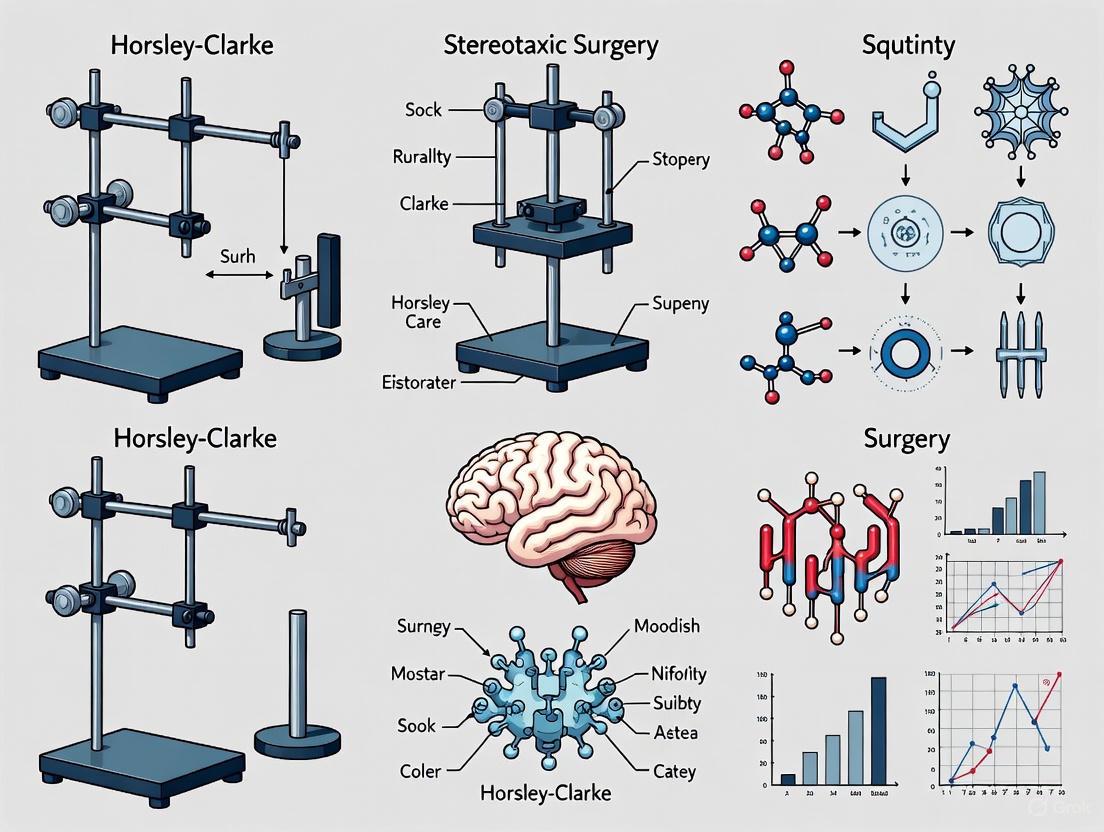
This article explores the seminal 1906 collaboration between Sir Victor Horsley and Robert Henry Clarke that produced the first stereotactic instrument, a foundational innovation for modern neurosurgery and neuroscience research.
Horsley and Clarke: The Origins of Stereotactic Surgery and Its Lasting Impact on Modern Neuroscience
Abstract
This article explores the seminal 1906 collaboration between Sir Victor Horsley and Robert Henry Clarke that produced the first stereotactic instrument, a foundational innovation for modern neurosurgery and neuroscience research. We detail the mathematical principles of the Horsley-Clarke apparatus, its initial application in animal neurophysiology, and the four-decade journey to human adaptation. The analysis covers the technical hurdles of human anatomical variability, the pivotal role of new imaging technologies, and the evolution toward frameless neuronavigation. For researchers and drug development professionals, this history provides crucial context for understanding current stereotactic techniques in neuromodulation, targeted drug delivery, and precise neurological intervention, highlighting how a century-old concept continues to enable precision medicine in the central nervous system.
The Pioneering Minds and Principles: How Horsley and Clarke Forged a New Neuro-scientific Paradigm
The genesis of stereotactic surgery at the beginning of the 20th century represents a pivotal moment in medical history, marking the successful fusion of surgical innovation with mathematical and engineering principles. This revolutionary approach emerged from the collaboration between Sir Victor Horsley, a pioneering neurosurgeon, and Robert H. Clarke, a physiologist with remarkable mathematical rigor. Their partnership, formed at University College London Hospital, addressed one of the most significant challenges in neurosurgery: the accurate and reproducible targeting of specific deep brain structures without causing extensive damage to overlying tissues [1]. The solution they developed—the Horsley-Clarke stereotactic apparatus—introduced a Cartesian three-dimensional coordinate system to brain surgery, creating a framework that would transform both experimental neurology and, eventually, human neurosurgery [2] [3].
The core innovation of their collaboration was the application of a three-orthogonal-axis system to navigate the brain's anatomy based on external skull landmarks. This principle of using cranial fixation points to establish the baselines of a three-dimensional Cartesian stereotactic coordinate system remains fundamentally unchanged in modern stereotactic techniques [3]. Their work, developed in 1906 and first used for making electrolytic lesions in the central nervous system of animals, established the foundational methodology that would enable precise interventions in deep brain structures for both research and therapeutic purposes [4] [5]. The Horsley-Clarke apparatus implemented what they termed "the stereotactic method," which Horsley described as "the measurement of the position of any point in the brain relative to a fixed point on the skull" [1]. This marriage of surgical practice with mathematical precision created entirely new possibilities for exploring and treating neurological disorders, establishing a paradigm that would evolve over the subsequent century into sophisticated human stereotactic systems.
Historical and Technical Background
The Pre-Stereotactic Era in Neurosurgery
Before the development of the Horsley-Clarke apparatus, neurosurgery faced profound limitations in accessing deep brain structures. Late 19th-century neurosurgical practice was primarily limited to superficial lesions and cortical exposures, with interventions in deeper brain regions considered prohibitively dangerous due to the high risk of damaging critical structures. The pioneering work of scientists like Paul Broca and Hughlings Jackson had established the principle of functional localization in the brain, demonstrating that specific brain regions were responsible for particular functions [3]. Broca's identification of the speech center through postmortem studies of patients with expressive aphasia, and Jackson's mapping of the motor cortex through observations of epileptic patients, provided crucial evidence for functional specialization within the brain [3].
These discoveries in cerebral localization created an imperative for developing more precise surgical techniques. Surgeons, including Horsley himself, began performing craniotomies based on cerebral localization, but the approach remained crude by modern standards [3]. The development of cranio-cerebral topography by Broca and others attempted to establish relationships between external skull landmarks and underlying brain structures, but these methods lacked the precision required for reliable targeting of deep structures without extensive tissue dissection [3]. It was within this context of growing understanding of brain function coupled with limited technical capacity to access specific brain regions that Horsley and Clarke began their collaboration.
The Horsley-Clarke Partnership
The collaboration between Victor Horsley and Robert Henry Clarke represented a perfect synergy of complementary expertise. Sir Victor Horsley (1857-1916) was already an established figure in neurosurgery, known for his pioneering work in brain surgery and his advocacy for the concept of functional localization [3]. His surgical experience provided the practical understanding of the clinical problems that needed solutions. Robert Henry Clarke (1850-1926) brought a different perspective as a physiologist with particular skill in mathematics and engineering [5]. Clarke was primarily responsible for the invention and construction of the apparatus that would enable their stereotactic experiments, while Horsley contributed the surgical expertise and neurophysiological knowledge [5].
Their partnership was forged at a time when interdisciplinary collaboration between medicine and engineering was rare, making their achievement particularly noteworthy. Clarke's mathematical rigor provided the framework for precisely localizing brain targets, while Horsley's surgical innovation ensured the system would be practical for biological application. This fusion of disciplines enabled them to overcome the significant technical challenges of creating a system that could reliably guide instruments to specific coordinates within the brain. Together, they designed and developed what would become known as the Horsley-Clarke apparatus, initially to study cerebellar function in monkeys, establishing a methodology that would endure for over a century [3].
The Horsley-Clarke Apparatus: Technical Specifications
Fundamental Design Principles
The Horsley-Clarke apparatus implemented a three-dimensional Cartesian coordinate system based on reproducible skull landmarks that maintained a constant spatial relationship to intracranial structures [3] [1]. The system established three orthogonal planes—sagittal, coronal, and horizontal—intersecting at a single origin point, creating the framework for precise targeting using three coordinates: latero-lateral (x), dorso-ventral (y), and rostro-caudal (z) [2] [1]. This coordinate system allowed any point within the brain to be specified numerically, then accessed mechanically through the apparatus with minimal disturbance to surrounding tissues.
The key insight was using bony landmarks—specifically the external auditory meatus (ear canals), inferior orbital ridges, and midline—as reference points that could be consistently identified and used to establish a standardized coordinate system [3]. In their initial animal experiments, these cranial fixation points established the baselines for the stereotactic coordinate system, enabling reproducible targeting across subjects [3]. The mechanical apparatus itself consisted of a rigid frame that fixed the animal's head in a standardized position, coupled with instrument guides that could be positioned along the three axes with high-precision vernier scales [1]. This arrangement permitted the insertion of electrodes, cannulae, or other instruments through small trephined holes in the skull to reach predetermined targets with minimal damage to overlying structures [1].
Coordinate System and Mathematical Framework
Table 1: Coordinate System of the Original Horsley-Clarke Apparatus
| Axis | Direction | Anatomical Reference | Measurement Principle |
|---|---|---|---|
| Latero-Lateral (X) | Left-Right | Midline sagittal plane | Bilateral symmetry from skull landmarks |
| Rostro-Caudal (Z) | Anterior-Posterior | Interaural line | Perpendicular to coronal planes |
| Dorso-Ventral (Y) | Superior-Inferior | Horizontal plane through skull base | Vertical measurement from reference plane |
The mathematical foundation of the apparatus relied on the principle that the spatial relationship between external skull landmarks and internal brain structures remained constant enough across individuals to allow predictable targeting [3]. Clarke's mathematical rigor was evident in the precision of the design, which accounted for the three-dimensional geometry of the skull and brain. The system essentially treated the intracranial space as a Cartesian grid, where any point could be defined by its orthogonal projections onto the three fundamental planes [2].
The apparatus employed a series of guide bars in the x, y, and z directions, fitted with precision vernier scales that allowed positioning of probes with sub-millimeter accuracy [1]. This mechanical implementation of the coordinate system enabled researchers to calculate the coordinates of a target structure based on brain atlases, then mechanically set the apparatus to guide instruments to that precise location. The original device established the paradigm for what would later be categorized as a simple orthogonal system, where the probe is directed perpendicular to a square base unit fixed to the skull [2]. This design provided three degrees of freedom through a carriage that moved orthogonally along the base plate or along a bar attached parallel to the base plate of the instrument [2].
Stereotactic System Integration: This diagram illustrates how Horsley's surgical innovation and Clarke's mathematical rigor converged in the technical implementation of their apparatus, creating a revolutionary approach to brain access.
Experimental Methodology and Protocols
Original Experimental Procedures
The initial experiments conducted using the Horsley-Clarke apparatus followed a systematic protocol designed to ensure precise targeting and reproducible results. The primary application was making electrolytic lesions in specific deep brain structures of animals, particularly in the cerebellar roof nuclei and other regions of interest to study their function [5]. The experimental workflow began with securing the animal—typically a monkey or cat—in the apparatus using the standardized skull landmarks to establish the coordinate system [3]. The target coordinates were determined based on anatomical studies and previous experiments.
Once the target coordinates were established, the apparatus was adjusted to position an electrode or cannula precisely at the calculated entry point on the skull. A small trephination was performed to allow passage of the instrument, which was then advanced to the target depth using the calibrated guidance system [1]. For creating electrolytic lesions, a direct electrical current was passed through the electrode to selectively destroy a discrete volume of tissue at the target site [5]. The animals were then recovered and observed for functional deficits, which provided insights into the function of the lesioned structure. Post-mortem examination verified the precise location of the lesion, allowing correlation between the anatomical location and observed functional changes [5].
Evolution of Stereotactic Techniques in Animal Research
The Horsley-Clarke apparatus established a methodology that would be refined and expanded throughout the 20th century. In the 1930s, improved versions of their original device came into widespread use in animal neuroscience laboratories [1]. The fundamental principles remained unchanged, but technical improvements enhanced precision and usability. The apparatus became standard equipment for neurophysiological research, enabling systematic exploration of brain function through localized stimulation and lesioning studies.
In modern neuroscience research, particularly in rodent models, the Horsley-Clarke principles continue to guide stereotactic procedures. The bregma—the point of confluence of the coronal and sagittal sutures—has become the standard reference point for establishing the coordinate system in rodent stereotaxic surgery [6]. Despite variations in measurement techniques across laboratories, the Cartesian coordinate system established by Horsley and Clarke remains the foundation [6]. Contemporary brain atlases, such as the widely used Paxinos and Franklin atlas, build upon this framework, providing detailed coordinate maps of brain structures relative to skull landmarks [6].
Table 2: Evolution of Key Stereotactic Landmarks
| Era | Subject | Primary Landmarks | Targeting Accuracy |
|---|---|---|---|
| Original H-C (1908) | Non-human primates | External auditory meatus, inferior orbital ridges | Approximately 1-2 mm in animals |
| Mid-20th Century | Humans | Pineal gland, foramen of Monro | Limited by radiographic visualization |
| Modern Human | Humans | Anterior/posterior commissures (AC-PC line) | Sub-millimeter with CT/MRI guidance |
| Modern Rodent | Laboratory rodents | Bregma point, skull sutures | Approximately 0.1-0.5 mm in rodents |
Transition to Human Applications
Technical Challenges in Human Adaptation
The application of stereotactic principles to human neurosurgery presented significant challenges that delayed clinical implementation for nearly four decades after the introduction of the Horsley-Clarke apparatus. The primary obstacle was the inability to visualize intracranial anatomic detail using the radiographic techniques available in the early 20th century [1]. While animal research could rely on consistent relationships between skull landmarks and brain structures across specimens, human neuroanatomy exhibited considerably greater individual variation, making skull-based coordinates insufficiently precise for therapeutic applications [4].
Initial attempts to overcome this limitation focused on identifying intracranial reference points that could be visualized radiographically. The first human stereotactic devices used the pineal gland (when calcified and visible on plain radiographs) and the foramen of Monro as internal landmarks [1]. However, the spatial variability of these structures—up to 12 mm or more in the anteroposterior axis and 16 mm in the interaural axis—proved incompatible with the precision required for safe and effective stereotactic procedures [3]. This limitation necessitated the development of new approaches that could account for individual neuroanatomical variations.
Pioneering Human Stereotactic Systems
The transition to human stereotaxy finally occurred between 1947 and 1949 through the independent work of several pioneering groups. Ernest A. Spiegel and Henry T. Wycis developed the first human stereotactic device in the United States, while Swedish neurosurgeon Lars Leksell created a separate system in Europe [1] [7]. Spiegel and Wycis maintained the Cartesian coordinate system used in the Horsley-Clarke apparatus, while Leksell implemented a polar coordinate system (spherical system) that proved easier to use and calibrate in the operating room [1].
A critical advancement came with the incorporation of intracranial commissures as reference points. Building on the work of French neurosurgeon Jean Talairach, the field gradually adopted the anterior commissure-posterior commissure line (AC-PC line) as the standard reference system for human stereotaxy [3]. This intercommissural line provided a more consistent internal reference that could be visualized using pneumoencephalography and, later, ventriculography [3]. Talairach further refined the approach by developing a proportional coordinate system that avoided absolute measurements in favor of relative positions within the individual brain geometry, effectively addressing the problem of inter-individual anatomical variation [3].
Modern Applications and Evolution
Technological Advancements in Stereotaxy
The development of computed tomography (CT) in the 1970s represented a watershed moment for stereotactic surgery, as first implemented in the Brown-Roberts-Wells (BRW) stereotactic system [1]. For the first time, neurosurgeons could directly visualize intracranial anatomy in relation to the stereotactic frame, dramatically improving targeting precision. This innovation stimulated intense interest and development in both stereotactic surgery and radiosurgery [1]. The subsequent advent of magnetic resonance imaging (MRI) provided even greater soft-tissue contrast, enabling exquisite visualization of deep brain structures and their relationship to stereotactic coordinates.
Modern stereotactic systems have evolved in two primary directions: frame-based systems that maintain the mechanical principles established by Horsley and Clarke, and frameless image-guided navigation that uses external fiducial markers and sophisticated registration algorithms [1]. Both approaches retain the fundamental concept of a three-dimensional coordinate system for precise intracranial navigation. The original Cartesian coordinate system of the Horsley-Clarke apparatus has been supplemented with various computational approaches, including recent innovations using geometric algebra to expand the operational work envelope and simplify the mathematical transformations required for precise targeting [8].
Contemporary Applications in Neuroscience and Drug Development
The principles established by Horsley and Clarke continue to enable critical advances across multiple domains of neuroscience research and therapeutic development. In deep brain stimulation (DBS), stereotactic guidance allows precise implantation of electrodes in targets such as the subthalamic nucleus for Parkinson's disease, with modern systems achieving targeting accuracy of 1.18 ± 0.28 mm in clinical settings [8]. For neuroscientific research, stereotactic delivery of tracers, viral vectors, and recording electrodes enables detailed mapping of neural circuits and experimental manipulation of specific populations of neurons.
In drug development, stereotactic techniques facilitate precise intracerebral delivery of experimental therapeutic agents, allowing researchers to target specific brain regions with minimal systemic exposure. The methodology enables localized microinjections for pharmacokinetic and pharmacodynamic studies, targeted delivery of neuroprotective compounds, and implantation of slow-release formulations. Modern adaptations continue to expand these applications, with recent developments enabling "total brain navigation capabilities" through sophisticated adapter systems that maintain the precision of traditional approaches while significantly expanding the accessible target space [8].
Table 3: Modern Stereotactic Applications and Technical Specifications
| Application Domain | Primary Uses | Technical Requirements | Targeting Accuracy |
|---|---|---|---|
| Deep Brain Stimulation | Parkinson's disease, essential tremor, dystonia | MRI/CT fusion, microelectrode recording | 1.18 ± 0.28 mm [8] |
| Stereotactic Radiosurgery | AVMs, tumors, functional disorders | Image guidance, precision collimation | Sub-millimeter isocenter precision |
| Research & Drug Development | Circuit mapping, drug delivery, optogenetics | Stereotactic atlases, precision injection systems | ~0.1 mm in rodents [6] |
| Biopsy Procedures | Tumor diagnosis, infectious etiology | Frame-based or frameless navigation | 1-2 mm clinical accuracy |
The Research Toolkit: Essential Materials and Methods
Historical Research Reagents and Solutions
The original Horsley-Clarke experiments relied on a limited but carefully selected set of research tools that enabled their pioneering investigations. The core methodology centered on creating discrete electrolytic lesions to study structure-function relationships in the brain. The essential reagents reflected the technological capabilities of early 20th-century neuroscience research while establishing approaches that would be refined over subsequent decades.
Table 4: Historical Research Reagent Solutions in Original Stereotactic Experiments
| Reagent/Apparatus | Composition/Specification | Primary Function | Experimental Role |
|---|---|---|---|
| Horsley-Clarke Apparatus | Cartesian frame with vernier scales | Mechanical guidance system | Precise 3D positioning of instruments |
| Electrolytic Electrodes | Insulated wires with exposed tips | Focal lesion creation | Discrete ablation of target structures |
| Direct Current Source | Constant current electrical supply | Lesion generation | Controlled tissue destruction via electrolysis |
| Histological Stains | Basic dyes (e.g., thionin) | Tissue processing | Verification of lesion location post-mortem |
| Skull Landmarks | Bony reference points | Coordinate system registration | Standardized positioning across subjects |
Modern Research Reagent Solutions
Contemporary stereotactic research builds upon the foundation established by Horsley and Clarke but incorporates advanced reagents and methodologies that have dramatically expanded experimental capabilities. Modern neuroscience research utilizing stereotactic approaches employs a sophisticated array of biological, chemical, and technical tools that enable precise manipulation and measurement of neural function.
Table 5: Modern Research Reagent Solutions in Stereotactic Neuroscience
| Reagent Category | Specific Examples | Function | Application in Research |
|---|---|---|---|
| Viral Vectors | AAV, lentivirus, rabies virus | Gene delivery, neural tracing | Circuit mapping, gene manipulation |
| Neural Tracers | Fluoro-Gold, cholera toxin B | Anatomical connectivity | Pathway identification, circuit analysis |
| Chemogenetic Tools | DREADDs, PSAMs | Remote control of neural activity | Behavioral circuit manipulation |
| Optogenetic Tools | Channelrhodopsin, halorhodopsin | Light-controlled neural activity | Precise temporal control of circuits |
| Biomaterials | Hydrogels, slow-release polymers | Controlled drug delivery | Localized pharmacologic manipulation |
The collaboration between Horsley and Clarke established a paradigm that continues to guide precise interventions in the brain more than a century after their original work. Their fusion of surgical innovation with mathematical rigor created not just a apparatus but a fundamental approach to navigating intracranial space that has adapted to every subsequent technological advancement in imaging and guidance. From the original frame-based mechanical systems to modern frameless navigation and robotic assistance, the Cartesian coordinate system they implemented remains the conceptual foundation for stereotactic technique.
The enduring relevance of their collaboration demonstrates the powerful synergies that emerge when clinical insight combines with engineering and mathematical principles. Their work enabled the systematic exploration of brain function through precise experimental interventions, created the technical foundation for countless therapeutic advances in functional neurosurgery, and established a methodology that continues to evolve through innovations such as geometric algebra-based targeting and increasingly sophisticated guidance systems [8]. The Horsley-Clarke apparatus stands as a testament to the enduring power of interdisciplinary collaboration in advancing both scientific understanding and clinical practice.
The integration of a three-dimensional Cartesian coordinate system for precise navigation of the human brain represents one of the most transformative conceptual advances in the history of neurosurgery and neurophysiology. This foundational methodology, now known as stereotaxis, was pioneered at the turn of the 20th century through the collaboration of British neurosurgeon Sir Victor Horsley and mathematician-physiologist Robert Henry Clarke. Their work established a mathematical framework for approaching the brain that would eventually revolutionize functional neurosurgery, radiotherapy, and deep brain stimulation. Clarke's Cartesian vision provided the critical link between anatomical knowledge and precise surgical intervention, creating a reproducible system for targeting specific brain structures that had previously been inaccessible without significant damage to overlying tissues. The core principle was elegantly simple yet powerfully effective: by assigning precise coordinates to every point within the cranial vault, the surgeon could navigate the brain's landscape with unprecedented accuracy. This whitepaper examines the historical context, mathematical foundations, experimental validation, and enduring legacy of Clarke's stereotactic instrument, framing its development within the broader history of stereotactic surgery and its profound implications for modern neuroscience research and therapeutic development.
Historical Context and Development
The development of the Horsley-Clarke apparatus emerged from a unique convergence of surgical innovation and mathematical rigor in early 20th-century London. Sir Victor Horsley (1857-1916), already an established pioneer in neurosurgery, had developed numerous surgical techniques for brain surgery during a period when the field was considered exceptionally risky [9]. His counterpart, Robert Henry Clarke (1850-1926), was a physiologist who believed strongly in applying mathematical principles to neurophysiology [9]. Their collaboration beginning in 1905 yielded the first stereotactic instrument, patented by Clarke in 1914 at a cost of 300 pounds [10].
Table: Key Historical Figures in Early Stereotactic Development
| Individual | Role & Contribution | Time Period |
|---|---|---|
| Robert Henry Clarke | Physiologist/Mathematician; Principal designer of stereotactic instrument and coordinate system | 1850-1926 |
| Sir Victor Horsley | Neurosurgeon; Collaborated with Clarke on application to neurosurgery | 1857-1916 |
| Aubrey Mussen | Student of Clarke; Created early human adaptation of frame | Circa 1918 |
| James Swift | Instrument maker; Constructed the first prototype machine | 1905 |
| Hayne & Gibbs | First to use human Horsley-Clarke frame for depth electroencephalography | 1947 |
Before this collaboration, neurosurgical interventions lacked precise targeting systems, relying largely on superficial anatomical landmarks and gross anatomical knowledge. Clarke's particular insight was recognizing that Cartesian coordinates—a three-dimensional system of mutually perpendicular axes—could be applied to map the brain's internal structures with consistent accuracy [9]. The first instrument, constructed by James Swift in London in 1905, was described as "Clarke's stereoscopic instrument employed for excitation and electrolysis" [10]. The following year, in 1906, Clarke and Horsley first used the apparatus to create minute electrolytic lesions in the central nervous system of animals, marking the birth of stereotactic neurosurgery [10] [11].
The original apparatus was designed specifically for animal brains, particularly those of cats and monkeys, rather than humans [9]. This limitation stemmed from the greater variability between human skulls and brain topography compared with laboratory animals [11]. Despite this limitation, the principles established in the Horsley-Clarke apparatus would form the basis for all subsequent stereotactic devices. It would take nearly four decades after its initial development for the technique to be adapted for human use, primarily due to the challenges of accounting for inter-individual variations in human brain anatomy [11].
Mathematical Foundations and Coordinate Systems
At the core of Clarke's innovation was the application of the three-dimensional Cartesian coordinate system to brain anatomy. This mathematical framework allowed any point within the brain to be specified using three coordinate values representing distances from a reference origin along three mutually perpendicular axes: lateral (x-axis), anteroposterior (y-axis), and vertical (z-axis) [12]. The system operated on the fundamental principle that the spatial relationships between cranial landmarks and deep brain structures remained consistent enough to allow predictable targeting.
The mathematical underpinnings of stereotactic surgery involve sophisticated coordinate transformations between different reference spaces. As described in contemporary technical literature, these transformations follow the affine conversion principle, mathematically represented as:
[ \begin{bmatrix} Xf \ Yf \ Zf \end{bmatrix} = \mathbf{R} \cdot \mathbf{S} \cdot \begin{bmatrix} Xa \ Ya \ Za \end{bmatrix} + \mathbf{T} ]
Where:
- (Xf, Yf, Z_f) represent coordinates in frame space
- (Xa, Ya, Z_a) represent coordinates in anatomical space
- (\mathbf{R}) is the rotational transformation matrix
- (\mathbf{S}) is the scaling matrix
- (\mathbf{T}) is the translation vector [12]
Table: Core Coordinate Systems in Stereotactic Navigation
| Coordinate Space | Definition | Primary Use |
|---|---|---|
| Anatomical Space | Based on brain reference points (AC, PC, Midline) | Target planning in relation to brain anatomy |
| Frame Space | Defined by the stereotactic apparatus physical coordinates | Intraoperative navigation |
| Head-Stage Space | Related to surgical head-stage for trajectory angles | Electrode/probe insertion guidance |
| Atlas Space | Standardized brain maps with coordinate references | Preoperative planning and target identification |
The anatomical reference points critical for human stereotaxis emerged later, primarily the anterior commissure (AC), posterior commissure (PC), and a midline point, which together define the coordinate system for human stereotactic procedures [12]. The mid-commissural point (MC) serves as the origin {0,0,0} in this anatomical space, calculated as the simple average of AC and PC coordinates:
[ MC = \left( \frac{AC + PC}{2} \right) ]
These mathematical foundations established by Clarke continue to underpin modern stereotactic procedures, including deep brain stimulation, biopsy, and radiosurgery, albeit with more sophisticated computational implementations [12].
Instrument Design and Technical Specifications
The original Horsley-Clarke instrument was a mechanical marvel of its time, designed to rigidly fix an animal's head in a standardized position while providing precise guidance for electrode placement. The apparatus established the basic design principles that would influence all subsequent stereotactic devices: a rigid frame that fixed to the skull, a coordinate system with vernier scales for precise measurement, and an electrode holder that could be positioned in three dimensions with sub-millimeter accuracy.
Table: Technical Evolution of Early Stereotactic Instruments
| Instrument/Developer | Key Technical Features | Primary Application |
|---|---|---|
| Original Horsley-Clarke Apparatus (1906) | Cartesian coordinate system, electrolytic lesion capability, head fixation system | Animal neurophysiology research |
| Mussen Human Adaptation (1918) | Scaled for human anatomy, Cartesian principles | Never used clinically; conceptual prototype |
| Spiegel & Wycis Apparatus (1947) | Human stereotactic frame, pneumoencephalography integration | First human stereotactic procedures |
| Leksell System (1949) | Arc-centered design, polar coordinates | Human stereotactic surgery and radiosurgery |
The instrument's design incorporated several innovative features that addressed the practical challenges of brain navigation. The head fixation system ensured that the subject's head remained in a consistent position relative to the coordinate framework throughout the procedure. The electrode carrier allowed for precise angular approaches in addition to linear targeting, a feature that would be refined in later arc-centered systems like the Leksell frame [9] [11]. The original device used a system of slides and vernier scales that enabled reproducible positioning with an accuracy reported to be within 0.5mm [10].
Technical adaptations for human use required solutions to the problem of individual anatomical variation. The solution emerged through the use of intracerebral landmarks visible via radiography, particularly the anterior and posterior commissures, which provided a reference system that compensated for differences in brain size and shape among individuals [11]. This principle of using consistent internal landmarks rather than external skull features significantly improved targeting accuracy for human applications and remains fundamental to modern stereotactic procedures.
Experimental Protocols and Methodologies
The initial experimental use of Clarke's stereotactic instrument followed meticulous protocols designed to validate both the apparatus and the underlying coordinate system. The landmark 1906 experiments conducted by Horsley and Clarke established methodologies that would become standard in stereotactic research for decades to follow.
Apparatus Setup and Alignment
The experimental protocol began with rigid fixation of the animal's head within the stereotactic frame, ensuring that the cranial sutures (particularly bregma and lambda) aligned with the coordinate system's reference planes [11]. This alignment created a reproducible relationship between the instrument's coordinate system and the animal's neuroanatomy. The precision of this alignment step was critical, as even minor deviations could result in significant targeting errors.
Target Coordinate Calculation
For each target structure, coordinates were determined relative to the standardized reference points. In their cerebellar studies targeting the dentate nucleus, Clarke calculated the three-dimensional coordinates based on prior anatomical studies of the specific species [11]. These coordinates were then set using the vernier scales on the instrument's slides, positioning the electrode guide tube along the desired trajectory.
Electrolytic Lesion Generation
With the electrode positioned at the target coordinates, lesions were created using electrolytic techniques. The protocol involved:
- Insertion of an insulated electrode with an exposed tip through the guide tube to the target depth
- Application of a controlled electrical current (typically DC) to create a focal electrolytic lesion
- Histological verification of lesion placement and size after sacrifice of the animal [10]
The following DOT language script represents the experimental workflow established by Horsley and Clarke:
Experimental Workflow of Horsley-Clarke Stereotactic Technique
Histological Verification and Atlas Development
Following the procedure, animals were sacrificed and their brains processed for histological examination. This critical verification step allowed Horsley and Clarke to confirm targeting accuracy and refine their coordinate system [9]. The cumulative data from these experiments formed the basis for the first detailed stereotactic atlases, which correlated coordinate positions with specific neuroanatomical structures.
The Scientist's Toolkit: Research Reagent Solutions
The implementation of Clarke's Cartesian vision required both specialized instrumentation and methodological approaches that collectively formed the essential toolkit for stereotactic research.
Table: Essential Research Tools for Stereotactic Neuroscience
| Tool/Reagent | Function | Technical Specification |
|---|---|---|
| Stereotactic Frame | Provides coordinate framework and electrode guidance | Original prototype by Swift (1905); precision vernier scales; rigid construction |
| Electrolytic Electrode | Creates precise lesions at target coordinates | Insulated shaft with exposed tip; compatible with DC current source |
| Cartesian Coordinate System | Mathematical framework for target localization | Three-dimensional reference system (LAT, AP, VERT) relative to cranial landmarks |
| Histological Stains | Verification of electrode placement and lesion location | Standard neuroanatomical staining protocols (e.g., Nissl, myelin) |
| Brain Atlas | Reference for coordinate planning | Species-specific anatomical maps correlating coordinates to structures |
This foundational toolkit established the methodological standards for stereotactic research, with many principles still observable in contemporary techniques, albeit with advanced technological implementations. The transition to human applications required additional tools, particularly imaging modalities that could visualize internal landmarks, beginning with pneumoencephalography and later incorporating computed tomography and magnetic resonance imaging [11].
Legacy and Modern Applications
The Cartesian vision established by Clarke and Horsley has evolved far beyond its original application to animal neurophysiology, becoming the foundational principle for numerous modern neurosurgical and research applications. The direct lineage from their 1906 apparatus to contemporary stereotactic systems is unmistakable, both in conceptual framework and technical implementation.
The transition to human stereotaxis began in earnest in 1947 with Ernest Spiegel and Henry Wycis, who adapted the principles for human use with their "stereoencephalotomy" technique [4] [11]. Their apparatus, while more sophisticated, maintained the core Cartesian principles established by Clarke. The subsequent development of the Leksell frame in 1949 introduced an arc-centered design that improved surgical accessibility while maintaining coordinate precision [11]. This period marked the beginning of widespread human stereotactic applications for conditions including movement disorders, pain, epilepsy, and psychiatric conditions [11].
The integration of advanced imaging modalities represents the most significant technological advancement in stereotactic technique. The 1978 invention of the N-localizer by Russell Brown enabled precise correlation between CT imaging and stereotactic coordinates, revolutionizing targeting accuracy [12]. Subsequent integration with magnetic resonance imaging provided unprecedented visualization of soft tissue structures, further refining targeting capabilities. Modern stereotactic surgery now incorporates sophisticated computational platforms that handle the complex coordinate transformations between image space, physical space, and atlas space [12].
The following DOT language script illustrates the coordinate transformation pipeline in modern stereotactic systems:
Coordinate Transformation Pipeline in Modern Stereotaxis
Contemporary applications of Clarke's Cartesian principles extend across multiple therapeutic domains:
- Deep Brain Stimulation: Precise electrode implantation for movement disorders, utilizing both frame-based and frameless stereotactic techniques with accuracies routinely within 1-2mm [11]
- Stereotactic Radiosurgery: Delivery of highly focused radiation to intracranial targets with sub-millimeter precision, particularly for brain metastases and other lesions [13]
- Biopsy Procedures: Minimal-access tissue sampling from specific brain regions for diagnostic purposes
- Gene Therapy and Drug Delivery: Targeted administration of therapeutic agents to precise neuroanatomical structures
The enduring legacy of Clarke's Cartesian vision is particularly evident in the ongoing development of frameless stereotactic systems, which replace the physical frame with fiducial markers and sophisticated registration algorithms while maintaining the same mathematical foundations [11]. Similarly, the integration of functional imaging and microelectrode recording continues to refine targeting beyond what is possible with anatomical imaging alone. As stereotactic techniques continue to evolve with advancements in robotics, artificial intelligence, and imaging technology, the fundamental Cartesian coordinate system established by Robert Henry Clarke remains the indispensable foundation for precise navigation of the human brain.
This whitepaper delineates the genesis and technical specifications of the first stereotactic instrument, conceived by Robert Henry Clarke and Victor Horsley, which established the foundational principles for modern stereotactic neurosurgery. The 'Clarke's stereoscopic instrument employed for excitation and electrolysis,' constructed in 1905 and first used experimentally in 1906, introduced a Cartesian coordinate system for precise intracranial navigation. Despite the commonly referenced date of 1908 for its seminal description, the apparatus was both built and utilized years prior. This guide examines the instrument's construction, its initial experimental protocols, and its enduring legacy, providing researchers and drug development professionals with a historical framework for understanding the evolution of precise surgical intervention in the central nervous system.
Historical and Conceptual Genesis
The development of Clarke's stereotactic instrument must be contextualized within the broader scientific ambition of the late 19th and early 20th centuries to systematically investigate the deep structures of the brain. Prior to this innovation, attempts to study subcortical areas were fraught with inaccuracy, often resulting in significant collateral damage or failed target acquisition.
The term 'stereotactic' is linguistically derived from two Greek words: 'stereon,' which in this context was used in the geometrical sense of 'solid' or 'three-dimensional,' and 'taxis,' meaning 'arrangement' or 'order' [14]. Thus, the term precisely describes the apparatus's purpose: the ordered, precise positioning within a three-dimensional space. The conceptual breakthrough was the application of a Cartesian coordinate system (x, y, z) to the intracranial space, allowing any point within the brain to be defined by three coordinates relative to a fixed zero point [2].
This principle was first materialized through the collaboration between the British surgeon and anatomist, Robert Henry Clarke, and the pioneering neurosurgeon, Victor Horsley [10]. Their partnership combined deep anatomical knowledge with surgical practicality. The first physical instrument was constructed in 1905 by instrument maker James Swift in London [10]. It was officially designated "Clarke's stereoscopic instrument employed for excitation and electrolysis" and was first used in 1906 to create minute electrolytic lesions in the central nervous systems of animals [10] [4]. Clarke secured a patent for the stereotactic apparatus in 1914, with a noted cost of 300 pounds [10]. The 1908 date often associated with the instrument pertains to the detailed methodological and results paper published by Horsley and Clarke in Brain, which cemented the instrument's place in scientific literature.
Technical Specifications and Construction
Clarke's original instrument was a mechanical marvel of its time, designed for unwavering stability and precision. Its core function was to hold an animal's head in a fixed position and guide a probe to a predetermined set of depths and angles based on a reference atlas.
Table 1: Core Components of Clarke's Original Stereotactic Instrument
| Component Name | Material | Primary Function | Technical Significance |
|---|---|---|---|
| Head-Holding Frame | Metal [15] (Assumed from context) | To immobilize the subject's head via clamps and bars, fixing it in relation to the coordinate system's origin (zero point) [2]. | Established a constant frame of reference, eliminating movement artifact and enabling reproducible targeting. |
| Coordinate Guide Bars | Metal with high-precision vernier scales [2] | Provided three degrees of freedom for movement in the latero-lateral (x), dorso-ventral (y), and rostro-caudal (z) axes [2]. | Enabled mathematically precise navigation to any point within the defined 3D space. Accuracy was a function of the vernier scale's precision. |
| Probe Holder | Metal | To securely carry electrodes or cannulas for lesioning (e.g., electrolysis) or stimulation [10]. | Served as the interchangeable end-effector, making the apparatus a platform for various experimental interventions. |
| Base Platform | Metal | Provided a rigid and stable foundation for the entire assembly, to which the head-holding frame and guide bars were attached. | Crucial for maintaining the integrity of the coordinate system during procedures by preventing flex or movement. |
The instrument operated on what would later be classified as a simple orthogonal system [2]. In this design, the probe is directed perpendicularly to a square base unit fixed to the skull. A carriage moved orthogonally along a base plate or a bar attached parallel to it, providing one plane of movement. A second track, attached to this carriage and extending across the head frame perpendicularly, provided the other planar movements, ultimately allowing for 3D positioning [2].
It is critical to distinguish Clarke's neurosurgical instrument from a contemporaneous device sharing a similar name. In 1908, Arthur Schwarz patented a "Stereoscope" (US720849A) [15], which was a foldable apparatus for viewing stereoscopic picture cards. This device, used for entertainment and optical effects, is functionally and conceptually unrelated to the stereotactic instrument developed by Clarke and Horsley for neurological research.
Experimental Protocol and Methodology
The initial experiments conducted by Horsley and Clarke in 1906 established a rigorous methodology that would become the standard for functional neuroscience research for decades.
Pre-Experimental Planning: The Atlas
The first and most critical step was the creation of a anatomical atlas. This atlas consisted of a series of cross-sections of the animal's brain (e.g., a primate or cat cerebellum), with every structure depicted in reference to a two-coordinate frame [2]. Each deep brain structure—such as a specific nucleus in the cerebellum—was assigned a range of three coordinate numbers relative to consistent bony landmarks (e.g., the external auditory meatus or the inferior orbital ridges) [2]. This atlas was the essential "map" used for target selection and coordinate calculation.
Apparatus Setup and Targeting
- Immobilization: The animal was anesthetized, and its head was securely fixed into the instrument's head-holding clamps. The landmarks used for the atlas were aligned to the instrument's coordinate system, establishing the origin or zero point.
- Coordinate Calculation: The target structure was selected from the atlas, and its three-dimensional coordinates (x, y, z) were determined.
- Instrument Adjustment: The guide bars on the instrument were meticulously adjusted using the vernier scales to the calculated coordinates. This positioned the probe holder directly above a small trephined hole in the skull.
- Probe Insertion: An electrode or cannula was affixed to the probe holder and lowered to the precise depth required to reach the target point deep within the brain [2].
Intervention and Lesioning
The primary intervention in the 1906 experiments was the creation of minute electrolytic lesions [10]. This was achieved by:
- Electrode Placement: Inserting an insulated electrode with a small exposed tip to the target location.
- Current Application: Passing a controlled electrical current through the electrolyte-filled tissue via the electrode. This process (electrolysis) caused a precise, localized destruction of tissue around the electrode tip.
- Histological Verification: After the procedure, the brain was extracted and examined histologically to confirm the exact location of the lesion, thereby validating the accuracy of the stereotactic targeting.
The following diagram illustrates this foundational experimental workflow.
The Scientist's Toolkit: Key Research Reagents and Materials
Table 2: Essential Materials for Early Stereotactic Experiments
| Item | Function in Protocol |
|---|---|
| Stereotactic Apparatus | The core platform for head fixation and precise 3D navigation of instruments [10]. |
| Anatomical Brain Atlas | The reference map linking intracranial structures to coordinate points based on bony landmarks [2]. |
| Electrolytic Electrode | An insulated wire with an exposed tip for creating precise, localized lesions via electrical current [10]. |
| Trephine / Burr Drill | A surgical tool for creating a small opening in the skull to allow probe passage. |
| Vernier Scale | A precision measurement device on the guide bars for accurate coordinate settings [2]. |
| Anesthetic Agents | To ensure the subject remained unconscious and immobile during the surgical procedure. |
Evolution and Legacy in Human Application
While revolutionary for animal research, the Horsley-Clarke frame was not immediately translated to human use, primarily due to the greater anatomical variability between external landmarks and deep brain structures in humans [4]. For four decades, it remained a cornerstone of physiological experimentation in animals.
The pivotal transition to human stereotactic surgery occurred independently in the 1940s. Although Aubrey Mussen, a student of Clarke, designed a human apparatus, no procedures were performed with it [4]. The first documented use of a Horsley-Clarke frame for human application was in 1947 by Robert Hayne and Frederic Gibbs for depth electroencephalography [4]. Their work paralleled the nearly simultaneous efforts of Ernest A. Spiegel and Henry T. Wycis, who are often credited with founding human stereotactic neurosurgery.
The fundamental principles embedded in Clarke's instrument—a rigid head frame, a 3D coordinate system, and correlation with intracranial anatomy—directly inspired all modern stereotactic systems [10] [2]. These include:
- Arc-Quadrant Systems: Where probes are directed perpendicular to the tangent of an arc, always arriving at the center (focal point) of a sphere.
- Arc-Phantom Systems: Utilizing an aiming bow that can be transferred to a phantom target for pre-setting coordinates [2].
This lineage extends beyond purely mechanical surgery to advanced modalities like stereotactic radiosurgery (e.g., Gamma Knife, CyberKnife), which uses the same principles of precise localization to deliver focused radiation, and deep brain stimulation (DBS) for functional disorders like Parkinson's disease [2].
Clarke's stereoscopic instrument, conceived in the first decade of the 20th century, was a paradigm-shifting innovation. Its construction and the experimental methodologies it enabled created an entirely new field of precise neurosurgical intervention. The core concept of relating intracranial space to a Cartesian coordinate system remains as relevant today in state-of-the-art neurosurgery and radiotherapy as it was in 1906. For modern researchers and drug development professionals, understanding this origin provides a critical perspective on the principles of targeted intervention, whether for delivering a novel therapeutic agent to a specific brain nucleus or for understanding the historical data from functional lesion studies. The apparatus stands as a testament to the power of interdisciplinary collaboration and engineering precision in advancing medical science.
Historical and Technical Foundation
The development of techniques for creating precise electrolytic lesions in the animal cerebellum is inextricably linked to the invention of the first stereotactic instrument by Victor Horsley, a pioneering neurosurgeon, and Robert Henry Clarke, an anatomist and physiologist [10]. Their collaboration in 1906 marked the birth of stereotactic surgery, a methodology designed to target specific deep-brain structures with minimal disruption to overlying tissues [4] [10]. The original apparatus, known as the Horsley-Clarke frame, was engineered for animal research and allowed for the accurate insertion of an electrode into the cerebellum or other subcortical structures to create minute electrolytic lesions [10]. The frame established a Cartesian coordinate system, the Horsley-Clarke coordinates, which used anatomical landmarks to reference any point within the brain in three dimensions [4].
This revolutionary approach enabled researchers for the first time to selectively ablate discrete neural circuits and systematically observe the resulting functional deficits, thereby establishing causal links between specific brain regions and behavior. The core principle of the Horsley-Clarke frame—precise spatial targeting based on a standardized coordinate system—constitutes the direct foundation for all modern human and animal stereotactic guides developed after World War II [10]. While a human version of the Horsley-Clarke frame was later developed for depth electroencephalography in 1947, its initial application and primary legacy lie in these foundational experimental lesioning studies in animals [4].
Modern Electrolytic Lesioning Methodology
Contemporary neuroscience has refined the core principles of Horsley and Clarke into a sophisticated platform that integrates lesioning with neuroelectrophysiology. The following workflow and technical specifications detail this modern approach.
Experimental Workflow for Integrated Lesioning and Recording
The diagram below illustrates the key stages of a modern experiment employing electrolytic lesioning through a chronically implanted microelectrode array.
Key Experimental Parameters and Specifications
The following tables summarize the core technical specifications and material requirements for executing this methodology.
Table 1: Electrolytic Lesioning Control Parameters
| Parameter | Typical Range/Specification | Functional Impact |
|---|---|---|
| Current Source | Custom-built, constant current [16] | Ensures stable, repeatable lesion formation. |
| Current Amount | Controlled, specified amount [17] | Primary determinant of lesion spatial extent. |
| Current Duration | Controlled duration [17] | Co-determinant of lesion spatial extent. |
| Electrode Configuration | Bipolar (Anode & Cathode) [17] | Sets the origin point of the lesion. |
| Location Resolution | 400 µm (with Utah array) [17] | Sub-millimeter precision for lesion placement. |
| Spatial Extent | Millimeter precision [17] | Controlled size balances behavioral effect and tissue sparing. |
Table 2: Research Reagent and Material Solutions
| Item | Function in Experiment |
|---|---|
| Stereotactic Frame (Horsley-Clarke) | Provides a rigid coordinate system for precise targeting of intracranial structures [4] [10]. |
| Chronic Microelectrode Array | Serves dual purpose: recording neuroelectrophysiology and delivering electrolytic current [16] [17]. |
| Custom Current Source Circuit | Generates a stable, specified electrical current for controlled electrolytic lesioning [16]. |
| Anatomical Reference Atlas | Standardized maps (e.g., cerebellum) used in conjunction with stereotactic coordinates for target selection. |
| Histological Staining Reagents | Used for post-mortem validation of lesion location and extent (e.g., Nissl stain for cell bodies). |
Technical Protocol and Validation
Detailed Experimental Protocol
- Stereotactic Implantation: A microelectrode array (e.g., a Utah array) is chronically implanted into the target region of the animal cerebellum using the stereotactic frame. The coordinates are derived from a cerebellar atlas aligned with the stereotactic system [16] [17].
- Baseline Data Acquisition: Following recovery, stable neuroelectrophysiological recordings (single-unit and multi-unit activity) are obtained from the implanted array during designated behavioral tasks to establish a pre-lesion baseline [17].
- Lesioning Execution:
- The recording system is disconnected.
- A custom-built external current source is connected to the microelectrode array.
- Anode and Cathode Selection: Two specific electrodes on the array are selected to act as the anode and cathode, determining the epicenter of the lesion with a resolution defined by the array's electrode spacing (e.g., 400 µm) [17].
- Current Delivery: A controlled, specified amount of direct current is passed between the electrodes for a predetermined duration. The product of current and duration directly governs the size and extent of the resulting electrolytic lesion [17].
- The lesioning device is disconnected.
- Post-Lesion Data Acquisition: The recording system is reconnected, often within minutes. Neuroelectrophysiological recording and behavioral testing resume, allowing for the direct comparison of neural activity and performance before and after the lesion [16] [17].
- Histological Validation: Upon conclusion of the experiment, the brain is perfused and extracted. The cerebellum is sectioned and stained to histologically verify the precise location and volume of the lesion, correlating the anatomical damage with the observed functional and electrophysiological changes [17].
Data Analysis and Outcome Validation
The methodology enables rigorous quantitative analysis across multiple domains:
- Electrophysiology: Single-unit activity is tracked from the same electrodes pre- and post-lesion. A key validation metric is the preservation of signal quality on electrodes not used for lesioning, confirming stable recording capabilities. A reduction in multi-unit activity in the immediate vicinity of the lesion confirms local termination [17].
- Behavior: Performance on behavioral tasks (e.g., motor coordination assays for cerebellar lesions) is quantitatively compared before and after the intervention to establish functional deficits and subsequent recovery profiles [17].
- Histology: Ex vivo and in vivo histology from tissue sections provides the ground-truth validation of the lesion's location and spatial extent, confirming the millimeter precision of the technique [16] [17].
Historical Foundation: From Clarke's Instrument to Modern Stereotaxy
The core principle of stereotactic surgery—the precise co-registration of external landmarks with internal brain anatomy—was fundamentally established by the pioneering work of Robert Henry Clarke and Victor Horsley at the turn of the 20th century. Their collaboration produced the first original stereotactic instrument, designed to create minute, predictable lesions within the central nervous system of animals [10].
In 1905, the first apparatus, termed 'Clarke's stereoscopic instrument employed for excitation and electrolysis,' was constructed by James Swift in London. The instrument was first used experimentally in 1906 and was later patented by Clarke in 1914 [10]. This device established the foundational mechanical principle of using a rigid, three-dimensional coordinate system to translate external points to precise internal targets. The design of these early machines, two of which were brought to the United States for animal research, constitutes the direct basis for the modern stereoguides developed for human use after World War II [10].
The Core Principle: Defining Co-registration in a Modern Context
Co-registration is the computational and spatial process of aligning two or more datasets into a single coordinate space. In modern neuroscientific practice, this principle has evolved from a purely mechanical alignment to a sophisticated image-based registration, which is a prerequisite for normalizing individual brain data into a standardized space for group-level analysis [18].
The process relies on affine transformations, a type of linear transformation that includes translations, rotations, zooms, and shears. These transformations possess twelve degrees of freedom, allowing for the comprehensive alignment of images of the same subject acquired through different modalities or at different times [18]. The ultimate goal is to ensure that each voxel for each subject corresponds to the same anatomical structure, enabling accurate comparison and analysis across a population [18].
Methodological Workflow for Co-registration
A standard co-registration protocol, as implemented in software packages like SPM, involves a logical sequence of steps to align functional data with a high-resolution anatomical image and subsequently to a standardized template brain. The following workflow diagram illustrates this process:
Diagram 1: Co-registration and Normalization Workflow
Advanced Co-registration Techniques: Exploiting Internal Anatomy
Beyond aligning surfaces, advanced co-registration methods significantly improve accuracy by incorporating internal anatomical information. One such method uses a cost function based on the Kullback-Leibler divergence between image intensity histograms to drive the registration of MRI and electrophysiological data like EEG [19].
This technique leverages two key similarities:
- External Similarity: The statistical similarity between local intensity histograms sampled at electrode positions and the global intensity histogram of the entire MRI image.
- Internal Similarity: The anatomical symmetry between brain hemispheres, measured by the similarity of local histograms from corresponding pairs of points derived from the EEG sensor array's geometry [19].
The combined cost function (CF) is defined as:
CF = Σ(k=1 to N) KL(H(Vk) || Hg) + (N/Np) * Σ(k=1 to Np) KL(H(V1i*(k)) || H(V2j*(k)))
where KL is the Kullback-Leibler divergence, H(Vk) is the local histogram at point k, Hg is the global MRI histogram, and the second term computes the internal dissimilarity between Np corresponding point pairs [19]. This method has demonstrated high accuracy, achieving a mean registration error of 0.48 ± 0.33 mm in simulations [19].
Contemporary Application: Co-registration in Deep Brain Stimulation
The principle of co-registration is critically applied in Deep Brain Stimulation (DBS surgery for movement disorders like essential tremor. Here, accurate lead placement is paramount, and co-registration is used to map intraoperative stimulation results onto patient-specific anatomy to identify the optimal implant position [20].
A modern technique known as "stimulation maps" visually summarizes a high amount of intraoperative data—including quantitative symptom evaluation, adverse effects, and patient-specific electric field simulations—to assist in surgical decision-making [20]. This process involves:
- Pre-surgical Planning: Relevant anatomical structures (e.g., the VIM thalamic nucleus for essential tremor) are outlined on patient MRI scans using commercial planning software [20].
- Intraoperative Testing: Micro-electrode recording and stimulation tests are performed at pre-determined positions along planned trajectories to confirm location and evaluate therapeutic and adverse effects [20].
- Data Fusion and Visualization: Patient-specific electric field simulations are combined with quantitative tremor improvement scores (e.g., from accelerometry) to create maps that divide the stimulation region into areas with different improvement levels, directly coregistered with the 3D anatomy [20].
Experimental Protocol for Intraoperative DBS Mapping
Objective: To quantitatively evaluate the optimal implant position for a DBS lead in a patient with essential tremor by coregistering intraoperative stimulation data with patient-specific anatomy.
Materials: Stereotactic head frame (e.g., Leksell System), planning software (e.g., iPlan Stereotaxy 3.0), microelectrode recording system (e.g., MicroGuide Pro), accelerometer for tremor quantification, clinical DBS lead (e.g., Medtronic 3389) [20].
Method:
- Imaging and Planning: Acquire a stereotactic T1 MRI and a white-matter attenuation inversion recovery (WAIR) sequence. Outline the target structure (e.g., VIM thalamus) and plan 1-2 parallel trajectories through the region of interest, defining 5-10 test-stimulation positions along each trajectory [20].
- Surgical Setup: Set the stereotactic coordinates on the frame system. Insert two intraoperative exploratory electrodes along the planned trajectories [20].
- Microelectrode Recording (MER): Perform MER at all planned positions to confirm anatomical location [20].
- Stimulation and Quantification:
- At each test position, administer stimulation (e.g., mono-polar, 60 μs pulse width, 130 Hz), varying the current amplitude from 0-3 mA in 0.2 mA steps [20].
- Simultaneously, record tremor using a 3-axis accelerometer attached to the patient's wrist. Synchronize data acquisition with the stimulation protocol [20].
- Note the current amplitude that produces the highest improvement in tremor and any amplitudes that induce adverse effects [20].
- Post-operative Analysis:
- Calculate quantitative tremor improvement from accelerometer data (e.g., using signal energy, standard deviation, amplitude of dominant frequency) for each stimulation [20].
- Simulate the patient-specific electric field distribution for each stimulation test using Finite Element Method (FEM) modeling based on the segmented MRI and electrode model [20].
- Generate the stimulation map by assigning each voxel in the stimulation region a value of symptom improvement, coregistered with the 3D anatomical outlines [20].
- Decision: The optimal implant position is identified on the stimulation map as the location fulfilling: low therapeutic current amplitude, high threshold for adverse effects, and favorable outcomes in neighboring positions [20].
Quantitative Data and Research Reagents
Table 1: Summary of Quantitative Co-registration Performance Data
| Registration Method / Application | Reported Accuracy (Mean Error) | Data Type / Context | Source |
|---|---|---|---|
| Anatomically-driven MRI-EEG Registration | 0.48 mm ± 0.33 mm | Clinical MRI with simulated EEG data | [19] |
| Anatomically-driven MRI-EEG Registration | 2.27 mm ± 0.02 mm (RMS) | Clinical MRI with real EEG data | [19] |
| Stimulation Maps for DBS Lead Placement | N/A (Qualitative visual aid) | Retrospective application on 9 implantations in Essential Tremor patients | [20] |
Table 2: The Scientist's Toolkit: Essential Reagents and Materials for Stereotactic Research
| Item / Reagent Solution | Function / Explanation | Experimental Context |
|---|---|---|
| Stereotactic Instrument / Frame | Provides the rigid 3D coordinate system for translating external coordinates to internal targets. The foundational device. | Animal research [10] & human DBS surgery [20]. |
| Commercial Planning Software (e.g., iPlan Stereotaxy) | Allows for pre-surgical visualization, target selection (e.g., VIM thalamus), and trajectory planning on patient-specific 3D anatomy. | DBS surgical planning [20]. |
| Microelectrode Recording (MER) System | Enables physiological confirmation of anatomical position by recording neuronal activity, validating the co-registered target. | Intraoperative DBS lead placement [20]. |
| Patient-Specific FEM Modeling Software | Simulates the spatial distribution of the electric field from stimulation, estimating the volume of tissue activated. | Analysis of DBS stimulation effects [20]. |
| Accelerometer (3-axis) | Provides quantitative, objective evaluation of tremor improvement during intraoperative stimulation tests, replacing subjective clinical scales. | Quantifying DBS outcomes in Essential Tremor [20]. |
From Animal Research to Human Therapy: The Evolution and Technical Expansion of Stereotaxy
The transition from animal experimentation to human application in stereotactic surgery represents a critical juncture in medical history. This evolution began with the foundational work of Sir Victor Horsley, a pioneering neurosurgeon, and Robert H. Clarke, a neurophysiologist with a passion for applying mathematical principles to biology [9]. In 1906, they introduced the Horsley-Clarke frame, a device that used a three-dimensional Cartesian coordinate system to accurately target deep-seated structures within the brains of experimental animals, most notably cats [21] [22]. Their collaborative apparatus became the prototype for all subsequent stereotactic devices, establishing the core principle that any point within a three-dimensional space (such as the brain) could be located using a precise set of coordinates derived from a fixed reference system [21]. Despite its revolutionary design, the original Horsley-Clarke frame had a significant limitation: it was designed for animal brains and was not suitable for human use [9]. The solution to this problem would emerge through the separate efforts of two key figures: Aubrey Mussen, and the team of Ernst Spiegel and Henry Wycis.
Aubrey Mussen's Unused Human Stereotactic Frame
Historical Context and Development
Following the initial development of the Horsley-Clarke apparatus, the next logical step was its adaptation for human neurosurgery. This task was undertaken by Aubrey Mussen, a neuroanatomist and neurophysiologist who had previously worked directly with Robert Clarke [23] [21]. Around 1918, Mussen designed and commissioned the construction of the first known stereotactic apparatus intended for use on the human brain [23] [9]. The device was patterned directly after the original Horsley-Clarke frame, utilizing the same Cartesian coordinate principles to define targets within the human cranial vault [21].
Table: Key Facts about Aubrey Mussen's Stereotactic Apparatus
| Aspect | Detail |
|---|---|
| Date of Development | Circa 1918 [23] |
| Design Influence | Direct adaptation of the Horsley-Clarke animal frame [21] |
| Key Innovator | Aubrey Mussen, a collaborator of Clarke [23] |
| Primary Purpose | Stereotactic procedures on the human brain [23] |
| Known Clinical Use | No evidence that it was ever used on human patients [23] [21] |
| Historical Significance | First stereotactic apparatus built for human use [23] |
Technical Specifications and Limitations
Mussen's device was a brass frame that implemented a Cartesian coordinate system, allowing for precise navigation along the X, Y, and Z axes [21]. While detailed schematics of the frame are scarce, its design philosophy was a direct translation of the animal-tested model. Despite its pioneering nature, historical records indicate that Mussen's apparatus was never actually used to operate on a human patient [21] [9]. The reasons for this are not fully documented but likely involve the technological and methodological limitations of the era, including the lack of adequate imaging technology to visualize intracerebral landmarks in a living patient, which made accurate target determination nearly impossible [2].
The Spiegel-Wycis 'Stereoencephalotomy'
Driving Motivation: Refining Psychosurgery
The successful adaptation of stereotactic principles to human surgery was ultimately achieved decades later by the neurologist Ernst Spiegel and the neurosurgeon Henry Wycis [24]. Their work, which began in the 1940s, was driven by a desire to improve upon the crude and often destructive psychosurgical procedures of the era, particularly frontal leucotomy (or lobotomy) [24]. Spiegel and Wycis were averse to the significant side effects of standard leucotomy, which could include profound personality changes, apathy, and disinhibition [24]. They sought a more precise and less damaging alternative. Their rationale was rooted in neuroanatomical evidence from autopsied lobotomized brains, which showed that the therapeutic effects were associated with retrograde degeneration in the dorsomedial nucleus of the thalamus [24]. They hypothesized that creating a discrete lesion directly at the thalamic level could replicate the benefits of a lobotomy while sparing the patient its widespread frontal lobe damage [24].
Technical Innovation and Protocol
Spiegel and Wycis named their pioneering method "stereoencephalotomy" (from the Greek stereos for "three-dimensional," enkephalos for "brain," and tome for "cutting") to emphasize its precision within the brain's interior [21]. Their first stereotactic apparatus, which they called a "stereoencephalotome," represented a significant technical advance [21]. Unlike Mussen's direct adaptation, their initial device utilized a translational movement system for probe or electrode placement and was often mounted to plaster casts fixed to the patient's head [21]. Critically, they moved beyond reliance on external skull landmarks. Instead, they used internal brain landmarks visualized via pneumoencephalography—a radiographic technique where air is injected into the ventricular system to outline its structures [4] [21]. This allowed them to define targets relative to stable intracerebral reference points, vastly improving anatomical accuracy.
Table: Comparative Technical Specifications of Early Human Stereotactic Frames
| Feature | Mussen Frame (c. 1918) | Spiegel-Wycis Stereoencephalotome (1940s) |
|---|---|---|
| Coordinate System | Cartesian (X, Y, Z axes) [21] | Cartesian, with translational and later angular adjustments [21] |
| Target Localization | Presumed reliance on external skull landmarks [2] | Internal brain landmarks via pneumoencephalography [4] [21] |
| Frame Fixation | Not specified, likely rigid fixation to skull | Mounted to a plaster cast fixed to the patient's head [21] |
| Primary Application | Not clinically applied | Psychiatric disorders, movement disorders, and intractable pain [4] [24] |
| Clinical Impact | None documented | First successful human stereotactic procedures; foundation of modern functional neurosurgery [4] |
Experimental and Clinical Workflow
The methodology established by Spiegel and Wycis set the standard for subsequent human stereotactic procedures. The following workflow diagram outlines the key stages of their stereoencephalotomy protocol, from preoperative planning to postoperative verification.
The Scientist's Toolkit: Key Research Reagents and Materials
The development and execution of early human stereotaxy relied on a suite of specialized tools and concepts. The following table details the essential "research reagents" and materials that defined this emerging field.
Table: Essential Toolkit for Early Human Stereotactic Surgery
| Tool/Reagent | Function & Explanation |
|---|---|
| Stereotactic Frame (Apparatus) | The core mechanical device that provides a rigid, fixed coordinate system attached to the skull, enabling precise navigation to intracranial targets [21] [2]. |
| Human Brain Atlas | A anatomical reference containing cross-sections of the brain mapped to a coordinate system. It allowed surgeons to assign 3D coordinates to specific brain structures for targeting [2]. |
| Pneumoencephalography | An imaging technique involving the injection of air into the ventricular system. It provided the necessary visualization of internal brain landmarks (e.g., anterior/posterior commissures) for target localization before CT/MRI [4] [21]. |
| Lesioning Electrode | A probe or electrode inserted to the target coordinate to create a controlled therapeutic ablation (e.g., in the dorsomedial thalamus) for treating psychiatric or movement disorders [24] [2]. |
| Coordinate System (Cartesian) | The mathematical foundation of stereotaxis. It uses three perpendicular axes (X, Y, Z) to define any point within the cranial volume relative to a fixed origin [21] [2]. |
The journeys of Aubrey Mussen's unused frame and the Spiegel-Wycis stereoencephalotomy represent two distinct, yet connected, phases in the history of medicine. Mussen's work demonstrated the conceptual leap from animal to human application, but it remained an unproven prototype. In contrast, Spiegel and Wycis successfully synthesized the core principles of the Horsley-Clarke apparatus with the practical demands of human surgery. Their integration of internal landmark-based targeting via pneumoencephalography was the critical innovation that launched the clinical field of human stereotactic and functional neurosurgery [4] [24] [21]. By developing a methodology to perform discrete, anatomically-based interventions for psychiatric disorders, movement disorders, and pain, they established a new, less invasive paradigm for treating deep-brain pathologies, a paradigm that continues to evolve and benefit patients to this day.
The human skull presents a fundamental challenge to neurosurgery: it is a solid, opaque structure that obscures the intricate and soft topography of the brain within. For centuries, this barrier impeded precise surgical intervention, as surgeons lacked a reliable method to correlate external cranial landmarks with specific, deep-seated brain targets. This problem was acutely felt in the nascent field of functional neurosurgery, where interventions for disorders like Parkinson's disease required accurate targeting of small, deep brain nuclei. The pivotal breakthrough came with the development of stereotactic surgery, a principle pioneered by Sir Victor Horsley and Robert H. Clarke [10] [2]. Stereotaxy involves using a three-dimensional coordinate system to locate small targets inside the body and perform actions such as lesioning or biopsy with minimal invasiveness [2]. The first stereotactic instrument, "Clarke's stereoscopic instrument employed for excitation and electrolysis," was constructed in 1905 and used in 1906 by Clarke and Horsley to create minute electrolytic lesions in the central nervous system of animals [10]. However, the successful application of this technique in humans hinged on solving the imaging problem—finding a way to visualize the brain's internal structures in relation to the stereotactic frame. It was the integration of pneumoencephalography and ventriculography that provided this crucial missing link, bridging the gap between external coordinates and internal anatomy and enabling the dawn of human stereotactic surgery.
The Horsley-Clarke Paradigm: Foundations of Stereotaxis
The collaboration between neurosurgeon Sir Victor Horsley and physiologist Robert H. Clarke at the beginning of the 20th century produced a revolutionary technology and methodology. Their original apparatus, designed for animal experimentation, established the core principles that would guide stereotactic surgery for decades.
Core Principles and Instrumentation
The Horsley-Clarke apparatus was based on a Cartesian coordinate system. The device fixed the animal's head in a stable position, defining an origin point, or zero point, from which any target within the brain could be reached by moving an electrode or cannula along three orthogonal axes (x, y, and z) [2]. Critically, their method relied on the assumption that intracranial structures bore a constant spatial relation to external bony landmarks, such as the external auditory meatus and the inferior orbital ridges [2]. This allowed them to create detailed brain atlases where each structure was assigned a set of three coordinates.
Table: Evolution of Early Stereotactic Frames
| Frame Name/Type | Developers | Key Principle | Primary Use |
|---|---|---|---|
| Horsley-Clarke Apparatus | Horsley & Clarke (1906) [10] | Cartesian coordinate system based on external bone landmarks | Animal research |
| Human Horsley-Clarke Frame | Hayne & Gibbs (1947) [4] | Adaptation of animal frame; used with pneumoencephalography | Human depth EEG |
| Arc-Phantom System | Spiegel & Wycis (1947) [2] | Use of a phantom target to pre-set coordinates on a separate base ring | Human psychosurgery and movement disorders |
The Limitation and the Need for Internal Visualization
While revolutionary, the Horsley-Clarke method had a significant limitation for human application: the relationship between external skull landmarks and deep brain structures in humans is not sufficiently constant. This anatomical variability meant that a target localized using an atlas based on external landmarks could be inaccurate, with potentially disastrous consequences in a human patient. Therefore, for stereotaxy to transition safely from the animal laboratory to the human operating room, a method was needed to visualize the patient's unique internal brain anatomy and to define the coordinate system's origin based on structures that were consistently visible and relatable to the target. This need was met by gas-based contrast radiography.
Pneumoencephalography and Ventriculography: Visualizing the Void
Technical Principles and Procedures
Pneumoencephalography (PEG), introduced by Walter Dandy in 1919, was a procedure designed to make the cerebrospinal fluid (CSF)-filled spaces of the brain visible on X-ray [25]. The procedure involved draining most of the CSF from around the brain via a lumbar puncture and replacing it with air, oxygen, or helium [25]. This air would rise to fill the ventricles and subarachnoid spaces, and because the gas was less dense than brain tissue, it would appear darker on X-ray images, outlining the brain's cavities.
A related procedure, pneumoencephalography (often used interchangeably with ventriculography in this context), involved the direct injection of air through burr holes drilled in the skull [25]. Both techniques were based on the same fundamental principle: replacing CSF with a gas to create radiographic contrast.
The procedure was notoriously arduous for conscious patients. They were strapped into a special chair that could be rotated into different positions, sometimes even inverted, to allow the gas to displace the CSF in various parts of the ventricular system [25]. This manipulation, combined with the headache and severe vomiting induced by CSF pressure changes and meningeal irritation, made PEG a highly unpleasant experience.
Role in Stereotactic Surgical Workflow
In the context of stereotactic surgery, pneumoencephalography was not used to image pathology directly. Instead, its value lay in visualizing the ventricular system, particularly the anterior commissure (AC) and posterior commissure (CP). These two small, midline structures are consistently identifiable and have a fixed anatomical relationship to key surgical targets in the thalamus and basal ganglia.
Table: Key Anatomical Landmarks Visualized by Pneumoencephalography
| Landmark | Anatomical Location | Role in Stereotactic Surgery |
|---|---|---|
| Anterior Commissure (AC) | A white matter tract connecting the two temporal lobes, forming the front wall of the third ventricle. | Serves as a primary reference point (along with PC) for defining the coordinate system in human stereotactic atlases (e.g., Schaltenbrand-Bailey). |
| Posterior Commissure (PC) | A small nerve fiber bundle near the cerebral aqueduct, forming the back of the third ventricle. | Together with the AC, it defines the AC-PC line, the fundamental horizontal plane of most human stereotactic systems. |
| Third Ventricle | A midline cavity filled with CSF, situated between the left and right thalamus. | Its clear outline on PEG allows for precise identification of the AC and PC, establishing the patient-specific coordinate system for the stereotactic frame. |
When a stereotactic frame was placed on a patient's head and a PEG was performed, the surgeons could now identify the AC and PC on the X-rays. These points could be correlated with the coordinate system of the frame, effectively creating a customized map for that specific patient's brain. This process corrected for individual anatomical variation and allowed for highly accurate targeting [4]. The 1947 work of Hayne and Gibbs, who used a human adaptation of the Horsley-Clarke frame for depth electrode placement, perfectly illustrates this integration. They used "pneumoencephalography [to confirm] depth electrode position" after initial targeting based on assumed landmarks [4].
Figure 1: Stereotactic Workflow Integrating Pneumoencephalography. This diagram illustrates the pivotal role PEG played in adapting a rigid stereotactic coordinate system to a patient's unique brain anatomy.
The Scientist's Toolkit: Key Reagents and Materials
The implementation of this integrated technological approach required a specific set of tools and reagents.
Table: Essential Research and Clinical Reagents for Historical Stereotaxy
| Item/Solution | Function in Procedure |
|---|---|
| Stereotactic Frame (e.g., Horsley-Clarke, Spiegel-Wycis) [10] [2] | Provides a rigid, 3D coordinate system fixed to the skull, allowing for precise mechanical guidance of surgical instruments. |
| Gas Contrast Medium (Air, Oxygen, Helium) [25] | Injected to replace cerebrospinal fluid, creating negative contrast on X-ray images to visualize ventricular anatomy. |
| X-ray Imaging System | The primary modality for capturing static images of the gas-filled ventricles for coordinate calculation. |
| Electrode/Cannula | The surgical tool guided by the frame to create lesions (e.g., for Parkinson's disease) or record activity [2]. |
| Human Stereotactic Atlas [2] | A anatomical reference correlating the AC-PC line with deep brain targets, allowing coordinate transformation from atlas to patient. |
Technical and Practical Limitations
Despite its pivotal role, the PEG-stereotaxy combination had significant drawbacks, which ultimately drove the search for better technologies.
- Patient Morbidity: The procedure was poorly tolerated, causing severe headaches, nausea, and vomiting, often lasting long after the procedure was complete [25]. This made repeat studies for disease progression impractical.
- Indirect Localization: PEG did not directly image most lesions or targets. Surgeons inferred the location of a target based on shifts or distortions of the ventricular system. A tumor located distant from the ventricles had to be large enough to cause a measurable shift to be detected [25].
- Limited Resolution and Superimposition: Plain X-rays superimpose all structures, making it difficult to isolate specific areas of interest. They are also poor at resolving soft tissues, so only the gas-filled spaces were clearly defined [25].
- Incomplete Anatomical Coverage: Major portions of the brain, particularly in the posterior fossa and periphery, were not well-imaged by PEG, creating blind spots [25].
Figure 2: Key Limitations of Pneumoencephalography. These drawbacks motivated the development of modern neuroimaging.
Legacy and Modern Successors
The reign of pneumoencephalography as the cornerstone of stereotactic imaging was relatively brief. By the late 1970s, it was rendered obsolete by the computed tomography (CT) and, later, magnetic resonance imaging (MRI) scanners [25]. These technologies revolutionized neuroimaging and stereotactic surgery by providing direct, non-invasive, and high-resolution visualization of both brain anatomy and pathology.
- CT and MRI: These techniques produce fine virtual slices of the body, eliminating superimposition and allowing direct visualization of soft-tissue abnormalities [25]. They are well-tolerated by patients and can be repeated to monitor disease. Modern stereotactic surgery, including advanced procedures like Deep Brain Stimulation (DBS) for Parkinson's disease, relies entirely on CT and MRI for direct target planning [2].
- Digital Integration: Contemporary systems, including robotic stereotaxy, have moved beyond simple frames to use sophisticated software for image fusion and trajectory planning, creating a seamless digital workflow [26].
- Advanced Tractography: Techniques like diffusion tensor imaging (DTI) tractography can now visualize white matter pathways, such as cranial nerves, in vivo, a capability far beyond the reach of PEG [27].
The integration of pneumoencephalography with the Horsley-Clarke stereotactic principle was a necessary and transformative, albeit imperfect, solution to the profound challenge of human skull-brain topography. It provided the critical missing link that allowed the laboratory technique of stereotaxis to be safely and effectively translated into human neurosurgery, paving the way for the precise and minimally invasive procedures that are standard of care today.
In 1947, a landmark collaboration between neurosurgeon Robert Hayne and neurophysiologist Frederic Gibbs culminated in the first documented application of the human Horsley-Clarke stereotactic frame for depth electroencephalography (EEG) in humans. This pioneering procedure represented a critical nexus between the nascent fields of stereotactic surgery and clinical neurophysiology, enabling the direct recording of electrical activity from subcortical structures in patients with epilepsy. Their work, performed at the University of Illinois, provided the first systematic evidence that subcortical areas could generate independent abnormal activity and isolated seizure discharges, fundamentally reshaping the understanding of epileptic networks. This technical guide delineates the historical context, precise methodology, and seminal findings of Hayne and Gibbs's experiment, framing it within the broader thesis of stereotactic surgery's evolution from animal research to human therapeutic application.
Historical Context and Technical Genesis
The development of depth EEG was predicated on the convergence of two distinct technological lineages: the stereotactic apparatus and the electroencephalograph.
The Stereotactic Foundation: From Horsley-Clarke to Human Application
The origin of stereotactic surgery can be traced to 1906 when British neurosurgeon Victor Horsley and physiologist Robert H. Clarke developed the first stereotactic instrument. Dubbed the "Horsley-Clarke frame," it was designed to create precise electrolytic lesions in the central nervous systems of animals [4] [10]. The apparatus utilized a three-dimensional Cartesian coordinate system, anchored to bony landmarks of the animal's skull, to accurately target deep brain structures without direct visualization [28]. Clarke patented the instrument in 1914, and its principles would later form the basis for all modern human stereotactic guides [10]. Despite early attempts by Clarke's student, Aubrey Mussen, to design a human apparatus, no procedures were performed with it [4]. For decades, the Horsley-Clarke frame remained exclusively in the animal research domain.
The Advent of Human Electroencephalography
Parallel to stereotactic developments, the field of neurophysiology was revolutionized by the discovery that the brain's electrical activity could be recorded. While Richard Caton made the first neurophysiological recordings in animals in 1875, it was German psychiatrist Hans Berger who, in 1924, first recorded the human electroencephalogram [29]. This non-invasive technique allowed for the evaluation of cerebral functioning and became particularly valuable for diagnosing epilepsy, as it could detect interictal epileptiform discharges (e.g., spikes, sharp waves, and spike-and-wave complexes) [29] [30]. However, scalp EEG was limited to recording from superficial cortical regions; deep structures like the hippocampus and thalamus were beyond its reach [30].
The Convergence: A Need for Depth Recording
By the 1940s, clinical evidence, particularly the work of Gibbs and Lennox on psychomotor (temporal lobe) epilepsy, suggested that seizures could originate from deep medial temporal lobe structures [31]. Scalp EEG was often inadequate for localizing these deep foci. The critical innovation was the adaptation of the stereotactic principle to humans, not for creating lesions, but for precisely implanting recording electrodes into subcortical areas. This convergence gave rise to stereoencephalography (SEEG) or depth EEG.
The 1947 Hayne-Gibbs Procedure: Methodology and Experimental Protocol
The 1947 experiment conducted by Hayne and Gibbs was a methodological breakthrough, meticulously combining stereotactic targeting with electrophysiological recording.
The Stereotactic Apparatus and Targeting
Hayne and Gibbs employed a human version of the Horsley-Clarke stereotactic frame [4]. The key challenge was adapting an apparatus designed for animal skulls to human anatomy and establishing a reliable coordinate system.
- Coordinate System Development: The team designed their instrument based on coordinate measurements obtained from studies of human brains fixed in situ [32]. This was crucial for creating a human stereotactic atlas, where each brain structure could be assigned a range of three coordinates (x, y, z) for accurate targeting.
- Target Localization: The initial target localization relied on the assumed relationship between external cranial landmarks and intracranial structures [4]. This was a foundational principle of the Horsley-Clarke system, though its accuracy in humans was still being validated.
- Radiological Confirmation: To verify the accuracy of electrode placement, pneumoencephalography was performed post-operatively [4] [32]. This technique involved replacing cerebrospinal fluid with air to enhance the contrast of brain structures on X-ray images, allowing visual confirmation of the depth electrode's position within the brain.
Table 1: Key Components of the Hayne-Gibbs Stereotactic Depth EEG Setup
| Component | Specification/Function | Rationale |
|---|---|---|
| Stereotactic Frame | Human Horsley-Clarke apparatus | Provides a rigid, 3D coordinate system for precise trajectory planning and electrode guidance. |
| Multi-electrode Needle | Depth probe with multiple contact points | Allows simultaneous recording from different subcortical depths and structures along a single trajectory. |
| Pneumoencephalography | Post-operative X-ray with air contrast | The primary imaging modality available in 1947 to anatomically verify electrode tip location. |
| Scalp Electrodes | Standard EEG electrodes placed on the scalp | Provides simultaneous cortical recording for comparison with subcortical electrical activity. |
Electrophysiological Recording and Data Acquisition
The core of the experiment was the comparative analysis of electrical signals from the cortex and subcortex.
- Patient Cohort: The study involved 22 patients with epilepsy, indicating an early application of stereotactic technique for functional neurosurgery in a clinical population [32].
- Recording Apparatus: A standard EEG bio-amplifier was used to record the electrical activity. EEG operates on the principle of differential amplification, measuring voltage differences between an active exploring electrode and a reference electrode [29]. The recorded signals primarily represent the summation of excitatory and inhibitory postsynaptic potentials from synchronized groups of cortical pyramidal neurons [29] [33].
- Signal Interpretation: The electrical potentials recorded were interpreted based on the principles of dipole generation. A superficial excitatory postsynaptic potential (EPSP) leads to a negative extracellular voltage and a negative deflection on EEG, while a deep EPSP can manifest as a positive deflection on the scalp due to the orientation of the resulting dipole [33].
Diagram 1: Hayne-Gibbs 1947 Depth EEG Workflow. This flowchart outlines the sequential steps from patient selection to data analysis.
Key Experimental Findings and Quantitative Data Analysis
The analysis of records from the scalp and depths of the brain led to several groundbreaking conclusions that challenged existing notions of epilepsy [32].
- Independent Subcortical Activity: The cortex and subcortex in epileptic patients displayed comparable normal and abnormal activity. Crucially, various subcortical areas could show entirely independent abnormal activity, demonstrating that the subcortex was not merely a passive relay but an active participant in network pathophysiology.
- Isolated Seizure Discharges: A critical finding was that isolated seizure discharges, while common in the cortex, were rare in the subcortex. However, their occurrence in deep structures was deemed highly important, as it could account for therapeutic failures in cases where only a cortical focus was ablated.
- Pharmacological Activation: The study used pentothal (an anesthetic) induction as an activation procedure. They observed that 20–30 Hz (beta) activity appeared first and remained most prominent in outer subcortical leads, while it was least evident in leads from the central grey mass (e.g., thalamus), highlighting region-specific drug responses.
- Localization Value of Electrical Sign: The study concluded that the polarity of electrical signals had localizing value. A negative potential, when referred to an indifferent area, indicated a local disturbance, whereas a positive potential suggested a distant disturbance. This was a fundamental principle for interpreting EEG and localizing epileptogenic foci.
- Limitations of Thalamic Theory: The research found no evidence that seizure discharges in or around the medial thalamus initiated the 3 Hz wave-and-spike discharges characteristic of petit mal epilepsy, challenging a prevailing theory of the time.
Table 2: Summary of Key Electrical Findings from Hayne and Gibbs (1947)
| Finding Category | Observation | Clinical/Research Implication |
|---|---|---|
| Spatial Independence | Subcortical areas can show abnormal activity independent of the cortex. | Established the concept of deep epileptogenic networks. |
| Ictal Discharges | Isolated seizure discharges do occur, albeit rarely, in the subcortex. | Explained potential failures of purely cortical resective surgery. |
| Pharmaco-EEG | Pentothal-induced fast activity (20-30 Hz) was most prominent in outer subcortical regions. | Revealed differential drug sensitivity across brain structures. |
| Electrical Polarity | Negative potential = local disturbance; Positive potential = distant disturbance. | Provided a rule for localizing the source of EEG signals. |
The Scientist's Toolkit: Essential Research Reagents and Materials
The following table details the key materials and technological solutions that were essential to the execution of the 1947 depth EEG experiments.
Table 3: Research Reagent Solutions for Stereotactic Depth EEG
| Item | Function in the Experiment |
|---|---|
| Human Horsley-Clarke Stereotactic Frame | The core apparatus providing rigid cranial fixation and a 3D coordinate system for precise, repeatable targeting of deep brain structures. |
| Multi-contact Depth Electrode | A sterile, insulated needle with multiple exposed conductive contacts, allowing for extracellular recording of electrical activity from specific subcortical nuclei at different depths. |
| Electroencephalograph (EEG) Machine | A bank of differential amplifiers and recording systems to capture, filter, and display the minute electrical potentials (measured in microvolts) from both scalp and depth electrodes. |
| Pneumoencephalography System | The imaging technology used for validation, involving the injection of air into the ventricular system via lumbar puncture to visualize cerebral anatomy and electrode placement on X-rays. |
| Scalp Electrodes (Silver/Silver Chloride) | Surface sensors placed according to a standardized layout (a precursor to the 10-20 system) to record baseline cortical activity for comparison with depth recordings. |
Impact and Legacy within Stereotactic Surgery and Epilepsy Research
The work of Hayne and Gibbs in 1947 had profound and lasting implications, cementing the role of stereotaxy in functional neurosurgery.
- Parallel Development with Spiegel and Wycis: The Hayne-Gibbs procedure was conducted simultaneously with the independent work of Ernest Spiegel and Henry Wycis, who are also credited with pioneering human stereotactic surgery [4]. While Spiegel and Wycis's work is often more widely cited, the efforts of Hayne and Gibbs were pivotal in demonstrating the specific application of stereotaxy for electrophysiological exploration.
- Catalyst for Epilepsy Surgery: This research provided a direct methodology for localizing deep seizure foci. It empowered neurosurgeons like Percival Bailey (with whom Gibbs collaborated) to define surgical excisions for intractable psychomotor seizures based on EEG findings [31]. This directly paved the way for modern temporal lobectomy and other resective procedures.
- Foundation for Modern Stereoelectroencephalography (SEEG): The principle of using stereotactically implanted depth electrodes to map epileptic networks before surgery remains a gold standard in epilepsy centers worldwide. Modern SEEG utilizes MRI-guided robotic systems, but the fundamental concept was established by these early pioneers.
- Expansion of Stereotactic Applications: By successfully adapting the Horsley-Clarke frame for a human therapeutic procedure, Hayne and Gibbs helped transition stereotaxy from an animal research tool to a clinical modality. This opened the door for its subsequent use in lesioning (e.g., pallidotomy for Parkinson's disease), deep brain stimulation, and biopsy [28] [2].
Diagram 2: Lineage from Animal Apparatus to Human Stereotactic Surgery. This diagram traces the key developments in the adaptation of stereotactic principles from animal research to diverse human clinical applications.
The field of stereotactic surgery, defined by its precise, three-dimensional approach to intracranial targets, represents a paradigm shift in neurosurgery. Its foundational principles were established at the turn of the 20th century by the British surgeon, anatomist, and physiologist Robert Henry Clarke and his collaborator Victor Horsley [10]. In 1905, James Swift constructed their "stereoscopic instrument employed for excitation and electrolysis" [10] [34]. This first stereotactic apparatus, used in 1906 for creating electrolytic lesions in animal brains, introduced a cage-shaped, three-dimensional Cartesian coordinate system that could define the location of any point within the brain [10] [34]. The instrument was patented by Clarke in 1914, and its core principles form the basis of all modern stereoguides [10]. However, the application of this technique to human patients had to await developments in imaging that would allow surgeons to visualize intracranial targets. This set the stage for the mid-century proliferation of frame designs, where the pioneering work of Lars Leksell, Jean Talairach, and Hirotaro Narabayashi would dramatically advance the field and expand its therapeutic potential.
The Pioneers and Their Apparatus
Lars Leksell: The Arc-Centric Innovator
Lars Leksell (1907–1986), a Swedish neurosurgeon, is renowned for his drive to make neurosurgery less invasive and traumatic. Appalled by the bloody nature of early neurosurgery and its high mortality rates, he sought to develop cleaner, more precise techniques [35]. In 1948, after visiting Ernest Spiegel and Henry Wycis in Philadelphia, he designed his own stereotactic instrument, which was first described in a 1949 paper [35] [34] [36].
Leksell's key innovation was the "center-of-arc" principle or "arc-quadrant" system. Unlike rectilinear frames, Leksell's design featured a probe mounted on a semicircular arc, which could be rotated around the target point [35] [34]. This geometry ensured that the instrument's tip would always reach the target point at the center of the arc, regardless of the approach angle chosen by the surgeon [35]. This was both functionally superior and aesthetically refined, reflecting Leksell's "refined aesthetic sensitivity" [35]. The design simplified the surgeon's task, allowing for infinite possible trajectories while maintaining unerring accuracy [35]. This frame became the foundation for his subsequent groundbreaking invention: the Gamma Knife, a non-invasive tool for radiosurgery that he first conceptualized in a seminal 1951 paper where he coined the term "radiosurgery" [34] [36].
Jean Talairach: The Anatomical Cartographer
Jean Talairach (1911–2007), a French neurosurgeon and scientist working at the Sainte-Anne Hospital in Paris, made his most enduring contributions to the anatomical mapping of the human brain [37]. His work was driven by an obsession with accurately localizing deep brain structures.
In 1947, Talairach developed his own stereotactic frame, designed to fit human brains of various sizes and allow for accurate repositioning [37]. His major technical innovations were multi-faceted:
- The Double Grid System (1949): A device made of two parallel grids attached to the stereotactic frame, through which electrodes or instruments could be guided. This system minimized distortion from X-ray diffraction in ventriculography images, enabling precise alignment of radiological and post-mortem anatomical data [37].
- The Anterior-Posterior Commissure (AC-PC) Coordinate System (1952): Arguably his most influential contribution, Talairach proposed using the anterior and posterior commissures—landmarks visible on ventriculography—as the fundamental references for a brain coordinate system [37]. This provided a consistent internal baseline for targeting.
- The Proportional Grid System (1967): To account for differences in brain size and shape among individuals, Talairach implemented the concept of proportional scaling relative to the AC-PC line [37]. This system allowed for the standardized localization of any brain structure, regardless of individual anatomical variation.
Talairach used these tools to create a series of detailed stereotactic atlases, the first in 1957 focused on deep gray nuclei, and a second in 1967 covering the telencephalon [37]. His 1988 co-planar stereotactic atlas became a cornerstone for the emerging field of human brain mapping [37].
Hirotaro Narabayashi: The Clinical Pragmatist
Hirotaro Narabayashi (1922–2001) was a key Japanese figure in the development of functional stereotactic surgery, particularly for the treatment of movement disorders like Parkinson's disease [38] [39]. His work was intensely clinical, focused on refining surgical techniques to alleviate patient symptoms.
While the specific design of Narabayashi's frame is not detailed in the available sources, his profound contributions lie in its application. He was a pioneer in treating parkinsonism via stereotactic interventions on the pallidum (pallidotomy) and thalamus (thalamotomy) [38]. His 1956 paper, "Procaine oil blocking of the globus pallidus," documents an early chemical pallidotomy technique [38]. He and his colleagues, including Chihiro Ohye, made significant advancements in intraoperative neurophysiology. They meticulously recorded neural signals, such as the "neural noise" within the human thalamus, to better identify and verify targets like the ventralis intermedius (Vim) nucleus for tremor alleviation [38]. This practice of functional targeting improved the accuracy and outcomes of procedures like thalamotomy [38]. His work ensured that stereotactic surgery remained a vital treatment for Parkinson's patients even after the discovery of levodopa [38].
Comparative Analysis of Frame Designs and Applications
Table 1: Comparative Analysis of Pioneering Stereotactic Frame Designs and Their Clinical Impact
| Feature | Lars Leksell | Jean Talairach | Hirotaro Narabayashi |
|---|---|---|---|
| Primary Contribution | Arc-centered stereotactic frame; Radiosurgery (Gamma Knife) | AC-PC coordinate system; Proportional scaling; Stereotactic atlases | Refinement of functional procedures for Parkinson's disease |
| Frame Design Principle | Center-of-arc (spherical coordinates) | Cartesian coordinates with double grid | Not specified in sources, but focused on functional applications |
| Key Technical Innovation | Intuitive, multi-angular approach | Anatomical standardization for intersubject comparison | Intraoperative microelectrode recording for target verification |
| Primary Clinical Application | Psychosurgery, pain, later radiosurgery for tumors/AVMs | Epilepsy, deep brain structure mapping | Parkinsonism (rigidity & tremor), movement disorders |
| Legacy in Modern Practice | Leksell Stereotactic System & Gamma Knife remain gold standards | Talairach coordinate system fundamental to brain mapping (fMRI, DBS) | Established the role of electrophysiology in functional neurosurgery |
Experimental Protocols and Methodological Advancements
The proliferation of frame designs was accompanied by the development of rigorous experimental and clinical protocols. These methodologies were crucial for translating geometric principles into safe and effective patient treatments.
The Stereotactic Workflow: From Imaging to Intervention
The core stereotactic procedure, refined by these pioneers, follows a defined sequence to ensure precision. The following workflow generalizes the processes they developed.
Key Experimental and Targeting Methods
- Anatomic vs. Functional Targeting: The pioneers employed two complementary targeting strategies. Anatomic targeting, perfected by Talairach, relied on meticulous atlas-based coordinates derived from the AC-PC line and proportional scaling [37]. Functional targeting, advanced by Narabayashi, involved intraoperative techniques such as electrical stimulation and microelectrode recording (MER) to map the neurophysiological properties of the target area (e.g., detecting tremor cells in the Vim) before creating a lesion [38].
- Radiologic Visualization: Early practitioners like Talairach and Leksell relied on X-ray iodo-ventriculography to visualize the cerebral ventricles and the AC-PC landmarks [37] [34]. Talairach's double-grid system was a specific innovation to minimize spatial distortion in these X-ray images [37].
- Radiosurgical Dosimetry: Leksell's transition from surgical instruments to radiation required a new experimental protocol. He collaborated closely with physicists like Börje Larsson, conducting extensive experiments with proton beams in animal models to understand the radiobiology of creating precise lesions in nervous tissue [34]. This work established the dose profiles and safety parameters necessary for effective human radiosurgery [34].
The Scientist's Toolkit: Essential Research Reagents and Materials
Table 2: Key Materials and Reagents in Stereotactic Research and Development
| Item / Reagent | Function in Stereotactic Research & Surgery |
|---|---|
| Stereotactic Frame | The core apparatus (e.g., Leksell, Talairach) providing a rigid, 3D coordinate system fixed to the skull for precise navigation [35] [37]. |
| Stereotactic Atlas | A detailed map of the brain (e.g., by Talairach or Schaltenbrand & Bailey) used to determine target coordinates based on anatomical landmarks [37] [38]. |
| Contrast Agent | Injected for enhanced X-ray (ventriculography) or angiography to visualize blood vessels or ventricular cavities for coordinate calculation [35] [37]. |
| Microelectrode | A thin, high-impedance electrode for intraoperative recording (MER) of single-neuron activity to functionally identify target structures [38]. |
| Radiofrequency Lesion Generator | An electrical generator used to create controlled thermal lesions at the target site via a heated electrode tip for treating movement disorders or pain [38]. |
| Cobalt-60 Radiation Source | The radioactive isotope used in the Leksell Gamma Knife, emitting gamma rays that are converged to create an ablative lesion non-invasively [34]. |
The proliferation of stereotactic frame designs by Leksell, Talairach, and Narabayashi was not a series of isolated events, but a synergistic evolution driven by distinct yet complementary philosophical and clinical goals. Building upon the Cartesian foundation laid by Horsley and Clarke, these pioneers transformed stereotaxy from a crude mechanical concept into a sophisticated discipline integrating engineering, anatomy, and physiology. Leksell's quest for elegance and minimal invasiveness yielded the versatile arc-centered frame and the revolutionary Gamma Knife. Talairach's cartographic obsession provided the neuroanatomical "Rosetta Stone"—the AC-PC system and proportional grids—that standardized human brain mapping. Narabayashi's clinical pragmatism honed the application of these tools for functional disorders, embedding electrophysiological verification into the standard of care. Together, their contributions created the technical bedrock upon which modern modalities like deep brain stimulation, stereotactic radiosurgery, and image-guided navigation are built, ensuring their enduring legacy in both the operating room and the neuroscience laboratory.
The development of human stereotactic surgery represents a pivotal advancement in functional neurosurgery, bridging foundational laboratory research with clinical application. This field originated from the pioneering work of Sir Victor Horsley and Robert H. Clarke, who in 1906 developed the first stereotactic apparatus for animal experimentation [9] [40]. Their Horsley-Clarke frame introduced the principle of using a Cartesian coordinate system to accurately target subcortical brain structures in animals, establishing the core stereotactic concept that would later revolutionize human neurosurgery [40]. While this original device was designed for animal brains, it provided the critical mathematical and mechanical foundation for all subsequent human stereotactic systems [9].
The translation of stereotactic principles from the laboratory to the clinic was ultimately driven by the pressing need to treat severe neurological and psychiatric disorders with greater precision. The first human applications did not emerge until the late 1940s, primarily motivated by the desire to refine the crude but widespread practice of psychosurgery [24] [41]. This article examines the three primary clinical indications—movement disorders, epilepsy, and psychiatric diseases—that shaped the early era of human stereotactic surgery, framing their development within the context of the groundbreaking work initiated by Horsley and Clarke.
The Horsley-Clarke Foundation and Its Translation to Humans
The original Horsley-Clarke apparatus was designed to address a clear experimental need: to create accurate, limited lesions in deep cerebellar nuclei of animals without injuring surrounding structures [40]. As described in their seminal 1908 paper, the device allowed for the precise electrical stimulation and lesioning of the dentate nucleus in monkeys, marking the birth of both stereotactic surgery and systematic physiological investigation of subcortical structures [40].
The transition to human application required overcoming significant challenges, particularly the need for internal brain landmarks rather than skull landmarks due to the greater anatomical variability in humans [40]. The first human stereotactic frame was used by Robert Hayne and Frederic Gibbs in 1947 for depth electroencephalography, employing pneumoencephalography for target confirmation [4]. However, the most influential early human stereotactic system was developed by Ernest Spiegel and Henry Wycis [24] [4]. Their "stereoencephalotomy" approach used internal landmarks such as the pineal gland and foramen of Monro for localization, later evolving to the intercommissural line (connecting the anterior and posterior commissures) as the standard reference [40]. This critical adaptation of the Horsley-Clarke principle made accurate human subcortical targeting feasible.
Table: Evolution of Early Stereotactic Systems
| Developer(s) | Year | System Name/Type | Primary Application | Key Innovation |
|---|---|---|---|---|
| Horsley & Clarke [9] [40] | 1906/1908 | Horsley-Clarke Apparatus | Animal experimentation | First stereotactic device; Cartesian coordinate system |
| Aubrey Mussen [9] | ~1918 | Human adaptation frame | Human (theoretical) | First designed human frame, but never used on patients |
| Spiegel & Wycis [24] [40] | 1947 | Stereotactic Apparatus (Stereoencephalotomy) | Human psychosurgery & pain | First used human frame; internal brain landmarks |
| Lars Leksell [24] [9] | 1949 | Leksell System | Human (multiple indications) | Introduced polar coordinate system (arc principle) |
Figure 1: Conceptual Pathway from Animal Experimentation to Human Application. The diagram illustrates how the core mathematical principle of the Horsley-Clarke apparatus was adapted to overcome the specific challenge of human neuroanatomy, leading to the key innovation of using internal brain landmarks for accurate targeting.
Movement Disorders: From Open Resection to Stereotactic Precision
Before the advent of stereotactic techniques, the surgical treatment for movement disorders such as Parkinson's disease (PD) and athetosis was drastic and carried significant morbidity. Sir Victor Horsley himself performed extirpation of the motor cortex for athetosis as early as 1890, acknowledging that while involuntary movements improved, the procedures resulted in paralysis or severe paresis with mortality rates as high as 15% [40]. Throughout the 1930s and 1940s, surgeons experimented with various targets, including the corticospinal (pyramidal) tract at levels from the cortex to the cervical spinal cord, and the basal ganglia via open craniotomy [40].
The pioneering work of Russell Meyers between 1939 and 1951 was particularly influential. He demonstrated that lesions of the head of the caudate nucleus, ansa lenticularis, and anterior internal capsule could ameliorate parkinsonian symptoms without causing unconsciousness or paralysis, thus establishing the safety and rationale for subcortical surgery [40]. However, the open techniques carried a formidable mortality rate of 10-16%, leading Meyers to conclude that open surgery at the basal ganglia level had "very limited applicability" [40].
Stereotactic surgery transformed this landscape by dramatically improving precision and safety. The first recorded stereotactic case by Spiegel and Wycis in 1947 involved an alcohol injection into the pallidum and dorsomedian nucleus of a patient with Huntington chorea, providing significant clinical benefit [40]. The subsequent adoption of the intercommissural line by Hassler and Riechert, and Talairach, provided a reliable internal standard for targeting, cementing stereotaxis as the preferred method for treating movement disorders [40]. The chronology of the Freiburg surgical record book explicitly shows that stereotactic techniques were first used for pain and psychiatric disorders, followed later by applications for epilepsy, torsion dystonia, and finally Parkinson's disease [24].
Table: Evolution of Surgical Targets for Movement Disorders (Pre-Stereotactic to Early Stereotactic Era)
| Era/Period | Primary Surgical Targets | Common Procedures | Reported Outcomes & Limitations |
|---|---|---|---|
| Prestereotactic (1890-1954) [40] | Motor cortex, Corticospinal tract, Head of Caudate, Ansa Lenticularis | Cortical resection, Pyramidal tract section, Open basal ganglia extirpation | Improvement in movements but trade-off of paralysis/paresis; High mortality (10-16%) |
| Early Stereotactic (1947-1968) [24] [40] | Globus Pallidus, Dorsomedial Thalamus, Ventral thalamic nuclei | Pallidotomy, Thalamotomy | Tremor and rigidity reduction without paralysis; Significantly lower mortality |
Epilepsy Surgery: Cortical Localization and the Prelude to Stereotaxis
The "modern" era of epilepsy surgery began in 1886, preceding stereotaxy, with the work of Sir Victor Horsley and William Macewen in the UK and Fedor Krause in Germany [42]. These pioneers operated based on the principles of cortical localization established by John Hughlings Jackson, who correlated epileptic phenomena with brain dysfunction and correctly identified the cerebral cortex as the seat of seizure generation [42]. Horsley's early surgeries, often for post-traumatic epilepsy, involved removing scar tissue from the cortex bordering the superior frontal sulcus, which led to the disappearance of seizures [42].
These initial procedures were fundamentally different from stereotactic surgery. They were open craniotomies based on anatomical landmarks and visible pathology, such as depressed skull fractures or cortical scars [42]. The collaboration between neurologists (like Jackson and Hermann Oppenheim) and neurosurgeons was a prerequisite for success, establishing the multidisciplinary model that would later define stereotactic epilepsy surgery [42].
While the earliest stereotactic procedures of the 1940s and 1950s were focused on psychosurgery and movement disorders, the stage was set for stereotactic applications in epilepsy. The development of stereoencephalography (SEEG) by Talairach and Bancaud in France, which used implanted depth electrodes for epileptogenic zone localization, represented a major convergence of stereotactic technique with the surgical treatment of epilepsy [42]. This French-Italian SEEG model stood in contrast to the Anglo-Saxon approach that favored surface electrocorticography, illustrating a historical dichotomy in invasive monitoring strategies [42].
The Controversy of Psychosurgery: The Driving Force Behind Early Stereotaxy
Paradoxically, the development of human stereotactic surgery was most directly fueled by the desire to improve upon one of neurosurgery's most controversial chapters: psychosurgery [24] [41]. The widespread and often indiscriminate use of the prefrontal lobotomy, popularized by Walter Freeman and James Watts, created a demand for a more refined and less destructive approach [24] [41].
The scientific rationale for the first stereotactic procedures was rooted in neuropathological observations of lobotomized brains. Studies showed that the therapeutic effects of lobotomy were associated with retrograde degeneration of the dorsomedial nucleus of the thalamus [24]. This led Spiegel and Wycis to reason that a direct, precise lesion of the dorsomedial thalamus could achieve the same therapeutic benefit—reducing emotional reactivity—while avoiding the widespread frontal lobe damage and its devastating side effects, such as apathy, disinhibition, and intellectual decline [24]. They explicitly stated that their motivation was "aversion against the devastating side effects of leucotomy" [24].
This pattern was repeated internationally. In Germany, Traugott Riechert introduced stereotaxy to perform "layered" or "graduated" leucotomy, creating more precise and smaller lesions to minimize complications [24]. Similarly, in France, Jean Talairach presented work on targeting the anterior limb of the internal capsule for mental disorders in 1949 [24]. The first stereotactic procedures in Sweden, under Lars Leksell, also primarily targeted psychiatric disorders, including schizophrenia, depression, and OCD [24].
Figure 2: The Psychosurgery-Driven Innovation Pathway. The flowchart shows how the significant problems associated with lobotomy directly led to a neuroanatomical rationale, which in turn became the primary driver for developing precise stereotactic ablation techniques as a safer alternative.
Despite the introduction of effective psychopharmacology in the 1950s, which largely replaced psychosurgery, stereotactic procedures for psychiatric disease did not disappear. Instead, they continued to "progress in silence" through the 1960s, leading to a proclaimed renaissance in the early 1970s with procedures like anterior capsulotomy and cingulotomy [24] [41]. However, public fear regarding "mind control" ultimately discredited much of functional neurosurgery for mental disorders, leading the field to gradually redefine its identity as a "surgical neurology" focused on movement disorders, thereby distancing itself from its psychiatric origins [24].
The Scientist's Toolkit: Key Research Reagents and Materials
The transition from laboratory concept to clinical reality relied on a suite of technological and methodological innovations. The table below details the essential "research reagents" and tools that defined the early era of stereotactic surgery.
Table: Essential Materials and Methods in Early Stereotactic Surgery
| Tool/Reagent | Function | Context and Evolution |
|---|---|---|
| Horsley-Clarke Apparatus [9] [40] | Foundational animal research device using Cartesian coordinates for subcortical targeting. | Basis for all human frames; designed for cats/monkeys; used for first brain atlases. |
| Pneumoencephalography/Ventriculography [4] [40] | Imaging for target localization by visualizing ventricular landmarks (e.g., pineal, foramen of Monro, anterior/posterior commissures). | Primary method before CT/MRI; allowed use of internal brain landmarks instead of inaccurate skull landmarks. |
| Human Stereotactic Frame (Spiegel & Wycis) [24] [40] | Mechanical device to accurately guide probes to predefined 3D coordinates within the human brain. | First used for dorsomedial thalamotomy; evolved from translational systems to arc-centered systems (Leksell). |
| Intercommissural (AC-PC) Line [40] | Standard internal reference line connecting anterior and posterior commissures on a ventriculogram. | Became the universal standard for human stereotactic targeting, replacing variable skull-based coordinates. |
| Electrolytic/Lesioning Electrode [40] | Tool for creating precise, controlled ablation lesions in target nuclei (e.g., pallidum, thalamus). | Early methods used DC electrolysis; later radiofrequency heating became standard. |
The clinical indications that launched human stereotactic surgery reveal a complex interplay of scientific innovation, clinical need, and ethical controversy. The foundational work of Horsley and Clarke in animal experimentation provided the necessary engineering and conceptual framework. However, it was the urgent desire to treat, and ultimately refine, the most daunting neurological and psychiatric conditions—particularly the devastating side effects of the lobotomy—that propelled the technology into the human operating room. The early history of stereotaxy is not one of a method in search of an application, but rather of pressing clinical problems demanding a more precise and safer surgical solution. This legacy established stereotactic surgery as a cornerstone of functional neurosurgery, a field dedicated to modulating neural circuits to restore function, a principle that continues to guide modern developments like deep brain stimulation.
Navigating Anatomical and Technical Hurdles: The Four-Decade Journey to Human Stereotaxy
Stereotactic surgery, since its inception with the work of Victor Horsley and Robert Clarke in 1908, has been fundamentally reliant on the principle that intracranial targets can be reached accurately using an external, Cartesian coordinate system based on cranial landmarks [28] [43]. The transition of this technique from animal models to human application exposed the field's primary obstacle: the significant and unpredictable variability in the spatial relationship between the human skull (the external reference frame) and the brain's internal topography [43]. This whitepaper details the historical context of this challenge, quantifies the sources of variability using contemporary 3D morphometric data, and outlines the modern methodologies and reagents that have been developed to overcome this fundamental limitation, thereby enabling the precision required for modern neurosurgical interventions and pharmaceutical research.
Historical Foundation: From Animal Models to Human Application
The genesis of stereotactic surgery is marked by the 1908 introduction of the first stereotactic apparatus by Sir Victor Horsley, a neurosurgeon, and Robert Clarke, a mathematician [28] [43]. Their apparatus for experimental animals utilized a Cartesian coordinate system to define any point within the brain by three coordinates: anterior-posterior (AP), lateral, and vertical [43]. This system assumed a consistent and predictable relationship between external cranial landmarks and subcortical structures in their animal subjects, an assumption that was largely valid within controlled laboratory conditions [28].
However, as pioneers like Ernst Spiegel and Henry Wycis at Temple University began adapting this technique for human patients in the late 1940s, a critical obstacle emerged [44] [43]. The human skull exhibits far greater morphological diversity than that of inbred laboratory animals. This diversity meant that the fixed spatial relationships assumed by early atlases were often inaccurate, leading to potential targeting errors. The initial solution involved injecting X-ray contrast dye to visualize deep brain structures, moving beyond reliance on the skull alone [44]. This highlighted the core problem: the human skull is an imperfect fiducial marker for the soft tissue structures of the brain [43].
The primary obstacle in stereotactic surgery is not merely academic; it is a quantifiable problem of morphological variance. Modern 3D geometric morphometric analyses of global populations have precisely detailed the sources of this variability, which can be categorized into three main areas.
Neurocranial Shape Variation
The shape of the braincase itself is highly variable. A comprehensive 2022 study analyzing 342 cranial specimens from 148 global populations identified that the second greatest source of cranial diversity (after overall size) is the length/breadth proportion of the neurocranium [45]. This manifests as a contrast between the elongated crania of individuals of African descent and the more globular crania of Northeast Asians [45]. This variation directly impacts the calculation of stereotactic coordinates, as the same external measurement will correspond to different internal positions in different cranial forms.
Facial and Basicranial Integration
The skull is a highly integrated structure, meaning variation in one region is correlated with variation in another. The same global analysis found that well-known facial features, such as the forward projection of the cheek (prognathism), are highly correlated with the calvarial outline, particularly the degree of frontal and occipital inclines [45]. Furthermore, the growth of the brain (neurocranium) and the face (splanchnocranium) are developmentally linked, with changes in one influencing the other [46]. This integration means that targeting errors cannot be corrected by considering the neurocranium in isolation.
Allometric Patterns
Cranial variation also follows allometric patterns, where shape changes with size. The global study confirmed that in larger crania, facial profiles tend to be longer and narrower [45]. This scaling relationship adds another layer of complexity to creating a universal stereotactic system based on external dimensions.
Table 1: Primary Components of Cranial Shape Variation Influencing Stereotactic Accuracy
| Principal Component | Description of Variation | Geographic Manifestation | Impact on Stereotaxis |
|---|---|---|---|
| PC1: Overall Size | Variation in the overall scale of the cranium. | Small South Asian crania clearly distinguished [45]. | Affects depth calculations; requires scaling of coordinates. |
| PC2: Neurocranial Proportion | Contrast between elongated and globular vault shapes. | Elongated African crania vs. globular Northeast Asian crania [45]. | Alters the three-dimensional vector to subcortical targets. |
| PC3/PC4: Facial Profile & Inclination | Variation in facial projection and incline of the frontal and occipital bones. | Forward cheek projection in Northeast Asians; compacted European maxilla [45]. | Changes the angular relationship between skull entry points and deep targets. |
Modern Methodologies: Overcoming Variability with Imaging and Computation
The evolution of stereotactic surgery is a history of developing solutions to the problem of variability. The following workflow and experimental protocols outline the modern approach to achieving precision.
Core Experimental Protocol: Image-Guided Stereotactic Targeting
Objective: To accurately target a specific deep brain structure (e.g., the subthalamic nucleus for Deep Brain Stimulation) while accounting for individual anatomical variability.
Methodology:
- Frame Registration: A stereotactic head frame (e.g., Leksell or Cosman-Roberts-Wells system) is fixed to the patient's skull. This establishes the initial, standardized coordinate system [2].
- High-Resolution Imaging: The patient undergoes Magnetic Resonance Imaging (MRI) and/or Computed Tomography (CT) with the frame in place. The CT scan clearly visualizes the fiducial markers of the frame, while the MRI provides exquisite detail of the soft tissue brain anatomy [44] [2].
- Image Fusion and Planning: The MRI and CT datasets are co-registered (fused) in a stereotactic planning computer system. This critical step maps the detailed brain anatomy from the MRI to the coordinate system defined by the frame on the CT [2].
- Target and Trajectory Planning: The surgeon selects the target structure directly on the fused 3D model. The software then calculates a safe trajectory from a skull entry point to the target, avoiding critical vessels and sulci [2].
- Coordinate Calculation: The planning software provides the precise X, Y, and Z coordinates, as well as the angles (arc and ring), for the stereotactic frame to guide the surgical instrument along the planned trajectory [2].
The following diagram illustrates this integrated workflow and the logical relationship between its components.
Advanced Protocol: Non-Rigid Registration for Atlas-Based Targeting
For procedures relying on historical brain atlases (e.g., Schaltenbrand-Wahren), a more advanced computational protocol is used.
Objective: To warp a standard brain atlas to fit an individual patient's unique brain anatomy.
Methodology:
- Acquisition: Obtain a high-resolution 3D MRI of the patient's brain.
- Pre-processing: Segment the patient's brain to isolate the cortex and ventricles.
- Initial Alignment: Perform a linear (affine) registration of the standard atlas to the patient's MRI, matching overall brain orientation and size.
- Non-Rigid Transformation: Apply a high-dimensional, non-rigid transformation algorithm, such as the Iterative Closest Point (ICP) algorithm used in creating 3D homologous models [45] or a Biomechanical Finite Element Model. This process warps the atlas to match the patient's specific cortical folds and ventricular shapes, effectively creating a patient-specific atlas.
- Validation: The accuracy of the non-rigid registration is validated by comparing the positions of internal landmarks (e.g., the anterior and posterior commissures) between the warped atlas and the patient's scan.
The Scientist's Toolkit: Key Research Reagent Solutions
The following reagents and materials are fundamental to conducting experimental and clinical work in stereotactic neurosurgery.
Table 2: Essential Reagents and Materials for Stereotactic Research
| Item | Function & Explanation |
|---|---|
| Stereotactic Frame | The physical apparatus (e.g., Leksell, CRW) that provides the rigid, 3D coordinate system fixed to the skull. It is the foundational tool for all frame-based procedures [2]. |
| High-Field MRI Contrast Agents | Intravenous agents (e.g., Gadolinium-based) used to enhance the visibility of pathological tissues, such as tumors, on MRI scans, improving target delineation during surgical planning [44]. |
| Microelectrodes | Fine-wire electrodes used for microelectrode recording (MER). They record neuronal activity to physiologically confirm the target structure (e.g., the subthalamic nucleus) immediately prior to lesioning or DBS lead placement, compensating for anatomical variability [43]. |
| Deep Brain Stimulation (DBS) System | An implantable system consisting of a stimulating electrode, extension wire, and implantable pulse generator. It is the therapeutic endpoint for many functional procedures, delivering electrical stimulation to modulate neural circuits [2]. |
| Radiosurgery Device (e.g., Gamma Knife) | A non-invasive device that uses hundreds of collimated beams of radiation converging on a stereotactically defined target to create a lesion or ablate a tumor without a physical incision [44] [2]. |
The journey from the elegant simplicity of Horsley and Clarke's apparatus to the sophisticated, image-guided systems of today has been driven by the relentless pursuit of a solution to one central problem: the profound variability of the human cranial form. This obstacle, once a major limitation, has been systematically addressed through the integration of advanced imaging, computational biology, and robust experimental protocols. By quantifying this variability and developing methods to account for it on an individual basis, the field of stereotactic surgery has transformed this primary obstacle into a manageable variable, ensuring its continued efficacy and expansion as a cornerstone of modern neurological therapy and research.
The quest for precise localization within the human body began over a century ago with the pioneering work of British surgeon and anatomist, Robert Henry Clarke, and neurosurgeon Victor Horsley. In 1906, they developed the first original stereotactic instrument, a apparatus designed to create minute electrolytic lesions in the central nervous system of animals [10]. This "stereoscopic instrument employed for excitation and electrolysis," constructed by James Swift in London, established the principle of using a three-dimensional coordinate system to accurately navigate and target deep anatomical structures [10]. The stereotactic apparatus was patented by Clarke in 1914, and its fundamental principles constitute the basis of modern stereoguides developed for human use after World War II [10].
This historical foundation set the stage for an ongoing revolution. The integration of advanced imaging modalities—X-ray, Computed Tomography (CT), and Magnetic Resonance Imaging (MRI)—has transformed the principle of stereotaxis from a mechanical targeting system into a dynamic, multi-modal process for exquisite target localization. This guide explores this evolution, detailing the quantitative capabilities of each modality, their synergistic integration in modern systems like the CyberKnife, and the experimental protocols that underpin their application in research and therapy.
The Core Imaging Modalities: A Quantitative Technical Guide
X-ray Imaging: Real-Time Tracking and Motion Management
Modern linear accelerators (LINACs) and systems like the CyberKnife employ X-ray imaging for real-time target verification. The CyberKnife, for instance, uses room-mounted dual X-ray imagers to capture kV images before and during irradiation, verifying the real-time spatial location of tumors and adjusting the robotic arm for precise targeting [47]. The primary challenge in X-ray target tracking is the poor soft tissue contrast and organ overlapping, which historically necessitated the invasive implantation of metal fiducial markers [47].
Deep Learning-Enhanced Tracking: Recent advances use deep learning to overcome these limitations. Convolutional Neural Networks (CNNs) and encoder-decoder architectures like U-Net are employed for direct, marker-less target tracking in 2D kV X-ray images [47]. These frameworks involve image acquisition, pre-processing, target localization, motion estimation, and tracking. The process uses digitally reconstructed radiographs (DRRs) generated from planning CT data as a reference to train models for real-time localization of tumors and organs at risk, thereby enabling adaptive radiotherapy and reducing irradiation of normal tissue [47].
Computed Tomography (CT): The Hounsfield Unit as a Quantitative Biomarker
CT scanning provides the anatomical backbone for most modern localization and treatment planning systems. Its quantitative power stems from the standardized Hounsfield Unit (HU) scale, which allows for precise characterization of tissue density [48]. In clinical practice, Region-of-Interest (ROI) measurements of average density are used for improved lesion characterization, such as distinguishing solid renal lesions [48].
A critical technical consideration is the use of contrast agents (CA). Iodinated contrast media significantly increase HU values in vascular structures and enhancing tissues. For example, the aorta can show an average HU increase of over 124 HU, with a maximum change of 223 HU [49]. This has direct dosimetric implications in radiotherapy, as the treatment planning system may overestimate electron density in contrast-enhanced regions, potentially leading to dose calculation errors. Studies on CyberKnife treatment plans have shown that while dose differences are generally below 2%, they can exceed 7% in specific scenarios, particularly when targets are near CA-sensitive structures or cavities [50] [49].
Dual-energy CT (DECT) further bolsters quantitative imaging by leveraging differential X-ray absorption at different energies to improve tissue characterization. DECT has demonstrated greater accuracy than single-energy CT in determining the composition of renal calculi, directly influencing treatment decisions between medical management and invasive procedures [48].
Magnetic Resonance Imaging (MRI): Functional and Microstructural Quantification
MRI offers unparalleled soft-tissue contrast without ionizing radiation and is uniquely suited for quantitative imaging (QI) through parametric mapping. Key QI applications in MRI include:
- T2* Relaxometry: By imaging the liver with varying echo times (TEs), the T2* relaxation time can be computed as a non-invasive biomarker for hepatic iron deposition [48].
- Diffusion-Weighted Imaging (DWI): Using motion-probing gradients of varying strength (b-values), the Apparent Diffusion Coefficient (ADC) of tissue can be calculated. Lower ADC values indicate restricted diffusion and serve as markers for cellularity in tumors like prostate cancer [48].
- Diffusion Tensor Imaging (DTI): An extension of DWI that quantifies the directionality and integrity of white matter tracts. DTI is used to guide surgery for brain tumors by defining surrounding neural pathways, thereby improving functional outcomes [48].
- Dynamic Contrast-Enhanced (DCE) MRI: Multi-phase post-contrast imaging allows for the quantification of kinetic parameters. While the relationship between gadolinium concentration and signal intensity is non-linear, pharmacokinetic models can generate quantitative metrics for evaluating gliomas and other tumors [48].
Table 1: Key Quantitative Biomarkers in Medical Imaging
| Modality | Quantitative Biomarker | Clinical/Research Application | Typical Values/Units |
|---|---|---|---|
| CT | Hounsfield Unit (HU) | Tissue characterization (e.g., renal lesion density) | -100 (fat) to +60 (muscle) [48] |
| DECT | Material Decomposition | Renal calculi composition | Uric acid vs. calcium stones [48] |
| Ultrasound | Flow Velocity (Doppler) | Diagnosis of vascular stenoses | m/s [48] |
| MRI (DWI) | Apparent Diffusion Coefficient (ADC) | Tumor cellularity and aggressiveness | × 10⁻³ mm²/s [48] |
| MRI (T2*) | T2* Relaxation Time | Hepatic iron deposition | ms [48] |
| PET | Standardized Uptake Value (SUV) | Tissue metabolism, tumor aggressiveness | g/mL [48] |
Integration for Precision Localization: From Concept to Workflow
The true revolution lies in the seamless integration of these modalities. Stereotactic radiosurgery (SRS) systems exemplify this integration. For brain SRS, the workflow often involves using a contrast-enhanced CT for clear tumor delineation. However, research shows a significant difference in CT numbers within the tumor between pre- and post-contrast scans (on average, 24.78 ± 18.56 HU) [50]. To mitigate potential dosimetric inaccuracies, the recommended protocol is to use the plain CT as the primary dataset for dose calculation, while relying on fused post-contrast CT and MRI for precise target contouring [50].
This multi-modal fusion is crucial. MRI provides superior soft-tissue contrast for defining the gross tumor volume (GTV), while CT provides the electron density map for accurate dose calculation. PET can further be incorporated to identify biologically active regions. The integration is managed within the treatment planning system, where sophisticated algorithms co-register the datasets into a single coordinate system—a direct descendant of the Cartesian principle established by Horsley and Clarke.
Diagram 1: Multi-modal integration workflow for target localization.
Experimental Protocols for Quantitative Imaging
Protocol: Assessing Contrast Agent Dosimetric Impact
Objective: To quantify the dose difference in a stereotactic radiosurgery (SRS) plan when using a contrast-enhanced (post-CA) CT scan for dose calculation compared to a non-enhanced (pre-CA) CT scan [50] [49].
Materials:
- Paired pre-contrast and post-contrast CT scans of the patient in the same immobilization position.
- A treatment planning system (TPS) with Monte Carlo or Ray-Tracing algorithm.
- Software for dose-volume histogram (DVH) analysis.
Methodology:
- Image Acquisition: Acquire a plain CT scan. Administer intravenous contrast (e.g., Ultravist 300) and acquire a post-contrast CT scan immediately after, using identical scanner settings (e.g., 120 kV, 400 mAs, 1-mm slice thickness) and patient position [50].
- Structure Delineation: Contour the target volume and organs at risk (OARs) on the plain CT image, using fused MRI for accuracy [50].
- Treatment Planning: Develop an optimal treatment plan on the pre-CA CT dataset according to clinical guidelines (e.g., TG-101) [50].
- Plan Transfer and Re-calculation: Copy the entire beam set (including monitor units, paths, and collimators) from the pre-CA plan to the post-CA CT dataset without any modification. Re-calculate the dose distribution using the same algorithm [50] [49].
- Analysis:
- Dosimetric: Compare the point doses at the center of the target, the dose to OARs, and DVH parameters (Dmean, Dmax, Dmin) between the two plans.
- Gamma Analysis: Perform a gamma analysis (e.g., criteria of 1 mm/1% and 2 mm/2%) between the 3D dose distributions of the pre-CA and post-CA plans [50].
- Tumor Control Probability (TCP): Calculate the TCP for both plans using an appropriate biological model to evaluate clinical impact [50].
Expected Outcomes: The post-CA plan will generally show a dose difference of less than 2% at the target center. However, larger discrepancies (>7%) can occur, especially for targets near cavities or highly vascularized structures [49]. This protocol validates the clinical practice of using pre-CA CT for final dose calculation.
Protocol: Deep Learning-Based Target Tracking with 2D X-ray Images
Objective: To develop a deep learning model for marker-less tracking of a tumor's position in real-time using 2D kV X-ray images during radiotherapy [47].
Materials:
- A dataset of 2D kV X-ray images (or sequences) from a LINAC or CyberKnife system.
- Corresponding planning CT scans and digitally reconstructed radiographs (DRRs).
- Ground truth annotations of tumor position (e.g., from implanted fiducials or expert delineation).
- A computing environment with deep learning frameworks (e.g., Python, PyTorch/TensorFlow) and adequate GPU resources.
Methodology:
- Data Pre-processing:
- Generate DRRs from the planning CT at multiple angles to simulate the X-ray imaging geometry [47].
- Pre-process all X-ray images and DRRs (e.g., normalization, resizing).
- Model Selection and Training:
- Architecture: Employ a Convolutional Neural Network (CNN) with an encoder-decoder structure, such as U-Net, for its efficacy in medical image segmentation and localization tasks [47].
- Input/Output: The model takes a 2D kV X-ray image as input. The output can be a segmentation mask of the tumor or direct regression coordinates for the tumor's centroid.
- Training: Train the model using the pre-processed X-ray images/DRRs and the corresponding ground truth labels.
- Validation and Testing:
- Use a separate set of clinical X-ray images to validate the model's tracking accuracy.
- Quantify performance using metrics such as the Hausdorff distance, Dice coefficient (for segmentation), or root mean square error (for coordinate regression) between the predicted and ground truth positions [47].
Expected Outcomes: A trained model capable of estimating tumor position from a single 2D kV X-ray image with sub-centimeter accuracy, facilitating real-time, non-invasive motion management.
Table 2: Research Reagent Solutions for Imaging and Localization Studies
| Reagent / Material | Function / Application | Example / Specification |
|---|---|---|
| Iodinated Contrast Agent | Increases vascular and tissue opacity on CT scans for improved visualization. | Ultravist 350 (350 mg I/ml) [49] |
| Immobilization Device | Ensures patient positioning reproducibility during scanning and treatment. | Thermoplastic mask (for cranial fixation) [50] |
| Metal Fiducial Markers | Provide radiopaque landmarks for direct visualization and tracking in X-ray/CT. | Gold seeds (typically 1-2 mm in diameter) [47] |
| Deep Learning Framework | Provides tools and libraries for developing marker-less tracking algorithms. | U-Net, Generative Adversarial Networks (GANs) [47] |
| Quality Assurance Phantom | Validates HU stability, geometric accuracy, and dose calculation of imaging systems. | Daily calibration phantoms (as per ACR accreditation) [48] |
The Scientist's Toolkit: Key Reagents and Materials
Table 2 details essential reagents, materials, and computational tools required for experiments in quantitative imaging and target localization.
The journey from the crude mechanical stereotaxy of Horsley and Clarke to today's integrated, image-guided systems represents a profound revolution in medical targeting. The original "Horsley-Clarke frame," last used clinically in the early 1950s and now residing in a museum, has been replaced by sophisticated platforms that fuse the anatomical precision of CT, the soft-tissue and functional detail of MRI, and the real-time tracking capabilities of X-ray imaging [10]. This multi-modal integration, powered by quantitative imaging biomarkers and advanced computational methods like deep learning, allows researchers and clinicians to navigate the human body with an accuracy that was unimaginable a century ago. As these technologies continue to evolve, they will further blur the line between diagnostic imaging and therapeutic intervention, enabling ever more precise and personalized patient treatments.
This whitepaper delineates the pivotal coordinate transformation in stereotactic neurosurgery pioneered by Lars Leksell, which culminated in the development of the Gamma Knife. Framed within the historical context of stereotaxy originating from the Cartesian coordinate-based instrument of Horsley and Clarke, Leksell's revolutionary arc-centered design is examined in detail. The transition from a rectilinear to a polar coordinate system enabled unprecedented surgical precision and intuitive targeting, forming the foundational principle for non-invasive radiosurgery. This document provides a technical analysis of the design's core mechanics, its experimental evolution, and its enduring impact on modern therapeutic protocols for brain disorders.
Historical Foundations: From Horsley-Clarke to Leksell
The genesis of stereotactic surgery is inextricably linked to the Cartesian coordinate system. In 1905, British surgeon-anatomist Robert Henry Clarke designed the first stereotactic instrument, which was constructed by James Swift [10]. Clarke, in collaboration with Victor Horsley, utilized this apparatus in 1906 to create minute electrolytic lesions in the central nervous systems of animals [10]. The device was a rectilinear, cage-like structure that established a three-dimensional Cartesian framework (X, Y, and Z-axes) around the head, allowing any point within the enclosed volume to be defined with precise coordinates [34].
This Horsley-Clarke apparatus constituted the archetype for human stereotactic guides developed after World War II [10]. However, a significant limitation persisted: while the frame could accurately define a target point in space, the practical approach for a surgical instrument to that point was often clumsy and complicated, requiring complex calculations for different trajectories [34].
In 1947, Swedish neurosurgeon Lars Leksell visited early pioneers of human stereotactic surgery, Ernest Spiegel and Henry Wycis in Philadelphia [35] [34]. Recognizing the limitations of existing apparatuses, Leksell sought a more elegant and intuitive solution. His fundamental insight was the introduction of the center-of-arc principle [34]. By fixing a semicircular arc to the stereotactic frame, which could be rotated forwards and backwards, an instrument could be directed to the target from an infinite number of trajectories and angles. This replaced the Cartesian approach with a spherical coordinate system, where the target was always maintained at the very center (isocenter) of the arc [35] [34]. This polar, arc-quadrant design, first described in 1949, optimized the surgical approach based on patient-specific anatomy and provided the geometric foundation for his subsequent work in radiosurgery [34].
Table 1: Evolution of Stereotactic Apparatus Design
| Feature | Horsley-Clarke Apparatus (1908) | Leksell Arc-Centered Apparatus (1949) |
|---|---|---|
| Coordinate System | Cartesian (X, Y, Z) | Polar / Spherical (Arc angles) |
| Core Principle | Rectilinear frame | Center-of-arc |
| Target Definition | A point in 3D space | The fixed isocenter of a sphere |
| Instrument Approach | Limited, complex trajectories | Infinite, simplified trajectories |
| Primary Application | Animal research [10] | Human neurosurgery and radiosurgery [35] |
The Core Innovation: Arc-Centered Polar Coordinate Design
Leksell's stereotactic apparatus represented a paradigm shift from the Cartesian model. The design ensured that regardless of the entry point selected on the arc, the instrument would always converge on the predetermined target. This eliminated the need for recalculation when changing surgical approaches and made the system both highly accurate and user-intuitive [35] [34].
The geometric principle is visually and functionally distinct from its predecessor. The rectilinear frame of the Horsley-Clarke system defined a volume, while Leksell's arc defined a sphere of operation. The key advantage of this arc-centered geometry is that it fundamentally decouples the targeting process from the instrument approach. The Cartesian coordinates are used initially to define the target relative to the frame fixed to the patient's head. Once this target is set as the isocenter of the arc, the surgeon is free to choose the best trajectory—such as avoiding a vessel or critical structure—without affecting the accuracy of reaching the target [34].
This polar design was not merely a mechanical improvement; it was the essential enabler for radiosurgery. Leksell recognized that his apparatus could be used to deliver multiple, cross-fired beams of radiation from numerous points on the arc [34]. In this application, the "instrument" is a beam of ionizing radiation. The arc-centered design ensures that all beams intersect precisely at the target, delivering a cumulative ablative dose while the individual beams, passing through separate pathways of healthy tissue, deposit a negligible and safe amount of energy [34]. This conceptual leap from mechanical surgery to "bloodless" radiation surgery was first articulated in Leksell's seminal 1951 paper, where he coined the term "radiosurgery" [34].
Diagram: Coordinate System Transition in Stereotactic Design
Experimental & Development Protocols: From Concept to Gamma Knife
The translation of the arc-centered principle into a practical radiosurgical device was a multi-decade endeavor involving cross-disciplinary collaboration and iterative experimentation.
Initial Experiments with X-Rays and Protons
Leksell's first practical foray into radiosurgery began in the early 1950s using an industrial X-ray unit [34]. The methodology involved:
- Equipment: A conventional X-ray source coupled with the Leksell stereotactic frame.
- Procedure: Radiation was delivered through multiple portals (positions) on the head, cross-firing at the intracerebral target. For instance, a patient treated for trigeminal neuralgia received doses through several portals to achieve a focused effect at the nerve root [34].
- Outcome & Limitation: Follow-up at 18 years showed lasting pain relief, proving the principle [34]. However, the relatively low energy of X-rays resulted in high skin dose and poor penetration, limiting its efficacy for deep targets [34].
Seeking a more suitable radiation modality, Leksell partnered with radiation biologist Borje Larsson at the Gustaf Werner Institute in Uppsala [51] [34]. Their work from 1956 onwards utilized:
- Radiation Source: The synchrocyclotron at the institute, which produced a beam of high-energy protons [34].
- Experimental Workflow: The stereotactic frame was used to precisely target proton beams into the brains of animal models. This research was crucial for understanding the radiobiological effects of focused, high-energy radiation on central nervous system tissue [34].
- Clinical Application: By 1962, the first three patients were treated with proton beam radiosurgery for neurological conditions including Parkinson's disease and intractable pain [34]. The procedures, termed radio-capsulotomy and radio-thalamotomy, demonstrated the feasibility of using ionizing radiation for precise, non-invasive ablation of deep brain structures [34].
The Gamma Knife Prototype
The experimental work confirmed that radiation could be used for precise intracranial ablation, but proton accelerators were prohibitively large and expensive for clinical use. Leksell and Larsson subsequently turned to Cobalt-60 as a more practical and compact gamma radiation source [51] [34]. The development protocol for the first Gamma Knife unit was as follows:
- Objective: To build a clinically practical device that could converge many beams of gamma radiation from a fixed array of Cobalt-60 sources onto a stereotactically defined target [51] [34].
- Core Mechanism: The device housed 179 Cobalt-60 sources in a hemispherical arrangement. The gamma rays from each source were collimated to form fine beams. The patient's head, secured in the Leksell stereotactic frame, was positioned such that the intracranial target coincided with the focal point where all 179 beams intersected [34].
- Outcome: The first Gamma Knife device was constructed and installed in Stockholm. The first patient was treated in 1967 [51] [34]. This prototype was specifically designed for functional neurosurgery, treating conditions like pain and movement disorders [51].
Table 2: Key Experimental Phases in Gamma Knife Development
| Phase | Radiation Source | Key Collaborators | Primary Application | Outcome/Limitation |
|---|---|---|---|---|
| Initial Concept (Early 1950s) | X-ray Unit | N/A | Trigeminal Neuralgia [34] | Proved principle; poor penetration, high skin dose [34] |
| Particle Beam Research (1956-1962) | Proton Beam | Borje Larsson (Physics) [34] | Functional disorders (Parkinson's, pain) [34] | Established radiobiology; impractical for widespread use [34] |
| First Clinical Unit (1967) | 179 Cobalt-60 Sources | Borje Larsson (Physics) [51] | Functional Neurosurgery [51] | Successful prototype; led to commercial development [51] |
The Scientist's Toolkit: Essential Research Reagents & Materials
The development of the arc-centered stereotactic frame and the Gamma Knife relied on a suite of foundational tools and concepts, bridging anatomy, physics, and clinical medicine.
Table 3: Key Reagents and Materials in Stereotactic Radiosurgery Development
| Tool/Material | Function & Explanation |
|---|---|
| Stereotactic Frame (Leksell) | The physical embodiment of the polar coordinate system. It provides a rigid, fiducial coordinate system attached to the skull for precise target localization and instrument guidance [35] [34]. |
| Cobalt-60 Isotope | A radioactive isotope that emits high-energy gamma rays. Served as a practical, reliably powerful energy source for the first Gamma Knife units, housed in a heavily shielded unit [51] [34]. |
| Brain Atlas (Spiegel & Wycis) | A cartographic reference of the human brain using internal landmarks (e.g., the anterior and posterior commissures). This "map" allowed surgeons to translate the coordinates derived from imaging to specific anatomical targets within the brain [34]. |
| Cross-Sectional Imaging (CT/MRI) | Although not available for the earliest work, the subsequent integration of CT and MRI was transformative. It allowed direct, high-resolution visualization of intracerebral targets like metastases, vastly expanding the indications for Gamma Knife surgery [52] [34]. |
| Animal Models (Cats, etc.) | Used in the foundational radiobiology experiments by Leksell and Larsson to understand the effects of focused radiation on neural tissue before clinical application [34]. |
Diagram: Logical Workflow from Clinical Problem to Technical Solution
Lars Leksell's innovative transition from Cartesian to polar coordinates was not merely a mathematical simplification but a fundamental re-imagining of surgical targeting. The arc-centered design provided the critical mechanical and conceptual bridge that made stereotactic radiosurgery a practical and robust clinical reality.
The Gamma Knife, the ultimate expression of this design, has had a profound impact, particularly in oncology. While Leksell was initially cautious about treating malignant disease, the advent of CT and MRI enabled precise targeting of brain metastases [52] [34]. Today, the treatment of metastases is the most common indication for Gamma Knife radiosurgery [52] [34]. It offers a one-day, outpatient alternative to whole-brain radiotherapy, effectively controlling local tumors while significantly reducing the risk of neurocognitive decline [52] [34].
From the rectilinear cage of Horsley and Clarke to the spherical geometry of Leksell's arc, the evolution of stereotactic surgery demonstrates how a fundamental innovation in engineering design principles can unlock entirely new therapeutic paradigms. The Gamma Knife stands as a testament to this principle, enabling a form of surgery without incision and forever changing the management of complex brain disorders.
The paradigm of physiological verification in neurosurgery was inaugurated at the turn of the 20th century with the pioneering work of British surgeon, anatomist, and physiologist Robert Henry Clarke. In collaboration with Victor Horsley, Clarke developed the first original stereotactic instrument, 'Clarke's stereoscopic instrument employed for excitation and electrolysis', constructed by James Swift in London in 1905 [10]. In 1906, they first used this apparatus to create minute electrolytic lesions in the central nervous system of animals [10]. The stereotactic apparatus was patented by Clarke in 1914, and its fundamental principle constitutes the basis of modern stereoguides developed after World War II [10]. This historical innovation established the foundational concept of using a mechanical guidance system to reach deep brain targets with precision, a practice that would evolve over decades to incorporate physiological confirmation of anatomical targets.
The core principle established by Horsley and Clarke—that precise anatomical targeting requires validation—has been dramatically advanced by the development of microelectrode recording (MER). MER technology allows neurosurgeons to transition from estimating a target based on static atlas coordinates to listening to the unique electrophysiological signature of the target structure and its surroundings in real-time. This guide explores the modern methodologies, experimental protocols, and critical role of MER in enhancing the accuracy of deep brain stimulation (DBS), firmly rooted in the stereotactic tradition begun by Clarke and Horsley.
The Scientist's Toolkit: Essential Research Reagents and Materials
Successful physiological verification demands a suite of specialized equipment and reagents. The following table details the core components of a modern MER system.
Table 1: Key Research Reagent Solutions for Microelectrode Recording
| Item Name | Function & Application |
|---|---|
| Microelectrodes | Thin, insulated tungsten or platinum-iridium electrodes used for recording single-neuron activity; high impedance (e.g., ~0.43 MΩ) minimizes tissue damage and isolates unit activity [53]. |
| Stereotactic Frame | A rigid head-fixed system (e.g., CRW or Leksell frame) that provides a three-dimensional coordinate system for precise trajectory planning, directly descending from Clarke's original instrument [10] [53]. |
| Microelectrode Recording System | An integrated hardware and software suite (e.g., MicroGuide) for amplifying (e.g., 10,000x), filtering (e.g., 250-6000 Hz band-pass), and sampling (e.g., 48 kHz) the raw neuronal signal [53]. |
| Microdrive | A precision hydraulic or electric motor device that allows for the controlled, micron-scale advancement of the microelectrode through the brain parenchyma to map neuronal activity [54]. |
| Preoperative MRI Sequences | High-resolution imaging (e.g., 3T T2-weighted, Susceptibility Weighted Imaging - SWI) used for direct visual targeting of deep brain structures like the subthalamic nucleus (STN) [54]. |
Core Physiological Concepts and Signaling
The Basis of Neuronal Signaling
Microelectrode recording functions by detecting the extracellular action potentials generated by neurons. In the context of movement disorders, the target nuclei often exhibit characteristic electrophysiological patterns. For instance, the parkinsonian Subthalamic Nucleus (STN) is typically characterized by high-frequency, irregular bursting activity and oscillatory patterns in the beta frequency range that are correlated with the patient's motor symptoms [53]. These signature patterns are the "physiological voice" of the target, confirming its identity and functional state beyond what anatomy alone can show.
Electrophysiological Signatures of Key Nuclei
Different brain nuclei possess distinct electrophysiological properties that MER can differentiate.
Table 2: Electrophysiological Signatures of Key DBS Targets
| Brain Structure | Mean Discharge Rate (Hz) | Characteristic Firing Pattern | Functional Notes |
|---|---|---|---|
| Subthalamic Nucleus (STN) | ~20-30 Hz [53] | Irregular bursts; beta oscillations [53] | Sensorimotor region neurons may respond to passive limb manipulation [55]. |
| Pedunculopontine Nucleus (PPN) | 19.1 ± 15.1 Hz [55] | Tonic, regular discharges [55] | Located 9–10 mm below the thalamus; involved in locomotion initiation [55]. |
| Substantia Nigra pars reticulata (SNr) | Significantly higher than STN | High-frequency, regular pattern | Serves as the electrophysiological landmark ventral to the STN during a trajectory. |
| Thalamus | Varies by nucleus | Bursting or tonic activity | Sensory relay nuclei may respond to passive sensory stimuli. |
The following diagram illustrates the workflow for intraoperative physiological verification, linking preoperative planning to final electrode implantation.
Diagram 1: Intraoperative Physiological Verification Workflow.
Experimental Protocols for Physiological Verification
Preoperative Imaging and Surgical Planning
The process begins with high-resolution preoperative magnetic resonance imaging (MRI). Key protocols include:
- Image Acquisition: A 3T MRI scanner is typically used. Sequences must optimize target visualization [54]:
- Target and Trajectory Planning: Images are fused with a stereotactic coordinate system (e.g., Leksell SurgiPlan). The target is visually selected, often at the ventral border of the STN where it meets the substantia nigra. The trajectory is planned to pass through the dorsolateral (sensorimotor) STN while avoiding vessels and ventricles [54].
Intraoperative Microelectrode Recording Protocol
Following burr-hole craniotomy, physiological mapping commences.
- Electrode Advancement: A microelectrode is advanced through a guiding tube using a microdrive. Recording often begins 10 mm above the radiologically defined target [53].
- Data Acquisition: The MER system records multi-unit activity. The raw signal is amplified (10,000x), band-pass filtered (250-6000 Hz), and sampled at a high frequency (48 kHz) [53].
- Structure Identification: The neurophysiologist listens to the audio output and observes the visual traces to identify characteristic changes as the electrode passes through different structures (e.g., thalamus, Zona Incerta, STN, Substantia Nigra). The dorsal and ventral borders of the STN are defined by a clear increase and subsequent decrease in background noise and specific neuronal firing patterns [54].
Data Analysis and Target Confirmation
- Quantitative Analysis: Neuronal activity is analyzed for mean discharge rate, bursting properties, and oscillatory activity [55]. The length of the STN along the trajectory is measured (e.g., 6.2 ± 0.7 mm via MER) [53].
- Combination with Test Stimulation: Once a suitable target is physiologically confirmed, test stimulation is performed through the macroelectrode to assess therapeutic benefits (e.g., tremor reduction, rigidity improvement) and rule out side-effects (e.g., muscle contractions, paresthesia) [54].
Validation and Quantitative Outcomes
The accuracy of imaging-based targeting is ultimately validated by comparing it to the "gold standard" of MER. Recent studies quantify this relationship with high precision.
Table 3: Quantitative Validation of STN Targeting: Imaging vs. MER
| Validation Metric | T2-Weighted MRI (T2w) | Susceptibility Weighted Imaging (SWI) | Source / Method |
|---|---|---|---|
| STN Trajectory Length | N/A | 5.8 ± 0.9 mm | 7T Machine-Learning Model on 3T MRI [53] |
| MER STN Trajectory Length | N/A | 6.2 ± 0.7 mm | Intraoperative Microelectrode Recording [53] |
| Dorsal Border Error | 0.75 ± 0.33 mm | 0.56 ± 0.32 mm | Compared to MER-defined border [54] |
| Ventral Border Error | 0.82 ± 0.45 mm | 0.72 ± 0.33 mm | Compared to MER-defined border [54] |
| Agreement with MER | Lower | 93% | Contact location classification [53] |
These quantitative findings demonstrate that while modern imaging techniques like SWI show remarkable concordance with MER, physiological recording remains the critical tool for final, millimeter-scale precision. The following diagram synthesizes the multi-modal approach to target verification that defines contemporary practice.
Diagram 2: Multi-Modal Target Verification Logic.
Advanced Applications and Future Directions
The principles of physiological verification are also being applied to other promising but less-defined DBS targets. For instance, targeting the pedunculopontine nucleus (PPN) for gait disturbance in Parkinson's disease benefits significantly from MER. Studies report that within the estimated PPN region, neurons exhibit a mean discharge rate of 19.1 ± 15.1 Hz, with about 33% responding to passive manipulation of the limbs or orofacial structures [55]. This physiological guidance is crucial for distinguishing the PPN from adjacent nuclei with similar firing patterns and for estimating the final stimulation site [55].
Future directions include the integration of machine learning with imaging databases. One advanced method uses a machine-learning algorithm trained on ultra-high-field (7 Tesla) MRI to predict a patient-specific 3D model of the STN on a standard clinical MRI [53]. This "virtual targeting" method has shown a 93% agreement with MER regarding contact location, indicating a future where computational modeling may augment, though not necessarily replace, direct physiological recording [53].
The history of stereotactic neurosurgery is a narrative of the relentless pursuit of precision, a journey from anatomical estimation to computational exactitude. This field, dedicated to navigating the delicate landscape of the human brain, originated with the fundamental principle of co-registration—the process of aligning a patient's anatomy with an imaging study to define a target within a three-dimensional coordinate system [56]. The seminal work of Victor Horsley and Robert Henry Clarke in the early 20th century established this core concept. Their Horsley-Clarke frame, invented in 1906, was the first true stereotactic instrument, designed for animal experiments to create precise lesions in the central nervous system [4] [28]. It conceptualized the relationship between skull landmarks and deep brain structures within a Cartesian coordinate system, providing the foundational mathematics for all future stereotactic devices [57].
The translation of this principle to human surgery, however, faced a significant hurdle: the inability to visualize individual intracranial anatomy. Early human adaptations, like the frame constructed by Robert Hayne and Frederic Gibbs in 1947, relied on the assumed relationship between external skull landmarks and internal brain structures, a method plagued by individual variability [4]. The true revolution arrived with the advent of computed tomography (CT) in the 1970s, which provided exquisite, non-invasive visualization of the brain. The critical challenge then became creating a consistent, mathematical link between the two-dimensional coordinate system of CT scan slices and the three-dimensional coordinate system of a stereotactic frame [58]. The solution, which would forever bridge the analog past of stereotaxy with its digital future, was the invention of the N-localizer and its incorporation into the Brown-Roberts-Wells (BRW) stereotactic frame, a development that ushered in the modern era of computational co-registration and paved the way for frameless stereotaxy [59] [58].
Historical Evolution of Stereotactic Apparatuses
The evolution of stereotactic technology represents a continuous refinement of the coregistration principle. Table 1 summarizes the key developments in early stereotactic systems, from their origins in animal research to the first device enabling CT-guided navigation.
Table 1: Key Early Stereotactic Apparatuses and Their Contributions
| Apparatus/Developer(s) | Year | Key Innovation | Primary Application/Limitation |
|---|---|---|---|
| Horsley-Clarke Frame [4] [28] | 1906 | First stereotactic instrument; introduced Cartesian coordinate system for animal brain targeting. | Animal research; relied on standardized brain atlases, not individual anatomy. |
| Spiegel & Wycis Stereoencephalotome [57] | 1940s | One of the first human stereotactic frames; referenced individual cranial landmarks. | Human psychosurgery and movement disorders; used ventriculography for imaging. |
| Leksell Frame [57] | 1949 | Arc-based design that became a clinical standard for frame-based procedures. | Human neurosurgery; required integration with later imaging technologies. |
| Mussen's Human Apparatus [4] | ~1940s | Early design for a human stereotactic frame. | Never used in actual surgical procedures. |
| Hayne & Gibbs Human Horsley-Clarke Frame [4] | 1947 | Early application of a Horsley-Clarke frame in humans for depth electroencephalography. | Used pneumoencephalography to confirm electrode position. |
| Brown-Roberts-Wells (BRW) Frame [59] [58] | 1978-1979 | First clinical system to incorporate the N-localizer, enabling guidance via CT, MR, or PET imaging. | Brought computational co-registration and modern image-guidance to stereotactic neurosurgery. |
The progression from the Horsley-Clarke frame to the BRW system demonstrates a clear trajectory: from reliance on anatomical averages to the use of patient-specific imaging data, and from mechanical calculation to computational transformation. This set the stage for the next logical step: removing the physical frame altogether to create the frameless stereotactic systems that are commonplace in modern operating rooms [56].
The BRW Frame and the N-Localizer: A Technical Breakdown
The Core Innovation: The N-Localizer
The N-localizer, invented by Russ Brown in 1978, solved the fundamental problem of mapping a point from a 2D CT image into the 3D coordinate space of a stereotactic frame [58]. The device consists of three N-shaped assemblies arranged in a ring that attaches to a base frame fixed to the patient's skull. Each N-localizer is made of two vertical rods and one diagonal rod connecting them [59].
When a CT scan slice intersects these rods, they appear on the image as two circles and one ellipse. The position of the ellipse relative to the two circles changes as the CT scan plane moves up or down relative to the diagonal rod. By measuring these distances on the CT image, the device provides the information needed to determine the precise orientation and location of the CT scan plane relative to the stereotactic frame [58]. The following diagram illustrates the core operating principle of a single N-localizer.
To achieve robust 3D localization, the BRW frame uses not one, but three N-localizers arranged around the patient's head. This configuration allows the system to account for any potential tilt or rotation of the CT scan plane relative to the frame. The three points of intersection provided by the diagonal rods of the three N-localizers are sufficient to define the plane of the CT scan in the coordinate system of the frame. This enables the application of a matrix transformation—a linear algebra operation—that converts the 2D coordinates of a target point on the CT image into the precise 3D coordinates within the stereotactic frame [58]. This process is the essence of computational co-registration.
The BRW Frame System and Workflow
The complete BRW stereotactic system consists of four major components [59]:
- Base Ring: Rigidly affixed to the patient's skull.
- N-localizer Assembly: Attaches to the base ring for CT, MR, or PET imaging.
- Arc System: Attaches to the base ring during surgery to guide the probe along the calculated trajectory.
- Phantom Base: Used preoperatively to verify the accuracy of the target coordinates and probe trajectory.
The original BRW system was supplied with a Hewlett-Packard HP-41CV calculator to compute the four arc angles (α, β, γ, δ) and probe depth needed to reach a target point [59]. Modern implementations use Stereotactic Surgery Planning Software (SSPS), which integrates information from multiple imaging sources (e.g., non-stereotactic MRI co-registered with stereotactic CT) and stereotactic atlases, providing a more powerful and intuitive planning interface [59].
Experimental Protocol: A Representative Functional Neurosurgery Case
The following detailed methodology, adapted from a clinical case of thalamotomy for Parkinson's disease, illustrates the complete workflow of the BRW frame and computational co-registration [59].
Objective: To create a precise therapeutic lesion in the right ventro intermedius (Vim) nucleus of the thalamus to treat tremor.
Preoperative Imaging and Co-registration:
- Non-stereotactic MRI: A high-resolution T1-weighted MRI is acquired days before surgery. This provides excellent anatomical detail of the basal ganglia and ventricles.
- Non-stereotactic CT: A CT scan is performed immediately prior to frame placement, with the scanner gantry tilt set to 0° to facilitate 3D reconstruction.
- Frame Fixation and Stereotactic CT: The BRW base ring is affixed to the patient's skull, and the N-localizer assembly is attached. A third CT scan (stereotactic CT) is then acquired.
- Computational Co-registration: The SSPS performs a geometric alignment of the preoperative MRI and non-stereotactic CT to the stereotactic CT dataset. This is achieved using a mutual information algorithm, which finds the best overlay of the images by matching bright voxels in one image with dark voxels in another [59] [18]. This critical step aligns the detailed anatomy of the MRI to the coordinate system of the stereotactic frame.
Surgical Planning and Target Selection:
- Target and Entry Point Selection: Using the co-registered MRI, the surgeon selects the target point within the right Vim nucleus. An entry point on the cortical surface is then selected to define a safe trajectory.
- Trajectory Verification: The SSPS performs 3D reconstruction to generate orthogonal para-coronal and para-sagittal images along the planned probe trajectory. The surgeon verifies that this path avoids ventricles, major sulci, and vascular structures.
- Coordinate Transformation: The software transforms the 2D image coordinates of the target and entry points into the 3D coordinate system of the BRW frame and calculates the final arc angles (α, β, γ, δ) and probe insertion depth.
Intraoperative Procedure:
- Phantom Verification: The arc system is attached to a phantom base, and the calculated angles and depth are set. A probe is inserted to verify that its tip precisely reaches the target point coordinates.
- Surgical Intervention: The arc system is transferred to the patient's base ring. A probe is inserted to the target depth.
- Target Confirmation and Lesioning: Macrostimulation is performed to confirm the target's viability. A temporary thermolesion (45°C for 30 seconds) is created, and the patient's response is assessed. Following positive confirmation, a permanent thermolesion (70°C for 60 seconds) is created.
Post-operative Assessment: Post-operative CT imaging confirms the location of the thalamotomy. Clinical assessment two weeks post-surgery showed complete resolution of the patient's tremor (tremor subscore of 0) [59]. The entire workflow, highlighting the central role of co-registration, is summarized below.
The Scientist's Toolkit: Essential Research Reagents & Materials
The advancement and application of stereotactic technology, from the BRW frame to modern co-registration algorithms, rely on a suite of specialized tools and concepts. Table 2 details these key elements, which form the essential toolkit for researchers and clinicians in the field.
Table 2: Key Tools and Concepts for Stereotactic Research and Application
| Tool/Concept | Category | Function & Research/Clinical Relevance |
|---|---|---|
| N-localizer [59] [58] | Hardware/Principle | Enables transformation of 2D image coordinates to 3D frame space; the foundational component for modern image-guided stereotaxy. |
| Mutual Information (MI) [59] [18] | Algorithm | A cost function metric used for cross-modal co-registration (e.g., MRI to CT) by aligning image intensities without a direct linear relationship. |
| Stereotactic Surgery Planning Software (SSPS) [59] | Software | Replaces manual calculators; integrates multi-modal imaging, atlas data, and trajectory planning for enhanced precision and safety. |
| Brown-Roberts-Wells (BRW) Frame [59] | Hardware | The first clinical stereotactic system to incorporate the N-localizer, establishing the paradigm for CT/MR-guided navigation. |
| Dice Similarity Coefficient (DSC) [60] | Metric | A spatial overlap index used to automatically quantify and validate the accuracy of co-registration outcomes between images. |
| Matrix Transformation [58] | Mathematical Concept | A linear algebra operation (e.g., using 4x4 matrices) that performs the rotation and translation to map points from one 3D space to another. |
| Phantom Base [59] | Hardware | A calibration device used to verify the accuracy of the planned stereotactic coordinates and probe trajectory before human application. |
The Dawn of Frameless Stereotaxy and Advanced Co-registration
The principles solidified by the BRW frame directly enabled the development of frameless stereotaxy. By proving that preoperative images could be accurately co-registered to a patient's anatomy without a permanently attached frame, the technological door was opened for less invasive navigation systems [56]. Frameless stereotaxy, now a cornerstone of image-guided neurosurgery (IGNS), utilizes tracking technologies—such as infrared cameras tracking light-emitting diodes (LEDs) on surgical instruments—to relate the position of a probe in the operative field to the co-registered preoperative images [57].
Modern co-registration algorithms have advanced significantly beyond early methods. For example, the SAMCOR (Sequence Adaptive Multimodal Co-registration) algorithm was developed to address the limitations of mutual information when co-registering brain CT and MRI scans from patients with implanted intracranial electrodes. In validation studies, SAMCOR successfully aligned 100% of 152 difficult datasets, whereas the success rates of other contemporary algorithms ranged from just 3% to 82% [60]. Furthermore, the Dice Similarity Coefficient (DSC) has been demonstrated as a superior metric for automatically quantifying co-registration accuracy, achieving a classification accuracy of 94.7% compared to 83.2% for mutual information-based metrics [60].
A major frontier in frameless stereotaxy is compensating for brain shift, the soft-tissue deformation that occurs during surgery due to gravity, drainage of cerebrospinal fluid, and tumor resection. This phenomenon can cause the preoperative images used for navigation to become progressively inaccurate, with studies reporting subsurface shifts of over 7 mm in a significant number of cases [61]. Computational biomechanical models, often using the finite element method, are now being integrated into IGNS systems to correct for these deformations in near real-time, representing the next evolution of the co-registration principle first established by Horsley and Clarke over a century ago [61].
The journey from the mechanical precision of the Horsley-Clarke frame to the computational power of the BRW system marks a pivotal transformation in neurosurgery. The invention of the N-localizer was the critical innovation that bridged this gap, providing an elegant mathematical solution to the problem of image-to-patient registration. This not only made precise, image-guided stereotactic surgery a clinical reality but also laid the foundational principles for the frameless stereotactic systems that dominate modern operating rooms.
The legacy of this development extends beyond hardware. It established computational co-registration as the central nervous system of surgical navigation, a concept that continues to evolve with advanced algorithms like SAMCOR and biomechanical models designed to compensate for brain shift. As we look to the future of personalized surgical therapy, the integration of real-time imaging, functional data, and patient-specific computational models can all trace their conceptual origins back to the fundamental coordinate transformation first enabled by the N-localizer and the Brown-Roberts-Wells frame.
Validating a Legacy: Comparative Analysis from Animal Labs to Modern DBS and Radiosurgery
The foundational principles embedded within the original stereotactic instrument developed by Robert Henry Clarke and Sir Victor Horsley in 1906 continue to underpin modern stereotactic neurosurgery. This whitepaper traces the direct technical lineage from the Horsley-Clarke apparatus to contemporary human stereotactic systems and radiosurgery platforms. We detail the core design tenets—the three-dimensional coordinate system, rigid frame fixation, and atlas-based targeting—established in their pioneering work. Furthermore, we analyze how these principles have been adapted for human application, incorporating advanced imaging and computational planning, to treat a spectrum of neurological disorders. The enduring legacy of Clarke's original design is a testament to its robust engineering and profound understanding of spatial localization in biological tissue.
The history of stereotactic surgery is a compelling narrative of technological evolution, one that originates with a single, groundbreaking instrument. In 1906, the British neurosurgeon Sir Victor Horsley and the engineer Robert Henry Clarke collaborated to create the first stereotactic apparatus, forever altering the approach to intracranial intervention [4] [10]. Dubbed the "Horsley-Clarke apparatus," this device was initially conceived for creating precise electrolytic lesions in the cerebellum of animals [10]. Its significance, however, transcended its immediate application, as it introduced a universal paradigm for accurate and reproducible targeting of deep-brain structures without direct visual exposure.
The central problem addressed by Clarke's design was the need to reach subcortical targets reliably through overlying tissue. Prior to this, surgeons relied solely on superficial landmarks and anatomical estimates, making procedures targeting deep structures highly risky and inconsistent. The Horsley-Clarke apparatus solved this by imposing a three-dimensional Cartesian coordinate system onto the anatomical space [3]. By fixing an animal's head in a rigid frame relative to a set of external bony landmarks (such as the external auditory meatus and inferior orbital ridges), any point within the brain could be assigned a unique set of coordinates (x, y, z) [3]. This transformation of anatomy into a mathematical space was the fundamental breakthrough. The apparatus, constructed by James Swift in London and patented by Clarke in 1914, featured guide bars with high-precision vernier scales that allowed a probe to be directed to the calculated coordinates through a small burr hole [2] [10]. This principle of frame-based navigation and stereotactic referencing constitutes the direct conceptual lineage from which all modern stereotactic guides descend.
Core Design Principles and Their Technical Evolution
The original Horsley-Clarke instrument established several non-negotiable design principles that have been refined, yet never abandoned, over more than a century of innovation.
The Cartesian Coordinate System and Atlas Integration
The most critical contribution was the use of a three-dimensional coordinate system for spatial localization. Clarke's instrument utilized a Cartesian (orthogonal) system, where any point in space is defined by its distance from three perpendicular planes [3]. This abstracted the complex anatomy of the brain into a precise numerical framework.
However, a coordinate system is useless without a "map." Thus, the invention of the stereotactic atlas was a logical and necessary companion to the hardware. The first atlases consisted of cross-sectional anatomical diagrams referenced to the same two-coordinate frame used by the stereotactic device [2]. This allowed surgeons to assign three coordinate numbers to each brain structure. Initially, in animal research, these atlases were based on cranial landmarks. The pivotal transition for human application, pioneered by Spiegel and Wycis, was the shift from cranial to intracranial landmarks [4] [3]. They realized that the extreme variability in the relationship between skull landmarks and deep brain structures made cranial references unreliable for human surgery. Instead, they began using landmarks visible in pneumoencephalograms, such as the posterior commissure (PC) and foramen of Monro [3].
This evolution culminated in the work of Jean Talairach, who introduced the anterior commissure-posterior commissure (AC-PC) line as the primary baseline for the human stereotactic coordinate system [3]. Talairach's "proportional system" used the AC-PC line to create a standardized, proportional grid for the human brain, compensating for individual anatomical variations. This system remains a cornerstone of modern functional neurosurgery for targeting deep brain structures in procedures like deep brain stimulation (DBS) [2] [3].
Table 1: Evolution of Stereotactic Coordinate Systems
| Era | Primary Landmarks | Coordinate System Type | Key Innovators | Application |
|---|---|---|---|---|
| 1906-1940s | Cranial Bony Points (e.g., auditory meatus) | Cartesian, Atlas-based | Horsley & Clarke | Animal Research |
| 1940s-1950s | Intracranial Points (e.g., Pineal, PC) | Cartesian, Atlas-based | Spiegel & Wycis | Human Functional Surgery |
| 1950s-Present | Anterior & Posterior Commissures (AC-PC) | Proportional/Topographic | Talairach | Human DBS, Lesioning |
Apparatus Design: From Rigid Frames to Frameless Navigation
The mechanical design of the stereotactic apparatus has seen significant diversification, yet the core types all reflect principles laid down by Clarke.
- Simple Orthogonal Systems: These direct descendants of the Horsley-Clarke apparatus use a probe directed perpendicular to a square base unit fixed to the skull, providing three degrees of freedom [2].
- Arc-Quadrant Systems: This design introduced a significant improvement. Probes are directed perpendicular to the tangent of an arc and a quadrant. The key innovation is that the probe, directed to a depth equal to the sphere's radius, will always arrive at the center (focal point) of that sphere, regardless of the arc angles [2]. This simplifies targeting and enhances accuracy.
- Arc-Phantom Systems: This system further streamlined surgical planning. An aiming bow is attached to the patient's head ring and then transferred to a phantom target ring containing a simulated brain. The probe holder is adjusted on the phantom to touch the desired target coordinates, and the entire aiming bow is then transferred to the patient, ensuring accuracy [2].
The late 20th century saw the next revolutionary step: frameless stereotaxy [62]. Also known as neuronavigation, this technology replaces the mechanical frame with digital tracking. It uses pre-operative imaging (CT/MRI), optical or electromagnetic trackers, and sophisticated software to create a real-time correlation between the patient's anatomy and the medical images [62]. While seemingly a departure, frameless systems are a direct conceptual evolution. They still rely on the core principle of mapping a coordinate system (now in software) to patient anatomy, and they function as a virtual, rather than physical, embodiment of the Horsley-Clarke frame.
Experimental Protocol: The Original Horsley-Clarke Cerebellar Lesion Study
The methodology established by Horsley and Clarke for their initial experiments is the prototype for all subsequent stereotactic procedures.
1. Objective: To create precise, reproducible electrolytic lesions in the deep cerebellar nuclei of an animal model (e.g., a monkey) to study cerebellar function [10] [3].
2. Apparatus Setup:
- The Horsley-Clarke stereotactic frame was securely mounted to a stable surface.
- The animal's head was fixed within the frame using ear bars inserted into the external auditory meatus and a clamp securing the upper jaw or orbital ridges. This established a fixed, reproducible position relative to the coordinate system's zero point [3].
3. Targeting and Coordinate Calculation:
- A stereotactic atlas of the animal's brain, referenced to the same bony landmarks, was consulted.
- The 3D coordinates (x, y, z) for the target cerebellar structure were determined from the atlas.
- The vernier scales on the guide bars of the apparatus were set to the calculated coordinates [10].
4. Surgical Intervention:
- A small burr hole was drilled in the skull at the calculated entry point.
- An electrode (for excitation or electrolysis) was mounted onto the guide and advanced to the precise target depth within the brain [10] [63].
- A lesion was created via electrolysis, or the area was electrically stimulated.
- The electrode was withdrawn, and the wound was closed.
5. Verification and Analysis:
- Post-procedure, the animal was sacrificed, and the brain was extracted for histological examination.
- The actual lesion location was verified against the intended target, validating the accuracy of the coordinate system and apparatus [3].
Modern Applications and Quantitative Outcomes
The principles established by Clarke are not historical artifacts; they are actively deployed in cutting-edge medical treatments. The most significant evolution has been the application of stereotactic precision to radiation delivery, known as stereotactic radiosurgery (SRS).
SRS utilizes externally generated ionizing radiation to inactivate or eradicate defined targets in the head or spine without an incision [2]. Platforms like the Gamma Knife, CyberKnife, and Novalis Radiosurgery all rely on the same core tenets: a rigid coordinate system (often established via a relocatable frame or mask), steep radiation dose gradients, and sub-millimeter accuracy to preserve adjacent normal tissue [2]. The treatment of brain metastases (BM) exemplifies its impact. As the most common intracranial tumor, BM is a leading cause of mortality in systemic cancer patients [13] [64]. SRS has become a mainstream treatment due to its precision and ability to minimize cognitive side effects compared to whole-brain radiotherapy [13].
Quantitative research highlights its efficacy. A 2025 bibliometric analysis identified 2,085 publications on SRS for BM from 2013-2023, showing a steady annual increase in research output, indicative of the field's vitality [13]. The United States is the core producer of this research, accounting for 48.63% of total publications [13]. Furthermore, advanced quantitative MRI (qMRI) biomarkers are now being developed to predict SRS outcomes. One study constructed an optimal qMRI biomarker from five imaging features, capable of predicting local failure with an area under the curve (AUC) of 0.79, and sensitivity and specificity of 81% and 79%, respectively [64]. This demonstrates how the foundational concept of precise localization is now being fused with computational analytics to further improve patient outcomes.
Table 2: Modern Stereotactic Systems and Their Lineage from Clarke's Design
| System/Platform | Primary Application | Core Principle from Clarke's Design | Technological Evolution |
|---|---|---|---|
| Leksell Frame | DBS, Biopsy, SRS | Rigid Frame, Cartesian/Arc System | Integrated with MRI/CT, Robotic assistance |
| Gamma Knife | Radiosurgery | Coordinate-based Focal Point Targeting | ~200 radioactive sources converge on a target defined by the frame |
| CyberKnife | Radiosurgery | Image-guided Coordinate System | Frameless, uses robotic arm and real-time imaging to track target |
| Neuromate Robot | DBS, SEEG | Precute tool positioning along trajectory | Robotic manipulation of instruments based on pre-planned coordinates |
The Scientist's Toolkit: Essential Research Reagents and Materials
The following table details key components essential for stereotactic research, from historical experiments to modern implementations.
Table 3: Key Research Reagent Solutions and Materials in Stereotactic Neurosurgery
| Item | Function & Application |
|---|---|
| Stereotactic Frame | The core apparatus providing a rigid coordinate system for targeting. Examples range from the original Horsley-Clarke device to modern frames like Leksell and Cosman-Roberts-Wells (CRW). |
| Stereotactic Atlas | A histological map of the brain correlating anatomical structures with stereotactic coordinates. Essential for pre-operative target planning. |
| Depth Electrode | Used for recording electrical activity (EEG) from deep brain structures or for electrical stimulation. First used in humans by Hayne and Gibbs in 1947 with a Horsley-Clarke frame [4]. |
| Lesioning Electrode | A probe for creating precise ablative lesions via radiofrequency or electrolysis, as in the original Horsley-Clarke experiments [10]. |
| Pneumoencephalography | A historical imaging technique using air to outline brain ventricles. It allowed visualization of the AC and PC, enabling the human stereotactic era [4] [3]. |
| MRI/CT Contrast Agents | Modern pharmaceutical solutions used to enhance the visibility of brain structures or pathologies on pre-operative scans for accurate target planning. |
| Microelectrode Recording (MER) | A technique for single-neuron recording to functionally map brain nuclei (e.g., the subthalamic nucleus) during DBS surgery, refining purely anatomical targeting [3]. |
| Deep Brain Stimulation (DBS) Lead | A chronic implantable electrode that delivers electrical stimulation to modulate neural circuits. Used to treat Parkinson's disease, essential tremor, and other disorders [2]. |
The direct lineage from Clarke's original stereotactic design to modern guides is unmistakable. The fundamental principles of a three-dimensional coordinate system, rigid fixation, and atlas-based targeting, first realized in the Horsley-Clarke apparatus, have proven to be enduring and universally applicable. These principles have successfully scaled from animal research to human functional neurosurgery and have transcended their mechanical origins to form the basis of frameless navigation and highly conformal radiosurgery. The continued innovation in this field—driven by advanced imaging, robotics, and artificial intelligence—does not obsolete Clarke's contribution but rather builds upon the robust foundation he and Horsley established over a century ago. Their original insight, that anatomy can be mathematically defined and surgically accessed with precision, remains the cornerstone of stereotactic medicine.
Diagrams
Diagram 1: Stereotactic Principle & Workflow Evolution
Diagram 2: Key Stereotactic Apparatus Systems
The evolution of stereotactic neurosurgery represents one of the most significant technical advancements in the history of neurological intervention. This journey began at the turn of the 20th century with the pioneering work of British surgeon Robert Henry Clarke and neurophysiologist Sir Victor Horsley, who designed and developed the first stereotactic apparatus for investigating the deep cerebellar nuclei in animal models [10] [65] [22]. Their "Horsley-Clarke device" established the fundamental principle of using a three-dimensional Cartesian coordinate system to accurately target specific intracranial structures based on cranial landmarks [65] [62]. This apparatus enabled the creation of minute electrolytic lesions in the central nervous system of animals with unprecedented precision, marking the birth of stereotactic principles that would later be adapted for human neurosurgery [10].
The transition from animal research to human application occurred after World War II, when Spiegel and Wycis developed the first human stereotactic frame, recognizing that human procedures required brain landmarks rather than the cranial landmarks used in animal studies [65] [22]. Subsequent innovations by Jean Talairach introduced the anterior commissure-posterior commissure (AC-PC) line as a reliable intracranial reference system, while Lars Leksell developed the arc-centered stereotactic system that would become the prototype for modern frame-based devices [65] [22]. The late 20th century witnessed the emergence of frameless neuronavigation, which liberated neurosurgeons from the constraints of rigid frames through the use of optical tracking and computational power [62]. This whitepaper examines three fundamental stereotactic frameworks—arc-quadrant, phantom-based, and frameless neuronavigation systems—within this historical context, providing researchers and drug development professionals with a technical comparison of their principles, applications, and performance metrics.
Technical Foundations and Operational Principles
Arc-Quadrant Systems (Frame-Based Stereotaxy)
Arc-quadrant systems represent the classical approach to stereotactic surgery, directly descending from the principles established by Horsley and Clarke. These systems utilize a rigid frame fixed to the patient's skull, establishing a reproducible three-dimensional coordinate system throughout the procedure [66] [67]. The fundamental operating principle involves coupling this frame with an arc-quadrant guidance device that enables precise trajectory alignment along predetermined Cartesian coordinates (X, Y, Z) to reach intracranial targets [62].
Key Components: The system consists of a rigid head frame (such as the CRW or Leksell frames), an arc-quadrant apparatus with calibrated scales, a localization system with fiducial markers, and compatible surgical instruments [66] [67]. The surgical workflow involves frame application, preoperative imaging with attached fiducials, trajectory planning using specialized software, coordinate calculation, and finally, the surgical procedure itself [67].
Technical Specifications: Arc-quadrant systems typically achieve mechanical accuracy within 1-2 mm [67]. The fixed relationship between the frame and the patient's anatomy minimizes registration error, making these systems particularly suitable for procedures requiring extreme precision, such as deep brain stimulation (DBS) electrode placement or biopsy of small deep-seated lesions [62].
Phantom-Based Systems and Registration Methods
Phantom-based registration systems provide an alternative approach to establishing spatial correspondence between the patient's anatomy and preoperative imaging data. Rather than relying solely on mathematical algorithms, these systems use physical phantoms with known geometries to calibrate and verify targeting accuracy [22].
Operational Principles: The core concept involves using a phantom base with fiducial markers that mimic the configuration of the patient's frame or reference markers. Surgeons can practice trajectories on the phantom before actual surgery, verifying target accuracy and refining their approach [22]. This method provides an additional layer of validation, particularly important for complex procedures or when using new surgical platforms.
Implementation: Modern iterations of phantom-based verification are often integrated into commercial stereotactic systems. For example, the Brainlab platform incorporates phantom registration to ensure targeting accuracy, especially for linear accelerator-based radiosurgery procedures [22]. The method bridges the virtual planning space with physical space, addressing potential errors that might arise from software algorithms alone.
Frameless Neuronavigation Systems
Frameless neuronavigation represents a paradigm shift from rigidly fixed frames to tracking systems that reference the patient's anatomy without mechanical restraint. These systems utilize optical tracking cameras, electromagnetic sensors, or increasingly, consumer-grade cameras with computer vision algorithms to monitor surgical instrument position in real-time [68] [69].
Core Technology: Modern frameless systems like Medtronic's StealthStation or low-cost alternatives such as NousNav employ infrared optical tracking of reference arrays attached to surgical instruments and the patient's head [68] [67]. The NousNav system, for instance, uses an Optitrack Duo infrared tracking platform with a mean localization error of 0.8mm (SD 0.4mm) [68]. Registration between patient anatomy and preoperative images is achieved through surface matching or point-based registration using anatomical landmarks [67].
Technical Workflow: The frameless navigation process involves: (1) preoperative planning with 3D imaging; (2) registration using surface landmarks or fiducials; (3) intraoperative navigation with real-time instrument tracking [68]. These systems typically achieve a target registration error (TRE) of 2.5-5.0mm, with commercial systems averaging 3.96mm (SD 1.98mm) in clinical settings and low-cost systems like NousNav demonstrating TRE of approximately 5.0mm (SD 2.3mm) in phantom testing [68].
Comparative Performance Analysis
Diagnostic Yield and Clinical Efficacy
Multiple clinical studies have directly compared the performance of different stereotactic frameworks, particularly in the context of brain biopsy procedures. The diagnostic yield—defined as the successful retrieval of tissue enabling definitive histopathological diagnosis—serves as a primary efficacy endpoint.
Table 1: Comparative Diagnostic Yield of Stereotactic Biopsy Methods
| System Type | Diagnostic Yield | Patient Population | Sample Size | Study Reference |
|---|---|---|---|---|
| Frame-Based (Arc-Quadrant) | 96.9% | Treatment-naïve patients | 288 total procedures | [66] |
| Frameless Neuronavigation | 91.8% | Treatment-naïve patients | 288 total procedures | [66] |
| Intraoperative MRI-guided | 89.9% | Treatment-naïve patients | 288 total procedures | [66] |
| Frame-Based | Comparable diagnostic accuracy | Mixed brain lesions | 112 patients | [67] |
| Navigated | Comparable diagnostic accuracy | Mixed brain lesions | 112 patients | [67] |
A comprehensive retrospective analysis of 288 consecutive brain biopsies at Brigham and Women's Hospital demonstrated that all three modalities—frame-based, frameless, and intraoperative MRI-guided—had comparable diagnostic yields for patients with no prior treatments [66]. The slightly higher yield observed in frame-based procedures (96.9%) must be balanced against other clinical considerations such as patient comfort, procedural efficiency, and surgical goals [66]. A more recent cohort study of 112 patients confirmed that both frame-based and navigated biopsies offer comparable diagnostic accuracy, with no statistically significant difference in diagnostic outcomes [67].
Safety Profiles and Complication Rates
Procedure-related complications represent another critical metric for comparing stereotactic frameworks. The most frequently reported complications include intracranial hemorrhage, neurological deficits, and infection.
Table 2: Safety Profiles and Complication Rates
| Parameter | Frame-Based | Frameless Neuronavigation | Intraoperative MRI-guided |
|---|---|---|---|
| Overall Serious Adverse Events | Reference rate | Comparable to frame-based | Fewer serious adverse events [66] |
| Hemorrhage Rates | 1.3-59.8% (literature range) [67] | 1.3-59.8% (literature range) [67] | Not specified |
| Postoperative Stay | Standard duration | Standard duration | Shortest duration [66] |
| Complication Rates (Recent Study) | 4.47% (no significant difference) [67] | 4.47% (no significant difference) [67] | Not specified |
The Brigham and Women's Hospital study noted that ioMRI-guided brain biopsy was associated with fewer serious adverse events and the shortest postoperative hospital stay [66]. A contemporary analysis found an overall complication rate of 4.47% across both frame-based and navigated techniques, with no statistically significant difference between the two approaches [67]. The wide range reported for hemorrhage rates (1.3-59.8%) reflects differences in surgical technique, patient populations, and classification of hemorrhages (symptomatic vs. asymptomatic) [67].
Technical Accuracy and Error Analysis
Spatial accuracy represents a fundamental technical parameter distinguishing stereotactic frameworks. Different systems exhibit characteristic error profiles influenced by their underlying technological principles.
Table 3: Technical Accuracy Metrics Across Platforms
| System Category | Target Registration Error (TRE) | Localization Error | Testing Environment |
|---|---|---|---|
| Commercial Neuronavigation (Meta-analysis) | 3.96mm (SD 1.98mm) | Not specified | Clinical (1431 measurements) [68] |
| Commercial Neuronavigation (Meta-analysis) | 2.49mm (SD 1.62mm) | Not specified | Phantom (7627 measurements) [68] |
| NousNav (Low-cost) | 5.0mm (SD 2.3mm) | 0.8mm (SD 0.4mm) for camera | Phantom testing [68] |
| NousNav (Low-cost) | 4.2mm (SD 1.5mm) vs. commercial system | 0.8mm (SD 0.4mm) for camera | Clinical evaluation (4 cases) [68] |
| Tool-free Method (Single-view) | ~13mm TRE | Not specified | Clinical assessment [69] |
Accuracy metrics demonstrate a clear progression from sub-millimeter mechanical precision in arc-quadrant systems to millimeter-level accuracy in frameless navigation platforms. The recent development of low-cost alternatives like NousNav (achieving TRE of 4.2-5.0mm) demonstrates the potential for accessible neuronavigation with clinically acceptable accuracy for many procedures [68]. Experimental tool-free methods using single-view camera tracking currently achieve approximately 13mm TRE, making them suitable primarily for burr hole placement rather than precise subcortical targeting [69].
Experimental Protocols and Methodologies
Frame-Based Stereotactic Biopsy Protocol
The frame-based stereotactic biopsy represents the historical gold standard for obtaining tissue samples from intracranial lesions. The following protocol details the methodology referenced in contemporary comparative studies [66] [67]:
Preoperative Planning:
- Frame Application: The CRW stereotactic frame (Integra Burlington MA) or equivalent is rigidly fixed to the patient's skull under local anesthesia.
- Imaging Acquisition: CT scanning is performed with the frame and birdcage fiducial in place. These images are fused with preoperative MRI (T1 post-contrast or T2-weighted sequences) to establish the target.
- Coordinate Calculation: Proprietary software (e.g., Radionics) is used for image registration, targeting, and calculation of stereotactic coordinates (X, Y, Z) and arc angles.
Surgical Procedure:
- Trajectory Setup: The arc system is attached to the head ring with calculated settings.
- Cranial Access: A burr hole or twist drill craniostomy is created at the defined stereotactic entry point.
- Tissue Sampling: Biopsy specimens are obtained using a side-cutting biopsy needle (e.g., Sedan needle) with standard suction-aspiration technique through the predetermined trajectory.
- Specimen Handling: Samples are immediately sent for histopathological evaluation, with multiple specimens often obtained along the trajectory to sample different regions of the lesion.
Validation Methods:
- Intraoperative cytological analysis of specimens may be performed to confirm adequate tissue sampling.
- Postoperative CT imaging is routinely obtained to assess for procedure-related complications such as hemorrhage [67].
Frameless Neuronavigation Biopsy Protocol
Frameless stereotactic biopsy utilizes optical tracking and preoperative image registration to guide biopsy needle placement without a rigid head frame [66] [67]:
Preoperative Planning:
- Image Acquisition: MRI (T1 post-contrast or T2-weighted) or CT scans are obtained with navigation sequences.
- Trajectory Planning: The surgical plan (entry point, biopsy target, and trajectory) is determined using navigation software (e.g., Medtronic StealthStation, Brainlab).
- Registration Preparation: Anatomical landmarks (nasion, outer canthi) or fiducial markers are identified for subsequent registration.
Intraoperative Procedure:
- Patient Registration: The patient's head is fixed in a three-point Mayfield clamp. Registration is performed using surface matching or fiducial-based methods.
- System Verification: Navigation accuracy is confirmed using anatomical landmarks before proceeding.
- Navigated Access: A burr hole is placed at the navigation-defined entry point.
- Guided Biopsy: Biopsy samples are obtained using standard needles attached to a trajectory guide, with real-time navigation feedback throughout the procedure.
Validation Methods:
- Continuous optical tracking of reference arrays ensures maintenance of registration accuracy.
- Intraoperative imaging (such as ioMRI in advanced systems) may be used to confirm needle placement [66].
- Postoperative CT imaging assesses for complications [67].
Accuracy Assessment Protocol for Low-Cost Systems
Recent research has developed standardized protocols for evaluating the spatial accuracy of emerging low-cost neuronavigation platforms [68]:
Hardware Configuration:
- Tracking System: Optitrack Duo infrared tracking platform (NaturalPoint, Inc.) or equivalent consumer-grade optical tracker.
- Computational Platform: Standard laptop computer (e.g., Dell XPS 15) running open-source navigation software.
- Registration Framework: 3D Slicer with SlicerIGT extension package for image registration and instrument tracking.
Accuracy Assessment Methodology:
- Camera Localization Error: Quantified by measuring the mean distance between known physical positions and system-reported positions (0.8mm SD 0.4mm for Optitrack Duo) [68].
- Target Registration Error (TRE): Assessed using anatomical phantoms with predefined targets, calculating the Euclidean distance between navigation-predicted and actual physical positions.
- Clinical Correlation: Comparison of intraoperative measurements between low-cost and commercial systems during actual procedures.
Benchmarking Standards:
- Performance comparison against commercial gold-standard systems (Brainlab Curve, Medtronic StealthStation).
- Phantom-based testing followed by clinical validation in actual surgical cases.
- Statistical analysis of TRE across multiple trials and targets [68].
Visualization of System Workflows
Diagram 1: Clinical Decision Framework for Stereotactic System Selection
Diagram 2: Accuracy-Complexity Relationship Across Stereotactic Platforms
Research Reagent Solutions and Essential Materials
Table 4: Essential Research Materials for Stereotactic System Development
| Component Category | Specific Examples | Technical Function | Representative Implementation |
|---|---|---|---|
| Tracking Hardware | Optitrack Duo infrared tracker | Optical motion capture for instrument localization | NousNav platform: 0.8mm mean localization error [68] |
| Registration Software | 3D Slicer with SlicerIGT | Open-source platform for image registration and visualization | NousNav custom application for preoperative planning [68] |
| Reference Arrays | Static Reference Body (SRB) | Maintains spatial registration despite patient movement | Rigid attachment to Mayfield clamp for continuous tracking [68] |
| Calibration Tools | Tracked pointer with reflective markers | Establishes transformation between tracker and instrument coordinates | Pre-procedure calibration to define tool tip position [68] |
| Communication Protocols | OpenIGTLink | Open network protocol for real-time data transfer | Interfaces PLUS Toolkit with 3D Slicer application [68] |
| Frame Systems | CRW stereotactic frame (Integra) | Provides rigid coordinate system for arc-quadrant navigation | Frame-based biopsies with mechanical trajectory guidance [66] |
| Biopsy Instruments | Sedan side-cutting biopsy needle (Elekta) | Tissue sampling with minimal disruption to surrounding structures | Titanium alloy construction for MRI compatibility [66] |
The evolution of stereotactic frameworks from the Horsley-Clarke apparatus to contemporary navigation systems demonstrates a continuous trajectory toward enhanced precision, minimized invasiveness, and increased accessibility. For researchers and drug development professionals, understanding these comparative frameworks is essential for designing preclinical studies and translating therapeutic interventions into clinical practice.
Future developments in stereotactic technology will likely focus on real-time compensation for brain shift, improved integration of multimodal imaging data, and further reduction of costs to enhance global accessibility. The emergence of low-cost systems like NousNav demonstrates that consumer-grade technology combined with open-source software can achieve clinically viable accuracy at a fraction of traditional cost [68]. Meanwhile, advances in artificial intelligence and machine learning are poised to enhance surgical planning, trajectory optimization, and target identification across all stereotactic platforms.
For the research community, these technological advancements create unprecedented opportunities to develop more sophisticated animal models, refine therapeutic delivery systems, and accelerate the translation of neurological therapeutics from bench to bedside—all while honoring the fundamental principles of stereotaxy established by Horsley and Clarke over a century ago.
The field of stereotactic surgery, the cornerstone of modern precise intracranial interventions, traces its origins to the pioneering work of British surgeon and physiologist Robert Henry Clarke and neurosurgeon Victor Horsley. In the early 20th century, they developed the first stereotactic instrument, a apparatus designed for the precise targeting of deep cerebellar nuclei in experimental animals [10]. Their "stereoscopic instrument employed for excitation and electrolysis," constructed in 1905 and first used in 1906, established the fundamental principle of using a three-dimensional coordinate system to locate any intracranial point with precision [10]. This stereotactic principle—from the Greek stereo (three-dimensional) and taxis (arrangement)—provides the foundational concept upon which Deep Brain Stimulation (DBS), stereotactic biopsy, and Stereotactic Radiosurgery (SRS) are built [70]. The original instrument, patented by Clarke in 1914, constituted the basis for all modern stereotactic guides developed after World War II, creating a direct technological lineage from their early experiments to today's advanced therapeutic armamentarium [10].
Deep Brain Stimulation (DBS): Mechanisms and Applications
Therapeutic Mechanisms and Experimental Insights
DBS is a neuromodulatory therapy involving the surgical implantation of electrodes into specific brain structures to deliver electrical impulses that normalize pathological neural activity [71]. While clinically effective for disorders like Parkinson's disease (PD), its exact mechanisms have remained incompletely understood. A recent seminal study employed spectrally resolved fiber photometry with genetically encoded fluorescent sensors in mouse models to dissect these mechanisms at the subthalamic nucleus (STN), a common DBS target for PD [72].
The experimental protocol revealed a nuanced mechanism: high-frequency DBS simultaneously produces contrasting presynaptic and postsynaptic effects. It activates afferent axon terminals (both glutamatergic and GABAergic inputs) while inhibiting postsynaptic STN neurons [72]. This paradox is resolved by differential synaptic depression—a decrease in neurotransmitter release that is more pronounced for glutamate than for GABA, shifting the excitation/inhibition balance toward net inhibition of the STN [72]. Chemogenetic inhibition of STN neurons mimicked the therapeutic effects of electrical DBS in PD mouse models, supporting inhibition as a key therapeutic mechanism and suggesting "chemogenetic DBS" as a potential future less-invasive alternative [72].
Table 1: Key Research Reagents for Investigating DBS Mechanisms
| Research Reagent | Function in Experimentation |
|---|---|
| GCaMP6f/GCaMP8f | Genetically encoded calcium indicator expressed in specific neuronal populations to monitor neural activity via fiber photometry [72]. |
| AAVretro-syn-jGCaMP7f-WPRE | Adeno-associated virus vector for retrograde labeling and expression of calcium sensors in afferent neurons projecting to the target site [72]. |
| SF-Venus-iGluSnFR.S72A | Genetically encoded green fluorescent glutamate sensor for measuring presynaptic glutamate release dynamics [72]. |
| iGABASnFR.F102G | Genetically encoded GABA sensor for measuring presynaptic GABA release dynamics [72]. |
| AAV-hSyn-DIO-tdTomato | Control fluorophore (red) used as a reference signal to control for motion artifacts and background fluorescence in photometry [72]. |
(DBS Mechanism: Contrasting Presynaptic/Postsynaptic Effects)
Clinical Applications and Long-Term Outcomes
The therapeutic applications of DBS extend beyond Parkinson's disease to several neuropsychiatric conditions, leveraging different neural targets:
Parkinson's Disease (PD): The INTREPID randomized controlled trial demonstrated the long-term efficacy of subthalamic nucleus (STN) DBS in moderate to advanced PD. At 5-year follow-up, patients sustained significant improvement in motor function (36% improvement in UPDRS-III scores) and activities of daily living (22% improvement in UPDRS-II scores), with a stable 28% reduction in anti-parkinsonian medication [73]. Dyskinesias were reduced by 70% from baseline [73].
Obsessive-Compulsive Disorder (OCD): DBS has been well-explored as a treatment for refractory OCD [71].
Emerging Applications: Research is exploring DBS for autism spectrum disorder (ASD) (targeting NAc, amygdala), treatment-refractory depression (TRD) (targeting SCG, MFB), and Alzheimer's disease dementia (targeting fornix, NBM) [71].
Table 2: Five-Year Outcomes of STN-DBS for Parkinson's Disease (INTREPID Trial)
| Outcome Measure | Baseline (Mean) | 1-Year Outcome | 5-Year Outcome | P-Value |
|---|---|---|---|---|
| Motor Function (UPDRS-III) | 42.8 | 21.1 (51% improvement) | 27.6 (36% improvement) | < .001 |
| Activities of Daily Living (UPDRS-II) | 20.6 | 12.4 (41% improvement) | 16.4 (22% improvement) | < .001 |
| Dyskinesia Score | 4.0 | 1.0 (75% reduction) | 1.2 (70% reduction) | < .001 |
| Levodopa Equivalent Dose | Baseline | 28% reduction | 28% reduction | < .001 |
Stereotactic Biopsy: Diagnostic Precision
Methodological Comparisons: Frame-Based, Navigated, and Robotic
Stereotactic brain biopsy remains a critical procedure for obtaining histopathological diagnosis of intracranial lesions. Modern techniques have evolved from the frame-based approach to include navigated and robot-assisted methods, all adhering to the coordinate-system principle established by Horsley and Clarke.
Frame-Based Stereotaxy: This traditional gold-standard method uses a rigid frame (e.g., Leksell) fixed to the patient's skull. Preoperative imaging with the frame in place allows for precise calculation of 3D coordinates to the target [74] [75]. While highly accurate, it requires frame placement and CT registration, adding to procedure time.
Navigated (Frameless) Biopsy: This technique uses preoperative MRI with fiducial markers and an intraoperative neuronavigation system to track surgical instrument position in real-time relative to a 3D brain model, without a rigid head frame [74].
Robot-Assisted Biopsy: Systems like the ROSA (Robotic Surgical Assistant) or SINO surgical robot provide a frameless platform with a robotic arm that guides needle placement based on preoperative planning. Registration is typically performed via facial laser scan or bone fiducials [75] [76].
Table 3: Comparison of Stereotactic Biopsy Techniques
| Characteristic | Frame-Based | Navigated (Frameless) | Robot-Assisted |
|---|---|---|---|
| Registration Method | Frame-based CT/MRI | Surface matching / fiducials | Laser scan / fiducials |
| Overall Procedure Time | Longer (e.g., 179 mins [75]) | Comparable | Shorter (e.g., 169 mins [75]) |
| Operative Time (OR only) | Shorter (113 mins [75]) | Data not specified | Longer (140 mins [75]) |
| Targeting Accuracy (TPE) | 1.63 ± 0.41 mm [76] | Comparable to frame-based [74] | 1.10 ± 0.30 mm [76] |
| Diagnostic Yield | 91-95.74% [74] [76] | Comparable to frame-based [74] | 98% [75] [76] |
| Complication Rate | 2.7-4.47% [74] [75] | Comparable to frame-based [74] | 2% [75] [76] |
Procedural Workflow and Efficacy
The general workflow for a stereotactic biopsy involves several key stages, refined by the chosen technology [74] [76]:
- Preoperative Planning: High-resolution MRI (often with contrast) is performed. The images are imported into a planning system where the neurosurgeon designs a safe trajectory to the target, avoiding vessels, sulci, and eloquent areas.
- Registration: For frame-based, a CT scan with the frame is merged with the preoperative MRI. For robotic systems, registration is done in the OR via laser scan of the patient's face or predefined fiducials.
- Surgical Execution: Under general or local anesthesia, a burr hole is drilled. After coagulating the dura, a biopsy needle is advanced to the target along the planned path. Multiple specimens are typically taken from different sites within the lesion.
- Postoperative Care: A control CT scan is performed immediately to check for complications like hemorrhage. The tissue samples are sent for histopathological and molecular analysis.
Studies demonstrate that both navigated and frame-based biopsies have comparable diagnostic accuracy (yield) and safety profiles, with complication rates around 4.5% (primarily hemorrhage) and no significant difference between techniques [74]. Robot-assisted systems show promising results with high diagnostic yield (98%) and potentially superior accuracy [75] [76].
(Stereotactic Biopsy Decision & Workflow)
Stereotactic Radiosurgery (SRS): Non-Invasive Ablation
Principles and Technologies
Stereotactic Radiosurgery (SRS) is a minimally invasive form of radiation therapy that uses highly focused, conformal beams of radiation to destroy abnormal tissue in a single or few sessions, without an incision [70] [77]. The term "stereotactic" refers to the use of a 3D coordinate system to deliver radiation with sub-millimeter accuracy, directly applying the principle pioneered by Horsley and Clarke to radiation physics [70]. SRS is not surgery in the traditional sense but is so named because it creates a surgical-like effect through precise radiation ablation [77]. Key technologies include:
- Gamma Knife (GK): A frame-based platform using 192 or 201 cobalt-60 sources to converge gamma rays on a single target. It is primarily used for intracranial indications [78] [77].
- Linear Accelerator (LINAC): Systems such as Cyberknife or TrueBeam use a mobile X-ray source that rotates around the patient, shaping the radiation beam to the target's contour. LINACs can treat both cranial and extracranial (SBRT) targets [70] [78] [77].
- Proton Therapy: A newer, less common form that uses charged proton particles for radiation delivery, offering unique physical dose deposition properties [77].
Clinical Applications and Global Impact
SRS has transformed interdisciplinary treatment paradigms for brain tumors globally. A systematic review of 538 studies reported on over 120,000 patients treated with SRS since 2000, with publication rates growing significantly, indicating widespread adoption [78].
Table 4: Clinical Applications and Efficacy of Stereotactic Radiosurgery
| Parameter | Details |
|---|---|
| Primary Applications | Brain metastases, benign brain tumors (meningioma, vestibular schwannoma), arteriovenous malformations (AVMs), trigeminal neuralgia [78] [77]. |
| Typical Session Count | 1-5 sessions (often single session for brain targets) [70] [77]. |
| Key Advantages | Non-invasive, no incision, minimal blood loss/infection risk, outpatient basis, rapid return to normal activity [70] [77]. |
| Radiographic Control (Metastases) | 82% median control rate [78]. |
| Complication Rate | 12% median rate [78]. |
| Global Adoption | Over 150,000 patients treated annually worldwide; 56% of research publications from the US, 46% from international centers [70] [78]. |
The procedure is a hallmark of multidisciplinary care, typically involving collaboration between radiation oncologists, neurosurgeons, and medical physicists at specialized tumor boards to optimize patient selection and treatment planning [78]. The success of SRS lies in its ability to treat complex tumors previously considered inoperable with minimized recovery times and improved long-term survival outcomes for multiple cancers [70].
The modern therapeutic armamentarium of DBS, stereotactic biopsy, and SRS represents the sophisticated evolution of the foundational stereotactic principle introduced by Horsley and Clarke over a century ago. From Clarke's first instrument used for animal experimentation to today's robot-assisted biopsies and adaptive DBS systems, the core concept of precise 3D targeting remains unchanged. DBS provides effective neuromodulation for movement and neuropsychiatric disorders, stereotactic biopsy enables safe and accurate tissue diagnosis, and SRS offers a non-invasive ablative alternative for tumors and vascular malformations. Continued advances in functional neuroimaging, connectomics, robotics, and closed-loop stimulation promise to further refine these techniques, enhancing precision, efficacy, and patient outcomes in the years to come.
The evolution of functional neurosurgery represents a relentless pursuit of precision in accessing the deep-seated structures of the human brain. This journey commenced with the pioneering work of Robert Henry Clarke and Sir Victor Horsley, who in 1908 introduced the first stereotactic apparatus for experimental use on animals [79]. Their device utilized a three-dimensional Cartesian coordinate system based on cranial landmarks (external auditory canals, inferior orbital rims, midline) to reproducibly target anatomical structures in the monkey brain [65]. This "Horsley-Clarke device" established the core principle of stereotaxis—that any point within a three-dimensional space could be defined and reached using a precise coordinate system [10]. The apparatus was patented by Clarke in 1914, with the first machine, termed 'Clarke's stereoscopic instrument employed for excitation and electrolysis,' constructed by James Swift in London as early as 1905 [10]. It was first used in 1906 by Clarke and Horsley to create minute electrolytic lesions in the central nervous system of animals, marking the birth of stereotactic technique [10].
The translation of this principle to human neurosurgery awaited the mid-20th century, when Ernest A. Spiegel and Henry T. Wycis adapted the system for human use in 1947 [79] [65]. This transition from animal research to clinical application initiated a paradigm that would dominate functional neurosurgery for decades: the reliance on indirect targeting via anatomical brain atlases to navigate the concealed landscape of the human brain. The subsequent evolution toward direct MRI targeting represents not merely a technological shift, but a fundamental transformation in how neurosurgeons conceptualize, visualize, and interact with the intricate architecture of the human brain.
Table: Major Historical Milestones in Stereotactic Neurosurgery
| Year | Development | Key Contributors | Significance |
|---|---|---|---|
| 1906 | First stereotactic apparatus | Clarke & Horsley [10] | Cartesian coordinate system for animal research |
| 1947 | First human stereotactic apparatus | Spiegel & Wycis [79] [65] | Translated stereotactic principle to human surgery |
| 1952 | Introduction of commissural coordinate system | Talairach [65] | AC-PC line as reference standard |
| 1959 | Detailed histological brain atlas | Schaltenbrand & Bailey [65] | Microstructural brain mapping for stereotaxy |
| 1980s | Integration with CT imaging | Brown, Roberts & Wells [79] | Frameless neuronavigation emerging |
| 2000s+ | Direct MRI targeting | - | High-field MRI enables direct visualization |
The Era of Anatomical Atlases: Probabilistic Navigation
Early Human Stereotaxis and the Search for Intracranial Landmarks
The initial application of stereotactic principles to humans exposed a critical limitation: the cranial landmarks reliable in animals demonstrated unacceptable variability when applied to human skulls and brains [65]. Spiegel and Wycis recognized that human stereotactic surgery required planning based on brain landmarks themselves rather than cranial features [65]. Their innovative solution involved using fixed post-mortem brain specimens, passing metal rods via the skull and cerebrum at known stereotactic coordinates to establish reliable, radiographically demonstrable reference points [65].
They initially utilized the pineal gland (when calcified and visible on plain X-ray films) as a reference point, but abandoned this approach due to extreme spatial variability—up to 12 mm or more in the anteroposterior axis and up to 16 mm in the interaural axis [65]. This variability was incompatible with the precision required for functional procedures. The breakthrough came with the use of pneumoencephalography, which enabled visualization of the posterior commissure (PC), the foramen of Monro (FM), and in some instances, the anterior commissure (AC) [65]. Spiegel and Wycis defined an imaginary baseline connecting the center of the PC with the pontomedullary sulcus (CP-PO line) to create their first atlas, establishing the foundation for commissural-based targeting [65].
The Talairach Proportional System and AC-PC Standardization
A transformative advancement came through the work of Jean Talairach, a French psychiatrist and neurosurgeon who introduced the anterior commissure-posterior commissure (AC-PC) line as the standard stereotactic reference system [65]. Talairach's system utilized combined positive-contrast and air ventriculography to reliably visualize the AC and PC, and he invented a relocatable stereotactic instrument that integrated angiography and ventriculography [65].
Talairach's most significant contribution was the proportional grid system, which avoided absolute measurements (e.g., millimeters) in favor of proportional subdivisions of the geometric forms outlined by the intercommissural line and the roof of the thalamus [65]. This system adapted along the antero-posterior dimension based on the AC and PC, while adaptations along the medio-lateral and cranio-caudal axes depended on the overall size of the cerebral cortex [65]. Neurosurgeons could thus reconstruct a properly scaled atlas template directly on patient ventriculograms, deriving stereotactic coordinates tailored to individual anatomy.
The Schaltenbrand and Bailey Atlas and Histological Validation
In 1959, Schaltenbrand and Bailey published a seminal brain atlas that provided exhaustive histological detail of human brain architecture [65]. While their coordinate system derived from Talairach's space, their approach differed fundamentally. Rather than Talairach's proportional system tailored to individual patients, the Schaltenbrand and Bailey atlas presented a more rigid, standardized map based on microscopic sections from a single brain [65].
The atlas presented frontal sections four per page at 4× magnification, with scaled and labelled transparent overlays [65]. The 16 sections, with thicknesses of 1-4 mm and all cut from the same brain, spanned the region from 16.5 mm anterior to 16.5 mm posterior to the midcommissural plane [65]. This atlas became a cornerstone of functional neurosurgery, providing unprecedented detail of deep brain structures targeted in procedures for movement disorders and psychiatric conditions.
Diagram Short Title: Atlas-Based Targeting Workflow
Table: Comparative Analysis of Major Stereotactic Atlases
| Feature | Talairach Proportional System | Schaltenbrand & Bailey Atlas | Modern Digital Atlases |
|---|---|---|---|
| Reference System | AC-PC line with proportional scaling | AC-PC line with fixed coordinates | MNI space with probabilistic mapping |
| Data Source | Ventriculography of living patients | Histological sections of single post-mortem brain | Multi-modal MRI of population samples |
| Key Innovation | Patient-specific proportional grid | Detailed cytoarchitectonic mapping | 3D deformation to individual anatomy |
| Primary Strength | Adapts to individual brain dimensions | Unprecedented histological detail | Statistical probability maps |
| Limitation | Requires invasive ventriculography | Does not account for inter-subject variability | Requires sophisticated registration algorithms |
| Clinical Era | 1950s-1980s | 1960s-1990s | 2000s-present |
The Neuroimaging Revolution: Toward Direct Anatomical Visualization
Computed Tomography: The First Digital Transition
The development of computed tomography by Godfrey Hounsfield and Allan Cormack (earning them the Nobel Prize in 1979) revolutionized neurosurgical targeting by providing the first direct, non-invasive visualization of brain parenchyma [79]. The first clinical CT scan was performed at Atkinson Morley Hospital in London in 1971 [79]. For functional neurosurgeons, CT eliminated the need for invasive pneumoencephalography and provided direct visualization of cerebral landmarks, significantly improving targeting accuracy while reducing patient morbidity.
The integration of CT imaging with stereotactic systems was pioneered by Brown, Roberts, and Wells in 1980, whose stereotactic head frame could target the brain using a standard CT scanner computer [79]. This integration represented one of the primitive notions of image-guided neuronavigation, creating a direct pipeline from digital imaging to surgical coordinates without intermediate interpretive steps.
Magnetic Resonance Imaging: The Soft Tissue Resolution Revolution
The subsequent advent of magnetic resonance imaging provided an even more profound advancement for functional neurosurgery. Following the first MRI scanner intended for human use in 1977 by Damadian and his team, MRI was introduced for clinical practice in the 1980s [79]. The discoveries of Paul Lauterbur and Sir Peter Mansfield (Nobel Prize 2003) regarding magnetic field gradients enabled the creation of high-resolution 3D models of the brain [79].
MRI offered exceptional soft tissue contrast without ionizing radiation, allowing clear differentiation between gray and white matter and direct visualization of many subcortical targets [80]. For functional procedures, this meant that surgeons could increasingly rely on direct anatomical visualization rather than probabilistic atlas coordinates. Specialized MRI sequences further enhanced targeting precision:
- Functional MRI detects brain activity by measuring changes in blood oxygenation related to neural activation, allowing localization of functional areas [80].
- Diffusion Tensor Imaging measures the diffusion of water molecules along white matter tracts, revealing neural connectivity in vivo and visualizing critical fiber bundles [80].
The Emergence of Frameless Navigation and Intraoperative Imaging
The development of frameless stereotactic systems represented another critical advancement. In 1987, Watanabe introduced a multijoint sensor arm connected to computer software that correlated preoperative CT images with the brain [79]. This concept evolved into surgical frameless neuronavigation that remains standard today. These systems provided greater flexibility and eliminated the need for rigid frame fixation, while maintaining acceptable accuracy for many procedures.
Intraoperative imaging modalities further enhanced precision by addressing the problem of brain shift during surgery. Intraoperative MRI allows for real-time updates during procedures, helping surgeons assess tumor resection extent and adjust plans instantly [80]. Fluorescence-guided surgery employs fluorescent agents like 5-aminolevulinic acid to differentiate tumor tissue from normal brain under specific lighting [80].
Modern Methodologies: Direct Targeting and Multi-Modal Integration
High-Field MRI and Direct Anatomical Targeting
Contemporary functional neurosurgery increasingly relies on direct targeting using high-field MRI (3T and 7T) to visualize deep brain structures without intermediary atlas systems. The substantial improvements in spatial resolution and signal-to-noise ratio at higher field strengths enable visualization of internal architecture within targets like the subthalamic nucleus, globus pallidus, and thalamus [65].
The methodology for direct targeting involves:
- Acquisition of high-resolution structural images using T2-weighted, T2*-weighted, or quantitative MRI sequences that maximize contrast in subcortical regions.
- Multi-planar reconstruction to visualize targets in axial, coronal, and sagittal planes.
- Identification of internal landmarks within the target structure and surrounding areas.
- Correlation with electrophysiological data when available to validate anatomical predictions.
Despite the capacity for direct visualization, modern practice often combines direct targeting with atlas-based reference information to avoid errors due to imaging artifacts or insufficient anatomical details [65]. The atlas thus functions as a guide rather than a primary localizer.
Multi-Modal Integration and Computational Approaches
Contemporary surgical planning integrates multiple data types to optimize targeting accuracy:
Diagram Short Title: Multi-Modal Surgical Planning
Image fusion technologies integrate data from MRI, CT, PET, and intraoperative ultrasound to produce comprehensive views of the brain [80]. This process compensates for brain shifts during surgery, allowing real-time updates and adjustments. Modern systems use algorithms to precisely align images, ensuring that morphologies from different scans are accurately superimposed [80].
Augmented reality represents another frontier, overlaying imaging data onto the surgeon's view and blending preoperative scans with live surgical anatomy [81]. This technology allows for seamless intraoperative navigation without the need to shift attention between screens, enhancing spatial awareness during complex procedures [81].
Experimental Protocols: Validating Targeting Accuracy
Research validating targeting methodologies employs sophisticated protocols to quantify accuracy:
Microelectrode Recording Validation:
- Preoperative planning with direct targeting identifies expected electrophysiological signatures.
- Intraoperative microelectrode recording traces are obtained along planned trajectories.
- Recorded signatures are correlated with predicted locations based on imaging.
- Statistical analysis determines concordance rates between predicted and observed physiology.
Clinical Outcome Correlation:
- Postoperative electrode locations are reconstructed using fusion of pre- and post-operative imaging.
- Euclidean distances between intended and actual targets are calculated.
- Clinical outcomes (e.g., UPDRS scores in Parkinson's disease) are correlated with localization accuracy.
- Optimization algorithms identify optimal targeting parameters for future procedures.
3D Model Validation Studies: Recent studies have utilized patient-specific 3D models to objectively assess and improve surgical planning accuracy [82]. In one protocol, participants planned craniotomies for parasagittal meningiomas first using conventional MRI, then with 3D models [82]. Quantitative metrics demonstrated significant improvements after 3D model training: tumor coverage increased (66.4% to 77.2%), excess coverage decreased (2,232 mm² to 1,662 mm²), and craniotomy margin deviation was reduced (57.3 mm to 47.2 mm) [82].
Table: Quantitative Outcomes from 3D Model Validation Study
| Metric | Planning with MRI Only | After 3D Model Training | Improvement | p-value |
|---|---|---|---|---|
| Tumor Coverage | 66.4 ± 26.2% | 77.2 ± 17.4% | +10.8% | 0.026 |
| Excess Coverage | 2,232 ± 1,322 mm² | 1,662 ± 956 mm² | -570 mm² | 0.019 |
| Margin Deviation | 57.3 ± 24.0 mm | 47.2 ± 19.8 mm | -10.1 mm | 0.024 |
| Incision Deviation | 16.3 ± 9.6 mm | 8.3 ± 7.9 mm | -8.0 mm | 0.02 |
Table: Essential Research Resources for Stereotactic Neuroscience
| Resource Category | Specific Examples | Function/Application |
|---|---|---|
| Reference Atlases | Schaltenbrand & Bailey; Talairach; Paxinos & Watson | Provide standardized coordinate systems and anatomical reference for planning |
| Stereotactic Instruments | Leksell (1949); Todd-Wells (1965); Brown-Robert-Wells (1980) | Mechanical guidance systems for precise electrode/cannula placement |
| Imaging Modalities | 3T/7T MRI; DTI; fMRI; CT | Preoperative planning and direct target visualization |
| Contrast Agents | 5-ALA; Gadolinium-based; Fluorescein | Enhance visualization of pathological tissue and vascular structures |
| Electrophysiological Tools | Microelectrode recording; Macro-stimulation | Physiological confirmation of target location and functional boundaries |
| Computational Resources | Image fusion software; 3D reconstruction; Statistical parametric mapping | Multi-modal data integration and probabilistic targeting |
| Validation Methodologies | Post-operative imaging reconstruction; Clinical outcome measures; Histological confirmation | Assessment of targeting accuracy and procedure efficacy |
Future Directions: Personalized Neurosurgery and Emerging Technologies
The evolution of precision in functional neurosurgery continues with several promising frontiers:
Connectomic-Guided Targeting: The integration of diffusion tensor imaging with resting-state functional MRI enables targeting based on network connectivity rather than isolated anatomical structures [80]. This approach recognizes that many neurological disorders represent circuitopathies rather than focal abnormalities, potentially optimizing neuromodulation outcomes.
Artificial Intelligence Enhancement: Machine learning algorithms are being trained on large datasets of surgical outcomes to identify optimal targeting parameters individualized to patient anatomy and pathology [80]. These systems can predict postoperative neurological function and complication risks with increasing accuracy, supporting personalized postoperative care plans [80].
High-Density Atlas Resources: Next-generation digital atlases with cellular resolution are in development. As described by researchers, "The new monkey atlas that we have just done is the most accurate atlas of a primate ever produced. The cortical delineations are state-of-the-art" [83]. Similar efforts for human brain mapping continue to advance, with potential for transformative impact on functional neurosurgery.
Augmented Reality Integration: AR technologies are evolving toward seamless integration of preoperative planning with intraoperative visualization. Current systems "provide navigational information directly into the surgical field, maximizing efficiency and minimizing error" [81], with ongoing refinements in registration accuracy and real-time updates.
The trajectory from Horsley and Clarke's primitive frame to contemporary image-guided systems exemplifies how technological innovation transforms surgical practice. Where early surgeons relied on probabilistic maps and indirect calculations, contemporary practitioners operate with direct visualization and individualized planning. This evolution has consistently pursued one goal: the precise and safe navigation of the most complex structure in the known universe—the human brain.
The history of treating Parkinson's disease (PD) is characterized by a dynamic interplay between pharmacological and surgical interventions, a pendulum swing that has profoundly shaped clinical neuroscience. The seminal work of Victor Horsley and Robert Henry Clarke in 1906 established the foundation of stereotactic surgery with their first stereotactic frame, designed for creating precise lesions in the central nervous system of animals [4] [10]. This "Horsley-Clarke frame," patented by Clarke in 1914, introduced the principle of using a Cartesian coordinate system to accurately target deep brain structures, forming the bedrock upon which human stereotactic apparatus would later be developed [10] [28]. For decades, stereotactic surgery was the primary intervention for movement disorders, until the introduction of L-DOPA in the 1960s catalyzed a dramatic shift toward pharmacological management [84]. This "L-Dopa interlude" saw the decline of ablative procedures, as the drug's remarkable efficacy in controlling bradykinesia offered a less invasive treatment path [85].
However, the long-term limitations of L-DOPA therapy, including motor complications, the "wearing-off" phenomenon, and drug-induced dyskinesias, eventually became apparent [85] [86]. These challenges created a therapeutic vacuum, prompting a resurgence of stereotactic techniques that evolved to complement, rather than compete with, pharmacological advances. This whitepaper details the sophisticated adaptation of stereotactic surgery in the context of L-DOPA therapy, tracing its journey from a standalone treatment to an integral component of a multimodal approach for managing Parkinson's disease. We examine the technical refinements that enabled this resurgence, providing detailed methodologies and data analysis for the research and drug development community.
Historical Context: From the Horsley-Clarke Frame to Human Application
The origin of modern stereotactic neurosurgery is inextricably linked to the Horsley-Clarke apparatus. Initially constructed in 1905 by James Swift in London, the instrument was first used in 1906 by Clarke and Horsley for creating minute electrolytic lesions in the cerebellum of animals [10]. The device's fundamental principle was the rigid fixation of an animal's head within a frame that established a three-dimensional coordinate system, allowing for reproducible targeting of specific brain structures based on external landmarks [4]. This original instrument, though intended for animal research, established the core concept that would later be translated to human medicine.
The adaptation for human use required overcoming the challenge of relating external cranial landmarks to internal brain structures. While Aubrey Mussen, a student of Clarke, designed a human stereotactic apparatus, no procedures were actually performed with it [4]. It was Robert Hayne and Frederic Gibbs in 1947 who first applied a human Horsley-Clarke frame for depth electroencephalography, using pneumoencephalography to confirm depth electrode position [4]. Their work paralleled the efforts of Ernest A. Spiegel and Henry T. Wycis, who are widely credited with performing the first human stereotactic procedures [4] [28]. This period marked the beginning of human stereotactic surgery for the treatment of epilepsy, movement disorders, and psychosurgery, establishing a direct lineage from the experimental work of Horsley and Clarke to clinical human application.
Table 1: Evolution of Key Stereotactic Apparatus
| Year | Developer/User | Apparatus/Application | Significance |
|---|---|---|---|
| 1906 | Horsley & Clarke | Original animal stereotactic frame | First stereotactic apparatus; established core coordinate principle [10] |
| 1914 | Clarke | Patented stereotactic instrument | Protected intellectual property; cost 300 pounds [10] |
| 1947 | Hayne & Gibbs | Human Horsley-Clarke frame for EEG | First application of a Horsley-Clarke frame in humans for depth electroencephalography [4] |
| 1940s-1950s | Spiegel & Wycis | Human stereotactic apparatus | Pioneered human stereotactic procedures independent of Hayne and Gibbs [4] |
The L-DOPA Interlude: Pharmacological Revolution and Limitations
The introduction of L-DOPA (levodopa) as a dopamine replacement therapy represented a paradigm shift in the management of Parkinson's disease. As the precursor to dopamine, L-DOPA's critical advantage is its ability to cross the blood-brain barrier, unlike dopamine itself [86] [84]. Once in the central nervous system, it is converted to dopamine by the enzyme DOPA decarboxylase, thereby restoring depleted striatal dopamine levels and compensating for the degeneration of substantia nigra neurons [86]. To enhance its bioavailability and minimize peripheral side effects, L-DOPA is almost always administered with a peripheral decarboxylase inhibitor, such as carbidopa or benserazide, which prevents its conversion to dopamine in the periphery [86] [84].
The efficacy of L-DOPA, particularly for the bradykinetic symptoms of PD, was remarkable and rapidly established it as the gold-standard pharmacological treatment. A seminal 10-year follow-up study published in 1980 demonstrated that while L-DOPA had a remarkable effect on bradykinesia, its long-term benefit on other manifestations of PD was negligible, and its effectiveness often waned after 3 to 5 years of use [85]. Furthermore, the study noted that L-DOPA-induced tremor and involuntary movements were less frequently noted in limbs contralateral to the side of a previous stereotaxic procedure, providing an early clinical hint of a potential synergistic effect between the two modalities [85].
The long-term use of L-DOPA is associated with significant challenges, including motor fluctuations ("on-off" phenomena), debilitating dyskinesias, and non-motor side effects such as nausea, orthostatic hypotension, and psychiatric symptoms [86]. The motor complications, in particular, affect approximately 50% of patients after 5 to 10 years of therapy [86]. This profile of limitations created a clear clinical need for alternative or adjunctive therapies, especially for patients with tremor-dominant PD or those experiencing refractory motor complications from L-DOPA.
Table 2: L-DOPA Therapy: Benefits and Long-Term Challenges
| Aspect | Clinical Benefits | Limitations & Adverse Effects |
|---|---|---|
| Mechanism of Action | Precursor to dopamine; crosses BBB; compensates for nigrostriatal degeneration [86] [84] | Requires co-administration with peripheral decarboxylase inhibitors (e.g., Carbidopa) [86] |
| Efficacy | Most effective drug for bradykinesia; improves quality of life in early disease [85] [86] | Waning efficacy after 3-5 years; poor long-term control of tremor and rigidity [85] |
| Motor Complications | - | Motor fluctuations, dyskinesias in ~50% of patients after 5-10 years [86] |
| Non-Motor Effects | - | Nausea, dizziness, somnolence, postural hypotension, psychosis, hallucinations [86] |
| Therapeutic Conclusion | - | "In patients presenting with tremor and rigidity as the major problem... the most effective form of palliative therapy is stereotaxic surgery" [85] |
The Resurgence of Stereotactic Surgery: Technical Adaptations
The resurgence of stereotactic surgery was not a simple return to previous techniques but an evolution driven by technological innovation and a more nuanced understanding of its role alongside pharmacology. Modern stereotactic procedures have been refined to achieve unprecedented levels of precision, minimize invasiveness, and improve animal welfare in research settings, directly supporting the development of new therapeutic agents.
Refinements in Preclinical Stereotactic Protocols
In laboratory settings, significant improvements have been made to stereotactic procedures in rodents. These refinements, driven by the need to comply with the 3Rs principle (Replacement, Reduction, and Refinement) and the European Directive 2010/63/EU on animal welfare, have directly enhanced the quality and reproducibility of preclinical data [87]. Key adaptations include:
- Enhanced Aseptic Techniques: Implementation of a "go-forward" principle with distinct "dirty" and "clean" zones, thorough surgical handwashing, sterile gowning and gloving, and meticulous preparation of the surgical site with iodine or chlorhexidine solutions [87].
- Improved Anesthesia and Analgesia: Evolution from intraperitoneal injections of ketamine/diazepam or sodium pentobarbital to more controlled and safer inhalation anesthetics like isoflurane, supplemented with pre-emptive analgesia for better pain management and postoperative recovery [87].
- Precision Targeting and Physiological Maintenance: Use of thermostatically controlled heating blankets with rectal probes to maintain body temperature, which is critical for animal survival and data consistency. The application of ophthalmic ointment prevents corneal desiccation during prolonged procedures [87] [88].
A 2025 study demonstrated that the use of an active warming pad system to prevent isoflurane-induced hypothermia resulted in a notable improvement in rodent survival during stereotactic surgery for controlled cortical impact (CCI) and electrode implantation [88]. Furthermore, the development of a modified CCI device with a mounted 3D-printed header that integrated a pneumatic duct for electrode insertion significantly decreased the total operation time by 21.7% by eliminating the need to change stereotaxic headers during different stages of the procedure [88].
Advanced Guidance Software and Imaging
The transition from two-dimensional (2D) histology-based atlases to three-dimensional (3D) image-guided systems represents a quantum leap in stereotactic precision. While 2D atlases like the Paxinos and Franklin atlas are valuable, they have limitations, including coverage of only a limited number of slice orientations and potential inaccuracies from tissue fixation and sectioning [89].
Software solutions like AtlasGuide utilize CT/MRI hybrid 3D atlases to overcome these limitations. This software provides critical functions for modern stereotactic research [89]:
- Visualization of Oblique Needle Paths: Allows investigators to examine brain structures that could be damaged by the needle path and optimize injection angles for high-precision trajectory selection.
- Dynamic Atlas Reorientation: Enables the reorientation and scaling of the digital atlas to match the orientation of the animal's head, eliminating the need for perfect manual alignment of the subject to the atlas frame.
- "Virtual Needle Path" Calculation: Facilitates pre-operative planning and allows for the targeting of structures through oblique angles to avoid damaging critical brain regions.
These technological adaptations have made stereotactic surgery a more reliable, reproducible, and ethically sound tool for neuroscience research and drug development, enabling sophisticated interventions like targeted delivery of vectors, cells, and chemicals, and the precise implantation of electrodes for neuromodulation studies [89].
Integrated Therapeutic Protocols: L-DOPA and Modern Stereotaxy
The modern management of advanced Parkinson's disease increasingly relies on the synergistic combination of L-DOPA and advanced stereotactic procedures, chiefly Deep Brain Stimulation (DBS). DBS involves the stereotactic implantation of electrodes into specific deep brain targets—most commonly the subthalamic nucleus (STN) or the globus pallidus internus (GPi)—which are then connected to a pulse generator that delivers continuous electrical stimulation [84].
Complementary Mechanisms of Action
The mechanisms of L-DOPA and DBS are distinct yet complementary. L-DOPA acts as a systemic dopaminergic replacement, broadly increasing dopamine levels throughout the striatum and modulating widespread brain networks. It increases functional connectivity within the motor network (putamen, anterior cerebellum, ventral brainstem) and decreases connectivity of the STN-thalamo-cortical motor network [84]. DBS, in contrast, provides a targeted, focal neuromodulation. Its effects are thought to arise from a complex interplay of suppressing pathological neural activity, disrupting aberrant oscillatory patterns in basal ganglia-cortical circuits, and introducing informational lesions, though its exact mechanisms are still debated [84].
The synergistic effect noted in early studies—where limbs contralateral to a stereotactic lesion were less prone to L-DOPA-induced dyskinesias—is now leveraged therapeutically. DBS of the STN or GPi allows for a significant reduction in the total daily L-DOPA equivalent dose, thereby mitigating its peak-dose side effects, while simultaneously providing superior control of tremor and motor fluctuations [85] [84]. This integrated approach represents the culmination of the adaptation process: stereotactic surgery is no longer an alternative to pharmacology but a tool to optimize its utility and extend its therapeutic window.
Experimental Workflow for Integrated Therapy Development
The following diagram illustrates the conceptual workflow and logical relationships in developing a combined L-DOPA and stereotactic surgery therapeutic strategy, as derived from the historical and clinical context.
Diagram Title: Integrated L-DOPA and Stereotactic Therapy Workflow
The Scientist's Toolkit: Essential Reagents and Materials
The following table details key research reagents and materials essential for conducting experiments in the field of stereotactic surgery and L-DOPA therapy for Parkinson's disease.
Table 3: Key Research Reagent Solutions for Stereotactic Surgery and L-DOPA Studies
| Item | Function/Application | Specific Examples & Notes |
|---|---|---|
| Stereotactic Frame | Provides rigid head fixation and a 3D coordinate system for precise targeting. | Original Horsley-Clarke frame for animals; various human models (e.g., Spiegel & Wycis) [4] [10]. |
| L-DOPA with Carbidopa | Gold-standard dopamine replacement therapy; used to establish pharmacological models and test interactions. | Immediate-release, controlled-release, and extended-release oral formulations; often combined with Carbidopa to inhibit peripheral decarboxylase [86]. |
| Anesthetic Agents | To induce and maintain anesthesia during stereotactic procedures in animal models. | Injectable (Ketamine, Pentobarbital) or inhalational (Isoflurane). Isoflurane requires active warming to prevent hypothermia [87] [88]. |
| Pre-Surgical Antiseptics | To prepare the surgical site and maintain asepsis, reducing the risk of infection. | Iodine foaming solution (Vetedine Scrub) or chlorhexidine-based soap (Hibitane), followed by iodine solution [87]. |
| 3D Atlas Guidance Software | For pre-operative planning and visualization of oblique needle paths to optimize trajectory and avoid critical structures. | Software like AtlasGuide, which uses co-registered CT/MRI hybrid atlases for dynamic reorientation and virtual needle path calculation [89]. |
| Deep Brain Stimulation (DBS) System | For chronic neuromodulation in preclinical and clinical settings; used to study network effects and therapeutic synergy with L-DOPA. | Includes implantable electrodes, pulse generator. Common targets: Subthalamic Nucleus (STN), Globus Pallidus internus (GPi) [84]. |
| Active Warming System | To maintain normothermia in anesthetized rodents, significantly improving survival and recovery post-surgery. | Custom-made PCB heat pad with thermistor, microcontroller, and PID controller to maintain body temperature at ~40°C [88]. |
The trajectory of stereotactic surgery in the context of L-DOPA therapy is a powerful testament to scientific adaptation. From its origins in the Horsley-Clarke frame, through its near-obsolescence during the pharmacological revolution, to its sophisticated resurgence as a complementary modality, stereotaxy has demonstrated remarkable resilience. Its evolution has been characterized by technological refinement—from crude mechanical frames to image-guided 3D navigation systems—and a conceptual shift from a competing therapy to an integral part of a multimodal strategy. The ongoing development of targeted drug delivery, gene therapy, and more advanced neuromodulation systems, all reliant on the core principles of stereotaxy, ensures that this surgical discipline will continue to adapt and remain at the forefront of therapeutic innovation for Parkinson's disease and other neurological disorders. For researchers and drug developers, understanding this synergistic relationship is crucial for designing the next generation of integrated treatments that leverage the unique strengths of both pharmacological and surgical interventions.
Conclusion
The 1908 invention of the Horsley-Clarke apparatus established the non-negotiable principle of precise, mathematically guided navigation within the brain, creating a paradigm that has continuously evolved for over a century. Its journey from an animal research tool to a cornerstone of human functional neurosurgery demonstrates how foundational engineering concepts can transcend initial limitations through technological synergy. The frame's legacy is vividly alive today in Deep Brain Stimulation for Parkinson's disease, minimally invasive biopsies, and stereotactic radiosurgery, all of which rely on the core idea of co-registration that Horsley and Clarke pioneered. For biomedical researchers and drug developers, this history underscores that innovation often lies in creating robust frameworks for precision. Future directions point toward even greater integration—of real-time intraoperative imaging, robotic assist systems, and genetically-informed neuromodulation—all building upon the coordinate-based foundation laid by two pioneers at the dawn of the 20th century, ensuring their work remains directly relevant to the future of precision neuroscience and therapeutic development.
References
- 1. Stereotactic surgery [https://www.ebme.co.uk/articles/clinical-engineering/stereotactic-surgery]
- 2. Stereotactic surgery [https://en.wikipedia.org/wiki/Stereotactic_surgery]
- 3. A Brief History of Stereotactic Atlases: Their Evolution and ... [https://www.mdpi.com/2076-3425/13/5/830]
- 4. Introduction of the human Horsley-Clarke stereotactic frame [https://pubmed.ncbi.nlm.nih.gov/8837810/]
- 5. The Horsley–Clarke stereotaxic apparatus [https://www.semanticscholar.org/paper/The-Horsley%E2%80%93Clarke-stereotaxic-apparatus-Clarke-Horsley/23d5625a33874cfd6f06884c0b8969fc388e75f9]
- 6. Where do you measure the Bregma for rodent stereotaxic ... [https://www.sciencedirect.com/science/article/pii/S266724212300060X]
- 7. The birth of human stereotactic surgery [https://pubmed.ncbi.nlm.nih.gov/23652649/]
- 8. Expansion of stereotactic work envelope using ... [https://pmc.ncbi.nlm.nih.gov/articles/PMC11704102/]
- 9. Who Developed the Foundations of Stereotactic ... [https://amethysthealthcare.com/who-developed-the-foundations-for-stereotactic-radiosurgery/]
- 10. History of Clarke's stereotactic instrument [https://pubmed.ncbi.nlm.nih.gov/1819133/]
- 11. Deep brain stimulation surgical techniques [https://www.sciencedirect.com/science/article/abs/pii/B9780444534972000036]
- 12. Coordinate Systems for Navigating Stereotactic Space [https://pmc.ncbi.nlm.nih.gov/articles/PMC7358954/]
- 13. Research trends on stereotactic radiosurgery in brain ... [https://pmc.ncbi.nlm.nih.gov/articles/PMC11847207/]
- 14. Remarks upon the Term Stereotaxy: A Linguistic and Historical ... [https://www.academia.edu/115716094/Remarks_upon_the_Term_Stereotaxy_A_Linguistic_and_Historical_Note?f_ri=1695323]
- 15. US720849A - Stereoscope. [https://patents.google.com/patent/US720849A/en]
- 16. Neuroelectrophysiology-Compatible Electrolytic Lesioning [https://elifesciences.org/reviewed-preprints/84385]
- 17. Neuroelectrophysiology-compatible electrolytic lesioning - PMC [https://pmc.ncbi.nlm.nih.gov/articles/PMC11390112/]
- 18. Chapter 3: Coregistration - Andy's Brain Book! - Read the Docs [https://andysbrainbook.readthedocs.io/en/latest/SPM/SPM_Short_Course/SPM_04_Preprocessing/03_SPM_Coregistration.html]
- 19. Registration of MRI and EEG based on internal ... [https://pmc.ncbi.nlm.nih.gov/articles/PMC2690649/]
- 20. Stimulation maps: visualization of results of quantitative ... [https://pmc.ncbi.nlm.nih.gov/articles/PMC7156362/]
- 21. 2 A Brief History of Brain Stereotactic Frames [https://neupsykey.com/2-a-brief-history-of-brain-stereotactic-frames/]
- 22. Historical Aspects of Stereotactic Radiosurgery [https://www.sciencedirect.com/science/article/abs/pii/S1878875019310228]
- 23. The first human stereotaxic apparatus. The contribution of ... [https://pubmed.ncbi.nlm.nih.gov/6350539/]
- 24. Psychosurgery in the History of Stereotactic Functional ... [https://pmc.ncbi.nlm.nih.gov/articles/PMC7592934/]
- 25. - Wikipedia Pneumoencephalography [https://en.wikipedia.org/wiki/Pneumoencephalography]
- 26. Principles of Stereotactic Surgery - PubMed - NIH [https://pubmed.ncbi.nlm.nih.gov/39627171/]
- 27. Overcoming Challenges of Cranial Nerve Tractography [https://pubmed.ncbi.nlm.nih.gov/30010992/]
- 28. Early history of the stereotactic apparatus in neurosurgery [https://pubmed.ncbi.nlm.nih.gov/19722814/]
- 29. Introduction - Electroencephalography (EEG) - NCBI - NIH [https://www.ncbi.nlm.nih.gov/books/NBK390346/]
- 30. Electroencephalography [https://en.wikipedia.org/wiki/Electroencephalography]
- 31. Psychomotor seizures, Penfield, Gibbs, Bailey and the ... [https://pmc.ncbi.nlm.nih.gov/articles/PMC2924506/]
- 32. Electrical activity of subcortical areas in epilepsy [https://www.sciencedirect.com/science/article/pii/0013469449902151]
- 33. Basic EEG Electrophysiology [https://www.learningeeg.com/basic-eeg-electrophysiology]
- 34. Leksell Gamma Knife: the invention of radiosurgery [https://www.oncopedia.wiki/contributions/leksell-gamma-knife]
- 35. Surgeon and inventor: Lars Leksell's brilliant mind [https://www.elekta.com/company/about-us/story/surgeon-and-inventor/]
- 36. Pioneer Surgeon Lars Leksell [https://www.movementdisorders.org/MDS/About/Committees--Other-Groups/Special-Interest-Groups/Neurosurgery-Special-Interest-Group/Pioneer-Surgeon-Lars-Leksell.htm]
- 37. Jean Talairach (1911–2007): A life in stereotaxy - PMC - NIH [https://pmc.ncbi.nlm.nih.gov/articles/PMC6870828/]
- 38. Contribution of Human Stereotaxic Surgery to Treatment ... [https://link.springer.com/chapter/10.1007/978-1-4899-0194-1_50]
- 39. [History and Present of Stereotactic and Functional ... [https://pubmed.ncbi.nlm.nih.gov/34376602/]
- 40. History of Surgery for Movement Disorders [https://neupsykey.com/history-of-surgery-for-movement-disorders/]
- 41. Evolution in the Treatment of Psychiatric Disorders [https://www.frontiersin.org/journals/neuroscience/articles/10.3389/fnins.2019.00108/full]
- 42. The start and development of epilepsy surgery in Europe [https://pmc.ncbi.nlm.nih.gov/articles/PMC4469771/]
- 43. of Stereotactic History | SpringerLink Surgery [https://link.springer.com/rwe/10.1007/978-3-540-69960-6_1]
- 44. Stereotaxic surgery | Research Starters [https://www.ebsco.com/research-starters/health-and-medicine/stereotaxic-surgery]
- 45. Global patterns of the cranial form of modern human ... [https://www.nature.com/articles/s41598-022-15883-3]
- 46. The Developmental Basis of Quantitative Craniofacial ... [https://pmc.ncbi.nlm.nih.gov/articles/PMC3514712/]
- 47. Deep learning-based target tracking with X-ray images for ... [https://pmc.ncbi.nlm.nih.gov/articles/PMC10963821/]
- 48. Clinical Utility of Quantitative Imaging - PMC - PubMed Central [https://pmc.ncbi.nlm.nih.gov/articles/PMC4259826/]
- 49. Dosimetric effect of CT contrast agent in CyberKnife treatment ... [https://ro-journal.biomedcentral.com/articles/10.1186/1748-717X-8-244]
- 50. Influence of Using a Contrast-Enhanced CT Image as the ... [https://pmc.ncbi.nlm.nih.gov/articles/PMC8483719/]
- 51. Gamma Knife Technology Development - Neurological Surgery [https://www.neurosurgery.pitt.edu/centers/image-guided-neurosurgery/gamma-knife/technology-development]
- 52. The past, present and future of Gamma Knife radiosurgery ... [https://pubmed.ncbi.nlm.nih.gov/22449215/]
- 53. Microelectrode Recordings Validate the Clinical Visualization ... [https://pmc.ncbi.nlm.nih.gov/articles/PMC6500885/]
- 54. Visualization of subthalamic nucleus on susceptibility ... [https://www.frontiersin.org/journals/human-neuroscience/articles/10.3389/fnhum.2025.1559549/full]
- 55. Role of Microelectrode Recording in Deep Brain ... [https://www.sciencedirect.com/science/article/pii/S1094715922005487]
- 56. Frameless stereotaxy of the brain [https://pubmed.ncbi.nlm.nih.gov/11021780/]
- 57. Cranial Application of Frameless Stereotaxy [https://www.barrowneuro.org/for-physicians-researchers/education/grand-rounds-publications-media/barrow-quarterly/volume-17-no-1-2001/cranial-application-of-frameless-stereotaxy-2/]
- 58. Inventing the N-Localizer for Stereotactic Neurosurgery [https://medicine.utah.edu/radiology/news/2017/08/inventing-n-localizer-stereotactic-neurosurgery-story-of-young-researcher]
- 59. Use of the Brown-Roberts-Wells Stereotactic Frame in a ... [https://pmc.ncbi.nlm.nih.gov/articles/PMC5875980/]
- 60. A robust and precise co-registration algorithm for brain CT ... [https://www.sciencedirect.com/science/article/pii/S2214751922001517]
- 61. Computational Modeling for Enhancing Soft Tissue Image ... [https://pmc.ncbi.nlm.nih.gov/articles/PMC4772964/]
- 62. Theory and Development of Frameless Stereotaxy [https://www.barrowneuro.org/for-physicians-researchers/education/grand-rounds-publications-media/barrow-quarterly/volume-17-no-1-2001/theory-and-development-of-frameless-stereotaxy/]
- 63. stereotactic surgery [https://yimingxiao.weebly.com/stereotactic-surgery.html]
- 64. Quantitative MRI Biomarkers of Stereotactic Radiotherapy ... [https://www.nature.com/articles/s41598-019-56185-5]
- 65. A Brief History of Stereotactic Atlases: Their Evolution and ... [https://pmc.ncbi.nlm.nih.gov/articles/PMC10216792/]
- 66. Comparative Effectiveness of Frame-based, Frameless and ... [https://pmc.ncbi.nlm.nih.gov/articles/PMC4450019/]
- 67. Comparison of Navigated and Frame-Based Stereotactic ... [https://www.mdpi.com/1648-9144/60/6/949]
- 68. Benchmarking NousNav: Quantifying the Spatial Accuracy ... [https://pmc.ncbi.nlm.nih.gov/articles/PMC12469177/]
- 69. A Tool-free Neuronavigation Method based on Single-view ... [https://pmc.ncbi.nlm.nih.gov/articles/PMC10348700/]
- 70. Stereotactic Radiosurgery (SRS) Guide 2025 [https://drmathangi.com/stereotactic-radiosurgery-guide/]
- 71. Deep Brain Stimulation: Overview and Applications in the ... [https://pubmed.ncbi.nlm.nih.gov/41181807/]
- 72. Differential synaptic depression mediates the therapeutic ... [https://www.nature.com/articles/s41593-025-02088-w]
- 73. Five-Year Outcomes from Deep Brain Stimulation of the ... [https://pubmed.ncbi.nlm.nih.gov/40952750/]
- 74. Comparison of Navigated and Frame-Based Stereotactic ... [https://pmc.ncbi.nlm.nih.gov/articles/PMC11205312/]
- 75. Comparison of frame-less robotic versus ... [https://www.sciencedirect.com/science/article/abs/pii/S0303846721002912]
- 76. A Comparation Between Frame-Based and Robot-Assisted ... [https://www.frontiersin.org/journals/neurology/articles/10.3389/fneur.2022.928070/full]
- 77. Stereotactic Radiosurgery (SRS) [https://my.clevelandclinic.org/health/procedures/stereotactic-radiosurgery]
- 78. Transforming Brain Tumor Care: The Global Impact of ... [https://pmc.ncbi.nlm.nih.gov/articles/PMC11909010/]
- 79. Evolution and Revolution of Imaging Technologies in ... [https://pmc.ncbi.nlm.nih.gov/articles/PMC9831622/]
- 80. Advanced Brain Imaging in Neurosurgery: Enhancing ... [https://themorrisonclinic.com/advanced-brain-imaging-neurosurgery-precision-outcomes]
- 81. Visualization, navigation, augmentation. The ever ... [https://www.sciencedirect.com/science/article/pii/S2772529422000674]
- 82. Quantitative assessment and objective improvement of the ... [https://pmc.ncbi.nlm.nih.gov/articles/PMC11076751/]
- 83. Stereotaxic Atlases for Neuroscience Research [https://www.leicabiosystems.com/us/knowledge-pathway/navigator-through-the-brain-stereotaxic-atlases-for-neuroscience-research/]
- 84. Deep Brain Stimulation and L-DOPA Therapy [https://www.frontiersin.org/journals/neurology/articles/10.3389/fneur.2018.00711/full]
- 85. The long-term results of stereotaxic surgery and L-dopa ... [https://pubmed.ncbi.nlm.nih.gov/6999132/]
- 86. Levodopa (L-Dopa) - StatPearls - NCBI Bookshelf - NIH [https://www.ncbi.nlm.nih.gov/books/NBK482140/]
- 87. Improving Stereotaxic Neurosurgery Techniques and ... [https://pmc.ncbi.nlm.nih.gov/articles/PMC8465152/]
- 88. Modified stereotactic neurosurgery techniques for rodent ... [https://www.nature.com/articles/s41598-025-05328-y]
- 89. AtlasGuide: Software for stereotaxic guidance using 3D CT ... [https://pmc.ncbi.nlm.nih.gov/articles/PMC3863333/]