Chronic Stress and Hippocampal Dysfunction: Mechanisms, Models, and Therapeutic Avenues for Drug Development
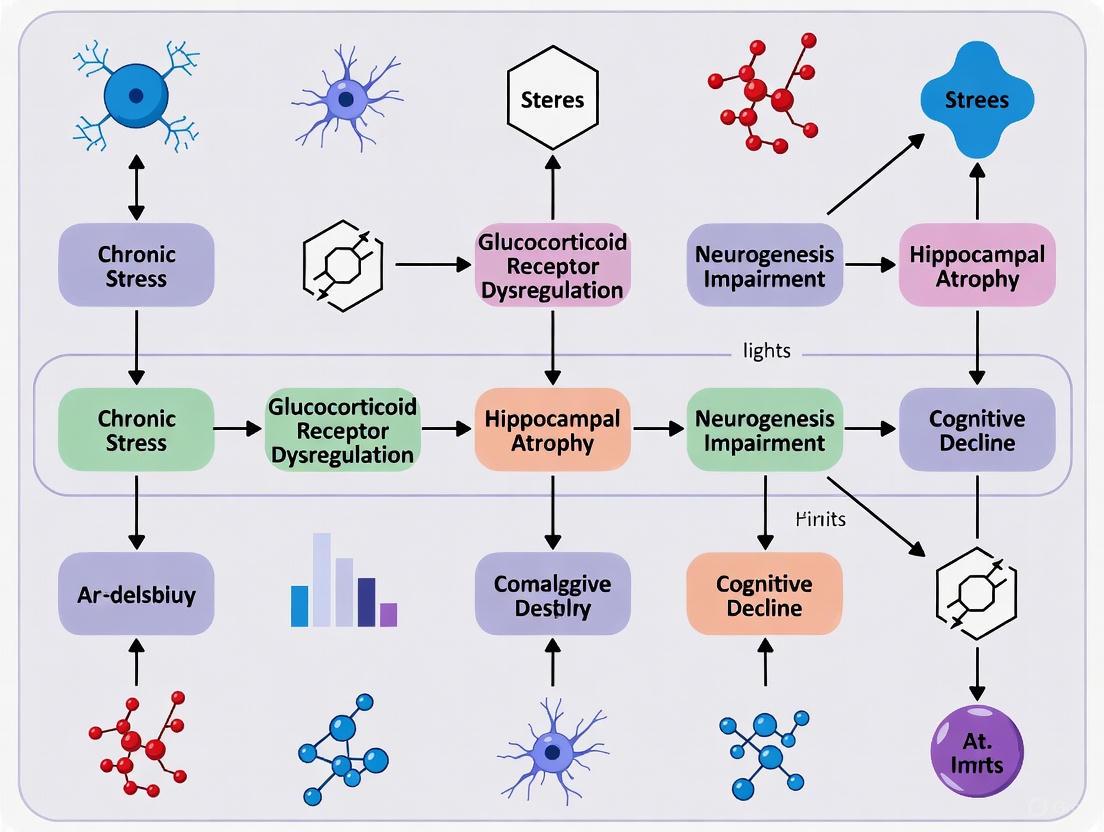
This article synthesizes current research on the impact of chronic stress on hippocampal function, tailored for researchers, scientists, and drug development professionals.
Chronic Stress and Hippocampal Dysfunction: Mechanisms, Models, and Therapeutic Avenues for Drug Development
Abstract
This article synthesizes current research on the impact of chronic stress on hippocampal function, tailored for researchers, scientists, and drug development professionals. It explores the foundational mechanisms by which chronic stress impairs hippocampal structure and synaptic plasticity, detailing the roles of the HPA axis, glucocorticoid signaling, and dendritic remodeling. The review further examines established and emerging methodological approaches in both animal models and human studies for investigating these effects. It discusses challenges in translating preclinical findings and explores potential therapeutic optimization strategies, including insulin signaling potentiation and anti-glucocorticoid treatments. Finally, it validates and compares findings across different stress paradigms and species, highlighting convergent pathways and their implications for developing novel interventions for stress-related cognitive disorders.
Unraveling the Core Mechanisms: How Chronic Stress Remodels Hippocampal Structure and Function
The hippocampus, a brain structure vital for learning, memory formation, and spatial navigation, is a primary target for glucocorticoids (GCs), the steroid hormones released in response to stress. Its high concentration of corticosteroid receptors makes it exceptionally sensitive to fluctuating hormone levels [1]. The response of the hippocampus to glucocorticoids follows a biphasic pattern; acute exposure facilitates essential adaptive processes, while chronic exposure triggers pathophysiological mechanisms that can lead to long-term structural and functional impairment [2] [3]. This whitepaper synthesizes current research on these mechanisms, framing the findings within a broader thesis on the impact of chronic stress on hippocampal function, with direct implications for neurodegenerative and psychiatric disease research and drug development.
Molecular Mechanisms of Glucocorticoid Signaling
Glucocorticoids exert their effects on the hippocampus via two receptor types: high-affinity mineralocorticoid receptors (MRs) and lower-affinity glucocorticoid receptors (GRs). This dual-receptor system allows the hippocampus to respond to a wide range of hormone concentrations, mediating different effects depending on the level of exposure [2].
Receptor-Mediated Signaling Pathways
- Mineralocorticoid Receptors (MRs): MRs are predominantly occupied under basal, non-stress conditions. They are essential for maintaining neuronal excitability, stability, and are implicated in the appraisal of sensory information and the selection of appropriate behavioral responses.
- Glucocorticoid Receptors (GRs): GRs become increasingly occupied as glucocorticoid levels rise during stress. Their activation facilitates memory consolidation of the stressful event and helps terminate the stress response via negative feedback on the hypothalamic-pituitary-adrenal (HPA) axis.
The balance between MR and GR signaling is critical for hippocampal homeostasis. A shift in this balance, particularly towards predominant GR activation during chronic stress, is thought to underlie the transition from adaptive to maladaptive responses [2].
Key Molecular Pathways and Interactions
The molecular response to glucocorticoids involves complex interactions with various signaling systems. The diagram below outlines the core signaling pathway and its primary outcomes.
Chronic glucocorticoid exposure induces a state of generalized metabolic vulnerability in hippocampal neurons [3]. This state sensitizes them to various metabolic insults, a mechanism demonstrated by the potentiation of damage from neurotoxins like kainic acid and 3-acetylpyridine. Glucocorticoids do not directly increase the diffusion or binding of these toxins but rather reduce the capacity of neurons to withstand the ensuing metabolic challenge [3]. Furthermore, GC signaling exhibits bidirectional interactions with the hypothalamic-pituitary-gonadal (HPG) axis. In depression, for instance, HPA axis hyperactivity is often paralleled by a diminished HPG axis, with lower estrogen in women and lower testosterone in men, which may contribute to the higher prevalence of mood disorders [2].
From Acute Adaptation to Chronic Dysregulation
Acute Adaptive Responses
Short-term, acute increases in glucocorticoids are essential for survival and cognitive function. They facilitate a rapid energy mobilization, enhance memory consolidation for emotionally salient events, and, through negative feedback on the HPA axis, promote recovery to physiological baseline. This is achieved through rapid non-genomic actions and traditional genomic effects that modulate the expression of genes involved in synaptic plasticity, such as those supporting long-term potentiation (LTP) [1].
The Transition to Chronic Toxicity and HPA Axis Dysregulation
Prolonged glucocorticoid exposure leads to a transition from adaptation to toxicity, primarily driven by dysregulation of the HPA axis. In major depression, for example, the HPA axis is hyperactive at all levels, characterized by strongly activated corticotropin-releasing hormone (CRH) neurons and increased production of vasopressin, which potentiates CRH's effect on ACTH release [2]. This results in sustained high levels of cortisol.
A key feature of this dysregulation is the impairment of glucocorticoid-mediated negative feedback. The hippocampus, a primary site for this feedback, becomes less effective at inhibiting HPA axis activity, potentially due to glucocorticoid receptor down-regulation or resistance, creating a vicious cycle of continued HPA axis activation and further hippocampal exposure to high GC levels [2] [1]. This state is often associated with elevated central CRH, which is hypothesized to originate not only from the paraventricular nucleus but also from other CRH pathways that may directly contribute to the symptoms of depression [2].
Table 1: Key Contrasts Between Acute and Chronic Glucocorticoid Exposure in the Hippocampus
| Feature | Acute Exposure (Adaptive) | Chronic Exposure (Maladaptive) |
|---|---|---|
| HPA Axis Function | Transient activation with efficient negative feedback | Persistent hyperactivity and impaired negative feedback [2] |
| Cellular Energy | Mobilization to meet immediate demand | State of generalized metabolic vulnerability [3] |
| Synaptic Plasticity | Facilitation of memory consolidation via LTP | Impairment of LTP and disruption of synaptic plasticity [1] |
| Structural Integrity | Transient, reversible changes in neuronal structure | Reduced dendritic complexity, decreased spine density [1] |
| Neurogenesis | Context-dependent modulation | Significant suppression of adult-born neuron survival [4] [1] |
Structural and Functional Consequences of Chronic Exposure
Quantitative Structural and Functional Changes in Hippocampal Networks
Advanced neuroimaging and electrophysiological techniques have quantitatively detailed the impact of chronic stress and GC exposure on the hippocampus and connected limbic structures. These changes are evident in both clinical populations and animal models.
Table 2: Quantitative Structural and Functional Changes in Hippocampal Circuitry
| Parameter | Experimental Condition | Change | Quantitative Measurement & Significance |
|---|---|---|---|
| Hippocampal Volume | Mesial Temporal Lobe Epilepsy (HS) [5] | Atrophy | Mann-Whitney U: 7.61, P<0.01 (MRI-positive); U: 6.51, P<0.01 (MRI-negative) |
| Amygdala Volume | Mesial Temporal Lobe Epilepsy (HS) [5] | Decrease | Mann-Whitney U: 2.92, P<0.05 |
| Intra-hippocampal FC | Hippocampal Sclerosis [5] | Increase | Student's t: 2.58, P=0.03 (Increased EEG synchronization) |
| Hippocampus-Amygdala FC | Hippocampal Sclerosis [5] | Decrease | Student's t: 3.33, P=0.01 (Decreased coupling) |
| Neuronal Connectivity | Chronic Mild Stress (Animal Model) [4] | Disruption | Significant impairment of intra- and extra-hippocampal inputs to dentate gyrus |
Cellular and Network-Level Alterations
At the cellular level, chronic glucocorticoid exposure targets several key processes. Adult hippocampal neurogenesis in the dentate gyrus is particularly vulnerable, with chronic stress significantly reducing the proliferation and survival of adult-born neurons (hABNs) [4] [1]. These hABNs possess unique plasticity and are critical for pattern separation and cognitive flexibility; their loss disrupts the balance of hippocampal neuronal networks [4]. Furthermore, chronic stress leads to dendritic remodeling, characterized by the retraction of apical dendrites and a reduction in dendritic spine density, particularly in the CA3 subfield [1]. This results in a simplification of the neuronal arbor and a loss of synaptic connections.
These cellular changes manifest at the network level as altered functional connectivity (FC). As shown in Table 2, conditions like hippocampal sclerosis feature increased synchronization within the hippocampus but decreased coupling between the hippocampus and amygdala [5]. This disruption of large-scale network communication underpins the cognitive and emotional deficits observed in stress-related disorders. The following diagram synthesizes the core experimental findings and consequences of chronic exposure.
Experimental Models and Methodologies
Key Experimental Protocols
Research into glucocorticoid toxicity relies on well-established in vivo models and precise histological and molecular analyses.
Chronic Mild Stress (CMS) Paradigm:
- Purpose: To model the effects of chronic, unpredictable low-grade stress on neurobiology and behavior in rodents.
- Protocol: Rats or mice are exposed to a series of mild, unpredictable stressors (e.g., cage tilt, damp bedding, paired caging, periods of food/water restriction, white noise) on a variable schedule over several weeks (typically 4-8 weeks). This unpredictability prevents habituation.
- Outcome Measures: Subsequent analysis includes sucrose preference test (anhedonia), forced swim test (behavioral despair), and cognitive tests like the Morris water maze. Post-mortem, brains are analyzed for changes in neurogenesis (BrdU/NeuN staining), dendritic morphology (Golgi-Cox staining), and synaptic protein expression [4].
Glucocorticoid Potentiation of Neurotoxin-Induced Damage:
- Purpose: To test the hypothesis that GCs sensitize hippocampal neurons to metabolic insult [3].
- Protocol: Rats are assigned to three groups: adrenalectomized (to remove endogenous GCs), intact, or treated with corticosterone to produce high physiological titers. After one week, unilateral hippocampal microinfusions of a neurotoxin (e.g., kainic acid or 3-acetylpyridine) are performed at doses calibrated to produce small lesions.
- Outcome Measures: The extent of hippocampal damage is quantified histologically and compared across groups. This protocol demonstrated that CORT exacerbates, while adrenalectomy attenuates, neurotoxin-induced damage, confirming the "metabolic vulnerability" mechanism [3].
Ablation of Adult Neurogenesis:
- Purpose: To directly investigate the causal role of adult-born neurons in hippocampal function and stress pathology.
- Protocol: Transgenic GFAP-Tk rats are used, where the herpes simplex virus thymidine kinase (HSV-TK) is expressed under the GFAP promoter. Administration of the antiviral drug valganciclovir is converted to a toxic compound in dividing GFAP+ progenitor cells, leading to their death and the specific ablation of adult neurogenesis without affecting development.
- Outcome Measures: Viral-mediated retrograde tracing is used to quantify changes in synaptic inputs to mature neurons and adult-born neurons in the dentate gyrus, revealing how neurogenesis ablation disrupts local and long-range connectivity [4].
The Scientist's Toolkit: Essential Research Reagents
Table 3: Key Reagents and Models for Investigating Glucocorticoid Effects
| Reagent / Model | Function/Description | Experimental Application |
|---|---|---|
| GFAP-Tk Transgenic Rat | Allows targeted ablation of dividing glial fibrillary acidic protein (GFAP+) cells, including neural stem cells [4]. | Selectively ablates adult hippocampal neurogenesis to study its role in network function and stress response. |
| Corticosterone (CORT) | The primary endogenous glucocorticoid in rodents [3]. | Administered exogenously (in drinking water, pellets, or injections) to mimic chronic high physiological or stress-level GC exposure. |
| Kainic Acid (KA) | A potent glutamate receptor agonist that induces excitotoxic neuronal death [3]. | Used in microinfusion studies to model metabolic insult and test GC-mediated potentiation of damage. |
| Unpredictable Chronic Mild Stress (uCMS) | A rodent model involving variable, mild stressors over weeks [4]. | Models the etiology of depression and investigates the neurobiological sequelae of chronic stress. |
| Fluoxetine | A selective serotonin reuptake inhibitor (SSRI) antidepressant [4]. | Used to probe mechanisms of recovery and restoration of hippocampal function and connectivity post-stress. |
| Virus-Mediated Retrograde Tracing | Uses engineered viruses (e.g., rabies) that travel backwards across synapses [4]. | Maps detailed changes in neuronal connectivity (connectome) to mature neurons and hABNs following manipulations. |
Implications for Drug Development and Future Research
The elucidated mechanisms provide clear targets for therapeutic intervention. The finding that the antidepressant fluoxetine can restore hippocampal network function disrupted by chronic stress, albeit with sex-specific effects, underscores the importance of targeting neuroplasticity pathways [4]. Furthermore, the central role of CRH and the HPA axis in driving hippocampal pathology suggests that CRH receptor antagonists remain a viable, though challenging, area of investigation. The interaction between the HPA and HPG axes suggests that sex hormone replacement therapy may have a role in managing mood disorders in specific populations, such as the elderly [2].
Future research must focus on several key areas:
- Critical Periods: Elucidating critical periods of vulnerability to glucocorticoid toxicity across the lifespan [1].
- Sex Differences: Systematically investigating the biological bases for sex-specific differences in stress responses and treatment outcomes, as indicated by findings that fluoxetine's restorative effects are sex-specific [4].
- Network Resolution: Moving beyond regional volume studies to understand functional circuit dynamics using high-resolution connectomics and electrophysiology.
- Human Translation: Correlating clinical imaging and biomarker data with post-mortem molecular analyses to confirm the mechanisms observed in animal models, particularly the lack of massive cell loss and the presence of adaptive, reversible changes in the human hippocampus in depression [2].
Chronic stress exerts a profound siege on the structural plasticity of the brain, particularly targeting the hippocampus, a region vital for memory, learning, and emotional regulation. This technical review synthesizes current mechanistic insights into how chronic stress triggers the retraction of dendrites and the loss of dendritic spines in hippocampal subregions such as CA3 and CA1. We detail the orchestration of these structural changes by glucocorticoid hormones, corticotropin-releasing hormone (CRH), glutamate-mediated excitotoxicity, and downstream cytoskeletal destabilizing actors. The review further presents standardized quantitative data on these morphological alterations, outlines critical experimental protocols for their investigation, and defines the key signaling pathways involved. Finally, we catalog essential research reagents and tools, providing a resource for scientists aiming to develop novel therapeutic interventions to bolster hippocampal resilience against the ravages of chronic stress.
The hippocampus has served as the foundational model for elucidating the interactions between stress and brain structural and functional plasticity [6]. The discovery of adrenal steroid receptors in the hippocampal formation was a pivotal moment, revealing that the brain is a key target organ for stress hormones and opening the door to understanding how these hormones mediate structural remodeling [6] [7]. This initial focus on the hippocampus has since expanded to encompass interconnected brain regions like the amygdala and prefrontal cortex, providing a circuit-level understanding of stress pathology [6].
Chronic stress exposure leads to a pronounced recalibration of hippocampal neural networks, not through massive neuronal death in its initial phases, but through the more subtle, yet functionally devastating, mechanisms of dendritic atrophy and synaptic loss [8] [9]. These changes are now understood to be core contributors to the cognitive and emotional dysregulation observed in stress-related psychiatric disorders and during aging [6]. The structural plasticity of the hippocampus—its ability to change the physical shape and connectivity of its neurons in response to experience—is thus under direct assault during chronic stress, a process that this review will dissect in molecular and methodological detail.
Core Structural Pathologies: Dendritic Retraction and Spine Loss
Chronic stress triggers a systematic dismantling of the neuronal architecture within specific hippocampal subfields. The most consistent morphological alterations are summarized in the table below.
Table 1: Quantitative Profiling of Chronic Stress-Induced Structural Pathologies in the Hippocampus
| Hippocampal Subregion | Structural Pathology | Quantitative Change | Experimental Model | Citation |
|---|---|---|---|---|
| CA3 Pyramidal Neurons | Dendritic retraction (apical dendrites) | Robust shortening and debranching | Rat (Chronic Restraint Stress) | [6] |
| CA1 Pyramidal Neurons | Spine synapse loss | Significant reduction | Rat (Multimodal Stress) | [6] |
| CA1 Pyramidal Neurons | Dendritic retraction | Robust retraction | Mouse (Chronic Immobilization Stress) | [6] |
| Dentate Gyrus | Suppressed neurogenesis | Reduced cell proliferation & survival | Rodent (Chronic Unpredictable Stress) | [9] |
| Hippocampus (Overall) | Volume reduction | ~10-15% decrease | Human (Major Depression) | [9] |
The CA3 region is notably vulnerable, showing significant shrinkage of the apical dendritic tree after chronic restraint stress in rats [6]. This retraction is not an isolated event but is accompanied by a profound loss of dendritic spines, the post-synaptic sites of excitatory connections. Remarkably, this spine loss can occur within hours of stress onset, indicating a rapid and active disassembly process [10]. The CA1 region is also a target, with specific stress paradigms leading to severe reductions in synapse numbers and dendritic complexity [6]. Furthermore, the ongoing neurogenesis in the adult dentate gyrus is potently suppressed by chronic stress, affecting multiple phases of the neurogenic process from progenitor proliferation to newborn neuron survival [9]. In the human brain, these cellular changes are reflected in an approximate 10-15% reduction in hippocampal volume observed in individuals with major depression [9].
Molecular Siege Engines: Signaling Pathways Mediating Structural Damage
The structural collapse of hippocampal neurons is executed by a coordinated set of molecular pathways activated by the stress response.
The Central Glucocorticoid Pathway
The hypothalamic-pituitary-adrenal (HPA) axis is the primary engine of the neuroendocrine stress response. Its end-product glucocorticoids (cortisol in humans, corticosterone in rodents) exert complex, biphasic effects on hippocampal plasticity primarily via two intracellular receptors: the high-affinity mineralocorticoid receptor (MR) and the lower-affinity glucocorticoid receptor (GR) [6] [9]. Under chronic stress, persistent GR activation drives many of the detrimental structural changes. GR signaling inhibits long-term potentiation (LTP) and is implicated in stress-induced dendritic remodeling [6] [7]. The opposing actions of MR (often pro-plasticity) and GR (often homeostatic or suppressive) help determine the net neuronal outcome, with chronic stress skewing this balance toward GR-mediated atrophy [9].
The CRH-CRFR1 Axis
Beyond glucocorticoids, the neuropeptide corticotropin-releasing hormone (CRH), released from hippocampal interneurons during stress, acts as a direct local mediator of spine loss. CRH binds to its receptor, CRFR1, on pyramidal cell dendrites [10]. Activation of CRFR1 triggers a rapid and reversible acceleration of spine retraction by destabilizing the spine's actin cytoskeleton, without affecting the formation of new spines [10]. This pathway is critical, as blocking CRFR1 abolishes stress-induced spine loss in vivo [10].
Glutamate and Excitatory Signaling
Stress hormones and neurotransmitters do not work in isolation. Glucocorticoids and CRH can enhance glutamate release and NMDA receptor (NMDAR) activity [6] [9]. The resulting excessive calcium influx activates enzymes like calcineurin, which in turn activates the actin-severing protein cofilin [11]. Cofilin dismantles the F-actin network that provides the structural scaffold for dendritic spines, leading to their shrinkage and elimination [10] [11]. This pathway is a final common mechanism for spine loss, also engaged by NMDAR-dependent long-term depression (LTD) protocols [11].
Table 2: Key Molecular Mediators of Stress-Induced Structural Plasticity
| Molecular Mediator | Primary Function | Effect of Chronic Stress | Net Structural Impact |
|---|---|---|---|
| Glucocorticoid Receptor (GR) | Genomic steroid hormone receptor | Persistent activation | Dendritic retraction, impaired LTP |
| Corticotropin-Releasing Hormone (CRH) | Neuropeptide released during stress | Increased release and CRFR1 activation | Rapid spine loss via actin destabilization |
| NMDA Receptor (NMDAR) | Glutamate-gated ion channel | Enhanced activation/function | Excessive calcium influx, spine shrinkage |
| Cofilin | Actin-binding protein, severs F-actin | Activated via dephosphorylation | Cytoskeletal disassembly, spine loss |
| Brain-Derived Neurotrophic Factor (BDNF) | Trophic factor supporting neuron health | Expression often decreased | Reduced support for dendritic growth/spines |
The following diagram synthesizes these core pathways into a unified signaling network driving dendritic retraction and spine loss.
Diagram Title: Core Signaling Pathways in Stress-Induced Hippocampal Damage
The Scientist's Toolkit: Research Reagent Solutions
To dissect the mechanisms outlined above, researchers rely on a specific toolkit of reagents, model systems, and analytical techniques.
Table 3: Essential Research Reagents and Models for Investigating Stress-Induced Plasticity
| Tool / Reagent | Function/Description | Example Application | Citation |
|---|---|---|---|
| CRFR1 Antagonist (e.g., NBI 30775) | Selectively blocks the CRH receptor type 1. | Used in vivo and in slice cultures to demonstrate CRH's specific role in spine loss. | [10] |
| GR Antagonist (e.g., RU486) | Blocks the glucocorticoid receptor. | Blocks stress-induced contextual fear memory and components of dendritic remodeling. | [6] |
| Thy1-YFP Transgenic Mice | Fluorescently labels subsets of pyramidal neurons. | Enables high-resolution confocal imaging and quantification of dendritic spines in vitro and ex vivo. | [10] |
| CRFR1 Knockout Mice | Genetic deletion of the CRFR1 receptor. | Used to demonstrate increased baseline spine density and resilience to stress-induced spine loss. | [10] |
| Chronic Unpredictable Mild Stress (CUMS) | Rodent model involving varied, mild stressors. | Induces depressive-like behaviors and hippocampal metabolic changes; used for antidepressant screening. | [12] |
| UPLC-MS/MS | Ultra-performance liquid chromatography with tandem mass spectrometry. | Used for metabolomic and lipidomic profiling of hippocampal tissue from stressed animals. | [12] |
| Two-Photon Glutamate Uncaging | Precise, localized activation of individual spines. | Used to study input-specific spine shrinkage mechanisms and the role of NMDARs/mGluRs. | [11] |
Detailed Experimental Protocols
To ensure reproducibility and provide a clear methodological reference, we outline two key protocols from the cited literature.
Protocol: Chronic Unpredictable Mild Stress (CUMS) Model
The CUMS model is a gold standard for inducing a depressive-like phenotype in rodents and studying subsequent hippocampal alterations [12].
- Animals: Utilize 8-week-old male Sprague-Dawley rats. House under standard conditions with ad libitum access to food and water prior to stress induction.
- Stress Regimen: Over a period of four weeks, expose animals to a randomized sequence of two different mild stressors per day. The regimen must be unpredictable to prevent habituation.
- Stressors: The protocol includes a variety of physical and psychological stressors:
- Food and water deprivation for 24 hours.
- Cage tilting at a 45° angle for 24 hours.
- Crowded housing for 24 hours.
- Placement in an empty water bottle for 4 hours.
- Tail clipping for 1 minute.
- Exposure to noise for 20 minutes.
- Forced swimming in 25°C water for 10 minutes.
- Day/night reversal (12h/12h).
- Behavioral Validation: Following the stress period, validate the depressive-like phenotype using:
- Sucrose Preference Test (SPT): Measures anhedonia. A significant reduction in sucrose preference compared to unstressed controls is expected.
- Forced Swim Test (FST): Measures behavioral despair. A significant increase in immobility time is expected.
- Tissue Collection: Euthanize animals and rapidly dissect the hippocampus on an ice-cold surface. Rinse with saline, snap-freeze in liquid nitrogen, and store at -80°C for subsequent molecular or biochemical analysis (e.g., metabolomics, Western blot).
Protocol: Assessing Spine Dynamics with Live Imaging
This protocol, adapted from Chen et al., details the use of organotypic hippocampal slices and live imaging to visualize the direct impact of CRH on spine dynamics [10].
Slice Culture Preparation:
- Prepare hippocampal slice cultures (300 µm thick) from postnatal day 1-14 Thy1-YFP transgenic mice, which express yellow fluorescent protein in a subset of pyramidal neurons.
- Culture slices on membrane inserts in serum-containing medium at 36°C in a 5% CO₂ atmosphere for 4-14 days in vitro (DIV).
Pharmacological Manipulation:
- For acute drug application, add synthetic rat/human CRH (100 nM) directly to the culture medium.
- To demonstrate specificity, pre-treat or co-apply a CRFR1 antagonist (e.g., NBI 30775, 1 µM).
Live Imaging and Analysis:
- Transfer cultures to a temperature-controlled superfusion chamber (36°C) on an upright microscope equipped with a two-photon laser.
- Select YFP-positive CA3 pyramidal neurons and image secondary or tertiary apical dendritic segments at high magnification.
- Acquire z-stack images (e.g., 12-16 optical slices, 2 µm each) at defined time intervals (e.g., every 5-10 minutes) before and after drug application.
- Analyze spine density and dynamics (rates of formation, retraction, and stability) by comparing the same dendritic segments across time points.
Fixation and Immunocytochemistry (Optional):
- After live imaging, fix cultures in 4% paraformaldehyde for 30 minutes.
- Process for immunocytochemistry (e.g., for F-actin using phalloidin or for activated cofilin) to corroborate live-imaging findings.
Discussion and Future Research Directions
The evidence is compelling that chronic stress lays siege to hippocampal structural plasticity through a multi-pronged attack involving glucocorticoid and CRH signaling, excitatory amino acids, and cytoskeletal collapse. A critical insight is that these changes are often reversible, representing a state of neuronal dormancy or dedifferentiation rather than an irrevocable loss of cells [8] [9]. This plasticity offers a fundamental rationale for therapeutic intervention.
Future research must continue to elucidate the detailed epigenetic and non-genomic mechanisms that translate stress hormone signaling into structural changes [6]. Furthermore, the exploration of non-pharmacological interventions, such as meditation, which has been shown to reduce functional connectivity between the posterior cingulate cortex and the hippocampus in correlation with improved stress biomarkers, represents a promising frontier [13]. Ultimately, the findings from mechanistic preclinical studies must be translated into novel therapeutic strategies that protect or rebuild hippocampal circuitry, thereby mitigating the cognitive and emotional consequences of chronic stress.
Synaptic plasticity, the activity-dependent modification of synaptic strength, is fundamental to learning and memory. Long-term potentiation (LTP) and long-term depression (LTD) represent the principal cellular models for investigating these processes. Within the context of chronic stress research, a pronounced disruption of the equilibrium between LTP and LTD emerges as a critical pathological feature. Chronic stress exposure instigates a cascade of neurobiological events that impair LTP while concurrently facilitating LTD within the hippocampus, a structure vital for memory and highly vulnerable to stress. This whitepaper provides an in-depth technical analysis of the mechanisms underlying stress-induced synaptic dysfunction, details experimental methodologies for its investigation, and discusses the implications for therapeutic development, providing a comprehensive resource for researchers and drug development professionals.
The hippocampus, a key structure in the medial temporal lobe, is integral to the formation of declarative memories and exhibits remarkable synaptic plasticity. Long-term potentiation (LTP), a long-lasting increase in synaptic efficacy following high-frequency stimulation, and long-term depression (LTD), a long-lasting decrease following low-frequency stimulation, are considered the primary cellular models for learning and memory [14] [15]. The delicate balance between LTP and LTD is essential for cognitive function, enabling both the encoding of new information and the selective weakening of synapses to prevent saturation [15]. Chronic stress, characterized by prolonged and uncontrollable exposure to stressors, disrupts this homeostatic balance. A substantial body of evidence from animal and human studies indicates that chronic stress precipitates hippocampal dendritic atrophy, suppresses neurogenesis, and alters the functional properties of synapses, leading to a pathological state where LTP is suppressed and LTD is enhanced [16] [17] [18]. This synaptic dysfunction is a strong candidate mechanism underlying the cognitive deficits, particularly in hippocampal-dependent memory tasks, observed in stress-related psychopathologies such as major depressive disorder (MDD) [17] [18] [19].
Molecular Mechanisms of Stress-Induced Synaptic Dysfunction
The shift in the LTP/LTD balance following chronic stress is mediated by complex, interacting molecular pathways. Key mechanisms involve glucocorticoid receptor signaling, glutamate receptor trafficking, and intracellular phosphatase/kinase activity.
Glucocorticoid and NMDA Receptor Interactions
The hypothalamic-pituitary-adrenal (HPA) axis is a primary mediator of the stress response. Chronic stress leads to sustained elevation of glucocorticoids (cortisol in humans, corticosterone in rodents), which exert profound effects on the hippocampus, a region dense with corticosteroid receptors [17]. Glucocorticoids interact with the glutamatergic system, particularly N-methyl-D-aspartate receptors (NMDARs). The magnitude of calcium influx through postsynaptic NMDARs is a critical determinant for whether LTP or LTD is induced; moderate rises in calcium preferentially trigger LTD, while larger increases are required for LTP [15] [17]. Chronic stress appears to modulate NMDAR function, particularly altering the ratio of regulatory subunits NR2A and NR2B. For instance, one study found a significant reduction in hippocampal NR2B subunit levels in a chronic social defeat stress model of depression, which was correlated with impaired LTP [20]. This change can bias the system toward the lower calcium influx associated with LTD induction.
Signaling Cascades and Receptor Trafficking
The intracellular consequences of altered calcium influx are executed by a network of kinases and phosphatases. LTP induction is typically associated with the activation of kinases such as calcium/calmodulin-dependent protein kinase II (CaMKII) and protein kinase C (PKC). In contrast, LTD arises from the activation of calcium-dependent phosphatases, primarily calcineurin [15]. Chronic stress-induced calcium levels preferentially activate calcineurin, which dephosphorylates target proteins, leading to the internalization of synaptic α-amino-3-hydroxy-5-methyl-4-isoxazolepropionic acid receptors (AMPARs) via clathrin-mediated endocytosis [15] [18]. This removal of AMPARs from the postsynaptic membrane reduces the synapse's responsiveness to glutamate, manifesting as LTD and a weakening of synaptic strength. The facilitation of this process under chronic stress provides a direct mechanistic link to enhanced LTD.
Table 1: Key Molecular Changes in Hippocampal Synaptic Plasticity Induced by Chronic Stress
| Molecular Component | Function | Change with Chronic Stress | Functional Consequence |
|---|---|---|---|
| Glucocorticoids | Stress hormones acting on hippocampal receptors | Sustained elevated levels [17] | Increased susceptibility to LTD, impaired LTP induction |
| NMDA Receptors | Mediate calcium influx, trigger plasticity | Altered subunit composition (e.g., reduced NR2B) [20] | Biased signaling toward LTD pathways |
| AMPARs | Mediate fast excitatory synaptic transmission | Increased internalization [15] | Weakened synaptic strength (LTD) |
| Kinases (e.g., CaMKII, PKC) | Phosphorylate proteins to strengthen synapses | Activity suppressed [21] | Impaired LTP expression and maintenance |
| Phosphatases (e.g., Calcineurin) | Dephosphorylate proteins to weaken synapses | Activity enhanced [15] | Facilitated LTD expression |
Structural Correlates of Synaptic Dysfunction
Chronic stress does not only impair functional plasticity but also induces structural remodeling of hippocampal neurons. A well-replicated finding is the atrophy of the apical dendrites of CA3 pyramidal neurons following chronic stress [16] [19]. This dendritic retraction is associated with a loss of synaptic contacts and is consistent with the observed deficits in synaptic plasticity and spatial memory. Current-source-density (CSD) analysis has revealed chronic stress-induced shifts in current sources and sinks in the apical dendrites and pyramidal cell layers of the CA3 field, indicating altered information flow through the hippocampal circuit [16]. These structural changes are thought to represent the anatomical substrate for the persistent cognitive deficits observed in chronic stress and depression.
Experimental Models and Quantitative Findings
Research into stress-related synaptic dysfunction employs a variety of well-established animal models and electrophysiological protocols.
Chronic Stress Models and Electrophysiological Recordings
The chronic restraint stress model involves subjecting rodents to daily restraint for several weeks (e.g., 6 hours/day for 21 days). Electrophysiological assessment of hippocampal slices from these animals 48 hours post-stress reveals a site-specific suppression of LTP. Specifically, LTP is significantly reduced in the medial perforant path input to the dentate gyrus (DG) and the commissural/associational input to the CA3 region, but not in the mossy fiber input to CA3 [16]. This indicates that chronic stress does not uniformly impair all hippocampal synapses.
The chronic social defeat stress (CSDS) model is another validated paradigm for inducing a depression-like phenotype. Mice exposed to CSDS show significant reductions in spatial working memory and contextual fear memory. Electrophysiologically, these mice exhibit decreased LTP amplitude and reduced NMDA receptor-mediated excitatory postsynaptic currents (EPSCs) in the hippocampus [20].
In vivo electrophysiology in anesthetized animals allows for the study of synaptic plasticity in a more intact system. Studies using the Wistar-Kyoto (WKY) rat, a model of depression vulnerability and antidepressant resistance, have demonstrated significantly impaired LTP in the dorsal hippocampal Schaffer collateral-CA1 pathway compared to control Wistar rats [22].
Table 2: Summary of Experimental Data from Chronic Stress Studies
| Experimental Model | LTP Measurement | LTD Measurement | Key Behavioral/Molecular Correlation |
|---|---|---|---|
| Chronic Restraint Stress (Rat) | ↓ LTP in DG & CA3 (commissural/associational path) [16] | Not explicitly measured | Dendritic atrophy in CA3; spatial memory deficits [16] |
| Chronic Social Defeat Stress (Mouse) | ↓ LTP amplitude in hippocampus [20] | Not explicitly measured | Impaired spatial working & contextual fear memory; reduced NR2B protein [20] |
| WKY Rat (Genetic Model) | ↓ LTP in dHPC SC-CA1 pathway [22] | Not explicitly measured | Impaired long-term spatial memory; resistant to conventional antidepressants [22] |
| Acute Inescapable Stress (Rat) | Impaired CA1 LTP [18] | Facilitated CA1 LTD [18] | Demonstrates psychological (uncontrollable) nature of stress effect [17] [18] |
Visual LTP in Human Studies
Non-invasive methods have been developed to study LTP-like synaptic plasticity in humans. These paradigms use visual evoked potentials (VEPs), where high-frequency visual stimulation is used to induce persistent modulation of VEP amplitudes, a proxy for LTP. Studies have found that this LTP-like visual synaptic plasticity is negatively associated with self-reported symptoms of depression and stress in healthy adults [21]. Furthermore, patients with Major Depressive Disorder (MDD) show impaired LTP-like plasticity compared to healthy controls, supporting the translational relevance of animal findings [21].
Detailed Experimental Protocols
To ensure reproducibility and rigor in research, below are detailed methodologies for key experiments cited in this field.
Chronic Restraint Stress and Hippocampal Slice LTP Recording
This protocol is adapted from the seminal work on chronic stress effects on LTP [16].
- Animals: Adult male Sprague-Dawley or Wistar rats.
- Stress Paradigm: Subjects are restrained in well-ventilated tubes (6 hours daily for 21 days). Control animals are handled briefly but not restrained.
- Tissue Preparation: 48 hours after the last stress session, animals are sacrificed. The brain is rapidly removed and placed in ice-cold, oxygenated (95% O₂ / 5% CO₂) artificial cerebrospinal fluid (aCSF). Hippocampal slices (400 µm thick) are prepared using a tissue chopper or vibratome.
- Electrophysiology: Slices are maintained in an interface chamber perfused with aCSF at ~32°C. A stimulating electrode is placed in the medial perforant path (for DG recording) or the commissural/associational pathway (for CA3 recording). A recording electrode is placed in the DG granule cell layer or the CA3 stratum lucidum, respectively.
- LTP Induction: After obtaining a stable baseline of field excitatory postsynaptic potentials (fEPSPs) for at least 20 minutes, LTP is induced using a high-frequency stimulation (HFS) protocol (e.g., 3 trains of 100 Hz, 1-second duration, 20-second inter-train interval). fEPSPs are recorded for at least 60 minutes post-tetanus. LTP is quantified as the percent increase in the fEPSP slope relative to baseline.
In Vivo LTP Recording in Anesthetized Rats
This protocol is used to study LTP in a more intact circuit, as described in ketamine studies [22].
- Animals: Wistar-Kyoto (WKY) and control Wistar rats.
- Anesthesia: Rats are anesthetized with urethane (1.5 g/kg, i.p.) and placed in a stereotaxic frame.
- Electrode Implantation: A bipolar stimulating electrode is lowered into the Schaffer collateral (SC) pathway of the dorsal hippocampus. A recording electrode is lowered into the stratum radiatum of the CA1 region.
- Baseline and LTP Induction: Evoked fEPSPs are recorded. The stimulus intensity is set to elicit a response that is 50% of the maximum fEPSP amplitude. After a stable baseline is established (minimum 30 minutes), LTP is induced using a strong protocol (e.g., 4 trains of 100 Hz, each 1-second long, spaced 5 minutes apart).
- Drug Administration: To test potential therapeutics like ketamine (5 mg/kg, i.p.), the drug is administered at a specific time (e.g., 3.5 hours) before LTP induction to assess its facilitatory effects on the stress-induced deficit.
The Scientist's Toolkit: Research Reagent Solutions
Table 3: Essential Reagents and Tools for Investigating LTP/LTD in Stress Models
| Reagent / Tool | Function / Application | Example Use in Research |
|---|---|---|
| Ketamine HCl | Non-competitive NMDA receptor antagonist; rapid-acting antidepressant | Used at 5-10 mg/kg (i.p.) to probe rescue of stress-impaired LTP and memory deficits [20] [22]. |
| (2R,6R)-HNK | Ketamine metabolite; putative antidepressant without strong NMDAR affinity | Used to dissect mechanisms of ketamine's action on LTP (5 mg/kg, i.p.) [22]. |
| Urethane | Long-lasting general anesthetic | Used for sustained anesthesia during in vivo electrophysiology recordings [22]. |
| Subunit-specific NMDAR Antagonists (e.g., Ro 25-6981, NR2B selective) | Pharmacological probes to dissect NMDAR subunit function | Used to investigate the role of specific NMDAR subunits in stress-induced plasticity deficits [14]. |
| ACSF (Artificial Cerebrospinal Fluid) | Physiological solution to maintain live brain slices | The standard medium for in vitro electrophysiology experiments in hippocampal slices [16]. |
| Antibodies (NR1, NR2A, NR2B, pGluA1) | Protein detection and quantification via Western Blot | Used to measure stress- or drug-induced changes in receptor subunit expression and phosphorylation in hippocampal tissue [20]. |
Signaling Pathways and Workflow Visualizations
The following diagrams, generated using Graphviz DOT language, illustrate the core mechanisms and experimental workflows described in this whitepaper.
Stress-Induced Synaptic Dysfunction Pathway
LTP Rescue by Ketamine Experiment
Implications for Therapeutic Development
The understanding that synaptic dysfunction is a core component of stress-related disorders has opened new avenues for therapeutic intervention. The success of ketamine, a rapid-acting antidepressant, has been a landmark in this field. Ketamine's mechanism is attributed to its ability to restore synaptic connectivity, potentially by "resetting" the system through the engagement of synaptic plasticity processes [22]. Studies show that a single low dose of ketamine (5 mg/kg) can restore stress-impaired LTP and long-term spatial memory in rodent models, an effect that can last for hours to days [20] [22]. This effect is associated with increased levels of the NR2B subunit and enhanced NMDA receptor-mediated EPSCs in the hippocampus [20]. Interestingly, the metabolite (2R,6R)-HNK can also restore LTP and spatial memory, suggesting that not all therapeutic effects require direct, high-affinity NMDAR blockade [22]. These findings validate the LTP/LTD axis as a high-value target for drug development, shifting focus toward compounds that can directly modulate synaptic plasticity to counteract the effects of chronic stress.
Chronic stress induces a state of synaptic dysfunction in the hippocampus characterized by a clear imbalance between LTP and LTD. This imbalance, driven by glucocorticoid-mediated effects on glutamate receptor trafficking and associated signaling cascades, provides a compelling mechanistic explanation for the cognitive symptoms observed in stress-related psychiatric disorders. The use of established animal models and rigorous electrophysiological protocols continues to elucidate these complex mechanisms. Furthermore, the demonstrated ability of novel therapeutics like ketamine to reverse these synaptic deficits underscores the translational importance of this research. Future work should focus on identifying more precise molecular targets within these pathways to develop safer and more effective treatments that can restore healthy synaptic plasticity.
The mammalian hippocampus maintains the remarkable capacity to generate new neurons throughout adult life, a process confined to the dentate gyrus (DG) subregion within a specialized microenvironment known as the neurogenic niche. This niche consists of neural stem cells (NSCs) with radial glia-like morphology located in the subgranular zone (SGZ), which undergo a tightly regulated developmental sequence to become fully integrated granule neurons [23]. Under physiological conditions, adult hippocampal neurogenesis (AHN) contributes critically to hippocampal-dependent learning and pattern separation—the cognitive ability to distinguish between similar experiences [23]. However, this delicate regenerative process proves highly vulnerable to dysregulation under pathological conditions, particularly during chronic stress exposure.
Within the broader context of hippocampal function research, understanding how chronic stress disrupts AHN provides critical insights into the mechanisms underlying stress-related psychiatric disorders, including major depressive disorder (MDD). The hypothalamic-pituitary-adrenal (HPA) axis, when persistently activated by chronic stress, initiates a cascade of molecular and cellular events that ultimately compromise the structure and function of the hippocampal neurogenic niche [24]. This review synthesizes current evidence on the suppressive effects of chronic stress on AHN, detailing the mechanistic pathways involved, experimental approaches for investigation, and potential therapeutic strategies to mitigate these detrimental effects.
Mechanisms of Stress-Induced Suppression of Hippocampal Neurogenesis
Glucocorticoid Signaling and Direct Cellular Effects
Chronic stress triggers sustained release of glucocorticoids (cortisol in humans, corticosterone in rodents), which exert profound effects on hippocampal neurogenesis through multiple interconnected pathways:
Reduced Cell Proliferation: Acute stress exposure rapidly decreases the number of proliferating SGZ cells, as evidenced by reduced S-phase marker BrdU labeling immediately following social defeat stress [25]. This suppression affects the earliest stages of neurogenesis, particularly the expansion of neural progenitor populations.
Altered Neuronal Maturation: While the initial suppression of proliferation is transient, chronic stress induces long-lasting changes in neuronal maturation and integration. Newborn neurons in stressed animals exhibit impaired dendritic development, reduced spine density, and diminished structural complexity [26].
Corticosterone-Induced Neurotoxicity: In vitro studies demonstrate that corticosterone treatment directly induces neurotoxicity in primary hippocampal neurons through activation of autophagic cell death pathways rather than classical apoptosis, as indicated by increased LC3-II markers without cleaved caspase-3 activation [27].
Intracellular Signaling Pathway Disruption
Chronic stress impairs several critical signaling pathways essential for NSC maintenance and neuronal development:
Insulin Signaling Impairment: Chronic restraint stress downregulates hippocampal insulin signaling, reducing insulin receptor substrate (IRS-1) phosphorylation and subsequent Akt/mTOR activation [27]. This signaling pathway normally promotes neuronal survival, growth, and protein synthesis, with its impairment contributing to spatial memory deficits and nesting behavior abnormalities.
Autophagy Dysregulation: The autophagy process, essential for cellular homeostasis, becomes dysregulated under chronic stress conditions. NRBF2, a key component of the autophagy-initiating PIK3C3/VPS34 complex, shows significantly reduced expression in the DG following chronic social defeat stress (CSDS) [26]. This impairment disrupts normal autophagic flux in NSCs, ultimately depleting the stem cell pool.
Table 1: Key Molecular Alterations in the Hippocampal Neurogenic Niche Under Chronic Stress
| Molecular Component | Change | Functional Consequence | Reference |
|---|---|---|---|
| Corticosterone | Increased | Reduced cell proliferation, impaired maturation | [27] |
| NRBF2 | Decreased | Impaired autophagic flux, NSC depletion | [26] |
| Insulin Receptor Signaling | Downregulated | Memory deficits, impaired neuronal survival | [27] |
| LC3-II | Decreased | Reduced autophagosome formation | [26] |
| AMPA Receptor Subunits | Increased GluA2/3 | Altered excitatory transmission | [28] |
Neuroinflammatory and Systemic Effects
Beyond direct cellular actions, chronic stress triggers broader systemic changes that indirectly suppress neurogenesis:
HPA Axis Dysregulation: Persistent stress leads to dysfunctional cortisol regulation, which interacts with inflammatory pathways and generates oxidative stress, contributing to cellular damage within the hippocampal niche [24].
Neuroinflammation: Chronic stress activates microglial cells and promotes pro-inflammatory responses in the hippocampus, creating an environment hostile to neurogenesis. Aged animals show particularly pronounced inflammatory responses that correlate with impaired neurogenesis [23].
Glutamatergic Dysregulation: Chronic unpredictable mild stress increases expression of AMPA receptor subunits GluA2 and GluA3 in hippocampal subregions, altering excitatory transmission and potentially disrupting the delicate balance required for proper integration of newborn neurons [28].
Experimental Models and Methodological Approaches
Established Stress Paradigms
Research into stress effects on neurogenesis employs several well-validated animal models that recapitulate different aspects of chronic stress:
Chronic Social Defeat Stress (CSDS): This paradigm involves repeated exposure to aggressive conspecifics, inducing a robust depression-like phenotype including social avoidance. CSDS produces transient reductions in SGZ proliferation immediately following stress, followed by a compensatory increase in neurogenesis specifically in susceptible mice that display persistent social avoidance [25].
Chronic Restraint Stress (CRS): Animals are physically restrained for prolonged periods (typically 6 hours daily for 2 weeks), resulting in impaired spatial working memory, nesting behavior deficits, and downregulated hippocampal insulin signaling [27].
Chronic Unpredictable Mild Stress (CUMS): This protocol exposes animals to varying, unpredictable mild stressors (e.g., food deprivation, tail pinch, cold swim) over extended periods, leading to altered AMPA receptor subunit expression and spatial learning impairments that recover following stress cessation [28].
Table 2: Behavioral and Physiological Outcomes in Different Chronic Stress Models
| Stress Paradigm | Neurogenic Effects | Behavioral Outcomes | Recovery Potential |
|---|---|---|---|
| Social Defeat | Transient ↓ proliferation, later ↑ in susceptible mice | Social avoidance, anxiety-like behavior | Variable individual resilience |
| Restraint Stress | ↓ Neurogenesis, impaired neuronal maturation | Spatial memory deficits, impaired nesting | Requires intervention |
| Unpredictable Mild Stress | Altered glutamate receptors | Impaired spatial learning | Spontaneous recovery possible |
Assessment Techniques for Neurogenesis
State-of-the-art methodologies enable precise tracking and analysis of neurogenic processes:
Cell Proliferation and Fate Mapping: Thymidine analogs like bromodeoxyuridine (BrdU) label dividing cells to quantify proliferation rates and track cell fate over time [26]. Combining BrdU with cell-type-specific markers (Sox2/GFAP for NSCs, DCX for neuroblasts, NeuN for mature neurons) allows precise staging of neurogenic development.
Viral Vector-Based Lineage Tracing: Retroviruses expressing fluorescent proteins (e.g., RV-RFP) specifically label dividing cells and their neuronal progeny, enabling detailed morphological analysis of newborn neurons, including dendritic complexity and spine density [26].
Single-Cell RNA Sequencing: This high-resolution approach reveals transcriptional profiles of individual cells within the neurogenic lineage, identifying distinct developmental stages and stress-induced alterations in gene expression networks [23].
Autophagic Flux Measurement: Lentiviral vectors expressing GFP-LC3 allow visualization and quantification of autophagosomes in hippocampal cells, critical for assessing NRBF2-dependent autophagy regulation in NSCs [26].
The Scientist's Toolkit: Essential Research Reagents
Table 3: Key Research Reagents for Investigating Stress Effects on Neurogenesis
| Reagent/Method | Application | Experimental Function | Example Use |
|---|---|---|---|
| BrdU | Cell proliferation labeling | Labels DNA during S-phase, marks dividing cells | Quantifying SGZ proliferation rates after stress [25] |
| RV-RFP | Neuronal morphology analysis | Labels newborn neurons for structural analysis | Dendritic complexity of new neurons after CSDS [26] |
| LV-GFP-LC3 | Autophagy flux measurement | Marks autophagosomes for visualization and counting | Assessing autophagic structures in DG after stress [26] |
| LV-NRBF2 | Gene overexpression | Rescues NRBF2 function in NSCs | Reversing CSDS-induced neurogenesis deficits [26] |
| Corticosterone ELISA | HPA axis activity assessment | Quantifies serum corticosterone levels | Verifying stress response activation [28] |
| Single-cell RNA-seq | Transcriptomic profiling | Identifies cell-type-specific gene expression | Characterizing neurogenic lineage responses to stress [23] |
Recovery and Therapeutic Interventions
The suppression of neurogenesis by chronic stress is not necessarily irreversible, with both endogenous recovery mechanisms and therapeutic interventions demonstrating potential for restoration:
Spontaneous Recovery: Following cessation of chronic unpredictable mild stress, animals exhibit normalized corticosterone levels, restored spatial learning performance in Barnes maze tests, and recovery of glutamate receptor expression changes, indicating inherent plasticity and self-repair mechanisms [28].
Intranasal Insulin Delivery: This intervention bypasses the blood-brain barrier to directly restore hippocampal insulin signaling, rescuing spatial working memory deficits and improving nesting behavior in chronically stressed mice [27].
NRBF2 Overexpression: Lentiviral-mediated NRBF2 expression specifically in DG NSCs restores autophagic flux, increases the number of neural progenitors and neuroblasts, and reverses depression-like behaviors in CSDS-exposed mice [26].
Environmental Enrichment and Physical Activity: Although not covered in the available search results, extensive literature demonstrates that these non-pharmacological interventions potently stimulate neurogenesis and counteract stress effects, representing promising therapeutic avenues.
Visualizing Key Mechanisms and Methodologies
Signaling Pathway Diagram
Chronic Stress Signaling Pathway: This diagram illustrates the primary molecular pathways through which chronic stress suppresses adult hippocampal neurogenesis, including HPA axis activation, glucocorticoid signaling, insulin pathway impairment, and autophagy dysregulation, along with potential intervention points.
Experimental Workflow Diagram
Experimental Workflow for Investigating Stress Effects on Neurogenesis: This diagram outlines the comprehensive methodological approach for studying chronic stress effects on hippocampal neurogenesis, combining stress paradigms with molecular, cellular, behavioral, and lineage tracing analyses.
The suppression of adult hippocampal neurogenesis represents a central mechanism through which chronic stress exerts its detrimental effects on brain function and emotional well-being. The vulnerability of the neurogenic niche to stress involves multiple interconnected pathways, including glucocorticoid signaling, insulin pathway impairment, autophagy dysregulation, and neuroinflammation. Importantly, recent evidence demonstrates that these effects are not necessarily permanent, with both endogenous recovery mechanisms and targeted interventions showing promise for restoring neurogenic capacity.
Future research directions should focus on elucidating the precise temporal dynamics of neurogenic suppression across different stress paradigms, identifying key molecular switches that determine recovery potential, and developing more targeted therapeutic strategies to protect the neurogenic niche in individuals exposed to chronic stress. The continued integration of single-cell technologies, precise genetic manipulation tools, and sophisticated behavioral analyses will further advance our understanding of this critical interface between stress, neurogenesis, and psychiatric disease.
1. Introduction
Chronic stress is a significant etiological factor in the development of neuropsychiatric disorders, and while its impact on hippocampal neurons is well-documented, the roles of glia and the neurovascular unit (NVU) have been historically underappreciated. This whitepaper synthesizes recent research to delineate the critical functions of non-neuronal cells in stress pathophysiology. Framed within the context of a broader thesis on hippocampal function, we posit that chronic stress induces maladaptive plasticity not merely within neurons, but via a complex glial-neurovascular network, leading to impaired hippocampal output and related cognitive and affective deficits. The dysfunction of this integrated cellular network represents a new frontier for therapeutic intervention in stress-related disorders [29] [30].
2. The Cellular Triad of Hippocampal Stress Response
2.1. Glial Cells as Primary Stress Targets Glial cells, comprising astrocytes, microglia, and oligodendrocytes, express receptors for stress mediators like glucocorticoids (GCs) and norepinephrine (NE), making them direct targets of the stress response. Their dysfunction is a cornerstone of stress-induced hippocampal impairment [30].
- Astrocytes: Under acute stress, astrocytes support memory enhancement by regulating glutamate reuptake, providing metabolic support (e.g., lactate) to neurons, and recycling neurotransmitters. However, chronic stress leads to a significant reduction in astrocyte volume and function in the hippocampus and prefrontal cortex. This atrophy contributes to synaptic dysfunction, diminished neurovascular coupling, and impaired cognitive processes. The shift from a supportive to a dysfunctional state is a key mediator of chronic stress pathology [30].
- Microglia: Chronic stress can shift microglia from a "ramified" (surveying) state to an activated state, releasing pro-inflammatory cytokines such as Interleukin-1 (IL-1) and IL-6. This neuroinflammatory response is increasingly linked to the negative cognitive and structural effects of chronic stress, including synaptic pruning deficits and contributions to anxiety-like behaviors [30].
- Oligodendrocytes: Though less studied, oligodendrocytes and the process of myelination are also affected by stress, potentially disrupting the speed and fidelity of neural communication within hippocampal circuits, thereby impacting learning and memory [29] [30].
2.2. Neurovascular Unit Dysfunction The NVU, composed of endothelial cells, pericytes, and astrocytes, ensures precise coupling between neural activity and cerebral blood flow. Chronic stress disrupts this harmony. Preclinical models indicate that stress resilience is associated with the transcriptional activation of a glial-neurovascular network in the dorsal hippocampus, involving processes like angiogenesis. Conversely, stress susceptibility is linked to NVU dysfunction, impairing the delivery of energy substrates and removal of metabolic waste, ultimately compromising neural homeostasis and cognitive function [29].
3. Integrated Mechanisms of Dysfunction and Resilience
Chronic stress triggers a cascade where hormonal signals (GCs, NE) act on glia, prompting a neuroinflammatory response and disrupting NVU function. This creates a vicious cycle: neuroinflammation can further activate the hypothalamic-pituitary-adrenal (HPA) axis, amplifying the stress response and leading to sustained dysfunction [30]. However, a data-driven study using single-cell RNA sequencing in a chronic social defeat stress model revealed that resilient individuals activate a distinct transcriptional program. This program involves coordinated upregulation of genes related to neuroimmune pathways, angiogenesis, myelination, and neurogenesis in the hippocampus, facilitating brain restoration and homeostasis [29]. This resilience-related network highlights the potential for targeted interventions aimed at bolstering these endogenous restorative processes.
4. Quantitative Data from Key Preclinical Studies
Table 1: Summary of Key Quantitative Findings from Preclinical Stress Studies
| Study Model | Key Measured Parameter | Finding in Experimental vs. Control Group | Statistical Significance | Biological Interpretation |
|---|---|---|---|---|
| Chronic Social Defeat Stress (Mouse) [29] | Transcriptional Activation of Resilience Network | Activated in a sub-group of resilient mice | N/A (Data-driven discovery) | Suggests an endogenous, coordinated molecular response supporting restoration after chronic stress. |
| High-Fat Diet Atherosclerosis (Rabbit) [31] | Carotid Artery Wall Shear Stress (WSS) | Significantly lower from the 1st week | P < 0.01 | Hemodynamic change precedes structural thickening, an analog for early vascular dysfunction. |
| High-Fat Diet Atherosclerosis (Rabbit) [31] | Carotid Artery Intima-Media Thickness (IMT) | Significantly larger from the 5th week | P < 0.05 | Indicates structural change and thickening of the vessel wall, a later-stage outcome. |
| High-Fat Diet Atherosclerosis (Rabbit) [31] | WSS Threshold for Fibrous Plaques | Mean WSS = 1.198 dyne/cm² | Sensitivity: 89.8%, Specificity: 81.3% (AUC: 0.9283) | Proposes a quantitative threshold for predicting the transition to a more advanced pathological stage. |
5. Detailed Experimental Protocols
5.1. Protocol: Chronic Social Defeat Stress and Single-Cell Transcriptomics This protocol is used to identify cell-type-specific molecular responses to chronic stress and resilience [29].
- Animal Model: Male mice are subjected to a standardized Chronic Social Defeat Stress (CSDS) paradigm, which involves repeated exposure to an aggressive resident mouse.
- Behavioral Stratification: Following CSDS, mice are classified as "susceptible" (exhibiting social avoidance) or "resilient" (not exhibiting social avoidance) using a social interaction test.
- Tissue Collection: Resilient, susceptible, and unstressed control mice are euthanized, and the dorsal hippocampus is rapidly microdissected.
- Single-Cell RNA Sequencing (scRNA-seq):
- The hippocampal tissue is dissociated into a single-cell suspension.
- Cells are partitioned into nanoliter-scale droplets using a microfluidic device (e.g., 10x Genomics).
- Within each droplet, individual cells are lysed, and mRNA transcripts are barcoded with a unique cell-specific identifier during reverse transcription.
- The resulting cDNA libraries are amplified and sequenced to a sufficient depth.
- Bioinformatic Analysis:
- Sequencing reads are aligned to a reference genome and quantified.
- Cells are clustered based on gene expression patterns to identify major cell types (e.g., neuronal subtypes, astrocytes, microglia, oligodendrocytes, endothelial cells).
- Differential expression analysis is performed between resilient, susceptible, and control groups within each cell cluster.
- Cell-cell interaction networks and pathway analysis (e.g., neuroimmune, angiogenesis) are computationally inferred.
5.2. Protocol: Pharmacological Induction of Resilience with Rapamycin As a proof-of-concept intervention following the discovery of the resilience network [29].
- Stress Induction: Mice undergo the CSDS protocol as described in 5.1.
- Pharmacological Intervention: Following the final defeat session, mice are administered rapamycin (an mTOR pathway inhibitor) or a vehicle solution via intraperitoneal injection. Dosing is based on established preclinical protocols (e.g., 5-10 mg/kg).
- Behavioral Testing: Social interaction behavior is assessed 24 hours after the last injection to determine if rapamycin treatment increases the proportion of mice classified as resilient.
- Molecular Validation: Hippocampal tissue can be collected from a subset of animals for subsequent analysis (e.g., immunohistochemistry, qPCR) to confirm the modulation of target pathways identified by scRNA-seq, such as a reduction in neuroinflammatory markers or an increase in angiogenesis-related factors.
Diagram 1: Experimental workflow for discovering and targeting the resilience network.
Diagram 2: Signaling pathways of stress-induced dysfunction and resilience.
6. The Scientist's Toolkit: Research Reagent Solutions
Table 2: Essential Research Reagents for Investigating Glial-Neurovascular Dysfunction
| Reagent / Material | Function / Application | Specific Example / Target |
|---|---|---|
| scRNA-seq Kits | To profile cell-type-specific transcriptomes in heterogeneous brain tissue. | 10x Genomics Chromium Single Cell 3' Reagent Kits. |
| Antibodies for Immunostaining | To visualize and quantify specific cell types and proteins in brain sections. | Anti-GFAP (astrocytes), Anti-Iba1 (microglia), Anti-CD31 (endothelial cells). |
| Pharmacological Inhibitors | To probe the functional role of specific signaling pathways in vivo. | Rapamycin (mTOR inhibitor) [29], Propranolol (β-adrenergic antagonist) [30]. |
| ELISA/Kits for Cytokines | To quantitatively measure levels of neuroinflammatory markers in tissue homogenates or serum. | IL-1β, IL-6, TNF-α ELISA kits. |
| High-Fat Diet Feed | To induce metabolic and vascular stress in animal models, studying the intersection with psychosocial stress. | Custom high-fat feedstuff (e.g., 1-2% cholesterol) [31]. |
| Ultrasound System with High-Frequency Probe | For non-invasive, longitudinal measurement of vascular parameters like Intima-Media Thickness (IMT). | Philips IE33 Diasonograph with L15-7 linear array probe [31]. |
From Bench to Biomarker: Methodological Approaches for Quantifying Hippocampal Deficits in Stress Research
Chronic stress is a pervasive factor in the pathogenesis of numerous neuropsychiatric disorders, and its impact on hippocampal structure and function represents a major focus of contemporary neuroscience research. Animal models serve as indispensable tools for disentangling the complex mechanisms through which chronic stress provokes hippocampal dysfunction, leading to cognitive deficits and emotional disturbances. By subjecting laboratory animals to controlled stress paradigms, researchers can systematically investigate the structural, molecular, and functional alterations that mirror aspects of human stress-related pathologies. These models, including restraint stress, chronic unpredictable mild stress (CUMS), and social defeat paradigms, have collectively revealed that the hippocampus is particularly vulnerable to the effects of prolonged stress exposure, showing characteristic changes in neuronal architecture, synaptic plasticity, and network dynamics [32]. This technical guide provides a comprehensive overview of these established models, with particular emphasis on their implementation, validation, and specific applications in studying hippocampal function.
Restraint Stress Paradigms
Protocol Implementation and Variations
Restraint stress involves physically confining animals in well-venticated tubes or devices that restrict movement without causing pain. The acute restraint stress (ARS) protocol typically involves a single episode lasting 2 hours, while chronic restraint stress extends this exposure over days or weeks, often with daily sessions of 2-6 hours [33] [34]. For example, one established chronic protocol restrains mice for 2 hours per day (preferably during their inactive light phase, from 14:00 P.M. to 16:00 P.M.) for 10 consecutive days prior to behavioral evaluations [34]. This temporal pattern intentionally disrupts the normal sleep-wake cycle of nocturnal rodents, adding a component of chronic sleep deprivation that itself acts as a stressor [35].
Hippocampal Impacts and Measurable Outcomes
Restraint stress induces profound functional and structural changes in the hippocampus. Electrophysiological studies consistently demonstrate that both acute and chronic restraint stress impair long-term potentiation (LTP) in hippocampal CA1 Schaffer collateral synapses, a cellular correlate of learning and memory [36] [34]. Morphologically, restraint stress produces retraction of apical dendrites and loss of synapses in the CA3 subregion of the hippocampus [34]. At the molecular level, restraint stress increases hemichannel activity in hippocampal glial cells and neurons, facilitating excessive release of ATP and glutamate that contributes to excitotoxicity and neuronal damage [34].
Table 1: Quantitative Hippocampal Changes in Restraint Stress Models
| Parameter Measured | Acute Restraint Stress | Chronic Restraint Stress | Measurement Technique |
|---|---|---|---|
| Plasma Corticosterone | Significant increase peaking at 30 min [37] | Sustained elevation [34] | Radioimmunoassay |
| Hippocampal Glutamate Release | Enhanced release [34] | Further increased release [34] | Microdialysis |
| CA3 Dendritic Complexity | Minimal change | Significant retraction [34] | Golgi staining |
| LTP Impairment | Moderate reduction [34] | Severe attenuation [36] [34] | Electrophysiology |
| Hemichannel Activity | Increased in astrocytes (Cx43, Panx1) [34] | Further increased in astrocytes, microglia, and neurons [34] | Dye uptake experiments |
Chronic Unpredictable Mild Stress (CUMS) Model
Core Principles and Standardization Challenges
The CUMS paradigm, originally developed by Willner in 1987, exposes animals to a variety of mild stressors in an unpredictable sequence over weeks, typically 2-6 weeks in duration [35]. The unpredictability is crucial—animals cannot anticipate which stressor will occur next, preventing habituation and mimicking the uncontrollable nature of human stress experiences. The core strength of CUMS lies in its face validity for modeling anhedonia, a core symptom of depression measured by reduced sucrose preference in rodents [35]. However, CUMS presents significant reproducibility challenges across laboratories, with success depending critically on careful control of numerous variables including animal strain, sex, age, handling quality, and specific stressor combinations [35].
Stressor Selection and Implementation
An effective CUMS protocol incorporates both physical and psychological stressors while avoiding factors that cause direct pain or sleep deprivation. Recommended stressors include cage tilt (45°), damp bedding, paired housing, stroboscopic lighting, white noise, and novel odors [35]. Food and water deprivation should be minimized or eliminated as they profoundly alter metabolic states and confound interpretation of sucrose preference tests. Stressors should be administered during both light and dark phases to enhance unpredictability, though researchers should note that daylight administration during rodents' normal sleep period introduces chronic sleep deprivation as a confounding stressor [35].
Hippocampal-Related Outcomes and Validation
In successfully implemented CUMS protocols, animals show reproducible reductions in neurogenesis within the hippocampal dentate gyrus and shrinkage in apical dendritic arbors of CA3 pyramidal neurons [32]. These morphological changes correlate with impairments in hippocampal-dependent memory tasks, particularly spatial memory in the Morris water maze and recognition memory in novel object recognition tests [36] [35]. The CUMS model responds to chronic antidepressant administration, further supporting its predictive validity for screening novel therapeutic compounds.
Social Defeat Stress Models
Chronic Social Defeat Stress (CSDS) Protocol
The CSDS paradigm models psychosocial stress by exposing experimental animals to repeated attacks from larger, aggressive conspecifics. In a standard protocol, a male mouse is introduced into the home cage of an aggressive resident male for 5-10 minutes daily, experiencing physical confrontation and defensive posturing. Following direct contact, the experimental animal is housed in a divided cage with the aggressor remaining nearby, maintaining sensory contact without physical interaction. This cycle repeats for 10-21 days, after which animals are categorized as susceptible or resilient based on social avoidance behavior in a subsequent interaction test [38] [37].
Hippocampal Correlates of Susceptibility
Recent miniscope imaging studies reveal that hippocampal dorsal CA1 neurons show distinct activity patterns correlating with social stress outcomes. CSDS-resilient mice exhibit more stable social memory traces and hippocampal representations of social interaction compared to susceptible mice [38]. Susceptible animals demonstrate diminished social memory and impaired hippocampal encoding of social information, suggesting that hippocampal processing of social cues may determine stress vulnerability [38]. Additionally, chronic social defeat alters hypothalamic-pituitary-adrenal (HPA) axis regulation, shifting primary drive from corticotropin-releasing factor (CRF) to arginine vasopressin (AVP) in the paraventricular nucleus [37].
Chronic Social Isolation Model
An alternative social stress model involves individual housing for extended periods (3-12 weeks), which induces a chronic psychosocial stress state. This paradigm produces neuroendocrine changes including depletion of brain catecholamine stores and altered gene expression of catecholamine biosynthetic enzymes in the adrenal medulla and spleen [39]. Socially isolated rats show increased concentrations of catecholamines in plasma and impaired immune function, providing a valuable model for studying stress-immune interactions [39].
Table 2: Social Stress Model Comparisons and Hippocampal Effects
| Parameter | Chronic Social Defeat Stress | Chronic Social Isolation | Significance |
|---|---|---|---|
| HPA Axis Adaptation | Shift from CRF to AVP drive [37] | Increased plasma catecholamines [39] | Differential neuroendocrine adaptation |
| Hippocampal Social Memory | Impaired in susceptible mice [38] | Not specifically assessed | Links hippocampus to stress susceptibility |
| CA3 Dendritic Morphology | Shrinkage of apical dendrites [32] | Similar dendritic remodeling [32] | Common structural outcome |
| Neurogenesis | Reduced dentate gyrus neurogenesis [32] | Inhibition of neurogenesis [32] | Shared cellular mechanism |
| Behavioral Profile | Social avoidance, anhedonia [38] [37] | Reduced grooming, increased defensiveness [39] | Distinct behavioral manifestations |
Molecular Mechanisms and Hippocampal Plasticity
CRH-CRF₁ Signaling Pathways
Early-life stress produces enduring effects on hippocampal function through persistent augmentation of corticotropin-releasing hormone (CRH) expression and excessive activation of CRH receptors (CRF₁). Middle-aged rats with chronic early-life stress show improved memory performance and normalized LTP when treated with CRF₁ blockers, even when administered long after the stress period [36]. This suggests that CRH-CRF₁ interactions represent a mechanism-based therapeutic target for reversing stress-induced hippocampal damage.
Glutamatergic Dysregulation and Hemichannel Activation
Chronic stress disrupts hippocampal glutamate homeostasis through multiple mechanisms. Restraint stress enhances glutamate release from glial cells via opening of connexin 43 (Cx43) and pannexin 1 (Panx1) hemichannels [34]. This excessive glutamate release activates NMDA and P2X7 receptors, ultimately leading to neuronal death through subsequent opening of neuronal pannexin 1 hemichannels [34]. Pharmacological blockade of these hemichannels reduces ATP and glutamate release in hippocampal slices from stressed mice, suggesting a novel therapeutic approach [34].
Oxidative Stress and Antioxidant Responses
Chronic stress induces oxidative stress in the hippocampus and peripheral tissues like the spleen. Social isolation stress decreases gene expression of antioxidant enzymes including superoxide dismutase (SOD), catalase (CAT), and glutathione peroxidase (GPx) [39]. Regular physical exercise can counteract these effects by inducing potentially positive physiological adaptations, increasing antioxidant enzyme gene expression and reducing malondialdehyde (MDA) concentrations, a marker of oxidative damage [39].
The Scientist's Toolkit: Essential Research Reagents
Table 3: Key Reagents for Chronic Stress Research
| Reagent/Category | Specific Examples | Research Application | Hippocampal Focus |
|---|---|---|---|
| CRF Receptor Antagonists | CRF₁ blockers [36] | Reverse stress-induced cognitive deficits | Normalizes LTP and dendritic atrophy |
| Hemichannel Inhibitors | Gap26 (Cx43), TAT-L2, 10panx1 peptides [34] | Block gliotransmitter release | Reduces ATP/glutamate release and neuronal death |
| Antioxidant Enzymes | SOD, CAT, GPx assays [39] | Quantify oxidative stress | Measures hippocampal oxidative damage |
| Catecholamine Assays | HPLC for noradrenaline, adrenaline [39] | Monitor sympathetic activation | Correlates with hippocampal norepinephrine changes |
| Synaptic Plasticity Markers | LTP electrophysiology, dendritic spine staining [36] [34] | Assess functional connectivity | Direct measure of hippocampal synaptic function |
| Neurogenesis Markers | BrdU, DCX immunohistochemistry [32] | Evaluate neuronal birth and maturation | Quantifies dentate gyrus neurogenesis |
| Calcium Imaging | Miniscope technology [38] | Record in vivo neuronal activity | Monitors CA1 social memory representations |
Animal models of chronic stress, including restraint, CUMS, and social defeat paradigms, have significantly advanced our understanding of hippocampal vulnerability to prolonged stress exposure. Each model offers distinct advantages and captures different facets of the human stress experience, from the physical constraint of restraint to the psychosocial dimensions of social defeat. The reproducibility of these models depends critically on careful attention to protocol standardization, animal selection, and validation methods. Continuing refinement of these models, coupled with emerging technologies like miniscope imaging and specific molecular interventions, will further elucidate the complex mechanisms through which chronic stress compromises hippocampal function and will accelerate the development of novel therapeutic strategies for stress-related psychiatric disorders.
The hippocampus, a brain structure crucial for memory formation and spatial navigation, has emerged as a primary target for investigating the neurobiological impact of chronic stress. As a central component of the limbic system, it participates in the regulation of the hypothalamic-pituitary-adrenal (HPA) axis and exhibits remarkable structural and functional plasticity in response to stressful experiences [17] [40]. Research conducted over the past decades has consistently demonstrated that the hippocampus is particularly vulnerable to the effects of chronic stress exposure, which can trigger a cascade of molecular, cellular, and systems-level alterations [17]. The advent of high-resolution structural and functional magnetic resonance imaging (MRI) has revolutionized our ability to probe these changes in vivo, providing unprecedented insights into hippocampal volume and network connectivity in both human and animal models of chronic stress.
Contemporary neuroscience research has leveraged these advanced neuroimaging technologies to elucidate how chronic stress disrupts brain homeostasis, potentially increasing vulnerability to neuropsychiatric disorders such as depression and post-traumatic stress disorder (PTSD) [41]. This technical guide examines how cutting-edge MRI methodologies are being employed to characterize stress-induced alterations in the hippocampus, with particular emphasis on multimodal approaches that integrate structural, functional, and metabolic data. By framing this investigation within the context of chronic stress research, we aim to provide researchers and drug development professionals with a comprehensive resource for designing studies, interpreting results, and identifying potential therapeutic targets for stress-related pathologies.
Quantitative Synthesis of Stress-Induced Hippocampal Alterations
Structural and Metabolic Changes Under Chronic Stress Conditions
Table 1: Structural and Metabolic Hippocampal Alterations in Chronic Stress Models
| Change Type | Experimental Model | Magnitude of Effect | Specific Subregions Affected | Citation |
|---|---|---|---|---|
| Volume Reduction | Chronic restraint stress (rats) | ~3% total hippocampal volume decrease | Not specified | [42] |
| Volume Reduction | Chronic social defeat (mice) | Arrested hippocampal growth in susceptible mice | Left hippocampus more vulnerable | [43] |
| Volume Reduction | PTSD patients (meta-analysis) | Significant bilateral reduction | Whole hippocampus | [44] |
| Volume Reduction | 10-day immobilization stress (rats) | Early reduction (day 3), progressive decline | Left hippocampus affected earlier than right | [45] |
| Metabolic Alteration | Chronic unpredictable stress (rats) | +19% GABA-glutamine, +17% glutamate-glutamine ratios | Dorsal hippocampus | [41] |
| Macromolecular Changes | Chronic unpredictable stress (rats) | -11% macromolecule levels | Dorsal hippocampus | [41] |
Functional Connectivity and Behavioral Correlates in Stress Models
Table 2: Functional Connectivity and Behavioral Changes in Chronic Stress
| Functional Change | Experimental Paradigm | Brain Regions/Networks Involved | Behavioral Correlation | Citation |
|---|---|---|---|---|
| Increased FC | Academic stress (students) | CA23DG with bilateral caudate and precuneus | Negative correlation with PM performance | [46] [47] |
| Decreased FC | Academic stress (students) | SUBC with left MFG, left IPG, right SMG | Negative correlation with PM performance | [46] [47] |
| Altered effective connectivity | Acute social stress (TSST) | Thalamus-hippocampus-insula/midbrain circuit | Predictive of stress condition | [40] |
| Memory impairment | Academic examination stress | Hippocampus-dependent PM systems | Significant decline in TBPM and EBPM | [46] [47] |
| Differential susceptibility | Chronic unpredictable stress | Hippocampus-amygdala-piriform cortex-thalamus | Associated with stress vulnerability | [41] |
The quantitative data synthesized in Tables 1 and 2 demonstrate consistent patterns of hippocampal alteration across diverse stress paradigms and species. Structural imaging reveals that volume reductions represent an early event in the stress response, detectable before overt memory impairments manifest [45]. Notably, different hippocampal subregions exhibit varying vulnerability, with the left hippocampus showing earlier volumetric changes than the right in rodent models [45]. At the metabolic level, stress-susceptible individuals display significant neurotransmitter dysregulation, particularly in glutamate-glutamine and GABA-glutamine ratios, suggesting imbalances in excitatory-inhibitory homeostasis that may underlie functional connectivity alterations [41].
The functional connectivity changes observed under chronic stress conditions reflect substantial reorganization of hippocampal networks. Of particular significance is the divergent pattern of connectivity changes in different hippocampal subregions. The cornu ammonis 2, 3 and dentate gyrus (CA23DG) subregion shows increased functional connectivity with the bilateral caudate and precuneus, while the subicular complex (SUBC) demonstrates decreased connectivity with frontal and parietal regions [46] [47]. This differential response suggests distinct functional roles for hippocampal subregions in adaptation to chronic stress, with potential implications for the development of targeted interventions.
Experimental Protocols for Hippocampal MRI in Stress Research
Multimodal Imaging Acquisition Protocol for Rodent Stress Models
Animal Preparation and Stress Paradigm:
- Subjects: Adult male Long-Evans rats (300-325g), individually housed with controlled light-dark cycle [42]
- Acclimation: 7 days of handling and habituation before baseline imaging [42]
- Stress induction: 21 days of chronic restraint stress (6 hours/day in DecapiCone restraints) [42]
- Control procedures: Food and water restriction matched to stress group during restraint periods [42]
- Physiological monitoring: Daily measurement of body weight and food consumption to verify stress efficacy [42]
MRI Acquisition Parameters (9.4 Tesla Bruker System):
- Anesthesia: Isoflurane (~3%) with physiological monitoring (heart rate, respiration, blood oxygen) [42]
- Head stabilization: Bite bar and ear bars to minimize motion artifacts [42]
- Structural imaging: T2-weighted RARE sequence for hippocampal volumetry [42]
- Spatial resolution: 0.068 × 0.068 × 0.75 mm
- Parameters: TR = 4000 ms; TE = 37 ms; averages = 6; slices = 10
- Coverage: Anterior commissure (bregma ~ -0.2 to -0.5 mm) through posterior hippocampus (bregma ~ -7.7 to -8.0 mm)
- Whole-brain imaging: T2-weighted sequence for total forebrain volume [42]
- Spatial resolution: 0.1 × 0.1 × 1 mm
- Parameters: TR = 4000 ms; TE = 37 ms; averages = 2; slices = 29
- Adrenal gland imaging: T1-weighted respiration-gated sequence [42]
- Spatial resolution: 0.195 × 0.195 × 0.5 mm
- Parameters: TR = 58 ms; TE = 1.5 ms; averages = 16; slices = 10
Volumetric Analysis Pipeline:
- Image reconstruction: AFNI software suite [42]
- Structural outlining: Semi-automated approach using Corel PHOTO-PAINT "trace contour" function with manual correction [42]
- Hippocampal boundaries: Defined according to standardized rat brain atlas [42]
- Dorsal boundaries: High contrast with corpus callosum enables automated tracing
- Ventral boundaries: Combination of automated and manual tracing
- Volume calculation: ImageJ software with summation of target areas multiplied by slice thickness [42]
- Statistical analysis: Repeated measures ANOVA in SPSS with between-group comparisons [42]
Human Hippocampal Subregion Functional Connectivity Protocol
Stress Induction and Experimental Design:
- Participants: Healthy right-handed volunteers (ages 18-25), screened for medical and psychiatric history [40] [46]
- Within-subject design: Stress and control conditions spaced approximately one month apart [40]
- Stress paradigm: Trier Social Stress Test (TSST) or academic examination stress [40] [46]
- Psychological assessment: Student-Life Stress Inventory (SLSI) and affect ratings at multiple timepoints [46] [47]
- Prospective memory testing: Event-based (EBPM) and time-based (TBPM) prospective memory tasks [46] [47]
fMRI Acquisition and Preprocessing:
- Resting-state fMRI: 8 minutes of resting-state data collection post-stress induction [40] [46]
- Hippocampal subregion definition: Segmentation of CA1, CA2/3/dentate gyrus (CA23DG), and subicular complex (SUBC) [46] [47]
- Seed-based functional connectivity: Correlation analysis between hippocampal subregions and target networks [46] [47]
- Effective connectivity: Granger causality analysis (GCA) to examine directional influences [40]
Functional Connectivity Analysis:
- Whole-brain analysis: Restriction to limbic system regions (amygdala, ACC, midbrain, insula, thalamus) [40]
- Machine learning validation: Support vector machine (SVM) classification of stress versus control conditions [40]
- Statistical thresholding: p < 0.0001, corrected by false discovery rate (FDR) [46] [47]
- Correlation analysis: Relationship between functional connectivity changes and behavioral performance [46] [47]
Visualization of Hippocampal Stress Response Pathways
Chronic Stress Impact on Hippocampal Networks
Diagram 1: Chronic Stress Impact on Hippocampal Networks. This pathway illustrates how chronic stress activates the HPA axis, leading to glucocorticoid release that differentially affects hippocampal subregions and networks, ultimately resulting in memory deficits. The CA2/3/DG subregion shows increased functional connectivity (FC) with striatal regions, while the subicular complex demonstrates decreased FC with frontoparietal cognitive control networks.
Multimodal Hippocampal MRI Experimental Workflow
Diagram 2: Multimodal Hippocampal MRI Experimental Workflow. This workflow outlines the comprehensive approach for investigating stress-induced hippocampal alterations, integrating multiple MRI modalities with sophisticated analysis techniques to elucidate structural, functional, and metabolic changes.
The Scientist's Toolkit: Essential Research Reagents and Materials
Table 3: Core Reagents and Equipment for Hippocampal Stress MRI Research
| Category | Specific Item | Research Application | Technical Notes |
|---|---|---|---|
| Stress Paradigms | Chronic Restraint Stress System | Induction of controlled stress in rodent models | Plastic DecapiCones for rats; 6-hour daily restraint for 21 days [42] |
| Stress Paradigms | Chronic Unpredictable Stress Protocol | Modeling variable stress exposure | Multiple unpredictable stressors over 7+ days; categorizes susceptible vs. resilient subjects [41] |
| Stress Paradigms | Trier Social Stress Test (TSST) | Standardized psychosocial stress in humans | Combines public speaking and mental arithmetic before panel [40] |
| MRI Acquisition | High-Field MRI Systems (9.4T animal, 3T/7T human) | High-resolution structural and functional imaging | 9.4T for rodent studies with ~0.068mm resolution; 3T/7T for human hippocampal subfields [41] [42] |
| MRI Acquisition | Physiologic Monitoring Systems | Animal anesthesia and vital sign maintenance | Isoflurane anesthesia with monitoring of heart rate, respiration, blood oxygen [42] |
| Behavioral Assessment | Prospective Memory Tasks | Evaluation of hippocampal-dependent memory | Event-based (EBPM) and time-based (TBPM) prospective memory paradigms [46] [47] |
| Behavioral Assessment | Student-Life Stress Inventory (SLSI) | Quantification of academic stress exposure | Multiple subscales (conflict, change, emotional reaction) with total stress score [46] [47] |
| Analysis Software | AFNI (Analysis of Functional NeuroImages) | MRI data reconstruction and processing | Open-source software suite for neuroimaging data analysis [42] |
| Analysis Software | ImageJ with Custom Segmentation Scripts | Semi-automated volumetric analysis | Trace contour function with manual correction for hippocampal boundaries [42] |
| Analysis Software | Granger Causality Analysis (GCA) Toolbox | Effective connectivity mapping | Examines directional information flow between hippocampal subregions and networks [40] |
| Analysis Software | Support Vector Machine (SVM) Algorithms | Multivariate pattern classification | Distinguishes stress versus control conditions using connectivity features [40] |
The integration of high-resolution structural and functional MRI methodologies has fundamentally advanced our understanding of hippocampal vulnerability to chronic stress. The consistent observation of early volumetric reductions, particularly in the left hippocampus, suggests that hippocampal shrinkage may serve as both a consequence of stress exposure and a potential risk factor for subsequent cognitive impairments [43] [45]. The differential response of hippocampal subregions to chronic stress highlights the functional heterogeneity within this structure and underscores the importance of subfield-specific analyses in future research.
The multimodal approach outlined in this technical guide—combining volumetry, functional connectivity, and magnetic resonance spectroscopy—provides a comprehensive framework for investigating the complex interplay between structural alterations, network reorganization, and neurochemical imbalances in stress-related pathologies [41] [46]. These advanced neuroimaging techniques offer promising avenues for identifying biomarkers of stress vulnerability and resilience, with significant implications for early detection and targeted intervention in stress-related psychiatric disorders. Furthermore, the experimental protocols detailed herein provide researchers with robust methodologies for translational investigations bridging animal models and human studies, ultimately facilitating the development of novel therapeutic strategies for mitigating the impact of chronic stress on hippocampal function.
The hippocampus, a brain region critical for learning, memory, and emotional regulation, is particularly vulnerable to the detrimental effects of chronic stress. Research within this field aims to elucidate the precise molecular and electrophysiological alterations that underlie stress-induced cognitive and emotional deficits. Chronic unpredictable mild stress (CUMS) and other stress models reliably produce changes analogous to human depressive disorders, providing a valuable experimental framework [48] [49]. Studies have revealed that the pathophysiology of major depressive disorder (MDD) is far more complex than originally hypothesized, with emerging evidence suggesting a divergence between the molecular mechanisms of endogenous depression and those of chronic stress-induced depressive behaviors [50]. This technical guide details the core methodologies enabling researchers to dissect these complex changes, focusing on ex vivo assessments of gene expression, receptor signaling, and synaptic plasticity, which are essential for advancing our understanding of stress-related hippocampal dysfunction and identifying novel therapeutic targets.
Molecular Profiling Techniques
Molecular profiling provides a snapshot of the biochemical landscape of the hippocampus under stress conditions, allowing for the identification of key proteins and pathways involved in the stress response.
Genome-Wide Microarray Analysis
Microarray analysis enables the simultaneous investigation of expression levels for thousands of genes, offering a broad view of transcriptional changes.
- Experimental Protocol: Hippocampal tissue is rapidly dissected from a model organism (e.g., the WKY More Immobile (WMI) rat substrain, a model of endogenous depression) and a control strain following an experimental paradigm such as chronic restraint stress. Total RNA is extracted, purified, and reverse-transcribed into complementary DNA (cDNA). This cDNA is then labeled with fluorescent tags and hybridized to a microarray chip containing probes for the entire genome. The resulting fluorescent signals are scanned and quantified to determine the relative abundance of each transcript [50].
- Key Applications in Stress Research: This technique has been pivotal in demonstrating that chronic stress and endogenous depression models show distinct gene expression signatures in the hippocampus. Notably, studies have revealed that significant differences are not found in classic monoaminergic transmission-related genes, but rather in novel genes related to amino acid metabolism, glutamate transport, and synaptic structure, prompting a shift in research focus away from the monoamine hypothesis [50] [49].
Integrated Metabolomics and Proteomics
The integration of metabolomics and proteomics provides a multi-omics perspective, connecting changes in the proteome with subsequent alterations in metabolic pathways.
- Experimental Protocol:
- Proteomics via iTRAQ: Hippocampal samples are homogenized and digested into peptides. These peptides are labeled with isobaric tags for relative and absolute quantitation (iTRAQ) and then analyzed using nano-liquid chromatography coupled with tandem mass spectrometry (nanoLC-MS/MS). This allows for the high-throughput identification and quantification of thousands of proteins, such as the 2,246 proteins identified in the normal mouse hippocampus [49] [51].
- Metabolomics via GC-MS: Metabolites are extracted from hippocampal tissue and derivatized to increase their volatility. The sample is then separated by gas chromatography and analyzed by mass spectrometry (GC-MS) to identify and quantify small-molecule metabolites [49].
- Key Applications in Stress Research: Integrated analysis of CUMS rat models has identified four major hippocampal alterations: (1) impairment in amino acid metabolism and protein synthesis/degradation; (2) dysregulation of glutamate and glycine metabolism; (3) disturbances in fatty acid and glycerophospholipid metabolism; and (4) abnormal expression of synapse-associated proteins. This comprehensive profile provides a systems-level understanding of depression's pathophysiology [49].
Table 1: Key Molecular Alterations in the Hippocampus Induced by Chronic Stress
| Analysis Technique | Major Identified Alterations | Experimental Model | Implications |
|---|---|---|---|
| Genome-Wide Microarray | Differential expression of novel genes unrelated to monoaminergic transmission [50] | Endogenously depressed (WMI) rats vs. controls (WLI) [50] | Suggests non-monoaminergic mechanisms in endogenous depression [50] |
| Integrated Proteomics | Dysregulation of glutamate transport/catabolism proteins; Altered synapse-associated proteins [49] | Chronic Unpredictable Mild Stress (CUMS) rat model [49] | Links metabolic dysfunction and synaptic remodeling to cognitive deficits [49] |
| Integrated Metabolomics | Disruptions in amino acid metabolism; Disturbances in fatty acid & glycerophospholipid metabolism [49] | Chronic Unpredictable Mild Stress (CUMS) rat model [49] | Induces oxidative stress and compromises neuronal membrane integrity [49] |
Electrophysiological Techniques
Electrophysiological techniques are indispensable for directly measuring the functional properties of neurons and their synapses, providing a real-time readout of hippocampal network function.
In Vivo Field Potential Recordings
This technique measures the summed electrical activity of a population of neurons, allowing for the investigation of synaptic strength and network-level plasticity in the intact brain.
- Experimental Protocol: A stimulating electrode is implanted into the axonal afferents (e.g., the Schaffer collaterals projecting to CA1), and a recording electrode is implanted into the synaptic layer (e.g., CA1 stratum radiatum). A baseline synaptic response (the field excitatory postsynaptic potential, fEPSP) is recorded in response to a test stimulus. To induce long-term potentiation (LTP), a high-frequency conditioning stimulus (e.g., 100 Hz or 200 Hz trains) is applied through the stimulating electrode. The change in the fEPSP slope or amplitude is then monitored for hours to weeks to assess the persistence of plasticity [52] [53].
- Key Applications in Stress Research: In vivo recordings have been critical in demonstrating that learned helplessness stress (from inescapable footshock) induces a persistent inhibition of LTP in the dorsal hippocampus that can last for several weeks, far outlasting the effects of acute stressors. This long-lasting disruption of synaptic plasticity is a strong candidate mechanism for the persistent cognitive impairments associated with stress-related disorders [52]. Conversely, some forms of stress, such as opiate withdrawal, can paradoxically facilitate LTP, highlighting the complex and diverse impacts of different stressors on hippocampal networks [54].
Ex Vivo Whole-Cell Patch-Clamp Recording
The whole-cell patch-clamp technique provides unparalleled detail on the intrinsic and synaptic properties of individual neurons in acute brain slices, preserving the native tissue architecture.
- Experimental Protocol:
- Slice Preparation: An animal is decapitated, and the brain is rapidly dissected into cold, oxygenated artificial cerebrospinal fluid (ACSF). A vibratome is used to cut thin (300 µm) hippocampal slices, which are allowed to recover in oxygenated ACSF [55].
- Targeted Patching: Under a microscope, a glass pipette filled with an intracellular solution is guided to a visually identified neuron. Using transgenic animals that express fluorescent proteins in specific neuronal subtypes (e.g., parvalbumin-positive interneurons) allows for targeted recording from defined cell populations. Positive pressure is applied, and the pipette is pressed against the cell membrane to form a "dimple." Upon releasing the pressure and applying slight suction, a high-resistance seal (giga-ohm seal) forms, and further suction ruptures the membrane patch, achieving the whole-cell configuration [55] [56].
- Recording Modes: In voltage-clamp mode, the cell's membrane potential is held constant, allowing for the measurement of ionic currents (e.g., excitatory or inhibitory postsynaptic currents). In current-clamp mode, the injected current is controlled, allowing for the recording of membrane potential fluctuations, including action potentials and synaptic potentials [56].
- Key Applications in Stress Research: This method enables the precise investigation of how stress alters intrinsic neuronal excitability and synaptic transmission at a single-cell level. For example, it has been used to show that opiate withdrawal stress enhances NMDA receptor-mediated excitatory postsynaptic currents (EPSCs) in CA1 neurons, specifically increasing the contribution of NR2A-containing NMDARs—a specific molecular change underlying the facilitated LTP observed in this model [54].
Table 2: Electrophysiological Changes in the Hippocampus Following Stress
| Technique | Stress Paradigm | Observed Electrophysiological Change | Functional Consequence |
|---|---|---|---|
| In Vivo LTP Recording | Learned Helplessness (Footshock) [52] | Persistent inhibition of LTP induction (lasting ≥24 hours) [52] | Proposed mechanism for long-term cognitive deficits [52] |
| In Vivo LTP Recording | Chronic Restraint Stress (2 days) [53] | Inhibition of LTP induction; Increase in basal synaptic transmission [53] | Impaired plasticity and altered baseline hippocampal excitability [53] |
| Ex Vivo Patch-Clamp | Opiate Withdrawal Stress [54] | Enhanced NMDAR-mediated EPSCs; Shift in NR2A/NR2B subunit ratio [54] | Facilitates LTP induction, potentially contributing to maladaptive learning [54] |
| Ex Vivo Field Recording | Chronic Unpredictable Mild Stress (CUMS) [48] | Disruption of synaptic plasticity (LTP); Probiotic treatment restores plasticity [48] | Links gut-brain axis to stress-induced plasticity deficits [48] |
The Scientist's Toolkit: Research Reagent Solutions
Successful execution of these techniques requires a suite of highly specific reagents and tools.
Table 3: Essential Research Reagents and Their Applications
| Reagent / Material | Function / Application | Technical Notes |
|---|---|---|
| Isobaric Tags (iTRAQ) | Labels peptides for relative and absolute quantitation in mass spectrometry-based proteomics [49]. | Enables multiplexing of up to 8 samples in a single MS run, improving quantification accuracy [49]. |
| Artificial Cerebrospinal Fluid (ACSF) | Maintains ionic and osmotic balance, and provides oxygenation for acute brain slices during electrophysiology [55]. | Must be carbogenated (95% O₂/5% CO₂) and often supplemented with sucrose for initial slice preparation [55]. |
| Intracellular Patch Solution | Fills the recording pipette to mimic the intracellular environment and record electrical signals [55]. | Composition (e.g., Cl⁻ concentration, Ca²⁺ buffering capacity) is tailored to the experimental goal (e.g., 4x higher [Cl⁻] improves IPSC detection) [55]. |
| Biocytin | A tracer molecule included in the patch pipette solution for post-hoc morphological analysis of the recorded neuron [55]. | Allows for reconstruction of the neuron's dendritic arborization and axonal projections after the recording is complete [55]. |
| RU38486 (Mifepristone) | A glucocorticoid receptor antagonist used to probe the role of stress hormones in observed phenomena [54]. | Its ability to block stress-facilitated LTP in opiate withdrawal implicates glucocorticoid receptor adaptation in the process [54]. |
Visualizing Experimental Workflows
The following diagrams outline the logical and technical flow of the key methodologies discussed in this guide.
Integrated Multi-Omics Analysis Workflow
Synaptic Plasticity Assessment Workflow
The concerted application of molecular profiling and electrophysiological techniques is fundamental to deconstructing the impact of chronic stress on hippocampal function. The evidence gathered through these methods reveals a complex picture involving widespread dysregulation of gene expression, specific alterations in synaptic proteins and metabolism, and functional impairments in synaptic plasticity. A critical insight from this work is the emerging distinction between the molecular underpinnings of endogenous depression and chronic stress responses, suggesting that these conditions may ultimately require different therapeutic strategies [50]. The continued refinement of these ex vivo and in vivo techniques, particularly their integration with behavioral analysis and novel interventions (e.g., probiotics [48]), will undoubtedly yield a more comprehensive understanding of stress pathophysiology and accelerate the development of targeted, effective neuropsychiatric treatments.
The translation of cognitive deficits from animal models to human conditions represents a cornerstone of modern neuroscience, particularly in the context of stress-related disorders. Chronic stress exerts a detrimental effect on mental health and is a significant environmental risk factor for a range of psychiatric and neurodegenerative disorders, including depression, anxiety, and Alzheimer's disease [57]. A primary target of the stress response is the hippocampus, a brain structure critical for memory formation and spatial navigation. The impact of stress on hippocampal function is largely mediated by the activation of the hypothalamic-pituitary-adrenal (HPA) axis and the subsequent release of glucocorticoids, which can impede long-term potentiation (LTP), dendritic plasticity, and neurogenesis [57].
This review focuses on the behavioral and neurobiological parallels between hippocampus-dependent spatial memory in rodents and prospective memory (PM) in humans. PM, which involves the encoding, maintenance, and retrieval of an intention to be executed at a future time, is a core component of everyday functioning that is frequently impaired in stress-related pathologies [58]. We argue that the maladaptive changes in the septohippocampal pathway (SHP) and medial temporal lobe structures induced by chronic stress provide a common mechanism underlying deficits in both of these memory domains, thereby offering a translational framework for therapeutic development.
Neuroanatomy and Stress Pathways
The Septohippocampal Pathway and Its Vulnerability
The septohippocampal pathway (SHP) is a fundamental circuit loop connecting the medial septum and diagonal band of Broca (MS/DBB) of the basal forebrain to the hippocampus. The SHP consists of cholinergic, GABAergic, and glutamatergic neurons, with the cholinergic component being particularly implicated in learning and memory [57]. These cholinergic neurons extensively innervate the hippocampus, releasing acetylcholine (ACh) to modulate hippocampal excitability, synaptic plasticity, theta oscillations, and ultimately, mnemonic processes [57].
Critically, the cholinergic response to stress is influenced by both neuronal and hormonal stimuli. Interactions between the SHP cholinergic pathway and the HPA axis are pivotal for shaping an adaptive homeostasis to stress. However, under conditions of chronic stress, this interaction becomes maladaptive, leading to compromised hippocampal functioning and the cognitive impairments observed in related disorders [57].
Functional Specialization Along the Hippocampal Axis
A critical consideration for translational models is the functional topography of the hippocampus. The dorsal hippocampus (septal part in rodents, posterior in humans) is primarily responsible for cognitive functions such as learning and memory. In contrast, the ventral hippocampus (temporal part in rodents, anterior in humans) is more involved in the control of emotional and anxious behaviors [59]. This dissociation explains why chronic stress, which profoundly impacts emotional regulation, often involves dysfunction of the ventral hippocampus, thereby linking emotional and cognitive pathologies [59].
Table 1: Key Brain Structures in the Stress-Memory Nexus
| Brain Structure | Primary Function in Memory & Stress | Consequence of Dysfunction |
|---|---|---|
| Hippocampus (Dorsal/Posterior) | Spatial learning, episodic memory, context processing [60] [61] | Deficits in navigation, factual recall, and temporal order memory [62] [63] |
| Hippocampus (Ventral/Anterior) | Emotional regulation, stress response integration [59] | Increased anxiety, altered emotional memory, HPA axis dysregulation [59] |
| Medial Septum | Source of cholinergic innervation to hippocampus; modulates theta rhythms and memory encoding [57] | Impairments in memory consolidation and retrieval processes [57] |
| Medial Prefrontal Cortex (mPFC) | Spatial working memory, prospective coding, and future action planning [64] | Impaired decision-making and failure to execute future intentions [58] [64] |
Rodent Spatial Memory: Behavioral Paradigms and Stress Effects
Core Behavioral Assays
Spatial learning and memory in rodents are typically assessed using navigation-based tasks that rely on an allocentric (world-centered) frame of reference, which is critically dependent on the integrity of the dorsal hippocampus [60].
- Morris Water Maze (MWM): A classic task where rodents learn to locate a submerged hidden platform using distal spatial cues. Deficits are indicated by longer path lengths and increased latency to find the platform, which are common sequelae of hippocampal lesions and chronic stress [60].
- Radial Arm Maze: Used to assess spatial working and reference memory. Animals must remember which arms contain food rewards across a session, requiring both the hippocampus and mPFC [60].
- T-maze Tasks: These include delayed non-match to position (DNMP) or spontaneous alternation tasks. They incorporate a delay between sample and choice runs, directly taxing spatial working memory and the ability to maintain information over a short period, a function that engages both the hippocampus and mPFC [64].
Quantifying Stress-Induced Deficits
Chronic stress paradigms, such as chronic unpredictable stress (CUS), reliably produce deficits in these spatial tasks. These deficits are correlated with biological markers including:
- Reduced hippocampal long-term potentiation (LTP)
- Decreased neurogenesis in the dentate gyrus
- Dendritic atrophy in CA3 pyramidal neurons
- Dysregulation of cholinergic markers in the SHP [57] [59]
Table 2: Translational Cognitive Tasks Across Species
| Task / Paradigm | Rodent Model | Human Analog | Core Cognitive Process Measured |
|---|---|---|---|
| Allocentric Navigation | Morris Water Maze [60] | Virtual Morris Water Maze [60] | Hippocampus-dependent spatial mapping and memory |
| Spatial Working Memory | T-maze DNMP [64] | Computerized Delayed Match/Non-match [58] | Maintenance and manipulation of spatial information over a delay |
| Temporal Order Memory | Odor Sequence Memory [62] | Word/Image List Memory [62] | Memory for the sequence and timing of past events |
| Prospective Memory | N/A | Focal/Non-focal PM Task [58] | Remembering to perform a future intention |
Human Prospective Memory: Concepts and Neural Correlates
Defining Prospective Memory
Prospective memory (PM) is the cognitive process that enables an individual to remember to carry out an intended action in the future, such as taking medication or keeping an appointment. It is fundamentally different from retrospective memory, which involves remembering past events or information. PM is often subdivided into:
- Focal PM: The PM cue directly overlaps with the processing of the ongoing task, allowing for relatively automatic, spontaneous retrieval. This type is thought to be more dependent on medial temporal lobe structures like the hippocampus [58].
- Non-focal PM: The PM cue is not integral to the ongoing task, requiring more strategic, monitoring-based retrieval processes that rely on prefrontal regions [58].
The Hippocampal Role in Prospective Memory
While early models emphasized the role of prefrontal cortex in PM, structural and functional neuroimaging evidence now solidly implicates the hippocampus. A key study found a positive relationship between medial temporal lobe grey matter volume and accuracy on a focal PM task, with the strongest correlation observed specifically in the hippocampus [58]. This supports the theory that the hippocampus supports the spontaneous retrieval of future intentions when the cue is focal, bridging its role in associative memory with the demands of future-oriented behavior.
A Translational Workflow: From Rodent to Human
The following diagram illustrates the conceptual and experimental workflow for translating findings on spatial memory deficits in stressed rodents to prospective memory impairments in humans, grounded in shared hippocampal pathophysiology.
The Scientist's Toolkit: Research Reagent Solutions
Table 3: Essential Reagents and Tools for Investigating Hippocampal Memory
| Reagent / Tool | Function/Application | Example Use in Research |
|---|---|---|
| Cholinergic Receptor Antagonists (e.g., scopolamine, mecamylamine) | Blocks muscarinic (mAChR) or nicotinic (nAChR) receptors to probe cholinergic function. | Intrahippocampal injections in rodents to induce pharmacologically controlled memory deficits, mimicking cholinergic dysfunction [57]. |
| High-Resolution MRI & Segmentation Tools (e.g., DeepHipp, FreeSurfer) | Precisely quantify hippocampal volume and morphology in vivo. | Identifying correlations between hippocampal grey matter volume and performance on focal prospective memory tasks in clinical populations [58] [65]. |
| In Vivo Electrophysiology (e.g., tetrode recordings) | Record single-unit and ensemble activity from freely behaving animals. | Identifying "time cells" and prospective coding in hippocampal and mPFC ensembles during T-maze DNMP tasks [62] [64]. |
| Virtual Reality (VR) Navigation Tasks | Assess allocentric spatial memory in humans in a controlled environment. | Using a virtual Morris water task to demonstrate severe spatial memory impairments in patients with hippocampal damage [60]. |
| CUS Protocol (Chronic Unpredictable Stress) | A validated rodent model to induce a depression-like phenotype and cognitive deficits. | Studying the effects of prolonged stress on hippocampal neurogenesis, LTP, and performance in spatial memory tasks [57] [59]. |
Detailed Experimental Protocols
Rodent T-maze Delayed Non-Match to Position (DNMP)
Purpose: To assess spatial working memory and its neural correlates in the mPFC and hippocampus [64].
- Apparatus: An elevated T-maze with a stem, two goal arms, and a start box.
- Habituation: Rats are familiarized with the maze and food reward locations.
- Sample Phase: On each trial, one goal arm is blocked, forcing the rat to enter the open arm to receive a reward. This is the encoding-dominant phase.
- Delay Phase: The rat is confined to the start box for a defined period (e.g., 20 seconds) for memory maintenance.
- Choice Phase: Both goal arms are open. The rat must remember the previously visited arm and choose the opposite (non-match) arm to receive a reward. This is the retrieval-dominant phase.
- Data Collection & Analysis: Performance is measured as the percentage of correct choices. Simultaneously, in vivo single-unit recordings from the mPFC can be analyzed with machine learning classifiers to decode trajectory-dependent information and prospective choices [64].
Human Focal Prospective Memory Task
Purpose: To evaluate the spontaneous retrieval of future intentions and its correlation with medial temporal lobe integrity [58].
- Participants: Cognitively normal and very mildly demented older adults.
- Ongoing Task: Participants perform a continuous, engaging task on a computer (e.g., lexical decision judgments).
- PM Instruction: Participants are instructed that whenever a specific word (the focal cue, e.g., "horse") appears within the ongoing task, they must press a different, designated key instead of the one for the ongoing task.
- Focal Cueing: The PM cue is embedded directly into the stimuli of the ongoing task, making its processing integral (focal) to the primary activity.
- Structural MRI: High-resolution T1-weighted scans are acquired for all participants.
- Data Analysis: Hippocampal and medial temporal lobe volumes are automatically segmented (e.g., using DeepHipp or FreeSurfer [65]). A correlation analysis is performed between these grey matter volumes and accuracy on the PM task, controlling for age and general cognitive status [58].
Integrated Pathophysiological Model
The following diagram synthesizes the core neurobiological pathway through which chronic stress leads to impairments in both rodent spatial memory and human prospective memory.
The translation of rodent spatial memory deficits to human prospective memory impairments provides a powerful, pathophysiology-driven model for understanding the cognitive sequelae of chronic stress. The hippocampus and its modulation by the septohippocampal cholinergic system serve as a critical nexus, vulnerable to stress-induced glucocorticoid signaling and capable of producing analogous cognitive deficits across species.
Future research must continue to refine cross-species behavioral tasks, such as virtual reality navigation for humans and more complex PM-like paradigms for rodents, to enhance translational validity. Furthermore, the development of therapeutic strategies—whether targeting cholinergic signaling, HPA axis reactivity, or mechanisms of neuroplasticity—should be guided by this integrated framework. By acknowledging the shared hippocampal substrate and the distinct behavioral readouts across species, researchers and drug development professionals can more effectively bridge the gap between the bench and the clinic.
This whitepaper provides a comprehensive technical guide to biomarker discovery for assessing hippocampal vulnerability within clinical trial frameworks. The content is framed within the broader thesis that chronic stress induces specific, measurable alterations in hippocampal structure and function, creating a vulnerable phenotype that predisposes individuals to neuropsychiatric and neurodegenerative disorders. We synthesize current evidence on circulating and neuroimaging biomarkers, detail standardized experimental protocols for their quantification, and present analytical frameworks for implementation in therapeutic development pipelines. The biomarkers and methodologies discussed here enable objective measurement of hippocampal vulnerability, offering critical tools for patient stratification, target engagement assessment, and treatment efficacy evaluation in clinical trials targeting stress-related pathologies.
The hippocampus, a limbic structure crucial for learning, memory, and stress regulation, exhibits particular sensitivity to chronic stress exposure and glucocorticoid signaling [66]. The Glucocorticoid Vulnerability Hypothesis posits that chronic stress history, characterized by repeated elevation of glucocorticoids, induces a vulnerable state in the hippocampus without immediate cell death, instead producing potentially reversible alterations such as dendritic retraction [66]. This vulnerable state widens the temporal window during which the hippocampus becomes susceptible to harm from subsequent neurotoxic or metabolic challenges.
Understanding and quantifying this vulnerability is paramount for developing interventions for numerous disorders. Chronic stress-induced hippocampal vulnerability provides a conceptual framework for understanding conditions including Cushing's disease, Major Depressive Disorder (MDD), Post-Traumatic Stress Disorder (PTSD), and potentially the neuropsychiatric sequelae of long COVID-19 [66] [67]. The identification and validation of biomarkers reflecting this vulnerability are thus critical for diagnostic, prognostic, and therapeutic applications, particularly in clinical trials aiming to prevent or reverse stress-related hippocampal pathology.
Imaging Biomarkers of Hippocampal Vulnerability
Neuroimaging provides powerful, non-invasive tools for assessing structural and functional alterations associated with hippocampal vulnerability. Advanced modalities allow for in vivo detection of changes that were previously only observable through post-mortem histology.
Structural MRI and Volumetric Analyses
Structural magnetic resonance imaging (MRI) is a cornerstone for quantifying macroscopic hippocampal alterations. Volumetric measurements serve as a key indicator of hippocampal integrity, with hippocampal volume reduction being a consistently reported finding in conditions of chronic stress and glucocorticoid excess.
- Cushing's Disease: A model of chronic cortisol overexposure, reveals significant bilateral reductions in total hippocampal volume. Multiscale analysis shows subfield-specific vulnerabilities, with the hippocampal head subfields (particularly right-lateralized) and the body and tail subfields (more bilateral) showing pronounced volumetric reductions [68].
- Post-Traumatic Stress Disorder (PTSD): In older adults, PTSD is associated with significantly smaller left and right hippocampal volumes, as well as reduced total grey and white matter volumes [69].
- COVID-19: Even in cases without neurological symptoms, patients exhibit hippocampal grey matter atrophy, with severe COVID-19 causally linked to reduced hippocampal volume via Mendelian randomization studies [67].
The table below summarizes key structural imaging biomarkers and their associations.
Table 1: Structural MRI Biomarkers of Hippocampal Vulnerability
| Biomarker | Measurement Technique | Associated Condition(s) | Technical Notes |
|---|---|---|---|
| Total Hippocampal Volume | T1-weighted MRI, automated segmentation (e.g., Freesurfer) | Cushing's Disease [68], PTSD [69], Long COVID [67] | Core biomarker for trial enrichment in conditions like early Alzheimer's [70] |
| Hippocampal Subfield Volumes | High-resolution T2-weighted MRI (e.g., 7T) | Cushing's Disease [68] | Reveals subfield-specific vulnerabilities (head, body, tail) |
| Grey Matter Volume | Voxel-Based Morphometry (VBM) | PTSD [69] | Provides broader brain context for hippocampal changes |
Functional MRI (fMRI) and Connectivity
Functional MRI captures dynamic aspects of hippocampal physiology and network integration, often revealing alterations before gross structural changes occur.
- Hippocampal Hyperactivity: A robust finding in schizophrenia spectrum disorders is greater hippocampal regional cerebral blood flow (rCBF) and cerebral blood volume (rCBV). This hippocampal hyperactivity is exacerbated in unmedicated patients, correlates with psychotic symptom severity, and predicts conversion to psychosis in at-risk individuals [71]. It is also observed in animal models of chronic stress and is implicated in depression-related circuitry [72].
- Functional Network Gradients: High-resolution 7T fMRI reveals a primary functional gradient along the hippocampus's longitudinal axis, from posterior (more linked to memory) to anterior (more linked to emotion) [73]. Analysis within this framework can identify specific hubs:
- A shared hub in the left mid-medial hippocampus is associated with both anxiety and memory.
- A depression-specific locus is found in the right anterior-lateral hippocampus [73].
- Default Network Abnormalities: Aberrant connectivity within the default mode network, which includes hippocampal components, is observed in schizophrenia and correlates with positive symptoms [71].
Table 2: Functional MRI Biomarkers of Hippocampal Vulnerability
| Biomarker | Measurement Technique | Associated Condition(s) | Clinical/Experimental Correlation |
|---|---|---|---|
| Hippocampal Hyperactivity | rCBF (PET, ASL), rCBV (fMRI) | Schizophrenia [71], Depression [72] | Correlates with positive symptom severity; predicts psychosis conversion |
| Anterior-Posterior Gradient | Resting-state fcMRI, Gradientography (7T preferred) | MDD, Anxiety [73] | Dissociable hubs for emotion (anterior) and memory (posterior) |
| Default Network Connectivity | Resting-state fcMRI, ICA | Schizophrenia [71] | Correlates with positive symptoms (SAPS) |
Experimental Protocol: Hippocampal Cerebral Blood Volume (rCBV) Mapping
This fMRI-based protocol is used to quantify hippocampal hyperactivity, a key functional biomarker [71].
- Subject Preparation: Participants fast for 2-4 hours prior to scan to stabilize blood glucose. Insert a venous catheter for contrast agent administration.
- MRI Acquisition:
- Use a 3T or higher MRI scanner with a multi-channel head coil.
- Acquire high-resolution T1-weighted anatomical scans (e.g., MPRAGE) for registration.
- Acquire T2*-weighted gradient-echo echo-planar imaging (GE-EPI) sequences sensitive to blood oxygenation and volume.
- Parameters: TR/TE = 1500/30 ms, matrix = 64x64, FOV = 240 mm, slice thickness = 3-4 mm.
- Contrast Administration:
- Use a bolus of a susceptibility contrast agent (e.g., Gd-DTPA) at a standard dose of 0.1 mmol/kg.
- Inject via power injector at 5 mL/s, followed by a saline flush.
- Data Analysis:
- Preprocessing: Include motion correction, coregistration to anatomical scan, and spatial smoothing.
- rCBV Calculation: The signal time course during the first pass of the contrast agent is related to regional blood volume. Calculate relative CBV (rCBV) maps by integrating the change in relaxation rate ΔR2* over time:
rCBV ∝ ∫ ΔR2*(t) dt. - Hippocampal ROI Analysis: Manually or automatically segment the hippocampus on the high-resolution T1 scan. Apply this region of interest (ROI) to the rCBV map to extract mean hippocampal rCBV values.
- Statistical Analysis: Compare mean hippocampal rCBV between patient and control groups using ANCOVA, covarying for age, sex, and total intracranial volume. Correlate rCBV values with clinical symptom scores (e.g., PANSS, SAPS).
Circulating and Molecular Biomarkers
Circulating biomarkers offer accessible, repeatable measures that can complement neuroimaging data, reflecting systemic and central pathophysiological processes linked to hippocampal vulnerability.
Serum and Glucocorticoid-regulated Kinase 1 (SGK1)
SGK1 is a serine/threonine kinase that has emerged as a critical molecular mediator of glucocorticoid effects on the hippocampus.
- Expression: SGK1 expression is increased in human hippocampal neurons following glucocorticoid exposure and is elevated in the postmortem hippocampus of depressed suicide decedents, particularly in those with a history of early life adversity (ELA) [72].
- Mechanism: In mouse models, chronic stress increases hippocampal SGK1 expression. Hippocampal-specific knockdown of SGK1 confers resilience to stress-induced behavioral abnormalities, while its pharmacological inhibition increases adult hippocampal neurogenesis and rescues stress-induced dentate gyrus hyperactivity [72].
- Genetic Risk: An expression-based polygenic risk score (ePRS) for high hippocampal SGK1 expression predicts depression severity and moderates the association between ELA and depressive symptoms in children [72].
Neurotrophic and Inflammatory Factors
- Brain-Derived Neurotrophic Factor (BDNF): In older adults with PTSD, serum BDNF levels (measured via xMAP technology) are significantly elevated compared to controls. The assay methodology is critical, as differences may depend on whether total BDNF, mature BDNF, or its precursor (proBDNF) is measured [69].
- Vascular Endothelial Growth Factor (VEGF-A): A novel finding is that serum VEGF-A levels are significantly higher in older adults with PTSD. VEGF-A has neurotrophic activities and parallels BDNF in stress-response pathways [69].
- Inflammatory Cytokines: While a Mendelian randomization study found no significant association between genetically predicted inflammatory biomarkers (e.g., IL-6, CRP) and Alzheimer's disease risk or hippocampal volume [74], other evidence suggests specific cytokines like IL-6 can impair human hippocampal progenitor cell proliferation and neurogenesis [67]. In long COVID, elevated CCL11 is linked to persistent cognitive symptoms and impaired neurogenesis in mice [67].
Table 3: Circulating Biomarkers of Hippocampal Vulnerability
| Biomarker | Sample Type | Assay Method | Association with Vulnerability |
|---|---|---|---|
| SGK1 | Peripheral Blood Mononuclear Cells (PBMCs), Postmortem Brain | qPCR, Western Blot, IHC | Elevated in depression; indicates glucocorticoid receptor activation and stress vulnerability [72] |
| BDNF | Serum, Plasma | xMAP, ELISA (mature/pro-BDNF specific) | Dysregulated in PTSD and MDD; assay specificity is critical [69] |
| VEGF-A | Serum, Plasma | ELISA | Elevated in PTSD; potential novel biomarker [69] |
| CCL11 | Plasma, CSF | ELISA | Associated with cognitive symptoms in long COVID; implicated in impaired neurogenesis [67] |
Experimental Protocol: SGK1 Expression Analysis in Peripheral Blood
This protocol outlines the quantification of SGK1 mRNA from human blood, a potential accessible proxy for central stress pathway activity [72].
- Blood Collection and Processing:
- Collect whole blood via venipuncture in PAXgene Blood RNA tubes.
- Invert tubes 8-10 times and store at -20°C or -80°C until RNA extraction.
- RNA Extraction:
- Use the PAXgene Blood RNA Kit according to manufacturer's instructions.
- Include a DNase digestion step to remove genomic DNA contamination.
- Quantify RNA concentration and purity using a spectrophotometer (e.g., Nanodrop; A260/A280 ratio ~2.0 is acceptable).
- cDNA Synthesis:
- Use 500 ng - 1 µg of total RNA for reverse transcription.
- Perform reaction using a High-Capacity cDNA Reverse Transcription Kit with random hexamers.
- Quantitative Real-Time PCR (qPCR):
- Prepare reactions in triplicate using TaqMan Gene Expression Master Mix and SGK1-specific TaqMan probe (e.g., Hs01044835_m1).
- Use stable reference genes (e.g., GAPDH, β-actin) for normalization.
- Run plates on a real-time PCR instrument using standard cycling conditions.
- Data Analysis:
- Calculate relative gene expression using the 2^(-ΔΔCt) method.
- Compare SGK1 expression levels between patient groups (e.g, MDD vs. controls) using t-tests or ANCOVA, adjusting for relevant covariates.
The Scientist's Toolkit: Research Reagent Solutions
The following table details key reagents and materials essential for conducting research on hippocampal vulnerability biomarkers.
Table 4: Essential Research Reagents for Hippocampal Vulnerability Studies
| Reagent/Material | Function/Application | Example Use Cases |
|---|---|---|
| PAXgene Blood RNA Tube | Stabilizes intracellular RNA in whole blood for transcriptomic studies | SGK1 mRNA expression analysis from patient blood [72] |
| TaqMan Gene Expression Assays | Sequence-specific probes for highly sensitive and specific qPCR | Quantifying SGK1, BDNF, and other target gene expression levels [72] |
| Gd-based Contrast Agents (e.g., Gd-DTPA) | Intravenous contrast for perfusion-weighted MRI | Measuring hippocampal rCBV to assess hyperactivity [71] |
| GSK650394 | Small-molecule inhibitor of SGK1 | Testing SGK1 as a therapeutic target in preclinical models [72] |
| ELISA Kits (BDNF, VEGF, Cytokines) | Quantify protein levels in serum, plasma, or CSF | Measuring circulating levels of BDNF, VEGF-A, and inflammatory markers [69] |
| High-Potency Corticosterone | To induce chronic glucocorticoid exposure in vitro or in vivo | Modeling chronic stress effects on hippocampal cells or in rodent models [72] |
Signaling Pathways and Workflow Visualization
Glucocorticoid-SGK1 Signaling Pathway in Hippocampal Vulnerability
The following diagram illustrates the key molecular pathway linking chronic stress to hippocampal vulnerability, integrating evidence from human and animal studies [66] [72].
Chronic Stress Signaling to Hippocampal Vulnerability
Integrated Biomarker Discovery Workflow
This diagram outlines a logical workflow for the discovery and validation of hippocampal vulnerability biomarkers, from initial measurement to clinical trial application.
Biomarker Discovery and Validation Workflow
The convergence of evidence from neuroimaging, molecular biology, and genetics is illuminating the multifaceted nature of hippocampal vulnerability. The biomarkers detailed in this whitepaper—from hippocampal hyperactivity on fMRI and subfield volumetry to circulating SGK1 and BDNF—provide a tangible and actionable toolkit for clinical researchers. Framing these biomarkers within the context of chronic stress and glucocorticoid signaling offers a unifying pathophysiological narrative.
Future efforts should focus on the cross-validation of multimodal biomarkers, establishing how circulating markers like SGK1 correlate with in vivo hippocampal function and structure. Furthermore, the standardization of assays and imaging protocols across research sites is critical for generating reproducible, large-scale data. Finally, the integration of these biomarkers into early-phase clinical trials, as enrichment tools, proof-of-mechanism readouts, and predictive biomarkers of treatment response, will be the ultimate test of their utility. By leveraging these tools, the field can accelerate the development of therapies aimed at mitigating the impact of chronic stress on the hippocampus and related neuropsychiatric disorders.
Overcoming Translational Hurdles: Troubleshooting Models and Optimizing Therapeutic Interventions
Research on the impact of chronic stress on hippocampal function is fundamental to understanding the pathophysiology of depression, anxiety, and post-traumatic stress disorder. However, experimental models of chronic stress face significant methodological challenges that can compromise their validity, reliability, and translational potential. Three core limitations persistently complicate interpretation: substantial inter-individual variability in stress responses, historically overlooked sex differences in stress susceptibility, and the critical yet often uncontrolled dimension of stressor controllability. This technical guide examines these methodological limitations within the context of hippocampal research and provides evidence-based strategies to address them, enhancing the precision and predictive value of chronic stress paradigms.
The hippocampus, rich in glucocorticoid receptors, is exquisitely sensitive to chronic stress exposure, which can trigger dendritic atrophy, suppress neurogenesis, and impair synaptic plasticity, ultimately compromising hippocampal-dependent memory function [75] [17]. While these effects are well-documented, the underlying models frequently fail to account for key moderating variables. A refined methodological approach that systematically incorporates variability, sex differences, and controllability is essential for generating clinically relevant insights and advancing targeted therapeutic interventions.
Core Limitations and Methodological Solutions
Accounting for Inter-Individual Variability
A significant challenge in chronic stress research is that not all subjects develop a depressive-like phenotype following identical stress regimens. This variability is often treated as experimental noise rather than a meaningful biological phenomenon. Approximately 20-30% of rodents subjected to chronic mild stress do not develop anhedonia, the core depressive-like symptom measured by sucrose preference tests [76]. Treating these animals simply as "non-responders" obscures valuable information about resilience mechanisms.
Solution: Implementation of Internal Control Designs A robust solution involves using non-anhedonic, stressed subjects as an internal control group. This methodological refinement allows researchers to distinguish biological correlates of stress-induced anhedonia from the non-specific consequences of stress exposure alone. Studies employing this design have revealed distinct physiological and molecular profiles in anhedonic versus non-anhedonic subgroups subjected to identical stress protocols, enabling more precise identification of mechanisms specific to pathology versus those related to adaptation [76].
Table 1: Strategies for Accounting for Inter-Individual Variability
| Strategy | Protocol | Key Outcome Measures | Interpretation Guidance |
|---|---|---|---|
| Internal Control Groups | Subject cohort to chronic stress paradigm (e.g., CMS); post-stratify based on sucrose preference test. | Sucrose preference < 65% = Anhedonic; Sucrose preference > 80% = Non-anhedonic (resilient). | Compare anhedonic vs. non-anhedonic stressed groups to isolate pathological mechanisms from general stress effects. |
| Multivariate Phenotyping | Conduct a behavioral test battery (e.g., SPT, FST, EPM) post-stress; use cluster analysis. | Profiles across anhedonia, despair, and anxiety-like behaviors. | Identifies coherent behavioral phenotypes, mimicking clinical heterogeneity of depression. |
| Longitudinal Tracking | Measure behavioral and physiological parameters (e.g., weight, corticosterone) before, during, and after stress. | Trajectories of change and recovery. | Differentiates transient adaptations from persistent pathological states. |
Integrating Sex as a Biological Variable
Historically, preclinical stress research has heavily favored male subjects, creating a significant gap in understanding female stress biology. This oversight is particularly problematic given that women have approximately a 1.7-fold higher prevalence of major depressive disorder and internalizing disorders like anxiety compared to men [77]. The NIH mandate to include sex as a biological variable has accelerated research in this area, revealing that sex differences permeate all levels of the stress response, from molecular adaptations to behavioral outcomes.
Solution: Systematic Inclusion of Both Sexes in Experimental Designs Meaningful investigation of sex differences requires adequately powered studies that include both males and females in the experimental design, with data analyzed to reveal sex-specific effects rather than simply pooled. Chronic stress paradigms in rodents reliably produce sexually differentiated effects on anxiety- and depressive-like behaviors, as well as on dendritic and synaptic plasticity in stress-responsive brain regions like the hippocampus, prefrontal cortex, and amygdala [77]. For instance, female rodents often show more pronounced physiological and behavioral responses to certain types of chronic stress.
Molecular Basis of Sex-Specific Stress Responses Recent research has identified key molecular differences underlying divergent stress responses. A 2025 study highlighted the role of the enzyme 5α-reductase 2 (5αR2) in the prefrontal cortex. The study found that acute stress increases levels of 5αR2, which is essential for producing the neurosteroid allopregnanolone (AP) in male rats. Female rats showed no such change, indicating a fundamental sex-specific difference in the molecular management of stress [78]. This suggests that AP-based treatments could represent a promising, rapidly acting therapeutic avenue, particularly for forms of depression resistant to conventional antidepressants.
Table 2: Key Sex Differences in Rodent Chronic Stress Models
| Domain | Typical Findings in Males | Typical Findings in Females | Relevant Behavioral Tests |
|---|---|---|---|
| Neuroendocrine Response | Often shows greater HPA axis reactivity to acute stressors. | May exhibit altered HPA axis habituation to chronic stress. | Corticosterone sampling, Dexamethasone Suppression Test. |
| Hippocampal Plasticity | Chronic stress typically reduces dendritic complexity and spine density. | Effects on dendritic morphology can be more variable or region-specific. | Golgi-Cox staining, analysis of dendritic arborization. |
| Behavioral Phenotype | May display more passive coping (immobility) in FST. | May show greater tendency for active coping behaviors. | Forced Swim Test (FST), Tail Suspension Test. |
| Molecular Mechanisms | Acute stress increases prefrontal 5α-reductase 2 for AP production [78]. | 5αR2 levels remain stable; alternative AP regulation pathways are implicated. | Western blot, PCR, mass spectrometry for neurosteroids. |
Parsing the Controllability Factor
The psychological dimension of controllability—whether an organism can terminate or mitigate a stressor—profoundly modulates the neurobiological and behavioral impact of stress. The learned helplessness paradigm, pioneered by Seligman and Maier, demonstrates that exposure to uncontrollable, but not controllable, stress induces subsequent deficits in escape learning, increased passivity, and anxiety-like behaviors [79] [17]. This distinction is critical for modeling depression, which is often linked to feelings of helplessness.
Solution: Implementation of Triadic Design and Behavioral Assays The gold-standard methodology for isolating controllability effects is the triadic design. This paradigm compares three groups: (1) an Escapable Stress (ES) group that can terminate a stressor (e.g., shock, noise) by performing a specific behavior; (2) a Yoked Inescapable Stress (YIS) group that receives identical stressor exposure but lacks behavioral control; and (3) a No-Stress Control (NS) group [79]. Proper yoking is essential to ensure the physical characteristics of the stressor are identical between ES and YIS groups.
Translational human studies have adapted this design, showing that uncontrollable stress leads to higher self-reported helplessness, exhaustion, and behavioral maladaptation, even when the objective stressor intensity is matched to a controllable condition [79]. Furthermore, chronic uncontrollable stress biases neural systems toward habit-based (striatal-dependent) learning at the expense of goal-directed, hippocampal-dependent memory, a shift that can be quantified behaviorally [17].
The Scientist's Toolkit: Reagents and Behavioral Assays
Table 3: Essential Research Reagents and Behavioral Tools
| Item Name/Assay | Function/Application | Key Considerations |
|---|---|---|
| Sucrose Preference Test (SPT) | Gold-standard measure of anhedonia, a core symptom of depression. | Requires careful habituation; use of age-matched controls; >65-80% preference is baseline. |
| Elevated Plus Maze (EPM) | Measures anxiety-like behavior based on conflict between exploration and aversion to open, elevated arms. | Sensitive to anxiolytic drugs; "gold standard" for anxiety; testing conditions must be standardized. |
| Triadic Design Apparatus | Isolates effects of stressor controllability (ES vs. YIS vs. NS groups). | Critical to ensure perfect yoking between ES and YIS subjects for shock/Stressor pattern. |
| Anti-Glucocorticoids (e.g., Mifepristone) | Pharmacological tool to reverse stress-induced hippocampal damage and cognitive deficits. | Normalizes stress-induced impairments in synaptic plasticity and structure [75]. |
| 5α-Reductase Inhibitors | Molecular tool to investigate sex-specific neurosteroidogenesis in stress. | Block production of allopregnanolone; reveals sex-dependent stress pathways [78]. |
| Corticosterone ELISA Kits | Quantifies HPA axis activity and glucocorticoid levels in serum or tissue. | Diurnal rhythm must be controlled; measure at consistent time of day. |
| Forced Swim Test (FST) | Assesses passive (despair-like) vs. active coping strategies. | Subject to interpretive controversy; best used as part of a broader behavioral battery. |
Detailed Experimental Protocols
Chronic Unpredictable Mild Stress (CUMS) with Internal Controls
The CUMS paradigm models the persistent, low-grade stressors associated with human depression.
Procedure:
- Acclimation & Baseline: House animals individually and establish baseline sucrose preference (1% sucrose solution vs. water) over 3 training sessions. Exclude non-drinkers.
- Stress Regimen: For 4-8 weeks, expose animals to 2-3 different, unpredictable mild stressors per day (e.g., damp bedding, cage tilt, white noise, period of food/water deprivation, stroboscopic lighting). Maintain a fixed schedule for the control group (no stress).
- Post-Stress Phenotyping: Following the stress regimen, reassess sucrose preference. Classify stressed animals as Anhedonic (significant decrease in sucrose preference from baseline, e.g., <65% preference) or Non-anhedonic/Resilient (no significant change, e.g., >80% preference).
- Secondary Behavioral Testing: Subsequently, subject subgroups to further tests (e.g., EPM for anxiety, FST for behavioral despair, spatial learning task in water maze for hippocampal function).
- Tissue Collection: Process brain tissue for molecular (e.g., Western blot for BDNF, GR/MR receptors) or histological (e.g., immunohistochemistry for neurogenesis, Golgi staining for dendritic morphology) analysis, comparing Anhedonic, Resilient, and Control groups.
Triadic Design for Controllability
This protocol tests the specific effect of behavioral control over a stressor.
Procedure:
- Group Assignment: Randomly assign subjects to one of three groups: Escapable Stress (ES), Yoked Inescapable Stress (YIS), and No-Stress Control (NS).
- Stress Exposure Session:
- ES Group: Placed in a chamber where a stressor (e.g., mild footshock) can be terminated by performing a specific operant response (e.g., pressing a lever, nose-poking).
- YIS Group: Receives an identical physical stressor experience as its yoked ES partner, but its operant responses have no consequence.
- NS Group: Remains in home cage or is placed in the chamber with no stressor presentation.
- Shuttle Box Test (Learned Helplessness Probe): 24 hours later, place all subjects in a two-way shuttle box. Present escapable shocks signaled by a cue (e.g., light). The subject can escape by shuttling to the other compartment. Measure latency to escape and number of failures to escape.
- Expected Outcomes: The YIS group will typically show significantly longer escape latencies and more failures to escape compared to both the ES and NS groups, demonstrating learned helplessness.
Refining chronic stress paradigms by systematically addressing inter-individual variability, integrating sex as a biological variable, and dissecting the role of controllability is paramount for enhancing the translational fidelity of preclinical research. The adoption of internal control designs, adequately powered studies in both sexes, and rigorous triadic paradigms will yield a more nuanced and clinically relevant understanding of how chronic stress impairs hippocampal function. These methodological advancements promise to unravel the complex neurobiological underpinnings of stress-related pathologies and accelerate the development of precisely targeted, more effective therapeutic strategies.
{#context}This whitepaper provides an in-depth examination of the endogenous mechanisms that facilitate neuronal resilience and structural recovery in the hippocampus following chronic stress. Framed within a broader thesis on the impact of chronic stress on hippocampal function, this guide consolidates current mechanistic understanding, details critical experimental methodologies, and visualizes key signaling pathways to support advanced research and therapeutic development. {#context}
The hippocampus, a brain region critical for memory and cognitive function, serves as a primary target of the physiological stress response. Chronic stress exposure induces significant structural remodeling of hippocampal neurons, including dendritic shrinkage and spine loss, which are correlated with cognitive impairments [6] [80]. This remodeling is largely mediated by hyperactivity of the hypothalamic-pituitary-adrenal (HPA) axis and subsequent glucocorticoid overexposure [80].
Countering this narrative of damage is the emerging concept of biological resilience—the inherent capacity of a biological system to recover after challenge by either returning to its original state or establishing a new adapted state [81]. This dynamic, adaptive process is fundamental to cellular health and involves complex, integrated networks of protective strategies that act across biological scales, from molecules to cells to entire circuits [81]. Understanding these endogenous protective and reparative mechanisms is paramount for developing interventions that can actively promote recovery from stress-related psychiatric disorders and cognitive deficits.
Molecular Mechanisms of Stress-Induced Remodeling and Recovery
The structural changes observed in the hippocampus following chronic stress are the product of specific, inducible molecular pathways. A detailed understanding of these mechanisms provides the foundation for investigating dendritic rebound.
Key Mediators of Dendritic Remodeling
Research has identified a growing list of mediators implicated in the stress-induced dendritic remodeling of hippocampal CA3 and CA1 neurons. Beyond glucocorticoids and excitatory amino acids, these include brain-derived neurotrophic factor (BDNF), tissue plasminogen activator (tPA), corticotropin-releasing factor (CRF), and endocannabinoids [6]. The giant mossy fiber terminals (MFTs) in the CA3 region act as a bellwether of stress effects; following chronic restraint stress, these terminals undergo a transformation, becoming depleted of vesicles but with remaining vesicles localized to active synaptic zones alongside increased mitochondria, suggesting a new steady state of heightened activity [6].
Endogenous Resilience and Recovery Pathways
Biological resilience is not merely a passive absence of damage but an active, adaptive process. Upon detection of mild (sub-lethal) stress, cells rapidly induce numerous cytoprotective pathways that promote both immediate recovery and longer-term adaptations, a phenomenon often referred to as conditioning or hormesis [81]. Key among these local molecular networks are:
- Antioxidant Upregulation: Cells increase production of antioxidants to neutralise free radicals and reactive oxygen species (ROS) generated during stress, preventing damage to DNA, proteins, and lipids [81].
- Heat Shock Proteins (HSPs) Induction: Acting as molecular chaperones, HSPs assist in protein refolding, degradation, and disaggregation, thereby protecting the cell from proteotoxic stress [81].
- Unfolded Protein Response (UPR) Activation: The UPR is triggered to clear misfolded proteins from the endoplasmic reticulum, restoring proteostasis [81].
These pathways collectively promote cellular health and survival, limiting dysfunction and creating a cellular environment conducive to structural recovery, such as dendritic regrowth [81].
Diagram 1: Integrated stress response and resilience pathways. Chronic stress activates damaging pathways (red/yellow) leading to structural remodeling, which in turn induces endogenous resilience mechanisms (green) that drive structural recovery (blue).
Experimental Protocols for Investigating Dendritic Rebound
To systematically investigate the phenomena of post-stress plasticity, standardized and validated experimental protocols are required. The following section details key methodologies for inducing stress, analyzing neuronal structure, and probing molecular mechanisms.
Chronic Stress Paradigms
Reliable induction of structural plasticity requires validated stress paradigms. Common protocols include:
- Chronic Immobilization Stress (CIS): Subjects (e.g., C57Bl/6 mice) are restrained for 2-6 hours daily for 10-21 consecutive days. This paradigm robustly induces dendritic retraction in dorsal CA1 and short-shaft CA3 pyramidal neurons [6].
- Chronic Restraint Stress: A variant of CIS, often using plastic restrainers, for similar durations.
- Multimodal Stress Paradigm: A more severe model involving concurrent exposure to multiple stressors (e.g., hours-long light, loud noise, jostling, and restraint). This paradigm produces severe deficits in hippocampal-dependent object recognition memory and unique patterns of synaptic loss, particularly in dorsal CA1, distinct from restraint alone [6].
Structural and Functional Analysis
Post-stress recovery is quantified using a combination of morphological and functional analyses:
- Dendritic Arborization Analysis: Neurons are filled with dyes (e.g., Lucifer Yellow) via intracellular injection or through diolistic labeling. Sholl analysis is then performed on reconstructed neurons to quantify dendritic length, branching complexity, and spine density [6].
- Synaptic Ultrastructure Analysis: Using transmission electron microscopy (EM), as performed by Magarinos et al. (1997), to examine changes in mossy fiber terminals (MFTs), including vesicle density and mitochondrial content, providing insights into presynaptic adaptations [6].
- Hippocampal-Dependent Memory Testing: To correlate structural recovery with function, behavioral tests such as the object recognition memory test [6] and contextual fear conditioning [6] are employed. These test the integrity of hippocampal circuits and their functional recovery.
Mechanistic Interrogation
To dissect the molecular players in dendritic rebound, the following approaches are critical:
- Genetic Manipulation Models: Utilizing transgenic models, such as mice lacking NMDA receptors specifically in CA3 neurons, which have been shown to prevent chronic stress-induced dendritic retraction [6].
- Pharmacological Blockade: Using receptor antagonists (e.g., the glucocorticoid receptor antagonist Ru486, which can block contextual fear memory) to test the necessity of specific signaling pathways [6].
- Molecular Visualization: Employing immunocytochemistry at the light and electron microscopic levels to localize and quantify proteins like adrenal steroid receptors, synaptic proteins, and resilience-related factors like HSPs [6] [81].
Diagram 2: Experimental workflow for post-stress plasticity. The core protocol proceeds from stress induction to recovery and analysis, with mechanistic interrogation (dashed lines) applied to specific experimental groups.
Quantitative Data Synthesis
The following tables consolidate key quantitative findings and experimental parameters from the research on stress-induced plasticity and recovery.
Table 1: Chronic Stress Effects on Hippocampal Neuronal Structure
| Brain Region | Stress Paradigm | Observed Structural Change | Functional Correlation |
|---|---|---|---|
| CA3 Hippocampus | 21d Chronic Restraint (Rat) | Apical dendritic shrinkage; Mossy fiber terminal vesicle depletion [6] | Impaired spatial memory [6] |
| Dorsal CA1 Hippocampus | 10d CIS (Mouse) | Robust dendritic retraction [6] | Deficits in object recognition memory [6] |
| Dorsal CA1 Hippocampus | Multimodal Stress (Rat) | Severe reduction in synapse numbers [6] | Severe deficits in object recognition memory; Altered connectivity with amygdala [6] |
| Prefrontal Cortex | Chronic Stress (Human/Model) | Diminished dendritic spine density [80] | Impaired executive function & emotional regulation [80] |
Table 2: Experimental Reagents for Investigating Plasticity & Resilience
| Research Reagent / Tool | Category | Primary Function in Research |
|---|---|---|
| Ru486 (Mifepristone) | Pharmacological Antagonist | Blocks glucocorticoid receptors (GR); used to test GR necessity in memory consolidation and structural effects [6]. |
| NMDA Receptor KO Mice | Genetic Model | Mice lacking NMDA receptors in CA3 neurons; prevents stress-induced dendritic retraction, testing receptor necessity [6]. |
| Lucifer Yellow | Morphological Tracer | Fluorescent dye used for intracellular filling of neurons to visualize and quantify dendritic arborization via confocal microscopy [6]. |
| Anti-BDNF Antibodies | Molecular Tool | Used for immunoblocking, immunohistochemistry, or ELISA to quantify BDNF expression and localization in resilient vs. vulnerable phenotypes. |
| Endo-neuraminidase-N (Endo-N) | Enzymatic Tool | Enzymatically removes polysialylated neural cell adhesion molecule (PSA-NCAM); shown to block stress-induced dendritic remodeling [6]. |
The Scientist's Toolkit: Research Reagent Solutions
This section provides a focused list of essential materials and tools critical for experimental work in this field.
Table 3: Key Reagents for Mechanistic Studies
| Item | Specific Example / Model | Research Application |
|---|---|---|
| Glucocorticoid Receptor Modulators | Ru486 (GR antagonist) | To dissect the role of GR signaling in stress-induced plasticity and rebound [6]. |
| Genetically Modified Models | CA3-specific NMDA Receptor KO mice | To test cell-type-specific necessity of glutamate signaling in structural remodeling [6]. |
| Neuronal Tracers | Lucifer Yellow, DiOlistics | For high-resolution morphological analysis of dendritic structure and spine density [6]. |
| Molecular Detection Kits | ELISA for BDNF, CORT; IHC/IF kits | To quantify changes in protein expression levels of neurotrophic factors, hormones, and resilience markers. |
| Synaptic Markers | Antibodies against PSD-95, Synapsin | To visualize and quantify synaptic changes pre- and post-synaptically using immunohistochemistry or Western blot. |
The investigation of endogenous mechanisms driving post-stress dendritic rebound represents a frontier in neuroscience, shifting the therapeutic focus from mere symptom suppression to active promotion of recovery and resilience. Future research must prioritize longitudinal studies that track the temporal dynamics of recovery, the epigenetic regulation that gates plasticity, and the development of polygenic resilience scores to predict individual recovery trajectories [81] [80]. A multidisciplinary approach, integrating insights from molecular biology, systems neuroscience, and computational modeling, is essential to fully harness the brain's innate capacity for resilience and to translate this knowledge into effective, plasticity-promoting therapeutics for stress-related cognitive disorders.
The hypothalamic-pituitary-adrenal (HPA) axis and its end-effectors glucocorticoid hormones play central roles in the adaptive response to stress, but chronic activation of this system confers significant risk for hippocampal dysfunction and cognitive decline. This review synthesizes evidence from preclinical models demonstrating that anti-glucocorticoid interventions, particularly glucocorticoid receptor (GR) antagonism, can rescue stress-induced and pathology-associated synaptic and cognitive deficits. We provide a comprehensive analysis of the mechanistic underpinnings, highlighting the normalization of N-Methyl-D-aspartic acid receptor (NMDAR)-dependent synaptic plasticity and the attenuation of microglia-mediated synaptic engulfment. Structured quantitative data, detailed experimental protocols, and key signaling pathways are presented to facilitate translational research and drug development efforts aimed at mitigating the cognitive costs of chronic stress.
Chronic stress exerts profound detrimental effects on brain structure and function, with the hippocampus emerging as a particularly vulnerable target. The hippocampus, essential for learning, memory, and emotional regulation, is densely populated with glucocorticoid receptors, making it highly sensitive to stress-induced hormonal fluctuations [82] [83]. Sustained activation of the hypothalamic-pituitary-adrenal (HPA) axis results in elevated glucocorticoid levels, which have been mechanistically linked to dendritic atrophy, suppressed neurogenesis, impaired synaptic plasticity, and eventual hippocampal volume reduction [83]. These morphological and functional alterations manifest behaviorally as deficits in hippocampus-dependent cognitive processes.
Anti-glucocorticoids, substances that inhibit the production or action of glucocorticoids, represent a promising therapeutic strategy for counteracting these deleterious effects. Among these, GR antagonists have demonstrated considerable efficacy in preclinical models. This review consolidates findings on the potential of anti-glucocorticoids, such as RU486 (mifepristone), to reverse synaptic and cognitive deficits, framing the discussion within the broader context of stress-hippocampus research. We will detail the molecular and cellular mechanisms, present quantitative outcomes from key studies, and provide methodological resources for researchers in the field.
Glucocorticoid Signaling in Hippocampal Pathology
The HPA Axis and Glucocorticoid Receptors
The HPA axis is the body's central stress response system. Upon perceiving a stressor, the hypothalamic paraventricular nucleus (PVN) secretes corticotropin-releasing hormone (CRH), which stimulates the anterior pituitary to release adrenocorticotropic hormone (ACTH). ACTH, in turn, prompts the adrenal cortex to produce glucocorticoids (cortisol in humans, corticosterone in rodents) [84]. These steroid hormones bind to two related receptors in the hippocampus: the high-affinity mineralocorticoid receptor (MR) and the lower-affinity glucocorticoid receptor (GR). Under conditions of chronic stress, elevated glucocorticoid levels lead to sustained GR activation, which is implicated in many of the neurotoxic effects observed in the hippocampus [85] [86].
Mechanisms of Glucocorticoid-Mediated Synaptic Dysfunction
Prolonged GR signaling disrupts several cellular processes critical for synaptic integrity and cognitive function:
- Synaptic Plasticity: Chronic stress and glucocorticoid exposure preferentially enhance NMDAR-dependent long-term depression (LTD), a process that weakens synaptic connections, while impairing long-term potentiation (LTP), which strengthens them [85].
- Microglial Activation: Excessive glucocorticoid signaling can prime microglia, the brain's resident immune cells, toward a pro-inflammatory state. This enhances their phagocytic activity, leading to excessive engulfment of synapses, a phenomenon observed in diabetes-associated cognitive dysfunction and other stress-related conditions [87].
- Neural Progenitor Cells: The hippocampal dentate gyrus contains neural progenitor cells (NPCs) crucial for neurogenesis. Glucocorticoids negatively impact the proliferation and differentiation of these NPCs, thereby impairing hippocampal function and mood regulation [86].
The following diagram illustrates the key signaling pathway through which chronic stress leads to hippocampal deficits, and the potential site of action for anti-glucocorticoids.
Diagram Title: Stress, GR Signaling, and Anti-Glucocorticoid Action
Preclinical Evidence for Anti-Glucocorticoid Efficacy
Evidence from animal models robustly supports the therapeutic potential of GR antagonism for reversing hippocampal deficits. The following table summarizes quantitative findings from key preclinical studies.
Table 1: Efficacy of Anti-Glucocorticoid Interventions in Preclinical Models
| Disease Model | Intervention | Key Behavioral Outcomes | Key Synaptic/Molecular Outcomes | Primary Reference |
|---|---|---|---|---|
| Tg2576 AD Mice(Early symptomatic) | RU486 (Mifepristone)40 mg/kg, subchronic | Rescued deficits in episodic-like memory (What, Where, When components) in object recognition task [85]. | Rescued enhanced NMDAR-LTD in CA1 neurons; NMDAR transmission normalized; LTP unchanged [85]. | [85] |
| High-Fat Diet (HFD) Diabetic Mice | Intracerebroventricular infusion of recombinant Prolactin | Alleviated cognitive impairment in diabetic mice [87]. | Reduced microglia-mediated synaptic engulfment; increased hippocampal synaptic density [87]. | [87] |
| Chronic Stress (Theoretical Framework) | RU486 / GR Antagonism | N/A (Therapeutic target identified) | Proposed reduction in microglia-mediated synaptic pruning and normalization of NMDAR-LTD [85] [84] [87]. | [85] [84] |
The data reveal that subchronic GR inhibition with RU486 is sufficient to reverse both cognitive and synaptic plasticity deficits in an Alzheimer's disease mouse model during the early symptomatic phase. The rescue of specific NMDAR-LTD dysfunction points to a precise mechanism of action rather than a general enhancement of synaptic function.
Detailed Experimental Protocols
To facilitate replication and further investigation, this section outlines detailed methodologies from seminal studies.
RU486 Treatment in Tg2576 AD Mice
This protocol is adapted from the study demonstrating the rescue of episodic memory and synaptic plasticity [85].
- Animal Model: 4-month-old male Tg2576 mice (overexpressing human APP with the Swedish mutation) and wild-type littermates.
- Drug Preparation:
- For in vivo behavioral/electrophysiology studies: RU486 is dissolved in water containing a droplet of Tween-20.
- For ex vivo electrophysiology: RU486 is dissolved in DMSO for direct application to brain slices.
- Dosage and Administration:
- In vivo: RU486 (40 mg/kg) or vehicle is administered via subcutaneous injection twice daily for 2-4 days prior to behavioral testing or electrophysiological analysis.
- Ex vivo: RU486 (0.5 μM) or vehicle (DMSO) is applied directly to hippocampal slices via the bath perfusion throughout the electrophysiological recording.
- Key Outcome Assessments:
- Episodic-like Memory Task: An elaborated object recognition test assessing "What," "Where," and "When" memory components. Mice are exposed to multiple objects in distinct locations and temporal sequences, with exploration times quantified.
- Calculation example:
Whatcomponent = (Exploration Time 'olds' - ET 'recents') / (ET 'olds' + ET 'recents') [85]. - Ex Vivo Electrophysiology: Field excitatory postsynaptic potentials (fEPSPs) are recorded in the CA1 hippocampal region. Synaptic plasticity is assessed by measuring the magnitude of NMDAR-dependent LTD induced by low-frequency stimulation.
Assessing Microglial Phagocytosis in Diabetic Models
This protocol is based on studies investigating prolactin's anti-glucocorticoid-like effects and microglial synaptic engulfment [87].
- Animal Models:
- Prolactin-knockout (PRL KO) mice.
- Microglial-specific prolactin receptor knockout (PRLR cKO) mice fed a high-fat diet (HFD) to model diabetes.
- Intervention: Diabetic mice receive an intracerebroventricular infusion of recombinant prolactin protein or vehicle.
- Key Outcome Assessments:
- Cognitive Assessment: Morris water maze or novel object recognition tests to evaluate spatial and recognition memory.
- Synaptic Density Quantification: Immunohistochemical analysis of hippocampal synaptic markers such as PSD-95 and synaptophysin.
- Microglial Phagocytosis Assay:
- Co-labeling of microglia (e.g., Iba1) and pre-synaptic markers (e.g., VGLUT1).
- Confocal imaging and 3D reconstruction of microglia.
- Quantification of the volume of synaptic markers contained within microglial lysosomes.
The experimental workflow for these key approaches is summarized below.
Diagram Title: Key Experimental Workflows in Preclinical Models
The Scientist's Toolkit: Research Reagent Solutions
Table 2: Essential Research Reagents for Investigating Anti-Glucocorticoid Mechanisms
| Reagent / Resource | Function/Application | Example Use in Context |
|---|---|---|
| RU486 (Mifepristone) | A potent mixed GR antagonist and progesterone receptor antagonist. | The primary pharmacological tool for in vivo and ex vivo GR blockade; used to reverse cognitive and synaptic deficits in AD and stress models [85] [84]. |
| Tg2576 Mouse Model | A transgenic model of Alzheimer's disease expressing mutant human APP (KM670/671NL). | Used to study early synaptic and cognitive deficits relevant to AD and the therapeutic potential of GR antagonism prior to significant plaque deposition [85]. |
| Corticosterone / Dexamethasone | Synthetic glucocorticoids used to model chronic stress or HPA axis dysregulation. | Used to induce a chronic high-glucocorticoid state in rodents, replicating the synaptic and structural changes seen in chronic stress [82] [83]. |
| PRL and PRLR Knockout Mice | Genetic models of prolactin deficiency or signaling disruption. | Used to dissect the role of the prolactin system, which has anti-glucocorticoid-like effects, in cognitive function and microglia-mediated synaptic pruning [87]. |
| Cx3cr1CreERT2; PRLRfl/fl Mice | A model for inducible, microglia-specific knockout of the prolactin receptor. | Allows for cell-specific interrogation of PRLR signaling in microglia, confirming its role in regulating synaptic phagocytosis independent of neuronal effects [87]. |
| NMDAR-Dependent LTD Protocol | An electrophysiological method (e.g., low-frequency stimulation at 1-3 Hz) to induce long-term depression. | Used to quantify the pathologically enhanced LTD in disease models and assess its normalization following anti-glucocorticoid treatment [85]. |
Therapeutic Translation and Future Directions
The consistent preclinical findings position GR antagonists as a compelling therapeutic strategy for conditions marked by hippocampal dysfunction and HPA axis dysregulation, including Alzheimer's disease, major depressive disorder, and post-TBI cognitive deficits [85] [84]. However, translating this promise into clinical success requires addressing several key challenges. The systemic side effects of long-term glucocorticoid intervention, such as osteoporosis and immunosuppression, remain a significant hurdle [84]. Furthermore, the dual action of RU486 on both GR and progesterone receptors complicates the interpretation of its effects and may limit its clinical applicability [84].
Future research should prioritize the development of more selective GR modulators and innovative delivery systems that target the brain while minimizing peripheral exposure. Emerging genetic technologies, such as viral vectors or cell-type-specific knockout models, offer powerful tools to dissect the precise contribution of GR in different cell populations (e.g., microglia versus neurons) [84] [87]. A nuanced, context-dependent understanding of GR signaling will be essential for designing the next generation of safe and effective anti-glucocorticoid therapeutics for cognitive disorders.
Chronic stress is a significant contributor to hippocampal dysfunction, leading to detrimental effects on learning, memory, and cognitive processes. The hippocampus, which abundantly expresses glucocorticoid and mineralocorticoid receptors, is particularly vulnerable to stress hormones [6] [82]. Research has demonstrated that uncontrollable stress impairs various hippocampal-dependent memory tasks, alters synaptic plasticity and neuronal firing properties, changes neuronal morphology, suppresses neuronal proliferation, and reduces hippocampal volume [82]. At the molecular level, chronic stress disrupts fundamental insulin signaling pathways in the hippocampus, creating a bridge between psychological stress and metabolic dysfunction in the brain [27]. This impairment of insulin signaling represents a critical mechanism through which chronic stress produces cognitive deficits, offering a promising target for therapeutic interventions aimed at restoring hippocampal function.
The Mechanism of Hippocampal Insulin Resistance Induced by Chronic Stress
Molecular Pathways of Stress-Induced Insulin Signaling Disruption
Chronic stress activates the hypothalamic-pituitary-adrenal (HPA) axis, resulting in elevated circulating glucocorticoids (corticosterone in rodents, cortisol in humans) that directly impact insulin signaling pathways in hippocampal neurons. Corticosterone treatment impairs insulin signaling from early time points, leading to downstream neurotoxic effects [27]. Specifically, chronic restraint stress downregulates key components of the insulin signaling pathway, including insulin receptor substrate (IRS-1) and phosphorylation of Akt and mTOR, which are critical for cell survival, protein synthesis, and attenuation of autophagy [27]. This impairment results in increased autophagic flux in hippocampal neurons, as evidenced by elevated LC3-II levels and decreased p62, markers of autophagic activity [27].
Brain-derived neurotrophic factor (BDNF), which maintains neuronal survival and morphology, is also reduced following chronic stress, further contributing to the detrimental effects on hippocampal plasticity [88]. The ability of restraint stress to reduce BDNF synthesis appears to be sustained throughout chronic stress exposure, though potentially less robust than in acute stress models [88]. Additionally, chronic stress induces microglial activation and increases signaling through the cGAS-STING pathway, indicating neuroinflammatory processes that further disrupt hippocampal homeostasis [89].
Structural and Functional Consequences
The molecular alterations induced by chronic stress translate to significant structural and functional changes in the hippocampus. Chronic stress causes shrinkage of dendrites of hippocampal CA3 pyramidal neurons, loss of spines in CA1 neurons, and suppression of neuronal proliferation in the dentate gyrus [6]. These morphological changes are associated with deficits in spatial working memory, impaired recognition memory, and disruptions in nesting behavior [27]. The hippocampus of hibernating animals demonstrates that the cytoskeleton can rapidly depolymerize and repolymerize when needed, suggesting potential mechanisms for structural remodeling in response to stress [6].
Table 1: Key Molecular Alterations in Hippocampal Insulin Signaling Induced by Chronic Stress
| Molecular Component | Alteration | Functional Consequence |
|---|---|---|
| IRS-1 phosphorylation | Decreased | Disrupted downstream signaling |
| Akt phosphorylation (S473) | Reduced | Impaired cell survival pathways |
| mTOR phosphorylation (S2448) | Diminished | Reduced protein synthesis, increased autophagy |
| BDNF expression | Downregulated | Impaired neuronal maintenance and plasticity |
| LC3-II levels | Increased | Enhanced autophagic flux |
| p62 levels | Decreased | Increased autophagic degradation |
| Iba-1 expression | Elevated | Microglial activation |
| pTBK1 expression | Increased | cGAS-STING pathway signaling |
Intranasal Insulin as a Targeted Intervention
Pharmacokinetic Advantages of Intranasal Delivery
The intranasal route provides a non-invasive method for direct delivery of insulin to the brain, bypassing the blood-brain barrier through the olfactory and trigeminal pathways [90]. This direct pathway allows insulin to reach the brain within minutes while minimizing systemic exposure and reducing the risk of peripheral hypoglycemia. Pharmacokinetic studies demonstrate that intranasal insulin peaks in the brain within 10-20 minutes and remains elevated for approximately 40-50 minutes, with effects on cerebral function lasting significantly longer than predicted by pharmacokinetic parameters alone [91]. The relative bioavailability of intranasal insulin compared to subcutaneous administration is approximately 12-20% over 2-5 hours [90] [91].
Molecular Mechanisms of Action
Intranasal insulin exerts its beneficial effects on hippocampal function through multiple complementary mechanisms. Upon administration, insulin binds to insulin receptors abundantly distributed throughout the hippocampus, triggering autophosphorylation of the receptor and tyrosine phosphorylation of insulin receptor substrate (IRS) proteins [90]. This activation initiates two primary signaling cascades: the phosphoinositide 3-kinase (PI3K)/protein kinase B (Akt) pathway and the mitogen-activated protein kinase (MAPK)/extracellular signal-regulated kinase (ERK) pathway [92]. These pathways promote synaptic plasticity, support neurogenesis, and enhance neuronal survival. Intranasal insulin has been shown to restore hippocampal BDNF levels, attenuate microglial activation, reduce cGAS-STING pathway signaling, and normalize autophagy markers in stressed hippocampal neurons [89] [27].
Diagram 1: Intranasal insulin mechanism of action in the hippocampus.
Experimental Models and Methodologies
Chronic Restraint Stress Model
The chronic restraint stress (CRS) protocol represents a well-validated animal model for studying the impact of psychological stress on hippocampal function. The standard methodology involves:
Animal Preparation: Eight-week-old male C57BL/6N mice are individually housed for one week with daily handling for acclimation prior to experiments [27].
Restraint Procedure: Mice are horizontally immobilized for 6 hours per day (typically from 10:00 to 16:00) in acrylic cylindrical flat-bottom head-first restrainers that firmly suppress physical movement of limbs without causing pain [27].
Duration: The restraint protocol is conducted daily for 2 weeks, after which mice are released back into their home cages [27].
Control Groups: Non-restrained mice remain in their home cages without CRS procedure but with identical restrictions on food and water access during the restraint period [27].
This protocol reliably produces deficits in spatial working memory and nesting behavior, downregulates insulin signaling pathways, and increases autophagic markers in the hippocampus [27].
Intranasal Insulin Administration Protocol
The administration of intranasal insulin follows a standardized protocol:
Formulation Preparation: Insulin is reconstituted in 0.01N HCl and diluted in 0.9% saline with 0.001% methyl cellulose as a stabilizing agent [27].
Dosing Regimen: In stress models, insulin is typically administered daily for 9-14 days following the stress period [89] [27]. Doses ranging from 0.5-1.0 IU/kg have shown efficacy in rodent models.
Administration Technique: The solution is delivered twice into both nares of lightly anesthetized mice using a micropipette, with care taken to ensure proper inhalation and distribution [27].
Verification of Delivery: Fluorescently tagged insulin (insulin-FITC) can be used to confirm hippocampal delivery through visualization of fluorescence in brain sections [27].
Table 2: Quantitative Effects of Intranasal Insulin on Hippocampal Function in Preclinical Models
| Parameter Measured | Chronic Stress Effect | Effect After INI Treatment | Assessment Method |
|---|---|---|---|
| Spatial Working Memory | Severe impairment | Significant improvement | Y-maze, Morris Water Maze |
| Recognition Memory | Significant deficit | Restoration to near-normal | Novel Object Recognition |
| Fear Memory | Impaired | Enhanced retention | Trace Fear Conditioning |
| Hippocampal BDNF | Reduced levels | Restored to normal | ELISA, Western Blot |
| pAkt/Akt Ratio | Decreased | Significant increase | Western Blot |
| pmTOR/mTOR Ratio | Reduced | Normalized | Western Blot |
| LC3-II/p62 Ratio | Increased (autophagy) | Normalized | Western Blot |
| Iba-1 Expression | Elevated (microglial activation) | Significant reduction | Immunohistochemistry |
Behavioral Assessment Methods
Multiple behavioral tests are employed to evaluate hippocampal-dependent cognitive function:
Y-Maze Test: Assesses spatial working memory through spontaneous alternation behavior. Mice are allowed to explore a Y-shaped maze for 5-10 minutes, and the sequence of arm entries is recorded to calculate percentage alternation [89].
Novel Object Recognition Test: Evaluates recognition memory by exposing mice to two identical objects during a training phase, then replacing one object with a novel object during testing and measuring exploration time preference [89].
Trace Fear Conditioning: Measures associative memory by pairing a conditioned stimulus (tone) with a mild footshock, separated by a trace interval, and assessing freezing behavior in response to the tone alone [89].
Nesting Behavior Assessment: Qualitatively scores nest construction using a 5-point scale, which reflects activities of daily living and hippocampal function in mice [27].
Signaling Pathway Analysis
The brain insulin signaling pathway regulates hippocampal neuroplasticity through two primary cascades: the PI3K/Akt pathway and the MAPK/ERK pathway. Insulin binding to its receptor triggers autophosphorylation of the receptor β-subunit and tyrosine phosphorylation of IRS proteins. The PI3K/Akt pathway is particularly crucial for synaptic plasticity, neuronal survival, and metabolic regulation, while the MAPK/ERK pathway influences gene expression, neuronal differentiation, and synaptic plasticity [92]. Chronic stress impairs signaling at multiple points along these pathways, primarily through reduced phosphorylation of IRS-1, Akt, and mTOR. Intranasal insulin restores these signaling cascades, leading to downstream effects including increased BDNF expression, reduced neuroinflammation, normalized autophagy, and enhanced synaptic plasticity.
Diagram 2: Stress effects on hippocampal insulin signaling pathways.
The Scientist's Toolkit: Essential Research Reagents
Table 3: Key Research Reagents for Studying Intranasal Insulin Effects on Hippocampal Function
| Reagent/Category | Specific Examples | Research Application | Function |
|---|---|---|---|
| Stress Model Reagents | Corticosterone (Sigma-Aldrich, 27840) | In vitro stress modeling | Glucocorticoid receptor agonist to simulate stress conditions |
| Insulin Formulations | Regular human recombinant insulin (Roche, 11 376 497 001) | Intranasal administration | Primary therapeutic agent for restoring brain insulin signaling |
| Antibodies for Signaling Analysis | Anti-IR-β (CST, 3025), anti-p-Akt-S473 (CST, 9271), anti-Akt (CST, 9272) | Western blot, IHC | Detection of insulin signaling pathway components and phosphorylation status |
| Autophagy Markers | Anti-LC3 (Novus, NB100-2220), anti-p62 (Sigma, P0067) | Immunoblotting, fluorescence imaging | Quantification of autophagic flux in hippocampal neurons |
| Neuroinflammation Assays | Anti-Iba-1 (Wako, 019-19741), anti-pTBK1 (CST, 5483) | Immunohistochemistry, Western blot | Assessment of microglial activation and neuroinflammatory pathways |
| BDNF Measurement | BDNF ELISA kits | Protein quantification | Evaluation of neurotrophic factor expression crucial for plasticity |
| Tracking Compounds | Insulin-FITC (Sigma, I3661) | Delivery verification | Fluorescent tracer to confirm intranasal delivery to hippocampus |
| Behavioral Test Equipment | Y-maze, novel object recognition setup, fear conditioning system | Cognitive assessment | Quantification of learning and memory functions |
Therapeutic Implications and Future Directions
The compelling evidence from preclinical studies demonstrates that intranasal insulin effectively counteracts stress-induced hippocampal dysfunction by restoring insulin signaling, reducing neuroinflammation, and promoting synaptic plasticity. These findings have significant implications for developing novel therapeutic approaches for neurocognitive disorders associated with chronic stress, including Alzheimer's disease, mild cognitive impairment, and depression-related cognitive deficits. The direct nose-to-brain delivery route offers particular advantages for targeting central nervous system pathologies while minimizing systemic side effects.
Future research should focus on optimizing delivery formulations to enhance bioavailability, determining optimal dosing regimens for long-term administration, and investigating potential sex-specific effects of intranasal insulin therapy. Additionally, clinical translation requires careful consideration of individual differences in stress susceptibility, nasal anatomy, and metabolic status that may influence treatment efficacy. The combination of intranasal insulin with other metabolic interventions such as GLP-1 receptor agonists or lifestyle modifications represents a promising multidimensional approach for preserving hippocampal function in the face of chronic stress.
Within the context of chronic stress research, the hippocampus emerges as a critically vulnerable brain structure. Extensive literature demonstrates that uncontrollable stress exerts deleterious effects at multiple levels of hippocampal analysis, including the impairment of hippocampal-dependent memory tasks, alteration of synaptic plasticity, and reduction in hippocampal volume [82]. This vulnerability is mechanistically linked to the hyperactivity of the hypothalamic-pituitary-adrenal (HPA) axis and the subsequent release of glucocorticoids [82]. The primary objective of this whitepaper is to provide researchers and drug development professionals with an in-depth technical guide on harnessing combination therapies—specifically, the integration of pharmacological agents with behavioral and environmental enrichment (EE)—to mitigate or reverse these stress-induced deficits in hippocampal function. Given that monotherapeutic approaches have shown limited translational success in conditions like traumatic brain injury (TBI) [93], the exploration of combinational regimens that target complementary pathological pathways is not only clinically relevant but also represents a more holistic approach to intervention.
Theoretical Framework and Rationale for Combination Therapy
The rationale for combining pharmacological and environmental interventions is predicated on the concept of engaging multiple, synergistic mechanisms to foster hippocampal recovery. Chronic stress disrupts the delicate balance of neuroendocrine, structural, and functional integrity of the hippocampus [82]. A combinational strategy can simultaneously target these disparate yet interconnected domains.
- Neuroendocrine System Modulation: Pharmacological agents can be selected to directly counter the neuroendocrine dysregulation caused by chronic stress. For instance, targeting the dopaminergic system may help normalize stress-induced alterations in motivation and reward processing, which are critical for engaging with an enriched environment.
- Neural Plasticity and Structural Integrity: EE has consistently been shown to promote neurogenesis, enhance synaptic plasticity, and attenuate histopathology in animal models [93]. When paired with a pharmacologic agent that primes the brain for plasticity, the two interventions can produce a more robust and resilient hippocampal structure than either could achieve alone.
- Functional Recovery of Cognitive and Motor Domains: Different interventions may preferentially benefit distinct functional domains. As demonstrated in a CCI injury model, while EE robustly improved both motor and cognitive recovery, the dopaminergic agonist methylphenidate (MPH) specifically enhanced cognitive performance [93]. A combination therapy can therefore provide a broader spectrum of functional benefit.
Quantitative Analysis of a Pivotal Pre-Clinical Study
A seminal study provides critical quantitative data on the efficacy of combining a pharmacological agent with environmental enrichment, offering a model for future research in chronic stress [93].
The study investigated the combined effects of EE and methylphenidate (MPH) on functional recovery after a controlled cortical impact (CCI) injury in adult male rats, a model that shares common pathophysiological features with chronic stress, including hippocampal dysfunction. The experimental design included sham-injured controls and TBI subjects randomly assigned to one of four post-injury conditions: Standard housing (STD) + Vehicle (VEH), STD + MPH (5 mg/kg), EE + VEH, and EE + MPH [93].
Table 1: Summary of Behavioral Outcomes from the CCI Combination Therapy Study [93]
| Experimental Group | Beam Balance Performance | Beam Walk Performance | Spatial Learning & Memory (MWM) |
|---|---|---|---|
| TBI + STD + VEH | Baseline impairment (reference group) | Baseline impairment (reference group) | Baseline impairment (reference group) |
| TBI + STD + MPH | No significant improvement | No significant improvement | Significant improvement relative to STD+VEH |
| TBI + EE + VEH | Significant improvement relative to STD+VEH | Significant improvement relative to STD+VEH | Significant improvement relative to STD+VEH |
| TBI + EE + MPH | Significant improvement relative to STD+VEH (similar to EE+VEH) | Significant improvement relative to STD+VEH (similar to EE+VEH) | Significant improvement relative to STD+VEH (similar to EE+VEH) |
Interpretation and Relevance
The data reveals a critical finding: while both EE and MPH individually conferred significant cognitive benefits, their combination did not yield an additive or synergistic effect greater than either treatment alone [93]. This suggests that the robustness of the EE paradigm may have created a "ceiling effect" for recovery, which could not be further enhanced by the addition of MPH. For researchers studying chronic stress, this underscores the importance of selecting combination components with non-overlapping and complementary mechanisms of action to maximize the potential for synergistic outcomes.
Detailed Experimental Protocols
This section provides detailed methodologies for key experiments, enabling replication and adaptation in the context of chronic stress research.
Protocol: Rodent Model of Environmental Enrichment
Application: To create a standardized, complex housing environment that stimulates sensory, cognitive, and motor systems, serving as a model of rehabilitative intervention [93].
- Housing Cage: Use specifically designed large steel-wire cages (e.g., 91 × 76 × 50 cm) featuring multiple levels connected by ladders.
- Social Housing: House 10-12 rats together to promote social interaction.
- Novel Objects: Provide a variety of toys (e.g., balls, blocks, tubes) and nesting materials (e.g., paper towels).
- Novelty Maintenance: Rearrange the objects daily and replace them entirely when the cage is cleaned (twice per week) to sustain cognitive engagement.
- Controls: Rats in standard (STD) conditions are housed in pairs in standard steel-wire mesh cages with only food and water available.
Protocol: Pharmacological Administration (Methylphenidate)
Application: To systemically administer a dopaminergic agonist to enhance cognitive function [93].
- Drug Preparation: Purchase MPH from a certified supplier (e.g., Sigma-Aldrich). Prepare a fresh solution daily by dissolving in sterile saline (vehicle).
- Dosage and Route: Administer MPH intraperitoneally (i.p.) at a dose of 5 mg/kg. A comparable volume of vehicle (1.0 mL/kg) should be administered to control subjects.
- Dosing Schedule: Begin treatment 24 hours post-injury (or post-stress paradigm). Administer once daily for a sustained period (e.g., 19 days). If behavioral testing is conducted, administer the injection 15 minutes prior to testing.
Protocol: Hippocampal-Dependent Behavioral Assays
Morris Water Maze (MWM) for Spatial Learning and Memory [93]:
- Apparatus: A large circular pool (e.g., 180 cm diameter) filled with opaque water, maintained at 26 ± 1°C, and containing a hidden submerged platform.
- Procedure: Conduct multiple trials per day across several days. The platform location remains constant relative to salient extra-maze visual cues.
- Data Acquisition: Use a video tracking system to record latency to find the platform, path length, and swimming speed during acquisition. Conduct a probe trial (platform removed) to assess spatial memory retention by measuring time spent in the target quadrant.
Beam Walk and Beam Balance for Motor Function [93]:
- Beam Balance: Place the rat on an elevated, narrow beam (1.5 cm wide) and record the time it maintains balance for up to 60 seconds per trial.
- Beam Walk: Require the rat to traverse an elevated, narrow beam (2.5 cm wide, 100 cm long) and record the time taken to traverse.
- Testing Schedule: Assess baseline performance pre-injury. Conduct testing on post-injury days 1-5, with 3 trials per day. Use the average daily scores for analysis.
Essential Research Tools and Methodologies
The following toolkit outlines critical resources and methods for conducting rigorous research in this field.
Research Reagent Solutions
Table 2: Essential Research Reagents and Materials
| Item | Function/Application | Technical Notes |
|---|---|---|
| Methylphenidate Hydrochloride | Dopamine reuptake inhibitor and D2 receptor agonist; used to probe cognitive enhancement via the dopaminergic system. | Source from Sigma-Aldrich (Cat# M2892). Dissolve in sterile saline for i.p. injection [93]. |
| Stereotaxic Apparatus | Precise targeting of brain regions for creating controlled lesions (e.g., CCI) or intracerebral drug infusions. | Ensure compatibility with the chosen rodent species and anesthetic system. |
| Automated Video Tracking System | Objective, high-throughput quantification of animal behavior in tasks like the Morris Water Maze and open field. | Systems such as EthoVision XT or AnyMaze provide detailed kinematic and behavioral data. |
| FreeSurfer Software Suite | Automated, volumetric segmentation of hippocampal and other brain structures from T1-weighted MRI scans. | Open-source software. Provides reliable and repeatable volumetric measures [94]. |
| FMRIB Software Library (FSL) | A comprehensive library of image analysis tools for structural and functional brain MRI data. | Includes the FIRST tool for subcortical segmentation, an alternative to FreeSurfer [95]. |
Hippocampal Volumetric Analysis: A Critical Technical Note
When employing automated software for hippocampal volumetry, it is imperative to note that different applications yield quantitatively different results and are not interchangeable. A comparative study of FreeSurfer (FS), SPM, GIF, STEPS, and Quantib revealed considerable mean volumetric differences (e.g., up to 2218 mm³ for the left hippocampus) and varying intraclass correlation coefficients (ICCs) when compared against the mean of all methods [94]. Therefore, the same software must be used consistently throughout a longitudinal study or clinical trial to ensure data comparability.
Signaling Pathways and Experimental Workflows
The following diagrams, generated using Graphviz and adhering to the specified color and contrast guidelines, illustrate the core concepts and methodologies discussed.
Chronic Stress Impact on Hippocampal Function
Combination Therapy Experimental Workflow
Hippocampal Volumetry Analysis Pipeline
Cross-Paradigm and Cross-Species Validation: Integrating Findings from Animal Models to Human Psychopathology
The hippocampus, a core structure of the medial temporal lobe, plays a vital role in learning, memory formation, and spatial navigation. Its intricate architecture is composed of distinct subregions, including the cornu ammonis (CA) fields CA1, CA2, CA3, CA4, the dentate gyrus (DG), and the subiculum (SUB), which together form a complex processing circuit [96] [1]. This review synthesizes current research on the differential vulnerability of these hippocampal subregions to chronic stress, a major environmental factor implicated in cognitive decline and the pathophysiology of psychiatric disorders. Chronic stress activates the hypothalamic-pituitary-adrenal (HPA) axis, leading to the release of glucocorticoids, which exert potent effects on the brain. The hippocampus, with its high density of glucocorticoid receptors, is a primary target for these stress mediators [17] [66]. While the detrimental impact of stress on the hippocampus as a whole is well-established, emerging evidence indicates that its subregions exhibit distinct structural and functional responses to chronic stress exposures [97] [98] [46]. Understanding this specialized vulnerability is crucial for developing targeted interventions for stress-related cognitive impairments.
The hippocampal formation is a heterogeneous structure with specialized subregions defined by unique cytoarchitecture, connectivity, and molecular profiles. The classic trisynaptic circuit begins with the dentate gyrus (DG), which receives input from the entorhinal cortex via the perforant path. DG granule cells project to CA3 pyramidal neurons via mossy fibers. CA3 neurons then send Schaffer collateral projections to CA1, which in turn projects to the subiculum, the main output structure of the hippocampus [96] [1].
- Dentate Gyrus (DG): The DG serves as the primary gateway for incoming sensory information from the entorhinal cortex. It is characterized by continuous neurogenesis throughout adulthood, producing new granule cells that contribute to pattern separation—the process of distinguishing similar experiences [96].
- CA3 Region: The CA3 subfield is notable for its extensive recurrent collateral connections, which allow for auto-associative memory processes, such as pattern completion. This region exhibits a high degree of synaptic plasticity [96] [99].
- CA2 Region: Though small, CA2 is a distinct subfield with unique molecular markers (e.g., Rgs14, Pcp4). It has been increasingly recognized for its role in social memory and is notably resilient to some neuropathological insults [96] [99].
- CA1 Region: CA1 is crucial for the consolidation of long-term memories. It integrates inputs from CA3 and the entorhinal cortex and is particularly vulnerable to metabolic challenges and ischemia [96] [99].
- Subiculum (SUB): As the primary output node of the hippocampus, the subiculum relays processed information to various cortical and subcortical targets, including the entorhinal cortex, anterior thalamic nuclei, and prefrontal cortex. It is involved in information processing and retrieval [96] [46].
Structural Vulnerability of Hippocampal Subregions to Chronic Stress
Chronic stress induces significant structural remodeling across the hippocampus, with subregion-specific patterns of alteration. Volumetric analyses from human and animal studies reveal that these changes are not uniform.
Table 1: Structural Vulnerabilities of Hippocampal Subregions to Chronic Stress
| Subregion | Observed Structural Changes | Supporting Evidence |
|---|---|---|
| CA3 | Dendritic atrophy, spine density reduction, volume loss | Animal studies show chronic stress causes retraction of apical dendrites in CA3 pyramidal neurons [17] [66]. |
| CA2/CA3 | Significant volume reduction associated with perceived stress | Human MRI study: Higher perceived stress linked to smaller CA2/CA3 volumes (β = -0.18, p=0.03) [97]. |
| CA4/Dentate Gyrus | Volume reduction, impaired neurogenesis | Human MRI study: Higher perceived stress linked to smaller CA4/DG volumes (β = -0.19, p=0.03) [97]. Animal studies show suppressed adult neurogenesis in DG [1] [66]. |
| CA1 | Altered GABAergic inhibition, variable volume changes | Less consistent reports of gross volumetric changes; molecular and synaptic alterations observed [46]. Some studies associate it with psychotic symptoms in schizophrenia [99]. |
| Subiculum | Volume loss in some studies, functional disconnection | Identified as a key region in schizophrenia with lower volumes correlating with cognitive deficits [99]. Shows decreased FC under chronic stress [98] [46]. |
| Total Hippocampus | Overall volume reduction | Human study: Higher perceived stress associated with smaller total hippocampal volume (β = -0.20, p=0.02) [97]. |
The CA3 and CA4/DG subfields demonstrate the most consistent vulnerability to volumetric reductions linked to psychological stress in humans [97]. This aligns with animal literature showing that chronic stress induces dendritic retraction and spine loss in CA3 pyramidal neurons, a reversible form of plasticity that, while initially adaptive, may render the region vulnerable to further insult over time [66]. The dentate gyrus shows marked sensitivity through the suppression of adult neurogenesis, a process critical for cognitive flexibility [1] [66].
Functional Vulnerability and Altered Connectivity
Beyond structural changes, chronic stress disrupts the functional networks of hippocampal subregions, impairing higher-order cognitive functions like prospective memory (PM).
Table 2: Functional Connectivity Changes in Hippocampal Subregions Under Chronic Stress
| Subregion | Functional Change | Cognitive Correlation |
|---|---|---|
| CA2/CA3/DG (CA23DG) | Increased FC with bilateral caudate and precuneus | Negative correlation with event-based prospective memory (EBPM) performance (r = -0.440, p=0.046) [98] [46]. |
| Subicular Complex (SUBC) | Decreased FC with left middle frontal gyrus, left inferior parietal gyrus, and right supramarginal gyrus | Negative correlation with both time-based (r = -0.496, p=0.022) and event-based (r = -0.525, p=0.015) PM performance [98] [46]. |
| Hippocampus (General) | Altered effective connectivity with thalamus, insula, and midbrain after acute stress | Associated with the processing and encoding of threatening emotional information [40]. |
A pivotal study on college students during examination stress revealed that chronic stress impairs PM by differentially altering the functional connectivity of the CA23DG and the subicular complex [98] [46]. The finding that increased connectivity of CA23DG with the caudate and decreased connectivity of the SUB with frontoparietal regions both correlate with worse PM performance suggests that chronic stress disrupts memory by skewing the balance between hippocampal subregions and distinct large-scale brain networks involved in habit and cognitive control [98] [46].
Diagram 1: Chronic stress impacts hippocampal subregions via glucocorticoids, leading to distinct structural and functional vulnerabilities. CA2/CA3/DG shows volume loss and aberrant connectivity with habit-related areas, while the subiculum shows disconnection from cognitive control networks. CA1 exhibits more variable molecular changes.
Key Experimental Protocols for Assessing Subregion Vulnerability
Volumetric Analysis via Structural MRI
Objective: To quantify the relationship between perceived psychological stress and the volumes of specific hippocampal subfields in a cohort of non-demented older adults [97].
- Participants: 116 community-dwelling adults aged 70+ were consecutively recruited from the Einstein Aging Study. Individuals with dementia or MRI contraindications were excluded.
- Stress Assessment: The 14-item Perceived Stress Scale (PSS-14) was administered. This self-report questionnaire measures the degree to which situations in one's life are appraised as stressful over the preceding month.
- MRI Acquisition: High-resolution T1-weighted structural images were obtained using a 3.0 T MRI scanner with a 3D magnetization-prepared rapid acquisition gradient echo (MPRAGE) sequence.
- Image Processing: The FreeSurfer software package was used for automated volumetric segmentation. The hippocampal subfield module, which utilizes a Bayesian inference approach and a statistical model of the medial temporal lobe, was employed to derive volumes for total hippocampus, CA1, CA2/CA3, CA4/DG, and subiculum.
- Statistical Analysis: Linear regression analyses were performed with each hippocampal volume as the dependent variable and PSS score as the independent variable, controlling for total intracranial volume (TICV), age, gender, and race.
Functional Connectivity Analysis via Resting-State fMRI
Objective: To investigate how chronic stress alters the functional connectivity (FC) of hippocampal subregions and its relationship to prospective memory (PM) performance [98] [46].
- Design: A longitudinal within-subject design comparing a baseline (low-stress) period to a chronic stress period (during final examination week).
- Participants: 21 college students underwent testing at both time points.
- Stress and Cognitive Measures: Stress was measured using the SLSI questionnaire. PM was assessed using time-based (TBPM) and event-based (EBPM) tasks.
- fMRI Acquisition: Resting-state functional MRI (rs-fMRI) scans were collected at both time points.
- FC Analysis: Seed-based functional connectivity was computed. Seeds were placed in hippocampal subregions (CA1, CA23DG, SUBC). The time course of the seed region was correlated with the time course of every other voxel in the brain to generate FC maps for each participant and condition.
- Statistical Comparison: FC maps were compared between baseline and stress conditions. Correlation analyses were then conducted between the significantly altered FC values and PM performance scores.
Table 3: Key Reagents and Tools for Hippocampal Subfield Stress Research
| Item / Resource | Function / Application | Example Use Case |
|---|---|---|
| FreeSurfer Software | Automated volumetric segmentation of hippocampal subfields from T1-weighted MRI. | Quantifying stress-associated volume changes in CA2/CA3 and CA4/DG [97]. |
| Bayesian Segmentation with Histological Atlas ('NextBrain') | High-granularity, 3D histological mapping of hippocampal subfields in vivo. | Detecting subtle subfield volume alterations in psychiatric disorders like schizophrenia [99]. |
| Perceived Stress Scale (PSS-14) | A validated 14-item self-report questionnaire for assessing global perceived stress. | Linking subjective psychological stress levels to hippocampal subfield volumes in human cohorts [97]. |
| Seed-Based Functional Connectivity (rs-fMRI) | Measures temporal correlations between a hippocampal "seed" region and the whole brain. | Identifying stress-induced changes in hippocampal-cortical networks, e.g., SUBC-frontoparietal disconnection [98] [46]. |
| Granger Causality Analysis (GCA) | A data-driven method to investigate directed (causal) influence between brain regions. | Mapping how acute social stress alters information flow from and to hippocampal subregions [40]. |
The evidence compiled in this review underscores a central theme: chronic stress targets the hippocampus in a subregion-specific manner. The CA3 and dentate gyrus subfields emerge as particularly vulnerable to structural degradation, showing consistent volume loss and dendritic remodeling. Functionally, the subiculum and CA2/CA3/DG networks are critically impaired, disrupting communication with cortical areas essential for executive function and memory [97] [98] [46]. This differential vulnerability can be explained by the unique cellular composition, neurochemical profiles, and connectivity patterns of each subfield. The "Glucocorticoid Vulnerability Hypothesis" provides a framework, suggesting that chronic stress does not necessarily immediately kill neurons but induces a state of reversible dendritic retraction and synaptic loss, thereby creating a prolonged window of vulnerability to secondary insults [66].
For researchers and drug development professionals, these findings highlight the importance of moving beyond the hippocampus as a monolithic structure. Future therapeutic strategies should aim to:
- Protect the structural integrity of the CA3 and DG from glucocorticoid-mediated atrophy.
- Restore the functional balance of the subiculum-centered networks with the prefrontal cortex.
- Consider gender differences in functional connectivity of hippocampal subregions, which may necessitate tailored approaches [100].
In conclusion, a precise understanding of the distinct and interactive vulnerabilities of hippocampal subregions is paramount for advancing our knowledge of stress-related neuropathology and for pioneering targeted, effective treatments for cognitive and emotional disorders.
Chronic stress is a major environmental risk factor for psychopathologies such as Major Depressive Disorder (MDD) and Post-Traumatic Stress Disorder (PTSD), which are characterized by structural and functional alterations in key brain regions. This review synthesizes evidence from rodent models and human neuroimaging studies to establish a parallel between stress-induced dendritic remodeling in the rodent brain and hippocampal volume loss in human patients. We explore the premise that microstructural dendritic and spinular alterations, quantifiable in preclinical models, represent the cellular substrate for the macroscopic volume changes observed in clinical populations. The discussion is framed within the context of a broader thesis on the impact of chronic stress on hippocampal function, highlighting convergent pathways and mechanisms that offer promising targets for therapeutic intervention in stress-related disorders.
The quest to understand the neurobiological underpinnings of stress-related psychiatric disorders like MDD and PTSD relies heavily on translational research. Rodent models of chronic stress provide unparalleled access to the dynamic cellular and molecular changes that precede or accompany behavioral shifts, many of which recapitulate features of human psychopathology [101]. A cornerstone finding in this field is that chronic stress induces structural plasticity—specifically, the remodeling of dendrites and spines—in a brain-region-specific manner [101] [102]. Concurrently, human neuroimaging studies have consistently identified reduced hippocampal volumes in patients with MDD and PTSD [103] [104].
This review posits that the dendritic remodeling observed in rodent hippocampus is a fundamental component of the cellular mechanisms that ultimately manifest as measurable hippocampal volume loss in humans. By examining the quantitative data from rodent studies and linking them to clinical observations, we aim to build a mechanistic bridge that explains how experiential factors (chronic stress) translate into structural and functional brain deficits across species.
Regional Specificity of Structural Remodeling
Chronic stress does not uniformly affect the brain; it elicits contrasting patterns of structural plasticity in different neural circuits. The following table summarizes the region-specific effects consistently reported in rodent models, which parallel the volume changes observed in human imaging studies.
Table 1: Regional Specificity of Structural Changes Induced by Chronic Stress
| Brain Region | Structural Change in Rodents | Putative Functional Consequence | Parallel in Human Disorders |
|---|---|---|---|
| Hippocampus (CA3/CA1) | Dendritic atrophy, spine loss, suppressed neurogenesis [101] [102] [105] | Impaired memory, contextual fear processing [101] | Reduced hippocampal volume, associated with memory loss [103] [104] |
| Prefrontal Cortex (PFC) | Dendritic retraction, loss of spines (especially large, stable "mushroom" spines) [101] [106] [102] | Cognitive inflexibility, impaired executive function [106] | Functional hypometabolism, volume reductions in subgenual PFC [106] |
| Amygdala (BLA) | Dendritic hypertrophy, increased spine density [101] [102] | Increased anxiety, enhanced fear conditioning [101] | Hyperactivity, potential volume changes [107] |
| Nucleus Accumbens (NAc) | Increased spine density [101] [102] | Altered reward processing, anhedonia [102] | Altered reward circuit function in anhedonia |
A critical insight from rodent work is that these changes are not monolithic even within a region. In the medial Prefrontal Cortex (mPFC), for example, chronic stress primarily causes a retraction of the apical dendritic arbor and a loss of spines in pyramidal neurons. Notably, this spine loss is accounted for by a reduction in large, stable mushroom spines, which are critical for long-term memory storage and stable network connections [106]. This selective vulnerability suggests that stress disrupts not just the number of connections, but the quality and stability of key synaptic circuits.
Quantitative Data from Preclinical Models
The effects of chronic stress on neuronal morphology are quantifiable, providing a solid foundation for translational comparisons. The data below, compiled from numerous rodent studies, illustrate the magnitude of these changes.
Table 2: Quantitative Data on Dendritic and Spine Alterations from Rodent Stress Models
| Parameter | Brain Region | Change | Notes | Source |
|---|---|---|---|---|
| Apical Dendritic Length | mPFC (IL, randomly selected neurons) | ↓ ~23% | After 10d immobilization stress | [107] |
| Dendritic Branch Points | mPFC (IL, randomly selected neurons) | ↓ ~25% | After 10d immobilization stress | [107] |
| Total Spine Loss per Neuron | mPFC (AC/PL) | ↓ ~30% | Combined effect of arbor retraction & spine density loss | [106] |
| Spine Density | mPFC (AC/PL) | ↓ 16% | After chronic restraint stress | [106] |
| Large Mushroom Spines | mPFC | Preferential loss | Reflects impaired spine stabilization/maturation | [106] |
| Spine Density | Amygdala (BLA) | ↑ | Associated with increased anxiety-like behavior | [101] [102] |
| Dendritic Complexity | Hippocampus (DG Immature Neurons) | Divergent, layer-specific | Increased in GCL/IML, decreased in M/OML | [105] |
Experimental Protocols: Methodologies for Assessing Structural Plasticity
To build this translational bridge, it is essential to understand the standard experimental protocols used to induce stress and assess morphological outcomes in rodent models.
Standard Chronic Stress Paradigms
The following are well-validated protocols for inducing chronic stress in rodents [101] [102]:
- Chronic Unpredictable Stress (CUS) / Chronic Variable Stress (CVS): Animals are exposed to a variety of changing mild stressors (e.g., cage tilt, damp bedding, temporary isolation, white noise) over weeks. This paradigm prevents habituation and is considered highly valid for modeling depression.
- Chronic Restraint Stress (CRS): Animals are placed in well-ventilated restraining tubes for a set period (e.g., 2-6 hours) daily for several weeks. A disadvantage is that rodents can habituate to this homotypic stressor.
- Chronic Social Defeat Stress (CSDS): An experimental mouse is exposed to a larger, aggressive "resident" mouse daily, leading to social subordination. This is a potent model for depression and anxiety-like behaviors, though typically limited to males.
- Immobilization Stress: Similar to restraint but more intense, often involving full-body immobilization using plastic cones or tape.
Core Methodologies for Dendritic and Spine Analysis
The quantification of neuronal structure relies on a combination of classic and modern techniques.
- Neuronal Labeling: Neurons are filled with a fluorescent dye, such as Lucifer Yellow, through intracellular microinjection in fixed tissue or via transgenic expression of fluorescent proteins [107].
- Circuit-Specific Targeting: To determine if specific neural pathways are differentially affected, retrograde tracers (e.g., FastBlue) are injected into a target region (e.g., the amygdala). This labels the soma of neurons that project to that site, allowing for selective analysis of defined circuits [106] [107].
- Morphological Reconstruction and Analysis: Labeled neurons are imaged using confocal microscopy. Their dendrites are then meticulously reconstructed in 3D using software like Neurolucida. Sholl analysis is employed to quantify dendritic complexity by counting the number of intersections between dendrites and a series of concentric circles centered on the soma [107].
- Spine Density and Morphology Analysis: High-magnification imaging of dendritic segments is used to classify and count spines based on their morphology (thin, stubby, mushroom). This allows for the assessment of both spine density and the structural maturity of synapses [106] [102].
The following diagram illustrates the core workflow for a circuit-specific morphological analysis after chronic stress.
The Scientist's Toolkit: Key Research Reagents and Solutions
This field relies on a suite of specialized reagents and tools for investigating structural plasticity.
Table 3: Essential Research Reagents for Investigating Structural Plasticity
| Reagent / Tool | Function / Application | Key Details |
|---|---|---|
| Retrograde Tracers (e.g., FastBlue) | Labels soma of neurons projecting to a specific injection site (e.g., BLA). | Enables circuit-specific analysis of morphology [107]. |
| Lucifer Yellow | Fluorescent dye for intracellular filling of fixed neurons. | Allows for detailed 3D reconstruction of dendritic arbors [107]. |
| Antibody: Doublecortin (DCX) | Immunohistochemical marker for immature neurons. | Used to study adult neurogenesis and dendritic development of newborn cells [105]. |
| Antibody: PSD95 | Immunohistochemical marker for postsynaptic densities. | Helps delineate synaptic layers and assess excitatory synapse integrity [105]. |
| Neurolucida Software | 3D neuron reconstruction and morphometric analysis. | Industry standard for quantifying dendritic length, branching (Sholl analysis), and spine density [107]. |
| Confocal Microscopy | High-resolution fluorescence imaging of labeled neurons in tissue sections. | Essential for capturing detailed dendritic and spinular architecture in 3D. |
Mechanistic Insights: From Dendritic Spines to Hippocampal Volume
The link between dendritic spine pathology and macroscopic volume loss is mechanistically plausible. Dendritic arbors and spines constitute a significant portion of the neuropil (the space between neuronal cell bodies containing synapses, dendrites, and axons). A substantial loss of these structures, as seen in the hippocampus and PFC of stressed rodents, would be expected to reduce the volume of the neuropil, thereby contributing to overall tissue shrinkage without necessarily requiring neuronal loss [108]. This is supported by human postmortem studies which often fail to find significant neuronal loss in MDD but report alterations in synaptic markers and glial cells [108].
Furthermore, the diagram below summarizes the convergent pathways through which chronic stress leads to divergent structural outcomes in different brain regions, ultimately contributing to the symptoms of MDD and PTSD.
A critical moderating factor in this pathway is early life experience. Human neuroimaging studies suggest that the relationship between MDD and hippocampal volume loss may be confounded by a history of childhood maltreatment. One study found that hippocampal volume loss was consistently associated with childhood maltreatment in both patients and healthy controls, and that no significant volume differences remained between patients and controls when maltreatment was accounted for [104]. This underscores the potent and lasting impact of early-life stress on the brain's stress-responsive circuits and highlights a key variable for translational models.
The parallels between rodent dendritic remodeling and human hippocampal volume loss provide a compelling translational framework for understanding the pathophysiology of MDD and PTSD. Evidence from rodent models demonstrates that chronic stress induces specific, quantifiable alterations in dendritic architecture and spine density that are region- and circuit-specific. These microstructural changes are a plausible substrate for the macroscopic volume loss observed in patients.
Future research must continue to bridge these levels of analysis. Key priorities include:
- Utilizing advanced imaging (e.g., super-resolution microscopy) in conjunction with genomic and proteomic approaches to delineate the full suite of molecular mechanisms underlying structural plasticity.
- Intensifying efforts to study both sexes, given the pronounced sex differences in the prevalence of MDD and PTSD and evidence of divergent stress responses in neuronal circuits [106].
- Developing and validating more sophisticated behavioral tasks in rodents that closely mirror the cognitive and affective deficits seen in human patients.
- Exploring therapeutic strategies that directly target the mechanisms of structural plasticity to promote the recovery of dendritic integrity and spine health, thereby reversing the debilitating effects of chronic stress.
Within the field of stress neurobiology, two pivotal hypotheses have shaped our understanding of how chronic stress and glucocorticoids impact hippocampal function and structure: the Glucocorticoid Cascade Hypothesis and the Glucocorticoid Vulnerability Hypothesis. The former, introduced by Sapolsky, Krey, and McEwen in 1986, posits a feed-forward cycle of stress-induced hippocampal damage leading to irreversible cell death and progressive dysregulation of the hypothalamic-pituitary-adrenal (HPA) axis with age [109] [110]. In contrast, the Glucocorticoid Vulnerability Hypothesis, extensively reviewed by Conrad (2008), proposes a more nuanced model where chronic stress induces a reversible, plastic retraction of dendrites rather than immediate cell death, creating an extended window during which the hippocampus is vulnerable to secondary insults [66] [111]. This critical re-evaluation delineates the conceptual distinctions between these hypotheses, synthesizes supporting experimental evidence, and discusses their implications for research and therapeutic development aimed at mitigating the impact of chronic stress on hippocampal function.
Historical Context and Conceptual Frameworks
The Glucocorticoid Cascade Hypothesis
The Glucocorticoid Cascade Hypothesis emerged from observations that aging rats exhibited hippocampal pathology correlated with elevated glucocorticoid levels [66]. This hypothesis outlines a damaging cycle:
- Initial Insult: Stress induces glucocorticoid (GC) hypersecretion.
- Receptor Downregulation: High GC levels damage and downregulate hippocampal glucocorticoid receptors (GRs).
- Impaired Feedback: This downregulation desensitizes the hippocampus to circulating glucocorticoids, impairing its ability to provide negative feedback to the HPA axis.
- Sustained Secretion: The failure to shut off the stress response leads to further, prolonged glucocorticoid secretion.
- Irreversible Damage: This cycle eventually culminates in permanent hippocampal cell loss, which in turn exacerbates HPA axis dysregulation in a feed-forward manner [66] [109] [110]. The hypothesis originally suggested that this process of receptor loss and cell death was a primary driver of brain aging [109].
The Glucocorticoid Vulnerability Hypothesis
The Glucocorticoid Vulnerability Hypothesis arose to address significant inconsistencies in the literature, as numerous studies failed to find hippocampal cell loss following chronic stress or glucocorticoid exposure in rats, tree shrews, non-human primates, and humans [66]. This model reframes the impact of chronic stress:
- Dendritic Retraction, Not Cell Death: The primary effect of chronic stress is a reversible dendritic retraction, a form of structural plasticity that does not involve irreversible neuronal loss [66] [111].
- Vulnerability State: This retracted state compromises the hippocampus, making it vulnerable to secondary challenges (e.g., neurotoxins, metabolic insults like ischemia or hypoxia) that then produce cell death [66].
- Broadened Window of Risk: Because dendritic retraction can persist for weeks, months, or even years, the window of time during which the hippocampus is susceptible to harm is significantly broadened [66] [111].
- Recovery Potential: The model emphasizes the potential for recovery from dendritic retraction without noticeable cell loss, highlighting the plastic and potentially reversible nature of stress-induced hippocampal changes [66].
Table 1: Core Conceptual Differences Between the Two Hypotheses
| Feature | Glucocorticoid Cascade Hypothesis | Glucocorticoid Vulnerability Hypothesis |
|---|---|---|
| Primary Proposal | Feed-forward cycle of GC→hippocampal cell death→further GC dysregulation | Chronic stress induces a reversible state of vulnerability |
| Key Structural Change | Irreversible neuronal death | Reversible dendritic retraction and synaptic loss |
| Role of Glucocorticoids | Directly neurotoxic over time | Sensitize the hippocampus to secondary insults |
| HPA Axis Dysregulation | Consequence of and contributor to cell death | Consequence of dendritic restructuring and impaired function |
| Outlook on Recovery | Largely irreversible | Potential for functional and structural recovery |
Mechanistic Insights and Signaling Pathways
The two hypotheses diverge significantly in their proposed biochemical and cellular pathways.
The Glucocorticoid Cascade Pathway
The cascade model centers on the damaging effects of prolonged glucocorticoid exposure on hippocampal neurons, ultimately leading to cell death and reduced inhibitory control over the HPA axis.
The Glucocorticoid Vulnerability Pathway
The vulnerability model details a more complex pathway involving dendritic remodeling and a specific molecular pathway that disrupts negative feedback, creating a state of vulnerability without immediate cell death.
A key mechanistic insight supporting the Vulnerability Hypothesis is the discovery of the MR-nNOS-NO pathway in the hippocampus. Chronic glucocorticoid exposure activates mineralocorticoid receptors (MR), upregulating neuronal nitric oxide synthase (nNOS) and leading to excessive nitric oxide (NO) production [112]. This excess NO disrupts glucocorticoid receptor (GR) function via soluble guanylyl cyclase-cyclic guanosine monophosphate (sGC-cGMP) and peroxynitrite (ONOO⁻) pathways, impairing the negative feedback mechanism and contributing to HPA axis hyperactivity without necessarily initiating cell death [112]. This pathway is notably absent in the hypothalamus, explaining the tissue-specific effects of chronic glucocorticoid exposure [112].
Experimental Evidence and Methodologies
Key Experimental Models and Findings
Table 2: Summary of Key Experimental Evidence
| Experimental Approach | Key Findings Supporting Cascade Hypothesis | Key Findings Supporting Vulnerability Hypothesis |
|---|---|---|
| Aging Rodent Studies | Age-related hippocampal cell loss correlated with high GC levels; adrenalectomy at mid-age attenuated age-related glial reactivity and neuronal loss [66]. | Evidence of dendritic retraction and synaptic loss without cell death in chronically stressed animals; recovery of dendritic architecture after stress cessation [66]. |
| Glucocorticoid Manipulations | Prolonged glucocorticoid administration exacerbated hippocampal damage following neurotoxins or metabolic challenges [66]. | Chronic glucocorticoid elevation in the hippocampus, but not the hypothalamus, induced HPA axis hyperactivity via the MR-nNOS-NO pathway [112]. |
| Primate & Human Studies | One study found hippocampal damage with prolonged and fatal stress in primates [113]. | Multiple studies failed to find hippocampal cell loss in non-human primates [66] and humans [66] [113] with chronic stress or GC exposure. |
| Clinical Correlations | Association between hypercortisolemia (e.g., in Cushing's disease) and reduced hippocampal volume [66] [113]. | Hippocampal volume changes in MDD and PTSD are often reversible, paralleling the model of dendritic plasticity rather than fixed degeneration [66]. |
Detailed Experimental Protocol: Chronic Stress and Glucocorticoid Vulnerability
To investigate the Glucocorticoid Vulnerability Hypothesis, researchers often employ a combination of chronic stress paradigms and pharmacological interventions. The following protocol outlines a standard methodology used in rodent models [66] [112].
Objective: To determine whether chronic stress induces a vulnerable state in the hippocampus characterized by dendritic retraction and increased susceptibility to a secondary insult, and to elucidate the role of the MR-nNOS-NO pathway.
1. Subjects and Groups:
- Animals: Adult male rodents (e.g., Sprague-Dawley rats or ICR mice).
- Experimental Groups: Subjects are randomly assigned to one of four groups in a 2x2 design:
- Control + Vehicle: No stress, administration of vehicle solution.
- Control + Secondary Insult: No stress, administration of a secondary insult (e.g., a low dose of a neurotoxin).
- Chronic Stress + Vehicle: Exposed to chronic stress paradigm, administration of vehicle.
- Chronic Stress + Secondary Insult: Exposed to chronic stress, then administered the secondary insult.
2. Chronic Stress Paradigm (3-6 weeks):
- Model: Chronic Mild Stress (CMS) or Chronic Restraint Stress.
- CMS Procedure: Animals are exposed to a series of mild, unpredictable stressors in a random order. These may include:
- Restraint Stress: 1 hour in a well-ventilated restrainer.
- Social Stress: Periodic housing with unfamiliar cage mates.
- Other Stressors: Cage tilt, damp bedding, intermittent white noise, periods of food or water deprivation.
- The schedule is varied to prevent habituation.
3. Pharmacological and Surgical Interventions:
- Glucocorticoid Synthesis Inhibition: To test the necessity of GCs, a subset of stressed animals receives daily injections of metyrapone (100 mg/kg, s.c.), an 11-β-hydroxylase inhibitor that blocks corticosterone synthesis [112].
- Intra-hippocampal Infusions: To test the sufficiency and site of action, cannulas are implanted to allow microinfusions of:
- Corticosterone (CORT): To mimic chronic stress GC levels.
- MR antagonists (e.g., Spironolactone): To block the MR-nNOS pathway.
- nNOS inhibitors: To assess the role of NO.
- Vehicle controls.
4. Secondary Insult Challenge:
- Following the chronic stress period, animals in the relevant groups are exposed to a mild metabolic or neurotoxic challenge that is sub-threshold for causing damage in naïve animals. Examples include:
- Kainic Acid: A low, systemic dose of this neurotoxin (e.g., 5-10 mg/kg) [66].
- Transient Global Ischemia: A brief period of induced cerebral ischemia.
- Hypoxia/Hypoglycemia: Exposure to controlled low oxygen or low glucose.
5. Outcome Measures (Assessed 1-7 days post-insult):
- Structural Analysis:
- Perfusion and Histology: Animals are transcardially perfused with paraformaldehyde. Brains are extracted and sectioned.
- Golgi Staining: To visualize and quantify dendritic branching and spine density in hippocampal subfields (CA1, CA3).
- Fluoro-Jade B Staining: A marker of degenerating neurons to quantify cell death.
- Molecular Analysis:
- Western Blotting/Immunohistochemistry: To measure protein levels of GR, MR, nNOS, and nitrosylated proteins in micro-dissected hippocampus.
- NO Measurement: Nitric oxide concentration in hippocampal tissue is measured using a commercial assay kit.
- Neuroendocrine Assessment:
- HPA Axis Function: Plasma corticosterone levels are measured basally and in response to a novel stressor. Dexamethasone suppression tests (DST) are performed to assess negative feedback efficiency.
- Behavioral Analysis:
- Spatial Memory: Morris water maze or radial arm maze to assess hippocampal-dependent learning and memory.
The Scientist's Toolkit: Key Research Reagents
Table 3: Essential Reagents for Investigating Glucocorticoid Hypotheses
| Reagent / Material | Function / Application | Rationale |
|---|---|---|
| Metyrapone | Synthetic inhibitor of 11-β-hydroxylase, blocking corticosterone synthesis. | Used to dissect the necessity of glucocorticoids in chronic stress effects [112]. |
| Corticosterone (CORT) | The primary endogenous glucocorticoid in rodents. | Administered via pellet or injection to mimic chronic stress-levels of GCs without applying a stressor [112]. |
| RU486 (Mifepristone) | Glucocorticoid Receptor (GR) antagonist. | Used to block GR and investigate its specific role in stress-induced plasticity and feedback [66]. |
| Spironolactone | Mineralocorticoid Receptor (MR) antagonist. | Used to investigate the role of the MR-nNOS pathway in the hippocampus [112]. |
| 7-Nitroindazole (7-NI) | Selective neuronal Nitric Oxide Synthase (nNOS) inhibitor. | Used to test the causal role of NO production in GC-induced vulnerability and HPA axis dysregulation [112]. |
| Kainic Acid | Neurotoxin targeting glutamate receptors. | Used as a standardized secondary insult to challenge the vulnerable hippocampus and unmask underlying damage [66]. |
| Golgi-Cox Stain | Histological stain that randomly labels a small subset of neurons in their entirety. | Essential for detailed morphological analysis of dendritic arbors and spine density [66]. |
| Fluoro-Jade B | Fluorescent stain that specifically labels degenerating neurons. | A critical tool for quantifying neuronal death following a secondary insult, distinguishing it from mere plasticity [66]. |
Implications for Research and Therapeutics
The re-evaluation from the Cascade to the Vulnerability Hypothesis has profound implications. For basic research, it shifts the focus from neuronal death to synaptic and dendritic plasticity, encouraging the study of recovery processes and the specific molecular pathways (like MR-nNOS) that mediate vulnerability [66] [112]. It also underscores the importance of studying the interaction of multiple hits (stress + insult) rather than single factors.
For drug development, the Vulberability Hypothesis opens more promising therapeutic avenues. Instead of aiming to rescue dead neurons (a formidable challenge), strategies can focus on:
- Promoting Resilience: Enhancing regulatory mechanisms to buffer against stress-induced plasticity.
- Accelerating Recovery: Developing compounds that actively stimulate dendritic regrowth and synaptogenesis after stress.
- Blocking the Vulnerability Pathway: Specifically targeting the MR-nNOS-NO pathway to prevent the development of the vulnerable state without broadly suppressing the entire stress response system, which is essential for survival [112].
- Timing Interventions: The model suggests there is a critical window after stress exposure where interventions can prevent the transition from a reversible, vulnerable state to irreversible damage.
In conclusion, while the Glucocorticoid Cascade Hypothesis provided a foundational model linking stress, aging, and the hippocampus, the Glucocorticoid Vulnerability Hypothesis offers a more dynamic, plastic, and clinically optimistic framework. It accounts for a wider body of experimental evidence and re-frames the neurological impact of chronic stress not as an inevitable downward spiral, but as a prolonged state of risk that is potentially amenable to therapeutic intervention.
Within the broader thesis on the impact of chronic stress on hippocampal function, this review delineates the complex and often opposing effects of chronic stress across three interconnected brain regions: the hippocampus (Hip), amygdala (Amy), and prefrontal cortex (PFC). Chronic stress exposure induces a cascade of physiological and neurological changes, primarily mediated by the hypothalamic-pituitary-adrenal (HPA) axis and the resultant release of glucocorticoids [114] [115]. While the hippocampus has been a central focus of stress research, understanding its role requires an integrated analysis of its interactions with the amygdala and prefrontal cortex [116] [117]. This review synthesizes current research to compare and contrast the structural plasticity, functional connectivity, and molecular mechanisms underlying the response of this tripartite circuit to chronic stress, providing a framework for identifying novel therapeutic targets for stress-related neuropsychiatric disorders.
Structural and Functional Divergence in the Tripartite Circuit
Chronic stress induces strikingly divergent, and often opposing, effects on the structure and function of the hippocampus, amygdala, and prefrontal cortex. The table below summarizes the key comparative changes.
Table 1: Divergent Effects of Chronic Stress on Key Brain Regions
| Brain Region | Primary Functions Affected | Structural Changes | Functional & Behavioral Outcomes |
|---|---|---|---|
| Hippocampus | Learning, memory, context processing [82] | Dendritic shrinkage, spine loss, suppressed neurogenesis, volume reduction [116] [118] [115] | Impaired declarative and spatial memory, reduced cognitive flexibility [118] [46] |
| Amygdala | Emotion processing, fear, anxiety [114] | Dendritic growth & spine increase (basolateral); spine loss (medial) [119] [115] | Hypervigilance, increased anxiety, heightened fear response [119] [114] |
| Prefrontal Cortex (mPFC) | Executive function, emotion regulation, top-down control [114] | Dendritic debranching, spine loss (medial PFC) [115] | Impaired executive function, cognitive rigidity, reduced regulatory control over amygdala [119] [114] |
These structural changes contribute to a functional imbalance within the circuit. The hippocampus and medial PFC, which typically work in concert to regulate cognitive responses and exert inhibitory control over the amygdala, are weakened [117] [115]. Simultaneously, the amygdala undergoes hyper-activation and enhanced connectivity with other regions, leading to a state of heightened emotional reactivity and anxiety [119] [114]. This shift from top-down cortical control to bottom-up amygdalar drive is a core feature of the chronic stress phenotype.
Molecular Mechanisms and Signaling Pathways
The divergent structural effects of chronic stress are driven by convergent and divergent actions of glucocorticoids and excitatory neurotransmitters at the molecular level.
Core Signaling Pathways in Chronic Stress
The following diagram illustrates the key molecular pathways activated by chronic stress in the hippocampal-amygdala-prefrontal cortex circuit.
Figure 1: Molecular Pathways of Chronic Stress. This diagram illustrates how chronic stress activates the HPA axis, leading to glucocorticoid release and subsequent molecular events that differentially impact brain regions, culminating in functional deficits. GC = Glucocorticoid; E/I = Excitation/Inhibition.
Key Molecular Players
Glucocorticoids and Glutamate: The hippocampus, rich in glucocorticoid receptors, is particularly vulnerable to chronic stress [116] [115]. Glucocorticoids potentiate the release of glutamate, the primary excitatory neurotransmitter. In the hippocampus and PFC, this leads to excitotoxicity, resulting in dendritic retraction and synaptic loss [115]. In contrast, in the basolateral amygdala, the combined effect of glucocorticoids and glutamate promotes dendritic growth and spinogenesis, underpinning its hyperactive state [119] [115].
Epigenetic Modifications: Chronic stress induces lasting changes through epigenetic mechanisms. This includes DNA methylation and histone modifications that alter the expression of genes critical for synaptic plasticity, neurogenesis, and stress reactivity in all three brain regions [114] [115]. These changes can be long-lasting and may mediate the increased vulnerability to psychopathology following early-life stress.
Integrated Circuit Dynamics and Systems-Level Effects
The PFC-Hip-Amy circuit does not operate in isolation; learning, memory, and emotional responses emerge from their dynamic interactions [117] [120]. Chronic stress disrupts this finely tuned coordination.
Circuit-Wide Dysregulation
The following diagram models the altered functional connectivity within the PFC-Hip-Amy circuit under chronic stress conditions.
Figure 2: Circuit Dysregulation by Chronic Stress. This diagram shows how chronic stress weakens prefrontal and hippocampal nodes and their inhibitory outputs, while strengthening amygdala-driven activity, leading to a dysregulated circuit. PFC = Prefrontal Cortex; Hip = Hippocampus; Amy = Amygdala.
Contextual Fear and Extinction: In a healthy state, the hippocampus provides contextual information to the PFC and amygdala to guide appropriate behavior [117]. For example, in fear extinction, the ventral hippocampus and infralimbic PFC work together to inhibit the amygdala, signaling that a previously threatening context is now safe [117] [121]. Chronic stress impairs this process, leading to a generalized fear response and an inability to suppress fear in safe contexts, a hallmark of anxiety disorders and PTSD [117] [121].
Compensation and Cross-Region Communication: When one node of the circuit is compromised, others may attempt to compensate. For instance, after hippocampal damage, the PFC can partially support contextual fear memory, though these memories lack the permanence and precision of those formed with an intact hippocampus [117]. This cross-talk often occurs via coordinated rhythmic (oscillatory) activity, which is disrupted by chronic stress [117].
Experimental Approaches and Methodologies
Research into chronic stress effects relies on a suite of sophisticated behavioral, physiological, and technical assays. The following table details key reagents and tools used in this field.
Table 2: Research Reagent Solutions for Chronic Stress Neuroscience
| Category / Reagent | Specific Example(s) | Primary Function in Research |
|---|---|---|
| Viral Vector Tools | AAV-ChR2 (Channelrhodopsin); AAV-ArchT (Archaerhodopsin) [119] | Cell-type-specific expression of optogenetic actuators for precise neuronal excitation or inhibition. |
| Neural Tracers | Retrobeads, Cholera Toxin Subunit B (CTb) [119] | Anatomical mapping of neural circuits by retrograde or anterograde tracing of neuronal connections. |
| Pharmacological Agents | Muscimol (GABAA agonist); CNQX/DL-AP5 (Glutamate antagonists); Picrotoxin (GABAA antagonist) [119] [121] | Temporary and reversible inactivation or modulation of specific neurotransmitter receptors. |
| Genetic & Model Systems | CaMKII promoter (targeting excitatory neurons); Cre-lox mouse lines [119] | Genetic access to specific neuronal populations for manipulation or monitoring of activity. |
| Behavioral Assays | Chronic Restraint Stress (CRS); Fear Conditioning; Elevated Plus Maze; Prospective Memory Tasks [119] [46] | Standardized protocols to induce stress and measure resulting anxiety, memory, and learning deficits. |
Key Experimental Protocols
Chronic Restraint Stress (CRS) Protocol: A widely used rodent model where subjects are placed in well-ventilated restraining tubes for a set period (e.g., 2 hours) daily for a continuum of days (e.g., 10 days) [119]. Control animals undergo gentle handling. This protocol reliably induces anxiety-like behavior and the neurobiological changes outlined in this review.
Circuit-Specific Interrogation via Optogenetics:
- Viral Injection: An adeno-associated virus (AAV) carrying a light-sensitive opsin (e.g., ChR2) under a cell-type-specific promoter (e.g., CaMKII for excitatory neurons) is injected into a source region (e.g., dmPFC) [119].
- Fiber Implantation: An optical fiber is implanted above the target region (e.g., BLA) to allow light delivery.
- Stimulation & Recording: In brain slices from stressed and control mice, light pulses are delivered to activate the presynaptic terminals while postsynaptic currents are recorded in identified BLA projection neurons using whole-cell patch-clamp electrophysiology [119]. This allows for the precise measurement of stress-induced changes in synaptic strength and E-I balance in defined pathways.
Human Functional Connectivity Analysis:
- Study Design: Participants (e.g., college students) undergo resting-state functional MRI and cognitive testing (e.g., prospective memory tasks) during a low-stress baseline period and a high-stress period (e.g., final examinations) [46].
- Data Processing: Hippocampal subregions (CA23DG, CA1, SUBC) are defined as seeds. Functional connectivity (FC) is calculated as the temporal correlation between the seed's BOLD signal and all other brain voxels.
- Statistical Comparison: FC maps are compared between baseline and stress conditions, and correlation analyses are performed between FC changes and changes in stress scores and PM performance [46].
The Scientist's Toolkit
Table 3: Essential Reagents and Resources for Investigating Stress Pathways
| Resource Type | Specific Tool | Research Application |
|---|---|---|
| Cell-Type Targeting | CaMKII promoter; Cre-driver mouse lines | Targets excitatory pyramidal neurons for manipulation or recording. |
| Pathway-Specific Modulation | Retrograde tracers (e.g., Retrobeads); Optogenetics | Identifies and manipulates neurons based on their projection targets. |
| Synaptic Analysis | Patch-clamp electrophysiology; Glutamate receptor antagonists | Measures changes in synaptic transmission and plasticity. |
| In Vivo Monitoring | fiber photometry; fMRI | Records neural activity in behaving animals or humans. |
| Behavioral Phenotyping | Elevated plus maze; Fear conditioning & extinction | Quantifies anxiety-like behavior and learning deficits. |
The impact of chronic stress on the brain is a tale of divergence and convergence. It divergently reshapes the structure and function of the hippocampus, amygdala, and prefrontal cortex, simultaneously weakening cognitive centers and strengthening emotional hubs. These changes converge at the systems level to disrupt the integrated operation of the PFC-Hip-Amy circuit, leading to maladaptive behavioral outcomes characterized by cognitive deficits and negative emotional states. A comprehensive understanding of these pathways—from the molecular alterations to the large-scale circuit dysregulation—is paramount for developing targeted interventions that can restore balance to this critical neural triad and mitigate the damaging effects of chronic stress.
The hippocampus, a brain region central to learning, memory, and contextual processing, serves as a critical nexus in understanding the impact of chronic stress on cognitive function and the pathogenesis of addiction. It is a primary target of stress hormones, and chronic stress exposure triggers a cascade of molecular and structural adaptations that disrupt its delicate neurocircuitry. These disruptions often manifest as specific cognitive deficits, or endophenotypes—measurable, heritable traits that lie on the causal pathway between genetics and complex clinical disorders. This whitepaper details a framework for validating hippocampal-dependent cognitive endophenotypes, such as behavioral flexibility and contextual memory formation, as translational bridges in drug development. By grounding this process in the neurobiology of chronic stress, we can enhance the predictive validity of animal models and accelerate the creation of novel therapeutics for cognitive deficits in neuropsychiatric disorders.
Theoretical Foundation: Hippocampal Function, Stress, and Cognitive Endophenotypes
The hippocampus is perhaps the iconic brain region associated with learning and memory, demonstrating a high degree of synaptic plasticity and playing a critical role in binding information to form complex contextual representations [122]. Its function is profoundly modulated by stress, and it is within this context that we can identify core cognitive endophenotypes.
Hippocampal Circuitry in Learning and Addiction: The hippocampus is essential for forming associations between the rewarding properties of drugs and the environmental context in which they are experienced. Acute exposure to certain drugs may enhance hippocampal function, leading to the formation of augmented, maladaptive drug-context memories that fuel addiction [122]. Conversely, chronic stress and drug withdrawal can induce hippocampal-dependent learning and memory deficits, contributing to cognitive inflexibility and relapse [122].
Impact of Chronic Stress on Hippocampal Plasticity: Chronic stress is a key vulnerability factor for numerous neuropsychiatric disorders. Research has demonstrated that chronic unpredictable stress can lead to the downregulation of endocannabinoid (eCB) signaling within the hippocampus. Specifically, it reduces levels of the endocannabinoid 2-arachidonylglycerol (2-AG) and CB1 receptor expression, a change linked to impairments in behavioral flexibility and the emergence of perseverative behaviors [123]. This eCB deficiency state represents a specific, druggable molecular mechanism underlying a stress-induced cognitive endophenotype.
Defining and Validating Cognitive Endophenotypes: Validated endophenotypes, such as reversal learning deficits or impaired extinction of contextual fear, provide a more direct link from model to human than complex, heterogeneous disease diagnoses. The validation of animal models for these traits rests on three pillars, as shown in Table 1 [124].
Table 1: Criteria for Validating Animal Models of Cognitive Endophenotypes
| Validity Criterion | Definition | Application to Hippocampal Cognitive Endophenotypes |
|---|---|---|
| Face Validity | The model recapitulates the phenomenological symptoms of the human condition. | The animal exhibits behavioral deficits (e.g., perseveration in a water maze) analogous to cognitive inflexibility in human patients [123] [125]. |
| Construct Validity | The model shares underlying biological mechanisms with the human disease. | The model shows stress-induced downregulation of hippocampal eCB signaling or LTP impairment, mirroring postulated human disease mechanisms [122] [123]. |
| Predictive Validity | The model's response to therapeutic interventions predicts human clinical outcomes. | A drug that rescues LTP deficits and cognitive flexibility in the model should show procognitive effects in human trials [124]. |
Experimental Protocols for Assessing Hippocampal-Dependent Cognition
To operationalize these endophenotypes, standardized behavioral assays with strong hippocampal dependency are required. Below are detailed protocols for key tasks.
Morris Water Maze (MWM) with Reversal Learning Protocol
The MWM tests spatial learning and memory. Adding a reversal learning phase specifically probes cognitive flexibility, a function impaired by chronic stress [123].
- Objective: To assess spatial reference memory and behavioral flexibility.
- Equipment: A large circular pool (e.g., 1.5m diameter), water made opaque with non-toxic paint, a hidden escape platform, and a video tracking system.
- Procedure:
- Habituation (1 day): Allow animals to explore the pool without the platform for 60 seconds.
- Acquisition Training (4-6 days): Place the hidden platform in a fixed quadrant. Conduct 4 trials per day from different start points. The animal is given 60 seconds to find the platform. If it fails, guide it to the platform where it remains for 15 seconds.
- Probe Trial (Day 7): Remove the platform and allow the animal to swim for 60 seconds. Measure time spent in the target quadrant versus others to confirm memory consolidation.
- Reversal Training (3-5 days): Move the hidden platform to the opposite quadrant. Conduct training as in the acquisition phase. This measures the ability to extinguish the old memory and learn a new one.
- Reversal Probe Trial: Conduct a final probe trial with the platform removed to confirm the new learning.
- Key Metrics: Escape latency during training; time spent in target quadrant during probe trials; number of platform crossings; and during reversal, perseveration (time spent searching in the original platform location).
Chronic Unpredictable Stress (CUS) Model Protocol
This protocol is used to induce a depression- and anxiety-like phenotype in rodents, including hippocampal-dependent cognitive deficits.
- Objective: To model the effects of chronic stress on neurobiology and behavior.
- Animals: Adult male or female rodents, with control groups housed in standard conditions.
- Procedure:
- Over a period of 3-6 weeks, animals are exposed to 2-3 different, unpredictable mild stressors per day. Stressors are applied in a randomized order to prevent habituation.
- Example Stressors: Cage tilt (45°, 12 hours), paired housing (1 hour), wet bedding (12 hours), restraint stress (1-2 hours), white noise (85 dB, 4 hours), overnight illumination, food/water deprivation (12 hours).
- Control Group: Control animals are handled only for routine cage cleaning.
- Post-Stress Validation: Following the CUS regimen, animals are behaviorally tested (e.g., in the MWM, sucrose preference test, elevated plus maze). Subsequently, hippocampal tissue is collected for molecular analysis (e.g., Western blot for CB1 receptors, ELISA for 2-AG levels, immunohistochemistry for synaptic markers) [123].
Signaling Pathways and Molecular Mechanisms
Chronic stress disrupts multiple signaling pathways within the hippocampus. The following diagram illustrates the key pathway linking stress to cognitive dysfunction via endocannabinoid downregulation, a mechanism with high construct validity for the perseveration endophenotype.
Diagram 1: Stress-induced eCB downregulation leads to cognitive deficits. Chronic stress elevates glucocorticoids, which downregulate endocannabinoid (eCB) signaling, specifically reducing CB1 receptor expression and the ligand 2-AG. This disrupts normal synaptic plasticity, leading to cognitive symptoms [123].
The Scientist's Toolkit: Essential Research Reagents and Models
Successfully modeling and probing these endophenotypes requires a suite of specialized tools, from animal models to molecular reagents.
- Table 2: Key Research Reagent Solutions for Hippocampal Cognitive Research
| Tool / Reagent | Function/Description | Application in Validation |
|---|---|---|
| Ovine CLN6 (Batten Disease) Model | A naturally occurring sheep model of a neurodegenerative disorder with hippocampal involvement. | Provides a large animal model for validating therapeutics, offering physiological and neuroanatomical parallels to humans that rodents cannot [125]. |
| HippoMaps Toolbox | An open-access toolbox for mapping and contextualizing subregional hippocampal data in a unified coordinate system. | Enables cross-participant and cross-modal (histology, MRI, EEG) data aggregation, crucial for translating findings from animal models to human hippocampal organization [126]. |
| CB1 Receptor Agonists/Antagonists | Pharmacological tools to directly activate or inhibit the cannabinoid receptor 1 (e.g., WIN 55,212-2; AM251). | Used to test the causal role of eCB signaling in cognitive endophenotypes and to probe potential for therapeutic intervention [123]. |
| c-Fos Immunohistochemistry | A marker for neuronal activation following a specific behavioral task. | Allows for the mapping of hippocampal (and other brain region) engagement during cognitive tasks like the Morris Water Maze, confirming circuit involvement [122]. |
| 9.4T/7T MRI Sequences | High-field Magnetic Resonance Imaging protocols for in vivo and ex vivo hippocampal scanning. | Provides high-resolution structural and functional maps (e.g., T1 relaxometry, functional connectivity) of the hippocampus in animal models and humans, bridging the anatomical scale [126]. |
Quantitative Data Analysis and Translational Biomarkers
Robust quantitative analysis is fundamental to validating endophenotypes. Key methodological approaches include:
- Inferential Statistics: Employ T-tests or ANOVA to compare cognitive performance (e.g., escape latency in MWM) between control and stressed groups. Regression analysis can relate molecular changes (e.g., hippocampal CB1 receptor density) to behavioral readouts (e.g., perseveration time) [127].
- Cross-Tabulation: Useful for analyzing categorical data, such as the number of animals that successfully reach a learning criterion versus those that do not, across different genotypes or treatment groups [127].
- Data Visualization: Utilize Likert-scale charts for subjective scoring of behavioral states, line charts for learning curves over time, and bar charts for group comparisons of molecular data to make quantitative data interpretable [127].
Translational biomarkers are critical for connecting animal model findings to human patients. HippoMaps, which integrates multimodal data (histology, high-field MRI, rs-fMRI, iEEG) into a common unfolded hippocampal coordinate system, represents a paradigm shift in this effort [126]. It allows for direct comparison of features like functional connectivity gradients or microstructural profiles across species, providing a powerful quantitative framework for validating the neurobiological relevance of cognitive endophenotypes identified in animals.
The path from animal models to clinical phenotypes in hippocampal research is paved with validated cognitive endophenotypes. By leveraging established experimental protocols, understanding the molecular pathways disrupted by chronic stress—such as endocannabinoid signaling—and utilizing a modern toolkit of reagents and analytical methods, researchers can build a predictive bridge for drug development. This rigorous, mechanism-based approach holds the promise of delivering more effective therapeutics for the cognitive deficits that are a core, and often untreatable, component of many stress-related neuropsychiatric disorders.
Conclusion
The evidence conclusively demonstrates that chronic stress induces a cascade of structural and functional alterations in the hippocampus, encompassing dendritic retraction, suppressed neurogenesis, impaired synaptic plasticity, and disrupted functional connectivity. These changes underpin significant deficits in hippocampal-dependent memory and cognitive processes. Critically, many of these alterations represent a state of vulnerability and reversible plasticity rather than irrevocable cell death, opening a vital window for therapeutic intervention. Future research must prioritize the identification of robust, translatable biomarkers, a deeper exploration of the molecular mechanisms governing post-stress recovery and resilience, and the development of targeted therapies that protect hippocampal integrity or accelerate its functional restoration. For drug development, this translates to a promising pipeline focusing on glucocorticoid modulators, insulin sensitizers, and pro-plasticity agents, with the ultimate goal of mitigating the cognitive burden of chronic stress-related disorders.
References
- 1. Structural and functional changes in the hippocampus ... [https://nsj.org.sa/content/30/1/5]
- 2. Glucocorticoid toxicity in the hippocampus [https://www.sciencedirect.com/science/article/abs/pii/0006899385914404]
- 3. A mechanism for glucocorticoid toxicity in the hippocampus [https://pmc.ncbi.nlm.nih.gov/articles/PMC6565068/]
- 4. Chronic stress and cytogenesis ablation disrupt ... [https://pubmed.ncbi.nlm.nih.gov/40686530/]
- 5. Quantitative assessment of structural and functional ... [https://pmc.ncbi.nlm.nih.gov/articles/PMC8047359/]
- 6. Effects on Neuronal Stress : Hippocampus, Amygdala, and... Structure [https://pmc.ncbi.nlm.nih.gov/articles/PMC4677120/]
- 7. Corticosteroids and hippocampal plasticity - PubMed [https://pubmed.ncbi.nlm.nih.gov/7825871/]
- 8. Stress and hippocampal plasticity - PubMed [https://pubmed.ncbi.nlm.nih.gov/10202533/]
- 9. Frontiers | Chronic Effects on Stress and... Hippocampal Structure [https://www.frontiersin.org/journals/synaptic-neuroscience/articles/10.3389/fnsyn.2010.00024/full]
- 10. Rapid Loss of Dendritic Spines after Stress Involves Derangement of Spine Dynamics by Corticotropin-Releasing Hormone - PMC [https://pmc.ncbi.nlm.nih.gov/articles/PMC2409370/]
- 11. Dendritic Spine Elimination: Molecular Mechanisms and Implications - PMC [https://www.ncbi.nlm.nih.gov/pmc/articles/PMC6167191/]
- 12. Integrated metabolomics and lipidomics profiling of hippocampus reveal... [https://atm.amegroups.org/article/view/32245/html]
- 13. PCC- hippocampal connectivity associated with functional ... stress [https://pubmed.ncbi.nlm.nih.gov/40414454/]
- 14. plasticity in learning and memory: Synaptic effects in the... stress [https://pubmed.ncbi.nlm.nih.gov/18394472/]
- 15. Long-term depression - Wikipedia [https://en.wikipedia.org/wiki/Long-term_depression]
- 16. Effects of chronic on hippocampal stress - long term potentiation [https://pubmed.ncbi.nlm.nih.gov/12000121/]
- 17. Stress effects on the hippocampus: a critical review - PMC [https://pmc.ncbi.nlm.nih.gov/articles/PMC4561403/]
- 18. How could stress lead to major depressive disorder? - PMC [https://pmc.ncbi.nlm.nih.gov/articles/PMC6111061/]
- 19. The impact from the aftermath of chronic stress on hippocampal structure and function: Is there a recovery? - ScienceDirect [https://www.sciencedirect.com/science/article/abs/pii/S009130221830013X]
- 20. Frontiers | Effect of Ketamine on LTP and NMDAR EPSC in... [https://www.frontiersin.org/journals/behavioral-neuroscience/articles/10.3389/fnbeh.2018.00229/full]
- 21. Frontiers | Long - Term -Like Visual Synaptic Plasticity Is... Potentiation [https://www.frontiersin.org/journals/human-neuroscience/articles/10.3389/fnhum.2022.867675/full]
- 22. Ketamine and its metabolite, (2R,6R)-HNK, restore hippocampal ... LTP [https://molecularbrain.biomedcentral.com/articles/10.1186/s13041-020-00627-z]
- 23. Frontiers | Survey of transcriptome analyses of hippocampal ... [https://www.frontiersin.org/journals/cell-and-developmental-biology/articles/10.3389/fcell.2025.1605116/full]
- 24. Chronic Stress-Associated Depressive Disorders: The Impact of HPA Axis Dysregulation and Neuroinflammation on the Hippocampus-A Mini Review - PubMed [https://pubmed.ncbi.nlm.nih.gov/40243556/]
- 25. Adult hippocampal is functionally important for... neurogenesis [https://pubmed.ncbi.nlm.nih.gov/20176946/]
- 26. Cell type-specific NRBF2 orchestrates autophagic flux and adult... [https://www.nature.com/articles/s41421-023-00583-7?error=cookies_not_supported]
- 27. Chronic restraint stress induces hippocampal memory deficits by impairing insulin signaling | Molecular Brain | Full Text [https://molecularbrain.biomedcentral.com/articles/10.1186/s13041-018-0381-8]
- 28. Recovery of Chronic Stress-Triggered Changes of Hippocampal Glutamatergic Transmission - PMC [https://pmc.ncbi.nlm.nih.gov/articles/PMC5831735/]
- 29. A Resilience Related Glial - Neurovascular Network Is Transcriptionally... [https://pubmed.ncbi.nlm.nih.gov/36359800/]
- 30. Frontiers | Role of Glia in Stress -Induced Enhancement and... [https://www.frontiersin.org/journals/integrative-neuroscience/articles/10.3389/fnint.2015.00063/full]
- 31. Correlation between quantitative analysis of wall shear stress and... [https://biomedical-engineering-online.biomedcentral.com/articles/10.1186/s12938-017-0425-9]
- 32. Animal Models of Stress - an overview | ScienceDirect Topics [https://www.sciencedirect.com/topics/neuroscience/animal-models-of-stress]
- 33. and Cerebellar Changes in Acute Hippocampal and... Restraint Stress [https://pubmed.ncbi.nlm.nih.gov/32218213/]
- 34. Frontiers | Restraint increases hemichannel activity in... stress [https://www.frontiersin.org/journals/cellular-neuroscience/articles/10.3389/fncel.2015.00102/full]
- 35. of Depression: Possible... Chronic Unpredictable Mild Stress Model [https://pmc.ncbi.nlm.nih.gov/articles/PMC9687170/]
- 36. dysfunction and cognitive impairments provoked by... Hippocampal [https://pubmed.ncbi.nlm.nih.gov/20881118/]
- 37. Differential effects of acute and chronic social defeat stress on hypothalamic-pituitary-adrenal axis function and hippocampal serotonin release in mice - PubMed [https://pubmed.ncbi.nlm.nih.gov/16629831/]
- 38. Diminished Social Memory and Hippocampal Correlates of Social Interactions in Chronic Social Defeat Stress Susceptibility - ScienceDirect [https://www.sciencedirect.com/science/article/pii/S2667174325000096]
- 39. Animal Models for Chronic Stress-Induced Oxidative Stress in the Spleen: The Role of Exercise and Catecholaminergic System | IntechOpen [https://www.intechopen.com/chapters/56420]
- 40. Hippocampal connectivity in the aftermath of acute social stress - PMC [https://ncbi.nlm.nih.gov/pmc/articles/PMC6889252/]
- 41. A Resting-State Functional MR Imaging and Spectroscopy Study of... [https://pubmed.ncbi.nlm.nih.gov/30804096/]
- 42. Chronic stress selectively reduces hippocampal volume in rats: a longitudinal MRI study - PMC [https://pmc.ncbi.nlm.nih.gov/articles/PMC2783199/]
- 43. A longitudinal study of stress-induced hippocampal volume changes in mice that are susceptible or resilient to chronic social defeat - PubMed [https://pubmed.ncbi.nlm.nih.gov/24753271/]
- 44. ( Magnetic ) measurement of resonance ... imaging MRI hippocampal [https://pubmed.ncbi.nlm.nih.gov/16033700/]
- 45. Early hippocampal volume loss as a marker of eventual memory deficits caused by repeated stress | Scientific Reports [https://www.nature.com/articles/srep29127]
- 46. An Effect of Chronic on Prospective Memory via Alteration of... Stress [https://www.nature.com/articles/s41598-019-56111-9?error=cookies_not_supported&code=5f6b706d-4ddd-4a43-95b4-acdbb5cdb072]
- 47. An Effect of Chronic Stress on Prospective Memory via Alteration of Resting-State Hippocampal Subregion Functional Connectivity - PMC [https://pmc.ncbi.nlm.nih.gov/articles/PMC6928207/]
- 48. Cognitive and synaptic in the plasticity exposed to... hippocampus [https://pubmed.ncbi.nlm.nih.gov/40886814/]
- 49. Integrated Metabolomics and Proteomics Analysis of Hippocampus in a Rat Model of Depression - PubMed [https://pubmed.ncbi.nlm.nih.gov/29237567/]
- 50. patterns in the Gene and amygdala of... expression hippocampus [https://pubmed.ncbi.nlm.nih.gov/21079605/]
- 51. Normal Mouse Brain Proteome II: Analysis of Brain Regions by High-resolution Mass Spectrometry | Cancer Genomics & Proteomics [https://cgp.iiarjournals.org/content/17/6/757]
- 52. Persistent inhibition of hippocampal long-term potentiation in vivo by learned helplessness stress - PubMed [https://pubmed.ncbi.nlm.nih.gov/19623539/]
- 53. Affects Stress and Basal Synaptic ... | SpringerLink Plasticity Synaptic [https://link.springer.com/chapter/10.1007/978-1-4020-8387-7_8]
- 54. Stress evoked by opiate withdrawal facilitates hippocampal LTP in vivo - PubMed [https://pubmed.ncbi.nlm.nih.gov/17094083/]
- 55. Whole-cell Patch-clamp Recordings from Morphologically- and Neurochemically-identified Hippocampal Interneurons - PMC [https://www.ncbi.nlm.nih.gov/pmc/articles/PMC4672954/]
- 56. In Vivo Whole-Cell Patch-Clamp Methods: Recent Technical Progress and Future Perspectives [https://www.mdpi.com/1424-8220/21/4/1448]
- 57. Septohippocampal cholinergic system at the intersection of stress and... [https://pmc.ncbi.nlm.nih.gov/articles/PMC10875782/]
- 58. Structural correlates of prospective memory - PubMed [https://pubmed.ncbi.nlm.nih.gov/21982698/]
- 59. Ventral hippocampus, Stress and Psychopathology: Translational ... [https://link.springer.com/article/10.1134/S1819712415020075]
- 60. Learning and Spatial in Animal Memory and Models Humans [https://link.springer.com/protocol/10.1007/978-1-60761-883-6_4]
- 61. The medial temporal lobe [https://pubmed.ncbi.nlm.nih.gov/15217334/]
- 62. and retrospective duration Prospective in the hippocampus... memory [https://pmc.ncbi.nlm.nih.gov/articles/PMC3895988/]
- 63. | SpringerLink Hippocampal Memory Deficits [https://link.springer.com/chapter/10.1007/978-1-4899-6778-7_20]
- 64. Frontiers | Representations of On-Going Behavior and Future Actions During a Spatial Working Memory Task by a High Firing-Rate Population of Medial Prefrontal Cortex Neurons [https://www.frontiersin.org/journals/behavioral-neuroscience/articles/10.3389/fnbeh.2020.00151/full]
- 65. DeepHipp: accurate segmentation of hippocampus using 3D dense-block based on attention mechanism | BMC Medical Imaging | Full Text [https://bmcmedimaging.biomedcentral.com/articles/10.1186/s12880-023-01103-5]
- 66. Chronic Stress-Induced Hippocampal Vulnerability [https://pmc.ncbi.nlm.nih.gov/articles/PMC2746750/]
- 67. Structural and functional neuroimaging of hippocampus to ... [https://pmc.ncbi.nlm.nih.gov/articles/PMC12208109/]
- 68. Multiscale Analysis Reveals Hippocampal Subfield ... [https://www.sciencedirect.com/science/article/abs/pii/S245190222500014X]
- 69. Circulating biomarkers and neuroanatomical brain ... [https://www.nature.com/articles/s41598-025-91840-0]
- 70. Empowering drug development - PubMed Central - NIH [https://pmc.ncbi.nlm.nih.gov/articles/PMC10014695/]
- 71. Neuroimaging Biomarkers for Early Drug Development in ... [https://pmc.ncbi.nlm.nih.gov/articles/PMC4026337/]
- 72. Hippocampal SGK1 promotes vulnerability to depression [https://www.nature.com/articles/s41380-025-03269-6]
- 73. A shared hippocampal hub for anxiety and memory ... [https://www.sciencedirect.com/science/article/abs/pii/S0165032725019354]
- 74. Circulating biomarkers of immunity and inflammation, risk ... [https://pubmed.ncbi.nlm.nih.gov/34001857/]
- 75. Chronic Stress Effects on Hippocampal Structure and Synaptic Function: Relevance for Depression and Normalization by Anti-Glucocorticoid Treatment - PMC [https://pmc.ncbi.nlm.nih.gov/articles/PMC3059694/]
- 76. Update in the methodology of the chronic stress paradigm: internal control matters - PubMed [https://pubmed.ncbi.nlm.nih.gov/21524310/]
- 77. Frontiers | Sex in Anxiety and Depression: Insights from... Differences [https://www.frontiersin.org/journals/behavioral-neuroscience/articles/10.3389/fnbeh.2025.1591973/abstract]
- 78. Scientists find key differences in male, female responses to stress [https://www.sciencedaily.com/releases/2025/02/250213143935.htm]
- 79. A Translational Paradigm to Study the Effects of Uncontrollable Stress in Humans - PMC [https://pmc.ncbi.nlm.nih.gov/articles/PMC7503322/]
- 80. Neuroplasticity, Memory, and Chronic : Stress ... Mechanisms [https://www.linkedin.com/pulse/neuroplasticity-memory-chronic-stress-mechanisms-galyna-cordero-auaje]
- 81. in health and disease - PMC Biological resilience [https://pmc.ncbi.nlm.nih.gov/articles/PMC11552498/]
- 82. effects on the hippocampus: a critical review Stress [https://pubmed.ncbi.nlm.nih.gov/26286651/]
- 83. Analyzing The Impact Of Chronic On Stress ... Hippocampal Function [https://www.riped-online.com/articles/analyzing-the-impact-of-chronic-stress-on-hippocampal-function-a-systematic-review-114176.html]
- 84. Frontiers | Context is key: glucocorticoid receptor and corticosteroid... [https://www.frontiersin.org/journals/cellular-neuroscience/articles/10.3389/fncel.2024.1351685/full]
- 85. Subchronic Glucocorticoid Receptor Inhibition Rescues Early... [https://pmc.ncbi.nlm.nih.gov/articles/PMC4915261/]
- 86. Frontiers | Stress, glucocorticoid hormones, and hippocampal neural ... [https://www.frontiersin.org/articles/10.3389/fphys.2015.00230/full]
- 87. Prolactin deficiency drives diabetes-associated cognitive dysfunction... [https://jneuroinflammation.biomedcentral.com/articles/10.1186/s12974-024-03289-z]
- 88. Chronic stress, as well as acute stress, reduces BDNF mRNA expression in the rat hippocampus but less robustly - PubMed [https://pubmed.ncbi.nlm.nih.gov/16024125/]
- 89. Mitigates Memory Impairment and... Intranasal Insulin [https://pubmed.ncbi.nlm.nih.gov/41193931/]
- 90. A Comprehensive Review of Intranasal Insulin and Its Effect on the Cognitive Function of Diabetics - PMC [https://pmc.ncbi.nlm.nih.gov/articles/PMC8442633/]
- 91. Pharmacokinetics and Pharmacodynamics of Intranasal Insulin Spray (Nasulin™) Administered to Healthy Male Volunteers: - PMC [https://pmc.ncbi.nlm.nih.gov/articles/PMC2769806/]
- 92. Brain Insulin Pathway Regulation of Signaling ... Hippocampal [https://www.imrpress.com/journal/JIN/24/8/10.31083/JIN39446/htm]
- 93. The Therapeutic Efficacy of Environmental and... Enrichment [https://pmc.ncbi.nlm.nih.gov/articles/PMC5220528/]
- 94. Qualitative and Quantitative Comparison of Hippocampal Volumetric Software Applications: Do All Roads Lead to Rome? [https://www.mdpi.com/2227-9059/10/2/432]
- 95. Hippocampal volume across age: Nomograms derived from over 19,700 people in UK Biobank - PMC [https://pmc.ncbi.nlm.nih.gov/articles/PMC6603440/]
- 96. Hippocampus: Molecular, Cellular, and Circuit Features in Anxiety - PMC [https://pmc.ncbi.nlm.nih.gov/articles/PMC10264315/]
- 97. Perceived Stress Is Differentially Related to Hippocampal Subfield... [https://pmc.ncbi.nlm.nih.gov/articles/PMC4856349/]
- 98. An Effect of Chronic on Prospective Memory via Alteration of... Stress [https://pubmed.ncbi.nlm.nih.gov/31873134/]
- 99. Frontiers | 3D histological mapping of hippocampal subfields: a comparative study in patients with schizophrenia and healthy controls [https://www.frontiersin.org/journals/psychiatry/articles/10.3389/fpsyt.2025.1682782/full]
- 100. Gender and cytoarchitecture differences: Functional connectivity of the hippocampal sub-regions - ScienceDirect [https://www.sciencedirect.com/science/article/pii/S2405844023075977]
- 101. Rodent models of stress and dendritic – Implications for... plasticity [https://pmc.ncbi.nlm.nih.gov/articles/PMC8897597/]
- 102. Dendritic Spines in Depression: What We Learned from Animal Models - PMC [https://pmc.ncbi.nlm.nih.gov/articles/PMC4736982/]
- 103. Reduced hippocampal and memory volumes in patients with... loss [https://pubmed.ncbi.nlm.nih.gov/15738499/]
- 104. Atrophy in Hippocampal : a Function of Childhood... Major Depression [https://www.nature.com/articles/npp2014145?error=cookies_not_supported]
- 105. triggers divergent Chronic alterations in immature... stress dendritic [https://www.nature.com/articles/s41398-019-0477-7?error=cookies_not_supported&code=caf98452-1dd8-49f2-bee2-b903195a9515]
- 106. Stress-induced dendritic remodeling in the medial prefrontal cortex: effects of circuit, hormones and rest - PMC [https://pmc.ncbi.nlm.nih.gov/articles/PMC2748148/]
- 107. (PDF) Stress -Induced Dendritic in the Prefrontal Cortex... Remodeling [https://www.academia.edu/55247051/Stress_Induced_Dendritic_Remodeling_in_the_Prefrontal_Cortex_is_Circuit_Specific]
- 108. What causes the hippocampal decrease in volume ? depression [https://link.springer.com/article/10.1007/s00406-007-0728-0]
- 109. The Glucocorticoid Cascade Hypothesis: the Link Between Stress and Well-being - Psychology Fanatic [https://psychologyfanatic.com/glucocorticoid-cascade-hypothesis/]
- 110. The neuroendocrinology of stress and aging: the glucocorticoid cascade hypothesis - PubMed [https://pubmed.ncbi.nlm.nih.gov/3527687/]
- 111. -induced Chronic : the... stress hippocampal vulnerability [https://pubmed.ncbi.nlm.nih.gov/19317179/]
- 112. The Different Roles of Glucocorticoids in the Hippocampus and Hypothalamus in Chronic Stress-Induced HPA Axis Hyperactivity | PLOS One [https://journals.plos.org/plosone/article?id=10.1371/journal.pone.0097689]
- 113. cambridge.org/core/journals/the-british-journal-of-psychiatry/article... [https://www.cambridge.org/core/journals/the-british-journal-of-psychiatry/article/glucocorticoid-cascade-hypothesis-in-man/6AD7520010C17625E4858DD543C28CC7]
- 114. The Impact of Chronic Stress on Brain Function and Structure [https://www.openaccessjournals.com/articles/the-impact-of-chronic-stress-on-brain-function-and-structure-18223.html]
- 115. Neurobiological and Systemic Effects of Chronic Stress - PMC [https://pmc.ncbi.nlm.nih.gov/articles/PMC5573220/]
- 116. Effects on Neuronal Structure: Hippocampus, Stress , and... Amygdala [https://pubmed.ncbi.nlm.nih.gov/26076834/]
- 117. Interactions between the hippocampus, prefrontal cortex, and amygdala support complex learning and memory - PMC [https://pmc.ncbi.nlm.nih.gov/articles/PMC6676505/]
- 118. The effects of chronic stress on the human brain: From neurotoxicity, to vulnerability, to opportunity - PubMed [https://pubmed.ncbi.nlm.nih.gov/29421159/]
- 119. Identification of a prefrontal -to- cortex for amygdala ... pathway chronic [https://www.nature.com/articles/s41467-020-15920-7?error=cookies_not_supported&code=d3309759-0029-42f9-a7e6-ffedba8ad611]
- 120. Frontiers | Potential common targets of music therapy intervention in... [https://www.frontiersin.org/journals/human-neuroscience/articles/10.3389/fnhum.2025.1471433/full]
- 121. Prefrontal cortex, amygdala, and threat processing: implications for PTSD | Neuropsychopharmacology [https://www.nature.com/articles/s41386-021-01155-7]
- 122. Effects of drugs of abuse on hippocampal plasticity and... [https://pmc.ncbi.nlm.nih.gov/articles/PMC5026208/]
- 123. Downregulation of Endocannabinoid Signaling in the Hippocampus... [https://www.nature.com/articles/1300601?error=cookies_not_supported&code=0d962d88-9f41-4409-b96e-d594f375bfe0]
- 124. Understanding Validity in Animal for... | Taconic Biosciences Models [https://www.taconic.com/resources/validated-animal-models]
- 125. Large animal of rare genetic disorders: sheep as... models [https://ojrd.biomedcentral.com/articles/10.1186/s13023-015-0327-5]
- 126. HippoMaps: multiscale cartography of human hippocampal organization [https://www.nature.com/articles/s41592-025-02783-3?error=cookies_not_supported&code=ad4e67e7-0ca6-40b4-977b-6de76a79abd5]
- 127. Top 6 Visualizations for Quantitative Analysis Methods Data [https://chartexpo.com/blog/quantitative-data-analysis-methods]