Beyond Animal Models: Unlocking Neurological Disease Secrets with Advanced In Vitro Neuron Cultures
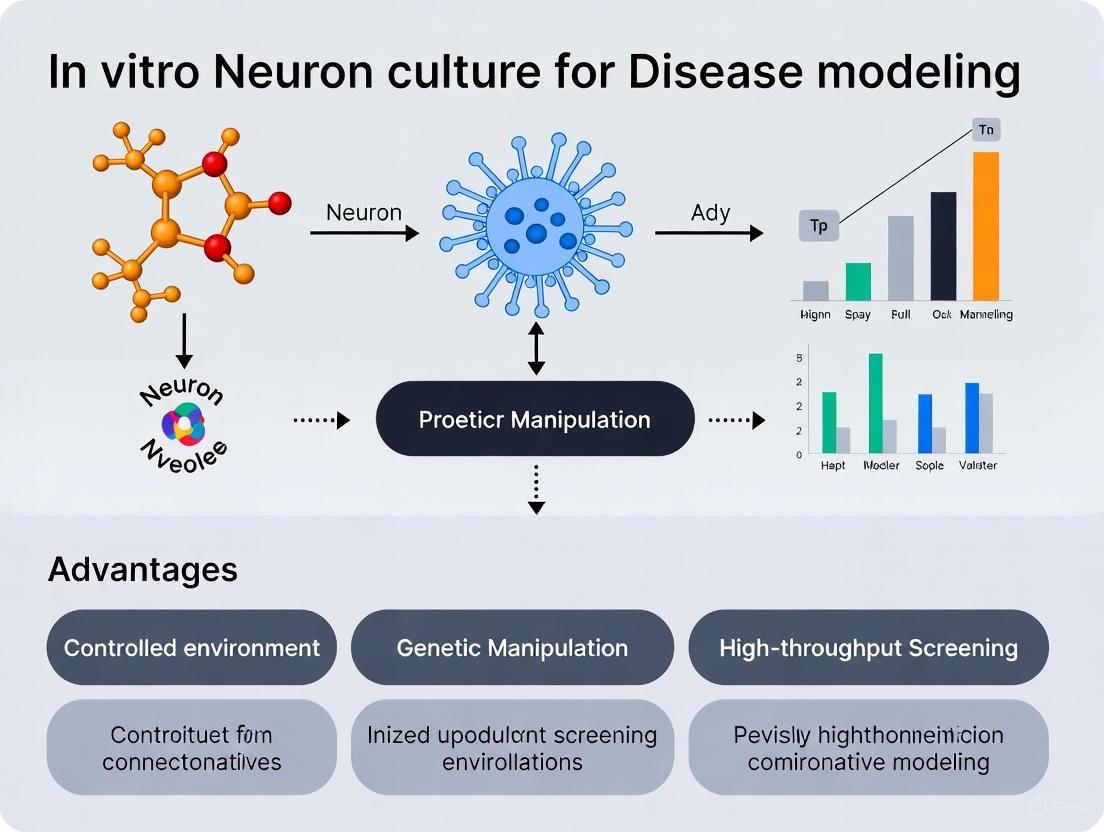
This article explores the transformative advantages of in vitro neuron cultures for modeling neurodegenerative diseases.
Beyond Animal Models: Unlocking Neurological Disease Secrets with Advanced In Vitro Neuron Cultures
Abstract
This article explores the transformative advantages of in vitro neuron cultures for modeling neurodegenerative diseases. It details how these human-relevant systems, derived from patient-specific stem cells and cultured in advanced 3D formats, bridge the translational gap between animal studies and clinical trials. We cover foundational principles, from harnessing pluripotent stem cells to generate diverse neuronal subtypes to the engineering of complex 3D organoids that recapitulate brain architecture. The article provides a methodological guide for applications in disease modeling, drug screening, and personalized medicine, while also addressing key challenges and optimization strategies. Finally, it validates these models by comparing their physiological relevance and predictive power against traditional 2D cultures and animal models, synthesizing their pivotal role in accelerating therapeutic discovery for conditions like Alzheimer's and Parkinson's disease.
The Human-Relevant Foundation: How In Vitro Neurons Recreate Brain Complexity
The development of effective treatments for neurodegenerative diseases has been significantly hampered by a persistent translational gap, where promising findings from preclinical research consistently fail to become viable clinical therapies. Traditional models, particularly animal-based systems, have demonstrated limited predictive value for human outcomes due to fundamental differences in brain architecture, immune responses, and metabolism between species [1]. The staggering statistic that only approximately 5% of preclinical studies in animal models ultimately lead to regulatory approval for human use underscores the critical inadequacy of existing approaches for modeling human brain pathology [1]. This discrepancy is particularly pronounced in complex neurodegenerative diseases such as Alzheimer's disease (AD) and multiple sclerosis (MS), where numerous therapies showing promise in preclinical stages have failed to translate clinically [1].
The inherent limitations of post-mortem human brain tissue—including limited availability, ethical concerns, preservation difficulties, and irreversible changes that alter results—further restrict its utility for large-scale studies [1]. Similarly, while traditional two-dimensional (2D) cell cultures have provided foundational insights, they lack the three-dimensional architecture, cellular diversity, and cell-to-cell interactions essential for replicating human brain physiology [2]. These limitations collectively highlight an urgent need for advanced, human-relevant models that can more accurately recapitulate the complexity of the human brain while remaining ethically viable and accessible for research.
The Rise of Advanced Human-Relevant In Vitro Models
Advanced in vitro models, particularly three-dimensional (3D) systems, have emerged as powerful tools that bridge the gap between traditional 2D cultures and in vivo models. These systems preserve the structural integrity, cellular diversity, and functional interactions of living brain tissue, enabling more accurate temporal modeling of neurological diseases and facilitating precise experimental manipulations [3].
Next-Generation 3D Brain Models
Several advanced platforms now offer unprecedented human relevance for neuroscience research:
miBrains (Multicellular Integrated Brains): Developed by MIT researchers, this pioneering 3D human brain tissue platform represents a significant technological leap as the first in vitro system to integrate all six major brain cell types, including neurons, glial cells, and vasculature, into a single culture [4]. Derived from individual donors' induced pluripotent stem cells (iPSCs), miBrains replicate key features and functions of human brain tissue, including the formation of functional neurovascular units and a blood-brain-barrier capable of gatekeeping which substances may enter the brain [4]. The platform's highly modular design offers precise control over cellular inputs and genetic backgrounds, enabling researchers to create customized models of specific health and disease states [4].
Brain Organoids: These 3D structures derived from human pluripotent stem cells (PSCs) recapitulate several aspects of human brain organization and functionality, including cellular diversity, cell-to-cell interactions, and developmental trajectories that closely resemble fetal brain development [1]. Neurons within organoids exhibit signs of polarity, migration, and electrical activity, making them valuable for investigating cellular and molecular mechanisms of neurological disorders [1]. While they represent simplified systems that do not yet recapitulate full neural circuitry, they capture early developmental and disease-related processes more effectively than animal models.
Human Organotypic Brain Slice Cultures (OBSCs): These cultures preserve the structural integrity, cellular diversity, and vascular networks of living brain tissue, maintaining in vivo characteristics more effectively than dissociated neuronal cultures [3]. This preservation enables accurate temporal modeling of neurological diseases and facilitates precise experimental manipulations, accelerating therapeutic development [3].
Table 1: Comparative Analysis of Advanced Human-Relevant Brain Models
| Model Type | Key Components | Strengths | Applications | Limitations |
|---|---|---|---|---|
| miBrains [4] | All 6 major brain cell types + vasculature | High cellular complexity; Modular design; Functional BBB | Disease mechanism studies; Drug discovery; Personalized medicine | Does not yet include fluid flow through vessels |
| Brain Organoids [1] | Neurons, glial cells from PSCs | Recapitulates developmental processes; Patient-specific | Disease modeling; Developmental studies; Drug screening | Variability in generation; Limited vascularization; Simplified circuitry |
| Organotypic Slice Cultures [3] | Preserved brain tissue architecture | Maintains native cellular diversity and connectivity | Electrophysiology studies; Disease progression modeling; Drug testing | Limited lifespan; Ethical considerations; Donor variability |
Quantitative Advantages of Human-Relevant Models
The transition to human-relevant models offers measurable benefits across multiple dimensions of research and drug development:
Table 2: Quantitative Advantages of Advanced In Vitro Models in Neuroscience Research
| Performance Metric | Traditional Animal Models | Advanced Human-Relevant Models | Evidence/Source |
|---|---|---|---|
| Translational Success Rate | ~5% lead to regulatory approval [1] | Improved predictive value for human outcomes | Preclinical study data [1] |
| Drug Development Timeline | ~42 months (industry average for candidate to clinical trials) | As little as 18 months demonstrated with AI-assisted organoid platforms [2] | Recursion Pharmaceuticals case study [2] |
| Cellular Complexity | Limited human-relevant cell types | Up to 6 major human brain cell types integrated [4] | MIT miBrains platform [4] |
| Personalization Potential | Limited to specific species/strains | Fully personalized from individual donor iPSCs [4] [1] | miBrains and organoid protocols [4] [1] |
Experimental Applications and Protocols
Modeling Alzheimer's Disease with miBrains
The application of miBrains to Alzheimer's disease research demonstrates the power of advanced in vitro systems to elucidate complex disease mechanisms. In a landmark study investigating the APOE4 gene variant—the strongest genetic predictor for Alzheimer's development—researchers employed miBrains to isolate the specific contribution of APOE4 astrocytes to disease pathology [4].
Experimental Protocol:
- Cell Line Generation: Generate isogenic iPSC lines where only astrocytes carry the APOE4 variant, while all other cell types carry the neutral APOE3 variant [4]
- miBrain Assembly: Combine cell types in optimized ratios to form functional neurovascular units within the customized neuromatrix hydrogel scaffold [4]
- Pathology Assessment: Measure accumulation of Alzheimer's-associated proteins (amyloid and phosphorylated tau) using immunostaining and biochemical assays [4]
- Cell-Type Interaction Studies: Systematically omit specific cell types (e.g., microglia) to determine their contribution to pathological cascades [4]
- Conditioned Media Experiments: Apply media from specific cell type cocultures to assess their role in inducing pathology [4]
Key Findings: The research revealed that molecular cross-talk between microglia and astrocytes is required for phosphorylated tau pathology, demonstrating how these multicellular systems can uncover complex cellular interactions that drive disease progression [4].
Organoid-Based Disease Modeling
Organoids have been successfully used to model key cellular and molecular aspects of various neurodegenerative diseases, including Alzheimer's, Parkinson's, and multiple sclerosis [1]. A recent study on progressive multiple sclerosis identified an unusual type of brain cell (disease-associated RG-like cells or DARGs) that may play a vital role in the persistent inflammation characteristic of the disease [2].
Experimental Protocol:
- Patient-Specific Cell Generation: Take skin cells from patients with progressive MS and reprogram them into induced neural stem cells (iNSCs) [2]
- Organoid Differentiation: Culture iNSCs under specific conditions to generate 3D organoids containing relevant brain cell types [2]
- Phenotypic Screening: Identify and characterize unusual cell types that emerge in disease conditions compared to healthy controls [2]
- Molecular Analysis: Investigate the molecular machinery behind dysfunctional cell behavior using single-cell RNA sequencing and proteomic approaches [2]
- Therapeutic Testing: Screen potential treatments that either correct dysfunctional cells or eliminate them entirely [2]
Essential Research Reagents and Materials
Successful implementation of advanced in vitro models requires specific reagents and materials optimized for 3D culture systems:
Table 3: Essential Research Reagent Solutions for Advanced In Vitro Neuroscience Models
| Reagent/Material | Function | Application Examples | Key Characteristics |
|---|---|---|---|
| Induced Pluripotent Stem Cells (iPSCs) | Starting cell source for generating patient-specific models | miBrains [4], Organoids [1] | Patient-derived; Reprogrammed; Differentiate into any cell type |
| Neuromatrix Hydrogel | Synthetic extracellular matrix providing 3D scaffold | miBrain platform [4] | Custom blend of polysaccharides, proteoglycans, basement membrane |
| Matrigel | Basement membrane extract for 3D culture support | Early organoid protocols [1] | Complex mixture of ECM proteins; Supports cell differentiation |
| PhysioMimix OOC | Organ-on-chip microphysiological system | Single-organ and multi-organ studies [2] | Microfluidic platform; USB-sized; Recreates fluid flow and mechanical forces |
| Differentiation Media | Specific cytokine/growth factor cocktails | Regional brain organoids (midbrain, hippocampus) [1] | Directs stem cell differentiation toward specific neural lineages |
Technical Workflows and Signaling Pathways
miBrain Development and Experimental Workflow
Neurovascular Unit Signaling in Alzheimer's Pathology
The field of human-relevant in vitro models is rapidly evolving, with several key areas representing promising future directions. Improved standardization and reproducibility across models will be essential for broader adoption and more reliable data interpretation. Enhanced vascularization through the integration of microfluidic systems that introduce blood flow will better replicate the in vivo environment and enable more realistic drug penetration studies [4]. The development of personalized medicine platforms using patient-specific iPSCs promises to revolutionize treatment approaches by enabling tailored therapeutic strategies [4] [1].
Advanced in vitro human brain models represent a paradigm shift in neuroscience research, offering unprecedented opportunities to bridge the translational gap that has long hindered progress in understanding and treating neurodegenerative diseases. By more accurately recapitulating human brain biology and pathology, these models provide physiologically relevant platforms for investigating disease mechanisms, screening potential therapeutics, and developing personalized treatment approaches. As these technologies continue to mature through improved standardization, vascularization, and integration with other advanced technologies like AI and organ-on-chip systems, they hold tremendous potential to accelerate the development of effective treatments for neurodegenerative disorders that affect millions worldwide.
The advent of technologies to generate human neurons in vitro has revolutionized the study of neurological diseases. Induced pluripotent stem cells (iPSCs) and direct conversion to induced neurons (iNs) provide powerful, complementary platforms for disease modeling, drug discovery, and regenerative medicine. While iPSCs offer unlimited expansion and multi-lineage differentiation potential, iNs uniquely preserve age-associated epigenetic signatures, making them particularly suited for modeling late-onset neurodegenerative disorders. This technical guide details the core methodologies, experimental protocols, and key reagents for both technologies, framing their application within the broader thesis of advancing neurological disease research.
Animal models of brain disorders have historically provided fundamental insights but often fail to recapitulate complex human conditions, a dilemma starkly illustrated by the repeated failure of Alzheimer's disease drug candidates developed from successful animal studies in human clinical trials [5]. This translational gap has driven the development of in vitro human neuron models that capture human-specific neuronal biology, genetics, and epigenetic signatures.
The two predominant technologies for generating human neurons are:
- Induced Pluripotent Stem Cell (iPSC) Technology: Involves reprogramming somatic cells to a pluripotent state, followed by differentiation into specific neuronal subtypes.
- Direct Conversion to Induced Neurons (iNs): Directly transdifferentiates somatic cells into neurons, bypassing the pluripotent intermediate.
Each approach offers distinct advantages and limitations for disease modeling, which will be explored in this technical guide.
Induced Pluripotent Stem Cell (iPSC) Technology
Core Methodology and Workflow
The iPSC technology is a two-step process: first, reprogramming somatic cells to a pluripotent state; second, differentiating these iPSCs into specific neuronal lineages.
Figure 1. iPSC Technology Workflow: From somatic cell to functional neuron via a pluripotent intermediate stage.
Key Experimental Protocols
Cellular Reprogramming to iPSCs
Objective: To convert somatic cells (e.g., skin fibroblasts) into induced pluripotent stem cells. Procedure:
- Source Somatic Cells: Isolate human dermal fibroblasts from a skin biopsy and culture in fibroblast medium.
- Introduce Reprogramming Factors: Deliver the "Yamanaka factors" (OCT4, SOX2, KLF4, c-MYC) using integrating methods (lentivirus, retrovirus) or non-integrating methods (Sendai virus, episomal plasmids, mRNA) [6].
- Culture for iPSC Emergence: Plate transfected cells on feeder layers (e.g., mouse embryonic fibroblasts) or in feeder-free conditions. Replace medium with iPSC culture medium (e.g., mTeSR1, TeSR-E8). Colonies with embryonic stem cell-like morphology typically appear in 3-4 weeks.
- Isolate and Expand Clones: Manually pick individual iPSC colonies and expand them for characterization.
Neuronal Differentiation via NGN2 Overexpression
Objective: To efficiently differentiate iPSCs into cortical neurons. Procedure [7]:
- Seed iPSCs: Seed a single-cell suspension of iPSCs on plates coated with Poly-D-Lysine (PDL) and laminin.
- Introduce NGN2: Transduce cells with a doxycycline-inducible lentiviral vector carrying Neurogenin-2 (NGN2), a pro-neuronal transcription factor.
- Induce Differentiation: Add doxycycline to the culture medium to activate NGN2 expression. Simultaneously, add small molecules for developmental patterning.
- Select and Mature Neurons: Add puromycin 48-72 hours post-induction to select for successfully transduced cells. After selection, culture cells in neuronal maturation medium (e.g., Brainphys medium with supplements) for several weeks to develop mature electrophysiological properties.
The Role of Artificial Intelligence
AI and machine learning are now supercharging iPSC technology by:
- Enhancing Reprogramming: Using convolutional neural networks (CNNs) to analyze time-lapse microscopy images, identifying morphological features predictive of successful reprogramming to iPSCs [6].
- Improving Quality Control: Employing deep learning algorithms to automatically assess iPSC colony morphology, identify genetic abnormalities, and predict differentiation potential from high-resolution images [6].
- Optimizing Differentiation: Leveraging predictive models to determine optimal conditions and timing for differentiation into specific neuronal subtypes.
Direct Conversion to Induced Neurons (iNs)
Core Methodology and Workflow
Direct conversion, or transdifferentiation, transforms somatic cells directly into neurons, bypassing the pluripotent state and preserving age-related epigenetic markers.
Figure 2. Direct Conversion Workflow: Pioneer transcription factors directly remodel chromatin to convert somatic cells into neurons.
Key Experimental Protocol: Direct Conversion of Human Fibroblasts
Objective: To transdifferentiate human fibroblasts directly into functional neurons. Procedure [5]:
- Source Fibroblasts: Use human fibroblasts from fetal or postnatal donors. Note that efficiency can decrease with donor age for some protocols.
- Deliver Conversion Factors: Transduce fibroblasts with viral vectors (e.g., lentivirus) expressing pioneer transcription factors. The most efficient protocols often combine ASCL1 and NGN2 [5]. Other common combinations include:
- Culture in Neuronal Medium: After transduction, maintain cells in a defined neuronal medium (e.g., Neurobasal Plus with B-27 Plus Supplement). To control astrocyte expansion, add a chemically defined supplement like CultureOne after a few days in vitro [8].
- Functional Maturation: Neurons typically develop extensive axonal and dendritic branching by 10 days in vitro (DIV). Synaptic maturity and electrophysiological activity can be assessed after 3-4 weeks.
Comparative Analysis: iPSC-Derived Neurons vs. Induced Neurons (iNs)
Table 1. Technical and Application-Based Comparison of iPSC and Direct Conversion Technologies
| Feature | iPSC-Derived Neurons | Directly Converted iNs |
|---|---|---|
| Theoretical Basis | Recapitulates developmental stages | Direct cell fate conversion, bypassing pluripotency |
| Process Duration | Several months | 3-4 weeks |
| Epigenetic Age | Rejuvenated, fetal-like | Preserves aging signatures of somatic cell |
| Tumorigenic Risk | Potential risk from residual undifferentiated iPSCs | No pluripotent intermediate, minimal risk |
| Expansion Potential | High (unlimited expansion of iPSC source) | Low (limited expansion of resulting neurons) |
| Neuronal Purity | Can be variable; often requires selection | Can achieve >90% purity with optimal TFs [5] |
| Ideal for Modeling | Neurodevelopmental, monogenetic disorders | Late-onset, age-associated neurodegenerative diseases (e.g., Alzheimer's, Parkinson's) |
Table 2. Key Culture Media and Reagents for Neuronal Maturation and Health
| Reagent / Solution | Function / Purpose | Example Use Case |
|---|---|---|
| Neurobasal Plus Medium | A common basal medium optimized for the long-term survival and maturation of primary neurons and iPSC-derived neurons. | Used in both iPSC neuronal differentiation and direct iN conversion protocols [8] [7]. |
| B-27 Plus Supplement | A serum-free supplement containing hormones, antioxidants, and other components crucial for neuron health. | Added to Neurobasal to create a complete neuronal medium [8]. |
| Brainphys Imaging Medium | A specialized medium designed to reduce phototoxicity during live imaging. Rich in antioxidants to mitigate reactive oxygen species (ROS). | Superior to Neurobasal in supporting neuron viability and outgrowth during longitudinal fluorescence imaging [7]. |
| CultureOne Supplement | A defined, serum-free supplement used to control the expansion of glial cells (like astrocytes) in culture. | Added to iN cultures at day 3 in vitro to maintain neuronal enrichment [8]. |
| Laminin (Mouse/Human) | An extracellular matrix (ECM) protein that provides critical bioactive cues for neuron attachment, migration, and maturation. | Used in combination with PDL to coat culture surfaces for iPSC-derived neurons and iNs [7]. |
| Poly-D-Lysine (PDL) | A synthetic polymer that coats culture surfaces to enhance cell adhesion. | Standard coating agent used in conjunction with laminin for neuronal cultures [7]. |
Optimizing the Neuronal Microenvironment for Disease Modeling
The physiological relevance of in vitro neuron models heavily depends on the health and maturity of the cultures. Key parameters for optimization include:
Culture Media and Phototoxicity Mitigation
For long-term imaging and functional assessment, media composition is critical. Brainphys Imaging medium has been shown to support neuron viability, outgrowth, and self-organization to a greater extent than classic Neurobasal medium under phototoxic conditions, thanks to its rich antioxidant profile and omission of reactive components like riboflavin [7].
Extracellular Matrix and Seeding Density
- ECM: The combination of PDL with laminin (e.g., human-derived LN511) synergistically promotes neuron adherence and functional maturation [7].
- Seeding Density: Higher seeding densities foster somata clustering and facilitate paracrine support, which can enhance survival under stress. However, density must be optimized based on the specific experimental needs, such as the requirement for single-cell imaging [7].
The Scientist's Toolkit: Essential Reagent Solutions
Table 3. Key Research Reagents for iPSC and iN Technologies
| Category | Specific Item | Critical Function |
|---|---|---|
| Reprogramming & Conversion | OCT4, SOX2, KLF4, c-MYC | Core set of transcription factors for iPSC reprogramming [6]. |
| ASCL1, NGN2, NEUROD1 | Pioneer transcription factors for direct neuronal conversion [5]. | |
| Cell Culture & Maintenance | Y-27632 (ROCK inhibitor) | Improves survival of dissociated single cells (e.g., after iPSC passaging). |
| Doxycycline | Induces gene expression in tetracycline-inducible systems (e.g., NGN2 activation) [7]. | |
| Characterization & Analysis | PreSynaptic (e.g., Synapsin) & PostSynaptic (e.g., PSD-95) Markers | Immunofluorescence labeling to confirm synapse formation and maturity [8]. |
| Patch-Clamp Electrophysiology | Gold-standard functional assay to confirm neuronal excitability and network activity [8]. |
iPSC and direct iN conversion technologies provide two powerful, complementary paradigms for generating human neurons in vitro. The choice between them should be guided by the specific research question: iPSCs are ideal for developmental studies and scalable assays, while iNs offer a unique window into age-related diseases. Ongoing advancements in protocol optimization, aided by AI and a deeper understanding of the neuronal microenvironment, continue to enhance the fidelity and translational relevance of these indispensable disease modeling tools.
The use of in vitro neuron cultures has long been a cornerstone of neuroscience research, providing invaluable insights into neuronal function, development, and degeneration. However, the traditional model of culturing neurons in isolation presents a significant limitation: it fails to recapitulate the intricate cellular ecosystem of the living brain. The brain is a complex network where neurons continuously interact with glial cells, including astrocytes and microglia. These interactions are not merely supportive; they are fundamental to homeostasis, synaptic plasticity, inflammatory responses, and ultimately, the progression of neurological diseases. Framed within the broader thesis on the advantages of in vitro neuron culture for disease modeling research, this whitepaper argues that incorporating glial cells through co-culture systems is a critical step toward achieving physiological accuracy. Moving beyond monocultures to multicellular models provides a more reliable platform for investigating disease mechanisms and screening potential therapeutics, thereby enhancing the predictive value of in vitro research [9] [10].
The limitations of single-cell-type cultures are particularly evident in the context of disease. Microglia, the resident immune cells of the central nervous system, play a key role in neuroinflammation, a common feature in conditions like Alzheimer's Disease (AD). When studied alone in vitro, microglia undergo rapid and substantial transcriptional changes, adopting an inflammatory state that poorly recapitulates their in vivo phenotype [10]. Similarly, astrocytes in monoculture lack the nuanced responses they exhibit when in contact with neurons and microglia. Co-culture systems address this by restoring a more native cellular environment, leading to microglia that express homeostatic markers and astrocytes that display a more physiological, ramified morphology [11] [10]. For disease modeling, this increased fidelity is transformative, allowing researchers to study complex, cell-mediated pathological processes such as inflammatory neurodegeneration and synapse loss in a controlled setting [12] [10].
The Critical Roles of Glial Cells in Neural Networks
To appreciate the value of co-culture systems, one must understand the distinct and synergistic functions of different glial cells. In the brain, communication between neurons and glia is bidirectional and essential for healthy function.
- Astrocytes are far more than "support" cells. They are integral to the formation, function, and elimination of synapses—a process critical for learning and memory. They release factors like thrombospondins that promote synaptogenesis and help maintain ionic and neurotransmitter balance in the synaptic cleft [10]. In inflammatory conditions, they can be induced into a reactive, neurotoxic state (A1 phenotype), which can be modeled more accurately in co-culture [10].
- Microglia are the dynamic immune sentinels of the brain, constantly surveying the microenvironment. They phagocytose pathogens and cellular debris, and are involved in synaptic pruning during development. Their activation state is highly plastic, and co-culture with neurons has been shown to promote a more anti-inflammatory, homeostatic profile, which is difficult to maintain in isolation [10].
- Oligodendrocytes, though not the focus of all co-cultures, are responsible for myelinating axons, which is crucial for rapid signal conduction.
The interplay between these cells is mediated through multiple signaling pathways. The following diagram illustrates the key molecular communications and functional outcomes in a neuron-glia network.
Quantitative Advantages of Co-culture Systems
The physiological benefits of co-culture systems are not merely observational; they are quantifiable. Research comparing monocultures to co-cultures has demonstrated significant improvements in markers of cellular health, maturity, and function. The table below summarizes key quantitative findings from recent studies, highlighting the measurable impact of incorporating glial cells.
Table 1: Quantitative Benefits of Neuron-Glia Co-cultures Demonstrated in Preclinical Studies
| Parameter Measured | Finding in Co-culture vs. Monoculture | Significance | Source |
|---|---|---|---|
| Neuronal Morphology | Neurons developed more and longer branches. | Indicates enhanced neuronal maturation and connectivity. | [10] |
| Synaptic Markers | Increased expression of post-synaptic markers. | Reflects a more mature and potentially functional neuronal network. | [10] |
| Microglial Phenotype | Increased Arginase I; reduced iNOS & IL-1β. | Shift towards a more homeostatic, anti-inflammatory state. | [10] |
| Astrocyte Phenotype | Reduced pro-inflammatory A1 markers (AMIGO2, C3). | Astrocytes are less reactive, better mimicking in vivo conditions. | [10] |
| Anti-inflammatory Markers | Increased TGF-β1. | Creation of a more physiologically balanced inflammatory milieu. | [10] |
| Drug Screening Output | Identified 29 neuroprotective compounds against LPS. | Validates the model's utility for discovering therapeutic candidates. | [12] |
| Electrophysiology | Neurons demonstrated functional maturity and excitability. | Confirms the development of functionally active networks. | [8] |
These data collectively demonstrate that co-culture systems provide a superior in vitro model by enhancing the physiological relevance of all cell types involved. This makes them particularly powerful for disease modeling, where accurate cellular responses are paramount.
Establishing a Co-culture System: Methodologies and Protocols
Several robust protocols have been established for creating neuron-glia co-cultures, ranging from simpler 2D models to more complex 3D systems. The choice of model depends on the research question, requiring a balance between physiological complexity and experimental practicality.
A 2D Triple Co-culture Model for Alzheimer's Disease Research
A straightforward and reproducible 2D triple co-culture model using murine primary cells has been developed to study AD-related pathology [10]. This model is based on the sequential seeding of astrocytes, neurons, and microglia, and has been shown to effectively recapitulate key features of AD, including Aβ-induced synaptic loss and microglial activation.
Detailed Experimental Protocol:
- Cell Source: Cortical neurons are harvested from E18/E19 Sprague-Dawley rat embryos. Mixed glial cultures (source of astrocytes and microglia) are prepared from the cortical lobes of P0/P1 Sprague-Dawley rat pups [10].
- Astrocyte Culture: The mixed glial cells are plated onto poly-D-lysine (PDL)-coated flasks in Iscove’s Modified Dulbecco’s Medium (IMDM) supplemented with 10% fetal bovine serum (FBS). After 24 hours, the medium is replaced to enrich for astrocytes [10].
- Microglia Isolation: Microglia are harvested from the mixed glial cultures after approximately 15 days, when cells are confluent. The flasks are incubated with 0.25% trypsin for 1.5 hours with periodic shaking. The adherent microglial cells are then detached and resuspended in culture medium [10].
- Sequential Seeding for Triple Co-culture:
- Day 0: Plate astrocytes onto PDL-coated plates or coverslips.
- Day 1: Seed cortical neurons onto the established astrocyte layer.
- Day 7: Finally, add microglia to the neuron-astrocyte co-culture.
- Maintenance: Cultures are maintained in a serum-free Neurobasal medium supplemented with B27. The medium is changed every 2-3 days [10].
- Disease Modeling: To model AD, oligomeric Amyloid-β (oAβ) can be added to the culture. This treatment recapitulates disease hallmarks, including a reduction in synaptic markers and an increase in the microglial activation marker CD11b [10].
The following workflow diagram outlines the key steps and timeline for establishing this 2D triple co-culture.
A 3D Hydrogel-Based Brain-like Tissue Model
For a more advanced model that incorporates three-dimensional architecture, hydrogel-based systems offer a promising approach. These models aim to mimic the brain's extracellular matrix (ECM), providing mechanical support and biochemical cues that influence cell behavior [9].
Detailed Experimental Protocol:
- Hydrogel Preparation: Semi-interpenetrating polymer networks (semi-IPNs) can be prepared using collagen (COLL) with hyaluronic acid (HA) or poly(ethylene glycol) (PEG). For a COLL-HA gel, a 3 mg/mL collagen solution is mixed with an equal part of a 5 mg/mL HA solution. Fibrillogenesis is induced by incubation at 37°C for about 1.5 hours to form the hydrogel [9].
- Cell Encapsulation (Embedded Condition): This is the preferred method for building a complex 3D model. A cell suspension containing primary cortical neurons and glial cells is mixed with the polymer solution at a ratio of 1:9 (v/v) before fibrillogenesis. The mixture is then plated to create a 1.5 mm-thick cell-laden hydrogel construct [9].
- Culture Maintenance: After the hydrogel forms, appropriate culture medium (e.g., Neurobasal medium for neurons) is added and changed every 2 days. Cells can be maintained in this 3D environment for up to 21 days, during which they form networks and mature [9].
- Assessment: Cell viability, morphology, spatial distribution, and synapse formation can be evaluated using metabolic assays, microscopy, and immunostaining [9].
Regional Specificity: A Protocol for Hindbrain Neurons
Neural cell populations vary significantly between brain regions. While most protocols use cortical or hippocampal tissues, studying brainstem functions requires region-specific cultures. An optimized protocol for culturing embryonic mouse hindbrain neurons has been developed to address this [8].
Key Protocol Steps:
- Dissection: Hindbrains are isolated from E17.5 mouse fetuses. The cortex, cerebellum, and meninges are carefully removed.
- Tissue Dissociation: The tissue is mechanically dissociated and then enzymatically loosened with 0.5% trypsin and 0.2% EDTA for 15 minutes at 37°C. This is followed by trituration using fire-polished Pasteur pipettes.
- Culture Setup: Dissociated cells are resuspended in Neurobasal Plus Medium supplemented with B-27 Plus Supplement, L-glutamine, and penicillin-streptomycin.
- Glial Control: To prevent overgrowth of astrocytes, the serum-free supplement CultureOne is added at the third day in vitro (DIV). This yields cultures with extensive neuronal branching and functional synapses by DIV 10, suitable for electrophysiological studies [8].
The Scientist's Toolkit: Essential Reagents and Materials
Success in establishing and maintaining physiologically relevant co-cultures relies on a foundation of specific reagents and materials. The following table details key solutions and their functions in the protocols discussed.
Table 2: Essential Research Reagents for Neuron-Glia Co-culture Systems
| Reagent/Material | Function | Example Usage in Protocol |
|---|---|---|
| Poly-D-Lysine (PDL) | Coats culture surfaces to promote neuronal adhesion. | Used for pre-coating plates and coverslips for 2D cultures of neurons and glia. [10] [8] |
| Collagen-Based Hydrogels | Provides a 3D extracellular matrix (ECM) mimic for cell growth and network formation. | Used as the base for semi-IPN hydrogels (e.g., COLL-HA) for embedding cells. [9] |
| Neurobasal Medium | A serum-free medium optimized for the long-term survival of neuronal cells. | Base medium for cortical neuron and triple co-culture maintenance. [10] [8] |
| B-27 Supplement | A defined serum-free supplement that supports neuronal growth and reduces glial proliferation. | Added to Neurobasal medium for neuron and co-culture systems. [10] [8] |
| CultureOne Supplement | A defined, serum-free supplement used to control astrocyte expansion. | Added to hindbrain cultures at DIV 3 to prevent glial overgrowth. [8] |
| All-Trans Retinoic Acid (RA) | A differentiation agent used to direct pluripotent cells toward a neural lineage. | Used to differentiate Ntera-2 cells into neurons and astrocytes. [11] |
| Cytosine Arabinoside (AC) | A cytostatic agent that inhibits DNA synthesis, used to suppress glial cell proliferation. | Used in neuron maturation and astrocyte culture protocols to control dividing cells. [11] |
Application in Disease Modeling and Drug Development
The enhanced physiological accuracy of co-culture models makes them exceptionally valuable for disease modeling and drug discovery. They bridge the gap between simple monocultures and the overwhelming complexity of in vivo models.
- Modeling Inflammatory Neurodegeneration: Neuron-glia co-cultures are ideal for screening compounds against inflammatory damage. One study used primary neuron-glia cultures to model lipopolysaccharide (LPS)-induced neurodegeneration. Using live-cell stains and automated image analysis, they screened 227 compounds and identified 29 that protected against neuronal loss. Hits included drugs affecting adrenergic, steroid, and MAP kinase signaling, demonstrating the model's utility in uncovering novel therapeutic pathways [12].
- Studying Alzheimer's Disease Mechanisms: The triple co-culture model has been directly applied to AD research. Exposure to oligomeric Aβ in this system led to increased microglial activation (CD11b) and synaptic loss, successfully recapitulating two core features of the disease. This provides a powerful, reproducible in vitro tool for mechanistic studies of Aβ-induced pathology and neuroinflammation [10].
- Integration with Complex In Vitro Models (CIVMs): Co-culture technology is a key component of advanced CIVMs like organ-on-a-chip platforms. These systems can incorporate fluid flow and mechanical forces to further mimic the in vivo environment. The FDA's Innovative Science and Technology Approaches for New Drugs (ISTAND) pilot program now qualifies certain organ-chip models for regulatory submissions, underscoring their growing importance in de-risking drug development and providing more predictive toxicology and efficacy data [13] [14].
The evidence is clear: to fully leverage the advantages of in vitro systems for disease modeling research, the field must move beyond a single cell type. Co-culturing neurons with astrocytes and microglia is no longer an exotic technique but a necessary evolution toward physiological accuracy. These models transform static neuronal cultures into dynamic, interactive systems where cells adopt more native phenotypes, enabling the study of complex disease mechanisms like neuroinflammation and synaptic loss in a controlled, human-relevant context. As drug development strives for higher predictability and reduced animal use, the adoption of sophisticated co-culture systems, particularly when integrated with 3D matrices and microfluidic platforms, will be instrumental in bridging the gap between traditional cell culture and clinical success, ultimately accelerating the discovery of effective treatments for neurological disorders.
The human brain possesses a remarkable diversity of neurons, with estimates ranging from several hundred to several thousand distinct subtypes that vary in function, morphology, and connectivity [15]. For decades, neurological disease modeling and drug development have been hampered by the inability to recapitulate this complexity in laboratory settings. Traditional in vitro approaches generated only a few dozen neuronal types, often resulting in molecularly confused neurons that expressed gene signatures from disparate brain regions—poor approximations for studying disorders with specific cellular pathology [16]. This limitation has forced researchers to use inadequate models while ignoring neuronal identity, potentially compromising the translational relevance of their findings.
A transformative breakthrough from researchers at ETH Zurich has fundamentally changed this landscape. Through systematic modulation of morphogen signals and transcription factor programming, scientists have successfully produced over 400 different types of nerve cells from human induced pluripotent stem cells (iPSCs) in Petri dishes [15]. This "neuron cookbook" represents an unprecedented resource for neuroscience, enabling the generation of neuronal subtypes spanning all major regions of the nervous system, including excitatory and inhibitory neurons from the forebrain, midbrain, hindbrain, spinal cord, and peripheral nervous system [16]. This technological advance promises to reshape our approach to modeling neurological diseases and conducting phenotypic drug screening with cell-type-specific precision.
The Imperative for Specific Neuronal Subtypes in Disease Research
The capacity to generate specific neuronal subtypes comes at a critical time for neuroscience research and drug development. The historical reliance on oversimplified models has contributed to the high failure rate of neurological therapies in clinical trials. Different neurological disorders affect distinct neuronal populations—Parkinson's disease primarily targets dopaminergic neurons in the midbrain, while Alzheimer's disease particularly affects cortical and hippocampal neurons [16]. Using generic neuronal models to study these conditions inevitably overlooks crucial aspects of their pathophysiology.
Advanced in vitro models like the recently developed "miBrains" from MIT researchers highlight the importance of cellular interactions in disease processes. These multicellular systems integrate all six major brain cell types, including neurons, glial cells, and vasculature, into a single 3D culture [4]. In one compelling application, miBrains revealed that molecular cross-talk between microglia and astrocytes is required for phosphorylated tau pathology in Alzheimer's models—a discovery that would have been impossible in simplified cultures containing only one or two cell types [4]. Similarly, the ETH Zurich platform enables researchers to select the precise neuronal subtypes relevant to their disease of interest, moving beyond the "one neuron fits all" approach that has limited progress in the field.
Advantages Over Traditional and Emerging Models
The new methods for generating neuronal diversity offer distinct advantages over existing approaches:
Precision and Specificity: Unlike brain organoids that reproduce regional brain organization but remain heterogeneous, the directed differentiation approach yields defined neuronal subtypes with specific transcriptional profiles [16]. This precision is particularly valuable for late-onset neurodegenerative diseases, where organoids may be less suitable as they tend to capture early developmental states [16].
Scalability and Standardization: The platform's modular design supports large-scale research applications, including high-throughput drug screening [4] [16]. The systematic protocols generate more consistent and reproducible results than organoid systems, which often exhibit significant variability.
Physiological Relevance with Practical Accessibility: While animal models remain essential for studying complex neural circuits and behavior, the in vitro-derived neurons provide human-specific genetic backgrounds and avoid cross-species extrapolation issues [1]. They also address ethical concerns associated with animal research while offering greater accessibility than post-mortem human tissue [1].
Core Methodology: A Developmental Biology-Informed Approach
The breakthrough in generating neuronal diversity stems from a sophisticated strategy that mimics embryonic development principles, combining transcription factor-driven neuronal conversion with patterning cues derived from morphogen gradients.
Theoretical Foundation: Recapitulating Development
During embryonic development, the nervous system forms through precisely coordinated spatial and temporal cues. Signaling molecules known as morphogens create concentration gradients that specify neuronal fate along the anterior-posterior and dorsal-ventral axes [16]. The ETH Zurich team leveraged this principle, recognizing that morphogens provide positional identity to developing cells. As one researcher noted, "There are morphogen gradients that specify both the spatial identity and the axial identity of cells. So we wondered, why not combine these two and induce neurodiversity, but, in addition, provide this kind of positional identity through morphogens?" [16].
Experimental Workflow and Protocol
The implementation required a meticulously designed large-scale combinatorial screen. The following workflow outlines the key experimental steps:
The specific experimental protocol consists of these critical steps:
Stem Cell Culture Preparation:
- Begin with human induced pluripotent stem cells (iPSCs) derived from blood cells [15].
- Maintain cells in standard pluripotency media under appropriate conditions.
Genetic Engineering for Neuronal Induction:
Combinatorial Morphogen Screening:
- Prepare nearly 200 different experimental conditions using seven core morphogens in various combinations and concentrations [15].
- Key morphogens include: retinoic acid (anterior-posterior patterning), sonic hedgehog (ventralization), BMPs (dorsalization), and other developmental signaling molecules.
- Apply morphogens in a temporally controlled manner to mimic developmental sequences.
High-Throughput Characterization:
- Perform single-cell RNA sequencing to assess transcriptional profiles of resulting neurons [15] [16].
- Conduct electrophysiological analyses using high-density microelectrode arrays to validate functional properties.
- Implement morphological profiling to assess structural characteristics like neurite outgrowth and branching patterns.
Identity Validation and Mapping:
- Compare transcriptional profiles to reference atlases of developing and adult human brain [16].
- Verify that induced neurons match known subtypes from specific brain regions and developmental stages.
Key Signaling Pathways and Molecular Logic
The methodology successfully recreates the native developmental signaling environment that guides neuronal specification. The core signaling pathways implemented include:
Quantitative Profiling of Generated Neuronal Diversity
The platform's success is demonstrated by extensive quantitative characterization of the resulting neuronal subtypes. The following tables summarize the key quantitative findings and methodological parameters:
Table 1: Experimental Parameters for Neuronal Subtype Generation
| Parameter Category | Specific Conditions | Number of Variations | Key Outcomes |
|---|---|---|---|
| Morphogen Combinations | Retinoic Acid, SHH, BMP, and others | 7 morphogens in systematic combinations | Positional identity along neural axes |
| Transcription Factors | Ngn2, ASCL1, DLX2 | 3 primary factors with inducible systems | Neuronal fate commitment and subtype specification |
| Screening Conditions | Morphogen concentration, timing, and combination with TFs | ~200 distinct conditions [15] | Optimization of subtype-specific differentiation |
| Characterization Methods | scRNA-seq, electrophysiology, morphology | Multi-modal validation | Confirmation of subtype identity and function |
Table 2: Characterization of Resulting Neuronal Diversity
| Characterization Method | Key Metrics | Results | Validation Against Reference |
|---|---|---|---|
| Transcriptional Profiling | Gene expression signatures | >400 distinct neuronal subtypes [15] | High similarity to developing human brain [16] |
| Regional Identity | Forebrain, midbrain, hindbrain, spinal cord, PNS | Coverage across all major nervous system regions [16] | Mapping to regional markers from brain atlases |
| Electrophysiological Function | Spontaneous activity, spike trains, signaling dynamics | Heterogeneous patterns matching regional origin [16] | Confirmation of functional neuronal properties |
| Morphological Features | Cellular appendages, neurite branching | Distinct structures matching neuronal class [15] | Consistent with known morphological classifications |
Research Reagent Solutions: Essential Tools for Neuronal Specification
The successful implementation of this technology requires specific research reagents and tools. The following table details the essential components:
Table 3: Essential Research Reagents for Neuronal Subtype Generation
| Reagent Category | Specific Examples | Function in Protocol | Technical Notes |
|---|---|---|---|
| Stem Cell Lines | Human induced pluripotent stem cells (iPSCs) | Starting cellular material for differentiation | Can be derived from individual donors for personalized applications |
| Transcription Factors | Neurogenin 2 (Ngn2), ASCL1, DLX2 | Initiate neuronal differentiation and specify subtype identity | Inducible systems allow temporal control over expression |
| Patterning Morphogens | Retinoic acid, Sonic Hedgehog (SHH), BMPs | Provide positional information and regional specification | Concentration and timing critically determine neuronal fate |
| Culture Matrices | Custom hydrogel "neuromatrix" with polysaccharides, proteoglycans [4] | Provide physical support and biochemical cues for 3D culture | Mimics brain extracellular matrix composition |
| Analysis Tools | Single-cell RNA sequencing, high-density microelectrode arrays | Characterize transcriptional and functional properties | Enables validation of subtype identity and maturity |
Applications in Disease Modeling and Drug Development
The capacity to generate specific neuronal subtypes has immediate and profound implications for disease modeling and therapeutic development. The platform's most significant utility lies in creating biologically relevant models for neurological disorders where cell-type specificity is paramount [16]. As one researcher emphasized, "If you study Parkinson's, you want motor neurons in the midbrain. Or if you study autism, you might want cortical neurons. We have the conditions that make one or the other" [16].
For Alzheimer's disease research, the ability to generate neurons with specific APOE variants (the strongest genetic risk factor for late-onset AD) enables precise investigation of how this gene contributes to pathology. The MIT miBrains platform demonstrated that APOE4 astrocytes contribute to tau pathology specifically through cross-talk with microglia—a finding that required a multicellular environment [4]. Similarly, the ETH Zurich platform allows researchers to generate the specific neuronal subtypes most vulnerable in different neurodegenerative diseases, then expose them to potential therapeutic compounds under conditions that closely mimic the human brain environment.
The pharmaceutical industry can leverage this technology to conduct more predictive preclinical screening of candidate compounds. By testing drugs on human neurons with specific genetic backgrounds and subtypes relevant to particular diseases, researchers can better evaluate efficacy and identify potential toxicity issues before advancing to clinical trials. This approach addresses a critical limitation of current drug development pipelines, where many compounds that show promise in animal models fail in human trials due to species-specific differences in brain biology and drug responses [1].
Future Directions and Concluding Perspectives
While the current technology represents a monumental advance, further refinements are ongoing. Researchers are working to increase the homogeneity of neuronal populations generated under specific conditions, as "oftentimes, the cells we got for a given condition were still a bit heterogeneous" [16]. Future developments may include the combinatorial expression of additional transcription factors for long-term identity maintenance, CRISPR-based approaches to induce entire transcriptional programs, and protocols to promote further maturation of neurons to better model late-onset conditions [16].
The convergence of this neuron specification technology with other cutting-edge approaches—including optogenetics for precise neuronal manipulation, advanced 3D culture systems, and high-content screening platforms—promises to accelerate discoveries in neural science [17]. These tools collectively enable researchers to not only model diseases with greater accuracy but also to identify and validate novel therapeutic strategies with improved translational potential.
In conclusion, the development of methods to generate over 400 specific neuronal subtypes marks a transformative moment for neuroscience and neurological drug development. By finally capturing the cellular diversity of the human brain in vitro, researchers can now investigate disease mechanisms and therapeutic interventions with unprecedented precision and biological relevance. As these tools become more widely adopted and refined, they hold the potential to dramatically accelerate the development of effective treatments for the many neurological disorders that have thus far proven intractable to therapeutic intervention.
The quest to understand and treat complex neurological diseases has long been hampered by the limitations of existing biological models. Traditional two-dimensional cell cultures fail to capture the intricate cellular interactions of the human brain, while animal models often diverge significantly from human pathophysiology, leading to high failure rates in therapeutic translation [1]. The emergence of advanced in vitro neuron culture systems represents a transformative approach that directly addresses these historical challenges by leveraging three fundamental advantages: human genetic background, patient specificity, and unprecedented scalability. These systems, particularly those derived from human induced pluripotent stem cells (hiPSCs), provide researchers with a powerful platform to study disease mechanisms, screen potential therapeutics, and advance personalized medicine approaches for neurodegenerative and neuropsychiatric disorders [18] [1]. This technical guide explores how these core advantages are revolutionizing neuroscience research and drug development.
Core Advantage 1: Human Genetic Background
Recapitulating Human-Specific Biology
In vitro neuronal cultures derived from human induced pluripotent stem cells (hiPSCs) inherently contain a complete human genome, enabling the study of neurological processes and diseases in a human genetic context. This is crucial because numerous aspects of brain development, function, and pathology exhibit significant human-specific characteristics that cannot be adequately modeled in other species [19]. For instance, human-specific segmental duplications, gene regulatory elements, and metabolic pathways all contribute to the unique vulnerability of the human brain to certain neurological disorders [19]. These human-specific genetic factors can now be studied directly in hiPSC-derived models, providing insights that were previously inaccessible.
The preservation of human genetic background extends to the transcriptional identity of the donor, which remains stable throughout the differentiation process from stem cells to neurons. Research has demonstrated that this transcriptional signature is conserved in replicate cell lines derived from the same genome and remains detectable even in post-mortem brain tissue matched to individual stem cell lines [18]. This stability ensures that observations made in vitro are genuinely reflective of human biological processes rather than artifacts of the culture system.
Applications in Disease Modeling
The maintenance of human genetic background enables more physiologically relevant modeling of disease mechanisms. For example, in Alzheimer's disease research, human neurons express the adult isoforms of tau protein, which is crucial for modeling the tau pathology that characterizes the disease [20]. Similarly, models for Huntington's disease using directly induced neurons (iNs) have successfully recapitulated pathology including huntingtin aggregation, which is dependent on human-specific genetic and epigenetic contexts [20]. The ability to preserve these human-specific molecular features represents a significant advantage over animal models or immortalized cell lines.
Table 1: Key Aspects of Human Genetic Background in In Vitro Neuron Cultures
| Aspect | Description | Research Implication |
|---|---|---|
| Complete Human Genome | Cultures contain all human genes and regulatory elements | Enables study of human-specific disease mechanisms and pathways |
| Stable Transcriptional Identity | Donor-specific gene expression patterns persist through differentiation | Ensures observed phenotypes are relevant to human biology |
| Adult Tau Isoforms | Expression of adult-specific protein variants crucial for neurodegeneration | Enables accurate modeling of tauopathies like Alzheimer's disease |
| Human-Specific Gene Regulation | Epigenetic markers and gene expression patterns unique to humans | Facilitates study of regulatory elements involved in disease susceptibility |
Core Advantage 2: Patient Specificity
Personalized Disease Modeling
The advent of hiPSC technology has enabled the creation of neuronal cultures that are genetically matched to specific patients, capturing their unique genetic predispositions and disease manifestations. This patient specificity is achieved by reprogramming somatic cells (typically skin fibroblasts or blood cells) from donors into induced pluripotent stem cells, which can then be differentiated into various neuronal subtypes [18] [1]. This approach preserves the individual's complete genetic background, including risk alleles, protective factors, and epigenetic signatures that may influence disease presentation and progression.
This personalized approach is particularly valuable for studying genetically complex disorders where multiple genetic variants interact to determine disease risk. By creating neuronal models from patients with different clinical presentations or genetic backgrounds, researchers can identify subtype-specific disease mechanisms and develop more targeted therapeutic strategies. The ability to model the genetic complexity of human populations in vitro represents a significant advancement over traditional model systems with uniform genetic backgrounds.
Direct Neuronal Conversion and Aging Signatures
Beyond hiPSC-based approaches, directly induced neurons (iNs) offer an alternative strategy that preserves critical aspects of patient specificity, particularly donor age-related signatures. iNs are generated by direct conversion of human somatic cells into neuronal cells, bypassing the pluripotent stage [20]. This method retains aging-associated epigenetic signatures that are often lost during reprogramming to pluripotency, making iNs particularly suitable for modeling late-onset neurodegenerative diseases like Alzheimer's and Parkinson's disease [20].
The preservation of aging signatures in iNs is crucial because many neurodegenerative diseases are age-dependent, with pathological processes that unfold over decades. iNs express adult tau isoforms and maintain age-related epigenetic marks that influence disease susceptibility and progression, providing a more accurate model for studying the molecular events that trigger neurodegeneration in aging human brains [20].
Case Study: APOE4 Modeling in miBrains
The recently developed "miBrains" platform exemplifies the power of patient-specific modeling. This 3D human brain tissue platform integrates all six major brain cell types into a single culture derived from individual donors' iPSCs [4]. In a groundbreaking application, researchers used miBrains to study how the APOE4 gene variant, the strongest genetic predictor for Alzheimer's disease, alters cellular interactions to produce pathology.
The experimental approach leveraged the modularity of the miBrain system in a series of sophisticated protocols:
Protocol 1: Establishing APOE-Specific miBrains
- Generate hiPSCs from donors with different APOE genotypes (APOE3/3, APOE4/4)
- Differentiate hiPSCs into the six major brain cell types: neurons, astrocytes, oligodendrocytes, microglia, and vascular cells
- Combine cell types in precise ratios to form functional neurovascular units
- Culture in a specialized hydrogel-based "neuromatrix" that mimics the brain's extracellular matrix
Protocol 2: Isolating Astrocyte-Specific Effects
- Generate APOE4 astrocytes from donor hiPSCs
- Integrate APOE4 astrocytes into APOE3 miBrains (where all other cell types carry the APOE3 variant)
- Compare pathology markers with all-APOE3 and all-APOE4 miBrains
Protocol 3: Investigating Microglia-Astrocyte Cross-Talk
- Culture APOE4 miBrains without microglia
- Treat APOE4 miBrains with conditioned media from: a) astrocyte cultures alone, b) microglia cultures alone, c) co-cultures of astrocytes and microglia
- Measure phosphorylated tau accumulation as a readout of Alzheimer's pathology
This systematic approach revealed that APOE4 astrocytes contribute to Alzheimer's pathology specifically within a multicellular environment, and that molecular cross-talk between microglia and astrocytes is required for phosphorylated tau pathology [4]. These findings would have been impossible to obtain using traditional monoculture systems or animal models, demonstrating the unique power of patient-specific human models.
Core Advantage 3: Scalability
High-Throughput Applications
Scalability represents the third critical advantage of modern in vitro neuron culture systems, enabling applications ranging from high-throughput drug screening to large-scale genetic studies. Unlike animal models, which are resource-intensive and low-throughput, hiPSC-derived neuronal cultures can be produced in quantities that support massive parallel experimentation [4]. This scalability is essential for drug discovery, where thousands of compounds must be screened to identify potential therapeutic candidates.
Recent innovations have significantly improved the scalability of neuronal culture systems. The miBrain platform, for instance, can be produced in quantities that support large-scale research, with each unit being smaller than a dime yet containing all major brain cell types [4]. This miniaturization enables researchers to conduct sophisticated experiments across hundreds or thousands of replicates, providing the statistical power needed to detect subtle phenotypic differences or compound effects.
Quantitative Assessment of Scalability
Table 2: Scalability Comparison of Different Neuronal Culture Systems
| Model System | Throughput Potential | Typical Experimental Scale | Key Applications |
|---|---|---|---|
| Primary Rodent Neurons | Low | Dozens of cultures | Basic mechanistic studies, electrophysiology |
| Animal Models | Very Low | N < 50 per study | Behavioral studies, systemic physiology |
| 2D hiPSC-Derived Neurons | Medium | Hundreds of cultures | Disease modeling, toxicity screening |
| Brain Organoids | Medium | Tens to hundreds of organoids | Developmental studies, circuit formation |
| miBrains (3D Multicellular) | High | Thousands of units | Large-scale drug screening, personalized medicine |
The market for neuronal cell culture media, projected to reach USD 2,500 million by 2025 with a compound annual growth rate of 12.5%, reflects the increasing adoption of these scalable platforms [21]. This growth is particularly driven by the biopharmaceutical sector's investment in drug discovery for neurological disorders, where scalable and reproducible neuronal models are essential for preclinical development.
Case Study: Homeostatic Plasticity at Network Level
A compelling example of scalability in action comes from a study that combined hiPSC-derived neuronal networks with microelectrode array (MEA) technology to investigate homeostatic plasticity at the network level [22]. The experimental workflow demonstrates how scalable platforms can yield robust, quantitative data:
Protocol: Measuring Homeostatic Plasticity in Neuronal Networks
- Generate glutamatergic neurons from hiPSCs
- Co-culture with rat astrocytes on microelectrode arrays
- Record baseline neuronal activity using MEA
- Treat networks with tetrodotoxin (TTX) for 24-48 hours to chronically suppress neuronal activity
- Wash out TTX and record network activity recovery
- Analyze changes in spike rates, burst patterns, and synchrony
- Combine with patch-clamp electrophysiology to measure miniature excitatory postsynaptic current (mEPSC) amplitude and frequency
- Perform immunostaining to quantify axon initial segment (AIS) elongation
- Conduct transcriptomic profiling of TTX-treated neurons versus controls
This multifaceted approach revealed that chronic suppression of neuronal activity triggered a compensatory increase in network excitability, mediated by both increased AMPA receptor expression and structural elongation of the AIS [22]. The ability to simultaneously monitor network-level activity while performing molecular and structural analyses exemplifies the power of scalable in vitro platforms to provide comprehensive insights into neuronal function and adaptation.
Integrated Experimental Workflows
Signaling Pathways in Homeostatic Plasticity
The following diagram illustrates the key signaling pathways involved in homeostatic plasticity, as characterized using scalable in vitro neuronal networks:
Diagram 1: Homeostatic plasticity signaling pathway
miBrain Experimental Workflow
The diagram below outlines the integrated experimental workflow for creating and utilizing miBrains for disease modeling:
Diagram 2: miBrain creation and experimental workflow
The Scientist's Toolkit: Essential Research Reagents
Table 3: Key Research Reagent Solutions for Advanced Neuronal Cultures
| Reagent/Material | Function | Example Application |
|---|---|---|
| Induced Pluripotent Stem Cells (iPSCs) | Starting material for generating patient-specific neurons | Foundation for all personalized disease models |
| Yamanaka Factors (OCT4, SOX2, KLF4, c-MYC) | Reprogramming somatic cells to pluripotency | Creating patient-specific iPSC lines |
| Specialized Neuronal Media | Support neuronal survival, differentiation, and function | Maintaining healthy cultures for long-term experiments |
| B-27 Supplement | Serum-free supplement containing hormones and growth factors | Enhancing neuronal viability and maturation |
| Extracellular Matrix (Matrigel) | Provides structural support and biochemical cues | 3D culture formation for organoids and miBrains |
| Neurotrophic Factors (BDNF, GDNF, NT-3) | Promote neuronal survival, differentiation, and synaptic plasticity | Enhancing neuronal maturation and network formation |
| Microelectrode Arrays (MEAs) | Non-invasive recording of network-level neuronal activity | Monitoring functional development and drug responses |
| Tetrodotoxin (TTX) | Sodium channel blocker that suppresses neuronal activity | Inducing homeostatic plasticity for mechanistic studies |
| Designer Receptors Exclusively Activated by Designer Drugs (DREADDs) | Chemogenetic tool for precise neuronal manipulation | Investigating causal relationships in neuronal circuits |
The convergence of human genetic background, patient specificity, and scalability in modern in vitro neuron culture systems has created unprecedented opportunities for understanding and treating neurological disorders. These complementary advantages enable researchers to model human-specific disease mechanisms with individual precision while conducting the rigorous, statistically powerful experiments necessary for therapeutic development. As these technologies continue to evolve—through improvements in reproducibility, vascularization, and functional maturation—their impact on basic neuroscience and drug discovery is poised to grow exponentially. The integration of these advanced culture platforms with cutting-edge analytical techniques represents the future of neurological disease modeling, promising to accelerate the development of effective treatments for conditions that have long resisted therapeutic intervention.
From 2D to 3D Brain Organoids: A Methodological Guide for Disease Modeling and Drug Discovery
In vitro neuron culture is a cornerstone of modern neuroscience research, particularly for modeling neurodegenerative diseases and screening therapeutic compounds. The transition from traditional two-dimensional (2D) systems to three-dimensional (3D) cultures represents a significant shift toward more physiologically relevant models. While 2D cultures grow cells as a monolayer on a flat surface, 3D cultures allow cells to grow and interact in all three dimensions, better mimicking the complex architecture of living brain tissue [23] [24]. Within the realm of 3D cultures, researchers can choose between scaffold-based systems, which provide a structural support matrix, and scaffold-free systems, which rely on cells' self-assembling capabilities [25] [26]. This technical guide provides a comparative analysis of these three culture paradigms—2D, scaffold-based 3D, and scaffold-free 3D—framed within their application and advantages for in vitro neuron culture and neurological disease modeling research.
Fundamental Differences Between Culture Models
The core distinction between these models lies in their spatial structure, which in turn dictates cell-cell and cell-matrix interactions, ultimately influencing cell behavior, gene expression, and therapeutic responses.
Two-Dimensional (2D) Cell Culture
In 2D culture, cells are seeded and grow as a monolayer attached to a flat, rigid surface, typically a plastic dish or flask [23] [27]. This setup forces cells to adhere and spread in a single plane, which dramatically alters their native morphology and polarity. For neuronal cultures, this means simplified neurite outgrowth patterns and a lack of the complex, multi-directional connectivity found in the brain.
Three-Dimensional (3D) Cell Culture
3D cultures provide an environment where cells can attach and interact with their surroundings in all three dimensions. This is achieved through two primary approaches:
- Scaffold-Based 3D Culture: Cells are embedded within or seeded onto a biocompatible matrix that mimics the native extracellular matrix (ECM) [23] [26]. These scaffolds, often composed of natural hydrogels (e.g., Matrigel, collagen) or synthetic polymers, provide structural support, mechanical cues, and biochemical signals that guide cell growth, organization, and differentiation [25] [26].
- Scaffold-Free 3D Culture: This approach leverages the innate tendency of cells to self-assemble into aggregates. Techniques such as the hanging drop method, use of low-adhesion plates, or spinner flasks encourage cells to form their own ECM and create complex structures like spheroids and organoids without an external scaffold [27] [25]. Midbrain organoids (MOs) derived from induced pluripotent stem cells (iPSCs) are a prominent scaffold-free example in neuroscience, capable of integrating all major brain cell types [4].
Table 1: Core Characteristics of 2D, Scaffold-Based 3D, and Scaffold-Free 3D Culture Models
| Aspect | 2D Culture | Scaffold-Based 3D Culture | Scaffold-Free 3D Culture |
|---|---|---|---|
| Spatial Structure | Monolayer on a flat surface [27] | Cells within a 3D support matrix [26] | Self-assembled cell aggregates (e.g., spheroids, organoids) [27] [25] |
| Cell Morphology & Polarity | Altered, flattened morphology; loss of natural polarity [27] [24] | More natural morphology; preserved polarity [27] | More natural morphology; preserved polarity [27] |
| Cell-Cell & Cell-ECM Interactions | Limited and unnatural [27] | Enhanced, guided by scaffold properties [26] | Enhanced, driven by self-organization [25] |
| Microenvironment | Uniform, unlimited access to nutrients and oxygen [27] | Can establish physiological gradients (e.g., oxygen, nutrients) [27] | Can establish physiological gradients (e.g., oxygen, nutrients); may develop hypoxic cores [27] [28] |
| In Vivo Relevance for Neural Tissue | Low; does not mimic brain architecture [23] [27] | High; can mimic brain ECM and tissue organization [23] [26] | High; can recapitulate tissue organization and cellular diversity (e.g., organoids) [4] [28] |
Quantitative Comparison for Model Selection
Selecting the appropriate model requires a practical understanding of its performance across key research parameters. The table below summarizes critical operational and output differences.
Table 2: Operational and Functional Comparison of Culture Models in Neural Research
| Parameter | 2D Culture | Scaffold-Based 3D Culture | Scaffold-Free 3D Culture |
|---|---|---|---|
| Formation Time | Minutes to hours [27] | Several hours to days [27] | Days to weeks (e.g., ~40-50 days for mature midbrain organoids) [28] |
| Relative Cost | Low [23] [25] | Moderate to High [25] | High [25] [28] |
| Throughput & Scalability | High; suitable for high-throughput screening [25] [28] | Moderate [23] | Generally lower; increasing with advanced platforms [23] [28] |
| Reproducibility & Standardization | High; well-established protocols [23] [28] | Moderate; depends on scaffold consistency [27] | Variable; batch-to-batch heterogeneity is a challenge [28] [1] |
| Ease of Analysis | Easy; direct microscopic observation [23] [25] | Challenging; can require specialized imaging [23] | Challenging; due to structure thickness and opacity [23] [25] |
| Predictive Power for Drug Response | Less accurate; high failure rate in translation [23] [29] | Better prediction; models tissue penetration [25] | Better prediction; recapitulates disease phenotypes like spontaneous protein aggregation [28] [1] |
Experimental Workflows and Protocols
The methodology for establishing each culture type varies significantly. Below are generalized protocols for creating these models, with a specific example for generating neuronal models.
General Workflow for 2D Neuron Culture
- Surface Coating: Coat culture plates with a poly-ornithine/laminin solution to promote neuronal adhesion.
- Cell Seeding: Thaw and seed neural progenitor cells (NPCs) or iPSC-derived neurons onto the coated surface at a defined density.
- Maintenance: Culture in a specialized neuronal maintenance medium, changing the medium every 2-3 days.
- Differentiation & Maturation: Allow neurons to mature over 2-4 weeks, during which they extend neurites and form synaptic connections in a monolayer.
- Analysis: Proceed to immunostaining, protein analysis, or functional assays.
General Workflow for Scaffold-Based 3D Neural Culture
- Scaffold Preparation: Select a suitable hydrogel (e.g., collagen, Matrigel). Mix the hydrogel precursor with the cell suspension.
- Polymerization: Dispense the cell-hydrogel mixture into a culture vessel and incubate to allow the matrix to solidify, entrapping the cells.
- Maintenance: Overlay with culture medium and refresh it regularly. The 3D structure is maintained throughout the culture period.
- Maturation: Cells proliferate and differentiate within the matrix, forming a 3D neural network.
- Analysis: May require tissue clearing before imaging or careful extraction of cells for omics studies.
Protocol: Generating Scaffold-Free Midbrain Organoids (MOs) for Parkinson's Disease Research
This protocol, based on recent studies, details the creation of region-specific brain organoids from iPSCs [4] [28].
Key Reagent Solutions:
- Induced Pluripotent Stem Cells (iPSCs): Sourced from healthy donors or patients with Parkinson's disease (e.g., carrying LRRK2 G2019S mutation). Function: Provides a personalized, genetically relevant cell source [4] [29].
- Matrigel: A basement membrane extract. Function: Used to mimic the embryonic brain's surrounding tissue, supporting 3D structure and providing initial ECM cues [28] [1].
- Small Molecules & Growth Factors:
- Sonic Hedgehog (SHH) Agonist (e.g., Purmorphamine): Patterns the tissue toward a ventral midbrain fate.
- WNT Activator (e.g., CHIR99021): Works with SHH to specify midbrain identity.
- Brain-Derived Neurotrophic Factor (BDNF) & Glial Cell Line-Derived Neurotrophic Factor (GDNF): Support survival and maturation of dopaminergic neurons [28].
Differentiation and Maturation Steps:
- Embryoid Body (EB) Formation: Harvest iPSCs and aggregate them in low-adhesion U-bottom plates to form EBs in neural induction medium.
- Neuroectoderm Induction: Culture EBs in a neural inductive medium to promote differentiation into the neuroectoderm lineage.
- Matrigel Embedding and Patterning: At the neuroepithelial bud stage, embed EBs in Matrigel droplets. Transfer to a differentiation medium containing SHH agonist and WNT activator to direct midbrain patterning.
- Long-Term Culture and Maturation: Transfer the embedded organoids to a spinning bioreactor or orbital shaker to enhance nutrient exchange and prevent central necrosis. Culture for 40-60 days, supplementing the medium with BDNF and GDNF to promote the maturation of tyrosine hydroxylase-positive (TH+) dopaminergic neurons.
- Validation: Functional maturation is assessed around day 50 via electrophysiology (spontaneous action potentials), immunostaining for midbrain markers (e.g., TH, FOXA2), and quantification of dopamine release [4] [28].
Diagram 1: Workflow for Generating Midbrain Organoids.
Application in Disease Modeling: A Case Study on Parkinson's Disease
The "miBrains" platform, a sophisticated 3D model, exemplifies the power of integrated 3D cultures in neurodegenerative disease research [4].
Experimental Objective
To investigate the role of the APOE4 gene variant (a strong genetic risk factor for Alzheimer's) in astrocyte-mediated pathology within a multicellular human brain environment [4].
Methodology and Workflow
- Model Generation: Create miBrains from iPSCs, incorporating all six major brain cell types: neurons, astrocytes, microglia, oligodendrocytes, and vasculature cells.
- Modular Genetic Design: Generate two experimental setups:
- APOE4 miBrains: All cell types carry the APOE4 variant.
- Chimeric miBrains: Only astrocytes carry the APOE4 variant, while other cells carry the neutral APOE3 variant. This isolates the astrocyte-specific effect.
- Intervention and Analysis:
- Culture all models and assess markers of Alzheimer's pathology, including amyloid-beta accumulation and phosphorylated tau.
- To probe mechanism, culture APOE4 miBrains without microglia and measure phosphorylated tau levels.
- Treat APOE4 miBrains with culture media from different cell type co-cultures to identify pathogenic cross-talk.
Diagram 2: Experimental Workflow for APOE4 Study in miBrains.
Key Findings and Implications
- Multicellular Environment is Crucial: APOE4 astrocytes only exhibited disease-associated immune reactivity when cultured within the multicellular miBrain environment, not in isolation [4].
- Astrocyte-Specific Effect: The chimeric miBrain (with only APOE4 astrocytes) still developed amyloid and tau pathology, confirming that astrocytes are a key driver.
- Microglial Crosstalk is Essential: The removal of microglia from APOE4 miBrains significantly reduced phosphorylated tau. Furthermore, media from microglia-astrocyte co-cultures, but not from either cell type alone, increased tau pathology [4]. This provided direct evidence that cross-talk between these two cell types is necessary for the development of tau pathology.
This case study underscores how 3D models' ability to integrate multiple cell types and their modular design enables the dissection of complex, cell-specific disease mechanisms that are impossible to study in 2D monocultures.
The Scientist's Toolkit: Essential Research Reagents
Table 3: Key Reagents for Advanced Neuronal Culture and Disease Modeling
| Reagent / Material | Function | Example Application |
|---|---|---|
| Induced Pluripotent Stem Cells (iPSCs) | Patient-specific cell source; can be genetically edited to introduce or correct disease mutations [4] [29]. | Generating personalized midbrain organoids from a Parkinson's disease patient [4] [28]. |
| Extracellular Matrix (ECM) Hydrogels (e.g., Matrigel, Collagen) | Provides a biologically active scaffold that mimics the native brain ECM, supporting 3D cell growth and signaling [23] [1]. | Used as an embedding matrix for brain organoids to support initial 3D structure formation [28] [1]. |
| Synthetic Scaffolds (e.g., PLA, PEG) | Offers a defined, controllable scaffold with tunable properties like stiffness and degradability; avoids batch variability of natural ECMs [25] [26]. | Fabricating scaffolds for engineered neural tissue with specific mechanical properties. |
| Small Molecules & Growth Factors (e.g., SHH, BDNF, GDNF) | Directs stem cell differentiation toward specific neural fates and supports survival and maturation of specialized neurons [28]. | Patterning organoids toward a midbrain identity and promoting dopaminergic neuron maturation [28]. |
| Microfluidic Organ-on-a-Chip Platforms | Integrates 3D cultures with continuous perfusion, enabling better nutrient exchange, incorporation of fluid shear stress, and creation of multi-tissue interfaces [23] [30]. | Modeling the human blood-brain barrier or connecting brain organoids to other tissue organoids (assembloids) [30]. |
The evolution from 2D to 3D cell culture systems marks a paradigm shift in neuroscience research. While 2D cultures remain valuable for high-throughput initial screens due to their simplicity and low cost, 3D models—both scaffold-based and scaffold-free—offer unparalleled physiological relevance for disease modeling and drug discovery [25] [28]. The choice of model is not one-size-fits-all; it depends on the research question, with each system providing complementary strengths.
Future developments will focus on overcoming the current limitations of 3D cultures. Key areas of innovation include:
- Enhanced Standardization and Reproducibility: Developing robust protocols and quality controls to minimize batch-to-batch variability, especially in organoid generation [28] [1].
- Vascularization: Integrating functional blood vessel networks to overcome nutrient diffusion limits and model neurovascular interactions [4] [1].
- Advanced Integration: Using microfluidics to create "assembloids" and "organoids-on-chip" that connect different brain regions or even link brain models to peripheral organs, providing a more holistic view of disease and treatment effects [4] [30].
- Automation and High-Throughput Screening: Adapting 3D culture platforms for automated, high-content screening to meet the demands of industrial drug discovery [23] [29].
As these technologies mature and become more standardized, they are poised to significantly reduce the reliance on animal models, accelerate the drug development pipeline, and pave the way for truly personalized medicine for neurological disorders [30] [29].
The pursuit of effective treatments for complex neurological diseases has been persistently hampered by the limited predictive power of traditional preclinical models. Two-dimensional (2D) in vitro neuron cultures, while valuable, fail to replicate the intricate three-dimensional architecture and cell-matrix interactions of the human brain, leading to poor translation of findings to clinical success [31]. The high failure rate of neurotherapeutic candidates underscores the critical need for more physiologically relevant human-based models [31]. This guide explores how the strategic engineering of the cellular microenvironment through biomaterials, hydrogels, and extracellular matrix (ECM) cues is revolutionizing in vitro neuron culture, offering unprecedented opportunities for accurate disease modeling and drug discovery.
The Limitations of TraditionalIn VitroNeuron Cultures
Traditional 2D neuron cultures, while simple and high-throughput, suffer from significant drawbacks that limit their physiological relevance.
Table 1: Comparison of 2D and 3D Neuron Culture Models
| Aspect | 2D Models | 3D Models |
|---|---|---|
| Physiological Relevance | Low: Lacks 3D architecture and native tissue organization [28] | High: Recapitulates tissue organization and cell-matrix interactions [28] |
| Cell Morphology & Polarity | Altered; loss of native phenotype [32] | Preserved morphological characteristics and diverse polarity [32] |
| Cell-Cell & Cell-ECM Interactions | Limited and unnatural [31] | Extensive and physiologically representative [31] |
| Gene Expression & Topology | Does not represent the in vivo environment [32] | mRNA splicing, gene expression, and topology are representative of the in vivo environment [32] |
| Disease Phenotype Modeling | Requires artificial induction of pathology [28] | Can exhibit spontaneous disease-relevant pathology (e.g., α-synuclein aggregation) [28] |
| Nutrient & Oxygen Gradients | Homogenous distribution [32] | Heterogeneous distribution, mimicking in vivo conditions [32] |
The primary issue with 2D cultures is their inability to mimic the in vivo extracellular matrix (ECM), a dynamic network of proteins that provides structural support and biochemical signaling essential for cellular function [33]. Cells in a 3D environment are surrounded by an ECM, enabling complex interactions that are severely limited on a flat, rigid plastic surface [31]. These interactions are crucial as they mediate cell morphology, behavior, gene expression, and response to drugs [31].
Biomaterial Solutions for a Native-like Microenvironment
Biomaterials engineered to mimic the native neural ECM are foundational for creating advanced in vitro models. These materials provide not only structural scaffolding but also the necessary biochemical and biophysical signals to guide neuronal development and function.
Decellularized Extracellular Matrix (dECM)
dECM is derived from tissues by removing cellular components, leaving behind a complex mixture of native ECM proteins, proteoglycans, and glycoproteins. This material can be further processed into a powder for suspension or enzymatically digested to form a nanofibrous hydrogel that self-assembles at physiological temperatures [34]. dECM hydrogels have been derived from tissues including the brain, spinal cord, and urinary bladder, and have shown promise in supporting neural repair and modeling neural environments [34]. The major advantage of dECM is its retention of the tissue-specific biochemical composition of the native ECM.
Synthetic and Natural Hydrogels
Hydrogels, 3D hydrophilic polymer networks, are ideal for neural culture due to their high water content, biocompatibility, and tunable physical properties. They can be designed to be injectable and undergo in situ gelation, enabling minimally invasive delivery and seamless integration with complex tissue shapes [35].
Table 2: Hydrogel Types and Their Applications in Neural Culture
| Hydrogel Type | Key Components/Properties | Application in Neural Culture |
|---|---|---|
| Natural/Source-Derived | Collagen, Matrigel, Alginate, Fibrin [32] | High biocompatibility; provides natural bioactive motifs for cell adhesion and signaling. |
| Synthetic | Poly(ethylene glycol) (PEG), Polyacrylamide (PAAm) [32] | Highly tunable mechanical properties and low batch-to-batch variability; can be modified with bioactive peptides (e.g., RGD). |
| Conductive Nanocomposite | GelMA-gold nanorods, GelMA-silica nanomaterials [32] | Enhances electrical excitability and signal propagation; useful for engineering functional cardiac and neural tissues. |
| Temperature-Responsive | Poly(N-isopropylacrylamide) [35] | Swells or contracts with temperature change; useful for controlled cell encapsulation and release. |
| pH-Responsive | Polymers with ionizable groups [35] | Reacts to acidic microenvironments (e.g., tumors); potential for targeted drug delivery in disease models. |
| ROS-Responsive | Polymers with disulfide or diselenium bonds [35] | Degrades in environments with high reactive oxygen species (e.g., inflammation, neurodegenerative conditions). |
A key application of hydrogels in neural disease modeling is the creation of advanced platforms like the "miBrain" model. This 3D human brain tissue model incorporates all major brain cell types derived from induced pluripotent stem cells (iPSCs). A critical factor in its success is a custom hydrogel-based "neuromatrix" that mimics the brain's ECM, providing a scaffold that supports the viability and self-organization of neurons, glial cells, and vasculature into functioning units [4].
Experimental Protocols for 3D Neural Culture
Protocol: Generating Midbrain Organoids for Parkinson's Disease Modeling
This protocol outlines the creation of 3D midbrain organoids (MOs) to model Parkinson's disease, which recapitulates key pathological features like dopaminergic neuron loss and α-synuclein aggregation [28].
- Cell Source Preparation: Obtain human pluripotent stem cells (hPSCs), either embryonic stem cells (hESCs) or patient-derived induced pluripotent stem cells (iPSCs).
- Floor Plate Patterning: Guide hPSCs toward a midbrain dopaminergic fate. This is achieved by exposing the cells to a combination of key morphogens:
- Sonic Hedgehog (SHH): Patterns the ventral midline.
- WNT Pathway Activators: Further specify midbrain identity.
- Fibroblast Growth Factors (FGFs): Support neural induction and growth [28].
- 3D Aggregation: Transfer the patterned cells to low-adhesion plates or embed them in a supportive hydrogel (e.g., Matrigel or a synthetic ECM) to promote self-assembly into 3D structures.
- Maturation and Patterning Refinement: Culture the organoids for 40-60 days. Enhance dopaminergic neuron survival and maturation by supplementing the culture medium with neurotrophic factors:
- Brain-Derived Neurotrophic Factor (BDNF)
- Glial Cell Line-Derived Neurotrophic Factor (GDNF) [28].
- Functional Validation: After maturation, assess organoids for:
- Electrophysiological Properties: Record spontaneous action potentials and synaptic activity.
- Biochemical Markers: Immunostaining for Tyrosine Hydroxylase (TH), a marker for dopaminergic neurons.
- Disease Phenotypes: Quantify dopamine, observe α-synuclein aggregation, and detect neuromelanin production [28].
Diagram 1: Workflow for generating functional midbrain organoids.
Protocol: Integrating ECM Biomaterials with Neural Stem Cell (NSC) Transplantation
This protocol describes co-administering ECM-based biomaterials with NSCs to enhance repair in central nervous system injury models [36].
- Biomaterial Selection and Preparation: Choose a biomaterial that mimics the neural ECM. Options include:
- dECM Hydrogel: Derived from brain or spinal cord.
- Synthetic Hydrogel: Functionalized with ECM-derived peptides (e.g., RGD, IKVAV from laminin).
- Fractone-Mimetic Hydrogel: Designed to replicate the specialized ECM of the subventricular zone, incorporating components like Laminin, Collagen IV, Perlecan, and Tenascin-C [36].
- NSC Expansion and Harvest: Culture NSCs in vitro under standard conditions. Gently detach and create a single-cell suspension.
- Cell-Biomaterial Integration: Gently mix the NSC suspension with the liquid hydrogel precursor. Ensure a homogeneous distribution of cells without introducing bubbles. The final cell density should be optimized for the specific application (e.g., 5-20 million cells/mL).
- Implantation/Therapeutic Delivery: For in vivo applications, inject the cell-hydrogel composite into the target site (e.g., injury site in a rodent brain). The hydrogel will gel in situ to form a supportive 3D niche.
- In Vivo Assessment: Monitor outcomes over time by analyzing:
- Cell Survival and Proliferation: Histological staining for cell markers and proliferation markers (e.g., Ki67).
- Cell Migration: Track the distribution of transplanted cells from the injection site.
- Neural Differentiation: Immunostaining for neuronal (e.g., β-III Tubulin), astrocytic (GFAP), and oligodendrocytic (O4) markers.
- Functional Recovery: Conduct species-appropriate behavioral tests (e.g., beam walking, Morris water maze for rodents) [36].
Key Signaling Pathways and ECM Cues in Neural Microenvironments
The ECM exerts its profound influence on neural cells through specific molecular interactions, primarily mediated by integrin receptors. Understanding these pathways is key to designing effective biomaterials.
Integrins, such as those containing the β1 subunit, are critical for transducing signals from the ECM to the cell interior. These interactions regulate fundamental neuroregenerative processes [36]:
- NSC Proliferation: In the subventricular zone (SVZ), fractones (specialized ECM structures) capture growth factors like FGF2 via heparan sulfate proteoglycans (e.g., Perlecan). Signaling through β1 integrin helps maintain NSC proliferation and stemness [36].
- Neuronal Migration: Glycoproteins like Reelin bind to α3β1 integrin, guiding the "inside-out" migration of newborn neurons during cortical development. This pathway can be harnessed to improve homing of transplanted cells to injury sites [36].
- Synapse Formation and Circuitry: Interactions between integrins and ECM components at the synapse are essential for the formation and fine-tuning of functional neural circuits, a process crucial for restoring function after injury [36].
Diagram 2: ECM signaling via integrin receptors drives diverse neural cellular outcomes.
The Scientist's Toolkit: Essential Reagents and Materials
Table 3: Research Reagent Solutions for Engineered Neural Microenvironments
| Item | Function/Description | Example Application |
|---|---|---|
| Induced Pluripotent Stem Cells (iPSCs) | Patient-derived cells that can be differentiated into any cell type; provide a personalized genetic background for disease modeling. [4] | Source for generating patient-specific neurons and glia for 3D organoids. |
| Decellularized ECM (dECM) | Tissue-specific ECM powder or digest; provides a native, bioactive scaffold. [34] | As a hydrogel base for 3D neural cultures to support endogenous cell infiltration and repair. |
| Synthetic PEG Hydrogels | Poly(ethylene glycol)-based hydrogels; offer highly tunable mechanical properties and modular biofunctionalization. [32] | Customizable 3D scaffold where stiffness, degradation rate, and adhesive ligands can be precisely controlled. |
| Laminin-Derived Peptides (e.g., IKVAV) | Short peptide sequences from laminin that promote neuronal adhesion and neurite outgrowth. [36] | Functionalizing synthetic hydrogels to make them bioactive and supportive of neural growth. |
| Morphogens (SHH, FGFs, WNT Activators) | Signaling molecules that direct stem cell fate during development and patterning. [28] | Patterning hPSCs toward a midbrain dopaminergic fate in organoid generation. |
| Neurotrophic Factors (BDNF, GDNF) | Proteins that support the survival, differentiation, and maturation of neurons. [28] | Supplementing culture media to enhance dopaminergic neuron survival in midbrain organoids. |
| Enzymatic Digest (Pepsin) | Enzyme used to digest particulate ECM into a soluble form capable of self-assembling into a hydrogel. [34] | Processing dECM from tissue into an injectable hydrogel precursor for cell encapsulation. |
The strategic engineering of the cellular microenvironment represents a paradigm shift in in vitro modeling of neurological diseases. By leveraging biomaterials, hydrogels, and ECM-derived cues, researchers can now construct 3D neural cultures that faithfully recapitulate key aspects of human brain physiology and pathology. These advanced models, from miBrains to midbrain organoids, bridge the critical gap between traditional 2D cultures and in vivo animal models, offering a more predictive and human-relevant platform for unraveling disease mechanisms and accelerating the development of novel therapeutics. As the field continues to mature, the integration of these technologies with patient-specific iPSCs and high-throughput screening methodologies promises to usher in a new era of precision medicine for neurodegenerative and neuropsychiatric disorders.
The study of human neurodegenerative diseases has long been constrained by the limitations of existing model systems. Traditional two-dimensional (2D) neuron cultures, while valuable for high-throughput screening, fail to recapitulate the complex three-dimensional architecture and cell-cell interactions of the human brain [28] [37]. Animal models, though instrumental for in vivo studies, exhibit fundamental species differences in brain development, aging processes, and drug responses that limit their translational relevance for human conditions [37] [38]. This is particularly true for Parkinson's disease (PD), which occurs naturally only in humans with no spontaneous counterpart in other species due to unique vulnerabilities in human nigral neurons [28].
The emergence of three-dimensional midbrain organoids (MOs) represents a paradigm shift in neurological disease modeling. These sophisticated in vitro systems are derived from human induced pluripotent stem cells (iPSCs) and self-organize into structures that mimic the developing human midbrain [37] [38]. For PD research, this technology offers an unprecedented opportunity to study disease mechanisms in a human-relevant context while accommodating individual genetic backgrounds [28]. The progression to 3D models addresses critical gaps in our ability to model PD pathogenesis, enabling investigation of key pathological events such as alpha-synuclein (α-syn) aggregation, Lewy body formation, and selective dopaminergic neuron vulnerability in an environment that more closely resembles the human brain [28] [39].
Fundamental Advantages of Midbrain Organoids
Comparative Analysis of Model Systems
Midbrain organoids bridge the critical gap between conventional 2D cell cultures and in vivo animal models, offering unique capabilities for Parkinson's disease research. The table below summarizes the key distinctions:
Table 1: Comparison of Parkinson's Disease Modeling Platforms
| Aspect | 2D Models | Animal Models | Midbrain Organoids |
|---|---|---|---|
| Physiological Relevance | Low: Lack 3D architecture and tissue organization [28] | Moderate: Species differences in brain anatomy and aging [28] [37] | High: Recapitulate midbrain tissue organization and cellular diversity [28] [38] |
| Disease Phenotypes | Artificial α-syn induction required [28] | Limited spontaneous α-syn/Lewy pathology [37] | Spontaneous α-syn aggregation and Lewy-like pathology [28] [39] |
| Cellular Complexity | Typically single cell type | Multiple cell types but species-specific | Multiple human cell types: mDA neurons, astrocytes, oligodendrocytes [37] [38] |
| Human Relevance | Human cells but simplified environment | Limited due to species differences [28] | High: Human cells with patient-specific genetics [28] [37] |
| Throughput & Cost | High throughput; Low cost [28] | Low throughput; High cost [37] | Medium throughput; High cost [28] |
| Key Utility | Target validation, high-throughput toxicity screening [28] | In vivo drug efficacy and behavioral studies [37] | Disease pathogenesis studies, host-graft interaction modeling [28] |
Key Pathological Features Recapitulated in Midbrain Organoids
Midbrain organoids successfully model several hallmark features of Parkinson's disease pathology that are difficult to capture in traditional systems:
Spontaneous Protein Aggregation: Unlike 2D models that require artificial induction, MOs can spontaneously develop α-synuclein aggregates and Lewy body-like inclusions, the pathological hallmark of PD [28] [39]. This enables more natural study of protein aggregation dynamics.
Neuromelanin Production: Long-term MO cultures have been shown to produce neuromelanin granules, a characteristic feature of adult human midbrain dopaminergic neurons that is absent in 2D cultures and rodent models [37]. These granules resemble those found in human substantia nigra tissue and their formation can be enhanced by exogenous dopamine treatment [37].
Functional Neural Networks: MOs develop electrophysiologically active neurons that form functional synaptic connections and exhibit pacemaker activity characteristic of midbrain dopaminergic neurons [38] [40]. They demonstrate regular neuronal firing patterns and network synchronicity measurable by multielectrode array recordings [38].
Multi-cellular Environment: Beyond dopaminergic neurons, MOs contain other relevant cell types including excitatory and inhibitory neurons, astrocytes, and oligodendrocytes, creating a more physiologically relevant microenvironment for studying cell-type specific vulnerabilities in PD [37] [38].
Core Methodologies: Generating Physiologically Relevant Midbrain Organoids
Signaling Pathways for Midbrain Patterning
The generation of region-specific midbrain organoids relies on carefully orchestrated developmental signaling pathways that guide pluripotent stem cells toward a midbrain fate. The most successful protocols employ a floor plate-based patterning strategy that mimics the ventral midline region of the developing neural tube [28] [41].
Experimental Workflow for Organoid Generation
The process of generating functional midbrain organoids typically spans several weeks, with specific milestones at each stage. The following workflow outlines key stages from stem cell differentiation to mature organoids:
Essential Research Reagents and Solutions
The successful generation of midbrain organoids requires carefully formulated media and specific signaling molecules at precise developmental timepoints. The following table details key reagents and their functions:
Table 2: Essential Research Reagents for Midbrain Organoid Generation
| Reagent Category | Specific Examples | Function in Protocol | Key Developmental Role |
|---|---|---|---|
| Pluripotency Maintenance | Essential 8 medium, Y-27632 (ROCK inhibitor) [40] | Maintain iPSCs in undifferentiated state, enhance cell survival after passaging [40] | Prevents spontaneous differentiation, improves viability of dissociated cells |
| Neural Induction | SB431542 (TGF-β inhibitor), LDN193189 (BMP inhibitor) [40] [41] | Dual-SMAD inhibition for efficient neural induction [38] [41] | Directs cells toward neural lineage while suppressing non-neural fates |
| Midbrain Patterning | SHH (Sonic Hedgehog), Purmorphamine (SHH agonist), CHIR99021 (GSK-3β inhibitor) [28] [40] [41] | Activates SHH and Wnt pathways for ventral midbrain specification [28] [41] | Induces floor plate identity and midbrain dopaminergic progenitor fate (FOXA2+, LMX1A+) |
| Dopaminergic Differentiation | FGF8b, BDNF, GDNF, Ascorbic Acid [28] [40] | Promotes survival and maturation of midbrain dopaminergic neurons [28] | Enhances yield of tyrosine hydroxylase (TH)-positive neurons with characteristic electrophysiology |
| Terminal Maturation | dcAMP, DAPT (Notch inhibitor) [40] | Promotes neuronal maturation and synaptic integration [40] | Induces functional maturation, network formation, and neuromelanin production |
Technical Innovations and Optimization Strategies
Addressing Limitations in Organoid Technology
Despite their significant advantages, traditional midbrain organoid platforms face several technical challenges that researchers are addressing through innovative approaches:
Necrotic Core Prevention: Conventional organoids often develop hypoxic cores when they exceed 400-500μm in diameter, leading to central cell death [28] [40]. Recent protocols have introduced mechanical cutting techniques where organoids are radially segmented into smaller fragments (300μm) that reorganize into healthy secondary organoids, enabling long-term culture without necrosis [40].
Enhanced Reproducibility: Batch-to-batch variability remains a significant challenge in organoid research [28]. Advanced platforms now employ 3D-printed mini-bioreactors and uncoated microplates for uniform embryoid body formation, significantly improving consistency across batches [42] [38].
Vascularization Strategies: The absence of functional vasculature limits nutrient exchange and organoid growth. Emerging solutions include fusion with vascular organoids to create perfusable vascular networks and integration with microfluidic "organ-on-chip" devices that enhance nutrient delivery [42] [43] [39].
Incorporation of Glial Cells: Traditional MOs lack microglia, the brain's resident immune cells crucial for neuroinflammation in PD. Co-culture systems with microglia-enriched organoids and peripheral immune cells now enable study of neuroimmune interactions in PD pathology [42] [39].
Functional Validation Methods
Rigorous functional assessment is essential for validating midbrain organoid models. The following table summarizes key validation approaches:
Table 3: Functional Assessment Methods for Midbrain Organoids
| Assessment Method | Measured Parameters | Significance for PD Modeling |
|---|---|---|
| Immunofluorescence | TH, FOXA2, LMX1A, NURR1 expression; Neuromelanin detection [37] [40] | Confirms dopaminergic identity and mature phenotypes; quantifies neuron loss in disease models |
| Electrophysiology | Spontaneous action potentials; pacemaker activity; synaptic currents [38] [40] | Validates functional maturity of neurons; detects aberrant activity in disease states |
| Calcium Imaging | Neural network synchronization; oscillatory activity [40] | Assesses functional connectivity and network-level dysfunction in PD |
| Multielectrode Array | Spontaneous firing patterns; network bursting; response to drugs [38] [40] | Enables high-throughput functional screening of compounds |
| HPLC/ELISA | Dopamine release and quantification [38] [44] | Confirms neurotransmitter synthesis and release capacity |
| scRNA-seq | Cellular heterogeneity; lineage trajectories; disease-specific gene expression [44] | Identifies subpopulation vulnerabilities and molecular pathways in PD |
Applications in Parkinson's Disease Research
Modeling Genetic and Sporadic Parkinson's Disease
Midbrain organoids have been successfully employed to model both familial and sporadic forms of PD, yielding insights into disease mechanisms:
Genetic PD Modeling: Organoids carrying PD-linked mutations (LRRK2 G2019S, GBA1, DNAJC6) recapitulate key pathological features including dopaminergic neuron loss, mitochondrial dysfunction, and increased α-syn accumulation [28] [39]. For instance, LRRK2 G2019S mutant organoids show early DA neuron degeneration and identify TXNIP as a key mediator of pathology [28].
Sporadic PD Modeling: Using toxin-based approaches (MPP+, rotenone) or exposure to PD-relevant environmental factors, researchers have induced selective dopaminergic vulnerability in MOs, providing platforms for studying gene-environment interactions [37].
Cell Replacement Therapy: MOs demonstrate promise for regenerative approaches, with successful integration and functional recovery observed after transplantation in animal PD models [28]. Organoids serve as valuable platforms for optimizing graft composition and survival prior to clinical translation.
Drug Screening and Therapeutic Development
The physiological relevance of MOs makes them particularly valuable for preclinical drug development:
High-Content Screening: Miniaturized organoid platforms enable medium-throughput screening of compound libraries while maintaining 3D complexity [28] [40]. The incorporation of multiple cell types allows for detection of cell-type-specific toxicities that might be missed in 2D systems.
Personalized Medicine Approaches: Patient-derived MOs with specific genetic backgrounds allow for efficacy testing of therapeutics tailored to individual mutations [39]. This is particularly relevant for GBA1 and LRRK2-associated PD where mutation-specific treatments are emerging.
Biomarker Discovery: MOs generated from patients with different PD subtypes provide platforms for identifying novel disease biomarkers and assessing their response to therapeutic interventions in a human-relevant system [39].
Future Perspectives and Concluding Remarks
Midbrain organoid technology represents a transformative advancement in our ability to model Parkinson's disease in vitro. While challenges remain—including enhancing reproducibility, achieving complete cellular diversity, and incorporating functional vasculature—rapid progress in bioengineering and stem cell biology continues to address these limitations [28] [45] [43].
The future trajectory of MO research points toward several exciting developments: assembloid technologies that combine organoids from different brain regions to model circuit-level dysfunction in PD [42]; advanced vascularization strategies using microfluidic devices that enable long-term culture and enhanced maturity [43] [39]; and integration with artificial intelligence for high-content analysis of complex organoid phenotypes [45].
As these innovations mature, midbrain organoids will increasingly serve as bridges between reductionist 2D systems and complex in vivo models, accelerating our understanding of Parkinson's disease mechanisms and the development of effective therapeutics. Their capacity to replicate human-specific aspects of neurodevelopment and neurodegeneration positions midbrain organoids as indispensable tools in the quest to conquer Parkinson's disease.
The study of neurite dynamics—the processes of outgrowth, retraction, and branching that underlie neuronal connectivity—is fundamental to understanding both normal brain development and the pathophysiology of neurodegenerative diseases. In vitro neuronal cultures derived from human induced pluripotent stem cells (iPSCs) have emerged as a transformative platform for disease modeling, overcoming critical limitations of traditional model systems while preserving human genetic contexts [46]. These patient-derived cellular models recapitulate disease-specific phenotypes, enabling researchers to investigate pathological mechanisms and identify potential therapeutic interventions with unprecedented relevance to human biology [4] [46].
High-content phenotypic screening represents a technological paradigm shift in this domain, combining automated live-cell imaging with multiparametric quantitative analysis to capture neurite dynamics in real-time [46] [47]. Unlike traditional endpoint assays, which provide static snapshots of cellular states, live-cell imaging reveals the temporal evolution of neurite morphology in response to genetic, pharmacological, or pathological perturbations. This approach generates rich, dynamic datasets that capture the complexity of neuronal networks, offering powerful insights into disease mechanisms and potential therapeutic strategies [46].
High-Content Imaging Fundamentals: From Image Acquisition to Quantitative Analysis
High-content imaging (HCI) refers to automated image-based high-throughput technology that blends multicolor fluorescence imaging with quantitative data analysis to simultaneously evaluate multiple molecular features at single-cell resolution [47]. When applied to neurite dynamics, HCI enables unbiased quantification of complex morphological parameters across thousands of neurons, generating statistically robust datasets that reveal subtle phenotypes inaccessible to manual analysis [46].
The integrated workflow of high-content screening (HCS) and analysis (HCA) transforms raw image data into biologically meaningful insights. High-content screening (HCS) involves the application of HCI to systematically test hundreds to millions of compounds in complex cellular systems, identifying hits that modulate neurite outgrowth, branching, or stability [47]. High-content analysis (HCA) then applies sophisticated algorithms to extract multiparameter data from HCS experiments, generating detailed profiles of cellular physiology within complex systems like neurite networks [47]. This integrated approach maximizes the translational potential of in vitro models by providing highly predictive preclinical data on compound effects [47].
Table 1: Core Components of High-Content Screening for Neurite Dynamics
| Component | Description | Application in Neurite Analysis |
|---|---|---|
| Automated Microscopy | High-throughput systems for multiwell plate imaging | Long-term time-lapse imaging of neurite outgrowth in 96/384-well formats |
| Multiparameter Fluorescence | Multiple fluorescent probes for simultaneous target detection | Concurrent labeling of neurites, synapses, and organelles |
| Live-Cell Capability | Environmental control for maintained cell viability | Real-time tracking of neurite elongation and retraction events |
| Quantitative Image Analysis | Algorithms for feature extraction and measurement | Automated tracing and morphometric analysis of neurite branching |
| Multidimensional Data Output | Single-cell resolution across populations | Heterogeneity analysis within neuronal cultures |
Experimental Platforms and Model Systems for Neurite Analysis
Advanced In Vitro Models: From 2D Cultures to miBrains
The sophistication of in vitro neuronal models has progressed substantially, with patient-derived iPSC-based platforms now enabling faithful recapitulation of disease-specific neurite pathologies [46]. These models preserve the donor's genetic background, allowing researchers to investigate how specific mutations affect neurite dynamics in human neurons [4]. Recently, the development of "miBrains" – 3D human brain tissue platforms that integrate all six major brain cell types, including neurons, glial cells, and vasculature – represents a significant advance [4]. These multicellular systems self-assemble into functioning units with blood-brain barriers and demonstrate complex cell-cell interactions that more accurately model the brain's cellular environment [4].
Microscope Systems for High-Content Neurite Imaging
Maximizing data acquisition in morphological analysis of iPSC-derived neurons requires specialized imaging platforms optimized for high-content screening [46]. These systems vary in their capabilities and are selected based on experimental requirements:
- High-throughput microplate imagers: Ideal for live-cell imaging in 24/96/384-well plates, these systems automatically collect large datasets of real-time images from wells maintained in controlled environmental chambers [46].
- Confocal microscopes with spinning disk design: Provide higher resolution imaging of complex neurite structures, with reduced spectral cross-talk ideal for multiplexed fluorescence applications [46].
- Super-resolution microscopy: Techniques including structured illumination microscopy (SIM), STED, and PALM overcome the diffraction limit, enabling visualization of synaptic structures approximately 40nm in size [46].
Table 2: Microscope Platforms for High-Content Neurite Analysis
| Microscope System | Resolution | Throughput | Live-Cell Capability | Primary Applications |
|---|---|---|---|---|
| Operetta CLS (PerkinElmer) | Moderate | High | Yes | Initial screening of compound libraries |
| Opera (PerkinElmer) | High | High | Yes | Detailed neurite outgrowth and trafficking |
| Confocal Spinning Disk | High | Moderate | Limited | High-resolution synaptic imaging |
| Structured Illumination (SIM) | Very High (<100nm) | Low | Specialized systems | Nanoscale organization of synaptic proteins |
Quantitative Analysis of Neurite Dynamics: Parameters and Methodologies
Core Morphometric Parameters
High-content analysis of neurite dynamics focuses on quantifying specific morphological features that serve as indicators of neuronal health, maturation, and pathological states [46]. These parameters can be broadly categorized into:
- Neurite outgrowth metrics: Total neurite length, number of neurites per neuron, percentage of neurons with neurites.
- Branching complexity: Number of branches, branch points, and hierarchical branching patterns.
- Neurite trafficking: Velocity and directionality of mitochondrial and vesicular transport along neurites.
- Synaptic density: Number and distribution of pre- and post-synaptic specializations along neurites.
The extraction of these parameters from time-lapse image series enables researchers to construct detailed profiles of neurite dynamics under experimental conditions, providing insights into the functional consequences of disease-associated mutations or pharmacological interventions [46].
Analysis Software and Computational Approaches
The computational analysis of neurite dynamics has evolved from manual tracing to fully automated pipelines capable of processing thousands of images [46]. Both commercial and open-source solutions are available, each with distinct advantages:
- CellProfiler: An open-source platform that enables automated analysis of neurite outgrowth, mitochondrial fitness, and neuronal branching complexity through customizable pipelines [46].
- ImageJ with specialized plugins: Semi-automated analysis using NeuronJ and Neurite Tracer macros, suitable for smaller-scale studies requiring researcher input [46].
- Commercial software packages: Instrument-specific solutions such as Harmony (PerkinElmer) that offer integrated acquisition and analysis workflows.
Recently, artificial intelligence approaches, particularly machine learning and neural networks, have been implemented to enhance the analysis of complex neurite patterns and to enable label-free prediction of neuronal phenotypes from phase-contrast images [46]. These methods can identify subtle patterns that may escape conventional analysis approaches.
Diagram 1: High-Content Screening Workflow for Neurite Dynamics. This workflow illustrates the integrated process from cell culture through data analysis in high-content screening of neurite dynamics.
Applications in Disease Modeling and Drug Discovery
Investigating Neurodegenerative Diseases
High-content screening of neurite dynamics has provided critical insights into the pathogenesis of neurodegenerative diseases. In Alzheimer's disease research, miBrain models incorporating APOE4 astrocytes – the strongest genetic risk factor for late-onset AD – have revealed how specific cell types contribute to pathology through intercellular communication [4]. When APOE4 astrocytes were co-cultured with APOE3 neurons in miBrains, the system exhibited accumulation of Alzheimer's-associated proteins including amyloid and phosphorylated tau [4]. Further investigation demonstrated that molecular cross-talk between microglia and astrocytes was required for phosphorylated tau pathology, a discovery enabled by the multicellular integration of the platform [4].
Similar approaches have been applied to Parkinson's disease, amyotrophic lateral sclerosis, and Huntington's disease, where characteristic disturbances in neurite morphology and organelle transport represent early pathological events that can be quantified through high-content analysis [46]. The ability to track these dynamics in real-time provides a window into disease progression that is inaccessible in post-mortem tissue or animal models.
Drug Discovery and Development
High-content phenotypic screening of neurite dynamics has become an invaluable tool in neuropharmacology, enabling researchers to identify compounds that modify disease-relevant phenotypes [46]. These approaches are particularly powerful for:
- Neuroprotective compound screening: Identification of molecules that prevent neurite retraction in response to pathological insults.
- Neuroregenerative screening: Discovery of compounds that stimulate neurite outgrowth in injury or degeneration models.
- Toxicity assessment: Evaluation of compound effects on neurite integrity and mitochondrial transport.
- Mechanistic investigation: Elucidation of signaling pathways involved in neurite development and maintenance.
The multiparametric nature of high-content analysis enables the creation of detailed compound profiles based on their effects on multiple aspects of neurite biology, facilitating the selection of lead compounds with optimal activity patterns [47].
Diagram 2: Multiparametric Assessment of Neuronal Phenotypes. This diagram illustrates how different phenotypic readouts contribute to comprehensive mechanistic understanding in high-content screening.
The Scientist's Toolkit: Essential Research Reagents and Materials
Successful implementation of high-content screening for neurite dynamics requires careful selection of reagents and tools optimized for live-cell imaging and quantitative analysis. The following table summarizes key components of the experimental toolkit:
Table 3: Research Reagent Solutions for Neurite Dynamics Screening
| Reagent Category | Specific Examples | Function in Neurite Analysis |
|---|---|---|
| Cell Lineage Markers | TUJ1 (neuronal), GFAP (astrocyte) | Identification of specific cell types in co-cultures |
| Viability Indicators | HCS LIVE/DEAD Green Kit | Assessment of neuronal health and compound toxicity |
| Neurite Outgrowth Stains | β-III-tubulin, MAP2 antibodies | Specific labeling of neurites for morphometric analysis |
| Mitochondrial Probes | HCS Mitochondrial Health Kit | Evaluation of mitochondrial distribution and health |
| Nuclear Stains | HCS NuclearMask stains, Hoechst 33342 | Cell identification and segmentation |
| Calcium Indicators | Fluo-4, Fura-2 | Monitoring neuronal activity and signaling |
| Synaptic Markers | PSD-95, Synapsin antibodies | Quantification of synapse formation and density |
| Metabolic Sensors | CellROX oxidative stress reagents | Detection of reactive oxygen species |
The field of high-content screening for neurite dynamics continues to evolve, with several emerging trends likely to shape future research. The integration of human iPSC-derived models with more complex multicellular systems, such as the miBrain platform, will enhance the physiological relevance of screening results [4]. Similarly, the development of in silico models that complement experimental approaches promises to create synergistic frameworks that advance our understanding of neuronal function beyond what either method could achieve alone [48].
Advances in artificial intelligence and machine learning are revolutionizing image analysis, enabling automated identification of subtle phenotypes and pattern recognition in complex neurite architectures [46]. These computational approaches facilitate the extraction of maximal information content from high-content screens, addressing historical limitations where many studies utilized only one or two measured features despite collecting multidimensional data [49].
Live-cell imaging for real-time analysis of neurite dynamics represents a powerful methodology within the broader context of in vitro neuron culture for disease modeling research. By enabling quantitative, dynamic assessment of neurite morphology and function in patient-specific models, this approach provides unique insights into disease mechanisms and creates opportunities for therapeutic intervention. As the technology continues to mature, high-content phenotypic screening will undoubtedly play an increasingly central role in bridging the gap between in vitro observations and clinical applications in neurodegenerative disease.
The journey from target identification to personalized medicine represents a paradigm shift in biomedical research, particularly within the field of neuroscience. Traditional drug discovery is a stressful and time-consuming task that involves labor-intensive methods including high-throughput screening and trial-and-error research, often requiring over a decade and billions of dollars to bring a single drug to market [50]. In oncology alone, an estimated 90% of drugs fail during clinical development [51]. However, the integration of artificial intelligence (AI) with advanced three-dimensional (3D) in vitro models is fundamentally transforming this pipeline by providing more physiologically relevant human systems for disease modeling and therapeutic validation [4] [50] [1].
The convergence of these technologies is especially crucial for neurological disorders, where the complexity of the human brain, species-specific differences, and ethical limitations of human tissue access have historically impeded progress. Brain organoids—3D structures derived from human pluripotent stem cells that recapitulate key aspects of human brain organization and functionality—have emerged as powerful tools that bridge the gap between traditional two-dimensional cultures and animal models [1]. When combined with AI-driven analytics, these models enable researchers to deconstruct disease mechanisms with unprecedented resolution and accelerate the development of personalized therapeutic strategies for neurodegenerative diseases, neuropsychiatric disorders, and other neurological conditions.
Target Identification and Validation Strategies
AI-Driven Target Discovery
Artificial intelligence has revolutionized the initial phase of drug discovery by enabling the systematic identification of novel therapeutic targets from complex, multi-modal datasets. Machine learning (ML) and deep learning (DL) algorithms can integrate multi-omics data—including genomics, transcriptomics, proteomics, and metabolomics—to uncover hidden patterns and identify promising targets that drive disease progression [51]. For instance, ML algorithms can detect oncogenic drivers in large-scale cancer genome databases such as The Cancer Genome Atlas (TCGA), while deep learning can model protein-protein interaction networks to highlight novel therapeutic vulnerabilities [51]. These approaches are equally applicable to neuroscience, where AI platforms can analyze brain-specific datasets to pinpoint novel targets for neurological disorders.
Companies like BenevolentAI have demonstrated this capability by predicting novel targets in glioblastoma through integration of transcriptomic and clinical data [51]. Similarly, AI systems such as AlphaFold, which predicts protein structures with near-experimental accuracy, have profound implications for neuroscience drug discovery by elucidating the structural conformation of neuronal proteins and improving the design of drugs that interact with these targets [50]. The ability of AI to rapidly analyze massive chemical libraries enables virtual screening that is significantly faster and less expensive than conventional high-throughput screening techniques, with platforms like Atomwise having identified two drug candidates for Ebola in less than a day [50].
Table 1: AI Applications in Target Identification and Validation
| AI Technology | Application in Target Discovery | Key Advantages | Representative Examples |
|---|---|---|---|
| Machine Learning (ML) | Analysis of multi-omics data to identify disease-associated pathways | Identifies subtle patterns in large datasets; integrates diverse data types | Detection of oncogenic drivers in TCGA data [51] |
| Deep Learning (DL) | Protein structure prediction; molecular interaction modeling | Handles complex, non-linear relationships; high predictive accuracy | AlphaFold for protein folding prediction [50] |
| Generative Adversarial Networks (GANs) | Generation of novel chemical structures with desired properties | Creates optimized molecular entities de novo | Insilico Medicine's novel inhibitor identification [50] [51] |
| Natural Language Processing (NLP) | Mining unstructured biomedical literature and clinical notes | Extracts knowledge from diverse text sources; identifies novel relationships | IBM Watson for Oncology therapeutic option suggestions [51] |
Advanced In Vitro Models for Target Validation
Once candidate targets are identified through computational methods, advanced in vitro neuronal cultures provide biologically relevant systems for experimental validation. While traditional two-dimensional neuronal cultures have contributed substantially to basic neuroscience, they lack the cellular diversity and complex cell-to-cell interactions characteristic of the human brain [1]. The development of 3D brain organoids has addressed these limitations by enabling the generation of self-organizing tissues that contain multiple brain cell types and recapitulate aspects of human brain development and function [1].
Recent innovations like the Multicellular Integrated Brain (miBrain) model developed by MIT researchers represent a significant advancement in this field. The miBrain platform is the first 3D human brain tissue system to integrate all six major brain cell types, including neurons, glial cells, and vasculature, into a single culture derived from individual donors' induced pluripotent stem cells [4]. These models replicate key features and functions of human brain tissue, possess a blood-brain-barrier capable of gatekeeping which substances may enter the brain, and can be produced in quantities that support large-scale research [4]. The modular design allows precise control over cellular inputs and genetic backgrounds, making miBrains particularly valuable for studying the contribution of specific cell types to disease pathology [4].
Table 2: Comparison of Neuronal Culture Systems for Target Validation
| Model System | Cellular Complexity | Key Features | Limitations | Applications in Target Validation |
|---|---|---|---|---|
| Traditional 2D Neuronal Cultures [52] | Low (typically 1-2 cell types) | Controlled environment; suitable for high-throughput screening; simplified analysis | Lacks tissue-level organization; limited cellular interactions | Initial target validation; high-content screening; mechanistic studies |
| Standard Brain Organoids [1] | Medium (multiple neuronal and glial cell types) | 3D architecture; cellular diversity; self-organization | Limited vascularization; variability in generation | Disease modeling; developmental studies; toxicity testing |
| Advanced miBrain Models [4] | High (all 6 major brain cell types plus vasculature) | Neurovascular units; blood-brain barrier functionality; modular design | Technical complexity; specialized protocols required | Complex disease mechanisms; cell-cell interactions; personalized medicine applications |
Experimental Design and Methodologies
Protocol for Generating Advanced 3D Brain Models
The generation of sophisticated 3D brain models requires meticulous attention to cell source selection, differentiation protocols, and culture conditions. For miBrain generation, researchers first develop the six major brain cell types from patient-donated induced pluripotent stem cells, verifying that each cultured cell type closely recreates naturally-occurring brain cells [4]. The team then experimentally iterates to establish the optimal balance of cell types that results in functional, properly structured neurovascular units [4]. This process involves identifying a substrate that provides physical structure for cells and supports their viability—a hydrogel-based "neuromatrix" that mimics the brain's extracellular matrix with a custom blend of polysaccharides, proteoglycans, and basement membrane [4].
For standard brain organoid generation, the process typically begins with human induced pluripotent stem cells (hiPSCs) cultured in Matrigel with agitation to promote 3D structure formation [1]. Protocol selection significantly influences organoid variability and cell-type representation, with different methods aimed at recapitulating specific brain regions such as dorsal and ventral forebrain, midbrain, and striatum [53]. Systematic analyses of the cellular and transcriptional landscape of brain organoids across multiple cell lines using different protocols have established that specific protocols can recreate the majority of cell types in the developing brain when selected appropriately [53].
Molecular Profiling and Functional Characterization
Rigorous characterization of 3D brain models is essential for validating their physiological relevance and utility in drug discovery. Single-cell RNA sequencing (scRNA-seq) has emerged as a powerful method for evaluating the cellular diversity and transcriptional profiles of brain organoids, enabling direct comparison to in vivo references [53]. Computational tools like the NEST-Score allow researchers to quantitatively evaluate cell-line- and protocol-driven differentiation propensities, providing a reference of cell-type recapitulation across different experimental conditions [53]. These approaches have demonstrated that brain organoids exhibit transcriptional profiles and neurodevelopmental trajectories that closely resemble fetal brain development, making them valuable tools for studying the patterning and specification of various neuronal and glial cell types [1].
Functional characterization of 3D brain models includes assessment of electrical activity, network formation, and blood-brain-barrier functionality. Neurons within organoids have been shown to exhibit signs of polarity, migration, and electrical activity [1]. Advanced models like miBrains demonstrate additional functional capabilities, including blood-brain-barrier properties that gatekeep which substances may enter the brain—a critical feature for predicting drug penetration in clinical applications [4]. These functional assessments provide crucial validation of the model's physiological relevance before proceeding with target validation studies.
Applications in Disease Modeling and Mechanism Elucidation
Modeling Neurodegenerative Disorders
Advanced in vitro neuronal cultures have proven particularly valuable for modeling neurodegenerative diseases such as Alzheimer's disease (AD) and Parkinson's disease (PD), offering insights into early disease mechanisms and potential novel treatment strategies [1]. In one notable application, miBrains were used to investigate the APOE4 gene variant, the strongest genetic predictor for the development of Alzheimer's disease [4]. The study design leveraged the modularity of the miBrain platform to integrate APOE4 astrocytes into cultures where all other cell types carried the APOE3 variant, enabling researchers to isolate the specific contribution of APOE4 astrocytes to disease pathology [4].
This approach revealed that molecular cross-talk between microglia and astrocytes is required for phosphorylated tau pathology—a discovery that would have been challenging with traditional models [4]. Specifically, when researchers cultured APOE4 miBrains without microglia, production of phosphorylated tau was significantly reduced [4]. Furthermore, dosing APOE4 miBrains with culture media from astrocytes and microglia combined increased phosphorylated tau, whereas media from cultures of astrocytes or microglia alone did not produce this effect [4]. These findings provide new evidence about the cellular interactions driving Alzheimer's pathology and highlight the value of complex in vitro models for elucidating disease mechanisms.
The Scientist's Toolkit: Essential Research Reagents
Table 3: Essential Research Reagents for Advanced Neuronal Culture Models
| Reagent/Category | Function | Example Products/Specifications | Application Notes |
|---|---|---|---|
| Induced Pluripotent Stem Cells (iPSCs) | Starting cellular material for generating patient-specific models | Donor-specific lines; disease-specific lines | Quality control essential; verify pluripotency markers [4] [1] |
| Extracellular Matrix Substitutes | Provide 3D scaffold for cell growth and organization | Matrigel; synthetic hydrogels; custom "neuromatrix" blends | Composition affects differentiation and organization [4] [1] |
| Neural Differentiation Supplements | Direct stem cell differentiation toward neural lineages | B27 supplement; N2 supplement; specialized growth factor cocktails | Concentration and timing critical for regional specification [52] |
| Cell Type-Specific Markers | Identification and validation of cellular populations | Antibodies for neurons (TUJ1), astrocytes (GFAP), microglia (IBA1) | Essential for quality control and protocol validation [4] [53] |
| scRNA-seq Reagents | Transcriptional profiling of cellular diversity | 10X Genomics Chromium; Smart-seq2 reagents | Enables quantitative assessment of cell-type recapitulation [53] |
AI-Enhanced Drug Discovery and Personalized Medicine
Accelerating Therapeutic Development
The integration of AI technologies with advanced in vitro models creates a powerful synergy that accelerates multiple stages of therapeutic development. AI-driven platforms can analyze complex datasets generated from 3D brain models to identify novel drug candidates, predict compound behavior, and optimize clinical trial designs [50] [51]. For example, companies such as Insilico Medicine and Exscientia have reported AI-designed molecules reaching clinical trials in record times, with Insilico developing a preclinical candidate for idiopathic pulmonary fibrosis in under 18 months compared to the typical 3–6 years [51]. Similar approaches are increasingly being applied to neuroscience, where AI-driven small molecules and antibody designs show promise for neurological disorders.
AI also plays a crucial role in drug repurposing—identifying new therapeutic uses for existing drugs—by predicting compatibility of known drugs with new targets from large datasets of drug-target interactions [50]. For instance, BenevolentAI used AI to repurpose Baricitinib, a drug used for rheumatoid arthritis, as a candidate treatment for COVID-19, leading to emergency use authorization for severe cases [50]. This approach is particularly valuable for neurological disorders, where de novo drug development faces significant challenges related to blood-brain-barrier penetration and complex disease mechanisms.
Enabling Personalized Therapeutic Strategies
The combination of patient-derived iPSCs and advanced 3D culture technologies enables the development of personalized models that reflect individual genetic backgrounds and disease characteristics. As Li-Huei Tsai, director of The Picower Institute at MIT, notes: "I'm most excited by the possibility to create individualized miBrains for different individuals. This promises to pave the way for developing personalized medicine" [4]. These personalized models allow researchers to study patient-specific disease mechanisms and perform drug testing on models that recapitulate individual variations in drug response.
In the context of clinical trial optimization, AI can address recruitment bottlenecks by mining electronic health records (EHRs) and real-world data to identify eligible patients, with up to 80% of trials currently failing to meet enrollment timelines [50] [51]. Furthermore, AI can predict trial outcomes through simulation models, optimizing trial design by selecting appropriate endpoints, stratifying patients, and reducing sample sizes [51]. Adaptive trial designs, guided by AI-driven real-time analytics, allow for modifications in dosing, stratification, or drug combinations during the trial based on predictive modeling, making the drug development process more efficient and responsive to individual patient characteristics [50].
Future Directions and Concluding Perspectives
The continued evolution of in vitro neuronal cultures promises to further enhance their utility in drug discovery and personalized medicine. Future developments are likely to focus on improving model complexity through incorporation of additional features such as functional vascularization, immune cell components, and connections between different brain region-specific organoids [1]. Integration of microfluidics systems could enable better nutrient delivery and more precise manipulation of the cellular environment, while advanced imaging technologies will provide deeper insights into dynamic cellular processes within these models [17].
From a technological perspective, the convergence of AI with advanced in vitro models is expected to become increasingly seamless. Multi-modal AI systems capable of integrating genomic, imaging, and clinical data promise more holistic insights, while federated learning approaches that train models across multiple institutions without sharing raw data may help overcome privacy barriers and enhance data diversity [51]. As these technologies mature, their integration throughout the drug discovery pipeline will likely become standard practice, fundamentally transforming how neurological therapies are developed and delivered.
In conclusion, the strategic integration of advanced in vitro neuronal cultures with AI technologies has created a powerful framework for drug discovery that extends from initial target identification to personalized therapeutic strategies. These approaches address fundamental limitations of traditional models by providing more physiologically relevant human systems for studying disease mechanisms and therapeutic responses. While challenges remain in standardization, scalability, and data interpretation, the continued refinement of these technologies promises to accelerate the development of effective, personalized treatments for neurological disorders, ultimately improving outcomes for patients worldwide.
Navigating Challenges: Optimizing Reliability and Relevance in Neuron Cultures
The advancement of disease modeling research hinges on the development of highly predictive and reliable in vitro models. Among these, 3D organoid technologies, particularly neural organoids, present substantial potential for pushing preclinical research and personalized medicine forward by accurately recapitulating tissue and tumor heterogeneity in vitro [54]. However, the lack of standardized protocols for organoid culture has hindered the reproducibility of these models, thereby limiting their translational impact [54] [55]. For researchers focusing on neurological diseases, the ability to generate consistent, high-fidelity neural organoids is paramount.
The limitations of traditional models are particularly acute in neuroscience. While animal models offer complexity, they are labor-intensive, costly, and do not accurately replicate human disease processes [55]. Conventional 2D cell cultures, on the other hand, lack the stromal components and three-dimensional architecture crucial for modeling the complex cell-cell interactions of the human brain [54] [55]. Organoid models bridge this gap by preserving native tissue architecture and genetic heterogeneity. Yet, their utility is compromised by technical variability introduced through non-standardized practices in tissue sourcing, processing, medium formulations, and the use of ill-defined matrix materials [54]. Overcoming this batch variability is a prerequisite for harnessing the full power of in vitro neuron culture for disease research and drug discovery.
The journey to standardization begins with a thorough understanding of the primary sources of variability in organoid culture. These sources introduce technical noise that can obscure biological signals and lead to irreproducible study outcomes.
The initial steps of organoid generation—selecting a tissue source and processing it—are significant contributors to variability. Organoids can be derived from primary tumors, metastatic lesions, circulating tumor cells, or pluripotent stem cells, each with inherent biological differences [54] [56]. The method of obtaining samples (e.g., surgical resection, liquid biopsy) and their subsequent dissociation (enzymatic versus mechanical) can drastically alter the initial cell population and viability [54]. Furthermore, clinical factors such as cancer subtype, patient treatment history, and histopathological grade can also affect organoid generation success, adding another layer of biological variability that must be accounted for in experimental design [54].
The Extracellular Matrix (ECM) Challenge
The composition and architecture of the ECM play critical roles in tumor organoid culture by influencing the tumor microenvironment and tumor behavior [55]. Traditional matrices, such as Matrigel, are basement membrane extracts derived from mouse sarcoma. While they have been pivotal for organoid research, these matrices suffer from significant batch-to-batch variability and limited tunability, which hinder reproducibility and broader applications [54] [55]. This variability stems from their complex and poorly defined composition of a wide range of ECM and biological components [55]. For neural organoids, which require precise environmental cues for proper differentiation and function, this inconsistency presents a major obstacle.
Ill-Defined Culture Medium Formulations
The culture medium is the biochemical environment that sustains organoids and directs their growth and differentiation. Many organoid culture protocols rely on ill-defined and non-specific medium formulations [54]. The use of non-standardized growth factor cocktails, varying serum lots, and undefined supplements introduces another dimension of variability that can affect organoid phenotype, morphology, and drug response [54]. Achieving a chemically defined medium is a critical step toward ensuring that organoid cultures truly reflect the underlying biology being studied rather than technical artifacts of the culture conditions.
Strategies for Standardization and Enhanced Reproducibility
To conquer batch variability, the field is moving towards more controlled and engineered systems. The following strategies are key to standardizing organoid and culture protocols.
Standardizing Tissue Sourcing and Holistic Culture Approaches
A critical strategy is to implement standardized protocols for tissue acquisition and initial processing. This includes obtaining tissue samples from multiple regions of a tumor to capture its spatial heterogeneity and carefully considering clinical factors that might affect generation success [54]. Adopting holistic culture models can also enhance reproducibility. Unlike reconstituted models that involve embedding single cells in a matrix, holistic models preserve the intrinsic immune microenvironment and native cell-cell interactions of the original tissue fragment.
Two prominent holistic approaches are:
- Air-Liquid Interface (ALI) Culture: Minced tissue fragments are mixed with a collagen gel and cultured on a transwell membrane, with media supplied from below and the top exposed to air [54] [55]. This setup preserves tumor cells alongside their native immune and stromal counterparts.
- Microfluidic 3D Culture: Tumor spheroids are encapsulated within a collagen matrix inside microfluidic devices, allowing for precise control over the microenvironment and better preservation of native cellular components [54] [55].
The following workflow diagram illustrates the key decision points in selecting and establishing a standardized organoid culture system.
Advancing with Engineered Extracellular Matrices
To address the limitations of animal-derived matrices, researchers are developing synthetic and engineered matrices [55]. These matrices offer precise tunability, reproducibility, and chemically defined compositions. They can be designed with specific mechanical properties (e.g., stiffness, porosity) and biochemical cues (e.g., adhesive ligands) to direct cellular behavior in a controlled manner [55]. For neural organoids, a "neuromatrix" that mimics the brain's ECM with a custom blend of polysaccharides, proteoglycans, and basement membrane components can provide a scaffold that promotes the development of functional neurons and the integration of all major brain cell types [4]. The move toward such defined matrices is essential for reducing technical variability and establishing reproducible organoid platforms.
Table 1: Comparison of Traditional vs. Engineered Matrices for Organoid Culture
| Matrix Characteristic | Traditional Matrices (e.g., Matrigel) | Engineered/Synthetic Matrices |
|---|---|---|
| Composition | Complex, poorly defined, animal-derived [55] | Chemically defined, synthetic or engineered [55] |
| Batch-to-Batch Variability | High [54] [55] | Low [55] |
| Tunability | Limited | Highly tunable mechanical & biochemical properties [55] |
| Reproducibility | Low | High [55] |
| Clinical Relevance | Low (xenogeneic components) | High (defined, human-compatible) |
| Key Advantage | Naturally contains cell-adhesive motifs | Precise control over cell-matrix interactions [55] |
Implementing Defined Culture Media and Modular Systems
The development of standardized, chemically defined culture media is another cornerstone of reproducibility. Replacing serum with specific growth factors and inhibitors (e.g., ROCK inhibitors to enhance cell survival after dissociation) in precise, consistent concentrations helps minimize unwanted variability [54] [55]. Furthermore, a modular system design, as demonstrated by the "miBrains" platform, is a powerful strategy [4]. In this approach, different cell types are cultured separately and then combined in precise ratios. This not only allows for the generation of complex, multi-cellular models but also enables the precise genetic editing of individual cell types before assembly, facilitating the creation of tailored disease models [4].
Case Study: Standardization in Action with miBrains
The development of the "Multicellular Integrated Brains" (miBrains) platform at MIT serves as an exemplary case study in conquering batch variability [4]. This 3D human brain tissue model is the first to integrate all six major brain cell types into a single, reproducible culture.
- Standardized Components: miBrains are grown from induced pluripotent stem cells (iPSCs) within a custom, hydrogel-based "neuromatrix" that mimics the brain's ECM, providing a consistent physical scaffold [4].
- Modular & Defined Assembly: A key to its reproducibility was the experimental determination of a specific balance of cell types that results in functional neurovascular units. Because cell types are cultured separately, the input into each model is highly controlled and consistent [4].
- Application in Disease Modeling: The platform's reproducibility was proven in a study on Alzheimer's disease. Researchers integrated astrocytes carrying the APOE4 gene variant (a major genetic risk factor) into otherwise APOE3 miBrains. This standardized system allowed them to isolate the specific pathological contributions of APOE4 astrocytes, revealing that molecular cross-talk between microglia and APOE4 astrocytes is required for the accumulation of phosphorylated tau, a key Alzheimer's-related protein [4].
This case demonstrates how standardized, reproducible models can yield novel biological insights that were previously obscured by technical variability.
The Scientist's Toolkit: Essential Reagents for Standardized Neural Organoid Culture
Table 2: Key Research Reagent Solutions for Standardized Neural Organoid Culture
| Reagent / Material | Function & Role in Standardization |
|---|---|
| Engineered Hydrogel (Neuromatrix) | A chemically defined, reproducible scaffold that mimics the brain's ECM to support 3D growth and differentiation of neural cells [4]. |
| Induced Pluripotent Stem Cells (iPSCs) | A patient-specific, self-renewing cell source for generating all neural cell types, enabling personalized disease modeling [4] [56]. |
| Rho-Kinase (ROCK) Inhibitor | A small molecule added to culture medium to enhance cell survival after dissociation and during initial culture, improving generation success rates [54] [55]. |
| Chemically Defined Neural Induction Media | A serum-free, precisely formulated medium to direct the differentiation of iPSCs toward neural lineages in a consistent and reproducible manner. |
| Tailored Growth Factor Cocktails | Defined combinations of growth factors (e.g., BDNF, GDNF) that support the survival and maturation of specific neuronal and glial subtypes. |
| Microfluidic Culture Device | A platform for housing organoids, allowing for precise control over medium flow, metabolite exchange, and the application of mechanical or chemical stimuli [54] [55]. |
The following diagram summarizes the key interactions within a standardized multi-cellular neural organoid system and how they can be perturbed to model disease, as demonstrated in the miBrains platform.
Conquering batch variability is not merely a technical exercise but a fundamental requirement for realizing the potential of in vitro neuron cultures in disease modeling and drug development. By implementing strategies that focus on standardization—including the adoption of holistic culture methods, the development of engineered extracellular matrices, the use of defined media, and the creation of modular, reproducible platforms like miBrains—researchers can significantly enhance the reliability and translational power of their work. The future of neurological disease research depends on models that are not only biologically complex but also rigorously consistent, enabling the discovery of robust biomarkers and effective therapeutics.
The blood-brain barrier (BBB) represents a critical bottleneck in both the study and treatment of neurological diseases. As a highly selective interface between the circulatory system and the central nervous system (CNS), the BBB protects the brain from harmful substances while simultaneously restricting the passage of approximately 98% of small-molecule drugs and nearly 100% of large-molecule therapeutics [57]. For researchers utilizing in vitro neuron cultures for disease modeling, this vascularization problem presents a fundamental limitation: traditional two-dimensional (2D) neuronal cultures lack the crucial physiological context provided by a functional neurovascular unit, severely constraining their translational relevance for drug development research.
Recent advances in microfluidic organ-on-a-chip technology have enabled the development of sophisticated three-dimensional (3D) in vitro BBB models that closely mimic the dynamic in vivo microenvironment. These systems replicate the critical interactions between brain microvascular endothelial cells (BMECs), pericytes, astrocytes, and neurons while incorporating essential physiological parameters such as fluid shear stress and perfusable flow [58] [59]. This technical guide explores the integration of BBB and microfluidic systems as a solution to the vascularization problem, providing researchers with a comprehensive framework for implementing these advanced models within the context of neurological disease research and drug development.
The Neurovascular Unit: Architectural Foundation of the BBB
Cellular Components and Structural Organization
The BBB functions as a complex multicellular system within the neurovascular unit (NVU), a collection of neurons, pericytes, astrocytes, and microglia that interact with brain microvascular endothelial cells to couple cerebral blood flow to local neuronal activity [57]. The central cellular components include:
Brain Microvascular Endothelial Cells (BMECs): Unlike peripheral endothelial cells, BMECs are characterized by continuous tight junctions that seal the paracellular space, minimal pinocytic activity, and the absence of fenestrations, creating a physical barrier with highly selective permeability [57]. These specialized endothelial cells express specific tight junction proteins including occludin, claudins (particularly CLDN-5), and junctional adhesion molecules (JAMs), which are connected to the actin cytoskeleton via cytoplasmic zonula occludins (ZO) proteins that ensure structural stability [57] [60].
Pericytes: Located on the abluminal side of the endothelium and embedded within the basement membrane, pericytes regulate BBB permeability by controlling the expression of tight junction proteins in BMECs [57] [60]. These cells wrap around endothelial cells in a "peg-and-socket" arrangement and play crucial roles in angiogenesis, vascular stability, and the regulation of capillary diameter and cerebral blood flow.
Astrocytes: Their end-feet processes extensively envelop cerebral blood vessels, forming close physical interactions with BMECs. Astrocytes contribute to BBB induction and maintenance through the secretion of various regulatory factors including TGF-β, GDNF, bFGF, and IL-6, while also participating in the regulation of water transport and neuronal metabolic support [61] [60].
Table 1: Cellular Components of the Neurovascular Unit
| Cell Type | Location | Primary Functions | Key Markers |
|---|---|---|---|
| Brain Microvascular Endothelial Cells (BMECs) | Luminal surface of blood vessels | Form selective barrier; regulate molecular transport; express efflux transporters | Claudin-5, Occludin, ZO-1, P-glycoprotein |
| Pericytes | Embedded in basement membrane (abluminal) | Regulate TJ expression; control capillary contractility; mediate angiogenesis | PDGFR-β, NG2, α-SMA |
| Astrocytes | Parenchymal side with end-feet contacting vessels | Maintain BBB integrity; provide trophic support; regulate water transport | GFAP, AQP4, S100β |
| Neurons | Adjacent to neurovascular unit | Regulate cerebral blood flow; modulate barrier function through signaling | MAP2, NeuN, Synapsin |
Molecular Transport Mechanisms
The BBB regulates CNS homeostasis through sophisticated transport systems that control the passage of molecules between blood and brain:
Paracellular Pathway: Restricted by tight junction complexes that effectively seal the intercellular spaces between endothelial cells, preventing the uncontrolled passage of most hydrophilic substances [57].
Transcellular Lipophilic Diffusion: Allows small (<400-500 Da), lipid-soluble molecules to passively diffuse through the endothelial cell membrane following concentration gradients.
Carrier-Mediated Transport (CMT): Solute carrier (SLC) transporters facilitate the bidirectional movement of essential small molecules such as glucose, amino acids, and hormones across the BBB [57].
Receptor-Mediated Transcytosis (RMT): Enables the selective transport of larger molecules such as peptides, proteins, and growth factors via specific receptors including transferrin receptor (TfR), insulin receptor (IR), and low-density lipoprotein receptor-related protein 1 (LRP-1) [57]. These pathways are increasingly exploited for therapeutic delivery by engineering antibodies, nanoparticles, or drug delivery systems to target these receptors.
Efflux Transport: ATP-binding cassette (ABC) transporters including P-glycoprotein (P-gp) and Breast Cancer Resistance Protein (BCRP) actively pump substrates back into the bloodstream, limiting brain penetration of many therapeutic agents [57].
Microfluidic BBB Platforms: Engineering Principles and Design Considerations
Fundamental Engineering Parameters
Microfluidic BBB platforms have emerged as powerful tools that overcome the limitations of traditional static models by replicating key physiological parameters of the human cerebrovasculature. These systems incorporate dynamic flow conditions that produce physiological shear stress ranging from 5-23 dyn/cm², which is essential for promoting and maintaining proper endothelial cell differentiation and barrier function [59] [60]. The systems are designed with channel dimensions that replicate the scale of human brain capillaries (typically 7-10 μm in diameter) and enable the formation of perfusable vascular networks that support physiological values of trans-epithelial electrical resistance (TEER) ranging from 1,500 to 8,000 Ω·cm² [60].
The most advanced microfluidic BBB models utilize a multi-compartment architecture that physically separates the "vascular" and "brain" chambers while allowing molecular communication and cellular crosstalk. This configuration enables the spatial organization of different cell types in their appropriate anatomical positions: endothelial cells in the vascular channel, astrocytes and pericytes in the intervening region, and neurons in the brain compartment [62] [59]. Materials selection for these devices typically includes thermoplastics (e.g., PDMS), elastomers, and natural or synthetic hydrogels, with considerations for optical clarity, gas permeability, and biocompatibility [63].
Microfluidic Platform Configurations
Several microfluidic configurations have been developed to model the BBB, each with distinct advantages and applications:
Planar Microfluidic Chips: Feature parallel channels separated by porous membranes or ECM hydrogels that allow cellular interactions and molecular transport studies. These systems are particularly suitable for high-resolution imaging and permeability assays [62].
Cylindrical/Vascularized Models: Incorporate self-assembled or engineered 3D vascular structures within hydrogels that more accurately mimic the tubular geometry of blood vessels. These models better replicate the basal lamina and cell-ECM interactions [63].
Multi-Organ Systems: Connect BBB chips with other organ models (e.g., liver, kidney) to study systemic drug distribution, metabolism, and potential toxicity in a linked multi-organ context.
Disease-Specific Platforms: Incorporate patient-derived cells or introduce pathological factors to model neurological disorders such as Alzheimer's disease, Parkinson's disease, or brain tumors [60].
Table 2: Microfluidic BBB Platform Configurations and Characteristics
| Platform Type | Key Features | Advantages | Limitations | Primary Applications |
|---|---|---|---|---|
| Planar Membrane Chips | Parallel channels separated by porous membranes | Simple fabrication; compatible with standard assays; easy TEER measurement | Limited 3D architecture; simplified flow patterns | Drug permeability screening; basic transport studies |
| Hydrogel-based 3D Models | Vascular channels embedded in ECM hydrogels | Physiological 3D geometry; better cell-ECM interactions; tubular vasculature | Challenging imaging; more complex fabrication | Mechanistic studies; disease modeling; cell migration |
| Multi-Organ Systems | Interconnected chips with different tissue models | Studies systemic ADME; identifies organ-specific toxicity | High complexity; requires cell compatibility | Preclinical drug development; toxicity assessment |
| Self-Assembled Vascular Networks | Spontaneous vessel formation from endothelial cells | Highly physiological architecture; complex branching patterns | Limited reproducibility; challenging to control | Angiogenesis studies; personalized medicine |
Experimental Protocols: Establishing a Microfluidic Human BBB Model
Device Fabrication and Preparation
The following protocol describes the establishment of a self-assembled human BBB model within microfluidic devices, adapted from Nature Protocols [62]:
Materials Required:
- Microfluidic device (commercial or fabricated in-house)
- Human brain microvascular endothelial cells (primary or stem-cell-derived)
- Primary human brain pericytes and astrocytes
- Fibrinogen (3-5 mg/mL) and thrombin (1-2 U/mL) for hydrogel formation
- Endothelial cell growth medium (EGM-2) and glial cell culture medium
- Cell culture reagents: collagen IV, fibronectin, penicillin-streptomycin
- Microfluidic syringe pump system and associated tubing
Device Fabrication (Duration: 1.5 days):
- Chip Design: Utilize a three-channel microfluidic design with a central gel region (width: 1-1.5 mm) flanked by two media channels (width: 0.5-1 mm each), separated by trapezoidal posts that prevent hydrogel collapse.
- Surface Treatment: For PDMS-based devices, employ oxygen plasma treatment (30-60 seconds) to enhance hydrophilicity followed by immediate bonding to glass coverslips.
- Sterilization: Expose the assembled devices to UV light for 30 minutes per side under sterile conditions.
- ECM Coating: Introduce collagen IV (100 μg/mL) and fibronectin (50 μg/mL) solutions into the media channels and incubate for 2 hours at 37°C to promote endothelial cell adhesion and maturation.
Cellular Assembly and Culture
Hydrogel Preparation and Cell Seeding (Duration: 2 days):
- Fibrin Matrix Preparation: Mix fibrinogen (3 mg/mL final concentration) with suspended astrocytes and pericytes (1:1 ratio, 2-3×10^6 cells/mL total density) in endothelial cell medium. Combine with thrombin (1 U/mL final) and immediately inject into the central gel region. Allow polymerization for 20-30 minutes at 37°C.
- Endothelial Cell Seeding: Trypsinize and resuspend BMECs at a density of 8-10×10^6 cells/mL. Introduce the cell suspension into the two media channels and allow cells to adhere for 15-20 minutes before connecting to flow.
- Perfusion Culture: Connect devices to a syringe pump system and initiate continuous flow at 10-20 μL/hour, gradually increasing to 30-60 μL/hour over 3-4 days. Maintain cultures at 37°C with 5% CO₂, replacing 50% of the medium in each reservoir every 48 hours.
Culture Duration and Model Maturation: The BBB model typically requires 5-7 days to establish mature barrier properties, as evidenced by the development of continuous endothelial monolayers, expression of tight junction proteins at cell borders, and stabilization of TEER values [62].
Functional Characterization and Validation
Barrier Integrity Assessment (Duration: 1-2 days):
- Transendothelial Electrical Resistance (TEER) Measurement:
- Use integrated or external electrodes to measure electrical resistance across the endothelial barrier.
- Apply a constant alternating current (10-100 μA) at low frequency (10-100 Hz).
- Calculate TEER values by subtracting background resistance and normalizing to the barrier surface area.
- Acceptable models should achieve TEER values >1500 Ω·cm² for human BBB models [60].
Permeability Coefficient Assay:
- Prepare a 10-50 μM solution of fluorescent tracer molecules (e.g., sodium fluorescein, 376 Da; dextran conjugates, 3-70 kDa) in endothelial cell medium.
- Introduce the tracer into one media channel (luminal side) and collect samples from the opposite channel (abluminal side) at 10-20 minute intervals over 60-120 minutes.
- Quantify fluorescence intensity using a plate reader and calculate permeability using the formula: P = (1/ΔC₀) × (ΔC/Δt) × (V/A), where ΔC₀ is the initial concentration gradient, ΔC/Δt is the change in abluminal concentration over time, V is the volume of the abluminal chamber, and A is the barrier surface area.
- Expected permeability values for sodium fluorescein should be approximately 0.26-2.0 × 10⁻³ cm/min in robust BBB models [61] [62].
Immunofluorescence and Imaging:
- Fix cells with 4% paraformaldehyde for 15 minutes at room temperature.
- Permeabilize with 0.1% Triton X-100 for 10 minutes and block with 5% BSA for 1 hour.
- Incubate with primary antibodies against tight junction proteins (ZO-1, occludin, claudin-5) overnight at 4°C, followed by appropriate fluorescent secondary antibodies for 2 hours at room temperature.
- Image using confocal microscopy to verify continuous junctional localization at cell borders.
The Scientist's Toolkit: Essential Research Reagents and Materials
Successful implementation of microfluidic BBB models requires careful selection of cellular components, extracellular matrices, and culture reagents. The following table details essential research tools and their specific functions in establishing physiologically relevant BBB platforms.
Table 3: Essential Research Reagents for Microfluidic BBB Models
| Reagent Category | Specific Examples | Function/Application | Notes & Considerations |
|---|---|---|---|
| Cellular Components | Primary human BMECs, iPSC-derived BMECs, Primary pericytes, Primary astrocytes | Recreate neurovascular unit cellular complexity | iPSC-derived cells enable patient-specific modeling; primary cells maintain physiological function |
| Extracellular Matrix | Fibrinogen (3-5 mg/mL), Collagen IV, Fibronectin, Laminin | Provide 3D structural support; present biochemical cues | Fibrin hydrogels support capillary morphogenesis; collagen IV/fibronectin coating enhances endothelial adhesion |
| Culture Media | Endothelial Cell Growth Medium-2 (EGM-2), DMEM/F12 for glial cells, Defined serum-free media | Support cell viability and differentiation | Serum-free formulations reduce variability; specialized media maintain cell-specific functions |
| Barrier Integrity Assays | Sodium fluorescein, FITC-dextran (3-70 kDa), Transendothelial Electrical Resistance (TEER) systems | Quantify paracellular and transcellular permeability | Multiple tracer sizes assess different transport pathways; TEER provides real-time barrier monitoring |
| Molecular Characterization | Antibodies to ZO-1, occludin, claudin-5, P-glycoprotein, GLUT-1 | Validate barrier phenotype and transporter expression | Immunofluorescence confirms proper protein localization; western blotting quantifies expression levels |
| Microfluidic Components | PDMS chips, Perfusion pumps (syringe or pressure-driven), Polyethylene tubing | Create dynamic flow environment | PDMS offers gas permeability; precise flow control enables physiological shear stress |
Applications in Disease Modeling and Drug Development
Neurodegenerative Disease Modeling
Microfluidic BBB platforms have demonstrated significant utility in modeling neurodegenerative diseases, where BBB dysfunction often precedes and contributes to neuronal degeneration. For Alzheimer's disease research, these systems have been used to study the disrupted clearance of amyloid-β (Aβ) peptides and the transmigration of inflammatory immune cells across the compromised barrier [60]. Similarly, in Parkinson's disease models, BBB chips have elucidated the role of barrier impairment in the accumulation of misfolded α-synuclein proteins and the transport of neurotoxic substances from the bloodstream into the brain.
The integration of patient-derived induced pluripotent stem cells (iPSCs) into microfluidic BBB models has enabled the development of personalized platforms that recapitulate individual disease phenotypes and genetic backgrounds [64]. However, challenges remain in achieving consistent cellular maturation, as iPSC-derived cells often maintain fetal-like characteristics that may not fully represent the adult BBB phenotype relevant to late-onset neurodegenerative conditions [64].
Drug Permeability and Delivery Studies
BBB-on-chip platforms have become invaluable tools for preclinical assessment of CNS drug candidates, providing human-relevant permeability data that can bridge the gap between traditional cell culture and animal models. These systems enable real-time monitoring of drug transport kinetics and can distinguish between passive diffusion, carrier-mediated transport, and active efflux mechanisms [62] [59].
Advanced applications include the evaluation of novel drug delivery strategies such as receptor-mediated transcytosis targeting transferrin or insulin receptors, nanoparticle-based delivery systems, and approaches to transiently modulate barrier function for enhanced therapeutic access [57] [62]. The ability to directly visualize and quantify the passage of fluorescently labeled compounds across the engineered barrier provides unprecedented insight into the spatial and temporal dynamics of drug transport.
Integration with Neuronal Cultures
A key advantage of microfluidic BBB platforms is their compatibility with integrated neuronal cultures, enabling the study of neurovascular interactions in both health and disease. Several configurations have been developed:
Sequential Connection: BBB chips are fluidically connected downstream to neuronal culture chambers, allowing conditioned media or transported compounds to influence neuronal viability and function.
Direct Contact Models: Neurons are cultured in adjacent compartments within the same device, separated by microgrooves or porous membranes that permit axonal extension and direct contact with the vascular interface.
Tri-culture Systems: Endothelial cells, astrocytes, and neurons are co-cultured within a single integrated platform, more fully recapitulating the neurovascular unit and enabling the study of bidirectional signaling.
These integrated models have been particularly valuable for studying neuroinflammatory processes, neurotoxicity, and the protective effects of potential therapeutic compounds in a more physiologically relevant context.
The integration of blood-brain barrier models with microfluidic technology represents a transformative approach to solving the vascularization problem in neuronal culture systems. These advanced platforms successfully replicate critical aspects of the human neurovascular unit, including its multicellular composition, three-dimensional architecture, and dynamic flow environment, thereby providing researchers with more physiologically relevant tools for studying neurological diseases and screening therapeutic compounds.
Future developments in this field will likely focus on enhancing model complexity through the incorporation of additional cell types (particularly microglia and neurons with regional specificity), implementing sensors for real-time monitoring of barrier function and metabolic activity, and establishing standardized protocols for higher-throughput screening applications. As these technologies continue to mature, they hold tremendous promise for accelerating CNS drug development, enabling personalized medicine approaches through patient-specific iPSC models, and advancing our fundamental understanding of neurovascular interactions in health and disease.
Enhancing Neuronal Maturity and Longevity in 3D Cultures to Model Age-Related Diseases
The study of age-related neurodegenerative diseases, such as Alzheimer's disease (AD) and Parkinson's disease (PD), has long been constrained by the limitations of existing research models. Traditional two-dimensional (2D) cell cultures lack the physiological complexity of brain tissue, while animal models cannot fully replicate human-specific pathophysiology and drug responses [1] [65]. This translational gap is particularly problematic for neurodegenerative research, as only about 5% of preclinical studies in animal models ultimately lead to regulatory approval for human use [1]. The development of advanced three-dimensional (3D) neuronal culture systems represents a transformative approach that bridges this gap, offering human-relevant platforms that recapitulate critical aspects of brain architecture and function while enabling personalized disease modeling.
The fundamental advantage of 3D cultures lies in their ability to mimic the brain's intricate microenvironment more accurately than 2D systems. These models support essential cell-cell interactions and cell-ECM dynamics that govern neuronal health, function, and aging [65] [66]. By incorporating all major brain cell types—including neurons, astrocytes, microglia, and vasculature—into a single culture system, researchers can now investigate disease mechanisms and therapeutic responses in a context that closely resembles human brain biology [4]. This capability is especially valuable for aging research, where the complex, multifactorial nature of neurodegeneration has been particularly challenging to model effectively.
Core Challenges in 3D Neuronal Culture Systems
Limitations in Functional Maturation and Long-Term Stability
Despite their promise, conventional 3D culture systems face significant challenges in achieving complete neuronal maturation and maintaining long-term viability. Many models exhibit slow differentiation into supporting glial cell types, particularly astrocytes, which are crucial for neuronal health and synaptic function [66]. Without proper astrocytic support, neurons in 3D cultures often fail to reach full functional maturity, limiting their utility for modeling age-related diseases that manifest in later life stages.
A critical technical limitation is the development of hypoxic cores in larger organoids, leading to central necrosis and compromised tissue viability over extended culture periods [28]. This issue becomes increasingly problematic for aging studies, which require stable cultures maintained for months rather than weeks to observe relevant pathological processes. Additionally, the absence of vascularization in most current 3D models restricts nutrient delivery and waste removal, further limiting their longevity and physiological relevance [1].
Reproducibility and Standardization Hurdles
The field also grapples with significant batch-to-batch variability in organoid generation, posing challenges for reproducible disease modeling and drug screening applications [1] [28]. This variability stems from multiple factors, including differences in stem cell lines, differentiation protocols, and ECM compositions. For aging research specifically, the reprogramming of aged donor cells to induced pluripotent stem cells (iPSCs) results in resetting of age-associated markers, potentially masking important aspects of the aging phenotype that must be reinduced through specialized techniques [67].
Table 1: Key Challenges in 3D Neuronal Culture for Aging Research
| Challenge Category | Specific Limitations | Impact on Aging Research |
|---|---|---|
| Maturation & Complexity | Slow astrocytic differentiation; Limited microglial incorporation; Incomplete regional specification | Compromised modeling of neuron-glia interactions crucial in neurodegeneration |
| Long-Term Viability | Hypoxic core formation; Lack of vascularization; Progressive cell death | Inability to model chronic age-related processes over extended durations |
| Technical Reproducibility | Batch-to-batch variability; Protocol heterogeneity; Donor cell line differences | Reduced reliability for longitudinal aging studies and drug screening |
| Aging Phenotype Capture | Epigenetic resetting during reprogramming; Lack of senescent cell populations | Limited recapitulation of aged cellular environment and pathology |
Strategic Approaches for Enhanced Neuronal Maturity
Advanced Biomaterial Systems for Brain-Mimetic Environments
The choice of extracellular matrix (ECM) represents a fundamental determinant of neuronal maturation and survival in 3D cultures. Conventional materials like Matrigel, while widely used, are derived from mouse sarcoma and lack many physiologically relevant biochemical cues present in native brain ECM [66]. More importantly, they are not chemically defined or xeno-free, presenting challenges for translational work [68]. Emerging biomaterial strategies focus on incorporating brain-derived ECM components from specific developmental stages to provide appropriate instructional cues.
Research demonstrates that fetal brain tissue-derived ECM preferentially supports long-term maintenance of differentiated neurons, evidenced by enhanced morphology, gene expression profiles, and secretome analysis [66]. In comparative studies, cultures enriched with fetal brain ECM showed significantly greater neuronal coverage volume and upregulated expression of mature neuronal markers including synapsin 1 (SYN1) and microtubule associated protein 2 (MAP2) compared to unsupplemented cultures [66]. These cultures also exhibited concurrent upregulation of multiple voltage-gated ion channels (sodium, potassium, and calcium) essential for neuronal signaling, confirming enhanced functional maturation.
Alternative hydrogel platforms such as VitroGel 3D offer chemically defined, xeno-free environments that support neuronal differentiation and long-term survival. In direct comparison studies, VitroGel demonstrated comparable or superior performance to Matrigel in supporting neural maturation over a 21-day culture period, with the added advantage of being fully chemically defined and customizable with specific soluble factors to recapitulate desired tissue niches [68].
Multicellular Integration for Physiological Relevance
The integration of all major brain cell types into a single culture system represents a breakthrough in physiological relevance. The recently developed "miBrains" platform is the first in vitro system to incorporate all six major brain cell types, including neurons, glial cells, and vasculature, into a single 3D culture [4]. This comprehensive approach enables the study of critical cellular interactions that drive both normal brain function and disease pathology.
The modular design of these advanced systems allows precise control over cellular inputs and genetic backgrounds, enabling researchers to isolate specific cellular contributions to disease processes [4]. For example, in Alzheimer's disease modeling, this capability revealed that molecular cross-talk between microglia and astrocytes is required for phosphorylated tau pathology—a finding that would not have been possible in simpler monoculture systems [4]. This demonstration highlights how multicellular integration provides insights into complex disease mechanisms that involve multiple cell types.
Table 2: Biomaterial Systems for Enhanced Neuronal Maturation
| Biomaterial System | Key Characteristics | Performance in Neuronal Culture | Applications in Aging Research |
|---|---|---|---|
| Fetal Brain-Derived ECM | Native biochemical cues from developmental stage; Tissue-specific composition | Enhanced neuronal coverage volume; Upregulation of mature neuronal markers; Functional ion channel expression | Long-term maintenance of aged neurons; Modeling developmental origins of aging |
| VitroGel 3D | Chemically defined; Xeno-free; Tunable properties | Comparable/superior to Matrigel in long-term survival; Supports self-organization into 3D clusters | Defined systems for compound screening; Personalized disease modeling |
| Silk-Scaffolded Constructs | Bioengineered protein scaffolds; Tunable mechanical properties | Improved tissue architecture; Enhanced DA neuron survival (~60%); Reduced hypoxia | Midbrain organoids for Parkinson's modeling; Long-term culture stability |
| Matrigel | Mouse sarcoma-derived; Complex composition; Undefined components | Good short-term differentiation; Performance declines after ~14 days | Established protocol baseline; Limited for translational aging studies |
Protocol Optimization for Regional Specification and Aging Phenotypes
The directed differentiation of stem cells into specific neuronal subtypes requires precise manipulation of developmental signaling pathways. Floor plate patterning strategies that expose stem cells to combinations of morphogens like Sonic Hedgehog (SHH), WNT pathway activators, and fibroblast growth factors induce a midbrain dopaminergic identity essential for Parkinson's disease research [28]. Further refinement with neurotrophic factors such as brain-derived neurotrophic factor (BDNF) and glial cell line-derived neurotrophic factor (GDNF) enhances dopamine neuron survival and maturation in 3D cultures [28].
For aging-specific studies, researchers have developed multiple strategies to induce aging phenotypes in iPSC-derived cells. These include progerin overexpression to accelerate cellular aging, long-term culture of differentiated cells to permit natural aging processes, and exposure to ROS-inducing agents or ionizing radiation to simulate age-associated damage [67]. Cerebral organoids cultured under hypoxic conditions, for instance, exhibit blood-brain barrier dysfunction, increased oxidative stress, and elevated secretion of inflammatory cytokines—all hallmarks of brain aging [67].
Diagram 1: Comprehensive Workflow for Generating Aged 3D Neuronal Cultures. This workflow outlines the key stages for deriving mature 3D neuronal cultures with aging phenotypes from pluripotent stem cells, encompassing regional patterning, functional maturation, and specific aging induction strategies.
Technical Protocols for Implementation
Multicellular 3D Culture Generation (miBrains Protocol)
The generation of advanced multicellular brain models requires meticulous attention to cell ratios and microenvironment conditions. Based on the miBrains platform, the following protocol provides a framework for establishing complex 3D cultures:
iPSC Differentiation and Validation: Independently differentiate patient-derived iPSCs into the six major brain cell types: neurons, astrocytes, oligodendrocytes, microglia, endothelial cells, and pericytes. Validate each cell type using cell-specific markers (e.g., β-III-tubulin for neurons, GFAP for astrocytes) and functional assays [4].
Optimized Cell Ratio Combination: Combine the differentiated cell types at optimized ratios that promote self-organization into functional neurovascular units. The exact proportions have been experimentally determined to balance all cell types—even rough estimates from literature suggest 45-75% for oligodendroglia and 19-40% for astrocytes, though specific optimal ratios require experimental iteration [4].
3D Culture in Custom Neuromatrix: Embed the cell mixture in a specialized hydrogel-based "neuromatrix" that mimics the brain's extracellular matrix with a custom blend of polysaccharides, proteoglycans, and basement membrane components. This scaffold provides physical support while promoting functional neuronal development [4].
Long-term Maintenance and Maturation: Maintain cultures in specialized media formulations for up to 21 days or longer, with media changes twice weekly. Monitor morphological maturation, self-organization, and functional activity throughout the culture period [4] [68].
Aging Phenotype Induction in iPSC-Derived Neurons
To recapitulate aging features in otherwise rejuvenated iPSC-derived neurons, implement one or more of the following established induction strategies:
Long-term Culture Induction: Differentiate iPSCs into target neuronal subtypes (e.g., dopaminergic neurons, cortical neurons) and maintain in culture for extended periods (55-120 days). Monitor for the emergence of natural aging markers including reduced proliferative capacity, increased β-galactosidase activity, lipofuscin accumulation, and expression of cell cycle restricting proteins (p14ARF, p16, p21, p53) [67].
Progerin Overexpression: Genetically engineer iPSCs to overexpress progerin, a truncated form of lamin A associated with premature aging. Following differentiation into target neuronal lineages, assess for accelerated aging phenotypes including dendrite degeneration, inclusion body formation, accumulation of DNA damage, and mitochondrial ROS [67].
Environmental Stress Exposure: Expose mature 3D neuronal cultures to sublethal stressors including reactive oxygen species (ROS)-inducing agents (e.g., hydrogen peroxide), ionizing radiation, or prolonged hypoxic conditions. Quantify resulting DNA damage, mitochondrial dysfunction, and inflammatory cytokine secretion (IL-1β, TNF-α, IL-6) as indicators of accelerated aging [67].
The Scientist's Toolkit: Essential Research Reagents
Table 3: Key Research Reagent Solutions for 3D Neuronal Culture
| Reagent Category | Specific Products | Function & Application | Considerations for Aging Research |
|---|---|---|---|
| Basement Membrane Matrix | Matrigel, Geltrex | Provides structural support and biological cues; Widely used in organoid protocols | Limited defined composition; Batch variability concerns for long-term studies |
| Chemically-Defined Hydrogels | VitroGel 3D, VitroGel 3D-RGD | Xeno-free, tunable alternatives to animal-derived matrices; Support long-term neuronal survival | Enable controlled factor incorporation; Superior for translational research |
| Patterning Morphogens | SHH, FGFs, BMPs, WNT Activators | Direct regional specification during differentiation; Establish brain area identity | Critical for modeling region-specific vulnerabilities in neurodegeneration |
| Neurotrophic Factors | BDNF, GDNF, NGF | Support neuronal survival, maturation, and synaptic function; Enhance dopamine neuron viability | Particularly important for long-term culture maintenance and aging studies |
| Extracellular Matrix Components | Fetal Brain-Derived ECM, Adult Brain-Derived ECM | Provide age-specific biochemical cues; Enhance functional maturation | Fetal ECM promotes long-term neuronal maintenance; Adult ECM may better model aged environment |
| Aging Induction Agents | Progerin Vectors, ROS Inducers, DNA Damage Agents | Accelerate aging phenotypes; Model age-related cellular stress | Enable compressed timeline for aging studies; Require validation against natural aging |
Applications in Disease Modeling and Therapeutic Development
Alzheimer's Disease Modeling with miBrains
The application of advanced 3D cultures to Alzheimer's disease research has yielded fundamental insights into disease mechanisms. Using the miBrains platform, researchers investigated how the APOE4 gene variant, the strongest genetic predictor for Alzheimer's disease, contributes to pathology through cell-type-specific effects [4]. By incorporating APOE4 astrocytes into otherwise APOE3 miBrains, researchers isolated the specific contribution of this cell type and demonstrated that molecular cross-talk between APOE4 astrocytes and microglia is required for phosphorylated tau pathology [4]. This finding would have been difficult to obtain using traditional models and highlights the power of complex 3D systems for unraveling cell-type-specific contributions to neurodegenerative disease.
Parkinson's Disease Modeling with Midbrain Organoids
Midbrain organoids (MOs) have emerged as particularly valuable tools for Parkinson's disease research, as they recapitulate key aspects of the substantia nigra region preferentially affected in PD. These models successfully replicate disease-specific hallmarks including spontaneous α-synuclein aggregation, dopaminergic neuron loss, and even neuromelanin production—a characteristic feature of adult human midbrain tissue [28]. When generated from iPSCs containing PD-linked mutations (e.g., LRRK2 G2019S, GBA1 deletions), these organoids exhibit enhanced vulnerability to dopaminergic degeneration, providing personalized platforms for mechanistic studies and drug screening [28].
Diagram 2: APOE4-Driven Alzheimer's Mechanism Elucidated by 3D Models. This diagram illustrates the cell-type-specific disease mechanism discovered using advanced 3D cultures, highlighting how pathological cross-talk between APOE4 astrocytes and microglia drives tau pathology in Alzheimer's disease.
Future Directions and Concluding Perspectives
The field of 3D neuronal culture continues to evolve rapidly, with several promising directions poised to enhance the relevance of these models for aging research. The integration of vascular networks using microfluidic organ-on-chip technologies addresses the critical limitation of nutrient diffusion in larger organoids, while also enabling the study of blood-brain barrier dysfunction in neurodegenerative diseases [1] [65]. The incorporation of resident immune cells, particularly microglia, provides essential neuroinflammatory components that play fundamental roles in both normal brain aging and disease pathogenesis [4] [1].
Advanced assembloid technologies that fuse region-specific organoids create circuits that more accurately model connectivity between brain areas, enabling studies of pathological spread across neural networks [28]. Similarly, the development of sensor-integrated platforms that permit real-time monitoring of neuronal activity, metabolic status, and neurotransmitter release throughout the aging process will provide unprecedented dynamic data on functional decline [65].
From a practical perspective, future work must address issues of standardization and scalability to enable broader adoption of these technologies in drug discovery pipelines. Automated, high-throughput production systems will be essential for generating the large numbers of uniform organoids required for compound screening [28]. Similarly, the establishment of standardized characterization protocols and quality control metrics will improve reproducibility across laboratories and applications.
In conclusion, the strategic enhancement of neuronal maturity and longevity in 3D cultures represents a transformative approach for modeling age-related neurodegenerative diseases. By leveraging advanced biomaterials, multicellular integration, and targeted aging induction strategies, researchers can now create human-relevant models that bridge the critical gap between traditional 2D cultures and animal models. These advanced systems offer unprecedented opportunities to unravel cell-type-specific contributions to disease pathogenesis, identify novel therapeutic targets, and ultimately develop more effective treatments for the devastating neurodegenerative disorders associated with aging.
The advent of stem cell-derived therapies, particularly those utilizing human induced pluripotent stem cells (hiPSCs), has revolutionized the prospect of treating neurodegenerative diseases. A paramount challenge in translating these "living drugs" to the clinic is the rigorous assessment and mitigation of their tumorigenic potential. This risk originates from the inherent proliferative capacity of stem cells and the possibility of residual undifferentiated cells persisting in the final therapeutic product. This whitepaper provides an in-depth technical guide to the strategies and methodologies for evaluating tumorigenicity, framed within the significant advantages offered by advanced in vitro neuron culture systems. We detail the global regulatory considerations, summarize established and emerging experimental protocols in tabular format, and outline essential research reagents. Furthermore, we demonstrate how modern in vitro models, including brain organoids-on-chip, are not only powerful tools for disease modeling but also indispensable for conducting sophisticated, human-relevant safety assessments that can de-risk clinical translation.
Stem cell-based therapies represent a frontier in treating conditions previously considered untreatable, particularly in neurology [69]. Human induced pluripotent stem cell-derived neurons (hiPSC-Ns) offer a patient-specific origin, expandability, and the ability to differentiate into various human neural cell types, making them an invaluable asset for disease modeling and regenerative medicine [70]. However, their application as cell-based therapeutics carries the inherent risk of tumorigenicity. This risk is multifaceted, stemming from the potential for residual undifferentiated cells in the final product, which retain high proliferative capacity, the oncogenic transformation of differentiated cells during ex vivo culture, and the influence of factors like phenotype, differentiation status, and culture conditions [71].
The evaluation of this risk is a crucial component of the safety assessment required by global regulatory bodies before clinical trial approval [69] [71]. Traditionally, this has relied heavily on in vivo models, which are expensive, time-consuming, and ethically challenging. Moreover, they often fail to predict human-specific responses due to physiological differences between species [72]. Within the broader thesis on the advantages of in vitro neuron culture for disease modeling research, a key argument is that these human cell-based models are now evolving to also address the critical need for more predictive safety platforms. Advanced in vitro systems, such as 3D organoids and microfluidic organoids-on-chip, provide a human-relevant biological context that can recapitulate complex tissue-level interactions and disease phenotypes more accurately than animal models [72] [30]. Their use in tumorigenicity assessment represents a paradigm shift towards more efficient, ethical, and human-predictive safety science.
Regulatory Landscape for Tumorigenicity Assessment
Globally, regulatory agencies including the U.S. Food and Drug Administration (FDA) and the European Medicines Agency (EMA) recognize tumorigenicity as a critical safety endpoint for cell-based therapies [71]. While a unified global technical guide is not yet established, regulatory requirements converge on a risk-based approach. The level of scrutiny depends on the product's characteristics. For instance, therapies using hiPSCs or human embryonic stem cells (hESCs) are considered higher risk due to their pluripotent nature, whereas somatic cell therapies may pose a lower risk [71].
A significant recent development is the regulatory endorsement of advanced in vitro models. In April 2025, the FDA announced a transformative shift toward replacing animal testing with human organoids and organ-on-a-chip systems for drug safety evaluations [30]. This initiative prioritizes regulatory submissions using these technologies to accelerate development and improve predictive accuracy. Similarly, China's National Medical Products Administration (NMPA) has issued guidelines acknowledging that cell- and tissue-based models like organoids and microfluidic models can provide valuable supplementary non-clinical safety data [30]. This evolving regulatory landscape underscores the growing acceptance of sophisticated in vitro systems in the formal safety assessment pathway.
Comprehensive Risk Assessment and Experimental Strategies
A thorough tumorigenicity evaluation strategy is multi-layered, designed to address different aspects of the risk. The following workflow outlines the key decision points and experimental approaches in a comprehensive safety assessment program.
Key Risk Factors for Product Profiling
The initial step involves a detailed profiling of the cell product itself to understand its inherent risk [71]. Key factors include:
- Cell Source and Type: Pluripotent stem cells (hiPSCs, hESCs) carry a higher intrinsic risk compared to multipotent or somatic cells (e.g., MSCs).
- Purity and Differentiation Status: The presence of residual undifferentiated cells in the final product is a major risk driver. The effectiveness of the differentiation protocol is critical.
- Genetic Stability: Extensive ex vivo culture and manipulation can lead to genetic and epigenetic changes that may predispose cells to transformation.
- Proliferative Capacity: The product's potential for continued proliferation post-transplantation is a central consideration.
Experimental Methodologies for Tumorigenicity Evaluation
A combination of in vitro and in vivo assays is typically employed to address different aspects of tumorigenic potential. The following tables summarize the core methodologies.
Table 1: In Vitro Assays for Tumorigenicity Assessment
| Assay | Protocol Summary | Key Readouts & Metrics | Regulatory Relevance |
|---|---|---|---|
| Soft Agar Colony Formation | Cells are suspended in a semi-solid agar matrix and cultured for 2-4 weeks. | Number and size of colonies. Anchorage-independent growth is a hallmark of transformation. | Recommended for assessing oncogenic transformation potential [71]. |
| Proliferation and Karyotyping | Cells are serially passaged in culture. Growth rates are monitored, and cells are harvested for karyotype analysis (G-banding). | Population doubling time, saturation density. Karyotype abnormalities (e.g., aneuploidy, translocations). | Expected by regulators to demonstrate genetic stability over long-term culture [69] [71]. |
| In Vitro Teratoma Assay | hiPSC-derived neurons are co-cultured with supporting fibroblasts or in a 3D organoid format to assess differentiation fidelity. | Presence of cells from unwanted germ layers (endoderm, mesoderm) via immunocytochemistry or qPCR. | Used to identify residual pluripotent cells with teratoma-forming potential [69]. |
Table 2: In Vivo Assays for Tumorigenicity Assessment
| Assay | Protocol Summary | Key Readouts & Metrics | Regulatory Relevance |
|---|---|---|---|
| Ectopic Tumor Formation | Immunocompromised mice (e.g., NOD/SCID) are injected with the cell product subcutaneously, intramuscularly, or into the CNS. Animals are monitored for up to 1 year. | Palpable mass formation, tumor histopathology, time to tumor onset. The No Observed Effect Level (NOEL) is determined. | Considered a gold-standard assay; often required for high-risk products [69] [71]. |
| Biodistribution and Engraftment | Cells are labeled (e.g., with luciferase for bioluminescence imaging, or GFP) and administered. Their migration and survival are tracked over time using imaging (PET, MRI) and PCR. | Persistence of cells at off-target sites, indicating potential for ectopic growth. | Critical for understanding cell fate post-transplantation and identifying non-target tissues at risk [69]. |
The Scientist's Toolkit: Essential Research Reagents
The following reagents and tools are fundamental for conducting the research and assays described in this guide.
Table 3: Key Research Reagent Solutions for Tumorigenicity Studies
| Reagent / Material | Function and Application | Example Use Case |
|---|---|---|
| Immunocompromised Mice | In vivo hosts that allow the engraftment and growth of human cells without immune rejection. | NOD/SCID or NSG mice are used for ectopic tumor formation assays [69]. |
| Matrigel / Basement Membrane Matrix | A biologically active gel used to support 3D cell culture and differentiation, mimicking the extracellular matrix. | Essential for embedding embryoid bodies in brain organoid generation and for supporting tumor xenograft growth [30]. |
| Lentiviral Vectors (e.g., for NGN2) | For forced expression of transcription factors to direct neuronal differentiation or to introduce reporter genes. | Used in protocols to generate induced neurons (iNs) from hiPSCs; can be used to label cells with GFP/luciferase for tracking [70]. |
| Microfluidic Co-culture Devices | Chips with patterned channels and chambers that allow compartmentalized, perfused culture of different cell types. | Used in Brain Organoids-on-Chip to model neuronal migration and study cell-cell interactions in a controlled microenvironment [30]. |
| CRISPR-Cas9 System | Gene editing technology used to introduce or correct disease-associated mutations in hiPSCs. | Creating isogenic control lines or introducing oncogenic/tumor suppressor mutations to study their specific effects [72]. |
AdvancedIn VitroModels as Safety Tools
The limitations of traditional models have accelerated the development of more sophisticated in vitro platforms that are particularly advantageous for neurological applications.
Brain Organoids-on-Chip represent the cutting-edge integration of 3D brain organoid culture with microfluidic technology [30]. This platform provides unprecedented control over the cellular microenvironment, allowing for the introduction of mechanical and chemical cues (e.g., fluid flow, concentration gradients) that more accurately mimic the in vivo brain milieu. The relationship between this advanced technology and its application in safety science is multi-faceted.
For tumorigenicity assessment, these systems can be used to track the long-term fate of transplanted cells within a complex, human neural network. They enable real-time, non-invasive monitoring for aberrant growth or the emergence of cell types from non-neural lineages (a sign of residual pluripotency) in a context that respects human physiology. The high-throughput nature of these platforms also allows for the screening of multiple patient-specific hiPSC lines or different manufacturing batches for consistent safety profiles, facilitating personalized risk assessment [72] [30]. The recent FDA policy shift explicitly endorsing such technologies for safety evaluation marks a critical step in their validation and adoption [30].
Mitigating the tumorigenicity of stem cell-derived therapies is a non-negotiable requirement for their successful clinical translation. The field is moving beyond reliance on animal models alone and towards an integrated approach that leverages the unique strengths of advanced in vitro human neuronal cultures. These models, particularly brain organoids-on-chip, serve a dual purpose: they are powerful for elucidating disease mechanisms and screening therapeutic efficacy, and they are increasingly capable of providing human-relevant, predictive data on safety risks like tumorigenicity.
The future of safety assessment lies in the continued refinement of these in vitro platforms—enhancing their reproducibility, incorporating immune components and vasculature, and validating their predictive value against clinical outcomes. As regulatory science evolves in tandem with these technological advancements, as evidenced by the recent FDA and NIH initiatives, the path to developing safe and effective stem cell-based treatments for neurodegenerative diseases will become more efficient, ethical, and firmly grounded in human biology.
The study of the human brain represents one of the most complex challenges in modern science, particularly in understanding neurodegenerative diseases and developing effective treatments. Traditional research paradigms have relied heavily on in vitro neuronal models, which provide controlled environments for investigating brain microcircuits, their responses to stimuli, and dysfunctions in pathological conditions [48]. While these experimental systems enable direct observation and manipulation of neuronal activity, they present significant limitations, including being resource-intensive, time-consuming, and raising ethical concerns, especially when involving human-derived neurons [48]. The recently developed "miBrains" platform exemplifies the advancement of in vitro modeling—a 3D human brain tissue platform that integrates all six major brain cell types, including neurons, glial cells, and vasculature, into a single culture derived from individual donors' induced pluripotent stem cells [4]. This model replicates key features and functions of human brain tissue while remaining customizable and scalable for large-scale research.
Within this research ecosystem, in silico models (computational simulations) have emerged as a powerful complementary approach that enhances the value and application of in vitro data. These computational tools offer a cost-effective, scalable alternative that integrates multi-scale data, enabling high-throughput investigations and the exploration of mechanisms that may be beyond the reach of experimental methods alone [48]. When strategically combined with in vitro studies, they create a synergistic framework that advances our understanding of neuronal function and dysfunction in ways neither method could achieve independently. This technical guide explores the methodologies, applications, and practical integration of computational neuroscience approaches with in vitro data, specifically within the context of disease modeling research.
Fundamental Concepts: Classifying Computational Approaches
Computational neuroscience employs a diverse array of modeling approaches, each with distinct strengths, limitations, and appropriate applications. Understanding this taxonomy is essential for selecting the right tool for specific research questions, particularly when seeking to complement in vitro data.
Table 1: Classification of Computational Neuroscience Models
| Model Type | Core Characteristics | Primary Applications | Key Advantages | Notable Examples |
|---|---|---|---|---|
| Biophysical Models | Replicate intricate details of neuronal physiology, including morphology, ion channel kinetics, and synaptic interactions [48]. | Investigating cellular mechanisms, drug effects on specific channels, synaptic plasticity. | High biological fidelity; detailed mechanistic insights. | "Morris-Lecar" neurons used to study glutamate dynamics and astrocyte interactions [48]. |
| Phenomenological Spiking Models | Abstract detailed cellular mechanisms, focusing on capturing emergent properties of neuronal networks using simpler mathematical equations [48]. | Studying large-scale network dynamics, population coding, system-level phenomena. | Computational efficiency; scalability to large networks. | Izhikevich neurons, Leaky Integrate-and-Fire models for network bursting activity [48]. |
| Network Topology Models | Focus on patterns of connectivity between neurons and how these architectural features influence collective dynamics [48]. | Understanding synchronization, information propagation, functional connectivity. | Reveals structure-function relationships; identifies critical connectivity motifs. | Functional clique models explaining burst initiation [48]. |
| Multi-Scale Integrated Models | Combine elements from different modeling approaches to bridge scales from molecular to circuit levels. | Comprehensive disease modeling, predicting system-wide responses to interventions. | Integrates diverse data types; captures cross-scale interactions. | Tripartite neuron-astrocyte interaction frameworks [48]. |
The distinction between biophysical and phenomenological models represents a fundamental trade-off in computational neuroscience between biological realism and computational efficiency. Biophysical models require the setting of a multitude of parameters to capture selected properties of real neurons, often at significant computational cost [48]. Phenomenological models, such as integrate-and-fire models, describe neuronal activity using simpler mathematical equations, focusing only on key features of spike generation, making them computationally more efficient and powerful for modeling large-scale population dynamics [48].
Methodological Framework: Integrating In Silico and In Vitro Approaches
The effective integration of computational and experimental approaches requires systematic methodologies that leverage the strengths of both paradigms. This section outlines practical workflows and experimental protocols for combining these approaches in neuroscience research.
Parameter Estimation and Model Calibration
A critical challenge in computational neuroscience is parameter estimation—determining the values that enable models to accurately reproduce experimental observations. The literature describes multiple strategies for this process, including hand tuning, brute-force search, grid search, and simulation-based inference (SBI) [48]. The fundamental workflow involves:
- Acquire experimental data: Collect high-quality in vitro recordings, such as micro-electrode array (MEA) measurements of neuronal activity from systems like miBrains or traditional cultures [48].
- Select appropriate model structure: Choose a computational framework (e.g., biophysical, phenomenological) based on the research question and scale of analysis.
- Define parameter ranges: Establish biologically plausible bounds for model parameters based on literature and preliminary experiments.
- Implement optimization algorithm: Apply computational techniques to identify parameter sets that minimize the difference between model output and experimental data.
- Validate with independent data: Test the calibrated model against data not used in the parameter estimation process to assess predictive power.
Figure 1: The iterative workflow for parameter estimation and model calibration, connecting experimental data with computational frameworks.
Experimental Protocol: Investigating Cross-Talk Mechanisms
A representative example of this integrated approach can be found in the investigation of the Alzheimer's-related gene variant APOE4 using the miBrains platform [4]. The following protocol details the combined experimental and computational methodology:
Objective: To determine how APOE4 astrocytes contribute to Alzheimer's pathology through interactions with other brain cell types.
In Vitro Experimental Components:
- Model System Preparation: Generate miBrains from induced pluripotent stem cells with controlled genetic backgrounds:
- Condition A: All cell types carrying APOE3 (control variant)
- Condition B: All cell types carrying APOE4 (Alzheimer's risk variant)
- Condition C: APOE4 astrocytes co-cultured with APOE3 other cell types [4]
Pathological Assessment: Measure accumulation of Alzheimer's-associated proteins (amyloid and phosphorylated tau) across conditions using immunostaining and biochemical assays [4].
Cell-Type Specific Manipulation: Create modified miBrains lacking microglia to test their necessary role in pathology development [4].
Conditioned Media Experiments: Apply media from:
- Astrocyte cultures alone
- Microglia cultures alone
- Combined astrocyte-microglia cultures Measure effects on phosphorylated tau production [4].
In Silico Computational Components:
- Network Model Development: Construct a computational model incorporating neurons, astrocytes, and microglia with differential APOE genotype effects.
Parameter Optimization: Calibrate model parameters using initial in vitro data on amyloid and tau accumulation.
Hypothesis Testing: Simulate molecular cross-talk mechanisms that cannot be directly measured experimentally:
- Predict signaling molecules mediating astrocyte-microglia interactions
- Test necessary and sufficient conditions for pathological cascade initiation
- Identify potential intervention points to disrupt pathological signaling
Model Prediction Generation: Output testable predictions for subsequent experimental validation (e.g., specific molecular pathways to inhibit).
This integrated protocol enabled the discovery that molecular cross-talk between microglia and astrocytes is required for phosphorylated tau pathology—a finding that emerged from the iterative process of computational modeling and experimental validation [4].
Key Applications and Case Studies
The synergy between in silico and in vitro approaches has yielded significant insights across multiple domains of neuroscience research. The following applications demonstrate the transformative potential of this integrated framework.
Elucidating Network Burst Mechanisms
A fundamental challenge in neuroscience has been understanding the origin of synchronized bursting activity observed in mature in vitro neuronal networks. These network-wide bursts, characterized by periods of synchronous firing followed by silent periods, represent a signature of functional network development but their underlying mechanisms remain incompletely understood [48].
Table 2: Computational Insights into Network Burst Mechanisms
| Proposed Mechanism | Experimental Evidence | Computational Model | Key Findings |
|---|---|---|---|
| Pacemaker Neurons | Identification of 4-16% of neurons with tonic firing activity in dissociated cortical cultures [48]. | Izhikevich neuronal network with pacemaker properties [48]. | Pacemaker neurons generate network bursts with sharp rise phases and longer decay phases, matching experimental observations better than purely noise-driven models. |
| Functional Cliques | Observations of specific connectivity patterns in cultured networks. | Leaky integrate-and-fire neuronal network with structured connectivity [48]. | Small sets of strongly connected neurons (functional cliques) can initiate and shape bursting behavior through network topology rather than intrinsic neuronal properties. |
| Stochastic Initiation | Statistical analysis of burst initiation patterns. | Integrate-and-fire models with stochastic inputs and cellular heterogeneity [48]. | Inhomogeneity in membrane resistances, dynamic thresholds, and noise can generate realistic burst profiles through stochastic synchronization. |
| Astrocyte Modulation | Pharmacological manipulation of glutamate signaling. | "Morris-Lecar" neuron network with glutamate dynamics and astrocyte feedback [48]. | Astrocytes regulate network bursts through glutamate uptake and recycle mechanisms, providing insights into pathological seizure-like phenomena. |
The miBrains platform, with its integration of all major brain cell types, offers an unprecedented opportunity to investigate these burst mechanisms in a more physiologically relevant context [4]. Computational models can leverage data from these advanced in vitro systems to explore how neuron-astrocyte-vascular interactions collectively influence network dynamics in health and disease.
Disease Modeling: The APOE4 Case Study
The application of integrated approaches to disease modeling is powerfully illustrated by the investigation of APOE4, the strongest genetic predictor for sporadic Alzheimer's disease. The miBrains platform enabled researchers to isolate the specific contribution of APOE4 astrocytes to disease pathology by creating chimeric models where APOE4 astrocytes were integrated with otherwise APOE3 cell populations [4].
Key findings from this integrated study included:
- APOE4 astrocytes exhibited immune reactivity markers associated with Alzheimer's disease only when embedded in the multicellular miBrain environment, not when cultured alone [4].
- APOE4 miBrains accumulated amyloid and phosphorylated tau proteins, while APOE3 miBrains did not [4].
- Crucially, APOE4 miBrains without microglia showed significantly reduced phosphorylated tau production, indicating microglia are necessary for this aspect of pathology [4].
- Conditioned media experiments revealed that combined astrocyte-microglia signaling, but not either cell type alone, drove tau pathology [4].
These experimental findings were complemented by computational modeling that helped elucidate the specific signaling mechanisms mediating this astrocyte-microglia cross-talk, demonstrating how in silico approaches can generate testable hypotheses about molecular pathways that are challenging to measure directly in complex multicellular systems.
Figure 2: Signaling pathway illustrating how APOE4 astrocytes interact with microglia to drive Alzheimer's pathology, as revealed through integrated studies.
Predictive Toxicology and Drug Development
In pharmaceutical development, integrated in silico and in vitro approaches are revolutionizing toxicology assessment and drug candidate evaluation. A recent study on 5-fluorouracil (5-FU) derivatives demonstrates this application, where computational predictions guided experimental validation of novel anticancer compounds [73].
The methodology employed:
- In silico ADMET profiling: Prediction of absorption, distribution, metabolism, excretion, and toxicity properties using computational tools like Toxometris-ADMET-Suite [73].
- Drug-likeness evaluation: Assessment of molecular weight, topological polar surface area, logP, and rigidity to prioritize candidates with optimal physicochemical properties [73].
- In vitro validation: Experimental testing of cytotoxicity, oxidative stress modulation, antioxidant enzyme effects, and alterations in cellular ploidy in human lung cancer cells [73].
This integrated approach identified two derivatives (2c and 3a) with greater cytotoxicity and selectivity toward cancer cells compared to 5-FU, while in silico predictions revealed improved pharmacokinetic properties and lower hepatotoxicity and neurotoxicity potential [73]. The workflow demonstrates how computational prescreening can focus experimental efforts on the most promising candidates, accelerating the drug discovery process.
Successful integration of in silico and in vitro approaches requires familiarity with key computational resources, experimental platforms, and data repositories. The following table summarizes essential components of the integrated neuroscience research toolkit.
Table 3: Research Reagent Solutions for Integrated Neuroscience Studies
| Resource Category | Specific Tools/Platforms | Primary Function | Key Features |
|---|---|---|---|
| Advanced In Vitro Platforms | miBrains [4] | 3D human brain tissue modeling | Integrates all 6 major brain cell types; patient-specific; modular design |
| Computational Model Databases | ModelDB, EBRAINS, Allen Brain Map [48] | Shared computational models and data | Community-vetted models; standardized formats; interoperability |
| Parameter Estimation Tools | Simulation-based inference (SBI), grid search, brute-force search [48] | Model calibration to experimental data | Multiple optimization strategies; handling of high-dimensional parameter spaces |
| Specialized Modeling Software | NEURON, Brian, NEST [48] | Simulation of neuronal networks | Scalable to large networks; support for multiple model types; active developer communities |
| Stem Cell Resources | Induced Pluripotent Stem Cells (iPSCs) [4] [1] | Patient-specific disease modeling | Genetic reprogramming of somatic cells; differentiation into multiple neural cell types |
| Extracellular Matrix Substrates | Custom hydrogel "neuromatrix" [4] | 3D scaffold for cell culture | Mimics brain's ECM with polysaccharides, proteoglycans, basement membrane |
These resources collectively enable researchers to bridge experimental and computational domains, facilitating the iterative model-building and validation processes that drive scientific discovery in neuroscience.
The integration of in silico and in vitro approaches represents a paradigm shift in neuroscience research, offering unprecedented opportunities to understand brain function and dysfunction. Current trends point toward several exciting future developments:
First, the increasing sophistication of in vitro models like miBrains will provide richer data for computational model calibration, particularly regarding multi-cellular interactions and tissue-level organization [4]. These advanced platforms replicate key features and functions of human brain tissue while remaining customizable and scalable for large-scale research, addressing fundamental limitations of earlier model systems.
Second, machine learning and artificial intelligence are transforming computational neuroscience through enhanced parameter estimation, pattern recognition in complex datasets, and automated model selection [48]. These approaches will increasingly handle the "corner problem" of parameter estimation in high-dimensional models, making sophisticated computational tools accessible to more researchers.
Third, the development of standardized model repositories and data sharing platforms will accelerate collaborative research and model validation across laboratories [48]. Resources like ModelDB and EBRAINS provide extensive, accessible model databases that enable neuroscientists to address scientific questions more efficiently by leveraging existing information rather than building entirely new frameworks from scratch.
The most promising future direction lies in creating truly personalized medicine approaches through individualized miBrains derived from patient-specific stem cells combined with customized computational models [4]. This would enable researchers and clinicians to predict disease progression and treatment responses for individual patients, potentially revolutionizing therapeutic development for neurodegenerative disorders like Alzheimer's disease.
In conclusion, the synergistic combination of in silico and in vitro approaches represents a powerful framework for advancing neuroscience research and drug development. Computational models enhance the value of experimental data by providing testable hypotheses, interpreting complex results, and extrapolating beyond practical experimental limitations. Conversely, sophisticated in vitro systems like miBrains provide the essential biological validation and refinement needed to keep computational models grounded in physiological reality. By continuing to strengthen this integration, researchers can accelerate progress toward understanding the brain's complexity and developing effective treatments for neurological disorders.
Validating the Model: How In Vitro Neurons Outperform Traditional Systems
The shift from traditional two-dimensional (2D) monocultures to three-dimensional (3D) organoids represents a paradigm shift in biomedical research, particularly for in vitro neuron culture and disease modeling. While 2D cultures have served as a longstanding workhorse for basic research, their limitations in replicating the complex architecture and functionality of living tissues have become a significant bottleneck in translational research. Organoid technology, leveraging the self-organizing capacity of stem cells, now offers a powerfully physiologically relevant alternative that more accurately mimics the pathophysiological conditions of the human brain. This whitepaper provides a direct comparison of these systems, detailing the technical methodologies, quantitative evidence of superior fidelity, and practical applications that position 3D organoids as an indispensable tool for modern neuroscience and drug development.
The high failure rate of clinical trials for neurological therapies underscores a critical weakness in conventional preclinical models. More than 90% of drugs that show promise in preclinical stages fail to gain regulatory approval, often because traditional models do not adequately predict human physiological responses [74]. For decades, neuroscience research has relied heavily on 2D neuronal cultures, where cells grow as a single layer on flat, rigid plastic surfaces. While these systems are inexpensive, easy to handle, and compatible with high-throughput screening, they fundamentally lack the three-dimensional architecture, cell-cell interactions, and cell-matrix interactions that define the complex microenvironment of the human brain [75] [27].
The emergence of 3D organoid technology addresses these limitations by enabling the generation of miniaturized, self-organizing structures that recapitulate key aspects of human brain organization and functionality [1]. Derived from human pluripotent stem cells (hPSCs), including embryonic stem cells (ESCs) and induced pluripotent stem cells (iPSCs), brain organoids develop diverse neuronal and glial cell types, exhibit electrical activity, and form synaptic connections, providing an unprecedented platform for studying disease mechanisms, drug responses, and potential therapeutic strategies within a human-relevant context [1] [76]. This whitepaper examines the direct comparison between these two systems, focusing on their physiological fidelity for neuronal disease modeling.
Fundamental Differences in Culture Systems and Methodologies
2D Monoculture Systems
In 2D monoculture, neurons are grown as a monolayer attached to flat, often specially treated plastic surfaces of culture flasks or multi-well plates [25]. These surfaces may be coated with extracellular matrix (ECM) proteins like collagen or poly-lysine to facilitate cell attachment. This setup creates an artificial environment where all cells have uniform and unrestricted access to oxygen, nutrients, and signaling molecules in the medium, a condition that starkly contrasts with the graded distributions found in living brain tissue [27].
3D Organoid Systems
3D organoid cultures allow cells to grow and interact in all three dimensions, creating a tissue-like architecture. There are two primary approaches for establishing 3D culture systems:
- Scaffold-based methods utilize a supporting matrix (e.g., Matrigel, collagen, or synthetic hydrogels) to provide a 3D framework that mimics the native extracellular matrix (ECM), enabling cell attachment, migration, and organization [56] [25].
- Scaffold-free methods rely on the innate ability of cells to self-assemble into 3D structures. Techniques include using low-adhesion plates for spheroid formation, the hanging drop method, and bioreactors. Organoids represent an advanced scaffold-free model where stem cells self-organize into complex structures that mimic organ development [56] [25].
Table 1: Core Methodological Differences Between 2D and 3D Culture Systems
| Feature | 2D Monoculture | 3D Organoid |
|---|---|---|
| Growth Pattern | Single layer on flat surface [27] | Three-dimensional, multi-layered structure [56] |
| Cell-ECM Interaction | Limited, unnatural attachment to plastic [27] | Complex, physiologically relevant interactions with natural or synthetic ECM [56] |
| Self-Organization | None | High; spontaneous formation of complex tissue architecture [1] |
| Key Techniques | Coated flasks/plates | Scaffold-based (e.g., Matrigel) or scaffold-free (e.g., low-adhesion plates, bioreactors) [56] [25] |
| Protocol Duration | Minutes to hours for setup [27] | Several days to weeks for full organoid maturation [27] |
Quantitative Comparison of Physiological Fidelity
A growing body of evidence demonstrates that 3D organoids surpass 2D monocultures in mimicking the in vivo brain environment. The differences manifest across multiple levels, from cellular morphology to drug response.
Cellular Morphology and Architecture
In 2D cultures, neurons adopt a flattened, spread-out morphology that deviates from their in vivo polar structure. This altered shape affects the organization of intracellular structures, cell signaling, and overall function [27]. In contrast, neurons within 3D organoids preserve their natural morphology and polarity, extending neurites in three dimensions and forming more authentic synaptic networks [1]. A 2023 study on colorectal cancer models, while not neuronal, provides a compelling parallel: cells in 3D culture displayed significantly different proliferation patterns and cell death profiles compared to their 2D counterparts, underscoring how a 3D environment fundamentally alters cellular behavior [77].
Gene Expression and Molecular Profiles
Perhaps the most significant differences lie in the molecular makeup of cells grown in 2D versus 3D. Transcriptomic studies reveal significant dissimilarity in gene expression profiles between the two models. Research involving colorectal cancer cell lines showed thousands of genes were differentially expressed (up/down-regulated) in 3D cultures compared to 2D, affecting multiple critical pathways [77]. Furthermore, 3D cultures and original patient tissue (FFPE samples) shared similar methylation patterns and microRNA expression, whereas 2D cultures showed elevated methylation rates and altered microRNA profiles, indicating that 3D systems better maintain epigenetic fidelity [77]. In brain organoids, this translates to transcriptional profiles and neurodevelopmental trajectories that closely resemble fetal brain development, including the generation of diverse neuronal and glial cell types [1].
Functional and Drug Response Fidelity
Functional outputs, particularly responses to therapeutic compounds, differ markedly.
- Drug Efficacy and Resistance: 2D cultures are notorious for overestimating drug efficacy because all cells are equally exposed to the compound [75]. In 3D organoids, the presence of oxygen, nutrient, and pH gradients creates heterogeneous microenvironments, including hypoxic cores and proliferating outer zones, which mimic the conditions of solid tissues and tumors. This architecture leads to more accurate modeling of drug penetration and resistance [75] [25]. For instance, a cancer therapy that successfully killed tumor cells in 2D culture failed in Phase I clinical trials because it could not penetrate the 3D tumor microenvironment in patients [75].
- Toxicological Prediction: 3D cultures provide more physiologically relevant data for toxicity screening. hPSC-derived neuronal and liver organoids are increasingly used for neuro- and hepatotoxicity assessments, yielding human-specific response data that is more predictive than that from 2D models or animal testing [76].
Table 2: Quantitative Comparison of Key Fidelity Parameters in Neuronal Modeling
| Parameter | 2D Monoculture | 3D Organoid | Experimental Evidence |
|---|---|---|---|
| Transcriptomic Fidelity | Low; significant alteration vs. in vivo [77] | High; resembles fetal brain development [1] | RNA-seq of CRC lines: 1000s of genes differentially expressed in 2D vs. 3D (p-adj < 0.05) [77] |
| Epigenetic Fidelity | Low; altered methylation & miRNA [77] | High; matches patient tissue patterns [77] | Epigenetic analysis: 3D and FFPE shared methylation, 2D showed elevated methylation [77] |
| Drug Response Prediction | Less accurate; overestimates efficacy [75] | More accurate; models penetration & resistance [76] | Real-world trial failure: drug active in 2D failed in 3D-like human tumors [75] |
| Cell Death Profile | Altered phase profile [77] | Physiologically relevant profile [77] | Apoptosis assay: Significant difference (p < 0.01) in death phase between 2D and 3D [77] |
| Electrical Activity | Limited network activity | Functional neuronal networks & synaptic activity [1] | MEA recording: Organoids show spontaneous and induced action potentials [78] |
Experimental Protocols for Key Applications in Neuron Research
Protocol 1: Establishing a Patient-Derived Brain Organoid Model for Neurodegenerative Disease
This protocol leverages patient-specific induced pluripotent stem cells (iPSCs) to model diseases like Alzheimer's and Parkinson's.
- Cell Source and Reprogramming: Obtain somatic cells (e.g., dermal fibroblasts) from a patient and healthy control. Reprogram them into induced pluripotent stem cells (iPSCs) using non-integrating Sendai virus or episomal vectors expressing Yamanaka factors (OCT4, SOX2, KLF4, c-MYC) [76].
- Directed Differentiation towards Neural Lineage: Culture iPSCs and direct their differentiation using a serum-free embryoid body (SFEB) protocol. Treat aggregates with small molecules to inhibit SMAD signaling, promoting a neural fate [1].
- 3D Matrix Embedding and Expansion: Embed the neural aggregates in Matrigel droplets to provide a supportive 3D environment that mimics the extracellular matrix. Transfer the embedded aggregates to a spinning bioreactor or an orbital shaker to enhance nutrient and gas exchange, facilitating the growth of larger, more complex organoids [1].
- Regional Patterning and Maturation: Add specific patterning morphogens (e.g., FGF8 for midbrain, SHH for ventral forebrain) to guide the organoids toward a desired brain region. Allow organoids to mature for several months to develop advanced features like layered cortex, specific neuronal subtypes, and glial cells [1].
- Phenotypic and Functional Validation: Analyze organoids via immunohistochemistry for neuronal (TUJ1, MAP2) and regional markers. Assess synaptic density (synaptophysin, PSD95) and functionality using multi-electrode arrays (MEA) to record spontaneous and evoked electrical activity [1] [78].
Diagram: Workflow for Generating Patient-Derived Brain Organoids.
Protocol 2: Drug Screening and Toxicity Assessment Using 3D Neuronal Organoids
This medium-throughput protocol is designed for preclinical efficacy and safety testing.
- Organoid Standardization and Plating: Generate a large, homogenous batch of brain organoids. At a defined developmental stage, transfer individual organoids to a 96-well ultra-low attachment (ULA) plate to maintain their 3D structure during treatment [77].
- Compound Library Treatment: Treat organoids with a library of drug candidates or toxins across a range of concentrations. Include positive (e.g., known neurotoxins) and negative controls. For personalized medicine applications, this can be performed using patient-derived organoids (PDOs) to match therapies to individuals [76] [74].
- High-Content Viability and Apoptosis Assay: After an appropriate incubation period, assess cell viability using a 3D-optimized assay like the CellTiter 96 Aqueous Non-Radioactive Cell Proliferation Assay (MTS). Quantify apoptosis via flow cytometry after dissociating organoids and staining with FITC Annexin V and propidium iodide (PI) [77].
- Functional and Molecular Analysis: Use calcium imaging or MEA to detect changes in neuronal network activity. For hit validation, process organoids for RNA sequencing (RNA-seq) or proteomics to identify differentially expressed genes and pathways, providing mechanistic insights into drug action or toxicity [77] [78].
The Scientist's Toolkit: Essential Research Reagents and Materials
Table 3: Key Reagent Solutions for Advanced Neuronal Culture
| Reagent/Material | Function | Example Use Case |
|---|---|---|
| Matrigel / Geltrex | Natural hydrogel scaffold providing a 3D extracellular matrix for organoid growth and polarization. | Used for embedding neural aggregates during brain organoid formation [1]. |
| Induced Pluripotent Stem Cells (iPSCs) | Patient-specific stem cell source capable of differentiating into any neuronal subtype. | Foundation for generating patient-derived brain organoids for disease modeling [76]. |
| Ultra-Low Attachment (ULA) Plates | Surface-treated plates that prevent cell adhesion, forcing cells to aggregate and form 3D spheroids or organoids. | Used for maintaining 3D organoids during drug treatment and viability assays [77]. |
| Y-27632 (ROCK Inhibitor) | Small molecule that increases survival of dissociated stem cells and neurons, reducing apoptosis. | Added during the passaging of iPSCs or dissociation of organoids to improve cell viability. |
| Neural Patterning Morphogens | Small molecules and growth factors that direct regional identity in neural tissue. | SHH for ventral forebrain, FGF8 for midbrain patterning in cerebral organoids [1]. |
| CellTiter 96 AQueous Assay (MTS) | Colorimetric assay for quantifying metabolically active cells in 2D and 3D cultures. | Used to measure proliferation and viability of organoids after drug treatment [77]. |
The evidence conclusively demonstrates that 3D organoids offer superior physiological fidelity for neuronal disease modeling compared to traditional 2D monocultures. Their ability to recapitulate the spatial organization, cellular heterogeneity, molecular profiles, and functional responses of the human brain makes them a transformative technology for understanding disease mechanisms and improving the predictability of drug development.
However, this does not render 2D cultures obsolete. The future of in vitro modeling lies in strategic, tiered workflows that leverage the strengths of both systems [75]. Researchers are increasingly adopting a paradigm where inexpensive and rapid 2D cultures are used for initial high-throughput screening and genetic manipulation, followed by validation of shortlisted candidates in more physiologically relevant 3D organoid models [75] [25]. This hybrid approach, augmented by advancements in automation, AI, and organ-on-a-chip technologies, is poised to bridge the long-standing gap between preclinical models and clinical success, ultimately accelerating the development of effective therapies for neurodegenerative diseases.
The study of neurodegenerative diseases (NDDs), such as Alzheimer's disease (AD) and Parkinson's disease (PD), has long been hampered by the limited translational potential of traditional research models. Animal models, while providing a whole-organism context, can present genetic and physiological differences that limit their applicability to human pathology [1]. Furthermore, ethical considerations and the cost of lengthy in vivo studies constrain their use [79]. Conventional two-dimensional (2D) in vitro cultures, though inexpensive and easy to manipulate, often fail to replicate the complex three-dimensional (3D) microenvironment and multicellular interactions of the human brain [80] [81]. This gap in modeling capability is a critical factor in the high failure rate of neuroprotective drugs in clinical trials, despite promising preclinical data [80] [1].
Advanced in vitro neuron culture systems are emerging as a powerful solution to this problem, offering unprecedented control over the cellular and molecular environment while recapitulating key aspects of human brain physiology. These systems bridge the gap between simple cell lines and complex whole organisms, providing a platform where the mechanisms of protein aggregation and neuronal death can be studied with high relevance to human disease [80]. The core advantage of these models lies in their ability to replicate the pathological hallmarks of NDDs—such as the accumulation of amyloid-beta (Aβ) and tau in AD, and α-synuclein (α-syn) in PD—within a controlled, human-based system [82] [83]. This technical guide details the methodologies and applications of these sophisticated in vitro models, framing them within the broader thesis that they represent a superior tool for deconstructing disease mechanisms and accelerating drug discovery.
Model Systems: From 2D Simplicity to 3D Complexity
The choice of in vitro model is pivotal and depends on the specific research question, balancing physiological relevance with experimental feasibility.
Traditional and Improved 2D Cultures
Traditional 2D cultures involve growing cells on a flat, plastic or glass surface. These systems are ideal for high-throughput drug screening and foundational mechanistic studies due to their simplicity, cost-effectiveness, and ease of observation [81]. Primary human dopaminergic neuronal precursor cells (HDNPCs), for instance, have been used to model progressive dopaminergic toxicity in PD, showing decreased expression of tyrosine hydroxylase (TH) and increased α-syn aggregation in response to the neurotoxin MPP+ [84].
However, the recognition that 2D cultures lack the cellular crosstalk and 3D architecture of native brain tissue has driven the development of more sophisticated co-culture systems. These models incorporate multiple relevant cell types—such as neurons, astrocytes, and microglia—into a shared 2D environment, allowing for the study of intercellular signaling in disease pathogenesis [84].
Advanced 3D Culture Systems
3D models represent a significant leap forward, as they foster a tissue-like environment that promotes more natural cell-cell and cell-matrix interactions.
- Brain Organoids: These are self-organizing 3D structures derived from human pluripotent stem cells (PSCs), including induced pluripotent stem cells (iPSCs). They can model various brain regions and recapitulate aspects of human brain development, cellular diversity, and organization [1]. Midbrain-specific organoids, for example, have been used to model PD, demonstrating that the triplication of the SNCA gene (encoding α-syn) leads to protein aggregation and a selective loss of dopaminergic neurons [82].
- Engineered 3D Platforms: The "miBrain" (Multicellular Integrated Brain) platform developed by MIT researchers is a prime example of a highly engineered 3D model. It is uniquely designed to incorporate all six major cell types of the human brain—including neurons, various glial cells, and vasculature—into a single, customizable culture derived from human iPSCs [4]. Its modular design allows researchers to introduce specific genetic variants, such as the APOE4 allele associated with Alzheimer's risk, into a single cell type to dissect its specific contribution to pathology [4].
Table 1: Comparison of In Vitro Model Systems for Modeling Neurodegeneration.
| Model Type | Key Characteristics | Advantages | Limitations | Primary Applications |
|---|---|---|---|---|
| Traditional 2D | Cells grown in a monolayer on a flat surface. | - Low cost- High reproducibility & scalability- Easy imaging & manipulation- Amenable to high-throughput screening | - Low physiological relevance- Lacks 3D architecture & cell-matrix interactions- Altered cell polarity and signaling | - Initial drug screening- Toxicity assays |
| Co-culture 2D | Two or more cell types cultured together in a shared 2D environment. | - Enables study of cell-cell signaling (e.g., neuron-glia interactions)- More physiologically relevant than monoculture | - Still lacks 3D architecture- Can be challenging to control cell ratios and interactions | - Studying neuroinflammation- Elucidating non-cell autonomous effects in disease |
| Brain Organoids | Self-organizing 3D structures derived from stem cells. | - Recapitulates aspects of human brain development & organization- High cellular diversity & complex cell interactions- Patient-specific via iPSCs | - High variability & lack of standardization- Limited size due to lack of vascularization- May mimic fetal rather than adult brain | - Disease mechanism studies- Developmental biology- Personalized medicine & drug testing |
| Engineered 3D (e.g., miBrain) | 3D structures built with a defined composition of cells and matrix (e.g., hydrogel "neuromatrix"). | - High control over cellular inputs and genetic background- Can incorporate all major brain cell types, including vasculature- Reproducible and scalable | - Complex and costly to develop and maintain- Requires expertise in cell culture and engineering | - Target discovery & validation- Advanced drug efficacy & toxicity testing- Studying human-specific disease mechanisms |
Modeling Key Pathological Hallmarks
A primary strength of advanced in vitro models is their ability to faithfully recapitulate the core pathological processes of NDDs.
Inducing and Studying Protein Aggregation
Protein aggregation is a hallmark of many NDDs. In vitro models allow for the precise induction and study of this process using various agents, each mimicking different aspects of disease etiology [83].
- Toxin-Based Induction: Mitochondrial complex I inhibition by rotenone is a well-established method to model PD, leading to dopaminergic degeneration and α-syn aggregation [82] [83]. Similarly, the proteasome inhibitor MG-132 prevents the degradation of misfolded proteins, leading to their accumulation and aggregation [83].
- Disease-Associated Protein Exposure: Direct application of pre-formed Aβ peptide fibrils is a classic model for AD, promoting the formation of intracellular neurofibrillary tangles and senile plaque-like deposits [83]. For PD, the use of α-syn pre-formed fibrils (PFFs) is highly effective. When introduced into cultures, these PFFs act as seeds, templating the conversion of endogenous, natively folded α-syn into pathological aggregates, thereby recapitulating the proposed prion-like spread of the disease [82].
Table 2: Common Agents for Inducing Protein Aggregation and Neuronal Death In Vitro.
| Agent / Method | Primary Mechanism of Action | Key Pathological Features Induced | Disease Model Relevance |
|---|---|---|---|
| MPP+ / MPTP | Inhibits mitochondrial complex I, leading to oxidative stress and energy depletion. | - Dopaminergic cell death- Decreased mitochondrial activity- Autophagy dysregulation- α-syn aggregation [84] | Parkinson's Disease |
| Rotenone | Inhibits mitochondrial complex I, generating oxidative stress. | - Cytotoxicity- α-syn and ubiquitin inclusions- Dopaminergic neurodegeneration [82] [83] | Parkinson's Disease |
| Aβ1–42 Peptide | Aggregated peptide directly seeds plaque-like deposits and triggers downstream toxicity. | - Senile plaque-like aggregates- Tau hyperphosphorylation (e.g., at Thr231)- Synaptic dysfunction [83] | Alzheimer's Disease |
| α-Synuclein PFFs | Pre-formed fibrils seed the misfolding and aggregation of endogenous α-synuclein. | - Lewy body-like inclusions- Propagation of pathology between cells- Dopaminergic neuron loss [82] | Parkinson's Disease |
| MG-132 | Proteasome inhibitor, blocking the degradation of misfolded proteins. | - Accumulation of ubiquitinated proteins- Aggresome formation- Increased HSP-70 chaperone expression [83] | Parkinson's Disease / Proteinopathies |
| Oligomycin | Inhibits mitochondrial ATP synthase, causing severe energy depletion. | - Protein aggregation due to lack of degradation energy- Disruption of proteostasis [83] | General Neurodegeneration |
Elucidating Mechanisms of Neuronal Death
The pathways leading from protein aggregation to neuronal death are complex and multifactorial. In vitro models are instrumental in deconstructing these pathways.
- Mitochondrial Dysfunction: Toxins like MPP+ and rotenone directly inhibit the electron transport chain, reducing ATP production, increasing reactive oxygen species (ROS), and ultimately triggering apoptotic signaling [84] [82].
- Disrupted Proteostasis: The accumulation of misfolded proteins overwhelms the ubiquitin-proteasome system and autophagy-lysosomal pathways, key cellular mechanisms for clearing damaged proteins. This is effectively modeled using proteasome inhibitors like MG-132 [83].
- Neuroinflammation: Advanced co-culture and 3D models that include microglia (the brain's resident immune cells) allow for the study of neuroinflammation. For example, research using the miBrain model revealed that molecular cross-talk between APOE4-expressing astrocytes and microglia is required for the amplification of phosphorylated tau pathology in Alzheimer's models [4].
The following diagram illustrates the interconnected signaling pathways of protein aggregation and neuronal death that can be modeled in these systems:
Detailed Experimental Protocols
This section provides actionable methodologies for key experiments in modeling protein aggregation.
Objective: To induce and assess progressive dopaminergic neurotoxicity and protein aggregation relevant to Parkinson's disease.
Cell Culture:
- Cell Type: Primary Human Dopaminergic Neuronal Precursor Cells (HDNPCs).
- Culture Vessels: Poly-L-lysine (PLL) coated plates.
- Basal Medium: PriGrow IV medium supplemented with 5% fetal bovine serum.
- Differentiation: At confluence, add 10 ng/mL basic fibroblast growth factor (bFGF), 10 ng/mL epidermal growth factor (EGF), and 100 µM dibutyryl-cyclic AMP. Maintain cells in this differentiation media for 7 days.
Treatment:
- Prepare a 10 mM stock solution of MPP+ in sterile water or differentiation media and filter sterilize (0.2 µm).
- On day 7 of differentiation, treat HDNPCs with MPP+ at a range of concentrations (e.g., 0, 0.1, 0.5, 1.0, 2.5, 5.0, 10 mM) for 24 hours.
- Include a vehicle control (e.g., sterile water) for each experiment.
Downstream Analysis:
- Cell Viability: Perform Lactate Dehydrogenase (LDH) assay to measure cytotoxicity and XTT assay to assess metabolic activity.
- Protein Aggregation & Autophagy:
- Western Blot: Analyze lysates for markers of autophagy (LC3BII/LC3BI ratio, LAMP-1) and dopaminergic status (Tyrosine Hydroxylase, TH).
- Immunofluorescence (IF): Stain for α-synuclein and parkin to visualize cytoplasmic and nuclear aggregates.
Objective: To compare different protein aggregation strategies relevant to Alzheimer's and Parkinson's disease.
Cell Culture:
- Cell Type: SH-SY5Y human neuroblastoma cell line.
- Culture Vessels: Standard tissue culture flasks/plates.
- Basal Medium: MEM/F12 (1:1) supplemented with 10% FBS, 0.05 g/L sodium pyruvate, and 1% antibiotic-antimycotic.
Treatment Preparation:
- Aβ1–42 Peptide (10 µM): Dissolve peptide in sterile water to make a 1 mM stock. Aggregate in PBS (pH 7.4) at 37°C for 48 hours to create a 100 µM aggregated stock. Dilute to 10 µM in serum-free medium for treatment.
- Rotenone (10 nM): Prepare a 10 mM stock in DMSO. Dilute to 10 nM in serum-free medium.
- Oligomycin (5 nM): Prepare a 5 mM stock in DMSO. Dilute to 5 nM in serum-free medium.
- MG-132 (5 µM): Prepare a 4 mM stock in DMSO. Dilute to 5 µM in serum-free medium.
Treatment Procedure:
- Plate SH-SY5Y cells at appropriate densities (e.g., 2.0x10^4 cells/well for 96-well plates; 8.0x10^5 cells/well for 6-well plates).
- The following day, replace the culture medium with serum-free medium containing the prepared treatments or vehicle control (DMSO).
- Incubate cells for 24 hours (Aβ, rotenone) or overnight (oligomycin, MG-132).
Downstream Analysis:
- Viability: Resazurin assay.
- Protein Analysis: Collect cell lysates in RIPA buffer. Perform Western Blotting for APP, total tau, p-tau (Thr231), α-synuclein, and HSP-70.
- Aggregate Detection: Use Proteostat Aggresome Detection Kit or immunofluorescence for direct visualization of protein aggregates.
The workflow for establishing and analyzing these models is summarized below:
The Scientist's Toolkit: Essential Research Reagents
Successful implementation of these models relies on a suite of specialized reagents and tools.
Table 3: Essential Research Reagents for In Vitro Neurodegeneration Modeling.
| Reagent / Tool Category | Specific Examples | Function & Application in Research |
|---|---|---|
| Cell Sources | - Primary Human Dopaminergic Neuronal Precursor Cells (HDNPCs)- SH-SY5Y Neuroblastoma Cell Line- Human Induced Pluripotent Stem Cells (iPSCs) | Provide the cellular substrate for models. iPSCs allow for patient-specific and genetically edited studies, while cell lines offer reproducibility and ease of use [84] [1] [83]. |
| Culture Matrices | - Poly-L-Lysine (PLL)- Matrigel- Synthetic Hydrogels (e.g., "Neuromatrix") | Provide a physical scaffold that supports cell adhesion, viability, and 3D structure formation. Mimics the brain's extracellular matrix [4] [1]. |
| Aggregation Inducers | - MPP+- Rotenone- Aβ1–42 Peptide- α-Synuclein Pre-Formed Fibrils (PFFs)- MG-132- Oligomycin | Chemically or biologically induce protein misfolding and aggregation, replicating core disease pathologies in a controlled manner [84] [82] [83]. |
| Differentiation & Growth Factors | - Basic Fibroblast Growth Factor (bFGF)- Epidermal Growth Factor (EGF)- Dibutyryl-cyclic AMP (dbcAMP) | Direct stem cells or precursor cells to differentiate into mature, functional neurons and glial cells [84]. |
| Key Antibodies for Analysis | - Anti-Tyrosine Hydroxylase (TH)- Anti-α-Synuclein- Anti-phospho-Tau (Thr231)- Anti-LC3- Anti-HSP-70 | Enable detection and quantification of cell-type specific markers, aggregated proteins, and pathway activation via Western Blot and Immunofluorescence [84] [83]. |
| Viability & Cytotoxicity Assays | - Lactate Dehydrogenase (LDH) Assay- XTT / MTT Assay- Resazurin Assay- Live/Dead Staining | Quantify the degree of neuronal death and metabolic dysfunction resulting from toxic insults or disease pathology [84] [83]. |
Advanced in vitro models have fundamentally transformed our approach to studying neurodegenerative diseases. By recapitulating the complex phenomena of protein aggregation and neuronal death within a controlled, human-based system, they offer a powerful and ethically advantageous platform that bridges the gap between traditional cell culture and animal models. From the mechanistic insights provided by toxin-based 2D models to the profound physiological relevance of multicellular 3D organoids and engineered platforms like miBrains, these tools empower researchers to deconstruct disease pathways with unprecedented precision. As these technologies continue to evolve—addressing challenges such as standardization, vascularization, and the modeling of aging—their role in validating therapeutic targets and accelerating the development of effective treatments for debilitating neurological disorders will only become more critical. The adoption of these sophisticated in vitro systems is, therefore, not merely a technical choice but a strategic imperative for any research program aimed at conquering human neurodegeneration.
The high failure rate of drugs in clinical trials, often attributed to the poor predictive power of traditional animal models, represents a critical challenge in pharmaceutical development. This whitepaper examines the growing evidence that human induced pluripotent stem cell (iPSC)-derived models, particularly for neurological applications, offer a more accurate platform for predicting clinical drug responses. By capturing patient-specific genetics and human-relevant disease pathophysiology, iPSC-derived neuronal models bridge the translational gap between preclinical studies and clinical outcomes. We present quantitative data, detailed experimental methodologies, and emerging computational approaches that establish iPSC technology as a transformative tool for disease modeling and drug discovery in neurological research.
Conventional drug development has heavily relied on animal models, particularly rodents, for preclinical efficacy and safety testing. However, fundamental interspecies differences in physiology, metabolism, and disease mechanisms make it impossible for rodent models to accurately mirror human clinical pathophysiology [85]. This translational gap is particularly pronounced in neurological disorders, where human-specific brain architecture and function are difficult to recapitulate in rodents.
The emergence of human induced pluripotent stem cell (iPSC) technology has introduced a paradigm shift in disease modeling and drug discovery. iPSCs can be generated from patient somatic cells and differentiated into disease-relevant cell types, including various neuronal subtypes, while preserving the donor's complete genetic background [86]. This capability enables researchers to model complex neurological diseases in human cells, creating more predictive experimental platforms for evaluating therapeutic efficacy and toxicity before clinical trials.
Fundamental Advantages of Human iPSC-Derived Models
Species-Specific Biological Relevance
The genetic and functional differences between human and rodent cells create fundamental limitations in translational research:
Genetic Divergence: Primates and rodents diverged approximately 75 million years ago, resulting in significant differences in gene regulation and expression patterns [85]. Comparative transcriptomic analyses reveal substantial differences in gene expression between human and mouse iPSC-derived cardiomyocytes, particularly in pathways relevant to disease pathology and drug response [87].
Functional Differences: Human iPSC-derived neurons and other cells exhibit species-specific functional characteristics that directly impact drug responses. For example, human cardiomyocytes display different electrophysiological properties and drug sensitivity compared to their rodent counterparts [88].
Patient-Specific Disease Modeling
iPSC technology enables researchers to capture the genetic diversity of human populations directly in experimental models:
Genetic Background Preservation: Patient-specific iPSCs maintain the complete genetic background of the donor, including disease-associated mutations, polymorphisms, and epigenetic modifications that influence drug metabolism and efficacy [29] [86].
Complex Disease Modeling: For sporadic neurological diseases with complex genetic contributions, such as sporadic Amyotrophic Lateral Sclerosis (ALS), iPSC-derived neurons recapitulate key pathological features including reduced neuronal survival, accelerated neurite degeneration, and transcriptional dysregulation patterns that mirror post-mortem patient tissues [89].
Table 1: Comparative Analysis of Model Systems for Drug Discovery
| Feature | Rodent Models | Immortalized Cell Lines | iPSC-Derived Models |
|---|---|---|---|
| Human Genetic Background | No | Limited (cancer mutations) | Yes (patient-specific) |
| Developmental Relevance | Intact organism but species-specific | Non-developmental, transformed | Human developmental trajectory |
| Disease Relevance | Engineered or induced phenotypes | Limited pathological relevance | Endogenous disease mechanisms |
| Predictive Value for Clinical Efficacy | Low (high failure rate) | Very low | Emerging high value |
| Throughput for Screening | Low | High | Moderate to High |
Quantitative Evidence: Superior Predictive Value in Drug Screening
Recapitulation of Clinical Trial Outcomes
A landmark study utilizing iPSC-derived motor neurons from 100 sporadic ALS (SALS) patients demonstrated remarkable concordance between in vitro drug responses and clinical trial outcomes. When researchers screened drugs previously tested in ALS clinical trials, they found that 97% failed to mitigate neurodegeneration in the human iPSC model, directly reflecting the failure rates observed in human trials [89]. This striking correlation provides compelling evidence that iPSC-based models can accurately predict clinical efficacy during preclinical screening.
Identification of Effective Therapeutic Combinations
The same large-scale SALS screening identified a promising therapeutic combination—baricitinib, memantine, and riluzole—that significantly increased motor neuron survival across diverse patient-derived models [89]. This finding demonstrates how iPSC platforms can not only predict clinical failures but also identify effective combination therapies that may be advanced to clinical testing with higher confidence.
Enhanced Safety Pharmacology
iPSC-derived cardiomyocytes have been systematically validated for predicting drug-induced arrhythmias, leading to their incorporation into the Comprehensive in vitro Proarrhythmia Assay (CiPA) initiative [29] [86]. These human cell-based models demonstrate superior prediction of clinical cardiotoxicity compared to traditional animal testing, leading to their widespread adoption by pharmaceutical companies including Roche and Takeda for preclinical cardiac safety profiling [29].
Table 2: Key Evidence Supporting Superior Predictive Value of iPSC Models
| Study Focus | Finding | Implication | Citation |
|---|---|---|---|
| Sporadic ALS Drug Screening | 97% of clinical trial failures also failed in iPSC model | Unprecedented concordance with clinical outcomes | [89] |
| Cardiac Safety Testing | Adopted for CiPA regulatory initiative | Superior to animal models for predicting arrhythmia risk | [29] [86] |
| Metabolic Disease Modeling | Patient iPSC-hepatocytes revealed drug repurposing opportunity | Identified cardiac glycosides reduce ApoB secretion | [29] |
| Species Comparison | Significant differences in gene expression between human and mouse iPSC-CMs | Explains limited translational value of rodent models | [87] |
Technical Approaches in iPSC-Based Disease Modeling
Experimental Workflow for iPSC-Based Drug Screening
The standard pipeline for iPSC-based drug discovery involves multiple critical steps, each requiring optimization and rigorous quality control. The following diagram illustrates a generalized workflow for iPSC-based disease modeling and drug screening:
Protocol: Large-scale Drug Screening in iPSC-Derived Motor Neurons
The following detailed methodology is adapted from a large-scale study investigating sporadic ALS [89]:
1. iPSC Library Generation
- Patient Cohort: 100 sporadic ALS patients, 11 suspected monogenic cases, and 25 healthy controls
- Reprogramming Method: Non-integrating episomal vectors delivered via automated robotics platform to maximize uniformity
- Quality Control: Genomic integrity verification (karyotyping), pluripotency marker confirmation (OCT4, NANOG, SOX2), trilineage differentiation potential
2. Motor Neuron Differentiation
- Protocol Type: Five-stage spinal motor neuron differentiation adapted from established protocols
- Key Factors: Sequential application of retinoids and sonic hedgehog pathway agonists
- Purity Assessment: Immunocytochemistry for motor neuron markers (ChAT, MNX1/HB9, Tuj1) with quantitative image analysis
- Purity Achieved: 92.44% ± 1.66% motor neurons, with minimal contamination (0.12% astrocytes, 0.04% microglia)
3. Phenotypic Screening Platform
- Longitudinal Imaging: Daily live-cell imaging with motor neuron-specific reporter (HB9-turboGFP)
- Health Parameters: Neurite degeneration, soma size, cell survival
- Throughput: Adapted for 384-well plates for high-content screening
4. Compound Screening
- Library: Drugs previously tested in ALS clinical trials plus novel compounds
- Concentration Range: Typically 0.1-10 μM with dose-response curves
- Exposure Duration: 7-14 days with continuous monitoring
- Validation: Multiple ALS donor lines (minimum n=5) with healthy controls
The Scientist's Toolkit: Essential Research Reagents
Table 3: Key Research Reagents for iPSC-Based Neuronal Disease Modeling
| Reagent Category | Specific Examples | Function & Application | Considerations |
|---|---|---|---|
| Reprogramming Factors | OCT4, SOX2, KLF4, MYC (OSKM) or OCT4, SOX2, NANOG, LIN28 | Somatic cell reprogramming to pluripotency | Non-integrating delivery methods (episomal, mRNA) preferred |
| Neural Induction Media | Dual SMAD inhibition (SB431542, LDN193189) | Directs differentiation toward neural lineage | Concentration and timing critical for efficiency |
| Motor Neuron Differentiation Factors | Retinoic acid, Purmorphamine (Shh agonist) | Specifies spinal motor neuron fate | Stage-specific application required |
| Cell Type Markers | PAX6 (neural precursor), TUJ1 (neurons), ChAT (motor neurons) | Characterization of differentiation efficiency | Multiple markers needed for conclusive identification |
| Functional Assay Reagents | Calcium indicators, Microelectrode arrays (MEAs) | Assessment of neuronal activity and network function | Compatible with long-term culture required |
Integrating Machine Learning with iPSC-Based Screening
The rich, multi-parameter data generated from iPSC-based screens provides an ideal foundation for machine learning approaches that enhance predictive accuracy:
Interpretable Neural Networks for Drug Response Prediction
The DrugCell model represents a breakthrough in interpretable AI for drug response prediction [90]. This visible neural network (VNN) maps tumor genotypes to states in cellular subsystems organized according to the Gene Ontology hierarchy, then integrates this biological information with drug structure to predict response mechanisms.
- Architecture: Two-branch network with VNN for cellular subsystems and conventional ANN for drug structure embedding
- Training Data: 509,294 cell line-drug pairs covering 684 drugs and 1,235 cell lines
- Interpretability: Identifies relevant biological pathways and mechanisms underlying drug response predictions
Few-Shot Learning for Data-Scarce Scenarios
The metaDRP model addresses the challenge of limited experimental data through few-shot learning [91]. This approach uses a Model-Agnostic Meta-Learning (MAML) framework to quickly adapt to new drug-tissue contexts with minimal data, significantly improving predictions across preclinical and clinical domains.
Current Challenges and Future Directions
Despite substantial progress, several challenges remain in fully realizing the potential of iPSC-based models:
Technical Limitations
Cellular Immaturity: iPSC-derived neurons often exhibit fetal-like characteristics rather than mature adult phenotypes [85] [29]. Extended culture times (90-120 days), metabolic selection, and incorporation of 3D culture systems can enhance maturation.
Protocol Standardization: Differentiation protocols vary between laboratories, potentially affecting reproducibility [29]. Initiatives to benchmark electrophysiological performance and gene expression signatures are underway to address this limitation.
Emerging Solutions
3D Organoid Systems: Self-organizing 3D cultures better recapitulate tissue architecture and cell-cell interactions [85] [86]. Organoid models demonstrate enhanced maturation and more complex physiological responses.
Multi-organ Systems: Recent bioengineering approaches combine different 3D organoid types into integrated "4D multi-organ systems" or "body-on-chip" platforms that can model systemic drug effects [85].
The following diagram illustrates how these advanced model systems create a more predictive pipeline for drug development:
Human iPSC-derived neuronal models represent a transformative approach for predicting clinical drug responses with greater accuracy than traditional rodent models. By preserving species-specific biology and patient-specific genetics, these systems better recapitulate human disease pathophysiology and drug mechanisms. Quantitative evidence from large-scale studies, particularly in neurological diseases like ALS, demonstrates unprecedented concordance between iPSC-based screening outcomes and clinical trial results.
The integration of increasingly sophisticated 3D culture systems with machine learning approaches creates a powerful framework for de-risking drug development. As protocols continue to mature and standardization improves, iPSC-based disease models are positioned to become the cornerstone of preclinical testing for neurological disorders, ultimately accelerating the development of effective therapies for patients.
The limitations of traditional animal models and two-dimensional (2D) cell cultures in replicating human-specific pathophysiology have long been a bottleneck in neurodegenerative disease research. The advent of three-dimensional (3D) brain organoids derived from human induced pluripotent stem cells (iPSCs) represents a transformative advance for modeling the complex cellular interplay in disorders such as Parkinson’s disease (PD) and Alzheimer’s disease (AD). This whitepaper details specific case studies demonstrating the successful application of midbrain and cortical organoids in recapitulating key disease hallmarks—from alpha-synuclein aggregation and dopaminergic neuron loss in PD to amyloid-beta plaques and neurofibrillary tau tangles in AD. By providing a human-relevant, physiologically complex platform, these models are accelerating mechanistic discovery and therapeutic development, squarely aligning with the core advantages of advanced in vitro neuron culture systems for biomedical research.
Neurodegenerative diseases are uniquely human conditions, yet research has historically relied on animal models that fail to fully replicate human brain physiology and drug responses [92]. This species gap is a significant contributor to the high failure rate of therapeutics in clinical trials. Similarly, conventional 2D in vitro models lack the cellular diversity, spatial organization, and cell-matrix interactions of native brain tissue, proving inadequate for studying complex disease processes [93] [80].
Human iPSC-derived 3D brain organoids have emerged to bridge this translational gap. These self-organizing structures mimic the cellular architecture and microenvironment of specific brain regions, allowing for the study of human neurodevelopment and disease in a controlled setting [93] [94]. This case study explores the successful implementation of organoid technology for PD and AD, highlighting its critical role within a modern in vitro research paradigm.
Parkinson's Disease: Midbrain Organoids (hMLOs) in Action
Model Development and Key Characteristics
Parkinson's Disease is characterized by the progressive loss of midbrain dopaminergic (mDA) neurons in the substantia nigra and the presence of Lewy bodies, which are primarily composed of aggregated α-synuclein protein [93] [92]. The development of human midbrain organoids (hMLOs) involves a directed differentiation protocol that mimics embryonic midbrain development.
The core protocol typically proceeds through two main stages over 40-70 days [93] [28] [95]:
- Floor Plate Induction: iPSCs are treated with specific morphogens, including Sonic Hedgehog (SHH) and WNT activators, to pattern the cells toward a midbrain fate.
- 3D Organoid Maturation: The patterned cells are assembled into 3D structures and maintained in culture with neurotrophic factors like BDNF and GDNF to promote the survival and maturation of mDA neurons.
These hMLOs successfully recapitulate critical features of the human midbrain:
- They contain a diverse cellular repertoire, including mDA neurons (tyrosine hydroxylase-positive, TH+), astrocytes, and oligodendrocytes [93].
- They demonstrate functional maturity, exhibiting electrophysiological activity and producing and releasing dopamine [93] [28].
- In long-term cultures (over 70 days), mDA neurons within hMLOs spontaneously produce neuromelanin, a pigment characteristic of adult human substantia nigra neurons that had never been observed in 2D cultures [93] [28] [95].
Case Study: Modeling Genetic and Pathological Hallmarks
hMLOs have been successfully used to model PD pathogenesis driven by genetic risk factors.
- LRRK2 G2019S Model: Kim et al. (2019) generated isogenic hMLOs carrying the common PD-associated LRRK2 G2019S mutation [28] [95]. The mutant organoids recapitulated key disease phenotypes, including progressive dopaminergic neuron degeneration and increased susceptibility to oxidative stress. Proteomic analysis identified TXNIP (thioredoxin-interacting protein) as a key mediator of the pathological cascade, revealing a novel potential therapeutic target [95].
- Dual-Hit GBA1/α-syn Model: Jo et al. (2021) investigated the interplay between GBA1 mutations (a major genetic risk factor) and α-synuclein pathology [28] [95]. Using hMLOs with GBA1 knockout and α-syn overexpression, they observed the formation of insoluble, β-sheet-rich α-syn aggregates that resembled Lewy bodies. This "dual-hit" model provides a powerful system for studying the synergistic effects of multiple risk factors.
Experimental Protocol: Generating and Analyzing hMLOs
Workflow for hMLO Generation and Phenotypic Analysis
Detailed Methodology:
- iPSC Culture: Maintain human iPSCs in a feeder-free culture system using essential media like mTeSR or StemFlex.
- Floor Plate Induction: Treat iPSCs with small molecules and growth factors to direct differentiation. A typical cocktail includes SB431542 (a TGF-β inhibitor), SHH (e.g., Purmorphamine), and a WNT activator (e.g., CHIR99021) for 10-14 days [93] [95].
- 3D Aggregation: Dissociate the patterned cells and aggregate them in low-attachment U-bottom 96-well plates or via orbital shaking to form uniform embryoid bodies.
- Long-term Maturation: Culture the aggregates in a neural differentiation medium supplemented with BDNF, GDNF, ascorbic acid, and cAMP to support neuronal maturation for up to 70 days, with medium changes every 3-4 days.
- Phenotypic Analysis:
- Immunocytochemistry: Confirm midbrain identity with markers like FOXA2, LMX1A, and OTX2. Validate dopaminergic neurons with Tyrosine Hydroxylase (TH) and assess synaptic density with Synapsin-1 or PSD-95 [93] [28].
- Functional Assays: Measure dopamine release via HPLC or ELISA. Assess neuronal activity using multi-electrode arrays (MEAs) or patch-clamp electrophysiology [93].
- Molecular Analysis: Use single-cell RNA sequencing (scRNA-seq) to characterize cellular heterogeneity and transcriptomic changes in disease models [28] [95].
Alzheimer's Disease: Cortical and Vascularized Neuroimmune Organoids
Model Development and Key Characteristics
Alzheimer's Disease pathology is defined by extracellular amyloid-beta (Aβ) plaques, intracellular neurofibrillary tangles (NFTs) of hyperphosphorylated tau, and pervasive neuroinflammation [94] [96]. While early organoid models focused on familial AD (fAD) with known mutations, recent breakthroughs have enabled the modeling of sporadic AD (sAD), which constitutes over 95% of cases [96].
A landmark 2025 study developed a novel vascularized neuroimmune organoid model that incorporates multiple key cell types affected in AD: neurons, astrocytes, microglia, and blood vessel-forming endothelial cells and pericites [96]. This complexity is crucial, as the interplay between these cells is central to AD progression.
Case Study: Inducing Sporadic AD Pathology in Vascularized Organoids
A significant challenge in AD research has been the lack of sAD models. The 2025 study addressed this by exposing the vascularized neuroimmune organoids to brain extracts from sAD patients, which contain proteopathic "seeds" of Aβ and tau [96].
Remarkably, within just four weeks of exposure, the organoids developed multiple AD pathologies:
- Aβ plaque-like aggregates and tau tangle-like structures.
- Synapse and neuronal loss.
- Activated neuroinflammation, with microglia displaying elevated synaptic pruning activity.
- Impaired neural network activity, as measured by electrophysiology.
This model was further validated for drug discovery. Treatment with Lecanemab, an FDA-approved anti-Aβ antibody, significantly reduced the amyloid burden in the treated organoids, confirming the model's utility for therapeutic screening [96].
Comparative Analysis: 2D vs. 3D Organoid Models
Table 1: Key Differences Between 2D Culture and 3D Organoid Models in Neurodegenerative Disease Research
| Aspect | 2D Models | 3D Organoid Models |
|---|---|---|
| Physiological Relevance | Low; lacks 3D architecture and complex cell interactions [28]. | High; recapitulates tissue organization and cellular diversity [93] [28]. |
| Disease Phenotypes | Often requires artificial induction of pathology (e.g., α-syn preformed fibrils) [28]. | Can exhibit spontaneous pathology (e.g., α-syn aggregation, Aβ plaques) in long-term culture or with genetic risk factors [28] [96]. |
| Cellular Composition | Typically limited to one or two cell types (e.g., neurons). | Contains multiple relevant cell types (neurons, astrocytes, microglia, oligodendrocytes) [93] [96]. |
| Throughput & Cost | High throughput; lower cost [28]. | Lower throughput; higher cost and technical demand [28]. |
| Reproducibility | High, due to standardized protocols. | Variable; batch-to-batch heterogeneity can be an issue [28] [97]. |
| Key Utility | Initial target validation, high-throughput toxicity screening. | Pathogenesis studies, complex phenotypic screening, modeling cell-cell interactions [28]. |
Successful organoid generation and analysis rely on a suite of specialized reagents and tools.
Table 2: Key Research Reagent Solutions for Brain Organoid Generation and Analysis
| Reagent / Tool Category | Specific Examples | Function in Organoid Research |
|---|---|---|
| Stem Cell Maintenance | mTeSR, StemFlex, Essential 8 Media | Maintains iPSCs in a pluripotent, undifferentiated state prior to induction. |
| Patterning Morphogens | SHH (Purmorphamine), WNT Activators (CHIR99021), TGF-β Inhibitors (SB431542) | Directs regional fate of iPSCs (e.g., toward midbrain or cortical identity) [93] [95]. |
| Maturation Factors | BDNF, GDNF, Ascorbic Acid, cAMP | Supports survival, maturation, and functional development of neurons in long-term culture [28] [95]. |
| Extracellular Matrix | Matrigel, Laminin, Collagen-based Hydrogels | Provides a 3D scaffold that supports cell adhesion, polarization, and self-organization. |
| Cell Type Markers | Neuronal: β-III-Tubulin, MAP2Dopaminergic: TH, FOXA2Astrocyte: GFAP, S100βMicroglia: IBA1, TMEM119Vascular: CD31, PDGFRβ | Validates cellular identity and composition via immunostaining or flow cytometry [93] [96]. |
| Functional Assays | Multi-electrode Arrays (MEAs), Calcium Imaging (e.g., GCaMP), HPLC | Assesses electrophysiological activity, network dynamics, and neurotransmitter release [93]. |
Critical Limitations and Future Directions
Despite their promise, current organoid technology faces several challenges that represent the frontier of model development:
- Batch Variability: Protocol standardization is needed to improve reproducibility across different cell lines and laboratories [28] [97].
- Absence of Vascularization: Most organoid protocols generate models with hypoxic cores due to a lack of perfusable blood vessels, limiting their size and maturity. Integrating vascular networks is a key goal [28] [96] [97].
- Incomplete Circuitry: Organoids model local synaptic connections but lack long-range, afferent and efferent connections found in the living brain [28].
- Modeling Aging: Neurodegenerative diseases are age-related, but organoids largely exhibit a developmental or neonatal state. Developing strategies to induce aging-related phenotypes is an active area of research [94].
Future innovations are focused on creating next-generation models through:
- Assembloids: Fusing organoids from different brain regions (e.g., midbrain and striatum) to create complex neural circuits [28].
- Organ-on-a-Chip Integration: Using microfluidics to incorporate vascular flow, mechanical cues, and multi-tissue interactions [94] [98].
- Advanced Functional Readouts: Employing high-density MEAs and machine learning to decode complex network activity and model cognitive functions, a field dubbed "Organoid Intelligence" [98].
The case studies presented herein unequivocally demonstrate that brain organoids are no longer a mere prospect but a present-day, powerful tool for modeling Parkinson's and Alzheimer's diseases. By faithfully recapitulating human-specific pathology, cellular diversity, and complex disease mechanisms in a controlled in vitro setting, these models provide an unparalleled platform for de-risking drug discovery and unraveling pathogenic cascades. While technical challenges remain, the relentless pace of innovation in organoid technology promises to further narrow the gap between model systems and human biology, ultimately accelerating the development of effective therapies for these devastating neurodegenerative disorders.
The pursuit of effective treatments for neurological and neurodegenerative diseases is often hindered by the limited translatability of results from animal models to human clinical outcomes. In this context, in vitro neuronal cultures derived from human induced pluripotent stem cells (hiPSCs) have emerged as a powerful platform for disease modeling and drug discovery. These systems provide an in-vivo-like assay that preserves patient-specific phenotypes while allowing for precise experimental control [99]. The core advantage of these engineered systems lies in their capacity for functional validation—the process of quantitatively assessing whether a model system accurately recapitulates the electrophysiological and network-level behaviors of native neural tissue.
Functional validation moves beyond mere structural or molecular characterization to demonstrate that in vitro systems exhibit dynamic, physiologically relevant activity. This is particularly critical for modeling complex brain disorders where network-level dysfunction is a key feature, such as Alzheimer's disease, epilepsy, and neurodevelopmental conditions [1]. This technical guide provides a comprehensive framework for assessing electrophysiology and network activity in engineered neuronal systems, with specific methodologies and validation criteria essential for rigorous preclinical research.
Core Concepts and Advantages of In Vitro Models
Key Advantages for Disease Research
Advanced in vitro models offer several distinct advantages over traditional approaches for neurological disease research:
- Patient-Specific Phenotypes: hiPSCs-derived neuronal cultures preserve the genetic background of the donor, making them ideal for studying patient-specific disease mechanisms and personalized therapeutic approaches [99].
- Complex Network Interactions: Unlike simple 2D cultures, 3D systems can recapitulate complex cell-to-cell interactions. For instance, the "miBrain" platform integrates all six major brain cell types—neurons, glial cells, and vasculature—into a single, self-assembling culture that replicates key brain tissue functions [4].
- Controlled Experimental Environment: These systems provide unparalleled control over cellular composition and environmental factors. Researchers can create defined network configurations, such as varying the balance between excitatory (glutamatergic) and inhibitory (GABAergic) neurons to study specific aspects of network function [99].
- High-Throughput Capability: When combined with technologies like multi-electrode arrays (MEAs), these models enable high-throughput, real-time monitoring of drug effects and network activity, significantly accelerating the preclinical screening pipeline [99].
Methodologies for Electrophysiological Assessment
Multi-Electrode Array (MEA) Recording
Multi-electrode array technology enables non-invasive, long-term recording of extracellular field potentials from multiple sites simultaneously in living neuronal networks. This provides critical information about both individual neuron activity and collective network dynamics.
Experimental Protocol for MEA Recording on hiPSC-Derived Networks [99]:
- Cell Culture Preparation: Plate hiPSC-derived neurons on pre-coated MEA devices at a density of approximately 1200 cells/mm². Use confining rings to protect cells without patterning networks.
- Cellular Configuration: Establish defined network compositions by mixing glutamatergic and GABAergic neurons in specific ratios (e.g., 100% excitatory, 100% inhibitory, or 75% excitatory/25% inhibitory).
- Coculture Support: Coculture with rat astrocytes to promote neuronal growth and maturation.
- Medium Maintenance: Maintain cultures in Neurobasal medium supplemented with B27, growth factors (BDNF, NT3), and differentiation agents until maturity (approximately 70 days in vitro).
- Recording Parameters: Record spontaneous extracellular activity weekly using low-impedance 64-channel MEAs. For pharmacological experiments, record baseline activity followed by post-treatment recordings.
- Spike Sorting: Employ temporal-spatial fingerprinting to isolate single-unit activity, distinguishing multiple neurons on a single channel and tracking individual neurons across multiple channels.
Table 1: Key Quantitative Parameters from MEA Recordings of hiPSC-Derived Networks
| Parameter Category | Specific Metric | Functional Significance |
|---|---|---|
| Individual Neuron Activity | Firing Rate | Basic excitability and health of individual neurons |
| Inter-spike Interval | Refractory period adherence and intrinsic properties | |
| Synchronized Network Activity | Network Bursting | Coordinated, synchronous firing across the network |
| Burst Duration and Frequency | Degree and pattern of network synchronization | |
| Functional Connectivity | Correlation-based Connectivity | Strength of functional relationships between neurons |
| Entropy | Complexity of network activity patterns [100] |
Pharmacological Modulation for Target Validation
Pharmacological challenge represents a critical method for functional validation, testing whether in vitro networks respond appropriately to known neuroactive compounds.
Experimental Protocol for Pharmacological Testing [99]:
- Drug Administration: Apply receptor-specific antagonists to mature networks (≥70 days in vitro). Key compounds include:
- APV: NMDA receptor antagonist
- CNQX: AMPA receptor antagonist
- Bicuculline, Picrotoxin, Pentylenetetrazole: GABAA receptor antagonists
- Concentration Ranges: Utilize established dose-response curves for each compound to ensure specific receptor targeting.
- Recording Timeline: Record activity before drug application (baseline) and at multiple time points after administration.
- Data Analysis: Quantify changes in firing rates, network bursting, and functional connectivity compared to baseline.
Table 2: Expected Electrophysiological Responses to Pharmacological Agents
| Pharmacological Agent | Target Receptor | Expected Effect on Network Activity |
|---|---|---|
| APV and CNQX | NMDA and AMPA (Excitatory Glutamatergic) | Abolished network bursting; major disruption of functional connectivity |
| Bicuculline | GABAA (Inhibitory) | Increased firing and network bursting; enhanced functional connectivity |
| Picrotoxin | GABAA (Inhibitory) | Increased firing and network bursting; enhanced functional connectivity |
| Pentylenetetrazole | GABAA (Inhibitory) | Increased firing and network bursting; enhanced functional connectivity |
Advanced 3D Model Systems
The development of sophisticated 3D brain models represents a significant advancement in in vitro neuroscience.
Multicellular Integrated Brain (miBrain) Protocol [4]:
- Cell Source Derivation: Generate all six major brain cell types from individual donors' induced pluripotent stem cells.
- Neuromatrix Scaffold: Culture cells within a specialized hydrogel-based "neuromatrix" that mimics the brain's extracellular matrix with a custom blend of polysaccharides, proteoglycans, and basement membrane.
- Cell Ratio Optimization: Experimentally iterate cell type ratios to achieve functional neurovascular units. The platform's modular design allows precise control over cellular inputs and genetic backgrounds.
- Genetic Manipulation: Employ gene editing to introduce disease-specific mutations (e.g., APOE4 variant for Alzheimer's disease modeling).
- Functional Assessment: Validate models by assessing pathological protein accumulation, cellular cross-talk, and blood-brain barrier function.
Validation Criteria and Metrics
Essential Validation Criteria for Engineered Systems
Establishing the credibility of in vitro models requires demonstration that they recapitulate key physiological and pathological features:
- Physiological Activity: Models should exhibit biologically plausible firing rates, burst patterns, and synchronized network activity comparable to in vivo observations [101].
- Appropriate Pharmacological Response: Networks must demonstrate predictable, dose-dependent changes in activity when exposed to known neuroactive compounds [99].
- Disease-Specific Phenotypes: Models incorporating disease-related genetic variants should recapitulate known pathological features. For example, miBrains with APOE4 astrocytes show accumulation of Alzheimer's-associated amyloid and phosphorylated tau proteins [4].
- Multicellular Interactions: Advanced models should demonstrate functionally relevant interactions between different cell types. Research has shown that pathological tau accumulation in miBrains requires molecular cross-talk between microglia and astrocytes [4].
- Network Complexity: The system should produce activity with appropriate complexity, which can be influenced by factors such as network size and density [100].
Quantitative Benchmarking
Successful validation requires comparison to established benchmarks:
- Activation Sequences: For cardiac models, time-activation plots should match physiological patterns observed in vivo [101].
- Disease Endpoints: Disease models should reproduce known molecular, cellular, and network-level pathologies observed in human patients.
- Therapeutic Response: Models should correctly predict known drug effects, including efficacy and toxicity profiles.
The Scientist's Toolkit: Research Reagent Solutions
Table 3: Essential Research Reagents for Functional Validation of Neuronal Networks
| Reagent / Material | Function and Application | Example Use Case |
|---|---|---|
| hiPSCs (Ngn2-positive) | Source for generating excitatory, glutamatergic cortical neurons | Creating excitatory network components; disease modeling [99] |
| hiPSCs (Ascl1-positive) | Source for generating inhibitory, GABAergic neurons | Creating inhibitory network components; studying E/I balance [99] |
| Extracellular Matrix (e.g., Matrigel) | Provides a 3D scaffold that mimics the brain's natural environment | Supporting complex 3D culture in organoid and miBrain models [4] [1] |
| Poly-L-ornithine & Laminin | Surface coating compounds that enhance neuronal attachment and growth | Pre-treatment of MEA plates and culture surfaces to improve cell viability [99] |
| Ionotropic Receptor Antagonists (APV, CNQX, Bicuculline) | Pharmacological tools for targeted manipulation of network activity | Validating network function and probing excitatory/inhibitory balance [99] |
| Neurotrophic Factors (BDNF, NT3) | Proteins that support neuronal survival, differentiation, and maturation | Promoting long-term health and maturation of hiPSC-derived neurons in culture [99] |
| Multi-Electrode Array (MEA) Systems | Platforms for non-invasive, long-term electrophysiological recording | Monitoring network-wide spiking, bursting, and oscillatory activity [100] [99] |
Experimental Workflows and Signaling Pathways
The following diagrams illustrate key experimental workflows and conceptual frameworks for functional validation of engineered neuronal systems.
Functional Validation Workflow
Network Activity Analysis Pipeline
Signaling Pathways in Pharmacological Validation
Functional validation of electrophysiology and network activity represents a critical step in establishing the relevance and predictive power of in vitro neuronal systems for disease modeling and drug discovery. The methodologies outlined in this guide—from MEA recording and pharmacological challenge to the use of advanced 3D multicellular models—provide a comprehensive framework for researchers to rigorously assess these complex systems. As the field continues to evolve, standardization of these validation protocols will be essential for generating reproducible, physiologically relevant data that can effectively bridge the gap between in vitro models and clinical applications, ultimately accelerating the development of novel therapeutics for neurological disorders.
Conclusion
In vitro neuron cultures represent a paradigm shift in neurodegenerative disease research, offering an unprecedented window into human-specific pathophysiology. By providing a scalable, patient-specific, and physiologically relevant platform, they directly address the high failure rates of CNS drug development. The evolution from simple 2D systems to complex, multi-cellular 3D organoids and assembloids marks significant progress in mimicking the brain's intricate architecture and cell-cell interactions. While challenges in standardization, vascularization, and full functional maturation remain, the trajectory of innovation—pointing toward vascularized assembloids, AI-driven standardization, and advanced biofabrication—is clear. The integration of these sophisticated in vitro models with in silico approaches and high-throughput screening platforms is poised to dramatically accelerate the discovery of disease-modifying therapies, ultimately paving the way for personalized neurological medicine and reducing the field's historical reliance on animal models.
References
- 1. Modeling neurodegenerative diseases with brain organoids [https://www.frontiersin.org/journals/cell-and-developmental-biology/articles/10.3389/fcell.2025.1663286/full]
- 2. Non-Animal & Human-Relevant Research News [https://riseforanimals.org/news/sci-news-oct-2025/]
- 3. Human brain slice cultures: translational applications and ... [https://www.life-science-alliance.org/content/8/12/e202403160]
- 4. MIT researchers invent new human brain model to enable ... [https://news.mit.edu/2025/researchers-invent-human-brain-model-to-enable-disease-research-drug-discovery-1105]
- 5. Next‐generation disease modeling with direct conversion [https://pmc.ncbi.nlm.nih.gov/articles/PMC6907729/]
- 6. Smarter stem cells: how AI is supercharging iPSC technology [https://link.springer.com/article/10.1007/s00441-025-03999-7]
- 7. Optimizing the in vitro neuronal microenvironment to mitigate ... [https://stemcellres.biomedcentral.com/articles/10.1186/s13287-025-04591-0]
- 8. Optimized Protocol for Culture of Mouse Fetal Hindbrain ... [https://pmc.ncbi.nlm.nih.gov/articles/PMC12153581/]
- 9. 3D brain tissue physiological model with co-cultured primary ... [https://pmc.ncbi.nlm.nih.gov/articles/PMC7570768/]
- 10. A Neuron, Microglia, and Astrocyte Triple Co-culture Model ... [https://www.frontiersin.org/journals/aging-neuroscience/articles/10.3389/fnagi.2022.844534/full]
- 11. NT2-derived astrocyte–neuron co-culture reflects ... [https://pmc.ncbi.nlm.nih.gov/articles/PMC12291249/]
- 12. Disease phenotypic screening in neuron-glia cocultures ... [https://www.sciencedirect.com/science/article/pii/S2589004224006758]
- 13. Complex in vitro model: A transformative model in drug ... [https://pmc.ncbi.nlm.nih.gov/articles/PMC10828975/]
- 14. The Role of Complex In Vitro Models in IND Submissions ... [https://emulatebio.com/role-of-complex-in-vitro-models-in-ind-submissions/]
- 15. Over 400 different types of nerve cell have been grown [https://ethz.ch/en/news-and-events/eth-news/news/2025/07/over-400-different-types-of-nerve-cell-have-been-grown-far-more-than-ever-before.html]
- 16. Over 400 Human Neuron Subtypes Induced from Stem Cells [https://www.insideprecisionmedicine.com/topics/translational-research/joy-of-cooking-over-400-human-neuron-subtypes-induced-from-stem-cells/]
- 17. Cutting-edge technologies in neural regeneration - PMC [https://pmc.ncbi.nlm.nih.gov/articles/PMC12413387/]
- 18. Creating Patient-Specific Neural Cells for the In Vitro Study of ... [https://pmc.ncbi.nlm.nih.gov/articles/PMC4881284/]
- 19. Human-specific genetics: new tools to explore the ... [https://www.nature.com/articles/s41576-022-00568-4]
- 20. The Application of Directly Induced Neurons into ... [https://www.sciencedirect.com/science/article/pii/S0168010225001762]
- 21. Neuronal Cell Culture Media Growth Opportunities and ... [https://www.datainsightsmarket.com/reports/neuronal-cell-culture-media-1767363]
- 22. A human in vitro neuronal model for studying homeostatic ... [https://www.sciencedirect.com/science/article/pii/S2213671123003703]
- 23. 2D Versus 3D Cell Cultures: Advantages and Disadvantages [https://www.mimetas.com/en/blogs/315/2d-versus-3d-cell-cultures-advantages-and-disadvantages.html]
- 24. How do cells cultured in 2D and 3D differ? A dimension shift [https://www.eppendorf.com/us-en/lab-academy/life-science/cell-biology/how-do-cells-cultured-in-2d-and-3d-differ-a-dimension-shift/]
- 25. 3D vs. 2D Culture Systems: A Comprehensive Comparison ... [https://www.creative-biolabs.com/3d-biology/3d-vs-2d-culture-systems.htm]
- 26. What Is Scaffold-Based 3D Culture? Techniques And ... [https://cellculturecollective.com/blog/what-is-scaffold-based-3d-culture-techniques-and-applications/?srsltid=AfmBOoqMneNtFsz0uWxkDKR3I0VJ4ONNjL_dj7q5_ZflAsWQt6sw8Vr9]
- 27. 2D and 3D cell cultures – a comparison of different types of ... [https://pmc.ncbi.nlm.nih.gov/articles/PMC6040128/]
- 28. Three-dimensional midbrain organoids: a next-generation tool ... [https://pmc.ncbi.nlm.nih.gov/articles/PMC12465556/]
- 29. Stem cell disease modeling: A new era for drug discovery [https://www.abcam.com/en-us/stories/articles/stem-cell-disease-modeling]
- 30. Brain organoids-on-chip for neural diseases modeling [https://pmc.ncbi.nlm.nih.gov/articles/PMC12594919/]
- 31. A comprehensive review on 3D tissue models [https://www.sciencedirect.com/science/article/abs/pii/S0142961223004167]
- 32. Three-Dimensional In Vitro Cell Culture Models for Efficient ... [https://pmc.ncbi.nlm.nih.gov/articles/PMC9412659/]
- 33. Progress in biomaterials inspired by the extracellular matrix [https://www.sciencedirect.com/science/article/pii/S2666542524000870]
- 34. Extracellular matrix hydrogel therapies: in vivo applications ... [https://pmc.ncbi.nlm.nih.gov/articles/PMC5857190/]
- 35. Harnessing the potential of hydrogels for advanced ... [https://www.nature.com/articles/s41392-024-01852-x]
- 36. Co-administration of extracellular matrix-based ... [https://www.frontiersin.org/journals/neuroscience/articles/10.3389/fnins.2023.1177040/full]
- 37. Human midbrain organoids - npj parkinson's disease [https://www.nature.com/articles/s41531-024-00799-8]
- 38. Midbrain Organoids: A New Tool to Investigate Parkinson's ... [https://www.frontiersin.org/journals/cell-and-developmental-biology/articles/10.3389/fcell.2020.00359/full]
- 39. Midbrain organoids for Parkinson's disease (PD) [https://www.sciencedirect.com/science/article/abs/pii/S0024320524002005]
- 40. Human Midbrain Organoids Enriched With Dopaminergic ... [https://pmc.ncbi.nlm.nih.gov/articles/PMC12240635/]
- 41. Generation of 3D Midbrain Organoids from Human- ... [https://pubmed.ncbi.nlm.nih.gov/40029817/]
- 42. Brain organoids: a new paradigm for studying human ... [https://www.frontiersin.org/journals/neuroscience/articles/10.3389/fnins.2025.1699814/full]
- 43. Brain organoids-on-chip for neural diseases modeling [https://www.sciencedirect.com/science/article/pii/S2095177925001406]
- 44. In vitro derivation of midbrain dopaminergic neurons from ... [https://stemcellres.biomedcentral.com/articles/10.1186/s13287-025-04693-9]
- 45. Emerging brain organoids: 3D models to decipher, identify ... [https://www.sciencedirect.com/science/article/pii/S2452199X25000258]
- 46. Recent Advances in High-Content Imaging and Analysis in ... [https://pmc.ncbi.nlm.nih.gov/articles/PMC10572296/]
- 47. High Content What? Deciphering between ... [https://blog.crownbio.com/differences-between-hci-hcs-hca]
- 48. When in vitro is not enough: In silico strategies to investigate ... [https://pmc.ncbi.nlm.nih.gov/articles/PMC12515083/]
- 49. Increasing the Content of High-Content Screening [https://www.sciencedirect.com/science/article/pii/S2472555222073774]
- 50. Transformative Role of Artificial Intelligence in Drug ... [https://pmc.ncbi.nlm.nih.gov/articles/PMC12406033/]
- 51. Artificial Intelligence in Cancer Drug Discovery in 2025 [https://oncodaily.com/oncolibrary/artificial-intelligence-in-cancer-drug-discovery]
- 52. Primary Neuronal Culture and Transient Transfection [https://en.bio-protocol.org/en/bpdetail?id=5169&type=0]
- 53. Quantitative profiling of human brain organoid cell diversity ... [https://www.sciencedirect.com/science/article/pii/S2211124725009398]
- 54. Toward reproducible tumor organoid : focusing on primary liver... culture [https://pmc.ncbi.nlm.nih.gov/articles/PMC10987700/]
- 55. Reproducible extracellular matrices for tumor organoid ... culture [https://translational-medicine.biomedcentral.com/articles/10.1186/s12967-025-06349-x]
- 56. Recent progress on the organoids: Techniques ... [https://www.sciencedirect.com/science/article/pii/S0753332225001362]
- 57. 3D in vitro blood–brain barrier models - PubMed Central [https://pmc.ncbi.nlm.nih.gov/articles/PMC12537694/]
- 58. Recent advances in blood-brain barrier-on-a-chip models [https://www.sciencedirect.com/science/article/pii/S1742706125002144]
- 59. Blood–brain barrier microfluidic chips and their applications [https://www.sciencedirect.com/science/article/pii/S2666102023000022]
- 60. Advances in 3D bioprinting for modeling the blood-brain ... [https://www.frontiersin.org/journals/molecular-biosciences/articles/10.3389/fmolb.2025.1703403/full]
- 61. 设置了一个体外模型(BBB):在BBB抗渗性和受体介导的运输 ... [https://www.jove.com/cn/t/51278/setting-up-an-vitro-model-rat-blood-brain-barrier-bbb-focus-on-bbb]
- 62. Engineered human blood–brain barrier microfluidic model ... [https://www.nature.com/articles/s41596-021-00635-w]
- 63. Microfluidic Systems to Mimic the Blood-Brain Barrier [https://pubmed.ncbi.nlm.nih.gov/40560145/]
- 64. 微流控技术前沿:使用hiPSC的中枢神经系统体外模型 [https://www.fluidiclab.com/hipsc/]
- 65. Transformative advances in modeling brain aging and ... [https://www.sciencedirect.com/science/article/pii/S1568163725000996]
- 66. Functional maturation of human neural stem cells in a 3D ... [https://pmc.ncbi.nlm.nih.gov/articles/PMC6884597/]
- 67. Strategies for modeling aging and age-related diseases [https://www.nature.com/articles/s41514-024-00161-5]
- 68. Long-Term Neuron Culture Maturation in 3D Hydrogel ... [https://www.thewellbio.com/application-notes/long-term-neuron-culture-maturation-in-3d-hydrogel-constructs/]
- 69. Safety Assessment of Stem Cell-Based Therapies [https://pmc.ncbi.nlm.nih.gov/articles/PMC12609812/]
- 70. The application of in vitro-derived human neurons in ... [https://pmc.ncbi.nlm.nih.gov/articles/PMC7487003/]
- 71. Global regulatory considerations and practices for ... [https://www.sciencedirect.com/science/article/pii/S0273230024002101]
- 72. Advances in current in vitro models on neurodegenerative ... [https://www.frontiersin.org/journals/bioengineering-and-biotechnology/articles/10.3389/fbioe.2023.1260397/full]
- 73. In silico and in vitro evaluation of drug-like properties ... [https://www.nature.com/articles/s41598-025-23237-y]
- 74. 2025 Trends: Organoids [https://www.genengnews.com/topics/genome-editing/2025-trends-organoids/]
- 75. 3D vs 2D Cell Culture: Which Model Suits Your Lab in 2025? [https://www.pharmanow.live/knowledge-hub/research/3d-vs-2d-cell-culture-comparison]
- 76. Stem Cells and Organoids: A Paradigm Shift in Preclinical ... [https://pmc.ncbi.nlm.nih.gov/articles/PMC12299584/]
- 77. Comparative analysis between 2D and 3D colorectal ... [https://www.nature.com/articles/s41598-023-45144-w]
- 78. Neuronal aging causes mislocalization of splicing proteins ... [https://www.nature.com/articles/s41593-025-01952-z]
- 79. In Vivo vs. In Vitro Models: Key Differences and ... [https://liveonbiolabs.com/in-vivo-vs-in-vitro-models/]
- 80. In vitro Models of Neurodegenerative Diseases [https://www.frontiersin.org/journals/cell-and-developmental-biology/articles/10.3389/fcell.2020.00328/full]
- 81. In Vitro vs In Vivo: A History of Modern Cell Culture [https://emulatebio.com/in-vitro-vs-in-vivo-cell-culture/]
- 82. Neurodegeneration models Parkinson’s disease: cellular and... in [https://behavioralandbrainfunctions.biomedcentral.com/articles/10.1186/s12993-025-00279-w]
- 83. Comparing in using strategies... vitro protein aggregation modelling [https://www.researchsquare.com/article/rs-5327214/v1]
- 84. Autophagy and protein as a mechanism of dopaminergic... aggregation [https://pmc.ncbi.nlm.nih.gov/articles/PMC9742814/]
- 85. Modeling human diseases with induced pluripotent stem cells [https://pmc.ncbi.nlm.nih.gov/articles/PMC5868991/]
- 86. Induced pluripotent stem cells (iPSCs) [https://www.nature.com/articles/s41392-024-01809-0]
- 87. Comparison of gene expression between human and mouse ... [https://transmedcomms.biomedcentral.com/articles/10.1186/s41231-023-00139-7]
- 88. Animal Disease Models and Patient-iPS-Cell-Derived In ... [https://pmc.ncbi.nlm.nih.gov/articles/PMC10045735/]
- 89. Large-scale drug screening in iPSC-derived motor neurons ... [https://www.nature.com/articles/s41593-025-02118-7]
- 90. Predicting Drug Response and Synergy Using a Deep ... [https://pmc.ncbi.nlm.nih.gov/articles/PMC7737474/]
- 91. Fast-adapting graph neural network with prior knowledge ... [https://www.sciencedirect.com/science/article/pii/S2095177925002035]
- 92. Human Brain-Based Models Provide a Powerful Tool for ... [https://www.frontiersin.org/journals/neuroscience/articles/10.3389/fnins.2022.851058/full]
- 93. Human midbrain organoids: a powerful tool for advanced ... [https://pmc.ncbi.nlm.nih.gov/articles/PMC11491477/]
- 94. The translational power of Alzheimer's-based organoid ... [https://pmc.ncbi.nlm.nih.gov/articles/PMC12119642/]
- 95. Three-dimensional midbrain organoids: a next-generation tool ... [https://stemcellres.biomedcentral.com/articles/10.1186/s13287-025-04660-4]
- 96. Alzheimer's disease patient brain extracts induce multiple ... [https://www.nature.com/articles/s41380-025-03041-w]
- 97. Pros and Cons of Human Brain Organoids to Study ... [https://pmc.ncbi.nlm.nih.gov/articles/PMC12539529/]
- 98. Self-organizing human neuronal cultures in the modeling ... [https://www.sciencedirect.com/science/article/abs/pii/S246874802400033X]
- 99. In vitro electrophysiological drug testing on neuronal networks ... [https://stemcellres.biomedcentral.com/articles/10.1186/s13287-024-04018-2]
- 100. Network size affects the complexity of activity in human iPSC ... [https://pmc.ncbi.nlm.nih.gov/articles/PMC10635014/]
- 101. Simulation Methods and Validation Criteria for Modeling ... [https://journals.plos.org/plosone/article?id=10.1371/journal.pone.0114494]